The first thing Evelyn March heard from behind the locked music room door was her uncle saying, “She does not need to know she is the bride until the papers are signed.”
The second thing she heard was the scrape of a chair.
The third was a man’s voice, low and cold enough to still the blood in her fingers. “I do not marry unconscious women, Lord Bellamy.”
Evelyn had been sitting on the floor for nearly an hour, her back pressed against the rosewood pianoforte, her legs folded beneath her gray silk skirts, one hand over her mouth so no one outside would hear her breathing. The music room smelled of dust, old varnish, and the orange oil the maids used on the floors every Thursday. It had once been her favorite room in Bellamy House.
Now it was where they locked her when guests arrived.
Not because she screamed. Not because she raged. Evelyn had learned long ago that anger only made men comfortable, because it allowed them to call her unreasonable. Silence frightened them more.
She had been silent for three months.
Three months since her father’s death. Three months since her uncle Rupert had taken control of her guardianship. Three months since her mother’s letters had vanished from the escritoire, her father’s solicitor had stopped returning inquiries, and every servant loyal to the old household had been dismissed.
Three months since Evelyn discovered the first altered ledger.
There were many ways to steal an inheritance. Her uncle had chosen the laziest one: isolate the heiress, call her grieving, empty the accounts, and marry her off before she could find a magistrate willing to listen.
But Evelyn had listened first.
She had listened through doors, behind curtains, beneath staircases, through the hollow place behind the blue sitting room wall where a heating grate carried every word from her uncle’s study.
And now she listened as he tried to sell her to a duke.
“She is not unconscious,” Lord Bellamy said quickly. “Merely overwrought. The girl has been fragile since her father passed. Grief does strange things to young women.”
“She is twenty-five.”
“Yes, well, the mind remains delicate even when the body ages.”
Evelyn closed her eyes.
Twenty-five. A spinster by every cruel measure of society. Old enough to be embarrassing. Young enough to be useful if paired with the correct title and the correct bank account.
The man in the study did not speak immediately.
When he did, his voice came closer to the door. “You told my solicitor Miss March was informed.”
“She is informed in principle.”
“That is not an answer.”
“It is a family arrangement, Your Grace. Surely you understand the necessity of firmness.”
“I understand coercion when I hear it.”
Evelyn’s breath caught.
There was a pause. A small one. But in that pause she heard her uncle recalculating.
The Duke was not behaving as expected.
That interested her.
She rose carefully, lifting her skirts so the fabric would not whisper. The keyhole had been covered on the other side with a slip of paper. Typical of her uncle. Lazy theft, but cautious cruelty.
She crossed to the window instead.
The music room overlooked the side garden, the gravel walk, and the narrow service door used by footmen carrying coal. Below, rain gathered in the black branches of the yew hedge. London had been drowning all afternoon.
A carriage stood beyond the gate.
Plain black. No gilded panels. No crest large enough to impress a fool.
A duke who did not need announcing.
That interested her too.
“Your Grace,” Lord Bellamy said, his tone turning smoother, oilier. “I speak plainly because time is short. My niece is difficult. Clever, yes, but in the way women become clever when allowed too much solitude. She has begun imagining irregularities in household accounts. She believes herself wronged. She believes everyone conspires against her.”
“Do they?”
Silence.
Evelyn smiled for the first time that day.
Not happily. Happiness had no place in a locked room.
But with recognition.
This duke asked the correct questions.
“She is an heiress,” her uncle continued. “Heiresses develop suspicions. Men want their money, servants flatter them, lawyers fill their heads. But marriage will steady her. Your title will protect her. Her fortune will restore Ashbourne.”
Ashbourne.
Evelyn knew the name then.
Julian Vale, Duke of Ashbourne. Thirty-three. Widower. Reclusive. Feared. A man Society said had buried his wife beneath roses and never permitted the gardener to cut them again.
Some said he killed her.
Some said he loved her so fiercely that grief made him monstrous.
Evelyn did not trust gossip. Gossip was merely evidence without ledgers.
“You are proposing,” the Duke said, “that I take your niece for her fortune.”
“I am proposing mutual rescue.”
“I require no rescue from you.”
“Your creditors may disagree.”
Another pause.
Sharper this time.
So that was it.
Ashbourne needed money. Her uncle needed a husband willing to take an inconvenient heiress quickly. The contract was a trap with lace around it.
Evelyn looked at the window latch.
The paint around it had swollen from damp, but it still shifted when she pressed her thumb beneath the brass. She had opened it once before, two weeks earlier, to pass a letter to a maid who never returned the next day.
She opened it now.
Cold rain-laced air rushed in.
The study door outside the music room opened.
Footsteps came down the corridor.
Her uncle’s voice followed. “Allow me to fetch her. I assure you, once she is properly dressed and composed—”
Evelyn climbed onto the window seat.
Her gown caught on a splinter. She pulled hard. Silk tore with a soft, savage sound.
Then she stepped out of the window.
The drop was six feet.
She landed badly in the wet flower bed below, one knee striking mud, one palm scraping against stone. Pain flared white through her wrist. She swallowed the cry, pushed herself up, and ran.
Not far.
Only to the service door.
Only around the garden wall.
Only three yards before she collided with a man in a black greatcoat who had just stepped out into the rain.
Strong hands caught her by the arms before she fell.
Evelyn looked up.
The Duke of Ashbourne looked down.
He was taller than she expected. Broader. Dark-haired, pale-eyed, unsmiling. Rain clung to his lashes and the shoulders of his coat. There was a scar along the left side of his jaw, thin and clean, as if a blade had once thought better of finishing the work.
He took in her torn hem, muddy knees, scratched wrist, and the open music room window above them.
Then he looked at her face.
Her face.
“Miss March,” he said.
“Your Grace.”
Behind them, the service door flew open. Lord Bellamy appeared, red-faced and breathing hard. “Evelyn!”
She stiffened.
The Duke did not release her arms immediately. He seemed to feel the change in her body before he saw her uncle.
His hands loosened.
Not withdrawing. Giving her the choice.
Evelyn stepped back on her own feet.
Lord Bellamy descended the steps. “You foolish girl. Look at yourself. You have humiliated this house.”
“No,” Evelyn said. “You did that before I reached the window.”
His face hardened.
The Duke’s gaze moved slowly to him.
Lord Bellamy recovered his smile with visible effort. “You see, Your Grace? Hysterical. Grief has unbalanced her.”
“I jumped from a locked room,” Evelyn said. “Hysteria would have chosen the door.”
Something changed in the Duke’s face.
A small thing.
A narrowing of the eyes. A slight lowering of the chin.
Interest.
“Was the room locked?” he asked.
Evelyn held his gaze. “Yes.”
Lord Bellamy laughed. “For her safety.”
The Duke looked at the open window.
Then at Evelyn’s bleeding wrist.
Then at Lord Bellamy.
“If you wished to keep her safe,” he said, “you might have started by not forcing her to escape from a second-floor window.”
“First floor,” her uncle snapped, then immediately regretted it.
The Duke’s mouth did not move.
But Evelyn saw the judgment arrive.
Heavy. Silent. Complete.
Lord Bellamy stepped forward. “Evelyn, go inside. Now.”
“No.”
The word shocked all three of them.
It shocked Evelyn most.
She had thought it often. Written it in margins. Whispered it into pillows. But she had not said it aloud to him since her father died.
Lord Bellamy’s eyes went flat. “You will not defy me in front of a guest.”
“She is not defying you,” the Duke said. “She is answering you.”
“She is my ward.”
“Not for long.”
Evelyn turned to him.
The Duke looked at her. “Your uncle has proposed a marriage between us.”
“Yes.”
“Were you informed?”
“No.”
“Do you consent?”
The rain fell between them.
Evelyn knew the correct answer. No. A proud woman would say no. A romantic woman would refuse the insult. A free woman would walk away.
Evelyn was none of those things.
She was a woman in mud with a stolen inheritance, a locked room behind her, and a powerful stranger asking permission no one else had bothered to request.
“I do not know you,” she said.
“No.”
“I do not trust you.”
“Good.”
“I believe you need my money.”
“I do.”
Lord Bellamy made a strangled sound.
Evelyn ignored him. “What do I receive in exchange?”
The Duke looked at her for a long moment.
“Your name out of his control. Your fortune placed under legal protection before your uncle can touch another pound. My household, my solicitor, and my title between you and any man who locks doors.”
Her heart beat hard.
“And what do you receive?”
“A duchess with enough money to keep Ashbourne intact.”
“At least you are honest.”
“Not always,” he said.
That answer was not reassuring.
It was, however, interesting.
Evelyn lifted her chin. “I have conditions.”
Lord Bellamy exploded. “Conditions? You ungrateful—”
The Duke turned his head.
He said nothing.
Lord Bellamy stopped speaking.
Evelyn had never seen her uncle silenced so completely by a glance.
She continued. “I keep control of my mother’s jewels.”
“Yes.”
“I choose my own maid.”
“Yes.”
“I read every paper before signing.”
“Yes.”
“I have access to your estate accounts.”
A pause.
Then, “Yes.”
“And you do not touch me unless I permit it.”
The rain struck the gravel like scattered beads.
The Duke’s expression did not change.
“Agreed.”
Her uncle was almost shaking with fury. “This is absurd. She has no authority to negotiate.”
“She is the bride,” the Duke said.
Evelyn looked at him in the rain, at the man society feared, the man who admitted needing her money, the man who had not lied yet because perhaps he had not needed to.
“Then I consent,” she said.
Lord Bellamy’s face changed.
Not anger now.
Fear.
That was the first plot twist Evelyn understood.
Her uncle had expected her terror.
He had not expected her agreement.
They were married two days later by special license in a private chapel that smelled of damp stone and lilies.
Lord Bellamy attended in a state of barely contained rage. He had been forced to produce the key to Evelyn’s mother’s jewel case, her father’s legal papers, and three trunks he had insisted were empty until the Duke’s solicitor found them behind a locked storeroom door.
They were not empty.
One contained gowns.
One contained correspondence.
One contained ledgers.
Evelyn had not known about the third trunk.
Her father had hidden more than she had.
The wedding itself was brief. No music. No flowers beyond the lilies someone had placed near the altar. No guests except her uncle, the Duke’s solicitor, a pale vicar, and a woman in severe gray whom the Duke introduced as Mrs. Morland, his housekeeper.
Evelyn wore cream silk because her black gown had been declared unsuitable for a bride and her gray one still bore mud at the hem.
The Duke stood beside her, gloved hands still, face unreadable.
When the vicar asked whether he would take Evelyn as his wife, he answered, “I will.”
When the vicar asked Evelyn, she looked at the man beside her.
He did not smile.
He did not reassure.
He did not pretend that this was romantic.
That helped more than romance might have.
“I will,” she said.
The Duke placed a gold ring on her finger.
It was plain, heavy, and warm from his hand.
“With this ring, I thee wed,” he said.
His voice did something strange to the chapel.
It made the words sound less like ceremony and more like oath.
Afterward, in the vestry, Evelyn signed the register with a steady hand.
Evelyn March became Evelyn Vale, Duchess of Ashbourne.
The ink had barely dried before her uncle leaned close and whispered, “You will regret making an enemy of me.”
Evelyn blotted her signature.
Then she looked up.
“I have been your enemy for months. You only just noticed.”
The Duke’s solicitor coughed into his hand.
The Duke said nothing.
But when Evelyn glanced at him, there was something nearly like approval in his eyes.
Ashbourne Hall lay three days north, near the edge of the moors, where the land rose wild and wind-stripped beneath a sky too large for comfort.
Evelyn spent the journey inside a carriage lined in dark green velvet, opposite a husband who spoke little and slept less. He read letters. She read contracts. Rain followed them for the first two days, then fog took over, pressing against the windows until the world beyond became a moving blur of gray.
On the second evening, at an inn outside York, she found him in the courtyard at midnight, standing beside the horses with one hand on the neck of a restless bay mare.
“You do not sleep,” she said.
He did not turn. “Nor do you.”
“I am married to a stranger.”
“I am married to a woman who jumped out of a window.”
“It was a calculated descent.”
“You landed in a flower bed.”
“I adjusted for softness.”
That almost made him smile.
Almost.
The mare shifted under his hand.
Evelyn stepped closer, pulling her shawl tight against the cold. “Why does Ashbourne need money?”
The Duke’s fingers stilled on the horse’s neck.
“There are debts.”
“That is not an answer. That is a curtain.”
He looked at her then.
Moonlight made his face sharper, hollowing the cheekbones, turning his pale eyes silver.
“My father borrowed heavily against the estate. My elder brother doubled the debts. After he died, the creditors began circling.”
“You had an elder brother?”
“Yes.”
“You were not born heir.”
“No.”
That explained something.
Not enough, but something.
“And your wife?” Evelyn asked.
The mare snorted softly.
For a moment, she thought he would refuse to answer.
“Catherine died three years ago.”
“Society says you killed her.”
“Society enjoys saying things it cannot prove.”
“Did you?”
He turned fully toward her.
A lesser woman might have stepped back.
Evelyn did not.
“No,” he said.
The word was quiet. It carried no anger. Only exhaustion.
“Then why not defend yourself?”
“Because the truth was worse for someone else.”
“Who?”
“My sister.”
That was the second plot twist, though Evelyn did not yet understand its shape.
The Duke turned back to the mare. “Go inside, Duchess. The cold here is different from London.”
“I know cold.”
“No,” he said. “You know locked rooms. The moors are more honest.”
Ashbourne Hall rose from the mist like the ruin of a kingdom.
It was vast, ancient, and severe, with black stone walls and narrow windows that reflected the pale morning sky. A long drive cut through heather and wet grass. Rooks circled above the eastern tower. The wind moved constantly, pressing Evelyn’s skirts against her legs as she stepped down from the carriage.
A line of servants waited at the entrance.
Too few servants.
She noticed immediately.
The Duke did not introduce her with warmth. He introduced her with authority.
“This is Her Grace. She is mistress of Ashbourne. She is to be obeyed in all domestic and estate matters unless she directs otherwise.”
Mrs. Morland curtsied. “Welcome home, Your Grace.”
Home.
The word startled Evelyn.
Not because it was sweet.
Because it was premature.
She was shown to a suite of rooms in the west wing. Bedroom, sitting room, dressing room, and a small study with windows facing the moor. The walls were faded blue. The bed hangings were old but clean. A fire burned properly in the grate.
On the desk sat a stack of account books.
Evelyn turned to Mrs. Morland.
“The Duke ordered these?”
“Yes, Your Grace.”
“When?”
“Before the wedding.”
That interested her.
She removed her gloves and opened the top ledger before taking off her bonnet.
By luncheon, she had found three irregularities.
By dinner, she had found seven.
By midnight, she understood that Ashbourne was not merely indebted.
Ashbourne was being bled.
Not by incompetence. Not by old debt alone. By a hand still inside the house.
The payments were small enough to hide, regular enough to matter, and disguised as repairs to tenant cottages that had never been completed.
Evelyn made a list.
Names. Dates. Amounts. Repeating signatures.
One name appeared often.
Mr. Silas Greer, estate steward.
The next morning, she requested his presence in the study.
He arrived with offended dignity, a narrow man in his fifties with ink-stained fingers and eyes that moved too quickly.
“Your Grace,” he said, bowing. “I was not informed the household accounts were to be inspected.”
“They are not household accounts.”
His expression tightened.
“Estate accounts,” Evelyn said. “And they are not being inspected. They are being understood.”
“The Duke has always left such matters to me.”
“How fortunate for you.”
Mr. Greer’s mouth thinned.
Evelyn turned one ledger toward him. “This cottage roof in Miller’s Hollow. Paid for twice. No repair completed.”
“There were delays.”
“The second payment was made before the first delay was reported.”
He said nothing.
She turned another page. “Three hundred pounds for stonework on the north bridge. I saw the bridge when we arrived. It is timber.”
“The stone was ordered.”
“From whom?”
“A local quarry.”
“Which quarry?”
He hesitated half a breath too long.
Evelyn smiled. “You do not know because there was no stone.”
The door opened.
The Duke entered.
Mr. Greer’s shoulders relaxed, as if the arrival of a man might rescue him from a woman’s arithmetic.
“Your Grace,” he said. “I was just explaining to Her Grace that estate finance is complex and perhaps not suitable for—”
“Did she ask you a question?” the Duke said.
Greer faltered. “Yes, Your Grace.”
“Then answer it.”
The steward stared.
Evelyn looked down at the ledger to hide the sudden warmth in her face.
Men had corrected her. Silenced her. Explained her own father’s accounts back to her as if she were a child playing at ink.
No man had ever entered a room and simply required that she be answered.
Greer did not recover well.
By the end of the hour, he had contradicted himself four times.
By the end of the day, Evelyn had searched his office.
By the end of the week, Mr. Greer had disappeared from Ashbourne Hall with two trunks, one horse, and a great deal less dignity than he arrived with.
The Duke found Evelyn in the steward’s office after dusk, standing amid open drawers and scattered papers, holding a sealed letter.
“Greer left something behind?” he asked.
“Yes.”
“For whom?”
Evelyn looked up.
“For your dead wife.”
The Duke went still.
She held out the letter.
It was addressed to Catherine Vale, Duchess of Ashbourne.
The seal was broken.
The date was three days before her death.
He did not take it at once.
Evelyn watched his face close, layer by layer.
“You should read it,” she said.
“I have read enough letters from the dead.”
“This one may not belong to grief.”
His eyes lifted to hers.
Slowly, he took the letter.
He read it standing by the empty steward’s desk.
Evelyn watched the color drain from his face.
When he finished, his hand lowered.
For the first time since she had met him, Julian Vale looked not cold, not severe, not controlled.
He looked young.
“What does it say?” Evelyn asked quietly.
He did not answer.
So she took the letter from his hand and read it herself.
Julian,
If this reaches you, then Greer did as I asked and kept it hidden until I found courage. I have discovered the withdrawals. They are not your father’s debts. They are Edmund’s.
He is alive.
Your brother is alive.
The body buried as Edmund was not Edmund. I believe Catherine knew the truth. I believe she was paying Greer to keep Edmund hidden. I do not know why.
The letter stopped there.
No signature.
Evelyn read it again.
Then a third time.
“The handwriting,” she said. “Whose is it?”
“My sister’s.”
“The one you protected.”
“Yes.”
“What is her name?”
“Marianne.”
“Where is she?”
“In a convent near Whitby.”
“Why?”
The Duke closed his eyes. “Because after Catherine died, Marianne swore she saw Edmund in the east tower. Everyone said grief had unbalanced her. My father had died. My wife was dead. My brother had been buried. I believed she was breaking.”
“And you sent her away.”
“I sent her somewhere safe.”
Evelyn folded the letter carefully.
The house seemed suddenly full of invisible doors.
“Your brother was declared dead when?”
“Four years ago.”
“How?”
“Hunting accident. Body found near the ravine. Unrecognizable.”
“Convenient.”
His eyes opened.
The word had been cruel.
It had also been accurate.
“Catherine died a year later?” Evelyn asked.
“Yes.”
“How?”
“Fall from the east tower stairs.”
“Also convenient.”
The Duke’s jaw tightened.
“You believe I do not know that?”
“I believe you have been taught to look away from the shape of certain truths because they hurt too much to face.”
He stared at her.
Evelyn thought he might shout.
Instead, he said, very quietly, “And you intend to make me face them.”
“No,” she said. “I intend to face them with you.”
That night, they opened the east tower.
No one had used it in three years.
Mrs. Morland unlocked the door with a key she wore beneath her bodice. She said nothing when the Duke looked at it. Only handed it over.
Dust lay thick on the stairs. The air smelled of cold stone, old paper, and mice. Evelyn lifted her lamp higher.
Halfway up, she stopped.
There were scratches along the wall.
Not random.
Four parallel marks, repeated at intervals, as if someone had dragged a ring or blade while falling.
“Catherine,” the Duke said behind her.
His voice was barely audible.
Evelyn crouched, holding the lamp close.
The marks led downward.
Not upward.
“She did not fall while descending,” Evelyn said.
“What?”
“She was pushed from above. She grabbed the wall as she fell.”
The Duke said nothing.
At the top of the tower, they found the chamber locked from the inside.
The Duke forced it open with his shoulder.
Inside were a narrow bed, a writing desk, a broken mirror, and a trunk.
In the trunk: men’s shirts, old bloodstained riding gloves, a silver flask engraved with the initials E.V., and a miniature portrait of Catherine with the face scratched away.
Beneath the mattress, Evelyn found another ledger.
Not estate accounts.
Payments.
Names.
Dates.
Greer had not only been stealing.
He had been funding someone.
Someone hidden.
Someone with expensive habits.
Someone using the name Mr. E. Vane.
Evelyn looked at the initials on the flask.
E.V.
Edmund Vale.
The dead brother.
The third plot twist arrived like a blade in candlelight.
The Duke’s brother was alive.
And his dead wife had known.
For three days, Ashbourne Hall became a quiet machine.
Letters were sent. Horses dispatched. Servants questioned privately. Mrs. Morland produced old keys, old rumors, old loyalties. Evelyn barely slept. Julian slept not at all.
They worked across from each other in the library.
He brought estate maps.
She brought ledgers.
He knew the land.
She knew lies.
Together, they found the pattern.
Payments moved from Ashbourne to Greer, from Greer to a banking house in York, from York to an account under the false name Edmund Vane. The account had been accessed most recently two weeks before Evelyn’s marriage.
“Why would Catherine pay him?” Evelyn asked.
The Duke stood at the fireplace, one hand on the mantel.
“She loved Edmund before she married me.”
The room stilled.
Evelyn looked up from the ledger.
“Did you know?”
“Yes.”
“And you married her anyway?”
“Our fathers arranged it. Edmund had already been disinherited for debt and scandal. Catherine’s family would not permit him near her. I was the respectable brother.”
“That must have been cruel.”
“To all of us.”
“Did she hate you?”
“No.” His voice was flat. “That would have been easier. She was kind. Sad. Always sad.”
Evelyn turned a page slowly.
“And when Edmund returned?”
“If he returned before her death, then everything I believed about those years is false.”
He looked at her then.
“Tell me what you are thinking.”
She hesitated.
Then answered honestly.
“I think Catherine was paying Edmund because he threatened her. I think Greer helped him. I think she tried to stop. I think Marianne discovered enough to frighten someone. I think Catherine died before she could tell you.”
The fire shifted.
The Duke’s face was carved from grief and fury.
“And my sister?”
“She may know the last piece.”
They rode to Whitby the next morning.
The convent stood above the sea, whitewashed, wind-battered, and silent. Marianne Vale received them in a small parlor overlooking a gray garden. She was twenty-seven, thin, pale, with the Duke’s eyes and hands that would not stay still.
At first, she would not look at him.
“Marianne,” he said.
“You sent me away.”
“I thought I was protecting you.”
“You always think pain becomes protection when you choose it for someone else.”
The words struck him.
Evelyn saw it.
She stepped forward. “Lady Marianne, we found your letter.”
Marianne’s eyes snapped to her.
“Greer kept it,” Evelyn said. “Not hidden well enough.”
A fragile laugh escaped Marianne. “Greer was never clever. Only frightened.”
“Of Edmund?”
Marianne looked toward the window.
For a long moment, only the sea answered.
Then she said, “Edmund came back before Catherine died. He was angry she had married Julian. Angry she would not leave. Angry she had no money of her own to give him except what she could steal quietly from the household.”
The Duke had gone very still.
Marianne continued, voice shaking. “Catherine tried to tell you. Twice. Edmund found out. He threatened to say she had been his mistress while married to you. He threatened to ruin her. She paid him to stay away.”
“And the tower?” Evelyn asked.
Marianne’s fingers twisted in her lap.
“I saw him leave.”
The Duke closed his eyes.
“I saw Edmund come down the east tower stairs the night she died,” Marianne whispered. “There was blood on his sleeve. I told Father. Father told me grief made women see ghosts. Then he died a month later. Then Julian sent me here.”
“I am sorry,” the Duke said.
Marianne finally looked at him.
“Do not be sorry yet.”
Evelyn felt the room shift.
There was more.
Marianne reached into her sleeve and withdrew a folded paper.
“I kept this because I was afraid if I gave it to anyone, I would die next.”
The Duke took it.
His face changed as he read.
“What is it?” Evelyn asked.
He handed it to her.
It was a marriage certificate.
Edmund Vale and Catherine Harrow.
Dated four months before Catherine married Julian.
Evelyn’s pulse stopped for one beat.
Then another.
Catherine had already been Edmund’s wife.
Julian’s marriage had been invalid.
The dukedom had no duchess then.
The debts, settlements, property transfers, even the legal standing of Catherine’s death investigation, all of it had been built on a lie.
But worse than that—
If Edmund had been alive when Julian inherited, then Julian was not the Duke.
Edmund was.
And if Edmund lived still, hidden under a false name, then Evelyn had not married the Duke of Ashbourne at all.
She had married his younger brother.
The fourth plot twist arrived without thunder.
Just a folded page in a convent parlor.
The Duke looked at Evelyn.
For the first time, she saw fear in him.
Not for himself.
For her.
“Our marriage,” he said quietly.
Evelyn folded the certificate.
“May be invalid if your title is invalid.”
“Yes.”
Marianne covered her mouth.
The sea wind rattled the window.
Evelyn looked at Julian Vale, the man who had pulled her out of her uncle’s reach, who had asked her consent in the rain, who had trusted her with accounts and grief and scandal. A man who had married her for money and somehow given her truth instead.
She should have been horrified.
She should have stepped back.
Instead, she laughed once.
Short. Sharp. Astonished.
Julian stared. “Evelyn.”
“I told you I did not trust you.”
“This is hardly the moment.”
“And you told me not always. That was honest enough.”
His face tightened. “You understand what this means?”
“Yes.”
“I may have no title.”
“Yes.”
“No estate.”
“Yes.”
“No right to what I gave you.”
“You gave me a locked door opened in the rain. That is not tied to a title.”
He looked as if she had struck him.
Marianne began to cry quietly.
Evelyn turned to her. “Where is Edmund now?”
Marianne wiped her face. “I do not know. But he sent one letter after Catherine died. Greer brought it.”
“What did it say?”
“That he would return when Ashbourne was weak enough to take.”
Evelyn looked at Julian.
Then at the certificate.
“Then we make Ashbourne strong enough to survive him.”
They returned to Ashbourne Hall with the truth wrapped in oilskin beneath Evelyn’s cloak.
For the first time since her father’s death, Evelyn was afraid.
Not of her uncle. Not of scandal. Not even of Edmund Vale, wherever he hid.
She was afraid of wanting something she could lose.
If Julian was not Duke, then everything changed. If their marriage was invalid, then Lord Bellamy could challenge her again. If Edmund appeared with proof, Ashbourne could be torn apart by inheritance courts for years.
So Evelyn did what fear had always taught her to do.
She worked.
She documented everything. Catherine’s hidden marriage. Edmund’s false death. Greer’s payments. Marianne’s testimony. The tower scratches. The false accounts. The missing body.
Julian wrote to his solicitor.
Mrs. Morland wrote to two retired servants who had been dismissed after Catherine’s death.
Marianne left the convent and came to Ashbourne.
For three weeks, the house held its breath.
Then Edmund arrived.
Not like a ghost.
Like a creditor.
He rode up the drive on a black horse, wearing a coat too fine for a dead man and a smile too careless for a murderer.
He looked like Julian if Julian had been made of charm instead of discipline. Same height, same pale eyes, same dark hair. But Edmund’s beauty had rot beneath it. The kind of rot that perfumes itself.
Evelyn watched from the library window.
Julian stood beside her.
“That is my brother,” he said.
“No,” Evelyn answered. “That is the man who has been spending your money.”
Edmund was received in the great hall.
Not warmly.
But publicly.
Evelyn had insisted on witnesses. Marianne stood at the foot of the stairs. Mrs. Morland near the library door. Mr. Pike, summoned from London, beside the fireplace. The local magistrate stood with a sealed packet in his hand.
Edmund entered smiling.
“Brother,” he said. “You look unwell.”
Julian’s face revealed nothing. “You look alive.”
“A shocking inconvenience, I know.”
Edmund’s gaze slid to Evelyn.
“And this must be the new duchess. Or should I say, not duchess? These things do become complicated.”
Evelyn stepped forward. “Mr. Vale.”
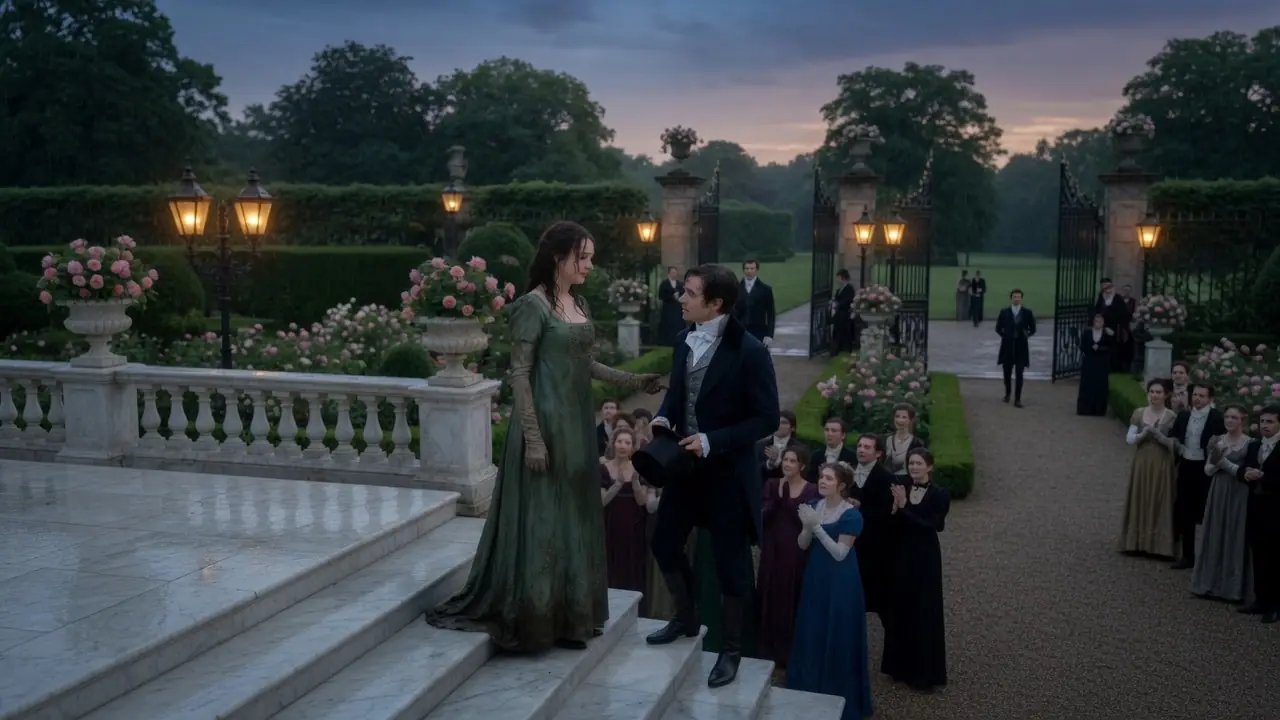
His smile sharpened. “Not Your Grace?”
“Not until the court decides whether attempted fraud, extortion, false identity, and murder disqualify a man from polite address.”
The smile weakened.
Just slightly.
“Bold woman,” Edmund said.
“Accurate one.”
He laughed. “Julian always did attract severe creatures.”
Marianne flinched.
Evelyn saw it.
So did Julian.
Edmund turned to his sister. “Marianne. Still trembling at shadows?”
“No,” Marianne said, voice shaking but clear. “Only at memories.”
“Unreliable things, memories.”
“Ledgers are more reliable,” Evelyn said.
Mr. Pike opened the first case.
Edmund’s eyes flicked toward it.
There.
Not fear.
Calculation.
Evelyn knew the look. Lord Bellamy had worn it the day she consented to marry.
A man adjusting to a game he no longer controlled.
“You have two choices,” Evelyn said. “You can claim the title publicly and answer publicly for Catherine’s death, your false burial, the forged payments, and Greer’s accounts. Or you can sign a sworn renunciation of all claims to Ashbourne, restore the funds stolen through Greer, and leave England before dawn.”
Edmund’s smile returned. “And why would I do that when I am the rightful Duke?”
“Because you are not.”
The room stilled.
Julian turned his head toward her.
Evelyn looked at Edmund.
This was the final twist.
The one she had not told even Julian yet.
“Your marriage certificate to Catherine is real,” Evelyn said. “But your father disinherited you legally six weeks before it was signed. Not merely from liquid inheritance. From succession claims where lawful forfeiture could be proven by fraud, debt, or assumed death. I found the deed in the third trunk my father kept hidden. He was one of the witnesses.”
Edmund stopped smiling.
Julian stared at her.
Evelyn continued, calm now, because this was numbers, paper, and truth. Her battlefield.
“You thought your father hid the deed to protect the family from scandal. He did not. He sent a copy to my father for safekeeping because Lord March was his solicitor’s private witness. My uncle stole many things, but he did not understand what he stole.”
She lifted the folded deed.
“You were legally barred from inheriting before your false death. Julian is Duke of Ashbourne. He has always been Duke of Ashbourne. Catherine’s marriage to you was valid, which makes her marriage to Julian invalid, yes, but it does not touch the title.”
Edmund’s face darkened.
“As for my marriage,” Evelyn said, “Julian Vale was unmarried when he married me. His title is lawful. Therefore, I remain Duchess of Ashbourne.”
Silence.
Then Marianne exhaled something like a sob.
Julian did not move.
Edmund looked at the doors. The footmen stood before them.
“You clever bitch,” he whispered.
Julian moved so fast Evelyn barely saw him.
In one step, he was between them.
“You will not speak to my wife again.”
Edmund laughed, wild now. “Your wife. Of course. You always wanted what was mine.”
Julian’s voice was low. “Catherine was never mine.”
“No. She was mine.”
“And you killed her.”
The room held still.
Edmund’s face changed.
Not enough for a jury, perhaps.
Enough for truth.
“You cannot prove that,” he said.
Marianne stepped forward.
“I can.”
Edmund looked at her with contempt. “No one believed you then.”
“They will now,” Evelyn said.
Mr. Pike placed another paper on the table.
“Greer has been found,” he said. “Alive. Arrested near York. He has signed a confession in exchange for transportation rather than hanging.”
For the first time, Edmund Vale looked afraid.
The magistrate stepped forward.
“Mr. Edmund Vale, you will come with me.”
Edmund lunged.
Not at Julian.
At Evelyn.
Later, she would remember only fragments. The flash of his hand. The shout. Julian’s body colliding with Edmund’s. Marianne screaming. Mrs. Morland ordering the footmen to shut the doors.
Edmund struck the edge of the table and fell.
The knife he had drawn clattered across the floor.
It stopped at Evelyn’s feet.
She looked down at it.
Then at the man who had nearly taken everything from the house and called it inheritance.
Julian stood between them, breathing hard.
Blood ran from a cut across his hand.
Evelyn picked up the knife with a handkerchief and gave it to the magistrate.
“There,” she said. “Now he has attempted murder in front of witnesses. That should simplify matters.”
Mrs. Morland made a sound suspiciously close to laughter.
Edmund was taken away before sunset.
He did not leave England before dawn.
He never left at all.
The trial lasted six weeks and was discussed in every drawing room from London to Bath. Edmund Vale was convicted of fraud, conspiracy, and the murder of Catherine Vale. Greer’s confession sealed him. Marianne’s testimony condemned him. Evelyn’s ledgers destroyed him.
He was sentenced to hang.
Julian did not attend the execution.
Neither did Evelyn.
They stood instead in the rose garden Catherine had loved and watched the gardener cut back the overgrown bushes for the first time in three years.
“I should have known,” Julian said.
Evelyn was beside him, gloved hands folded.
“No.”
“I sent Marianne away.”
“You were drowning.”
“That does not absolve me.”
“No,” she said. “But it explains the water.”
He looked at her then.
The roses were brown and thorned and stubbornly alive.
“Evelyn.”
“Julian.”
“Our marriage began as a bargain.”
“Yes.”
“I needed your money.”
“I know.”
“You needed escape.”
“I know that too.”
He turned fully toward her.
“And now?”
She looked at him, at the man who might have lost everything and had not tried to hide the possibility from her. The man who asked permission with his hands even when his eyes were full of hunger. The man who trusted her mind before he ever touched her heart.
“Now,” she said, “I believe we should renegotiate.”
His mouth curved.
A real smile.
Small. Rare. Devastating.
“What terms does Her Grace propose?”
She stepped closer.
“Truth first. Always.”
“Agreed.”
“No locked doors.”
“Agreed.”
“No decisions about me made in rooms where I am absent.”
“Agreed.”
“And when you are afraid, you tell me before you turn yourself into stone.”
That one took longer.
Then he said, “Agreed.”
He reached for her hand, but stopped before touching her.
She placed her hand in his.
“And your terms?” she asked.
His thumb brushed once across her knuckles.
“That you remain.”
The simplicity of it undid her.
Not own me. Not obey me. Not save me.
Remain.
Evelyn looked toward the house that had nearly collapsed beneath secrets and still stood.
“I remain,” she said.
He bowed his head and kissed her hand.
Not because the garden required ceremony.
Because he did.
Six months later, Ashbourne Hall no longer felt like a house holding its breath.
The east tower was opened, repaired, and filled with books. Marianne took the brightest chamber as her own and painted the window frames blue, scandalizing Mrs. Morland and delighting the maids. Catherine’s roses bloomed again in spring, cut back into health instead of worshipped into decay.
Lord Bellamy attempted one final lawsuit against Evelyn’s fortune.
He lost.
Publicly.
The judge called his claim “inventive in the extreme,” which became the polite phrase everyone used for fraud when they wished to laugh without appearing vulgar.
Evelyn used the recovered funds to establish a legal trust for women whose guardians mismanaged inheritances. She called it the March Fund. Julian called it a weapon disguised as paperwork.
He was not wrong.
On the anniversary of their marriage, rain fell over Ashbourne exactly as it had fallen the day she jumped from the music room window.
Evelyn stood in the great hall, watching it silver the glass.
Julian came up behind her, stopping at the distance he always stopped until she turned.
“You are thinking of Bellamy House,” he said.
“I am thinking of windows.”
“Should I be concerned?”
“Only if you lock one.”
“I would not dare.”
“No,” she said. “You are an intelligent man.”
He smiled.
She turned to face him.
There had been a time when she thought safety would feel like silence.
It did not.
Safety felt like being heard when one spoke plainly. Like ledgers opened instead of hidden. Like doors unlocked before one reached them. Like a husband who did not mistake strength for the absence of scars.
“I have a gift for you,” Julian said.
“That sounds ominous.”
“It is a key.”
“More ominous.”
He placed it in her palm.
Small. Brass. Old.
Evelyn looked at it.
“The music room at Bellamy House?” she asked.
“I purchased the house.”
She stared at him. “You what?”
“Your uncle’s creditors were eager.”
“Julian.”
“It is yours.”
She looked down at the key again.
The room where she had been locked. The window she had jumped from. The house that had tried to make her a ghost in her own life.
“What am I to do with it?”
“Whatever you like.”
The answer was perfect.
She closed her fingers around the key.
Three months later, Bellamy House opened as a school for girls with fortunes, guardians, and nowhere safe to put either.
The music room became the accounting classroom.
Evelyn kept the window unrepaired.
Not broken.
Simply open.
On the first morning, twenty girls sat at polished desks while rain tapped lightly against the glass. Evelyn stood before them in dark blue silk, a ledger in one hand and the brass key at her throat on a chain.
“You are here,” she said, “because someone has told you that obedience is the price of protection.”
The girls watched her.
Some frightened. Some skeptical. Some hungry for whatever came next.
“They lied,” Evelyn said. “Protection that requires your silence is not protection. It is ownership. Here, you will learn the difference.”
At the back of the room, Julian stood in the doorway, arms folded, silent and proud.
Evelyn saw him there and nearly smiled.
Nearly.
She had learned some restraint from him after all.
When the lesson ended, the youngest girl remained behind. She was thirteen, with ink on her fingers and anger in her eyes.
“Your Grace,” she said, “is it true you jumped from that window?”
Evelyn looked at the open window.
Rain moved softly beyond it.
“Yes.”
“Were you frightened?”
“Terribly.”
“Then why did you jump?”
Evelyn looked at the girl.
Then at Julian in the doorway.
Then at the room that had once been a cage and was now full of desks, ink, paper, and dangerous young women learning numbers.
“Because,” Evelyn said, “sometimes the door is locked, and you must still leave.”
The girl nodded slowly, as if placing the sentence somewhere she would need it later.
Outside, the rain cleared.
Light entered through the open window.
And Evelyn Vale, Duchess of Ashbourne, who had once been sold through a locked door by men who thought her fortune was the only valuable thing about her, stood in the room where her life had almost ended and taught another girl how to begin.