Diane’s hands shook as she locked the register. Twenty-one years ago, she had fed a starving teenager with a black eye and a stolen jacket. She had given him bread, asked no questions, and told him he mattered.
Then he vanished. Now the lead rider was removing his helmet. And when Diane saw his face, every single year collapsed into nothing. What she had done for a broken boy was about to change everything.
The rumble started low, like distant thunder rolling across the Pennsylvania hills. Then it grew louder, closer. A sound that didn’t belong in Millbrook on a Tuesday morning.
Diane Morris was restocking the cinnamon roll display when Mrs. Patterson burst through the bakery door, eyes wide, face pale.
“Diane, you need to see this.”
The sixty-four-year-old baker wiped her hands on her apron and followed her customer to the window. What she saw made her blood turn to ice.
Motorcycles. Dozens of them. No, not dozens. She counted three rows, each stretching the length of Main Street. Ninety-seven Harley-Davidsons rolling toward her bakery in perfect formation, chrome glinting in the morning sun, leather-clad riders sitting tall in their saddles. Every single one wore the same patch on their backs: the Hell’s Angels death’s head, skull grinning, wings spread wide.
This didn’t happen in towns like Millbrook — population 2,400, one stoplight, three churches, a place where everyone knew everyone and the biggest news was usually who won the pie contest at the county fair.
The motorcycles pulled up outside Diane’s bakery and stopped. The engines cut off one by one, and the sudden silence felt heavier than the noise. Diane’s hands found the edge of the counter and gripped it. Her register was open. She had been counting yesterday’s receipts.
Through the window, she watched the lead rider dismount. Tall, maybe 6’2”, weathered face, early forties. A scar ran from his left temple down to his jawline. He wore black leather from head to toe, his vest covered in patches she didn’t understand.
When he removed his helmet, dark hair fell past his shoulders. He looked directly at the bakery, directly at her, and started walking toward the door. Behind him, ninety-six other men did the same.
Diane’s mind raced. What had she done? Who had she offended? She had lived in this town for forty-three years, ran this bakery for twenty-five, paid her taxes, went to church, helped her neighbors. She wasn’t the kind of person who attracted this kind of attention.
But then something flickered in the back of her memory. A different winter, twenty-one years ago. A boy with a black eye and an empty stomach. A stolen jacket that looked just like the ones these men wore. She had given him bread. She had given him shelter. She told him something she couldn’t quite remember now, something that had made him cry. Then he had vanished without a trace, and she had spent years wondering if he had survived.
The lead rider reached for the door handle. Diane’s heart hammered against her ribs. Every customer in the bakery had gone silent. Mrs. Patterson grabbed her purse like she was preparing to run. Old Mr. Henderson, who had been reading his newspaper in the corner booth for the past thirty years every Tuesday morning, folded it slowly and set it down.
The door opened. The man stepped inside. He was bigger up close, broader, but his eyes — his eyes weren’t hard. They were searching, looking at her like he was trying to solve a puzzle.
The man removed his sunglasses. His voice was deep, gravelly, but not unkind.
“Diane Morris?”
She nodded. Her throat had closed up. No words would come.
He looked around the bakery slowly, taking in every detail: the cinnamon rolls cooling on wire racks, the photographs on the wall, faded pictures of the grand opening, of her late husband Tom standing proud in front of the storefront, the chalkboard menu written in her careful handwriting, the red and white checkered curtains she had sewn herself, the smell of yeast and sugar and coffee that had defined this place for a quarter century.
“You remember feeding a kid in 2003,” he said. His eyes came back to her face. “Seventeen years old, beat to hell, no place to go.”
Diane’s hand flew to her chest. The memory grew sharper, clearer. The boy, the January cold snap, the knock on the door before sunrise.
“You gave him bread,” the man continued. His voice had softened. “You gave him a place to sleep. You told him something he never forgot.”
Behind him, more men filed into the bakery. They moved quietly, respectfully, but they filled the small space until there was barely room to breathe. Leather and denim and the smell of road dust. Tattoos covering arms, necks, hands. Patches declaring chapters from cities she had never been to. Faces that had seen hard living, hard years, hard choices. But none of them looked threatening. They looked like men waiting for something important.
Diane’s hands were trembling now. She pressed them flat against the counter to stop the shaking.
“I remember,” she whispered.
The man’s face changed. Something in his expression cracked open.
“Good,” he said, “because that kid never forgot you either.”
The other customers were frozen. Mrs. Patterson had her phone out. Mr. Henderson was staring with his mouth slightly open. A young mother with two children had pulled them close, protective.
But the man only had eyes for Diane.
“What you told that boy became the foundation of everything he built.” He paused, glanced at the men behind him, then back to her. “But before I explain why we’re here, I need to take you back. Back to that winter, because you need to understand what you did and why it changed everything.”
Twenty-one years earlier, Diane Morris had been a different woman. Younger, yes — forty-three instead of sixty-four. But more than that, she had been hollowed out by grief, scraped raw by loss, barely holding herself together with routines and responsibilities and the stubborn refusal to give up on her dead husband’s dream.
Tom Morris died in November 2002. Construction accident. A scaffolding collapse on a job site in Harrisburg. He was forty-five years old. They had been married twenty-two years. He died instantly, the doctors said. Didn’t suffer. Like that was supposed to make it better.
The bakery had been his idea. Tom worked construction his whole adult life, but he had always talked about opening a business, something they could run together, something they could leave to their daughter Jenny when they were gone. In 1998, they bought the failing bakery on Main Street, poured their savings into renovations, and opened Diane’s Bakery the following spring. Tom did all the carpentry work himself, built the display cases, the shelves, the counter, installed the industrial oven, painted the walls. His fingerprints were all over that building.
After he died, Diane thought about selling it, walking away. What was the point of running a bakery alone? But Jenny was at Penn State, sophomore year, studying to be a teacher. The tuition wasn’t going to pay itself. The mortgage on the bakery wasn’t going to pay itself. The medical bills from Tom’s accident, even with insurance, weren’t going to pay themselves.
So Diane got up every morning at 4:00 a.m. She mixed dough. She baked bread. She made cinnamon rolls using Tom’s mother’s recipe. She opened at 6:00 and closed at 6:00 and pretended she was fine.
The town knew better. Small towns always know. They saw the dark circles under her eyes. They saw how thin she had gotten. They saw her sitting alone in the empty bakery after closing, staring at nothing. But what could they do? They bought their bread. They offered their condolences. They told her if she needed anything, anything at all, to just ask. And then they went home to their intact families and their living husbands and their uncomplicated, grief-free lives.
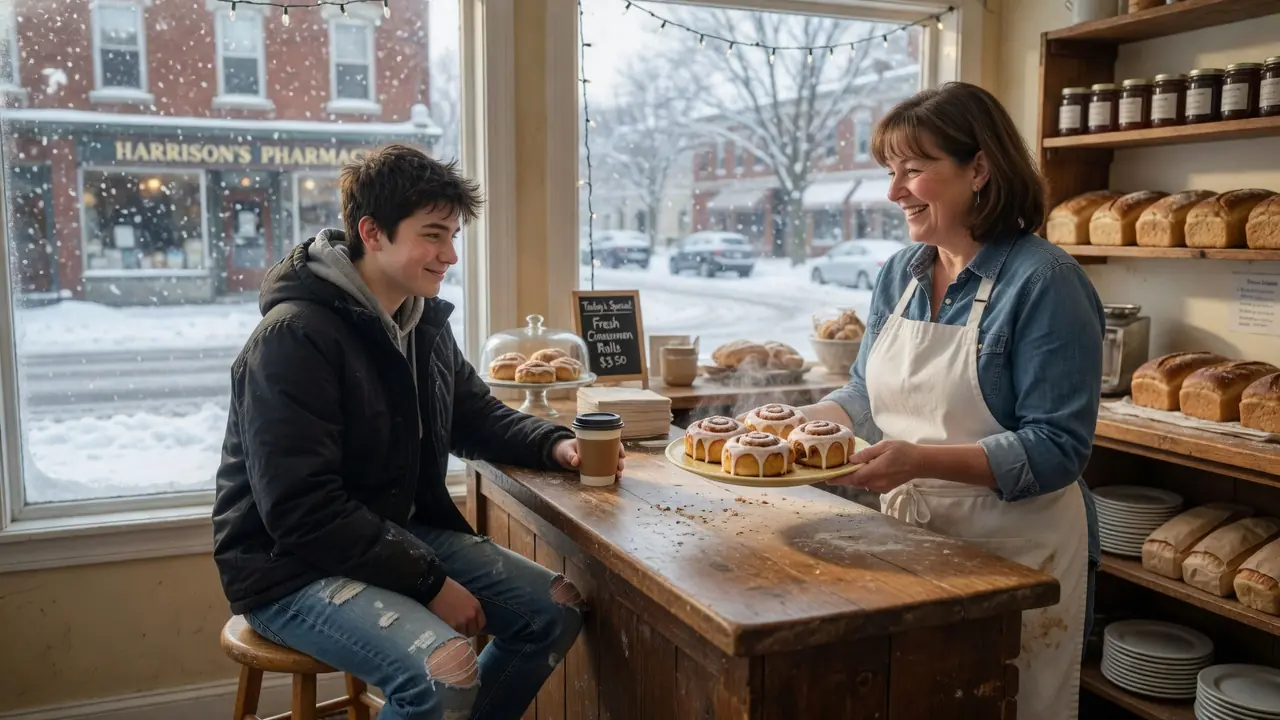
By January 2003, Diane had been running the bakery alone for fourteen months. She had developed a rhythm: 4:00 a.m. wake up, shower, drive to the bakery in the dark, unlock the door, turn on the ovens, start the first batch of bread. Cinnamon rolls next, then the pastries. Coffee brewing by 5:30. Lights on. Door unlocked at 6:00 sharp.
The winter was brutal that year. Pennsylvania cold, the kind that seeped into your bones and wouldn’t let go. Temperatures dropped below ten degrees for two weeks straight. The bakery’s heating system struggled to keep up. Diane wore layers, thermal underwear under her jeans, two sweaters under her apron. She kept the ovens running constantly just for the warmth.
Behind the register, she had taped a photograph of Tom. Young Tom, smiling the kind of smile that made you want to smile back. She talked to that photograph sometimes, late at night when she was cashing out. She would tell him about her day, about the customers, about Jenny’s phone calls from college, about how tired she was, how lonely, how some days she wasn’t sure why she was doing any of this.
So when the boy walked in that frozen January morning, when she saw something in his eyes she recognized — someone who had been knocked down and wasn’t sure how to get back up — she made a choice.
The knocking started at 5:30 a.m. Diane was elbow-deep in dough when she heard it. Sharp, insistent. The bakery didn’t open for another thirty minutes. She wiped her flour-covered hands on her apron and walked to the front, peering through the glass door.
A boy stood outside. Teenager, maybe seventeen. His left eye was swollen nearly shut, purple and black spreading across his cheekbone. His lip was split. He wore a jacket two sizes too big, black leather with patches she recognized: Hell’s Angels prospect rocker. But it was his eyes — the right one still visible — that stopped her. Exhausted. The kind of tired that came from running too long with nowhere to run to.
His hands, pressed against the glass, were red from cold, knuckles bruised. No gloves. No hat. The temperature outside was twelve degrees.
Diane’s first thought was to call the police. Her second thought was Tom. Tom had grown up rough. He never forgot what it felt like to be young and scared.
“Feed first,” he used to say. “Ask questions later. You never know whose life you’re saving.”
She unlocked the door.
The boy flinched.
“Get inside before you freeze to death,” she said.
He hesitated, then stepped into the warmth.
Up close, he was worse than she thought. The jacket hung off his thin frame. His jeans were torn. His sneakers had holes. He was shaking.
“I’m not here to rob you,” he said, voice hoarse. “I just… I’m hungry. I can work. I’ll wash dishes, mop, whatever you need.”
“Sit down,” she said, pointing to the corner booth. “Sit down before you collapse.”
He obeyed.
Diane went to the kitchen. She cooked without thinking: scrambled eggs, bacon, toast, hot chocolate with extra marshmallows, and a warm cinnamon roll. She brought it all to the booth on Tom’s favorite tray.
“Eat,” she said.
He ate like someone who hadn’t seen a meal in days. When he finished, his shoulders started shaking. He was crying.
“Thank you,” he whispered.
Diane sat across from him. “What’s your name?”
“Jake.” She didn’t believe him, but she didn’t push.
She offered him the storage room in back with a space heater. “You can stay there if you work. Wash dishes, mop floors, prep ingredients. I’ll pay you minimum wage and feed you three meals a day.”
“Why would you do that?” he asked.
“Because it’s cold,” she said. “Because you’re somebody’s son. Because I can.”
In the bakery twenty-one years later, the lead biker reached up and unzipped his leather vest, pulled it off. Underneath, he wore a black T-shirt. His arms were covered in tattoos. But it was his chest that made Diane’s breath catch. Right over his heart was a tattoo of a cinnamon roll, perfectly detailed, golden brown swirls, white glaze dripping. And behind it, enormous angel wings.
The man saw her staring. He smiled. It transformed his face.
“You told me something that January,” he said quietly. The bakery had gone completely silent. “You said, ‘You matter, kid. The world beat you down, but that doesn’t mean you don’t matter. Somebody should tell you that.’”
Diane’s hand flew to her mouth. Those exact words.
“Jake.”
The man’s smile widened. “My real name’s Marcus. Marcus Cole. But yeah, I was Jake when I walked into your bakery twenty-one years ago, when you fed me, when you let me sleep in your storage room, when you paid me for work I barely did, when you talked to me like I was a human being instead of garbage.”
He took a step closer. “When you saved my life.”
“You’re alive,” she whispered.
“Because of you.”
Marcus told her everything. How he had been running from a bad club pretending to be Hell’s Angels. How he had planned to end his life that day. How her kindness had broken through when he was ready to give up.
After he left her bakery, he went to Pittsburgh, worked construction, met Dutch — a real Hell’s Angel — who invited him to prospect legitimately. He earned his patch, opened Second Chance Cycles, and started helping kids aging out of foster care.
He started the Second Wind Foundation ten years ago. It had helped over four hundred kids with housing, job training, mentorship, and therapy. Every kid heard the same words Diane had given him: You matter.
Seventy-two of the men in the bakery had similar stories of someone who had shown them kindness when they had nothing. That was why ninety-seven of them had ridden from eight different states to find her.
Marcus handed Diane a thick envelope. Inside were legal documents for a building in Pittsburgh — a three-story center for the Second Wind Foundation. It was in her name. They wanted her to run it.
Diane was overwhelmed. She was just a baker. But Jenny arrived and reminded her how helping Marcus had brought her back to life after Tom died. Tom would want this.
Diane agreed on one condition: the mechanics program would be named after Tom, and the culinary program after Jenny. And every kid would get a fresh cinnamon roll every morning.
The celebration spilled onto the street. Townspeople joined in. Children sat on motorcycles. Plans were made.
Six months later, the Diane Morris Second Wind Center opened in Pittsburgh. Diane still brought cinnamon rolls every morning. The program grew to three locations and helped over six hundred youth.
Kindness doesn’t end. It multiplies. One woman chose to open her door and feed a broken boy. That boy grew up and helped hundreds more. And those hundreds will help thousands.
Because one small act — a warm cinnamon roll, a safe place to sleep, and the words “You matter” — can change everything.