"You're a Hell's Angels man," Emily said, staring at the sabotaged brake line coiled in her hand like a dead snake. "Somebody tried to kill you tonight." Dax looked at her, this young woman covered in grease at midnight, holding the proof of his murder attempt as calmly as if she'd found a loose bolt. "And you fixed it anyway," he said quietly. "Without asking me a single question."
Emily set the brake line on her workbench and reached for a clean one. "You needed help," she said. "That's the only question that mattered." If a stranger showed up at your door at midnight, broken, bleeding, and riding a motorcycle that someone had rigged to kill him, what would you do?
Emily Carter opened her garage door anyway. And that one decision changed everything. The rain started around 9 that night. Emily Carter heard it before she felt it, a low drumming on the metal roof of the garage that her father had built with his own two hands 22 years ago. One corrugated panel at a time on a piece of land at the edge of Denton, Texas that nobody else had wanted.
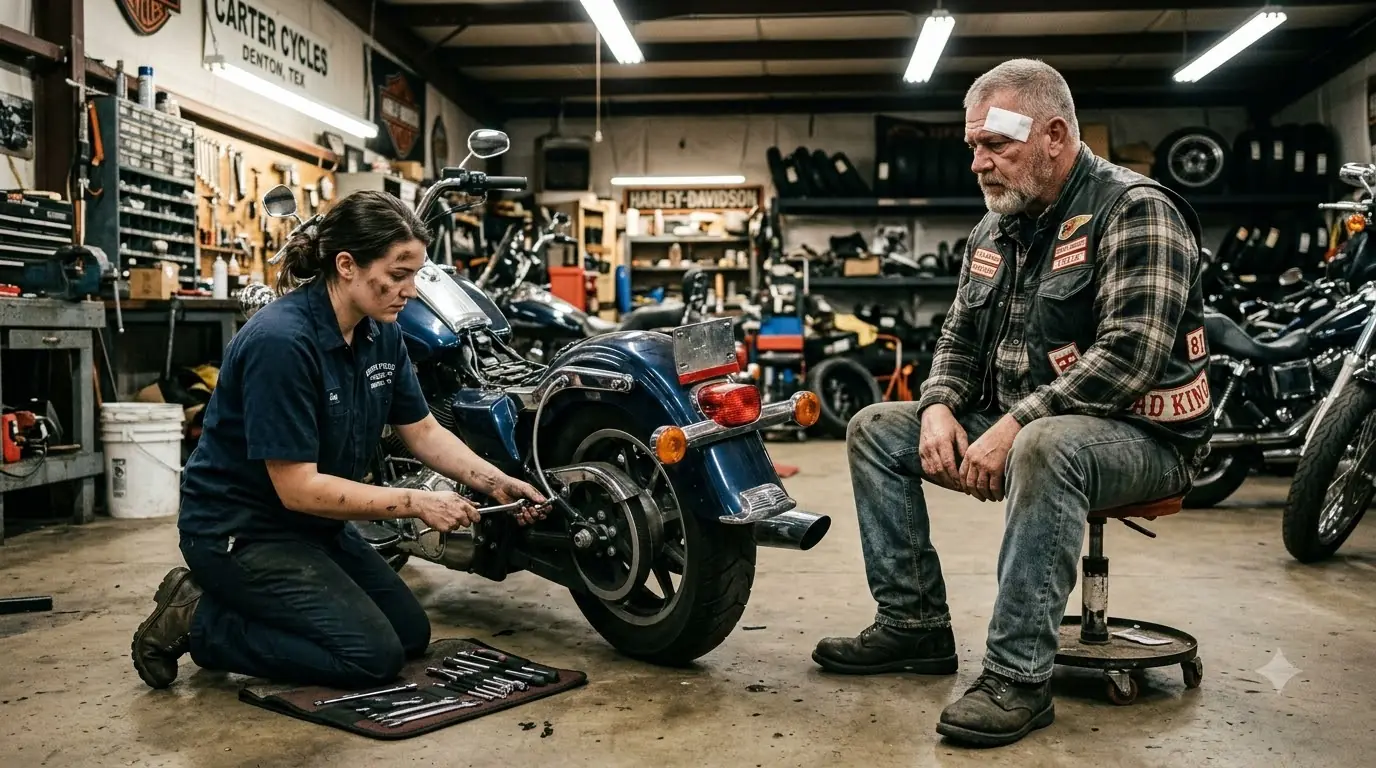
Carter Cycles The letters on the sign were still in her father's handwriting. It was painted by him in 1999 in dark green against white. And she had never changed them because she couldn't bring herself to paint over the last thing in this town that still looked the way he'd intended. She was on her back beneath a 2019 Indian Scout, flashlight clenched between her teeth, working on an oil pan gasket that had no business being as stubborn as it was.
The owner wanted the bike back by Thursday. It was currently Tuesday, which meant midnight Tuesday which meant she had roughly 36 hours to finish this one and get started on the two others waiting in the far corner, a customer's vintage Triumph that needed a full carburetor rebuilt and a beat up 2014 Sportster that had come in with an electrical fault she hadn't fully diagnosed yet. 3x 36 hours herself. That was the math she lived inside now. She turned the flashlight up toward the gasket, locked her jaw around it, and kept working.
She didn't let herself think about the envelope on her desk. The envelope had arrived certified mail on Friday morning, forwarded from her father's old attorney, a man named Gerald, who had handled the estate with the cheerful competence of someone doing the bare minimum required by law. The return address on the envelope was Meridian Property Solutions LLC and the letter inside had used the word compliance 11 times in four paragraphs She'd counted the core of it was simple enough. Her father had signed a financing agreement in 2019 to get emergency capital to keep the garage running during a rough stretch And that agreement had a balloon provision that Gerald apparently hadn't explained clearly and that her father apparently hadn't fully understood.
And that balloon was now due. And it was large. And she had 60 days. She had read the letter twice. Put it in the envelope.
Put the envelope in the middle drawer of the desk. Closed the drawer. And gone back out to the garage to work. That was Friday.
Today was Tuesday. She had not opened the drawer again. The Indian's gasket finally gave way at 11:47 and she let out a breath that was mostly relief and a little bit prayer. She slid out from under the bike, sat up. Pulled the flashlight from between her teeth.
And pressed the back of her wrist against her forehead. The garage smelled the way it always smelled, oil and metal and rubber and the faint chemical ghost of solvent. And that smell was the closest thing to comfort she had left in this building. She was reaching for a shop rag when she heard it. She stopped moving.
The sound was coming from the road outside. She could hear it even over the rain. And it was wrong in a way she recognized immediately because she had been listening to motorcycles her entire life. Her father had taught her to hear engines the way other fathers taught their daughters to hear music. There was a Harley out there and it was in trouble.
The idle was ragged. Cutting and catching. And there was something else underneath it. A rhythmic grinding she didn't like at all. And the whole mechanical voice of it was telling her what no rider ever wanted to hear.
I am almost done. She was already standing. She pulled the garage's side door open and stepped out into the rain. And the headlight hit her almost immediately. A single beam swinging wide and unsteady from the road into her lot.
And she could see the rider wrestling with the machine. Both hands locked on the bars, the bike weaving in a way that had nothing to do with the wet asphalt and everything to do with the fact that the man controlling it was operating at the very edge of what his body had left to give. The Harley made it 15 ft into her lot before it stopped not gently, not gracefully, but in the way machines stopped when they have simply spent everything they had. The engine coughed twice and went silent. And the man on it held himself upright for a long moment.
One boot on the ground. Both hands still gripping the bars. His chest working hard against whatever it was costing him to still be vertical. Then his left arm buckled. Emily was moving before she thought about it.
She crossed the wet concrete in six steps and got her shoulder under his arm before he went all the way over. And he was heavier than he looked, which was already heavy because this was not a small man. He was somewhere around 50 or 55. Broad shouldered wearing a soaked leather vest over a soaked flannel shirt. And when she got close enough to see his face in the spill of light from her open garage, she saw that there were blood mixing with rain water on the left side of his temple and his pupils were uneven. "
I've got you," she said. Not gently, not shakily. She said it the way her father used to say things, like a declaration of fact. "I've got you. Don't fight me." "
Don't need—" he started. E, you fell sideways on a motorcycle in a parking lot, she said. E, you need something. Come on. She got him inside.
She sat him on the metal stool she kept beside the parts bench, the one her father used to call the throne, because he'd always gone there when he needed to think. And she got a look at him in the full light of the garage. Late 50s, she revised, maybe right at 60. The kind of man who had been powerful for a long time and still carried it in his frame even when the rest of him was struggling. The leather vest had patches on it and she didn't look at them right away because she was focused on his head. "
What hit you?" she asked, already moving to the first aid kit on the wall. "The road." His voice was low and rough. Came off around mile marker 12 on 380.
His bike went sideways. You hit the asphalt left side. He's mostly shoulder. The helmet took the head. He paused.
He's mostly. She came back with the kit and a clean rag. Sit still. She examined the temple wound without fanfare. It wasn't deep.