In 1882, a woman was found sitting at a crossroads in the Wyoming territory with nothing but a carpet bag, a dead man's watch, and 19 cents in her pocket. She had been waiting 6 hours. The man she was waiting for had married someone else that morning. 50 miles away in a church she had paid for with her own savings. This is not the story of how she was left behind.
This is the story of what she did with the broken wagon wheel that rolled into her path that afternoon. And the strange thing that arrived at her door before sunrise the next day. The sun pressed down hard on the Wyoming flats. Sarah Hawthorne sat on her carpet bag with her hands folded in her lap watching three roads bake in the heat. North climbed toward the Bighorn Mountains.
East ran flat into more prairie. South curved back to Beaver Crossing. The town where his mother had once called her common at a Sunday picnic. She had not moved in 2 hours. Her lips were cracked.
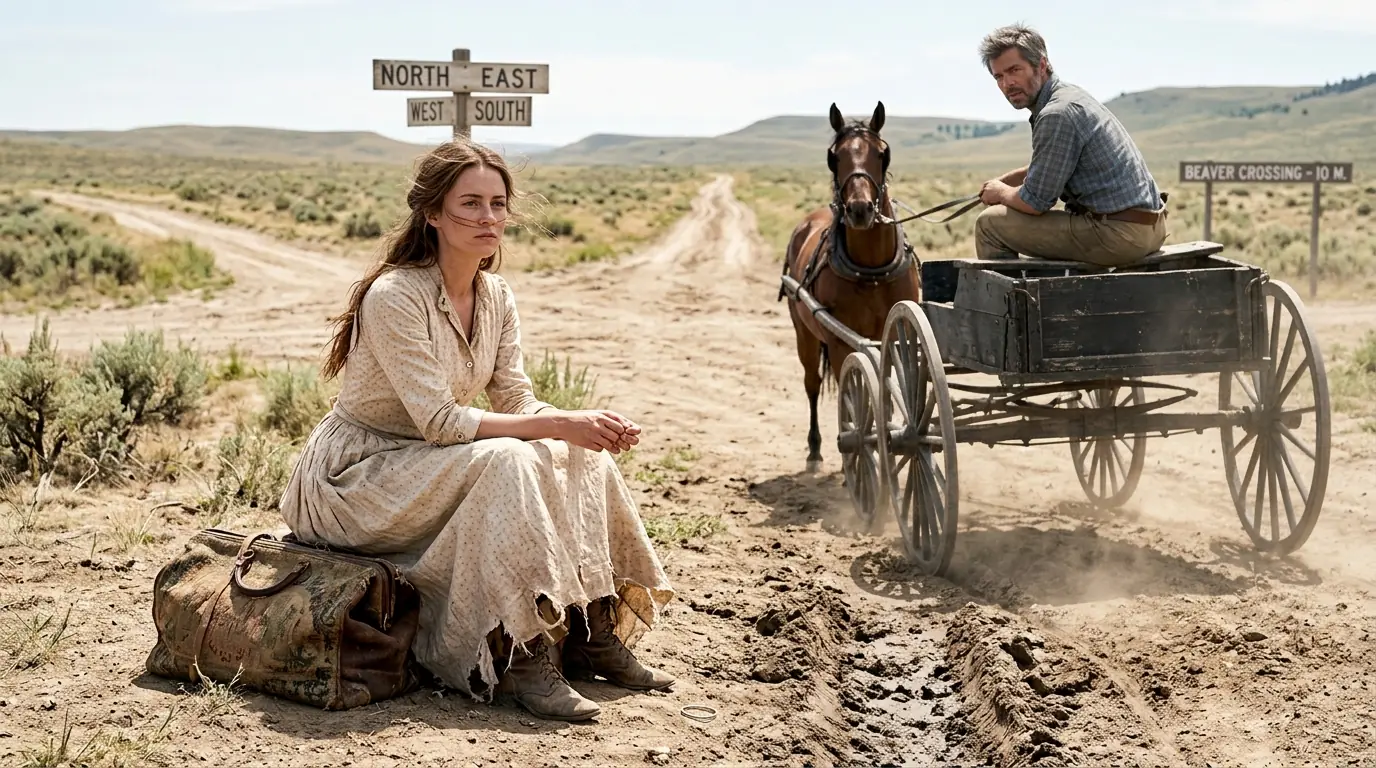
Her cheeks were burned. The collar of her cream calico dress had three buttons left out of six. The other three had popped off somewhere on the long walk from the church she had not been allowed to enter. She slid the silver ring off her finger. The band was thin and light.
He had told her it was real gold from a Denver jeweler. She had known the truth the first time she scrubbed it with vinegar and the silver showed through. She had said nothing. She let the ring drop into the dust between her boots. It bounced once, rolled into the wagon ruts, and disappeared.
She did not look down to see where it landed. A creak came from the south road. Sarah lifted her head. A wagon was rolling toward her. Black buckboard, fine paint, polished brass on the harness.
A tall black gelding pulled it, lathered along the chest. The wagon was listing hard to one side. The right rear wheel was dragging a crooked furrow through the dust, wobbling with every turn. Sarah's father had been a blacksmith for 26 years before the fever took him. She had grown up watching wheels like that one and listening to him say the same words every time.
Kingpin split. Axles next. She stood up. Her knees cracked. She steadied herself, picked up her carpet bag, and walked toward the wagon.
Her boots made no sound in the dust. The driver was a man in his early 40s, broad through the shoulders, dark hair gone gray at the temples. His shirt collar was wet through with sweat. He was leaning forward, listening to the sound of his own wheel, and frowning like a man who knew something was wrong but didn't know what. He startled when she spoke. "
Stop the wagon," she said. " Now." He pulled back on the reins. " Kingpin's cracked," she said. " Keep driving and the axle shears.
Then you walk." The man stared at her. Sweat ran from his hairline down into his collar. His eyes moved over her dress, the torn hem, the dust on her cheeks, the empty ring finger of her left hand. There was a pale white line where silver had sat for 3 months. "
Road's no place for a woman alone," he said. Sarah did not answer that. She knelt beside the wheel. The iron rim was hot enough to burn through her skirt. She ran her palm along the hub, pressed where the wood met the metal, felt the give in the kingpin where the wood had split clean through. "
You got tools?" she asked. He pointed to a wooden box behind the seat. She opened it. Brand new hammers, wrenches still wrapped in oiled paper, a rich man's kit, probably never been used. "
These will work." she said. She found an iron tent stake. She unbuckled his leather belt where it lay coiled in the box and pulled it free. Then she lifted the hem of her skirt and tore a long strip from her petticoat.
The muslin ripped loud in the empty afternoon. " Hold the wheel." she said. " Both hands. Don't let it shift."
He crouched beside her, close enough she could smell horse sweat and pipe tobacco and something else underneath. Leather, coal smoke, the same smell her father used to carry home from the forge every night. She wrapped the iron stake along the cracked kingpin, cinched the belt around it, tied the muslin strip tight over the leather, and pulled until her shoulders shook. Her hands came away black with axle grease. She stood up and wiped her palms on her ruined skirt.
The man was watching her. The man rolled the wagon forward 3 ft. The wheel held. The buckboard rode level for the first time in miles. He turned back towards Sarah.
She was already walking away from him, carpet bag in her hand, heading nowhere in particular. " Wait." He pulled a canteen from under the seat and held it out. Sarah came back. She took it without thanking him.
The water was warm and tasted like tin, but she drank three long swallows and handed it back. My father ran a shop, she said. She did not know why she said it. Fixed things. The man nodded once.
His eyes moved from her face to the carpet bag to the three roads back to her left hand. You got people? No. She offered no more than that. Her throat was still dry from the dust.
She could taste it on her tongue. He looked at the horizon, not at her. I need a housekeeper. Last one quit. Said the ranch was too far from town.
He paused. It is too far from town. Sarah rubbed her thumb against her stained palm. What's the pay? He looked surprised that she had asked.
$20 monthly, separate quarters. I manage the household. If you want to leave, you leave. He looked at her full on for the first time. His eyes were gray, lighter than she had expected from a man who lived under that much sun.
I'm not looking for someone to decorate my house, he said. Last woman tried. Made us both miserable. Sarah's fingers found the bone button at her collar. Her mother had stitched it tight 12 years ago before the cough took her.
I don't know how to do those things anyway, she said. Something in his mouth eased. Not a smile, just less pressure around the corners. How far? She asked.
3 hours. She looked back at the road she had walked from. The silver ring was still there, a small bright point catching sun between the wheel ruts. She could see it from where she stood. She turned away from it.
She picked up her carpet bag and climbed onto the buckboard. The leather seat was hot through her skirt. She set the bag between her feet. The brass clasps clicked. He stood there a moment longer just watching her sit in his wagon.
Then he climbed up beside her. The seat dipped under his weight. He picked up the reins. The leather was dark from hand sweat, worn smooth in the grip spots. He clicked his tongue.
The gelding leaned into the harness. The wagon rolled forward. The wheel held. Sarah did not look back. After what felt like an hour, he spoke.
Name's Silas. She waited. Sarah. He nodded. Did not ask for more.
The prairie rolled past them, gold and green and waist-high in places. The seed heads bent in waves with the wind. The sun slid down toward the western edge of the world. The ranch appeared on the horizon just as the sun touched the prairie. A two-story house, white clapboard with the paint peeling at the corners.
A red barn behind it. A cedar corral with good fencing. Three men by the barn stopped working and turned to watch the wagon roll in. Silas pulled the gelding to a stop and set the brake. The men did not move.
Sarah's hands tightened on the carpet back. Silas climbed down and walked toward them. New housekeeper, he said loud enough for her to hear. Miss Sarah. The three men nodded.
One of them lifted his hat. Gray hair underneath. All three were older than Sarah had expected. 50 at least, Maybe 60. Weathered faces, bent backs.
They looked at her once, then went back to their work. No questions. No comments. Sarah climbed down from the buckboard. Her knees wobbled.
She locked them straight. The front door of the house stood open. She walked toward it, up three creaking steps, and across the porch. Inside, the air was dim and cool. An oak table sat in the center of the main room, six ladder-back chairs around it.