Clara Whitlow arrived at Dunmere Court on the ninth of April, 1816, in the back of a carrier's cart, with one trunk, one bonnet she had trimmed herself, and a letter of introduction that had cost her aunt three weeks of careful writing and a great deal of pride.
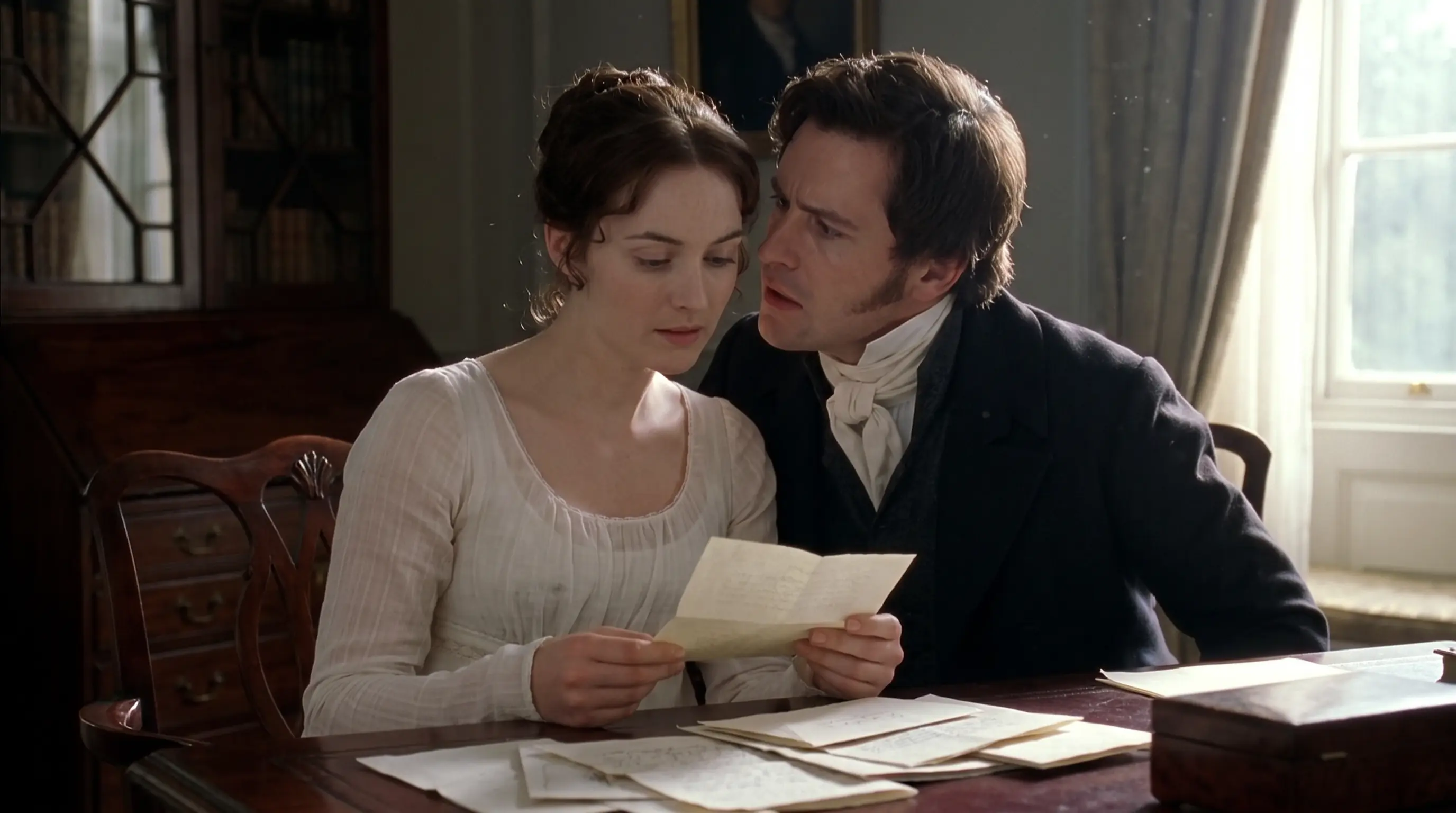
She had been told to expect a grand house. She had not been told that it would look at her like that.
Dunmere Court stood at the end of a mile of limes, long and honey-coloured and many-windowed, with a pediment like a lifted eyebrow and a flight of shallow steps that seemed to have been designed to make visitors feel that they had climbed too far. The windows on the east side were all shuttered. The knocker on the great door had been tied up in black crape, and the crape had been left there so long that it had faded to the colour of a wet crow. It was the house of a family that had been in mourning for a while and had forgotten how to stop.
"You'll be the secretary," said the housekeeper, who opened the door herself and looked Clara up and down in one long sweep, from the bonnet to the boots. Mrs. Grice was a tall, narrow woman in grey, with a face that had learned long ago to keep its opinions to itself. "We expected someone older."
"I am twenty-five, ma'am."
"That is what I mean." She stood aside. "Her ladyship will see you now. Wipe your feet."
Clara wiped her feet. She had been wiping her feet on other people's mats for six years, since her father's death had taken the post office at Little Haddon out of the family and left her with a talent nobody wanted and a mother's small annuity that did not stretch to two. She had been a governess for a year, which had been a disaster, and a companion to a deaf widow for two, which had been merely dull. Now she had come to Wiltshire to put in order the papers of a dead viscount, and she was determined to do it so well that no one would ever think to send her away.
The Dowager Viscountess of Dunmere received her in a room full of clocks.
There were seventeen of them. Clara counted. They stood on every surface, tall-case and bracket and carriage, gilt and ebony and plain walnut, and every one of them was ticking, a little out of step with its neighbours, so that the room seemed to be full of small impatient creatures all trying to say the same thing at once. In the midst of them, in a high-backed chair by the window, sat a very small, very old woman in a cap of black lace.
She was blind. Clara saw that at once, in the way the pale eyes rested on the middle distance, and in the way the hands lay folded in the lap, not quite still, like two sleeping birds.
"Come here, child," said the Dowager. Her voice was thin and dry and perfectly clear. "No, nearer. Give me your hand."
Clara gave it. The old woman's fingers closed on it, light and cool, and moved over the palm and the knuckles and the calluses on the first and second fingers where a pen had rubbed a groove.
"You write a great deal."
"I did, my lady. My father was the postmaster at Little Haddon. I sorted his letters from the time I was eight."
"Did you indeed." The fingers paused. "Then you can tell me something. If I put a letter in your hand, and I do not tell you who wrote it, and you cannot read it, what can you learn from it?"