The frost came early that year, biting through wool and resolve alike, and Eleanor Hartley walked the mile back from the village with her basket cutting red lines into her palm, and her breath rising in pale clouds before her. She did not complain; she had long since stopped expecting the world to notice whether she was cold. 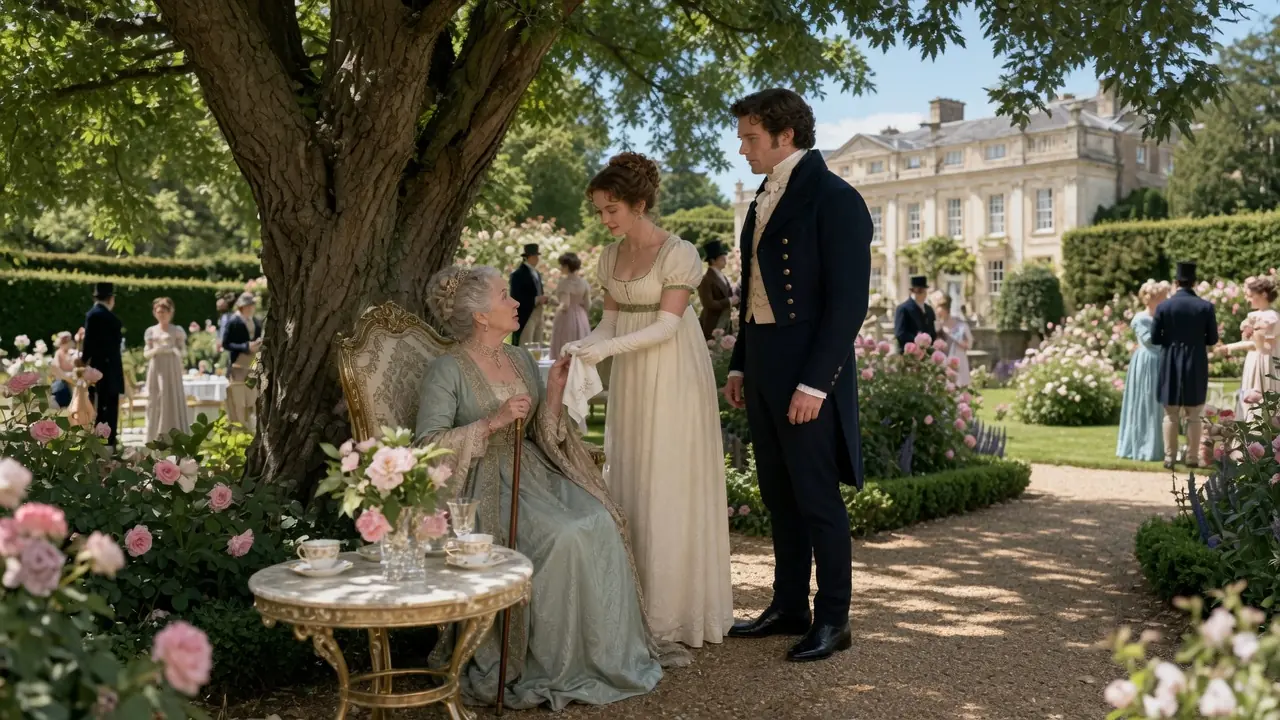
It was on the bend past the old stone bridge that she saw the woman, huddled against the low wall, wrapped in a coat so thin it might as well have been paper. The old woman sat with her knees drawn to her chest, shivering in a way that had gone past shivering into something more dangerous—a stillness that frightened Eleanor more than any trembling could have.
"Are you injured?" Eleanor knelt in the frozen mud without a thought for her skirts.
"Only cold, miss. Only cold." The woman's voice cracked like dry kindling. "I'll manage. Don't trouble yourself over an old fool who lost her way to her daughter's house."
Eleanor did not deliberate. She unwound the shawl from her own shoulders—the only one she owned, mended twice at the fringe—and settled it around the stranger with the same unthinking tenderness she might have shown a wounded bird.
"There. That will hold the worst of it until you reach the village. Ask for the Widow Pruitt's cottage. Tell them Eleanor Hartley sent you, and they will give you a fire and bread besides."
The woman's eyes, sharp despite her apparent frailty, studied her for a long moment. "You'll freeze yourself, miss, giving away the only warmth you have."
"I have a coat," Eleanor said, which was not entirely true, for her coat was little better than the shawl—patched at the elbows and thin at the seams. "You have nothing. It seems the simpler arithmetic."
What Eleanor did not see, what she could not have known, was the rider who had drawn his horse to a halt at the crest of the road behind her, cloaked against recognition, his hat low over his brow, watching the entire exchange with an attention he had not paid to anything in the length of his long and weary journey. He was not meant to be seen. He had wanted, for once in his guarded life, to arrive somewhere as no one at all, to watch a place and its people before they arranged themselves into the performance his title always summoned.
He had not expected to watch a threadbare girl surrender her only shawl to a stranger on a public road, asking nothing, expecting nothing, simply because the arithmetic seemed simple. Julian Ashcombe, Duke of Renfield, sat very still upon his horse for a long moment after the girl had walked on, and something in his chest that had been closed for a very long time creaked open just slightly, like a door no one had used in years.
He told himself it meant nothing. He told himself this three more times before he nudged his horse forward toward Hartley Hall, and none of the three times did he believe it.
***
The house that received him formally two days later, when he arrived by carriage with his title announced and his retinue in proper order, wore its genteel poverty like a woman wears a gown one size too small—stretched tight over pride that refused to admit the seams were failing. Hartley Hall had once been grand; the tapestries said so, faded as they were. The Hartley name had once carried weight in three counties before debts and a father's illness had worn it down to something that required careful management and careful smiles.
Lady Hartley met him in the drawing room with the particular brightness of a woman who understood exactly what was at stake and had rehearsed her warmth until it gleamed like polished silver.
"Your Grace does us the greatest honor," she said, sinking into a curtsy so precise it might have been measured with a ruler. "May I present my daughter, Serafina."
Serafina Hartley was, by any honest measure, a beauty: golden-haired, blue-eyed, with the kind of symmetrical loveliness that painters spent careers chasing and rarely caught. She curtsied with practiced grace, and her smile, when she lifted her eyes to his, was warm, knowing, and entirely aware of its own effect.
"Your Grace," she murmured. "We had heard such accounts of you that I confess I feared reality would disappoint. I am relieved to find it does not."
And then his eyes moved past Serafina's shoulder to the doorway, where a second young woman stood half in shadow, dressed in a gown the color of dishwater, her dark hair pulled back with a severity that suggested no one had thought her worth adorning. She was not introduced. She simply stood, awaiting some signal to know whether she belonged in the room at all.
Julian recognized her immediately. The shawl was gone, of course—given to a stranger on a frozen road—but the face was unmistakable: the same steady, dark eyes that had knelt without hesitation in the mud.
"And this," Lady Hartley said, following his gaze with the faintest note of impatience, "is my other daughter, Eleanor. She manages the household accounts. You'll forgive her plainness, Your Grace. She has always been our practical one."
The word *plainness* landed in the room like a dropped teacup, and Julian watched Eleanor's expression flicker, just once, before it settled back into careful blankness. She had heard this before. She had built, he understood in that instant, an entire architecture of composure around hearing exactly such things.
"Miss Eleanor," he said, and bowed to her with precisely the same depth he had bowed to her sister—no more, no less.
Something crossed her face then, quick as a bird's shadow: surprise, perhaps, that he had bowed to her at all.
***
Dinner that evening was arranged, unsubtly, to showcase Serafina at every turn. She was seated nearest him. She was invited to speak on painting, on poetry, on the merits of the London season—each subject chosen, he suspected, because she had been coached to shine at it. She did shine. She was clever in the particular way of someone who had learned cleverness as a performance rather than a habit of mind: quick with compliments, quicker with laughter at his driest remarks.
Eleanor sat at the far end of the table, near enough to be present, far enough to be forgotten, and said almost nothing unless directly addressed, at which point her answers were brief, precise, and entirely without artifice.
"You manage the accounts, Miss Eleanor?" he asked her once, deliberately, watching Lady Hartley's mouth tighten at the interruption of her orchestrated evening.
"I do, Your Grace."
"That must require considerable discipline, given the estate's difficulties."
A pause. He watched her decide whether honesty was permitted.
"It requires a willingness to say no to things one wishes one could say yes to," she said finally. "That is the whole of the discipline, I think. The rest is arithmetic."
*Arithmetic.* The same word she had used on the road about a shawl and a stranger's need. He felt that door in his chest creak open a fraction wider, and across the table Lady Hartley swiftly redirected the conversation toward Serafina's accomplishments at the pianoforte. The moment closed like a curtain drawn too soon.
He did not sleep well that night. He lay in the unfamiliar guest chamber of Hartley Hall and turned over the day's events with the methodical suspicion that had become, since his broken engagement three years prior, as much a part of him as his own name. He had learned, at considerable cost, that beauty offered freely and warmth performed on command meant nothing about a woman's true character.
Lady Camilla Rothsley had offered him both in abundance, had smiled at him with precisely Serafina's practiced radiance, and had left him standing at the edge of a ballroom two days before their wedding with a note explaining that a marquis with a larger fortune had made her a better offer, and that she trusted he would understand the sense of it. He had understood the sense of it; he had simply never trusted a woman's warmth again.
But a shawl given to a stranger on a frozen road, asked for nothing, witnessed by no one who mattered—that was not performance. That was character with the mask entirely off, because the girl who gave it had not known anyone worth impressing was watching. He resolved, lying there in the dark, that he would learn more of Eleanor Hartley before he allowed himself to believe anything at all.
***
The following days established, with quiet insistence, patterns Julian found himself noticing more than he intended to. Serafina occupied the center of every arranged gathering—every walk through the gardens angled to display the roses at their most flattering hour, every conversation steered toward subjects calculated to charm. Eleanor occupied the margins, and yet it was in the margins that Julian found himself most often looking.
He saw her kneel to bandage a stable boy's cut hand when no one had asked her to, working with quick, competent fingers while the boy's father hovered, embarrassed and grateful in equal measure. He saw her slip an extra roll into the pocket of an elderly groundskeeper who ate his midday meal alone by the hedge, a gesture so practiced it was clearly not the first time. He saw her, one gray afternoon, sit for nearly an hour beside an aging spaniel too stiff in its joints to follow the family on their walk, simply so the animal would not be left entirely alone.
None of it was performed for him. That was the singular, arresting truth of it. She did not know he watched from the library window, or from the far end of the stable yard, or from the shadow of the garden wall. She behaved, in short, exactly as she had behaved on the frozen road when she believed herself entirely unobserved. Julian began to understand that this was simply who she was, undecorated, whether an audience existed or not.
"You watch my sister a great deal, Your Grace," Serafina observed one afternoon with a laugh light enough to seem harmless. "I confess I cannot fathom the interest. She is dreadfully dull company—all accounts and duty, no conversation to speak of."
"I find dullness relative," Julian said mildly. "Some conversations are simply quieter than others."
Serafina's smile did not waver, but something behind her eyes sharpened, filed itself away for later use, and Julian understood he had made, without quite meaning to, the opening move in a contest he had not agreed to enter.
That evening at supper, Lady Hartley steered the conversation with renewed determination toward the approaching Harvest Ball, three weeks distant, at which the county's finest families would gather, and at which, it was understood without being spoken, Julian's intentions toward Serafina would be expected to declare themselves with rather more formality.
"Eleanor, of course, will not attend," Lady Hartley added, almost as an afterthought, spearing a piece of pheasant with more force than the task required. "There is a great deal of preparation to oversee below stairs, and someone sensible must manage it while the rest of us enjoy ourselves."
Eleanor's face did not change. She had, Julian was coming to understand, spent years perfecting the particular stillness required to receive such pronouncements without visible injury. But he saw her hands, folded in her lap beneath the table's edge, tighten briefly around themselves before releasing.
"Surely," he said, before he had fully decided to speak, "Miss Eleanor might oversee the preparations and still attend the ball itself. I should think both tasks manageable for someone of such evident competence."
The table went quiet. Lady Hartley's smile thinned to something considerably less warm.
"Your Grace is generous, but Eleanor herself has never cared for such gatherings. She finds them tiresome. Is that not so, Eleanor?"
It was, Julian understood, not a question; it was an instruction dressed as a question. He watched Eleanor absorb it, watched the flicker of something—longing, perhaps, quickly suppressed—cross her face before she answered.
"I find them tiresome," Eleanor said quietly, and did not lift her eyes from her plate.
He did not press the matter further that night, but he resolved, with the same quiet stubbornness that had carried him through every difficult negotiation of his adult life, that Eleanor Hartley would attend that ball if he had to contrive the means himself.
***
The means, as it happened, arrived sooner than expected and from an unlikely direction. Two days later, riding alone along the eastern boundary of the Hartley lands, Julian came upon an old woman gathering fallen branches for kindling, her movements slow but steady. Something in her bearing struck him as familiar before he had fully placed the recognition.
"Forgive me," he said, drawing his horse to a halt. "But have we met before?"
The woman straightened, studying him with eyes that missed very little. "On the road, sir. Though you were cloaked then, and I doubt you meant to be seen. I remember faces. It is one of the few luxuries left to the old and the poor—remembering things others would rather forget."
Julian dismounted. "You are the woman who received Miss Hartley's shawl."
"I am. And I have wondered since whether the fine gentleman who watched from the ridge ever thought to wonder what became of the girl who gave it. She walked the rest of that road in nothing but a threadbare coat, sir, in weather that had grown men reaching for their greatcoats. She took a chill for her trouble—a bad one, nearly a fortnight abed—though her mother scarcely noticed, being occupied with her elder daughter's new gowns for the season."
Something cold moved through Julian's chest, colder than the wind off the eastern fields. "She was ill, and no one attended her?"
"Oh, the housekeeper attended her out of decency. But her own mother visited twice in a fortnight, sir, and both times to ask whether Eleanor might rise early enough to see to the household ledgers before the physician's bill came due. That is the manner of family the girl was born into. A pity, for a kinder heart I have not encountered in sixty years of living, and I have encountered a great many hearts—kind and otherwise."
Julian rode back to Hartley Hall that afternoon with a great deal to consider, and a growing, uncomfortable certainty that the woman he had been sent to evaluate as a potential bride was very likely the lesser treasure in that household, however loudly her mother insisted otherwise.
He began, after that, to seek Eleanor out with rather less subtlety than he had previously employed. He found her in the library one wet afternoon, curled into a window seat with a book of estate management balanced on her knees, her brow furrowed in concentration.
"Poultry yields," he observed, glancing at the page. "Hardly the reading material of a woman who finds gatherings tiresome and little else."
Eleanor closed the book, startled, color rising in her cheeks. "Your Grace, I did not hear you enter."
"I am told you find balls tiresome," he said, settling into the chair opposite without invitation, watching her carefully. "And yet, I have never met anyone who studies poultry yields for entertainment unless the alternative held rather more appeal than tedium implies."
She was quiet a moment, weighing, he suspected, how much honesty the situation permitted.
"My mother finds it convenient that I should prefer solitude," she said finally. "It requires less explanation than the truth."
"Which is?"
"That I was told, quite plainly, at fifteen years old, that Serafina would marry well and I would manage the household, and that both arrangements suited the family equally, and that I ought not waste sentiment wishing for anything different." She said it without self-pity, simply as fact, the way she might have reported the weather. "I stopped wishing rather a long time ago, Your Grace. It is a more comfortable way to live."
"Is it comfortable?" Julian asked, and something in his voice must have carried more than he intended, because she looked up at him then—truly looked, for the first time since his arrival—and something passed between them that neither had words ready for.
"No," she admitted, very quietly. "It is merely survivable."
He wanted, in that moment, to say a great many things he had no right to say to a woman in a house where every gesture was watched, weighed, and reported. He said none of them, but he left the library that afternoon with the certainty settling into him like a stone into still water: whatever he had come to Hartley Hall to find, he had not expected to find it in the sister no one thought worth introducing properly.
***
Serafina Hartley was not a stupid woman, whatever her mother's careful instructions had made of her ambitions, and she had not failed to notice the direction of the Duke's increasingly frequent absences from the drawing room. She raised the matter with her mother that same evening in the privacy of Lady Hartley's dressing room, her voice tight with a fury she was careful to keep from her face in company.
"He seeks her out in the library, in the gardens. Once, I am told, even in the stable yard while she tended some wretched dog! Mother, I did not spend three seasons cultivating the manners this match requires, only to watch it slip toward Eleanor because she has a talent for appearing interesting through the simple expedient of saying almost nothing."
"He will not choose her," Lady Hartley said, though her voice carried less certainty than her words. "A duke does not marry a household manager in a dishwater gown. It is beneath consideration."
"He has considered her enough to interrupt supper on her behalf," Serafina snapped. "Something must be done before the Harvest Ball, or I fear the arrangement we have worked toward these two years will unravel for want of attention to a girl no one thought worth watching."
What was done in the days that followed was done quietly, the way cruelty in genteel households so often is, dressed in the language of practicality and necessity. Eleanor found herself burdened, suddenly, with a great deal more household duty than the preparations for the ball strictly required—tasks invented, she suspected though could not prove, specifically to keep her occupied and out of the drawing room during the hours the Duke was most likely to be present.
Her one good gown, kept carefully for the rare occasion such things were required, was discovered inexplicably torn along the seam two days before the ball—a tear too clean and too convenient to be entirely accidental. Though when she raised the matter, Serafina expressed such elaborate sympathy that pressing further seemed both futile and beneath her own dignity.
"How dreadful," Serafina said, examining the ruined seam with an expression of concern that did not quite reach her eyes. "But you were not attending the ball regardless, were you, dearest? So it hardly signifies."
Eleanor said nothing. She had learned over many years that saying nothing cost less than the alternative. But something in her had shifted since that afternoon in the library—some small ember she had believed extinguished long ago. And that evening, alone in her small room beneath the eaves, she allowed herself, for the first time in longer than she could remember, to cry over something as foolish as a torn gown and a ball she had already told herself she did not wish to attend.
She did not know that the Duke, passing in the corridor below on some errand of his own, had heard the muffled sound through her door and had stood there in the darkness for a long moment, his hand raised to knock, before some sense of propriety—or perhaps cowardice—stayed him. He withdrew instead to his own chamber, where he lay awake considerably longer than sleep required, turning over a decision he had not yet admitted to himself he had already made.
***
The morning of the Harvest Ball arrived bright and cold—the kind of clear autumn day that promised a beautiful evening. Hartley Hall moved through its preparations with the particular chaos of a household determined to present its best face to the county.
Eleanor spent the day precisely as her mother had arranged: overseeing linens, provisions, and the endless small crises of a great gathering. If her hands moved a little more slowly than usual, if she paused once or twice at a window to watch the carriages beginning to arrive, no one below stairs remarked upon it, for no one below stairs had been told to expect anything different.
It was the housekeeper, Mrs. Bellwether—a woman who had known Eleanor since infancy and harbored no illusions about the fairness of her treatment—who found her that evening pressing the ruined seam of her gown with hands that trembled slightly, attempting some repair that would allow her, at the very least, to look presentable while she worked below stairs.
"That will not hold, miss," Mrs. Bellwether said gently, taking the gown from her hands. "But I have kept something all these years that might."
What she produced from the depths of an old trunk in the servants' quarters was a gown that had belonged to Eleanor's grandmother: deep green silk, gone slightly out of fashion, but exquisitely made—the kind of quality that Hartley Hall in its more prosperous days had once taken for granted.
"Your grandmother wore this the night she met your grandfather," Mrs. Bellwether said, shaking out the fabric with careful hands. "She always said it was the only night in her life she felt truly seen. I have kept it thirty years, miss, waiting for someone worth giving it to. I believe that someone is you."
Eleanor wept again that evening, but differently this time. And when Mrs. Bellwether finished lacing her into the gown and arranging her dark hair with a simplicity that suited her far better than Serafina's elaborate styling ever suited her sister, the young woman who looked back from the mirror was one Eleanor barely recognized. Not because the gown had transformed her, but because for the first time in years, she looked like someone who believed she deserved to be looked at.
"You cannot attend, miss," Mrs. Bellwether said, sudden doubt crossing her weathered face. "Your mother expressly forbade it."
"My mother expressly forbade me a great many things," Eleanor said, and heard with some surprise a thread of steel in her own voice that had not been there in a very long time. "I find I am tired of obeying all of them."
***
The ballroom at Hartley Hall, restored for one evening to something approaching its former grandeur through candlelight and careful arrangement, was in full and glittering swing when Eleanor appeared in the doorway. If she had expected to slip in unnoticed, she was quickly disabused of the notion, for a hush moved through the nearest clusters of guests with the particular speed that unexpected beauty always commands.
Julian, standing near the far windows enduring a conversation about crop rotation with a red-faced squire, felt the shift in the room before he understood its cause. When he turned and saw her standing uncertain in the doorway in deep green silk, her chin lifted despite the uncertainty in her eyes, something in his chest that had been slowly opening for weeks now swung fully wide.
He crossed the ballroom without excusing himself from the squire, without pausing to consider how the gesture would appear, and stopped before her with a bow considerably deeper than protocol strictly required.
"Miss Hartley," he said, "you look as though you belong precisely here. I confess I have been waiting the better part of a fortnight to see it confirmed."
"Your Grace," she managed, "I was not meant to attend."
"I am given to understand," he said, offering his arm, "that you were told a great many things you were not meant to do, and that this evening you have decided—wisely, I think—to disregard most of them. Will you dance with me, Miss Hartley? I find I have been waiting rather longer than a fortnight for the question, if I am entirely honest."
Across the room, Lady Hartley's composure cracked visibly, her fan snapping shut with a sound like a small gunshot. Serafina, midway through a laugh calculated to charm a viscount's son, went utterly still, her eyes fixed on her sister's hand settling into the crook of the Duke's arm as though the sight physically pained her.
They danced, and the room watched. Whispers moved through the assembled guests like wind through wheat, for it was one thing for a duke to show polite attention to a household's plainer daughter, and quite another for him to seek her out before her own sister, before the whole of the county's assembled society, with an expression that made no attempt whatsoever at concealment.
"You will ruin everything," Serafina hissed, catching Eleanor's arm the moment the dance ended and the Duke had been drawn briefly aside by his hostess's obligations. "Two years, Eleanor! Two years of careful work, and you appear in Grandmother's old gown and undo it in a single evening because you cannot bear to see someone else admired for once!"
"I did not seek his attention," Eleanor said, and found, to her own surprise, that she did not flinch from her sister's fury the way she once might have. "I came because Mrs. Bellwether believed I deserved one evening of being seen, and because I discovered, somewhere in these past weeks, that I agreed with her. If his attention has followed me rather than you, Serafina, that is a matter between him and his own heart, and I will not apologize for existing in a room he happened to look toward."
"You will apologize," Serafina said, low and furious, "or I will ensure Mother makes you regret this night for a very long while."
It was Lady Hartley herself, however, who delivered the evening's final and most public humiliation, sweeping across the ballroom floor with a smile fixed rigidly in place and steel beneath every syllable.
"Your Grace is too generous with his attentions," she said, drawing Julian aside within earshot of a dozen curious guests. "Eleanor is not accustomed to society, and I fear she has quite forgotten herself this evening, appearing uninvited and in a gown scarcely fit for the occasion. I must apologize for any confusion her presence may have caused."
The words landed exactly as Lady Hartley intended: sharp, public, and designed to shrink Eleanor back into the shadows where she had always been expected to remain. Eleanor felt her face burn, felt every eye in the nearby cluster of guests turn toward her with the particular cruelty of polite society's silent judgment. For one terrible moment, old habit nearly won, nearly sent her retreating toward the door with her head bowed as it always had before.
But Julian did not allow the moment its intended course.
"Confusion, madam?" His voice, when he spoke, carried the particular quiet that commanded attention far more effectively than volume ever could, and the nearby conversations stilled to listen. "I find no confusion whatsoever. I find a young woman of remarkable character who gave the only shawl she owned to a freezing stranger on a public road without expectation of witness or reward, who has managed this household's affairs with a competence I have rarely encountered in men twice her age, and who has spent, by every account I can gather, years absorbing exactly the kind of diminishment you have just offered her in public, without complaint and without deserving a moment of it. If there is confusion here, Lady Hartley, it belongs entirely to those who failed for so long to see what stood plainly in front of them."
The ballroom had gone very quiet. Serafina's face had drained of color. Lady Hartley opened her mouth and found, for perhaps the first time in her carefully managed life, that she had nothing prepared to say.
"Miss Hartley," Julian said, turning to Eleanor and offering his arm once more, his voice softening entirely as he addressed her. "Would you do me the honor of walking with me in the garden? I find the ballroom has grown rather too warm for comfortable conversation."
She took his arm. Her hand trembled, but she did not lower her eyes. Together they walked out through the tall doors into the cold, clear night, leaving behind them a ballroom buzzing with a scandal that would occupy the county's drawing rooms for weeks to come, and a mother and sister who understood with sinking clarity that whatever careful architecture they had built toward Serafina's advantageous match had just been dismantled in full view of everyone whose opinion mattered.
***
The garden was cold, moonlit, silvered with the first frost of the season, and Eleanor walked beside him in silence for a long moment before she trusted her voice enough to use it.
"You did not need to say all that," she said finally. "It will cost you a great deal, Your Grace. My mother will not forgive the humiliation, and Serafina less still. And the county will speak of nothing else for a month."
"I find I do not particularly care what the county speaks of," Julian said. "I have spent three years of my life guarding myself against exactly the sort of warmth your sister offers so easily and so intimately, because I once trusted such warmth completely and was very nearly destroyed by discovering how little of it was real. Do you know what I saw on the road the day I arrived here?"
She shook her head, though something in her eyes suggested she suspected.
"I saw a woman give away the only warmth she possessed to a stranger who could offer her nothing in return—not gratitude that would reach the right ears, not advantage, not even a name worth remembering. I have spent every day since watching to see whether that moment was truly who you are or whether I had simply witnessed a fortunate accident of circumstance. I have found, in every single instance, that it was entirely who you are. You have been told your whole life that you are the plain one, the useful one, the one not worth the trouble of introducing properly. I have found you to be the only person in this county who has never once tried to perform a version of herself for my benefit. Do you understand what that is worth to a man who has been lied to by every beautiful smile he has ever trusted?"
Eleanor's eyes filled, and she pressed her hand briefly to her mouth. When she spoke, her voice was unsteady. "I was told at fifteen that I ought not wish for anything more than what I was given. I have spent nine years believing that was simply the truth of my life, and being told so so many times, so many ways, that I stopped questioning whether it was fair. It is strange, Your Grace, to be told in the space of a single evening that everything I believed about my own worth was wrong."
"Not wrong," Julian said, stepping closer, his voice low and certain. "Merely unwitnessed by anyone who mattered enough, or was brave enough, to say otherwise. I intend to spend considerable time correcting that particular oversight, Miss Hartley, if you will permit me the privilege."
He did not kiss her that night; propriety, and the very public nature of the evening's scandal, forbade it, and both of them understood the wisdom of restraint, even as neither particularly wanted it. But he held her hand a moment longer than strictly necessary before escorting her back toward the house, and something had been settled between them in that frozen garden that neither the county's gossip nor her mother's fury would easily undo.
***
The days that followed the Harvest Ball were, as Eleanor had predicted, considerably difficult. Lady Hartley's fury, contained through the remainder of that evening by the demands of hospitality, broke fully once the last guests had departed. Eleanor endured a scene of recrimination that lasted the better part of an hour—accusations of ingratitude, scheming, and deliberate humiliation, delivered with a viciousness that Eleanor had rarely seen her mother display so openly.
"You have ruined your sister's prospects," Lady Hartley said, her composure entirely abandoned. "Two years of careful cultivation, and you destroy it in a single evening because a duke happened to notice a shawl!"
"I did nothing, Mother, but exist in a room he chose to look toward," Eleanor said, and found, to her own quiet astonishment, that she did not weep through this confrontation as she once might have.
Something in her had hardened—or perhaps simply straightened—in the days since the ball, some old, bent posture of apology finally allowed to unbend.
"I am sorry Serafina's prospects have suffered. I am not sorry for the manner in which they suffered, for I did nothing dishonest to bring it about. If the Duke's regard was so easily lost, Mother, perhaps it was never so securely held as you believed."
Serafina, for her part, did not speak to Eleanor at all in the days that followed, moving through the house with a cold fury that filled every room she entered. It was this silence, more than any direct accusation, that Eleanor found hardest to bear. For whatever their differences, whatever years of favoritism had worn between them, Serafina had once, long ago, been a sister she loved.
Julian, meanwhile, found himself facing pressures of his own. His aunt, the Dowager Duchess, arrived at Hartley Hall within the week, summoned by an anxious letter from a mutual acquaintance who had witnessed the ball's scandal firsthand and considered it her duty to alert the family to what she termed his "reckless attachment."
"A household manager?" the Dowager said, seated stiffly in the drawing room Lady Hartley had reluctantly surrendered for the interview, her voice carrying every ounce of aristocratic disapproval she could summon. "Julian, I understand the appeal of novelty, but you are a duke. You cannot simply attach yourself to whichever young woman happens to strike your fancy at a country ball. There are obligations. There is the succession to consider, alliances that matter, a name that carries weight far beyond your own preferences."
"I am aware of my obligations, Aunt," Julian said with a patience that cost him considerable effort. "I have spent the whole of my adult life discharging them precisely as expected. I ask only that you allow me this single decision to be entirely my own."
"You are allowing sentiment to override judgment. You did precisely this once before, if you will recall, and it cost you a broken engagement and considerable public humiliation."
The comparison struck deeper than his aunt likely intended, and for a moment Julian felt the old wound flare—the memory of Camilla's careless note, the ballroom he had stood in alone, the years of careful distance he had built since. But where Camilla's warmth had been a performance from the very beginning, calculated and conditional, Eleanor's had never once wavered, whether observed or not. It was this distinction, he understood now with complete clarity, that made all the difference in the world.
"Camilla left me for a larger fortune the moment one was offered," he said quietly. "Eleanor Hartley gave away her only shawl to a woman who could offer her nothing at all. I have spent three years believing those two women represented the full range of what a woman's affection might mean. I have learned this past fortnight how wrong I was to believe it."
His aunt studied him for a long moment, her expression unreadable, and when she finally spoke, some of the rigidity had left her voice. "You are certain?"
"I have never been more certain of anything in my life."
***
It was not, however, quite so simple as certainty declared aloud. Serafina, desperate, humiliated, and unwilling to accept the collapse of two years of careful ambition, made one final and considerably more dangerous attempt to reverse the course events had taken. She wrote to the Dowager Duchess directly—a letter carefully worded to suggest that Eleanor's kindness on the frozen road had been no accident at all, but a calculated performance staged after learning of the Duke's habit of traveling incognito, designed specifically to catch his attention through false humility.
The accusation, delivered to the Dowager and relayed with considerable distress to Julian himself, struck at the one vulnerability his history had left rawest: the fear that warmth offered to him might always, in the end, prove to be performance rather than truth.
He rode to Hartley Hall that same afternoon in a state of turmoil he had not experienced since the worst days following Camilla's betrayal, and found Eleanor in the garden gathering the last of the season's herbs before the deeper frost destroyed them.
"Is it true?" he asked without preamble, watching her face register first confusion, then hurt, as she understood the accusation embedded in the question.
"You believe I staged it," she said slowly. "You believe I somehow knew a duke traveled that road incognito and arranged to be found giving away a shawl in order to secure your regard."
"I do not know what to believe," Julian said, and hated himself for the roughness in his own voice, hated that three years of careful guarding had left him unable to simply trust the evidence of his own eyes and instincts. "I have been wrong about a woman's affections before, Eleanor. Catastrophically wrong. The cost of that error nearly broke something in me that has taken years to mend even partially."
Eleanor set down her basket of herbs with careful precision, and when she looked at him, her eyes carried more hurt than anger, which somehow cut deeper.
"I did not know you traveled that road, Your Grace. I did not know your name, your title, or that you existed at all until you were introduced formally in my mother's drawing room two days later. And even then, I confess, I did not immediately connect the cloaked rider on the ridge with the duke seated at our table until you yourself acknowledged it. I gave that woman my shawl because she was cold, and I had one to give. That is the entire truth of it. And if you cannot trust that truth after everything you have witnessed these past weeks, then perhaps your aunt is correct, and this was never a match either of us was prepared to survive."
She turned then and walked back toward the house, leaving him standing alone among the frost-touched herbs with the particular ache of a man who has just wounded, through his own unhealed fear, the one thing that might have finally healed it.
***
The days that followed were the coldest of Julian's life, though the season had scarcely turned toward true winter. He spent them in a state of miserable self-reproach, riding the estate boundaries alone, replaying the conversation in the garden, and understanding with growing and painful clarity exactly how badly he had failed her.
It was, in the end, Mrs. Bellwether who forced the reckoning, intercepting him one gray afternoon at the edge of the stable yard with the particular boldness that long service to a family sometimes earns.
"Your Grace will forgive an old servant's plain speaking," she said, "but I have watched Eleanor Hartley her whole life—watched her give away her comfort to everyone from starving beggars to stiff old dogs, watched her absorb every unkindness this family has offered her without once turning bitter. I have never, not once in all those years, seen her calculate anything for her own advantage. She does not know how; it is not in her nature. If Your Grace has doubted her, Your Grace has simply not yet understood what an uncalculating heart looks like, having spent too long among hearts that calculate everything."
The words struck with the particular force of truth spoken plainly, and Julian understood, standing there in the cold stable yard, that his aunt's warning and Serafina's letter had done exactly what fear does best: found the oldest wound and pressed against it until he mistook the ache for evidence.
He found Eleanor that same afternoon in the small chapel at the edge of the estate grounds, sitting alone in the gathering dusk. He did not approach with excuses prepared, for he understood that excuses would insult her further.
"I was wrong," he said simply, sitting beside her without invitation. "I let an old wound speak louder than the evidence directly in front of me—evidence I had gathered myself over weeks of watching you when you believed no one watched at all. Serafina's letter told my aunt what my aunt's fears wanted to hear, and I very nearly let fear cost me the truest thing I have found in three years of careful, guarded solitude. I am sorry, Eleanor. Not merely for the doubt, but for the years it took me to arrive at trusting anything at all—years that meant you bore the weight of a suspicion you did nothing to earn."
Eleanor was quiet a long moment, studying her hands in the dim chapel light.
"I understand wounds that make trust difficult," she said finally. "I have my own. Nine years of being told I was the lesser sister does not simply vanish because a duke says kind words in a ballroom. I do not know, Julian, whether I can offer you certainty when I possess so little of it myself."
"I am not asking for certainty," he said. "I am asking for the chance to earn it, slowly, the way you earned my trust without either of us performing anything for the other's benefit. I find I do not want a wife who dazzles a ballroom. I want a woman who would give away her only shawl on an empty road with no one watching. And I have found, beyond any doubt now, that such a woman is worth considerably more patience than I initially offered."
***
It was not resolved in a single conversation, for wounds nine years deep and three years deep alike do not mend in an evening, however sincerely spoken the words that begin the mending. But something shifted in the chapel that gray afternoon—some careful bridge extended and cautiously accepted.
In the weeks that followed, Julian courted Eleanor with a patience and openness that stood in sharp contrast to the guarded distance he had maintained through every prior attachment of his adult life. He wrote to her plain, honest letters when estate business called him briefly away—letters that spoke of small things: a difficult tenant dispute resolved, a favorite dog's recovery from illness, rather than the practiced flattery Serafina had always offered so effortlessly. He sought her counsel, genuinely, on matters of his own estate's management, having learned that her competence with figures and accounts rivaled his own steward's. He found, to his considerable satisfaction, that she offered opinions with the same unguarded honesty she offered everything else.
Lady Hartley, watching the courtship proceed despite every obstacle she and Serafina had attempted to place in its path, eventually arrived at the bitter understanding that further resistance would only cost her whatever remained of the family's standing. Her opposition softened, publicly at least, into a grudging and unconvincing approval.
Serafina's reckoning came more slowly and more painfully, for pride does not surrender easily. It was not until she overheard, quite by accident, a conversation between Julian and Eleanor in the garden—in which he spoke with quiet and unmistakable sincerity of the years he had spent believing himself incapable of trusting anyone's warmth again—that something in her own carefully maintained resentment began, finally, to crack.
She found Eleanor alone that same evening in the small room beneath the eaves that had been Eleanor's sanctuary through so many years of quiet diminishment. She stood in the doorway a long moment before she trusted herself to speak.
"I have been cruel to you," she said finally. "And I have told myself, all these years, that it was simply the natural order of things—that beauty was owed advantage and plainness was owed patience—and I never once questioned whether that arithmetic was fair. I watched him choose you, Eleanor, not for anything you performed, but for everything you simply are. And I do not know how to be a person who is chosen for that reason, because I have spent my whole life being chosen for the other kind."
Eleanor rose and crossed the small room, and after a long moment's hesitation, embraced her sister for the first time in longer than either could easily remember.
"You are not owed less love for having been taught the wrong arithmetic," she said gently. "You were as trapped by Mother's teaching as I was, only trapped in the opposite direction. I do not wish to be your rival, Serafina. I never did. I only wished, once, to be seen at all."
It was not instant reconciliation, for old patterns do not dissolve in a single embrace, but it was a beginning. In the months that followed, something between the sisters slowly, carefully mended, aided by distance from their mother's careful favoritism, and by Serafina's own gradual, difficult discovery that a life built entirely on performed charm left little foundation once the performance was no longer required to secure advantage.
***
The wedding took place the following spring at the small chapel where Julian had first admitted his fear and his fault. It was decorated not with the ostentatious grandeur the Dowager Duchess had initially proposed, but with simple garden flowers Eleanor herself had chosen. The entire county, having spent a winter thoroughly occupied with gossip regarding the scandal of the Harvest Ball, arrived in considerable numbers to witness what had become, by unanimous local opinion, the most romantic occurrence Hartley Hall had produced in three generations.
Eleanor wore, at Julian's quiet insistence, her grandmother's green silk gown once more, mended now with considerably more care than her mother's threadbare economy had ever afforded her own garments. When she walked the short aisle toward him—past a Mrs. Bellwether weeping openly into a handkerchief, and a Serafina watching with an expression that held, for the first time in Eleanor's memory, uncomplicated and genuine happiness for her sister's sake—Julian felt the last remnant of the guarded distance he had carried for three long years dissolve entirely.
"I have spent considerable time these past months," he said, when the ceremony's formal words had concluded and the small assembled crowd waited for some final word from the couple, "learning that the truest wealth a person can possess is not measured in title or fortune, but in the simple, rare willingness to give warmth away without calculating what it might return. I found that wealth on a frozen road, in a shawl given to a stranger who could offer nothing in exchange, and I have spent every day since counting myself the most fortunate man in England for having witnessed it."
Eleanor, standing beside him in the spring sunlight, in a gown that had once belonged to a grandmother who had also once felt truly seen for the first time on a single, transformative evening, understood at last that the years of diminishment—the careful arithmetic of duty and denial she had been taught to accept as her whole inheritance—had never once been the truth of her worth, merely the failure of those around her to recognize it.
The old woman from the frozen road, it emerged in the years that followed, had indeed found her way to her daughter's cottage in the village, warmed through that terrible winter by a stranger's shawl. She lived long enough to attend, seated in a place of honor Julian insisted upon, the christening of the young Duke and Duchess of Renfield's first child—a daughter whom Eleanor insisted upon naming for the grandmother whose gown had, in its own quiet way, helped carry her toward a happiness she had once believed entirely beyond her reach.
And in the great house that had once made her feel invisible, Eleanor Hartley—now Duchess of Renfield—moved through every room not as the useful, overlooked sister she had been taught to believe herself, but as a woman finally, fully seen. She had discovered that the smallest acts of unwitnessed kindness had, in the end, been the truest currency of all, worth infinitely more than any beauty performed for advantage.
The coldest road in the harshest winter had led her, against every expectation her family had ever taught her to hold, directly to the warmest and most deserved happiness of her life.