The frost came early that year, and it settled over the cobblestones of the lane behind Thornfield Row like a warning no one cared to heed. Eleanor Wren pulled her shawl tighter over shoulders that had not known a new coat in three winters, and counted, for the fourth time that morning, the coins in her palm. Four. Only four. And one of them so worn the king's profile had all but vanished from its face.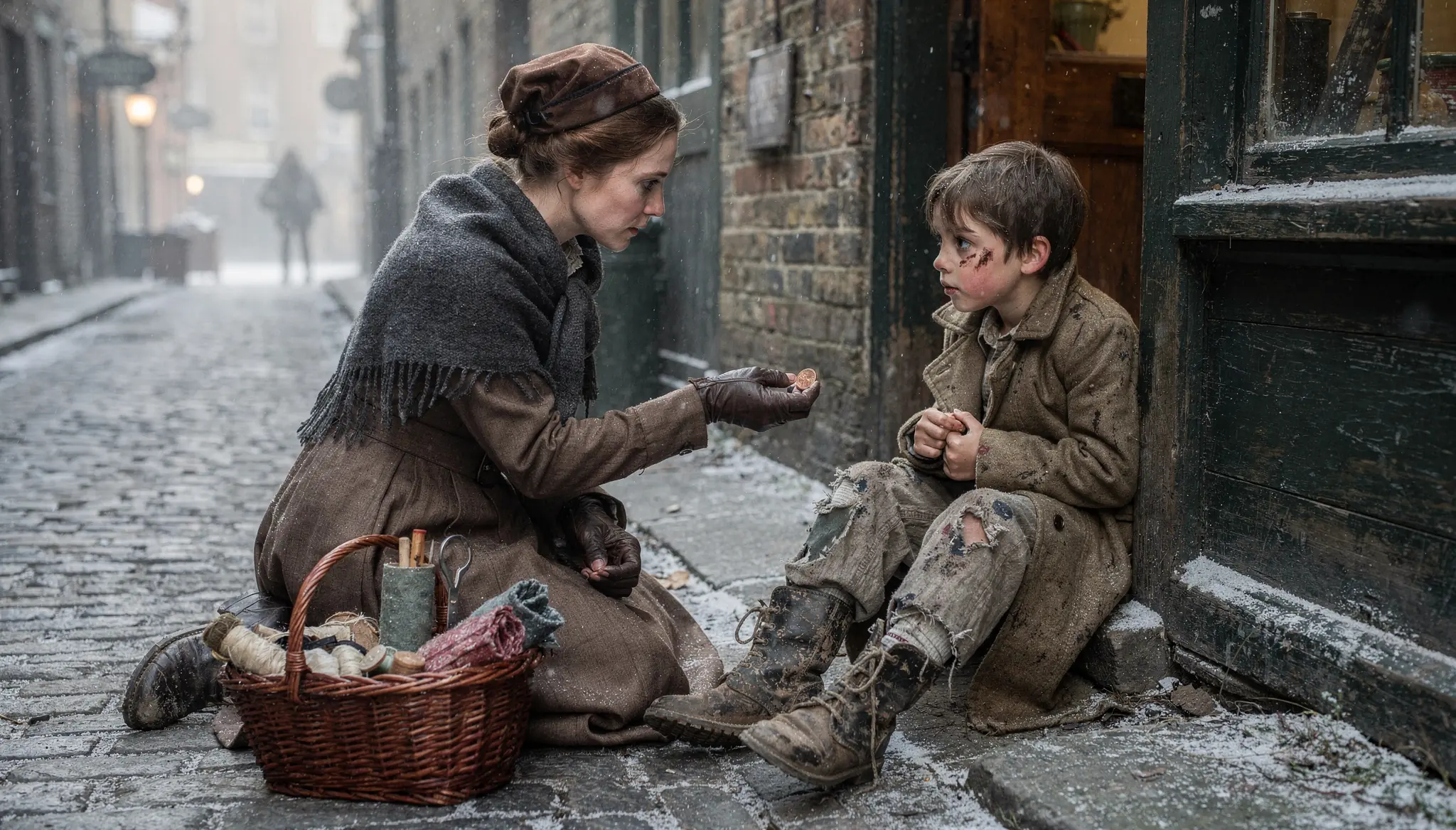
It was meant to buy bread. It was meant to last her and her ailing aunt through to Thursday, when the mending money would come in. She did not know yet that giving away the smallest of those four coins would change the entire shape of her life. The lane was empty save for the wind and the crows picking at frozen refuse, until she saw him, a boy, or what she took to be a boy, huddled in the recessed doorway of a shuttered chandler's shop. He could not have been older than 12 by the look of him, small and slight beneath a coat too large and too thin, his face smudged with soot, his boots, if they could be called boots, held together with twine.
He did not beg. That was the strange part. He did not hold out his hand or call after her the way the other street children did. He only watched her pass with eyes that seemed, even in the gray morning light, unusually steady. Unusually aware.
Eleanor stopped. She should not have. She knew the cost of every coin in her hand better than she knew her own reflection these days. But something in the boy's stillness undid her. It was the dignity of a creature who had learned not to ask for what he needed because asking had taught him only disappointment.
She knelt before him on the frozen stone, heedless of her skirt, and pressed the smallest coin into his palm. "For something warm," she said. "Please." The boy's fingers closed around the coin slowly as though he were unused to receiving rather than being denied. He looked at her for a long moment, too long, she would think later, for a child, and said nothing at all. He only nodded once, gravely, like a man twice his years acknowledging a debt he intended to repay.
Eleanor smiled at him, rose, and walked on toward the baker's, already calculating how three coins might be stretched to feed two mouths for four days. She did not look back. She did not see the way the boy watched her go, nor the way, once she had turned the corner, he straightened from his crouch with a fluidity no true street child would have possessed, and walked, not scurried, walked toward a waiting carriage two streets away, where a manservant in Calderley livery opened the door without a word of surprise. She did not know that the beggar child she had pitied was in fact a grown man of six and twenty, His Grace Julian Ashworth, Duke of Calderley, who had taken to walking the poorer lanes of the city in disguise for the better part of a year, testing quietly, methodically, the character of a world that bowed to him for his title and told him nothing true.
He was slight of build for a man, fine-boned where his late father had been broad, and it was this, along with a talent for stillness he had cultivated since boyhood, that let him fold himself into rags and grime and pass, in poor light, for a child half his age. It was a foolish habit, his steward told him often. A dangerous one, his aunt told him more often still. But Julian had inherited a dukedom at two and twenty from a father who had been flattered and lied to by every soul who wanted something from him. And he had promised himself, standing over that grave, that he would never again be so easily deceived.
The only way to know a person's true nature, he had come to believe, was to observe them when they believed no one worth impressing was watching. No one had ever knelt.
In the carriage, he opened his palm and looked at the coin, worn nearly smooth, the last of what she had, for a long while before he closed his fist around it. "Find out who she is," he said quietly to the manservant. Her name, he learned discreetly within the day, was Eleanor Wren, five and twenty years of age, gentlewoman by birth and seamstress by necessity. Her father, a country solicitor of modest means, had died four years prior leaving debts he had never spoken of. Her mother had not survived the winter that followed.
Julian found that he could not stop thinking of her stillness. Not her beauty, though she was not without it. Her face was more striking than pretty, all clean lines and steady gray eyes. The kind of face that revealed itself slowly, rather than announcing itself at once. It was the composure that had caught him.
The dignity that poverty had not managed to strip from her, though it had clearly tried. He told himself it was merely curiosity. A duke did not fall in love with a seamstress glimpsed once in a frozen lane. He told himself this for 11 days, during which he found some pretext to walk that same lane four more times, in the same disguise, hoping, though he would not have called it hoping, to see her again.
On the fifth occasion, he did. She did not recognize him, of course. Why would she? He was careful to keep his face half turned, his shoulders hunched in the posture of a boy accustomed to making himself small, so as not to invite trouble. But he watched her from the doorway as she passed with a basket of mending balanced against her hip, her breath clouding in the cold.
Her cheeks were chapped raw by wind she had no proper coat to guard against. She did not pass him by this time. She stopped as she had before and crouched to his level, and from the basket she produced a heel of bread wrapped in a handkerchief that had clearly once been fine linen, now mended so many times it was more stitch than cloth. "You're the boy from before," she said. "I hoped I might see you again. Are you fed? Is there somewhere warm you go at night?" He could have told her, in that moment, precisely who he was.
The words rose in his throat and very nearly escaped him, but something in her face, that open unguarded concern for a stranger's child she had no obligation to remember, let alone seek out, stopped him. He did not want to see that expression change. He did not want to watch warmth curdle into mortification, the particular horror of a poor woman realizing she had knelt before a duke and treated him as an object of pity. So, he only shook his head, mute, and accepted the bread with hands he made deliberately unsteady. "There's a workhouse two streets from here," she said, "though I understand if you'd rather not. My aunt says they're not kind places. If ever you're truly desperate, come to the milliner's on Cross Lane and ask for Eleanor. I haven't much, but I have never yet turned away a hungry child, and I don't intend to start." She touched his soot-streaked cheek once, briefly, with a gentleness that struck him harder than any blow he had taken in the boxing rooms of his club, and then she rose and continued on her way, late already for the mending she had promised to deliver by noon.
Julian remained in the doorway long after she had gone, the bread growing cold in his hands, and understood, with the particular clarity that comes to a man only once or twice in a lifetime, that he was no longer merely curious. He did not go to her as himself, not yet. A duke did not simply appear on the doorstep of a milliner's shop and declare an interest in the seamstress within, not without setting every tongue in the city wagging, not without exposing her to precisely the sort of scrutiny that could ruin a woman with no name or fortune to protect her. He had seen enough of society's appetite for cruelty to know that the surest way to ruin Eleanor Wren would be to make her visible to it before she was ready to withstand its teeth.
Instead, he became, over the following weeks, a quiet and persistent presence at the edges of her life, never as the beggar child again, for he judged that disguise had served its purpose and could not be repeated without risk of discovery. Instead, he came as Mr. Ashworth, a gentleman of modest means and no particular consequence, who had, so the story went, taken rooms nearby and found himself in frequent need of a fine hand with a needle. It was not entirely a fiction. He did, in fact, require his cravats mended and his waistcoats altered, though any of a dozen tailors in Mayfair could have seen to the task with a snap of his fingers.
He came instead twice and then three times a week to the narrow shop on Cross Lane and sat in the small back room where Eleanor worked, and watched her hands move with a precision that fascinated him far more than it ought. "You've a talent for this," he told her once, turning a mended cuff in the lamplight. "The stitches are nearly invisible." "Invisible stitches keep a garment from falling apart at the seam a man least expects it," she said, not looking up from her work. "Rather like most things worth doing well, Mr. Ashworth, no one notices them until they're absent." He found he could not stop returning to that sentence in his mind. "No one notices them until they're absent." He wondered, not for the first time, how long a woman such as Eleanor Wren had gone unnoticed, how many years of quiet excellence had passed beneath the gaze of a world too preoccupied with wealth and title to see what she truly was.
"You are unusually observant," she said, glancing up at last, "for a gentleman who claims to have no particular occupation." "I have been accused of worse." "I did not accuse you of anything." A faint smile touched her mouth, rare and all the more precious for its rarity. "I merely observed you observing. It seems only fair." He found himself in that moment wanting very badly to tell her everything. The disguise, the coin, the year of walking lanes no gentleman walked in search of a truth no title could purchase. But Aunt Constance called from the front room just then, her voice thin and rasping with the cough that had worsened these past weeks, and Eleanor was on her feet and gone before he could find the words.
And a moment passed as such moments do, leaving only its echo behind.
It was through Aunt Constance's illness that Julian first began to understand the true weight Eleanor carried. The physician who called, paid for through a discreet arrangement Julian made with his man of business and disguised as a charitable subscription supposedly won by the milliner's shop, spoke gravely of a weakness in the lungs that the cold months would not improve. Eleanor received this news the way she seemed to receive all news, with a stillness that gave away nothing of what it cost her, and then went directly back to her needle, because there were still gowns to be finished and rent to be paid and no room in her life, however desperately she might have wished for it, to fall apart.
Julian watched this from the doorway of the back room one gray afternoon, unseen, and felt something in his chest that he did not immediately recognize as anger, not at her, never at her, but at a world so arranged that a woman of her evident worth should be made to bear such weight entirely alone. You needn't stay, she told him later, catching him still lingering near the shop long after his fictitious errand had been completed. I know I am poor company today. I did not come for company, he said, which was true in the way that most true things are also somehow lies. I came because I hoped you might mend this.
He held out a handkerchief that required no mending at all. Eleanor took it, turned it over once in her hands, and looked at him with an expression he had not seen from her before. Not quite suspicion, but something adjacent to it. The wary attentiveness of a woman who had learned, through long practice, to notice when a kindness did not quite add up. Mr.
Ashworth, she said slowly, I begin to wonder whether you require nearly so much mending as you claim. His pulse quickened in a way he was not accustomed to, and did not entirely like. Perhaps I simply enjoy the company of someone whose hands are never idle, and whose tongue is never dull. Perhaps. She did not sound convinced, but she did not press further, either, and he understood, with the particular gratitude of a man who has been given more grace than he has earned, that she had chosen not to examine the gift horse too closely, because she needed, just then, whatever small warmth his visits provided, and pride was a luxury she could no longer afford in every corner of her life.
The turning point came, as such things often do, from a direction neither had anticipated. Eleanor's cousin, her father's sister's daughter, a sharp-tongued woman named Priscilla Vane, who had married reasonably well, and never once let Eleanor forget the disparity between their circumstances, arrived unannounced at the shop one December morning with an invitation that was in truth an obligation dressed in silk. "Lady Howick's ball," Priscilla announced, dropping the cream-colored card onto the worktable as though it were a great condescension. "Mother insists you attend, if only so people stop asking why father's own niece is never seen anywhere respectable. You'll come as my companion, of course. No one will expect you to dance." "I have nothing to wear that would be suitable," Eleanor said, quite reasonably, for the gowns she owned were serviceable and nothing more, mended so many times over that no amount of pressing could disguise their age.
Priscilla's smile was thin. "I thought as much. I've brought Sophia's old blue silk. She's grown too stout for it since the baby, and it seemed a waste to give it to the poor when I have a poor relation of my own who might make use of it first." She said this last part without any evident awareness of its cruelty, or perhaps with full awareness and simple indifference. Eleanor had long since stopped trying to distinguish between the two where Priscilla was concerned. Aunt Constance, weak as she was, insisted from her bed that Eleanor go. "You've hidden yourself away in this shop for four years, my dear," she said, her voice thin as paper.
"I'll not have you hide from the whole of your life as well. Go. Wear the gown. Let someone see you, just this once." And so Eleanor went, not because she wished for a ball, but because she loved her aunt too much to refuse a dying woman's small request, and because some quiet, buried part of her, the part that had knelt before a beggar child without calculating the cost, the part that had not yet been entirely worn away by four years of grief and mending, still remembered what it was to want, however faintly, to be seen.
Julian, for his part, had known of Lady Howick's ball for a month, had known his attendance was expected as a matter of course, and had planned to make the briefest possible appearance before retreating to the quiet of his own study. He had not known, could not have known, until he arrived and saw her across the crowded ballroom in a blue silk gown two seasons out of fashion, and not quite properly fitted through the shoulders, that Eleanor Wren would be there at all. She stood near the edge of the room in the particular posture of a woman trying very hard to occupy as little space as possible. Her chin lifted with a dignity that made the ill-fitting gown seem to Julian's eye more elegant than anything the other women in the room were wearing, precisely because she wore it as though she did not care that it marked her as poor relation, rather than guest of consequence.
He crossed the room toward her before he had entirely decided to do so. "Miss Wren." He bowed properly in the manner of Mr. Ashworth, though every instinct in him wanted to take her hand and simply look at her unguarded for as long as she would permit it. "I confess I did not expect to see you here." Something in her face eased at the sight of him. Relief, he thought at finding one face in the crowd that did not regard her with the particular blend of pity and contempt Priscilla Vane's circle seemed to specialize in.
"Nor did I expect to see you, Mr. Ashworth. I did not realize gentlemen of no particular occupation received invitations to Lady Howick's ball." "I have my ways of being included where I'm not strictly wanted," he said, and the words carried more truth than she could possibly have understood. They spoke for the better part of an hour, tucked into a quiet alcove near the terrace doors, and Julian found, as he had found in the back room of the milliner's shop, and in the frozen lane where he had first knelt as a boy who was not a boy, that he did not want the conversation to end. She spoke of her aunt with a tenderness that undid something in his chest. She spoke of her work with a pride that most gentlewomen would have been trained to hide.
She spoke, once, briefly and only when he pressed gently, of the beggar child she had given her last coin two weeks before, and how she still wondered, sometimes, whether the boy had found his way to somewhere warm. "I think of him more than I probably ought," she admitted, a faint flush rising in her cheeks as though the confession embarrassed her. "There was something in his eyes. I can't explain it. As though he saw more than a child his age should see." Julian's throat tightened. He did not trust himself to speak for a moment. "Perhaps," he said, finally, carefully, "he was not entirely what he seemed." She looked at him with sudden, sharp curiosity, the same wary attentiveness he had seen before, the sense of a woman noticing that something did not add up.
But before she could press him further, Priscilla Vane appeared at the edge of the alcove with two other ladies in tow. Their eyes bright with the particular malice of women who have found fresh sport. "Eleanor, there you are. Lady Ashcombe was just remarking how well that gown suits you, considering it was made for someone with Sophia's figure and not your own. Do try not to strain the seams, dearest. Sophia will want it back once she's recovered her waist." The laughter that followed was soft, practiced, the kind of cruelty that could be denied as mere teasing if ever called to account. Eleanor's spine straightened, her chin lifted a fraction higher, and she said nothing at all. But Julian saw the color drain from her face, saw the particular effort it cost her to hold her composure, and felt something in himself go very cold and very still.
"Mrs. Vane," he said, and his voice, though quiet, carried an authority he had not permitted himself to use since he had adopted the persona of Mr. Ashworth. "I confess I find the gown entirely suited to its wearer. It is not every woman who can make second-hand silk look as though it were chosen deliberately for her out of genuine good taste rather than necessity. A rarer gift than you might imagine." Priscilla's smile faltered. She had not expected to be contradicted, least of all by a gentleman whose name she did not entirely recognize. "I only meant..." "I know precisely what you meant." Julian's tone did not rise, but something in it made the two ladies beside Priscilla take an involuntary step back.
"I should hate to see it repeated." He offered Eleanor his arm then, and let her away toward the terrace doors, and if Priscilla Vane's face burned scarlet behind them, neither of them looked back to see it.
Outside, in the cold, clear air, Eleanor let out a breath she seemed to have been holding for the better part of the evening. "You needn't have done that," she said, though her voice was not entirely steady. "I am accustomed to it." "That you are accustomed to cruelty does not mean you deserve it," Julian said. "No one should grow accustomed to being made small, Miss Wren. Least of all someone who has spent the last four years making everyone around her larger: her aunt, her cousin's children, half the mended garments in this city, I should think, while asking for nothing in return." She looked at him then with an expression he had not seen before, something between wonder and disbelief, as though he had spoken a language she had not heard in a very long time, and had begun to fear she never would again.
"Who are you really, Mr. Ashworth?" she asked softly. "I have wondered it more than once. A gentleman of no occupation who nonetheless commands a room without raising his voice, who pays a physician's bill for my aunt and thinks I do not notice, though I have noticed and said nothing, because I did not know how to thank you without giving you the satisfaction of knowing I'd guessed." Julian's chest tightened. This was the moment, he understood, the precipice from which there would be no retreating. No returning into the careful fiction he had constructed. He opened his mouth to tell her everything, and then, from the ballroom behind them, a voice called his true name.
His steward arrived with an urgent matter that could not wait, addressing him without thinking as "Your Grace" within earshot of a room full of people eager for precisely such a slip. Eleanor went very still.
"Your Grace," she repeated, the words dropping like stones into still water. "Ashworth, Duke of..." Her breath caught. "Calderley. You are the Duke of Calderley."
"Eleanor, don't."
She stepped back from him, wrapping her arms around herself as though against a cold that had nothing to do with the winter air. "Do not call me that. Not now. Not when I do not know which of you has been standing before me all this time. Was it the gentleman I thought I knew, or the duke who watched me play the fool for weeks, mending his handkerchiefs and telling him secrets I have told no one else while he laughed, I suppose, at how easily I trusted him?"
"I have never once laughed at you." His voice was low and urgent, cutting through her rising distress. "Eleanor, I swear to you on my father's grave, I have never regarded you as anything but..."
"As what?"
Her eyes were bright with unshed tears. Beneath the hurt, he saw something worse: humiliation, the particular horror of a woman who believed she had been made a fool of. Every kindness she had extended and every private confidence she had shared had been observed by a man who let her believe he was her equal when he was, in truth, one of the most powerful men in England.
"I was the beggar child," he said quietly. "I was the boy in the lane. The boy you knelt for. The coin you gave me, I kept it. I keep it still."
Eleanor's hand rose to her mouth. Whatever she had expected him to say, it had not been this.
"I have walked the poorer streets of this city in disguise for the better part of a year," he continued, the words coming faster now, as though a dam long held had finally given way. "My father was deceived by everyone who claimed to love him. He was flattered, robbed, and lied to by men who bowed and smiled while taking everything they could from him. A title makes people perform virtue rather than possess it. I swore I would not be so easily fooled. I began going out disguised, watching and listening, learning who people truly were when they believed no one of consequence was watching. Then I saw you kneel in a frozen street and give away the last coin in your hand to a child you owed nothing. I have not been able to stop thinking of you since."
"So all of it," Eleanor said, her voice trembling. "The visits to the shop, the mending, the physician... it was all part of your testing?"
"It began that way," he admitted, because he would not lie to her now, not when the truth was the only thing that might yet save what stood between them. "I will not pretend otherwise. But it did not remain a test, Eleanor. Somewhere between the lane and this ballroom, it became something I no longer wished to disguise. I fell in love with a seamstress who did not know my name. I have been trying, clumsily and perhaps cruelly, to find some way to tell you the truth without losing whatever made you speak to me so freely, without becoming in your eyes merely a duke, as I have become in everyone else's."
Eleanor said nothing for a long moment. The cold wind pulled at the ill-fitting blue silk while her eyes searched his face for some sign of the deception she still feared might be hiding there.
"I need time," she said finally. "I need to think, Your Grace. I cannot simply..." Her voice broke. "You have made me a fool before half of London, whether you intended it or not. Everyone in that ballroom will know by morning that the poor relation in a borrowed gown was speaking intimately with the Duke of Calderley. They will say I set my cap for you. They will say worse, and I will have no way to defend myself because I did not even know who I was speaking to."
She left him on the terrace. Julian did not follow, because he understood with the painful clarity of a man who had finally seen the full cost of his own carefully constructed fiction that following her would only prove every fear she carried about men of his rank: that they took what they wanted, when they wanted it, regardless of what a woman herself required.
The days that followed were among the darkest Eleanor had known since her mother's death. Priscilla Vane, true to Julian's prediction, spread the story of the terrace conversation through every drawing room in the city by the following afternoon. With each retelling, Eleanor became either a scheming fortune hunter who had somehow ensnared the Duke of Calderley's attention through unseemly means or a foolish woman who had briefly, laughably, believed a duke might genuinely court her.
Neither version was kind. Both wounded Eleanor in ways she had not expected, precisely because both contained, twisted though they were, some fragment of truth she could not entirely deny. She had spoken to him freely. She had told him things she told no one else. In his company, she had felt something she had not permitted herself to feel in the four long years since her family's ruin.
"You must not blame yourself," Aunt Constance said from her bed, her voice weaker each day though her mind remained sharp. "You did nothing wrong, my dear. You spoke honestly to a man who deceived you about his identity. The wrong, if there is one, is entirely his."
"I do not know what to feel," Eleanor admitted, sitting at her aunt's bedside with a mending basket she had not touched in an hour. "I am angry with him. I am angrier still with myself for how much I wish he would come, even now, even after everything."
Aunt Constance's thin, cool hand found hers. "Then perhaps that is your answer, Eleanor. Anger and longing rarely occupy the same heart unless there is love beneath them both."
Julian did not come, not that week nor the next. Eleanor told herself this was for the best. A duke had a hundred more suitable women to consider, and whatever fascination she had briefly held for him had surely been extinguished by the scandal his revelation caused.
She returned to her needle, to her aunt's care, and to the narrow, careful shape of the life she had built for herself. If something in her chest ached each time the shop bell rang and it was not him, she told no one, not even herself, how much that ache had come to matter.
She did not know that Julian spent those same weeks in a different kind of agony, closeted with his solicitors and his own conscience, working to undo the damage his disguise had caused. He was determined that when he came to her again, he would come with nothing left to explain and nothing left to prove, only the plain truth of what he wanted, laid before her without artifice for the first time since that frozen morning in a forgotten lane.
The turn came, as it so often does, at the worst possible hour. Aunt Constance's cough, which had worsened steadily through the cold months, suddenly became far more dangerous on a night when the physician could not be reached until nearly dawn.
Eleanor sat beside her aunt's bed through the long hours of darkness, pressing cool cloths to her fevered brow and praying with a desperation she had not allowed herself since her mother's final illness. When the physician finally arrived, his verdict was grave enough that Eleanor understood, with the clarity grief brings before it fully arrives, that she might soon be entirely alone in the world.
It was Julian who arranged for the finest physician in London to be brought within the hour, having learned of the crisis through the network of quiet inquiries he had never entirely stopped making on Eleanor's behalf. It was Julian who ensured coal, broth, and medicine arrived at the milliner's shop before Eleanor had even thought to ask.
And it was Julian who came himself at last, not as Mr. Ashworth and not in disguise, but precisely as he was: the Duke of Calderley, standing in the doorway of a rented room above a milliner's shop with his hat in his hands and an expression of such naked concern that Eleanor's anger, held so tightly for three weeks, began at last to crack.
"You should not have come," she said, though there was no real conviction in it.
"I could not stay away," he replied simply. "Eleanor, I know I have no right to your forgiveness. I deceived you, even if I did not intend the deception to last so long or to wound you so deeply when it ended. But I could not let you face this alone, whatever you decide to feel about me. I have watched you carry every burden this world placed upon you without once asking for help. I find I cannot bear to watch you carry this one unaided as well."
Aunt Constance, weak as she was, turned her head toward the doorway and managed a faint, knowing smile. "Well," she rasped, "the duke has come at last. Eleanor, do let the poor man in. He has been standing in doorways on your account for the better part of a year, by my reckoning, and I confess I am tired of watching him hover."
In the end, Aunt Constance's illness broke the final wall between them, not because tragedy makes forgiveness easy, but because in the long nights that followed, as they sat together at her bedside and took turns so that neither collapsed from exhaustion, Eleanor watched Julian care for a dying woman who was no relation of his with a tenderness and patience no calculation could have produced.
He read to Constance from her favorite novels in a voice grown hoarse with fatigue. He held her hand through the worst of her fevered nights. He asked Eleanor for nothing and expected nothing in return.
Slowly, in the quiet spaces between crisis and calm, Eleanor began to understand that the man beside her was not the disguise he had once worn, nor the title that had frightened her, but something far simpler and more precious. He was a man who loved her enough to be patient and who had become honest enough never again to let a lie stand between them.
Constance did not die that winter, though the physician had feared she would. Her slow, hard-won recovery became, for Eleanor, a parable she would carry for the rest of her life: proof that the darkest nights did not always end in loss and that sometimes, if one held on long enough, morning came after all.
When Constance was finally well enough to sit up and take broth unaided, Julian asked Eleanor to walk with him. He did not take her to a ballroom or any place of society's making. He took her back to the lane behind Thornfield Row, to the very doorway where he had once crouched in rags and watched her kneel before him.
"I have often thought," he said, standing where the beggar child had once stood, "of what I might have lost had you walked past that morning without stopping. I have thought about how many people did walk past, and how many still walk past children exactly like the one I pretended to be without once breaking their stride."
"You were not truly a beggar child," Eleanor said gently. "The comparison is not entirely fair to yourself or to them."
"No, but I learned in that doorway what it is to be invisible, to be looked past rather than looked at. I had never known it before, not truly, not in six and twenty years of being seen, deferred to, and attended upon everywhere I went. And you..."
His voice caught. He reached inside his coat and drew out a small velvet pouch worn soft with handling.
"You saw me, not because I was a duke, for you did not know it, and not because I performed some grand virtue to earn your notice, for I performed nothing at all. You saw me because it is simply your nature to see what others overlook and to give what you can, even when you yourself have almost nothing left to give."
He opened the pouch and withdrew the coin. Her coin. The worn, nearly featureless piece she had pressed into his palm on that frozen morning, kept close through every day since.
"I have carried this every day since you gave it to me," he said. "Not because I needed it, Eleanor. God knows I have never lacked anything in my life but this. I carried it because it is the truest gift I have ever been given. You gave me your last coin without knowing who I was, without any hope of return, simply because I appeared to need it more than you did. I have spent every day since trying to become a man worthy of having received it."
Eleanor's eyes filled with tears she no longer tried to hide. "I am not a duchess," she said softly. "I have no dowry, no connections worth the name, a shop-worn gown, a needle-worn hand, and an aunt who will need my care for years yet to come, however well she recovers. Society will say you have thrown yourself away on a nobody."
"Society said a great many things about my father, and every one of them was wrong. I do not want merely a duchess, Eleanor. I have met a hundred women who would make excellent duchesses, who would manage my houses and grace my table, and never once trouble me with an honest word. I want a wife who kneels in frozen streets for strangers who need her more than she needs to preserve her own comfort. I want a wife who mends invisible stitches so carefully that no one but she and God will ever know the care she has taken. I want you, Eleanor Wren. Not the fantasy of you, not the poor relation to be pitied or the seamstress to be elevated, but precisely who you are, exactly as you are, for every day I am given to have you."
He knelt in the very doorway where he had once crouched in rags and held the worn coin upon his open palm.
"I cannot offer this back to you as payment, for what you gave me that morning was never a debt to be repaid. I offer it instead as a promise that I will spend the whole of my life trying to be worthy of the woman who gave everything she had to a stranger and asked nothing in return but that he find somewhere warm. Eleanor, will you marry me? Will you let me be the somewhere warm you have given to everyone else and never once allowed anyone to give to you?"
Eleanor knelt before him in the frozen lane, her hands closing over his. For a long moment, she could not speak. She could only look at the man who had first come to her in rags and returned to her in truth, who had watched her when the whole world looked past her, and who now knelt before her not as a duke, but simply as a man who loved her.
"Yes," she whispered at last. "Yes, Julian. I will marry you."
He rose and drew her up with him. There in the lane, with no audience but the crows, the frost, and the pale winter sun beginning at last to break through the clouds, he kissed her, softly at first and then with all the restrained longing of a year spent watching from doorways, of weeks spent apart in careful, aching distance, and of a love that had begun with a single coin and grown slowly and honestly into something neither title, scandal, nor circumstance could diminish.
They were married in the spring in a small ceremony that scandalized precisely no one. By then, the full truth of their story, the coin, the disguise, and the year of quiet devotion, had spread through London not as gossip but as something closer to legend, and even the sharpest tongues found themselves, however reluctantly, charmed by it.
Priscilla Vane attended, tight-lipped and civil, and never again spoke ill of Eleanor's gowns. Eleanor could now choose from among the finest silks in England, though she still mended her own hems from time to time because she continued to love the quiet, careful work of invisible stitches.
Aunt Constance lived to see the wedding and many springs after it. She was installed in comfortable rooms at Calderley House, where she was fussed over by a duke who came to love her as his own family and who never forgot that her insistence, "Go. Let someone see you, just this once," had set the whole of his happiness in motion.
On the mantel of Julian and Eleanor's private sitting room, inside a small glass case commissioned specially, sat a single worn coin, its king's profile long since vanished. It was kept where the morning light always fell upon it, a reminder neither of them needed but both treasured: the frozen lane, the beggar child, and the moment a woman who had almost nothing chose without hesitation to give away what little she possessed and found in that giving everything she had never dared to hope for in return.
She had thought that morning that she was giving away her very last coin. She had not known she was receiving, in the same breath, the whole of her life to come.