Eleanor Puit broke her last loaf in two, and pressed the larger half into the stranger's hands before she let herself count the cost of it. The bread was a day old, and gone firm at the crust. But it was warm still, where it had lain against the banked embers of her oven, and the stranger's fingers closed around it the way a man closes his hands around the first fire of a cold season. Though it was not cold, it was midsummer, and the evening lay thick and gold over the village of Little Dunmore, and the dust of the lane hung in the last light like something that had forgotten how to fall.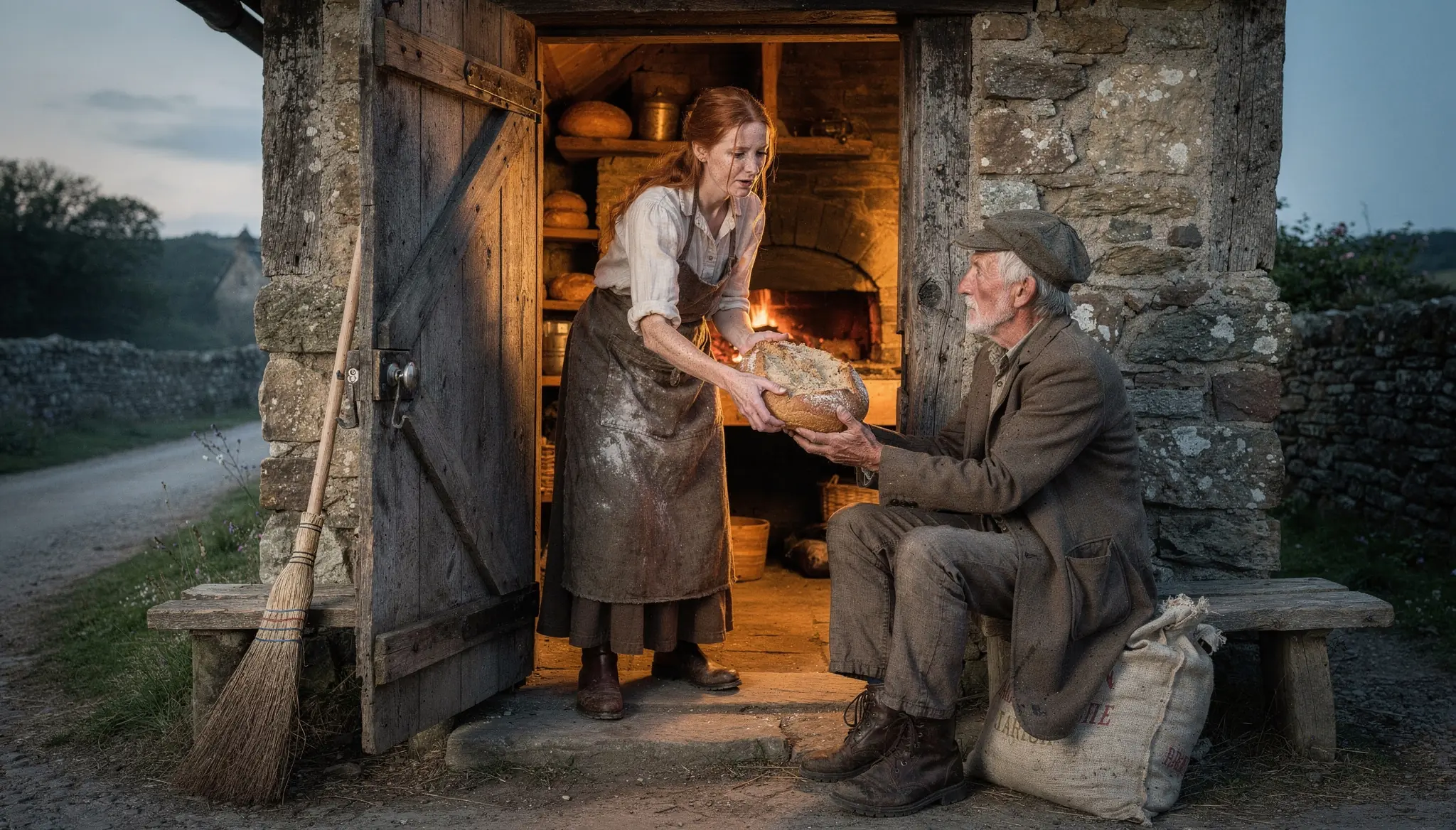
"I have nothing to give you for it," the old man said. His voice was cracked but courteous, the voice of a man who had once had cause to mind his manners. "Not so much as a farthing, mistress. I'll not pretend otherwise."
"Then it is fortunate I did not ask you for one." She wiped her palms down her apron, leaving two pale ghosts of flour on the linen. "Sit on the step there before you fall down on it. You have the look of a man who has walked farther than his boots agreed to." He sat.
He was gaunt as a winter hedge. His coat worn to the color of nothing at all, and his hands, when they tore the bread, trembled in a way that made her look away out of kindness rather than watch him be ashamed of it. The smell of the loaf rose between them, yeast and char, and the faint sweetness of the barley she stretched her flour with when the good wheat ran thin, which lately was always. A moth blundered against the doorpost. Somewhere down the lane, a dog gave one bored bark and thought better of a second.
"You keep this house alone," the old man said. It was not quite a question.
"I keep it as well as one pair of hands can keep it." She leaned in the doorway of the bake house, arms folded, and the low sun caught the loose copper of her hair, where it had come down from its pins across the long, hot afternoon, and turned it for a moment to the color of the crust cooling on her sill. "My father held the ovens before me. Folk hereabouts still call it Puit's, though there's only the one Puit left to answer to it, and he is three summers in the churchyard. I'll thank you not to make me sadder than the day already has." She said it lightly because she had learned that lightness was the only cup that would carry such a thing without spilling it.
"There you've eaten. You have a color to you now that is almost the color of a living man." The stranger chewed slowly, watching her over the bread, and there was something in the watching that did not match the coat. His eyes were a clear pale gray and altogether too steady. And they moved across her small kingdom. The swept floor, the cold second oven she could no longer afford to fire, the single tallow dip guttering on the shelf and counted it, she thought.
The way a man counts what he means to remember.
"You gave me the larger half," he said.
"I gave you the half that would do you the most good. There is a difference, though I'll grant it does not look like one from where you sit."
"Most would have given the smaller. Most gave me nothing at all." He set the last of the crust down on his knee with a care that undid her a little. "I have knocked at eleven doors between Marlborough and this one, mistress. Eleven. Grand doors and mean ones. A parsonage with a fat glebe and a farm with a fat larder. Not one of them opened wider than a hand's breadth, and not one gave me so much as the rind off a cheese." He looked up. "Yours is the twelfth, and yours is empty, and yours opened all the way."
Eleanor's laugh came out of her before she could stop it, tired and true.
"Then you have gone about your begging very poorly, to save the poorest house for last." "No," said the old man softly. No, I do not think I have gone about it poorly at all. Something moved along the back of her neck at that. Not fear precisely, but the cousin of it, the small, cold thing that stirs when a plain evening turns a corner you did not see in it. Before she could put a name to it, he was on his feet again, straightening the ruin of his coat with a dignity that sat strangely on the rags, and the last of the daylight had gone amber to red behind the church tower.
You should eat the other half yourself, he said, for you will want your strength before this night is out. I have no doubt of it. I have a quarter's rent due at cockcrow and not the coin to cover a tenth of it, so my strength and I are old companions in the dark. She had not meant to tell him that. It surprised her, the telling.
The words simply walked out into the warm dusk of their own accord. Go on with you now. There's a barn at Wellers Yonder where the straw is dry and no one will trouble you for it. Tell them Nell Puit sent you and they'll not turn a dog out. He paused at the edge of the lane, a thin dark shape against the burning west.
Nell Puit, he repeated as if he was setting the name down carefully in a ledger only he could read. You'll not remember. I dare say that you were kind tonight. Kind folk never do. That is what makes them so.
But it will be remembered for you. It will be remembered before the moon is high. And then he bowed to her, bowed in his ruined coat from the middle of a village lane, a bow that belonged to a marble hall and a hundred candles, and was gone into the blue between the hedges before she had finished deciding whether to laugh at him or run after him with the other half of the loaf as well. The bake house felt smaller when she went back into it, the way a room always does when the one warm, foolish thing that happened in it is over. She latched the door.
She ate the smaller half of the bread standing up at the cold oven, dry because there was no butter and had not been butter for a fortnight, and she told herself it was enough, and it very nearly was. Then she opened the tin box on the shelf where the takings lived, and it was as empty as it had been that morning, and the telling herself stopped working. She sat down on the stool by the good oven, and set the box in her lap, and looked into it as though looking might teach it to fill. Four shillings, and a bent sixpence. Against that stood the whole weight of the summer quarter, the rent that Mr.
Sillitoe would come for with the first light, the sack of Marlborough flour bought on trust in May that the miller's man had already asked after twice the new iron peel she had needed when the old one cracked. Sillitoe owned the mill and half the lane and the note on Puit's besides and Sillitoe was not a patient man nor a kind one and he had said to her plainly in the spring holding his hat and not sitting because sitting would have made it a conversation between equals that a bake house wanted a baker with a head for figures and not a soft-hearted girl who gave her crusts to every vagrant on the road. He had said soft-hearted as though it were a disease she might be cured of.
"Well, and perhaps it is," she said aloud to the empty room, to the beam hooks and the flour ghost on her apron, and her father's proving cloths folded on their shelf, where she could not bring herself to move them. Her voice sounded very loud and very alone. Outside the last swifts screamed once round the tower and were still, and the warm dark came down over Little Dunmore, and moths found the seam of light beneath her door, and battered themselves against it, wanting in. She did not weep. She had wept through the whole of the first year, and found it changed nothing but the salt in the bread, and so she had given it up, as she had given up butter, as a thing she could not afford.
Instead, she banked the fire down proper, and she said the small, graceless prayer she said each night, not for herself, she had stopped that, too, but for the house, that it might stand, and she carried the tallow dip up the crooked stair to the cot under the eaves, where the heat of the day still lay trapped and sweet. She had one boot off when she heard the horses, not one horse. Horses, a team of them, and iron-shod wheels behind, coming fast down a lane that no carriage had ever had reason to come down in all the six-and-twenty years of her living on it. The sound was wrong the way a bell rung at the wrong hour is wrong. She sat with the boot in her hand and listened to it grow. The roll and the ring and the blowing of hot horses. And then the whole racket of it drew up outside her own door with a groan of leather and a stamp and a jingle and stopped.
There was a silence then that had a shape to it. Eleanor set the boot down. She went to the little window under the eaves and put her eye to the gap in the shutter, and below her in the risen moon stood a carriage such as had no business in the world outside a picture. Black and glossed to a mirror, four gray horses steaming in the summer night, a crest painted on the door that she could not read, but knew the way one knows deep water to be a thing that could pull her under. A footman was already down and setting the step.
A poor man knocks loudly. To be heard through his own doubt, this was two raps. Unhurried from a hand that had never once in its life wondered whether a door would open to it. She went down the stair with the tallow dip shaking in her fist and told herself on every step all the sensible reasons a girl did not open her door to strangers in the black of midsummer night. And then she thought of the old man in his ruined coat and the 12 doors and it will be remembered before the moon is high.
And she drew the bolt. He filled the doorway entire. She had to tip her head to find his face. And when she found it, the breath went out of her a second time. For it was a hard and beautiful face, a straight severe mouth, a jaw like something the frost had cut, eyes dark as the space between the stars, and just now every bit as cold.
He was perhaps eight-and-twenty. He wore his authority the way other men wore their coats, without seeming to think of it, and the small mean light of her candle gutted up at him, and made no impression on him whatsoever. Eleanor Puit, he said, not a question. Everyone tonight, she thought wildly, has decided my name is not a question. That is my name, she said.
And this is my door, and it is midnight, sir, which is an hour that most men who mean well have the manners to sleep through. Something crossed the dark eyes, surprise, perhaps, or its distant relative. I do not mean you ill. Forgive me if I reserve my judgment. The last man to stand where you are standing told me I was soft-hearted and then named a figure for my rent that would have made a Turk blush.
She held the candle a little higher to see him and to be seen, and the flame steadied because her hand, to her great surprise, had steadied.
"Who are you that you come to a bake house with four horses and a crest I cannot read?" I am Ravensmere, he said as though that answered everything. And to the world beyond her door, she understood. It did. The name went through her like the toll of the great bell. Ravensmere, the Duke of Ravensmere, whose lands began somewhere past Marlborough and ran, folk said, further than a strong man could ride between sunup and dark.
She had never seen him. No one she knew had ever seen him. He was a name on the corn factor's lips and a shadow behind the price of bread. And he was standing on her step in the moonlight with the summer wind moving the dust around his boots. Eleanor did the only thing left to a woman who has run out of other things.
She held to the doorframe the way a sailor holds to a mast, not for comfort, but against capsizing. And she said, "Your grace will understand that I have nothing here worth the shoeing of one of those horses, let alone the four. If you have come to buy the bake house, you are a day early and want Mr. Sillitoe, not me. And if you have come for any other reason at all, I cannot for my life imagine what it is." "No," he agreed.
I don't suppose you can. And for the first time he looked, not down at her, but past her, into the small swept dark of the room at her back, at the cold second oven, at the folded proving cloths, at the tin box she had left open, and empty on the stool. She saw his gaze go over it exactly as the old man's had gone over it, counting, remembering, and she understood in one cold rush of the blood that the two men were joined, that the ruin of a coat and the gloss of the carriage were the same hand shown palm and back. The old man, she said slowly, "The beggar. He was yours.
He is not a beggar." The duke's jaw tightened by the width of a hair. He is the oldest and most trusted servant of my grandmother's house. And my grandmother sent him out along the western roads three weeks ago in the worst coat we could find him to knock at every door between Marlborough and the edge of the county and ask for bread. Eleven doors turned him away. Those dark eyes came back to her. And there was something behind the cold now, something that was not warmth, but was at least alive.
A kind of grim, reluctant reckoning. The look of a man reading an account he had expected to find in one column and has found against all sense in the other. Yours is the twelfth. Yours had nothing. Yours gave him the larger half.
The night pressed warm against her back. Down the lane the dog had begun to bark in earnest now at the horses, at the strangeness, at the moon. I gave a hungry man some bread. Eleanor said. That is all that happened here tonight, and I'll not have it made into more than it was.
It has already been made into more than it was, said the Duke of Ravensmere. It was made into more the moment you did it, and there is no unmaking it now. For my grandmother is a woman who keeps her word as other women keep their jewels. And she has given her word before witnesses, before her solicitor, before God and half the county in a document I have spent the whole of this cursed hot day riding to prevent that the woman who fed her messenger with kindness she could not spare would be brought to Ravensmere and offered what my grandmother intends to offer. He drew a breath and it was the first thing about him that had looked like effort.
I told her it was madness. I told her the woman would be a slattern, a schemer or a fool. I came tonight to see the fool for myself and to buy her off with £50 and send her back to her oven. Eleanor's chin came up. And now that you have seen her?
The duke was quiet for a long moment. Behind him the grays stamped and blew, and the crest on the door caught the moon and let it go. Now, he said at last, and something in the flatweary honesty of it was worse than any threat could have been. I find that £50 will not answer. Get your cloak, Miss Puit.
Whatever you owe at Cockcrow, you will not be here to owe it. My grandmother is waiting, and my grandmother does not wait well, and you and I, between us, have until morning to decide which of us is going to be ruined by the kindness you did on that step tonight. For a long moment, Eleanor did not move, and the candle flame between them stood as still as she did.
"Rued," she said at last.
"You have come here in the black of Midsummer with four horses to tell me that I am to be ruined by a half a loaf of yesterday's bread. Your grace, I have stood half a step from ruin every quarter day of my life, and I have never once wanted a duke to fetch it to my door. It has always come very well on its own. You mistake me. His voice did not rise.
It had the low, even carry of a man accustomed to being the quietest thing in any room, and heeded anyway. I did not say you would be ruined. I said one of us would. Then take the other road home, and let it be you, for I have the more practice." She held the door and did not widen it. Down the lane the dog had worked itself into a fury at the horses, and a shutter banged somewhere, and she thought, with a lurch of every window in Little Dunmore, now open a crack upon the sight of a great black carriage drawn up at Puit's at midnight.
You will forgive me. I am not coming out into the dark on the word of a man I met a minute since be his coat never so fine and his horses never so gray. My mother did not raise a fool and my father her chin lifted. My father is past raising anyone. Something moved far back in the dark eyes.
I know what your father was, said the Duke of Ravensmere. He held these ovens nine-and-twenty years and carried three families through the bad winter of the price rise on bread he was never paid for. My grandmother's man learned that at your churchyard gate not two hours since from the Sexton who wept telling it. He paused. I did not come to insult the house.
I came because I could not stop what has been set in motion, and I would rather you heard the whole of it from me than from the county, which will have it by breakfast and improve it by dinner." The dog fell quiet. Into the sudden hush a moth ticked against the glass of her candle once, twice, and she watched it, and not him, because his face was a hard thing to keep looking at.
"Say it plain, then," she said. I am a plain woman and it is very late. Plainly, three summers ago, my grandmother, the Dowager Duchess, buried her faith in the whole of her rank. He chose the words the way a man chooses stones to cross a river. She had come to believe that mercy had gone out of the great houses of this county, as the good wheat goes out of a thin harvest, that a man might starve on the doorstep of every gentleman between here and Marlborough and be shown the toe of a boot.
I told her she had grown fanciful with keeping indoors. She told me she would prove it. She sent old Coombe along the western roads in a beggar's coat with orders to knock at 12 doors and ask for bread. And she set her whole belief upon the twelfth. And the twelfth, Eleanor said slowly, was mine. The 12th was to be whatever the twelfth turned out to be.
She did not know it would be a bake house with an empty till. She did not order it. That is rather the point of the thing. For the first time, a line of something that was almost feeling crossed the severe mouth and was gone. Eleven doors turned him out. Yours had nothing and opened all the way.
And before Coombe left this county, my grandmother had set her hand to a paper before her solicitor and two witnesses and her own chaplain, binding herself past any unbinding of mine, that whatever soul fed her messenger with kindness she could not spare should be brought to Ravensmere and offered. He stopped. Offered what? That said the Duke, you will hear from her and not from me, for it is hers to give and I will not have it said. I put a word of it in your mouth to serve my own ends.
He drew breath. I will tell you only this, Miss Puit, since you have asked me twice to be plain. What she means to offer changes the whole standing of my house. And there are those who have waited a long while upon its not being offered. And if you refuse it, as I devoutly hope you will, it must be refused to her face and under her roof, or it is not refused at all.
A note sent back by carrier will not answer. She will hold it open till the frost. Do you begin to see? She saw a little of it, and what she saw she did not like. You want me to come and say no to her so that you needn't?
I want the thing ended, he said cleanly, tonight before it can grow teeth, and you cannot end it from this doorstep. Eleanor looked past his shoulder at the grays steaming in the moon, at the footman standing so still he might have been cast in the same iron as the wheels, and then back into the small swept dark of her own room, the cold second oven, the open tin, four shillings and a bent sixpence against the whole weight of the summer quarter. And a thought came to her, cold and clear as well water, that she was ruined already, that Sillitoe would come at Cockcrow, whether she was here to meet him or not. That a girl with nothing to lose is the one person in the world a duke cannot buy and might, if she kept her wits, use I will come, she said. The duke's brows drew a fraction.
I will come, she repeated, on three conditions, and you'll hear them before I fetch my cloak, for I have no wish to arrive at your grand house and find the terms have shrunk in the carriage. First, I go to say no as you wish it, and I go by my own choosing, and not because you had the horses. Second, whatever your grandmother offers and I refuse, you will bring me back to this door by tomorrow's dusk, and you will not use the journey to work upon me for your own comfort." And third, hear her voice caught only a little, and she despised it. You will send word to Mrs. Sillitoe, the miller, that Puit's is not to be touched, nor sold, nor entered until I am home to answer for it.
That much you can do with a single letter, and it costs you nothing, and I will not stir a foot without it. For a moment he only looked at her, and she could not read the look at all, which frightened her more than temper would have. Sillitoe, he said, the note on this house is Sillitoe's. The note, the mill, half the lane, and his good opinion of himself, which is the largest holding of the four. She managed it dry.
Have I asked too much? You may keep your £50, your grace. I'd sooner have the letter. You are the first person in some years, said the Duke of Ravensmere, to name me a price I had not already guessed. He turned his head a bare inch.
Coombe. And out of the black scene between the hedges, where he must have been standing this whole while in the beggar's coat she had fed a stranger in, came the old man, unhurried, wiping crumbs of her barley loaf still from his cuff, and his clear gray eyes found her over the duke's shoulder and creased at their corners in a way that undid her all over again.
"I told you, mistress," said old Coombe, "that it would be remembered before the moon was high." He looked up at the tower where the moon indeed hung white and swollen over the leads. And so it has been. I am sorry for the fright of the horses. Her grace has no notion how a carriage sounds to a body that was expecting only sleep. You ate my bread, Eleanor said, and never said a word of what you were about.
A word would have spoiled it. He said it gently without a shred of shame. Kindness that knows it is being weighed is only manners, and manners her grace has in plenty at home. It was the other thing she wanted, and the other thing cannot be asked for. It can only be caught in the act.
He inclined his head toward the house. Fetch your cloak, child, and bank your fire proper, for the nights are warm, but the mornings on the Ravensmere road come up off the water cold as charity. I'll see to the letter to your miller myself, and I'll see it says more than his grace would trouble to say, which is a servant's whole art. She left them on the step. Inside she moved through her own small kingdom by the light of the guttering dip, and did not let herself think, because thinking would have stopped her hands.
She rad the embers down and set the fire cover over them the way her father had taught her, so the heat would keep till morning, and there would be a fire to come home to if there was a home. She folded a change of linen into a cloth. Her fingers hovered over the proving cloths on their shelf, his cloths, worn soft as skin at the corners, where his palms had smoothed a thousand risings, and she did not take them, because to take them felt like admitting she might not come back, and she would not admit that, not on any road, not for any duke. At the last she took down the good gray cloak that had been her mother's that smelt still faintly under the flour and the woodsm smoke of the lavender her mother had laid in the press against the moth. She pulled it round her shoulders in the dark and stood a moment with her hand on the cold iron of the door latch and she said the small graceless prayer not for herself but for the house that it might stand.
Then she went out into the moonlight, and the footman handed her up into the carriage as though she were made of the same porcelain as its lamps, and the door with the crest she could not read, shut upon her, with a sound like a book closing. The Duke sat across from her, all shoulder and shadow, filling his side of the carriage, as he had filled her door. Coombe rode above with the coachman, having refused with great firmness to sit inside. A servant that forgets his place, gives his mistress two problems. Where she had none. And so it was the two of them and the swaying lamplight and the long white road unspooling under the four gray horses.
And for the better part of a mile, neither of them said a word. It was Eleanor who broke first, because silence had never yet baked her a loaf. You said there were those who had waited a long while upon your grandmother's offer not being made. She kept her eyes on the dark hedgerows sliding past, sweet with the last of the dog roses and the heavy green smell of hay lying cut in the water meadows. You had best tell me who I am to be a disappointment to.
I would not like to walk into a room and be hated without knowing the shape of it. The lamplight rocked across his face and left it. You are quick, he said. I had not expected that. You had looked for a slattern, a schemer or a fool.
You told me so on the step, so you needn't pretend now to a courtesy you have already spent. She turned from the window and met the dark eyes square. Who? Your grace? He was silent long enough that she thought he would refuse her.
When he spoke, it came flat and careful, the voice of a man laying down a card he would rather have kept. There is an understanding, he said, of some years standing between my house and the house of Cray, not a betrothal. My grandmother would tell you loudly that nothing has been signed and nothing is owed. But the world has understood it, and Lady Honoria Crayle has understood it, and her brother Sir Julian has understood it best of all, for the joining of the two estates would clear a mortgage on his that no other joining will clear. His jaw tightened by the width of a hair, the same small motion she had seen on the step. My grandmother's paper does not name marriage in so many words, but its plain effect, if the woman she has bound herself to, should accept what is offered, is that no such joining with the Crayle can ever come about.
Sir Julian knows this. He was at Ravensmere within the day of hearing of it, and he has not gone home. The carriage went over a rut and the lamp swung and Eleanor's stomach swung with them though it was not the road. Marriage, she said, and the word came out of her small and disbelieving in the dark. Your grandmother means to offer me.
She means for you two. She could not finish it. A laugh tried to come and found no purchase. That is not an offer, your grace. That is a madness.
I am a baker. I have flour under my nails that will not come out for scrubbing. I have never in my life been nearer a duchess than the far side of a churchyard wall. And your grandmother has never in her life clapped eyes on me. She cannot mean it.
No one could mean it. She means it entirely. His voice had not changed. And that was the dreadful thing. You have not met her.
When you have, you will understand that my grandmother has never in ninety years wanted a thing she did not eventually hold in her two hands. And she wants this more than she has wanted anything since my grandfather went into the churchyard. She has got it into her head that the blood of my house has gone cold, and that a woman who gives away her last bread in an empty year is the one physic in England that might warm it. She does not care that you are a baker. She cares that you are the twelfth door.
To her that is not a low thing. To her it is the only high thing left. And to you the question was out before she had weighed it and it landed between them and sat there. To me, said the Duke of Ravensmere, and for one moment one only. The moonlight and the lamp light caught his face together, and she saw under the cold something that looked worn nearly through.
To me it is the ruin of a plan I have spent eight years building stone on stone to save what my father. He stopped himself hard as a man reigns a bolting horse to save this house. I am not free to be warmed, Miss Puit. Warmth is a thing for men who can afford the price it fetches, and I have never once been able to afford it. So you will go in tomorrow and you will refuse her with all the plainness you showed me on your step and you will be home by dusk with your bake house safe and Sir Julian Crayle will take his sister home and the world will run on in the one channel it can run in without flooding.
That is the whole of what I want. I am telling you so that you will know it is not you I am refusing. It is the flood. She should have felt relief. He was handing her the very freedom she had bargained for.
Go, say no, come home. Instead, she felt something turn over in her chest that had no name she cared to give it. A small perverse ache at being spoken of by a man she had known two hours as a flood to be damned.
"You are very sure," she said, that I will say no. The dark eyes came back to her sharper.
"Will you not?" "Oh, I shall." She looked away out at the moon silvered hay. I have a bake house and a fire banked to come home to, and no more wish to be a duchess than to be the moon. But I'll thank you all the same, not to spend my answer for me before I've been asked the question. It is the one thing I own outright tonight, your grace, my own no, and I find I do not care to have even that taken out of my hands by a man with better horses. He said nothing to that.
But she felt him look at her in the dark a moment longer than a man looks at a flood, and she turned her face resolutely to the window, and did not let him see that she had felt it. They changed horses at a coaching in at the county's edge, where the ostlers came out yawning with lanterns, and the yard smelt of straw and hot iron, and the ale sour spillings of the tap. And Eleanor took a cup of small beer standing by the mounting block, and watched the moon go behind a rag of cloud. It was there, in the guttering light of the inn yard, that the first hard thing happened. A rider came in off the Ravensmere road, going the other way fast.
A young groom on a lathered cob who flung himself down and would have run straight past their carriage had Coombe not stepped from the shadow and caught his arm. There was a low, quick exchange she could not hear over the stamping of the fresh horses. Then Coombe came to her and his face that had been kind at her door had gone grave.
"Mistress," he said quietly, "drawing her a pace apart from the Duke, I'll tell you, for you have the right of it more than his grace allows, and you'll bear it better for not being ambushed." Sir Julian Crayle has not been idle at Ravensmere this day. He has sent to Marlborough for a lawyer of his own, and he has been about the servant's hall with a loose purse and a loud voice, saying to any that will hear him that the woman her grace means to raise up is a scheming baggage who fed a beggar a purpose, having somehow got wind of the whole design beforehand. His gray eyes held hers. It is a lie and a clumsy one, and no one who was at your door could believe it. But you were not seen at your door by the folk who matter.
And Sir Julian is handsome and highborn and free with his money, and a lie in a fine coat travels faster than the truth in a beggar's. The cold that went through Eleanor then had nothing to do with the mist coming up off the inn yard cobbles. He is calling me a cheat, she said. Before I have so much as set foot in the place, before your grandmother has offered me a thing to cheat her of, he is frightened. Mistress, frightened men are the crulest, having the most to lose.
Coombe glanced back at the carriage where the Duke stood tall and unmoving against the lantern light, watching them, too far to hear. There is a thing I'll say to you, and no further, for it is not mine to tell, and I have said too much of it already at your oven. Her grace's reasons are older than you know, and they are not all of them so pretty as a loaf of bread. It is not the first time a kindness done at a low door has come home to that house and changed its fortunes past mending. Ask her when you are alone with her why she chose the western road and no other.
Ask her that and watch her hands. He pressed something into Eleanor's palm, cool and small, the bent sixpence from her own tin that she had not known was gone. You left this behind. A woman should never come to a great house with nothing at all in her pocket. It puts her at their mercy, and their mercy is a chancy weather.
Before she could answer, the Duke's voice came across the yard, level and cool. Coombe the horses are put to. They took the road again in the deep of the night, and the country changed under the moon. The hedges giving way to long pale walls, the walls to iron gates, the gates to an avenue of limes that closed over the carriage like the nave of a church, and breathed down on her their thick honey scent, till she was near sick with it. And then the limes ended, and Ravensmere stood up out of the dark before her, so vast and so lit that for a moment her mind refused it altogether. A whole cliff face of stone with a hundred windows and half of them ablaze with candles at an hour when honest houses lay black.
The moon riding the roofs, a fountain somewhere throwing up a cold silver noise into the summer night. They are all awake, Eleanor said faintly. The whole house is awake. My grandmother does not sleep when she is winning. The Duke leaned to the window and she saw his face harden by a further degree. Saw him go somewhere behind his own eyes.
"No," he said, very low, more to himself than to her.
"No, not all of them are hers." She followed his gaze. On the great pale sweep of the steps, under a lamp held high by a footman, a woman stood waiting for the carriage as though she had stood there some while. A woman gowned in something that took the light and gave it back as deep and dark as spilled wine. Her fair hair dressed high, her beauty so complete and so cold that Eleanor felt her own flour-scarred hands curl shut inside her mother's cloak. Beside the woman, one hand resting easy on the stone balustrade, as though the whole house already answered to it, stood a fair-haired gentleman, with a smile ready made upon his mouth, and nothing whatever behind it. The carriage rolled to its halt at the foot of the steps, and the woman came down two of them, unhurried, and looked in through the very window where Eleanor sat, and her lovely mouth curved.
"Ravensmere," she said to the Duke, without taking her eyes from Eleanor for an instant.
"How good of you to bring her yourself," and to think we were told to expect a common little baker." The smile widened, and did not reach the pale eyes at all. But how tired you look, my dear. You must be quite worn to the bone. Do come in out of the night. Julian and I have been so very eager to make your acquaintance before her grace does.
The footman drew the carriage door wide, and the summer knight came in with the smell of cut limes and cold fountain water, and Lady Honoria Crayle's gloved hand was already reaching to take Eleanor's arm, before Eleanor had so much as found the step with her foot. You will lean on me, Honoria said, sweet as spilled honey. These stones are treacherous to feet that are not used to them. My feet have stood on a flagged floor since before I could talk, Eleanor answered, and drew her arm out of the reaching hand as gently as she could manage, which was not very. I'll not fall down your steps, my lady, and shame the house before I've been let inside it.
She heard behind her the Duke come down out of the carriage, that unhurried settling of weight that made the whole conveyance rock and write itself. She did not look back at him. She had decided somewhere in the last mile of limes that she would not look to him for anything in this place. For a woman who looks to a man in a strange house has already told the house where to strike her. The hall swallowed them whole.
It was not a room so much as a weather. A vault of pale stone rising up past the reach of the candlelight into a dark she could not measure. A staircase wide enough to drive a hayne up. The flames of a hundred candles standing dead still in the airless heat. And throwing back off the marble a shine like ice on a February pond.
It smelt of beeswax and hot house liies and something under both of them, cold and mineral. The smell of a place that had never once in its life had to warm itself at its own hearth. Eleanor's boots rang on the floor in her mother's gray cloak, with the flour of the afternoon still ground into the hollows of her knuckles. She felt herself go small, and hated the smallness, and stood the straighter for hating it. Sir Julian Crayle came off the balustrade where he had been leaning and crossed to her with his hand out and his ready smile turned all the way up.
And by the light of the great hall she saw that Coombe had told her true. He was handsome as a picture of a man, fair and even featured and easy, and there was nothing whatever living behind his eyes, Miss Puit. He took the hand she had not offered and bowed over it, and his mouth did not touch her flour-scarred fingers, but she felt the warm breath of the word against them, which was worse. Julian Crayle, your very great servant. You must forgive my sister her eagerness.
We have been on tenterhooks the whole night through, wondering what manner of paragon could have overturned a house at midnight. And here you are, and I declare the reality quite outdoes the report. That is a kindness, said Eleanor, since the report, as I hear it, was that I am a scheming baggage who fed a beggar a purpose to trick a duchess out of her senses. She let it sit a beat in the ringing air. I'd sooner out dodo that than live up to it, so we are agreed.
Something flickered across the handsome face. Not shame, she thought, but calculation. The small recalibration of a man who has found the ground softer or harder than he stepped for. Behind her, the Duke's voice came, level and cold as the stone. Julian, you are up late.
Ravensmere. Julian turned all warmth, and the two men looked at one another across the width of the hall in a way that made Eleanor think of two dogs that have long since worked out which is which, and go through the smelling of one another, only for form's sake. I could hardly sleep with the house in such a ferment. Her grace has scarcely let a candle go out. She has been asking for her guest this hour and more.
Then she will have her guest presently, and she will have her from me, and not from you. The Duke came to stand at Eleanor's shoulder, not touching, only there, a wall of dark cloth and colder purpose. Honoria, I'll thank you to send word up that we are come. Lady Honoria did not move to send any word anywhere. She stood with one hand resting on the new post, the deep wine of her gown drinking the candlelight, and she looked Eleanor over slowly from the crown of her fallen copper hair to the toes of her honest boots. And she smiled, the smile that never once went near her eyes.
"Poor creature," she said, to no one to the room. She does not even know what she has been fetched here to be offered.
"Look at her face. She has not the smallest notion." The pale gaze came back up and fixed on Eleanor with a bright and pitying interest.
"Has he told you, my dear? Has he told you in the carriage what Her Grace means to make of you? Or has he only frightened you, which is his usual way with women he means to be rid of?"
"He has told me enough," Eleanor said, "to know that I am wanted here by exactly one soul in this house, and that soul I have yet to meet." She lifted her chin. "Which is one more than wants me in most houses, so I count myself ahead of the night."
Julian laughed at that, an easy, pleasant sound with a wire pulled tight beneath it. "Oh, she is sharp, Ravensmere. You did not tell us she was sharp." He came a half step nearer, dropping his voice to the register men used to make a threat sound like a confidence. "Miss Puit, before you go up those stairs, let me do you the one true kindness that will be done you in this house tonight."
For I promise you no one else will trouble to. Whatever her grace offers you, however grand, however golden, it is a rope, and it is dressed as a ribbon, and the far end of it is tied to a ruin you cannot see from where you stand. Refuse it. Take the £50 his grace was good enough to bring, and take your pretty conscience home to your oven, and be glad all your life that you got out of Ravensmere with your neck." The smile never wavered.
"I say this as your friend."
"You say it," Eleanor answered, "as a man who has ridden very hard to get here first, who calls me a cheat behind my back and his friend to my face inside the same four-and-twenty hours. I have a word for that in the trade, sir, but it is a baker's word and would not sit well on a knight's ears." The wire under Julian's laugh went for just an instant, all the way tight. They put her before ever she was let up to the dowager into a small square room off the great hall, a morning room she supposed it, though it was the black middle of the night, where a fire she did not need had been lit against the summer heat, so that the little room baked, and a decanter of wine stood ready on a table, inlaid with more woods than she had names for. It was Julian who steered her in, a hand hovering an inch from the small of her back and never quite landing, and Honoria who followed, and the duke who came last, and stood by the door with his arms folded, and his face shut like a book with a lock on it.
Sit, sit, said Julian. You must be worn through. Ravensmere works his horses and his guests the same, into the ground, and no thought for either. He poured wine she had not asked for, and set it by her hand. Now, let us be sensible together, the four of us, before the poor old lady upstairs makes us all say things we cannot take back.
Miss Puit, I am going to be very plain with you, plainer than is polite, because there is not the time to be otherwise. I have found, said Eleanor, that men are only ever very plain with me when they are about to be very unpleasant. Go on. You have a bake house. Julian smiled.
Puit's in Little Dunmore. A good little house. Or it was in your father's day. There is a note upon it. I think a mortgage held by one Sillitoe, a miller.
Am I right so far? The heat of the fire pressed on the back of Eleanor's neck, and under it a colder thing walked. You are very well informed, sir, about a bake house 40 miles from your own gate. I make it my business to be informed. From inside his coat, he drew a folded paper, thick, sealed, the wax still faintly bright, as though the seal were newly set, and he laid it on the inlaid table between them with two fingers, and a care that made her think horribly of old Coombe setting down the last of her barley loaf on his knee.
This came into my hands but a few hours since, by a rider, who beat your own carriage the length of the road. It cost me rather more than £50, Miss Puit. But then I have always thought a man should spend where his heart lies. He turned the paper, so the seal faced her. It is the note on your house.
All of it bought outright from Mr. Sillitoe, who was, I will not deceive you, a very willing seller once the sum was named. Puit's is mine. As of some hours since. The roof you banked your fire under tonight, the ovens your father held, the very step you fed my beggar on, every stone of it answers now to me." The fire ticked down some far corridor a clock let go a single soft chime and was quiet. Eleanor sat very still and did not touch the wine and did not touch the paper and she felt the floor of the night open under her by a slow degree the way ice gives before it goes.
"You are lying," she said, but her voice had lost its edge, and they all three heard it.
"He is not." That was the Duke from the door. He had not moved, but his voice had changed, gone lower, gone careful. The voice of a man watching a fire jump a fire break he had thought would hold Julian when this very evening Ravensmere while you were riding about the western roads playing at rescue Julian did not trouble to look at him he kept his pale pleasant eyes on Eleanor watching what the words did to her the way a boy watches what a stone does to still water your grandmother's little pantomime was known in this house by breakfast servants talk and gold makes them eloquent. And it was not hard to reason out that whatever door proved soft would be a door with a debt on it. Soft-hearted folk always have debts. It is the same failing wearing two coats.
So I set a man to shadow her grace's messenger the length of the western road, and the moment this good creature's door opened all the way, he was off to Sillitoe to buy the ground out from under her. It is only business, Miss Puit. Do not take it hard. Eleanor stood up. She did not decide to.
Her body did it the way a hand comes off a hot peel before the mind has named the burn. She stood in the baking little room with the wine untouched at her elbow and the seal of her own ruin bright as blood on the table. And she looked at the Duke of Ravensmere across the heads of the two beautiful cold people who had brought her here. And she made herself say it steadily. You gave me your word.
Her voice did not shake, which cost her everything she had on my own step. Three conditions, and the third was that Sillitoe should be sent to this very night, that Puit's was not to be touched, nor sold until I was home to answer for it. You said would see to the letter himself. You told me it would say more than you would trouble to. Did it go?
She took a step toward him. Did the letter go your grace, or did you let me climb into your carriage on a promise you had already spent? For a moment, one moment only, the Duke did not answer, and in the silence of it, Eleanor felt something in her chest that she had been carefully not naming since the inn yard come loose from its moorings and begin to go down.
"It went," he said at last, and lo, Coombe wrote it at your own oven, and gave it to a boy at the crossroads to carry. And I saw the boy take the road. It went, Miss Puit. But it went to Sillitoe, and here his jaw set in the way she had learned already meant a hard truth was coming through it. And Sillitoe, if what Crayle says is true, no longer held the note to be warned about.
The letter reached a man who had already sold you. It could not stay a hand that was no longer on the knife. Then it was worth precisely nothing. She heard herself say it and could not stop it. Your word was worth precisely nothing, because a man with a faster horse got to my life before your letter did, and you rode me 40 miles from the one door I might have defended and set me down in the middle of his web with a fire at my back and no way home.
That is what your word was worth tonight. The heat and the wine smell and the honey lily reek of the whole cold house rose up in her throat. You wanted me to say no. He wants me to say no. You told me so yourself in the carriage, plain as plain, that all you wished in the world was for me to refuse your grandmother and go home.
And here he stands wishing the very same, having bought my home so that home is a word with no meaning left in it. She looked from the one man to the other, the dark and the fair. And her laugh came out of her cracked and terrible. You are on the same side, the pair of you. I rode here beside my enemy, and I have only now the wit to see it.
That is not, the Duke began, and stopped, because it was, in the one particular that mattered to her tonight, exactly true, and he was too honest a man to say it was not. It was Honoria who filled the silence, rising from her chair in a slow slide of wine dark silk, coming to lay one cool hand on Eleanor's rigid arm, as though they were the oldest friends in the county.
"You see now, my dear," she said, and there was something almost gentle in it, the gentleness of a cat that is finished with the mouse and can afford to be kind.
"You see how it lies? There is no home to go back to. Julian has seen to that. And Julian, whatever else he is, does not unsee to things, and there is no friend in this room to carry you out of it. His grace has told you himself what he wants.
And what he wants is your absence. So you have this one card, and only this. Go up those stairs. Tell the old woman no. Refuse her offer to her face as the paper she signed requires, and my brother will put that note in the fire before your eyes and hand you back your bake house clean out of gratitude. And you will go home tomorrow the mistress of Puit's with no debt on it at all, richer than you have been in your life, and the only soul in England to have been made rich by saying no to a duchess, the cool hand tightened, the smallest degree.
Or you may be a fool and say yes and be a duchess's puppet and a duke's prisoner and my brother's debtor all at once in a house that will hate you to the last footman. Choose the wise thing. We have gone to a great deal of trouble to make the wise thing also the kind one. And that was the trap sprung whole and shining. And Eleanor stood in the middle of it and understood at last the whole shape of what had been done to her. Her precious no, the one thing she had told the Duke on her own doorstep that she owned outright, the one answer no man with better horses could take out of her hands, had been bought and dressed and laid before her as the very thing they all required.
To say the free true word that was already in her heart was now to do exactly the bidding of every cold soul in the room, and to be paid for it, and to be grateful. There was no clean no left anywhere in the world. They had seen to that. The door opened. It opened without a knock, without a footman's announcement on old Coombe, who had shed the beggar's coat somewhere, and stood now in the sober black of a great house's oldest servant.
And behind his shoulder in the corridor, the candlelight fell on a small upright figure in gray. Her grace said Coombe'll see Miss Puit now alone. Alone. Honoria's hand came off Eleanor's arm. Coombe that is absurd.
The girl is half fainting. She cannot possibly her grace. Coombe repeated in exactly the same mild unbudgeable tone he had used at Eleanor's own oven. We'll see Miss Puit now. Alone she was, if I may remind the company, very particular.
His gray eyes went past Honoria, past Julian, past the Duke standing dark and silent by the cold hearth, and found Eleanor's, and creased once at the corners. This way, mistress, mind the sill, and take your time upon the stair. The great houses were built to be climbed slowly, whatever they tell you down here." Eleanor left the wine untouched and the sealed ruin of her home lying bright on the inlaid table and she went to the door and as she passed the Duke of Ravensmere she did not look at him though she felt him turn his head to her the way a needle turns and she heard him say her name once low Miss Puit with something in it she would not let herself examine. She went out past him into the cool of the corridor after the old man, and behind her the little baking room and the two beautiful cold Crayles, and the man whose word had been worth nothing fell away into the candle dark. The stair was long, and Coombe was right.
It wanted climbing slowly halfway up on a landing where a tall window stood open to the summer night and let in the cold silver noise of the fountain and a breath of air that smelt blessedly of nothing at all but grass and water. The old man paused as though his knees required it, though she did not think they did. You'll be thinking," he said quietly, not looking at her, but out at the moon riding the black roofs, that every door in this house has shut on you tonight, same as eleven doors shut on me, and you'd be near right. But you'll recall, it was the twelfth that mattered, and there is one door left in this house you have not yet been through." He nodded up the last flight to where a single line of candlelight lay under a great pale door. Behind that one is a very old woman who has been waiting three summers for you, though she did not know your name until this morning.
She will offer you the earth. Let her hear the whole of it out before you say your word, the wise one they've fitted you for downstairs or any other, and when you are alone with her, and only then you ask her what I bade you at the inn." His voice dropped. Ask her why she chose the western road. Ask her whose door it was all those years since that this house shut in a hard winter. A man and his old mother turned from that step in the frost and never taken in, and what it cost this house after that his grace's own father spent his life trying to pay and could not.
Ask her that child and watch her hands. The rest of them down there are playing for your bake house. Her grace is playing for something she lost a great deal longer ago, and she means you to be the mending of it. You had best know the size of the thing before you let them make you small with it." Eleanor stood on the landing, with the fountain's cold voice pouring in at the window, and the whole vast sleeping and not sleeping house pressing down around her, and she thought of four shillings, and a bent sixpence, and a fire banked 40 miles off under a roof that was no longer hers, and a larger half of a firm old loaf pressed into a stranger's trembling hands in the last gold light of midsummer, and she found, to her own great weariness, that her heart was still beating, and her feet still held her up.
"His father," she said slowly.
"The Duke's father." On the step, it was you, and then it was him, and both of them broke off the same broken half of a sentence to save what my father. What was it he could not say? That said, Coombe, and for the first time, his kind old face closed as tight as any door in the house is his to tell you. Or never to. And I'll not take the last thing he owns out of his mouth as they took your no out of yours. But you go up now and ask her grace her half of it.
She has kept it three summers behind that door, and it has near eaten her through. And I think, God forgive an old man's meddling, I think she has waited all this while for a soul that would ask her the question and not flinch at the answer. You are the first that ever might." He turned from the window and gave her there on the dim landing with no one to see it the same full deep bow he had given her from the middle of her own lane the bow that belonged to marble halls and a hundred candles twelfth door Nell Puit go on and open it and Eleanor Puit gathered her mother's lavender smelling cloak close about her flour-scarred hands and climbed the last of the great pale stair alone and set her palm to the cold gilt of the door where the single line of candlelight night lay, and pushed it open upon the woman, who had signed away her own unbinding to have her, and the little gray figure by the far window turned, and the whole shape of the night seemed to turn with her. The room was smaller than she had braced for. She had climbed toward it, expecting another vault, another weather of cold marble.
Instead, she came through the gilt door into a chamber no bigger than the whole ground floor of Puit's, hung in faded rows, warmed past sense by a fire that had no business burning on a midsummer night, and smelling under the beeswax, under the guttering wax of a dozen candles, of dried lavender, and old paper, and the thin sweetish must of a person who has grown very old and does not go out into the weather anymore. By the far window stood the Dowager Duchess of Ravensmere. She was tiny. That was the first thing and the thing Eleanor's mind kept snagging on. For the whole night had been built of large things, large men, large horses, large cold rooms.
And here at the top of all of it was a woman no higher than Eleanor's collarbone, straight as a proving stick, gowned in a gray that had once been silver, with a face folded down to its bones and two black eyes in it, bright and unblinking, and terribly awake.
"Come in and shut the door," said the dowager. Her voice was dry as flour, and had not the least tremor in it. Coombe will have told you to walk up the stairs slowly and hear me out before you speak. Coombe has been telling people how to behave in this house for 60 years and is very seldom wrong. Sit there where I can see your face and you cannot quite see mine.
I have not the vanity left to want a young woman close enough to count my ruin, and I have every intention of counting yours." Eleanor sat on the low chair by the fire. The heat pressed at her cheek. In her lap, her flour-scarred hands folded themselves, and she made them still.
"They have frightened you downstairs," the dowager went on.
"It was not a question, no one." Eleanor thought wearily, asked her questions tonight.
"The Crayle woman with her honey and her brother with his paper. One imagines they have shown you the note upon your house, and told you the only wise thing left in the world is to say no to me and go home. From a heroine with a clean deed. Julian Crayle has never in his life offered a soul a kindness that was not a leash. You need not tell me. I have watched him do it to cleverer heads than yours.
Then your grace knows already. Eleanor said that my home is bought out from under me, and that whatever grand thing you mean to offer, I have nothing behind me now to make it a choice and not a mercy. The black eyes moved over her slow, and something in the folded face shifted. In the daer's lap, her two hands were working at a small thing. Eleanor could not at first make out, a miniature oval set in worn gilt.
The paint upon it soft with much handling. Her thumb passed over the little painted face, and passed over it again, back and forth, as though she had forgotten she was doing it, as though the motion were older than her memory of starting it. Ask me your question, girl. The dowager said. You have one.
Coombe gave it to you at the crossroads in. Do not look surprised. I have known that man's whole art since before your father was breeched. And giving a frightened woman the one right question to carry into a hard room is the finest thing he does. Ask it.
Eleanor's mouth had gone dry. Down through the floor. She could still feel the great house awake beneath her. The murmur and the candle heat and the two beautiful cold people waiting to be told which way she had fallen. She looked at the old woman's restless thumb on the painted face and she asked it plain as she had asked everything tonight. Why did you choose the western road?
Coombe said to ask you that whose door was it that this house shut in a hard winter? A man and his mother turned off the step in the frost and never let in. And what did it cost the house after? She drew a breath. He said to ask you that and to watch your hands.
The thumb stopped. For a long moment the only sound in the rose-hung room was the fire eating itself and far off through the open window, the cold silver pouring of the fountain into the summer dark. The dowager looked down at the miniature in her lap as though it had spoken, and when she lifted her face again, the brightness in the two black eyes had gone wet at its edges, and would not by any effort of that iron old will spill over. So he told you to watch my hands, she said. He would sit then and I will give you the thing I have carried three summers behind this door and longer than that behind my own ribs and we will see whether you are the soul he swears you are or only a tired girl who gave away a loaf because she had not the sense to keep it.
She turned the miniature so Eleanor could see the little painted face. A young man fair, laughing, an easy open look that Eleanor knew with a jolt from nowhere and from everywhere, for she had seen its bones downstairs across a cold hearth in a harder frame. My son, as he was at four-and-twenty, before the world had a chance to teach him what his fathers had done, he has been three summers in the churchyard now, the same three summers, I am told, as your own father. We are neither of us strangers to that particular cold, you and I. Whatever else divides us. I am sorry for it, Eleanor said quietly.
Whatever divides us, I am sorry for it. I know you are. That is the whole trouble with you. The dowager set the miniature upright on the little table at her elbow, facing them both, and folded her empty hands and began. 40 winters ago, I was young and new to this house and this rank, and it was the hardest winter in the memory of anyone then living. The bread went to a price no working soul could meet.
The roads froze, folk walked to keep from perishing, and walked in the wrong direction as often as the right. And one such night a man came to the great door of Ravensmere with his old mother on his arm. The both of them gray with cold and asked at the door not for money girl only for a place by the kitchen fire till the frost broke and the coin to see them to the next parish. Her voice did not change. It only went on dry and level and remorseless as a ledger being read.
My husband's father was master then. He was a proud man and a frightened one, and the two are the same coat, as Coombe says. He gave orders they were to be sent off the step. And I, I was young, and I was new, and I stood at that landing window there, and watched two gray shapes turned back into the white lane, and I said nothing. Not one word.
That is the thing I have watched my hands do or fail to do for forty years. Nothing. Eleanor sat very still. The fire ticked. They walked the western road.
The dowager said, "Because the western road is the one that leads down off our high cold ground toward the low country and the mills and the little market villages where poor folk keep poor houses with the doors on the latch. And somewhere down that road, past Marlborough, in the black of that same frozen night, a door opened all the way. A baker took them in. A young man, then with an oven still warm from the day's work, and a wife with child asleep upstairs, and not a shilling to spare against the price of flour. He gave them the kitchen settle and the fire, and in the morning bread, he asked nothing.
He did not so much as give his name over readily. The old mother had to coax it from him at the parting.
"Prew it," he said, "of little Dun more." and they went on and they lived because a man with nothing had done the thing a house with everything would not. The room tilted slow the way the carriage had tilted over the rut and Eleanor's hand found the arm of the chair.
"My father," she said. Her voice came out of her small and strange.
"That was my father. That was your father." The black eyes held her wet and unrelenting. Though he never knew whose lives he had saved by it, nor cared to ask, which is precisely the point of him, and the whole reason I have signed away my own freedom to find his like again. The man he sheltered was my husband's own younger brother, cast out of this house in a quarrel, and too proud to name himself at a strange door, and his mother was the woman who had borne the master that shut him out. The old hands tightened on one another.
So you see the shape of it, girl. The blood of Ravensmere was turned into the frost by Ravensmere and taken up out of it by Puit. There is not a debt in England to match it, and it has never for one hour been paid. Watch her hands," Coombe had said. And Eleanor watched them now, the two old hands ringing white in the gray lap, and understood that she was looking at forty years of a silence that had eaten a woman through.
"My husband learned of it at the last in his own hard winter," the dowager said, and it broke whatever piece he had, and he charged our son to find that baker's house and repay it past any question. And our son tried. God knows he tried. He spent the ready treasure of this estate down to the wainscot, searching and settling and pressing money on a proud man who would take none of it. Your father sent every draft back unopened girl.
Did you know that? Sent them back, saying he had done a night's plain Christian duty 40 year gone, and would not be paid for it like a hired nurse. And so my son could never discharge the thing, and it beggared him in the trying, and he went into the churchyard three summers passed, with the debt still open, and this great cold house cash poor to its rafters because of it. That is what your father's kindness cost this house. It cost its whole fortune, and could not be made to take a penny back.
That is the mending my grandson has spent eight years trying to work by the only means his cold clever head can see. A marriage of gold to the house of Crayle that would pour money into these dry veins and let him leave the old wound decently buried. Eleanor's breath had gone shallow below her faint through the floor. She heard a door open somewhere, and a woman's voice raised, sweet and carrying, and the deeper answer of a man, and the tread of feet upon the great stair. She scarcely heard them.
She was looking at the little painted face on the table, and at the old woman's ruined hands.
"And your offer," she said, "the paper binds you to." "It is. It is the only settlement of that debt that will ever hold," the dowager said. And for the first time, her voice cracked clean across the middle. A fissure in forty years of stone. Not gold.
Gold your father proved will not answer. He sent it all back. Blood, girl, hearth. I will join the houses that the frost divided. I will take the merciful house up into the proud one, and make its daughter the mistress of the very door that was shut.
I have bound myself past my own power to unbind it before my solicitor and my chaplain and God that the soul who fed my messenger with the kindness she could not spare shall be brought here and offered my grandson's hand and my whole heart with it and I did not know when I signed that the western road would carry Coombe to a Puit oven. I hoped. I am ninety years old and I have hoped exactly once in forty years. And the road brought me your father's daughter with flour under her nails, giving away her last bread in an empty summer, as he gave away his shelter in a full frost. Do you wonder that I am weeping who have not wept since I buried my son?
The debt has come to pay itself. It has walked up my stairs in your mother's gray cloak. The tread on the stair had reached the landing. There were voices at the door now. Honoria's honey gone sharp.
Coombe's mild immovable refusal. And then the gilt door was flung open under a stronger hand than Coombe's. And Sir Julian Crayle came in out of the candle dark with his sister at his shoulder and the Duke of Ravensmere behind them both, tall and dark and shut as a locked press, his eyes going straight across the little rose room to Eleanor's face, as though to read there what had already been said. Grandmother, the Duke's voice was very level. You were not to be troubled alone, Coombe.
Coombe did precisely as I bade him, which is more than I can say for the persons crowding my door. The dowager snapped, and the tears were gone from her voice as though a shutter had come down over them, her whole iron self drawn up small and bright in the gray chair. Julian Crayle, you were not asked up here. Take your hand off my door. Forgive me your grace.
Julian's smile was all in place. Easy, warm, wired tight beneath. He came into the room with the confidence of a man who has bought the floor he stands on. And Eleanor saw his pale eyes flick once to the miniature on the table, to the old woman's face, to Eleanor's own, measuring, measuring. But the hour grows late, and the poor child grows faint, and I could not in conscience leave her to be worked upon without a friend by. We have had our little talk downstairs, Miss Puit, and I.
She knows how the land lies. She knows there is no home to go back to unless she is very wise indeed. He has bought the note on Puit's, your grace, Eleanor said. She was surprised how steady it came. She rose from the low chair and stood and the fire was at her back and the whole cold house below her and she was not for the first time all night afraid of any of them.
Bought it this very night by a man he set to follow Coombe the length of the road. He came up here to tell you that I have no ground left to stand on. So that when I say no to your offer, as they have all been so very careful to arrange that I must, I shall say it as their puppet and be paid for it and be grateful. That is the whole of the wisdom he means. Is it so?
The dowager's black eyes turned upon Julian, and Eleanor almost pied him for the coldness that came into them. You bought a poor girl's roof over her head to make my paper worthless. One imagines you thought yourself clever. I thought myself prudent. Your grace.
Julian spread his hands. The joining of Ravensmere and Crayle is understood the length of the county. It clears a mortgage on my land that no other joining will clear, and it pours gold into yours that no baker's daughter can bring you. I merely secured the sensible outcome against a knight's sentiment. Ravensmere himself wants it.
Ask him. He told this creature so in his own carriage. Did you not, Ravensmere? That all you desire in the world is her refusal and her absence, so the old channel may run on without flooding. The room went still.
Every face turned to the Duke. Eleanor turned with them. He stood against the candle, dark, and she made herself look at him. The hard beautiful face, the frost cut jaw, the dark eyes that had been so cold on her step and were not cold now that were doing something behind themselves she could not read. I did say that, the Duke said. There, Julian's smile widened.
I said that on her doorstep, and I said it in my carriage, and I meant it, and it was the truest and the most cowardly thing I have ever said. The Duke came forward into the light of the fire, slow, and Eleanor watched the thing she had thought was cold in him break open at last, and show what had been under it all the while, which was not coldness, but a long grief held so tight it had learned to pass for it. I have spent eight years, Miss Puit, building a wall of good sense between this house and the wound that begged it. Marry money. Bury the debt.
Let no soft thing near the account, for soft things fetch a price I have never been able to pay. My father spent himself to the bone trying to make your father take our gold. And your father would not. And my father went into the churchyard grieving over an open book. And I swore over him that I would close it my own cold way and never once let it cost me what it cost him.
His voice dropped. And then my grandmother sent an old man out along the western road, and he knocked at your door, and your door opened all the way, and I rode 40 miles in the heat, meaning to buy you off, and found I could not name a price that would answer, because there is no price. Your father taught mine that. I only learned it tonight, standing on your step, watching you refuse to widen your door by so much as a hand's breath to a duke, and give away the whole of it to a beggar. Ravensmere.
Honoria's voice had lost its honey entirely. You forget yourself. You forget what is owed. I forget nothing. Honoria.
That is my whole affliction. He did not look at her. He looked at Eleanor. The half sentence I broke off twice tonight on her step and in the carriage was this. To save what my father could not.
I have carried it eight years and I will say the whole of it now in this room and be ruined by it if I must. My father could not save this house by gold because the debt this house owes cannot be discharged in gold. Your father proved that when he sent the drafts back unopened. It can only be discharged the way my grandmother has known all along. And I have been too proud and too frightened to allow.
Not by taking Crayle money to bury the wound. By taking the merciful house up into this one and letting it heal us. He drew a breath that shook. The second thing about him all night that had looked like effort. There is no marriage with Cray. There never can be now.
I am telling you before witnesses, Julian, and you may do your worst with your note and your mortgage and your loud voice in my servants hall. The understanding is ended. It was ended the moment I saw a woman with nothing open her door all the way. Julian's smile came apart at last, the wire snapping through it. You are a fool, Ravensmere.
You are ruining yourself. My land takes your gold down with it. You know the figures better than I do. Refuse the joining, and you have not the ready coin to see this estate through two seasons, and I have the roof over your baker's head in my pocket. Besides, I will foreclose on Puit's by Michaelmas out of nothing but the pleasure of it.
And there is not a thing in this room can stop me. There is one thing," said the dowager. She had risen from the gray chair without any of them marking it, small and straight, one hand on the little table where her son's young painted face laughed up at the ceiling. In the other hand, she held out a folded paper, thick, and Eleanor saw the seal of it, not Julian's bright new wax, but an old dark seal worn. The ribbon through it gone the color of dust.
Sit down, all of you, or stand. I care not. The old voice had gone quiet, which was worse than any shout. Julian Crayle, you have bought a mortgage of some £50 upon a village bake house, and you believe it makes you master of this night. Let me tell you what you have not bought.
She laid the old sealed paper on the table beside the miniature. This is my son's deed of settlement, drawn nine summers gone, before he went into the churchyard. The instrument by which he tried and failed to repay the puit house. Your father sent the money back, girl, but he could not send back a deed of land, for a deed once entered stands whether the grantee will have it or no. My son settled the whole of the western farms, the mills, the low water meadows, the good wheat ground, where your own flour has been ground from these ten years upon the line of Puit of Little Dunmore, to descend to the baker's heir. It has sat unclaimed and unspoken in my solicitor's strong box these nine years because your father would not hear of it and I had not the heart to force it on him living.
The black eyes turned bright and terrible and gentle all at once upon Eleanor. You are the baker's heir child. You have been the mistress of a third of this estate's best land since the hour your father went into the churchyard and never knew it. And Sir Julian Crayle has just bought a £50 note against a woman who could buy his whole entailed mortgage out of one year's rents and never feel it. The silence that came down then was the shape of the whole night breaking open. Julian Crayle stood in the middle of it with his ruined smile and his pale eyes going from the old sealed deed to the old woman to the baker in her mother's gray cloak and Eleanor watched the arithmetic run behind his face and come out for the first time all night in the wrong column for him.
He had waged his sinking land on a joining now ended forever. He had spent a fortune he did not have to buy a leash on a woman who held it seemed the very ground he had thought to starve her off. Honoria had gone the color of tallow at his shoulder.
"You are lying," Julian said, "but it came out of him thin. The way Eleanor's own you are lying had come out thin in the little baking room an hour since, and every soul in the room heard it. I have not lied in ninety years. I have not had time," said the dowager.
"The deed is with Prescott and Gaunt in Marlborough, and you may ride there at Cockcrow and read it till your eyes fail. Now you have a note upon Puit's you paid too much for and will get nothing by. My grandson will do you the single courtesy you do not deserve. She turned her head a bare degree. Ravensmere.
The Duke crossed to the inlaid table and from within his coat he drew a folded draft and Eleanor saw his hand was not quite steady as he laid it down. A real cost she understood. Ready coin this cash poor house could ill spare spent to close a spiteful man's grip finger by finger the full sum you paid sill Julian and not a shilling of the extortion you added. Take it and put the note on that table and be gone from my grandmother's house before the moon is off the roofs you will have your carriage and your civility and nothing else from Ravensmere tonight or ever for a moment Julian Crayle did not move. Then he took up the draft with two fingers. As a man takes up a thing he despises, because he cannot afford his own pride, and from inside his own coat, he drew the fat sealed note upon Puit's, the deed of her whole ruin, the roof she had banked her fire under, the ovens her father held, and he flung it down upon the inlaid table, so that it slid across the many colored woods, and came to rest against Eleanor's own hand.
She picked it up. Her flour-scarred fingers broke the bright new seal, and she unfolded the thick page in the firelight, and she read one line of it aloud into the ringing quiet, because she found she needed to hear it said in her own voice in this room to believe it done. The messuage, bakehouse, and appurtenances known as Puit's, in the parish of Little Dunmore. She looked up. Mine again, bought back by the man who carried me 40 miles from it.
At a price I saw him grudge and pay all the same. Miss Puit, Julian began, gathering the shreds of himself. You may go, Sir Julian. She did not raise her voice. She had learned in an evening how the quietest thing in a room may be the most heeded.
You called me a scheming baggage in a servant's hall before ever you clapped eyes on me and a friend to my face inside the same night. And you bought my father's oven to make a puppet of my one free word. I have a baker's name for a man like you, but there is a duchess in the room, and I will spare her ears. Take your carriage. Take your sister.
The mercy of this house is not for sale to you at any price, and I find it never was. Honoria Crayle drew her wine dark silk about her as though against a cold, and looked once at Eleanor with a hatred so pure it was almost admiration, and swept from the room without a word. Julian followed slower, the ruin of his smile pasted back over the ruin beneath it, and at the gilt door he paused and did not turn, and then he was gone, too. And the tread of the two of them went down the great stair and into the candle dark and out into the summer night where a carriage stood waiting to carry them home to a house that no gold from Ravensmere would ever now come to save. Coombe closed the door upon them gently and set his back to it. He looked at his mistress, and the two old faces held one another for a long moment in the firelight and said, without a syllable, a great deal. "Well," said the dowager at last, her voice gone thin and very tired, the iron all spent out of it, "you told me at Whitsun I was a mad old woman to send you onto the roads in a beggar's coat. I have not heard you say I was right, and I should like to hear it once before I go up to bed."
"You were right, Your Grace," said Coombe. "You were right, and you knew you were right, which is a different and a worse thing, and I have been forty years learning to live alongside it." His gray eyes creased at the corners. I'll ring for your woman. You have wept and confessed and settled a fortune all in one night, and even you must sleep on that.
"Presently, presently." The dowager put out one hand and rested it, light as a leaf, upon Eleanor's arm, not gripping, not steering, as Honoria had gripped and steered, only resting there. An old woman touching a younger woman to be sure she was real. You have not given me my answer, child. I have offered you the earth, as Coombe said, I would.
My grandson has ended his cold plan and stripped himself of his sense in front of witnesses which I never thought to see. And I am too old to pretend I do not know why. But I will not have you say yes as a payment. Do you hear me? I have had enough of things bought and sold in this house for one lifetime.
If your answer is no, you shall have your farms and your bake house and your fortune all the same, and go home to Little Dunmore your own free woman, and I shall have had the one thing I truly wanted, which was only to know that mercy still stood at a door somewhere in this hard county. So look at my grandson, and then look at me, and tell me true." Eleanor looked at the Duke of Ravensmere. He had not moved from beside the table. The firelight found the hard plains of his face, and under them the worn-through thing he had shown her only twice all night, and was showing her now, without any guard at all, a man who had ruined a plan of eight years building in the space of an hour, and stood in the wreck of it, and did not seem to want it back.
"Your grandmother has offered me the earth," Eleanor said slowly.
"And you have offered me nothing at all, your grace, which I notice, and mark to your credit. You have not said one word to me tonight of wanting. You have said flood and ruin and sense and debt. You told me on my own step that warmth was a thing for men who could afford the price and that you had never once been able to afford it. She took a step toward him and another until the fire was warm on both their faces.
I am a woman who gave away her last loaf because a hungry man wanted it more than I wanted to keep it. And I have never once in my life been able to afford that either. And I have done it every quarter day the same. So I will not marry you to pay your grandmother's debt. And I will not marry you to save your house.
And I will not marry you because the road brought me here and it would be tidy. I want to hear you say the one thing you have spent the whole night not saying. The Duke of Ravensmere looked down at her and the last of the frost went off him. I have been afraid of you, he said low, since you told me on your step that your own no was the one thing you owned outright, and you would not have it taken from your hands by a man with better horses. I have known you a night, Eleanor Puit, and I have watched you refuse a duchess and outface a Crayle and read your own ruin aloud in my grandmother's firelight without your voice shaking.
And I find I do not want your absence at all. I want to come home along a lane that has your oven at the end of it. I want to be the twelfth door in nobody's story ever again, only a warm one you would open all the way." His voice went down to almost nothing. "I have loved you since the moon was high, which I am told is exactly when it began. There, that is the thing I was not saying."
"Then that," said Eleanor Puit, "is an offer and not a mercy, and I find I can answer it." She put her flour-scarred hand into his large one, and felt his fingers close around it the way a man closes his hands around the first fire of a cold season. Though it was not cold, it was midsummer still and would be for an hour or two yet. "Yes. Freely, and by my own choosing, and not because you had the horses."
"Yes." Behind them, the Dowager Duchess of Ravensmere let go a long breath she seemed to have been holding forty years and sat down quite suddenly in her gray chair and turned her son's young painted face gently to the wall as one turns a lamp down that is no longer needed because the true light has come up in the room. They were married in the little church at Little Dunmore and not in the great cold chapel at Ravensmere because Eleanor asked it and the Duke who was learning fast did not argue. It was a bright, hard morning at the very end of summer, the hay long in, the first apples reddening in Weller's orchard, and the swifts screaming their last low circuits around the tower before they went south. Half the village crowded the churchyard wall to see Nell Puit walk out of the porch on the arm of a duke, wearing a gown the color of ripe wheat that the dowager had sent down with a note written in a hand like wrought iron: "You will not shame me by wearing gray. There has been gray enough in this business." Coombe stood as a witness in his sober black and wept without the smallest shame. He told anyone who would hold still long enough that he had eaten the bride's bread on the poorest step in the county and would set it against the finest table in England and know which had fed him better. Mr.
Sillitoe the miller did not come. Mr. Sillitoe, it was said, had grown very quiet since Michaelmas, having sold a certain note in a great hurry to a fine gentleman for a fine price, and then been made to understand by a letter from Prescott and Gaunt of Marlborough, exactly whose western wheat ground he had been grinding at a profit these ten years, and to whom, henceforth his rent would very promptly be paid. They did not shut Puit's. That was the thing the village had feared and the thing Eleanor would not hear of.
On the morning after the wedding, before the dew was off the lane, the new Duchess of Ravensmere let herself into her father's bake house by the cold iron latch her own hand had drawn a hundred times and lit the good oven, and set the second oven going too, the cold one, the one she had not been able to afford to fire, roaring now with the estate's own wood, and by noon the whole of Little Dunmore smelled of new bread, as it had not smelt since her father held the ovens, and the barley was gone. Gone from the flour for good. And there was butter.
"You need not do this, you know," the Duke said, standing in the low doorway that he still had to bow his head to clear, watching her slide a peel under a risen loaf, with a sure motion of six-and-twenty years. He had ridden over from Ravensmere before breakfast, as he did most mornings now. 40 miles of good road grown suddenly short. "There is a duchess in you that the whole county is waiting to be terrified of. You might leave the flour to other hands."
"I might."
Eleanor drew the loaf and turned it and tapped its base for the hollow note and set it to cool on the sill where the morning sun could gild it. There was flour to the elbow of her good gown, and she did not care. And her copper hair had come down from its pins in the oven heat, and he was looking at her the way she had once caught him not looking at a flood. But then, who would give away the last loaf on the day it happened to be the last again? "You cannot buy that, Your Grace.
Your father spent a fortune finding it out. I'll not have it lost in this family a second time for want of one warm door on the lane." She broke the cooling loaf in two there in the doorway and pressed the larger half into his hands before she let herself count the cost of it, which was nothing now and everything, and would go on being both for all the good years of their lives. He closed his fingers round it. Down the lane a dog barked once, bored at the great gray horses standing patient at the gate, and thought better of a second.
It was the very end of the summer, and the light lay thick and gold over Little Dunmore, and the dust of the lane hung in it as though it had forgotten how to fall.
"You gave me the larger half," said the Duke of Ravensmere.
"I gave you the half that would do you the most good," said his duchess.
"There is a difference. I'll grant it does not always look like one, but you, of all men, have cause to know it is there."