The rain had not yet come, but Eleanor Faircross could feel it gathering in the low gray sky, the way she could feel most things nobody else in her family bothered to notice. She stood at the edge of the kitchen garden with a basket of wilted comfrey on her arm, listening to her mother's voice carry through the open morning room window, bright and urgent in a way it never was for her. “Cassandra, the blue silk, not the gray. We do not know precisely when he will arrive, and I will not have you caught looking like a governess.” Eleanor did not need to see her mother's face to know the shape of it, the particular glow it wore, only when speaking of her elder daughter's prospects.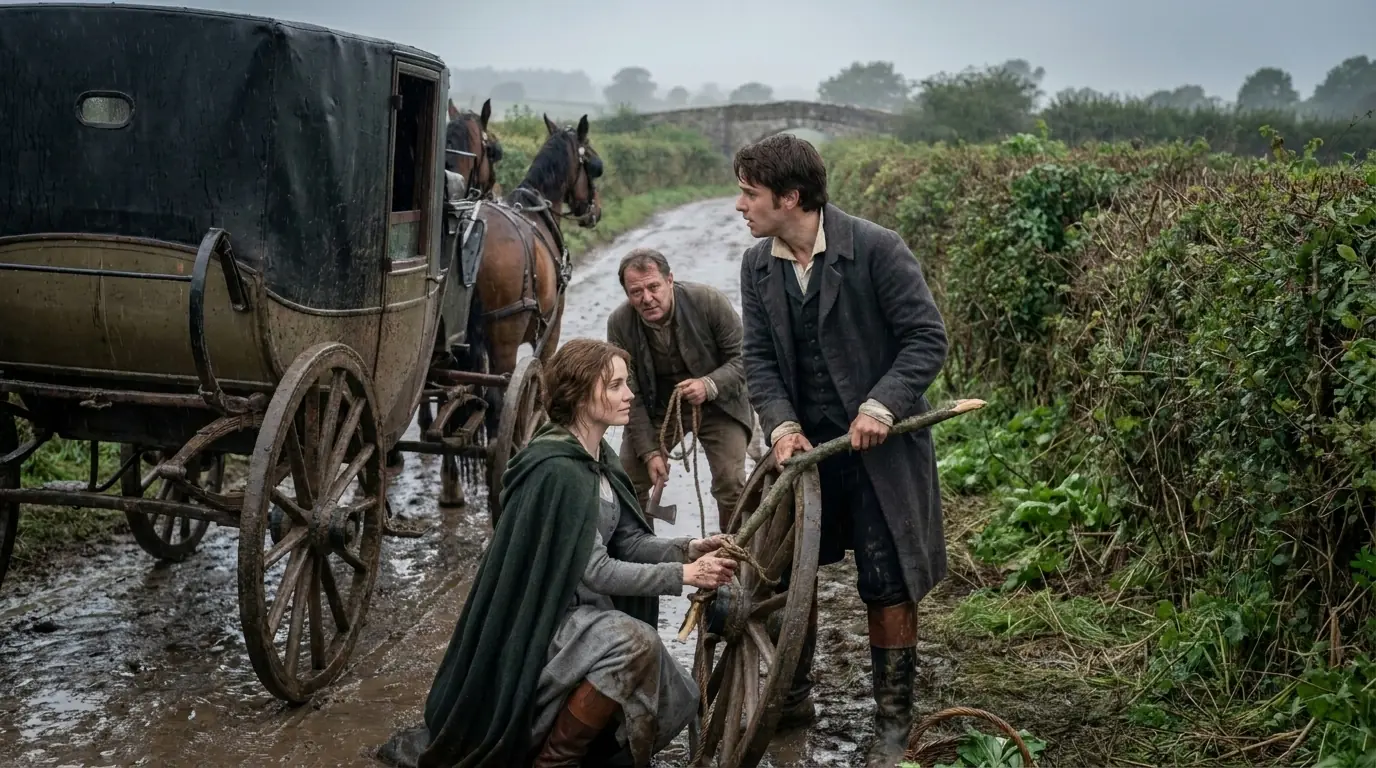
She had grown so accustomed to being spoken past rather than to that she sometimes wondered if she had become genuinely difficult to see, like a chair pushed into a corner of a room too long, its shape forgotten by everyone who passed it daily. A royal visitor was expected in the county. Not merely a lord, not merely a wealthy bachelor from London, come to shoot grouse on a neighboring estate, a prince, the younger son of a ruling house from beyond the western sea, said to be touring the great families of the kingdom on behalf of his father, quietly assessing which among them might be suitable for an alliance that mattered more than any single marriage. Nobody in the village had seen him.
Nobody could even agree on his name with certainty. Some said Cassian, some said Casemir, but everybody agreed that whichever family managed to charm him would rise beyond anything Hartfield Hollow had produced in three generations. And everybody agreed without needing to say it aloud that the family's hopes rested on Cassandra. Eleanor did not resent her sister for this. That was the strange private ache of it.
Cassandra was not cruel, only golden, the way some people simply are, without any particular effort, the way sunlight falls more warmly on one side of a garden than the other. It was her mother's hope that stung, so naked and specific, and the quiet way her father's eyes would pass over Eleanor at the breakfast table, as though counting the ways she failed to be useful to the family's fortunes. She was three years older than Cassandra, unmarried at four-and-twenty, and though nobody had ever said the word spinster to her face, she had learned to hear it in the pauses before sentences about her future. She turned from the window and walked the lane toward Widow Pell's cottage, the comfrey basket swinging against her skirts, glad of the cold air and the errand that gave her an excuse to be away from the house's mounting fever of preparation.
The sky had gone the color of a bruise by the time she reached the bend near Ashfield Bridge, and it was there, rounding the hedgerow, that she heard the first sound of trouble, a sharp crack, like a bone breaking, followed by a low, controlled voice, swearing under its breath, in a tone far too composed for the disaster it described. A carriage stood canted at a terrible angle in the mud. One wheel shattered clean through its spokes. The axle dug half a foot into the soft verge. Two horses stamped nervously in their traces.
A driver crouched beside the wreck, hands raked through his hair, muttering that they were a full three miles from the nearest smithy, and the light was already failing. And a man stood a little apart from the wreckage, coat dark with rain that had only just begun to fall, watching the wheel with an expression of controlled, almost scholarly frustration, as if it were a puzzle rather than a catastrophe. He was not dressed poorly, precisely. His coat was well cut, his boots good leather, but travel-worn enough, mud-spattered enough that Eleanor's first thought was that here was some gentleman's steward, or perhaps a younger son of modest means, caught unlucky on a bad road. Nothing in his bearing announced wealth.
Nothing in his face announced rank. What she noticed before anything else was that he was not shouting at his driver, not cursing the road or the county or his luck the way she had seen gentlemen of far lower consequence do over far smaller inconveniences. He simply stood very still, arms folded, jaw tight, thinking, "You'll want to keep the horses from bolting before you worry about the wheel," Eleanor said, setting down her basket at the edge of the lane. Both men turned. The driver looked at her the way men often looked at a woman appearing alone on a country road, some mixture of surprise and dismissal.
The stranger only studied her for a moment, his gaze quick, and assessing in a way that made her suddenly conscious of her plain wool cloak, her mud-hemmed skirts, her hair coming loose from its pins. "You have some experience with carriages, miss?" he asked. His voice was low, careful, faintly amused, though whether at her or at the situation, she could not tell. I have some experience with things that break, she said, which in my family's house happens with distressing regularity. She crossed to the horse's first, murmuring to the nearer one, running a steadying hand down its neck until its ears came forward and its stamping eased.
Have you rope in the boot and a hatchet or a good strong knife? The driver blinked at her as though she had addressed him in a foreign tongue. But the stranger after a beat of silence in which something unreadable crossed his face, said quietly, "Do as she says, Torvald." It took the better part of an hour in the thickening rain, with Eleanor directing and the driver fetching and the stranger, to her considerable surprise, rolling up his own sleeves, and lending his strength where it was wanted, without a word of complaint about his ruined coat. She showed them how to lash a section of fallen ash branch along the weakened rim to bind it, how to pack the crack with wet clay to swell it tight, how to walk the horses at the barest crawl so the makeshift repair might hold as far as the smithy in Hartfield Hollow.
It was not elegant. It was not the kind of thing a lady was meant to know, but it would get three strangers and two horses out of a ditch before nightfall, and that to Eleanor had always mattered more than elegance. "You've done this before," the stranger said, watching her tie off the final knot with quick, sure fingers. "My father's estate cannot always afford a groom who is sober past noon," Eleanor said before she could stop herself, and then flushed, appalled at her own tongue. She had spoken to him as she might speak to a stable boy or a passing tradesman freely without the careful varnish she was taught to apply to gentlemen of unknown consequence.
But something about his plain coat and his mud-streaked hands had made her forget to be careful. He did not look offended. If anything, something in his face eased as though he had been waiting the entire hour for her to say something honest. Then your father is fortunate to have you," he said. "Whatever the state of his grooms." "My father would tell you differently," Eleanor said before she could help it again.
And this time she did stop herself, biting back the rest of the sentence, embarrassed at how easily her private grievances came spilling out to a stranger on a muddy road. "Forgive me, I don't know why I said that. Because it was true," the stranger said simply, "and because I asked nothing that required you to guard it." He extended his hand, formal despite the mud on it, despite the rain running down the line of his jaw. "Cassian Gray, at your service, and considerably in your debt." “Eleanor Faircross,” she replied. She took his offered hand briefly, and found his grip warm and steady despite the cold.
“Of Faircross Grange, a mile past the church.” Something flickered behind his eyes at the name quick, gone before she could read it, and she thought perhaps he only recognized the family as one of the county's lesser gentry, unremarkable, except for the daughter everyone spoke of, the pretty one, not the practical one, kneeling in the mud with clay under her fingernails. "Faircross," he repeated, as though testing the shape of it. I believe I may have business in that direction before long. Then I hope your business brings finer weather than mine did," Eleanor said. And something in his answering half smile struck her as entirely unlike the smiles of the young men who occasionally called at her father's house to look past her toward her sister.
This smile seemed to be entirely for her. She helped them walk the crippled carriage the last stretch toward the smithy, refused Mr. Gray's earnest offer to see her home in what remained of his conveyance. She would rather walk in the rain than arrive at Faircross Grange in a stranger's carriage and invite a fresh storm of her mother's questions and turned back toward Widow Pell's cottage with her comfrey basket, half-convinced she had imagined the whole encounter, except that her hands still smelled of wet clay and ash bark, and something in her chest had not settled since the moment his eyes had held hers. A beat too long over the ruined wheel. She thought of him twice more before supper. An embarrassing indulgence, she told herself, for a man she would very likely never see again, a traveling gentleman of undetermined fortune, who had said quite plainly that his business might bring him toward Faircross Grange, though surely he had only meant it as a courtesy, the kind of thing strangers said to be kind.
She did not think of him a third time until two days later when her mother came into the morning room with a letter in her hand and an expression of such barely contained triumph that Eleanor knew before a word was spoken that something had shifted in the small careful architecture of their family's hopes. He has confirmed it, Mrs. Faircross said, pressing the letter to her chest as though it might otherwise escape her. Lord Renfield has written to say the prince will dine at Faircross Grange a week Thursday on his way through the county. Us, Eleanor, out of every house that might have hosted him, he has chosen ours. Her eyes were bright, wet, fixed somewhere past her daughters entirely on some private vision of the future.
Cassandra, my darling girl, you must have the blue silk let out at the waist. And Eleanor. The briefest pause, the barest reallocation of attention. Eleanor, you will see that the good china is unpacked and the west parlor properly aired. We cannot have his highness thinking us provincial. Eleanor said she would see to it because she always saw to such things and left the room before her mother could notice that her hands, folded neatly in her lap, had gone very still. His highness, a prince dining at Faircross Grange a week Thursday, and two days prior, on a rain-soaked lane near Asheford Bridge, a plainly dressed traveler with mud on his boots and clay under his fingernails, had told her quite gently that he expected his business to bring him in this very direction.
She told herself it was nothing. There must be a dozen gentlemen of the prince's retinue traveling ahead of him to arrange his lodgings and his engagements. Equerries, secretaries, men of business who might easily have been mistaken in bad light and worse weather for something humbler than they were. Cassian Gray was very likely no more than some minor official in the prince's household, sent to survey the roads and smooth the arrangements before his master's arrival, and she had simply been fortunate enough to be useful to him on a day when he badly needed it. She told herself this for six days and mostly believed it and spent those six days watching her mother transform the house around her with the single-minded fervor of a woman rebuilding a cathedral for one visiting saint.
New candles were ordered. The good silver was polished until it achd to look at. Cassandra's blue silk was let out, taken in, let out again, until the seamstress from the village threatened, not entirely jest, to charge by the hour rather than the garment. Eleanor, meanwhile, was set to inventorying linens and instructing the kitchen, and smoothing every small domestic crisis that arose in the household's fever. Tasks that kept her hands busy and her presence as always largely unremarked. On the seventh day, the Thursday itself, the house stood ready by 4 in the afternoon, gleaming and anxious, every candle trimmed, every chair angled precisely as her mother had directed.
Cassandra came down the stairs in the blue silk looking. Eleanor had to admit with an ache that was not quite envy and not quite anything else she had a name for. Genuinely lovely, golden-haired, brighteyed, the picture of everything a prince might be told to want. Eleanor herself wore the gray her mother had dismissed as governess-like, because it was the only gown she owned that did not need mending, and stood a little behind her sister in the receiving line, where she had learned to stand and waited. The carriages arrived at 5, three of them, liveried and grand, and Eleanor watched from the parlor window as footmen leapt down to open doors.
As a small retinue of officials and attendants began to arrange themselves in the drive with the fluid, practiced choreography of men who did this constantly, and then the door of the central carriage opened, and a man stepped down into the evening light, and Eleanor's breath left her body entirely. It was him, Cassian Gray, except that he was not Cassian Gray, or rather he was, but he was also, unmistakably, impossibly the prince himself, dressed now not in mud-spattered travel wool, but in dark, exquisitely tailored blue, a signet ring catching the last of the light on his hand, the very same hand that had helped her lash ash bark to a broken wheel six days before in the pouring rain. She heard her mother's soft gasp beside her, heard Cassandra's quick, delighted intake of breath, and understood, with a cold plunge of feeling she could not immediately name, that neither of them had the faintest idea what she now knew: the prince their family had spent a week preparing for, had already met her, had already heard her complain freely of her father's drunken groom, had already shaken her mud-streaked hand on a public road and called her, with a directness that now seemed almost cruel in hindsight, considerably in his debt.
He had known from the moment she'd given her name Faircross of Faircross Grange a mile past the church. He had known precisely who she was and what house he was bound for, and he had said nothing. The receiving line blurred past her in a haze of curtsies and careful phrases. Lord Renfield made the introductions with obvious relish at his own proximity to royalty. Mrs. Faircross curtsied so low Eleanor feared for her knees.
Cassandra's curtsy was a masterpiece of practiced grace, her smile radiant, her hand lingering a fraction too long as the prince bowed over it. And then his eyes found Eleanor's over her sister's bent golden head, and something passed between them that no one else in the room could have read. Recognition and something that might have been apology and something else beneath both that she refused in that crowded parlor to give a name to. Miss Faircross, he said when it came her turn, his voice pitched for courtesy, but his eyes holding hers with an intensity that made her pulse trip. "We are not strangers, I think." No, your highness, Eleanor said, and was proud afterward of how steady her own voice came out.
I believe we have met before. Though I confess I did not know at the time quite whom I was addressing. Nor did I intend that you should, he said, low enough that it did not carry beyond the two of them, which I hope in time you will allow me to explain. Her mother's eyes were darting between them now, sharp with sudden, uncomprehending suspicion, and Cassandra's smile had gone very slightly fixed at the edges. And Eleanor understood with the particular clarity of a woman who had spent her whole life being overlooked, that something in the shape of her family's evening, perhaps her family's future, had just been quietly and irrevocably altered, and that she had no idea yet whether it had been altered for better or for worse.
Dinner was, by every outward measure, a triumph. The prince. Eleanor found she could not yet make her mind call him Cassian, not in company, though the name sat strangely close to her tongue, praised the fish, admired the silver, complimented Mrs. Faircross on her hospitality with a warmth that made her mother glow like a struck match. He asked Cassandra questions about her accomplishments, her music, her opinions on the county's assemblies, and Cassandra answered each one with the easy brilliance she brought to everything, laughing at his small jokes, tilting her golden head at precisely the angle that caught the candlelight best. And yet Eleanor, seated further down the table in the position reserved for the less consequential daughter, noticed that his eyes returned to her with a frequency that had nothing to do with courtesy and everything to do with something else entirely.
Quick glances there and gone, as though he were checking that she was still real, still present, still the same woman who had knelt in the mud and told him the truth without knowing it mattered. Once, when Cassandra made a pretty practiced remark about how tiresome she found country roads, how she vastly preferred the smoothness of London's streets, Eleanor caught the prince's gaze flicking toward her with an expression so nearly amused, so nearly private, that she had to look down at her plate to keep her own face from betraying her. He had spent an hour in the mud of a country road because of her. He knew precisely how far from smooth those roads could be, and precisely who had gotten him out of the ditch they'd left him in.
After dinner, when the gentleman did not long linger over their port, the prince, it was noted with some surprise by Lord Renfield, seemed remarkably eager to rejoin the ladies. There was music in the drawing room and cards and the particular restless energy of a household still not quite believing its own good fortune. Eleanor busied herself pouring tea, refilling glasses, performing the small invisible labors that kept an evening running smoothly, and told herself she did not mind that no one asked her to play, that no one asked her opinion of anything at all. She had nearly convinced herself of this when she found the prince suddenly beside her at the tea table, having crossed the room with an ease that suggested he had simply willed himself there without anyone quite noticing the transit.
"You are angry with me," he said quietly, watching her hands as she poured. "I am not permitted to be angry with a prince," Eleanor said, keeping her voice light, keeping her eyes on the teapot. "It would be terribly bad manners. I would rather have your honesty than your manners, he said. You gave me the one freely on a public road before you knew who I was.
I find I have missed it rather badly in the six days since. She looked up at him then and found his face entirely without the practiced ease he had shown Cassandra across the dinner table. Instead, there was something almost unguarded there, something that looked absurdly like nervousness. "You let me believe you were nobody in particular," she said. "You let me speak of my father's failings, of my own place in my family, as though I was speaking to no one who mattered.
And all the while you knew you would be sitting at our table within the week, being told by my mother how very fine our house is, how very accomplished my sister is. I knew nothing of the sort, he said. Low and quick. I knew I was traveling toward Faircross Grange because my father's ministers had arranged it as one stop among a dozen such visits meant to survey the great families of this kingdom for an alliance neither you nor I have any say in. I did not know when I gave you my name on that road that the woman kneeling in the mud with clay on her hands was the very daughter of the house I was bound for.
I did not connect the two until you said the word Faircross yourself. And by then, forgive me, I did not know how to say so without ruining the one honest conversation I had enjoyed in a fortnight. Eleanor sat down the teapot, her hands not quite steady. You might have told me at the smithy. I might have, he agreed.
I was a coward not to. I did not want to watch your face change the way I imagine it changed tonight in that receiving line when you understood what I was. I wanted one more hour of being simply a man whose wheel you had fixed before I became a rank you were obliged to curtsy to. There was nothing practiced in the way he said it, nothing of the smooth diplomatic charm he had shown her sister at dinner. And Eleanor found her anger, which had been quite genuine a moment before, dissolving into something far more dangerous, a kind of aching sympathy she had no wish to feel for a man her family had spent a week preparing to offer quite openly to her sister.
Your highness, she said carefully, whatever passed between us on that road, I think you understand that my family believes you have come here for Cassandra. My mother has spoken of little else for a week. It would be a cruelty to her and to my sister both to suggest otherwise now over a shared secret about a broken wheel. I have come here, he said, because my father's ministers instructed me to survey the character of the great families of this kingdom and to report honestly on what I found. I intend to do precisely that.
His eyes held hers steady now entirely unguarded. I have found a family that dressed its prettiest daughter in silk, and forgot, I think, to mention its other daughter at all, except to send her to inventory linens and air out parlors. I find I am considerably more interested in the daughter they forgot to mention. Eleanor's breath caught somewhere in her chest, painful and sudden, and she was saved from having to answer, saved, or perhaps robbed of the chance. She could not afterward decide which, by her mother's voice, calling brightly across the room, summoning the prince to hear Cassandra play, and he bowed to Eleanor with a formality that did nothing to disguise the warmth still lingering in his eyes, and crossed the room to take his place beside the pianoforte, leaving Eleanor alone at the tea table, with her hands still faintly trembling, and a hope she had no business feeling beginning, treacherously, to unfurl in her chest.
She did not sleep well that night, turning the conversation over and over, examining it from every angle the way she might examine a broken wheel, searching for the crack that would tell her whether it could bear weight or whether it would shatter the moment she trusted it. A prince did not simply choose the overlooked sister over the beautiful one. Not in the stories she had grown up hearing, not in the world she had grown up watching. And yet his eyes had not lied to her. Not once, not across an entire dinner table full of reasons to look elsewhere.
The prince's visit, it emerged, the following morning, was not to be so brief as a single dinner. The prince's ministers had arranged a fortnight-long survey of the county's principal families, and Faircross Grange, having made so favorable an impression, was invited to host a series of smaller gatherings. A picnic in the orchard, an evening of cards, and a walk through the water meadows if the weather allowed were all arranged so that the prince might further acquaint himself with the family he was, in the delicate language of diplomacy, considering. Mrs. Faircross received this news with something approaching rapture. Cassandra, for her part, seemed genuinely pleased, genuinely hopeful, and Eleanor, watching her sister's bright, uncomplicated happiness, felt the first true stab of guilt she had experienced since the receiving line. Because whatever the prince had said to her at the tea table, however unguarded his eyes had been, Cassandra did not know that anything had passed between them at all, and Eleanor was not at all certain she had the right to let it continue.
She resolved that second morning to avoid him. It seemed the only honest course available to her, to remove herself as thoroughly as possible from whatever strange current had begun to run between them, to let the fortnight play out as her mother intended, with Cassandra at its warm and glowing center, and to return once the prince's carriages rolled away toward the next great house on his minister's list, to the quiet, useful, overlooked life she had always known. It proved considerably harder than she had anticipated. He found her in the orangery on the third day, where she had gone to escape the noise of the picnic being arranged in the garden beyond, ostensibly to check on the state of the potted lemon trees, her father was inordinately proud of, in truth to have five minutes in which no one required anything of her.
You have been avoiding me, he said without preamble, stepping between the rows of trees with the unhurried confidence of a man accustomed to going wherever he pleased. I have been attending to my duties, Eleanor said, examining a lemon leaf with far more interest than it deserved. "Your duties do not require you to leave a room the moment I enter it," he said, though not unkindly. "I have counted four times now. Three," Eleanor said before she could stop herself, and then flushed at having admitted to counting at all.
Something in his face eased into a smile that was, for the first time since the receiving line, entirely unguarded, entirely without the careful diplomacy he wore at dinner. Three, then will you tell me why? Eleanor set down the lemon leaf and turned to face him properly because she had never been a woman who found it easy to speak sideways, whatever her family's silences had taught her about the safety of being overlooked. "Because my sister believes you have come here for her," she said. "Because my mother has spent a fortnight's savings on silk and candles and good china in service of that belief.
Because whatever passed between us on a muddy road before either of us knew the other's name, I have no right to encourage it now, when it can only end in humiliating my own family or in some cruelty to Cassandra that she has done nothing to deserve. She took a breath. And because your highness, I find that I want to encourage it rather badly, and I do not entirely trust myself around a man I want that much. The silence that followed was long enough that Eleanor began to regret every word of it. Certain she had overstepped some line she did not fully understand the shape of.
Certain he would retreat now into the smooth diplomatic distance he showed the rest of her family. Instead, he crossed the remaining distance between them and took her hand, not with the formal courtesy of the receiving line, but simply, as one might take the hand of someone one had decided, quietly and completely, to trust. I have met perhaps 40 young women in the past fortnight alone, he said, daughters of every great house between here and the western coast. Each of them coached and dressed and presented to me like the finest piece in a shop window. Every one of them has told me precisely what she believes I wish to hear.
You are the only one who has ever told me what she actually thinks, and you did it before you had any reason to believe it would matter. His thumb moved once gently across her knuckles. I did not come to this county to fall in love, Miss Faircross. My father's ministers would be appalled to hear me say such a word aloud in connection with a diplomatic survey. But I find I have very little control over it and considerably less desire to fight it than duty would suggest I ought to have.
“Your Highness—”
“Cassian,” he said. “When we are alone, I would very much like to be Cassian to you, as I was on that road before any of this complicated it.” She did not answer him directly, could not, with her heart beating so hard she feared he might feel it through her hand. But she did not pull away either, and for a long moment they stood among the lemon trees in a silence that perhaps said more than either of them yet dared to say aloud. It could not last, of course. Nothing built on a secret ever does, and Eleanor had known this, even as she stood in the orangery with her hand in his, even as the fortnight unfolded with small stolen moments between the larger, more public performances of courtship her mother had orchestrated, a walk in the water meadows, where he fell deliberately behind the group to speak with her alone, a moment at the pianoforte, when Cassandra played, and he stood ostensibly at the instrument side, but angled his body so that his eyes could rest on Eleanor across the room, a note folded small and pressed into her hand as he took his leave one evening. It said, “You are the only true thing I have found in this county.” She burned it in her bedroom fire afterward, terrified of what discovery would mean and unable to make herself regret having read it first. There was also her aunt to contend with.
Aunt Prudence, her mother’s elder sister, had arrived at Faircross Grange the week the prince’s visit was confirmed, ostensibly to lend her support to the family’s grand occasion. Within a day, she had appointed herself the household’s sharpest observer of every small social currency that passed between its members. Aunt Prudence had never married herself, a fact she had spent 30 years transforming into a kind of bitter expertise, and she watched Cassandra's courtship with the prince the way a general studies a battle map, alert to every possible threat. It did not take her long to notice what Mrs. Faircross had noticed, and to voice it with considerably less restraint. “You would do well to keep your elder daughter farther from the drawing room,” Aunt Prudence said to Mrs. Faircross one afternoon, in a voice pitched, Eleanor suspected, quite deliberately to carry through the half-open door where she sat mending in the next room. “I have watched him these three days. He looks at her the way a man looks at a woman he has already decided upon, and it will do Cassandra no good at all to be made a spectacle of—second best in her own home, in front of half the county’s gossips. Send Eleanor to the dower cottage until the visit concludes, if you must. Better an empty chair at supper than a rival daughter seated in it.” Eleanor set down her needle, her hands gone cold, and did not trust herself to enter the room at all. She had grown accustomed over the years to being spoken past, but she had never before heard herself spoken of as a threat to be managed, removed like an inconvenient piece of furniture from a room she had every right to occupy. It was Cassandra in the end who answered their aunt, her voice sharper than Eleanor had ever heard it. "I will not have my own sister sent away like a servant caught stealing silver," Cassandra said.
“Whatever the prince chooses to look at, Aunt, it is not Eleanor’s doing, and I would rather lose every prospect in this kingdom than win one by exiling her from her own home.” Aunt Prudence did not raise the subject again in Eleanor's hearing, though Eleanor caught her watching, thereafter with the cold, assessing patience of a woman waiting for a better opportunity. An opportunity that arrived soon enough in the form of a whispered rumor Aunt Prudence carried to Lord Renfield's own sister at the fourth day's picnic. A rumor suggesting that the elder Faircross daughter had been seen walking alone with the prince on more than one occasion, unchaperoned, in a manner that could only invite scandal should it reach the wrong ears.
The rumor traveled, as rumors do, faster than any denial could follow it, and by the following morning, Eleanor found herself the subject of pointed, curious glances from half the ladies at church, their fans lifted just high enough to hide their whispering mouths. She did not learn until later from Cassandra that it had been her sister who first traced the rumor to its source and confronted their aunt directly, informing her in terms unusually blunt for so gentle a girl that she would write to their father in Bath herself, and expose the whole scheme if Aunt Prudence breathed one further word against Eleanor's reputation. Whatever effect this had, the rumor died as quickly as it had risen, though the memory of those lifted fans, those curious sideways glances, stayed with Eleanor rather longer than she cared to admit, a small, sharp reminder of how quickly the world could turn a woman's private hopes into public sport.
Her mother noticed before Cassandra did. Mrs. Faircross had spent four-and-twenty years learning to read the smallest currents of advantage in any room she entered, and it took her rather less than a week to notice that the prince's eyes, however dutifully they attended to Cassandra's conversation, kept drifting toward her elder daughter with a frequency that had nothing to do with politeness. She confronted Eleanor on the eighth day in the privacy of the linen room, her voice low and shaking with an anger Eleanor had rarely seen directed at her so nakedly. “I do not know what you imagine you are doing,” Mrs. Faircross said, “but I will not have you ruin your sister’s chance at a match that could secure this family’s future for three generations. Do you understand me? A prince does not marry the plain daughter who mends linens. He marries the beautiful one who plays the pianoforte and charms his ministers. Whatever fancy has gotten into your head, you will put it aside, and you will absent yourself from his company until this business is concluded. Or I will send you to your aunt in Bath until the wedding is arranged.” Eleanor stood very still, the linens forgotten in her hands, and felt something in her chest crack open that had been sealed shut since childhood, the old patient wound of being told over and over in a hundred small ways that her own happiness was a lesser consideration than her family's convenience.
“I have not sought his attention, Mother,” she said, and her voice, to her own surprise, did not shake. “I have avoided him at every opportunity you did not require me to attend. If his eyes have wandered from Cassandra, it is not because I invited it.”
“Then discourage it more forcefully,” her mother snapped. “You will wear the gray to every remaining engagement. You will speak only when spoken to. You will find some excuse to be absent from the water meadows, the picnics, and every occasion at which he might find you alone. Do you understand me, Eleanor? This is not a request.” Eleanor did not answer because she did not trust herself to answer honestly, and her mother, taking silence for compliance, swept from the room with the particular satisfaction of a woman who believed she had settled a difficult matter with efficient firmness.
She had not, of course, settled anything at all, only driven it deeper into the kind of quiet, aching resolve that does not announce itself, but does not disappear either. Eleanor spent the following two days doing precisely as her mother instructed, absenting herself from every gathering she was not strictly required to attend, wearing the gray, speaking only when spoken to, and watching with a private misery she told no one. As Cassandra's bright, hopeful smile grew a little wider each day, the prince's public attentions seemed to settle more comfortably upon her. She told herself this was right. She told herself her mother's logic was in its way unassailable, that her family's future ought not be sacrificed for one daughter's private happiness, that Cassandra had done nothing to deserve losing a match that might secure her whole life, that Eleanor herself had no true claim on a man she had known, in truth, for barely a fortnight, however much that fortnight had rearranged something essential inside her. She was nearly convinced, nearly settled into the familiar well-worn groove of self-effacement she had occupied her whole life when the crisis broke from an entirely unexpected direction.
It came as such things so often do in the form of a letter. Lord Renfield arrived at Faircross Grange on the eleventh day of the prince's visit in a state of some agitation requesting a private audience with Mrs. Faircross that lasted the better part of an hour and left her looking when she finally emerged pale in a way Eleanor had never seen. The household buzzed with speculation through supper, and it was not until the following morning, when Cassandra came to Eleanor's room with red-rimmed eyes and a letter clutched in her hand, that the truth emerged. The prince’s father, the king, whose ministers had arranged this entire survey of the kingdom's great families, had in the intervening weeks, concluded a separate arrangement entirely, a political betrothal between his son and the daughter of a neighboring royal house, whose alliance mattered more, in the cold calculus of statecraft, than any affection formed along the way.
The prince's fortnight of visits had been intended, it now transpired, as a courtesy tour, a chance for him to know the families of his father's kingdom before duty claimed him. Not as every hopeful mother in the county had assumed, a genuine search for a bride of his own choosing. “He is to be married,” Cassandra said, her voice thick with tears that Eleanor understood with a fresh stab of guilt were not for herself, but for the sister she had begun in recent days to suspect harbored feelings she had not dared examined too closely. “To some lady of the House of Ashenmore, arranged before he ever set foot in this county. Oh, Eleanor, I had begun to hope, and I feel such a fool for it.”
“But I think it was never truly hope for myself at all, was it? I have seen how he looks at you. I am not so blind as Mother believes.” Eleanor sat frozen on the edge of her bed, the letter’s contents settling over her like cold water: a political betrothal arranged before he ever came to Faircross Grange, before he had ever knelt in the mud beside a broken wheel and called her, with such quiet certainty, the only true thing he had found in the county. Had he known even then? Had every stolen moment in the orangery, every note pressed into her hand, been offered by a man who already understood he could not honor them?
“Cassandra,” she said carefully, “I never meant—”
“I know you did not mean it,” Cassandra said, and to Eleanor’s considerable surprise, reached out and took her hand. The gesture was so unexpectedly tender that Eleanor’s throat closed entirely. “I am not angry with you, Eleanor. I am angry that no one in this family has ever looked at you the way you deserve to be looked at until a prince did it by accident. And now even that is to be taken from you by some arrangement neither of you had any say in. It is not fair. I do not think I have ever seen anything less fair in my life.” Eleanor did not see the prince again that day, nor the next.
He sent no note, called at no hour, and the silence, after the warmth of the preceding fortnight, felt like its own particular cruelty, though she told herself, with the grim practicality that had carried her through every disappointment her family had ever handed her, that this was likely for the best. Whatever had grown between them in the orangery and the water meadows had been, in the end, exactly what her mother had warned her it would be: an unsustainable fancy, doomed from its very foundation by a betrothal arranged before either of them had ever spoken. Those three days without word from him were Eleanor thought afterward among the longest of her life. She busied herself with the household’s small returning rhythms: the linens, the accounts, the quiet, unglamorous labors that had always been hers to keep, and told herself, with each hour of silence that she had been foolish to hope at all that a prince's promises made on a public road were easily made, and just as easily set aside once the harder machinery of kingdoms and ministers began to turn against them.
She did not weep. She had trained herself long ago against the indulgence of tears over things she could not control. And she found to her own quiet surprise that she was not entirely undone even now, only tired, in the particular way that comes from holding one's heart very carefully open after a lifetime of learning to keep it shut. Cassandra sat with her each evening of that silence, saying little, simply present. And it was in those quiet hours that Eleanor came to understand something she had never quite let herself believe before.
That her sister's affection had never been diminished by their mother's favoritism, only crowded out of view by it. The way a smaller plant will grow perfectly well in a garden's shade, if no one troubles to notice it is thriving there at all. On the second evening, Cassandra took her hand and said, “Whatever comes of this, Eleanor, I want you to know that I have never once wished to be chosen instead of you. I only ever wished someone would finally choose you at all." It was, Eleanor thought, one of the kindest things anyone in her family had ever said to her, and she held it close through the remainder of that anxious, uncertain silence, a small, steady warmth against the cold uncertainty of not knowing whether a prince's fight against his own father's ministers could possibly be won.
It was on the third day of his silence that Eleanor, unable to bear the house’s stifling atmosphere of collapsed hope, walked out along the lane toward Ashfield Bridge—the same lane, the same bend in the hedgerow, where she had first knelt in the mud beside a stranger's broken wheel, and found him there again, standing alone beside the very spot, as though he too had been drawn back to the place where the truth of things had still felt simple. “I did not know about Ashenmore,” he said before she could speak, his voice rough in a way she had not heard from him before. “I swear to you, Eleanor, I did not know until Renfield’s letter arrived.” My father's ministers concluded the arrangement while I was traveling this county, believing, I imagine, that a survey of the kingdom's families was harmless enough occupation for a prince who had already been promised elsewhere, and not worth troubling me with until it suited them to inform me.
“It does not change the outcome,” Eleanor said, though her voice was not as steady as she wished it to be. “Whether you knew or not, the arrangement exists. You are to marry Lady Ashenmore. There is nothing left to discuss.”
“There is everything left to discuss,” he said, closing the distance between them with a suddenness that stole her breath. I have spent three days locked in correspondence with my father, Eleanor, arguing a case I never imagined I would need to argue. That a king’s son might be permitted some say in the shaping of his own life. That an alliance built on cold advantage is no true alliance at all, if it costs a man the one honest thing he has found in years of dutiful performance. I do not know yet whether I will win that argument.
My father is not an easy man to move. And the Ashenmore alliance carries weight I cannot simply wish away. But I could not let another day pass in silence, letting you believe I had abandoned this, abandoned you without a fight. “And if you do not win?” Eleanor asked, though she already dreaded the answer.
“If my father holds firm and I am bound to Lady Ashenmore regardless of what either of us wants, then I will have lost the argument,” he said.
"But I will not have lost my honesty, and I find, having spent a fortnight learning what it costs to hide behind a false name, that I am no longer willing to spend the rest of my life hiding behind a false marriage, either." He took her hands, both of them in his, heedless of who might see them on the open road. “I am not asking you to hope blindly, Eleanor. I am asking you to trust that I am fighting for this with everything I have, and that whatever the outcome, I would rather you know the truth of my heart than spend one more day believing I had simply walked away.” She wanted more than she had wanted almost anything in her four-and-twenty careful, overlooked years to believe him entirely without reservation without the old habitual bracing for disappointment that her family had trained into her since childhood.
And so standing on the same muddy lane where this had all begun, she allowed herself for the first time to hope out loud. “Then fight,” she said. “And whatever comes of it, know that I did not need a crown to want you. I wanted the man who rolled up his sleeves in the rain and did not once complain.” The fortnight's remainder passed in a strange suspended tension that the whole county seemed to sense without quite understanding its cause. Lord Renfield's household buzzed with rumor.
Mrs. Faircross, catching some new coldness in the prince's manner toward Cassandra, and some new warmth in his rare, careful glances toward Eleanor, grew increasingly anxious, though she said nothing more directly, perhaps sensing that the ground beneath her careful plans had shifted in ways she could no longer fully control. The prince's final dinner at Faircross Grange, before his retinue was due to depart for the capital, was arranged with all the ceremony the family could muster, a last desperate flourish of hospitality that Mrs. Faircross clearly hoped might yet tip some invisible scale in Cassandra's favor. Eleanor, dressing for the evening in her gray gown, as her mother had instructed weeks before, felt a curious calm settle over her, the particular stillness of a woman who has decided to stop bracing against disappointment, and simply meet whatever comes.
It was during the second course that a messenger arrived, travel-stained and urgent, requesting immediate audience with the prince. He excused himself from the table with a brief word to Lord Renfield, and the dinner continued in his absence with the strained artificial brightness of a household, pretending not to notice that something important was happening just beyond its walls. When he returned some twenty minutes later, his face gave nothing away, and Eleanor's stomach dropped with a dread so complete she could barely swallow her next bite. He resumed his seat, made polite conversation through the remainder of the course, and it was not until the table had been cleared, and the company had begun to rise for the drawing room that he spoke again.
His voice was pitched to carry to the whole gathered party. "Before we adjourn," he said, "I find I must share some news that concerns this house directly, and I would rather share it plainly than let rumor reach you in some distorted form." He paused, and Eleanor watched her mother's hands twist together in her lap, watched Cassandra's face go carefully, bravely composed. "My father has reconsidered the arrangement with the House of Ashenmore. Lady Ashenmore's own family, it transpires, had reservations of their own regarding the match—reservations that had nothing to do with anyone in this room, and everything to do with a prior attachment on the lady's own part, which she was, I understand, considerably relieved to have released from. My father, presented with this development and with certain arguments I have spent the better part of a week making to him at some length, has agreed that the alliance my house requires might be secured by other means and that I might be permitted for the first time in my adult life to choose a wife according to my own judgment rather than his minister's calculations.
The room had gone entirely silent. Mrs. Faircross had stopped breathing by the look of her. Cassandra's eyes had found Eleanor's across the table, and in them was something that looked astonishingly like triumph on her sister's behalf rather than grief for her own lost hopes. “I have spent a fortnight in this county,” the prince continued, “meeting daughters coached to please me, presented in silk and candlelight, each performing precisely what she believed a prince required.” I met quite by accident on a rain-soaked road three weeks ago a woman who did not know who I was who spoke to me with a plain unguarded honesty I have found nowhere else in a lifetime of careful courtly performance.
“She fixed a wheel I could not have fixed myself. She told me the truth about her family without softening it for my comfort. And in every meeting since, dressed in silk or in gray, celebrated by her mother, or set quietly aside in favor of her sister, she has remained without exception the only entirely honest person I have met in this kingdom's great houses. His eyes found Eleanor’s and held them, steady, certain, entirely unguarded before the whole assembled table. “Miss Eleanor Faircross, I do not offer you a crown because I imagine it will impress you.
I suspect it is nearly the least impressive thing about the offer I mean to make. I offer you a man who would rather kneel in the mud beside you for the rest of his life than sit on any throne without you beside it. Will you have me?” The silence that followed felt to Eleanor like the held breath before a wave breaks. Her mother frozen mid gasp.
Cassandra's hand pressed to her own mouth, Lord Renfield's eyebrows climbing toward his hairline, the whole room suspended in the particular electric stillness that precedes an answer no one present had quite dared to expect. Eleanor rose from her chair, her heart hammering so hard she felt certain the whole table must hear it, and crossed the room to where he stood, because whatever gray gown her mother had chosen for her, whatever corner of the family's hopes she had spent a lifetime occupying, she found that in this moment she did not want to answer him from across a table. She wanted to answer him standing close enough to see his face. “You once told me,” she said, low enough that it carried only to him and to the breathless room beyond, “that you had missed my honesty rather badly in the days since we met.
I will give you nothing less than that for the whole of our lives, your highness. Not silk performances, not practiced smiles, only the truth, however plain it comes. If that is a bargain you are prepared to make, then yes. Yes, I will have you.” What followed was not by any account later given in the drawing rooms and assembly halls of the county a scene of quiet dignity. Mrs. Faircross wept openly, and without any pretense of composure, Lord Renfield offered congratulations in a voice thick with astonishment.
Cassandra crossed the room and embraced her sister with a warmth that erased, in a single gesture, whatever quiet rivalry their mother’s favoritism had once threatened to plant between them, whispering into Eleanor’s ear that she was glad, truly and entirely glad, and that she had always rather thought her sister deserved to be chosen first, just once, for something that was not duty. The prince took Eleanor's hands before the whole assembled table, heedless of propriety, and pressed a kiss to her knuckles that lingered rather longer than courtesy strictly required, and said, for her ears alone, that he had known from the very first hour beside that broken wheel, that he had found something in her he could not afford to lose. He had simply needed the whole kingdom's machinery of duty and arrangement to catch up to what his own heart had settled the moment she knelt in the mud and told him without knowing who he was exactly what she thought.
They were married the following spring in the small stone chapel near Faircross Grange rather than the grand cathedral of the capital because Eleanor had asked for it, and because Cassian—the name he had first given her on a rain-soaked road, and the name she now used in every hour of every day—understood better than any minister or courtier ever could that the truest thing about their beginning had happened in mud, rain, and honest labor. It deserved to be honored in a place just as plain and just as real. Mrs. Faircross, in the years that followed, told the story of her daughter's courtship so often, and with such increasingly elaborate embellishment, that the county's younger generation grew up believing she had orchestrated the entire romance herself. A claim Eleanor never troubled to correct, understanding by then that her mother's pride, however belatedly earned, cost her nothing to indulge.
And Eleanor Faircross, who had spent four-and-twenty years believing herself the overlooked daughter, the useful one, the plain one, set quietly aside while the world's attention settled elsewhere, discovered in the decades that followed, that she had never once needed a crown to know her own worth. She had only needed one honest man, stranded on a muddy road, willing to see it. She kept for the rest of her life a small piece of ash bark from that first broken wheel, wrapped in linen in the bottom drawer of her writing desk, and told her own daughters, when they were old enough to ask why their mother treasured so plain and homely an object among her finer things, that it had taught her the only lesson about love that had ever truly mattered.
The truest measure of a person, she told them, is never found in silk, candlelight, or the careful performances the world teaches us to offer, but in what people do quietly and without an audience, when they believe no one of consequence is watching at all.