The rain had been falling since dawn, and by the time the sky turned the color of wet slate, the small village of Harrowbridge smelled of mud, woodsmoke, and the sour breath of the river. Marin Ashcombe stood at the edge of the wooden pier with her hood pulled low, her boots sinking slightly into the softened planks, and counted the coins in her pocket for the third time. There were only three: two small copper pieces and one silver coin that had once belonged to her mother. The silver coin had a bent edge where a nail had been driven through it long ago, and the mark had never gone away.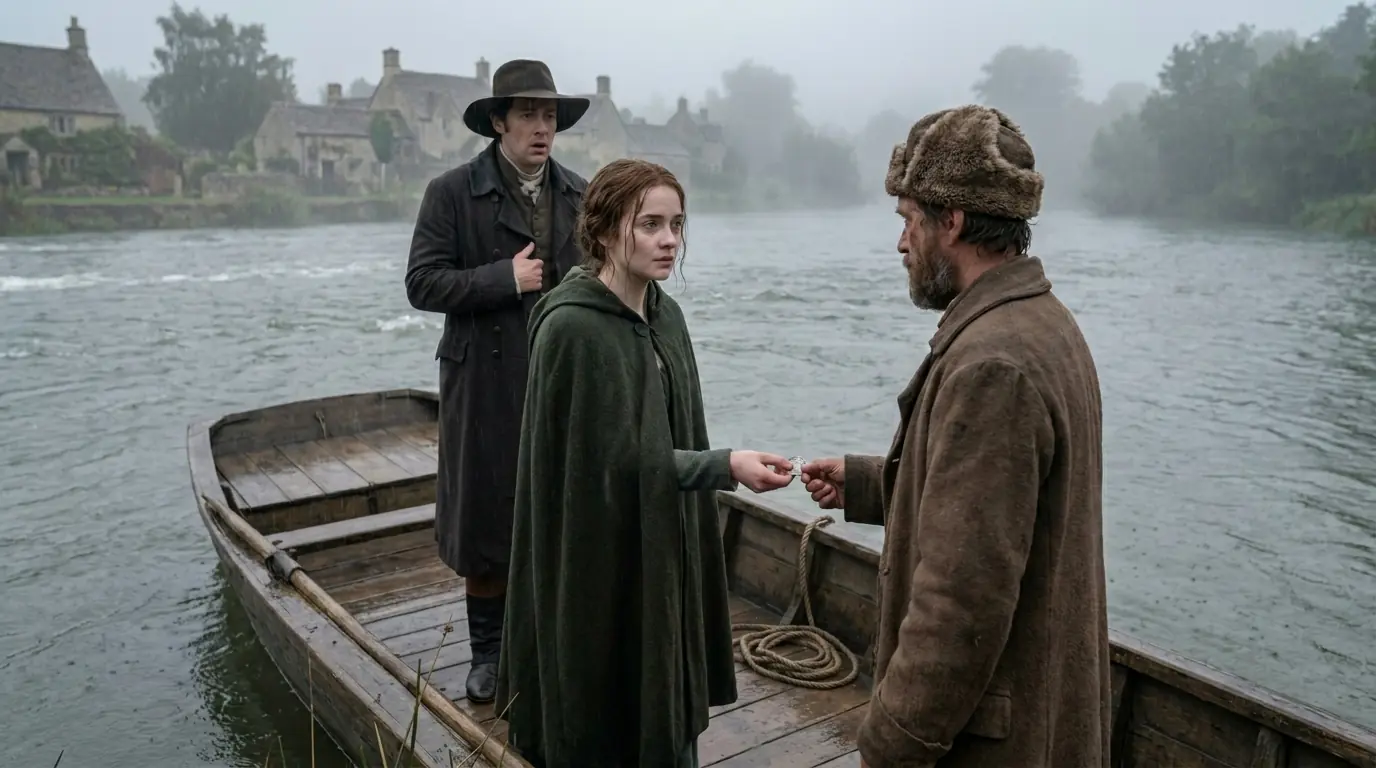
Marin rubbed her thumb across that bent edge the way another woman might rub a rosary. It steadied her. The ferry was late. It was always late, but today the delay felt heavier because the wind was sharp and her cloak was thin. She had walked six miles from the little cottage she rented at the edge of Ashcombe Moor, and she had come to Harrowbridge for one reason: to bring medicine back to old Mrs. Poole, who had taken ill in the night.
Marin was not a nurse, and she was not a doctor. She was a young woman with quick hands and a soft voice who had promised the old woman she would not let her die alone in a damp bed. So Marin had walked through the rain, bought the little brown bottle from the apothecary, and now stood waiting for the ferry that would carry her across the River Harrow to the moor road home. The smell of the river was strong there—cold water, rotting reeds, and the faint trace of tar the ferryman used to seal his boat.
Somewhere behind her, a horse snorted and shook its harness. The coins in Marin's pocket clinked together like small bells, and she pressed her hand flat against her side to quiet them. Three coins. That was all she had until the end of the week, when Mr. Bramfield, the miller, would pay her for the mending she had done for his wife. Three coins, and one of them was her mother's silver. She had already decided she would not spend it unless there was no other choice.
The bent edge beneath her thumb was a promise she had made to a woman ten years in the grave. Marin was still counting when she heard footsteps behind her. They were heavy but uneven, as though the man who made them was trying not to limp and mostly failing. She turned her head only slightly.
A traveler stood at the end of the pier with a cloak darkened by rain and a satchel over one shoulder that looked far too small to hold whatever a real journey required. His hat was pulled low, leaving half his face in shadow, but she could see that his jaw was hard and his mouth pressed into a thin line—the expression of a man who did not want to say what he was thinking. Water ran from the brim of his hat and dripped onto his coat in a steady rhythm.
"Is this the ferry to Ashcombe Moor?" he asked.
His voice was low and carried the tired sound of a man who had asked too many questions already that day.
"It is," Marin replied.
She did not look at him again. She had learned long ago that a young woman traveling alone did well not to hold the gaze of strange men on empty piers. He did not seem offended. He came a few steps closer and stood beside her, keeping a careful distance. For a moment they were only two shapes in wet cloaks, watching the gray river slide past the pier posts.
The wind pushed woodsmoke down from the village. A dog barked somewhere behind them in a high, complaining way. Farther off, the church bell began to toll the hour. One. Two. Three. Four. Marin felt the coins shift in her pocket as she moved her weight from one foot to the other.
"Have you been waiting long?" the traveler asked.
"Long enough. Not too long."
He nodded once, the kind of nod a man gives when he has run out of easy questions and has not yet worked up to the difficult ones.
The ferryman finally came around the bend, pulling his flat little boat through the slow brown water. He was a broad man with a red face and a fur cap so old that the fur had gone bald in three places. He fastened the boat to the pier, looked up at his passengers, and wore the expression of a man who had already decided that today was not a day for kindness.
"Sixpence each," he said. "Cash. No promises."
Marin felt the world tilt slightly. Sixpence. She turned away from the traveler so he would not see the color leave her face. She had two coppers—twopence—and the silver coin. If she remembered rightly, the silver was worth one shilling, twelve pence. Sixpence out of a shilling would leave another sixpence in change, enough to get home with something to spare.
It should have been easy. Yet her thumb returned to the bent edge. The metal was cold, and the cold seemed to travel up her arm and settle in her chest. Her mother had pressed that coin into her hand on the last morning of her life. She had not said, "Keep this." She had said, "This is the last thing I own that is only mine, and I want it to belong to you."
Marin had been eleven. She had understood then, and she had understood every day since, that the coin was not truly a coin. It was a small silver piece of her mother that she carried wherever she went.
She turned back toward the ferryman, preparing to ask whether he would take the two coppers now and let her pay the rest when Mr. Bramfield paid her on Friday. An older ferryman who had known her father had agreed to such an arrangement once, two years earlier. This man had not known her father. She could see it in the flat way he looked at her, as though she were a bundle of laundry he did not wish to carry.
Before she could speak, the traveler stepped forward. He reached into his coat and patted the inside pocket, then the outside, then the inside again. Slowly his face changed. He had looked tired before. Now he looked like a man who had discovered, in one small motion, that he was no longer the man he had been an hour ago.
"My purse," he said, then stopped because saying it twice would not bring it back.
Marin watched him. He was too still. A man who had never lost a purse before might have shouted, cursed, or searched the pier boards. This man stood with one hand inside his coat and stared at nothing. Whatever he felt was not merely about the missing purse, but about something the purse represented. The muscle at the corner of his jaw moved once. His fingers closed into a slow fist before his empty hand emerged.
"I appear to have been robbed," he told the ferryman. "Somewhere between the last coaching inn and this pier."
"Then I appear to have no room in my boat for you," the ferryman replied.
He did not smile. It was not a joke, only a fact reported as plainly as the weather.
"I can pay you tomorrow," the traveler said. "Twice the fare. Three times. I give you my word."
"Words don't row the boat, sir."
The traveler's shoulders shifted only slightly. He was not the sort of man who begged. Marin could see that as clearly as she could see the river. He would stand in the rain for the rest of the day before begging a ferryman for passage. She could already see him deciding to return to the village, to search for another way, a longer way that would cost him something he could not name.
She thought of Mrs. Poole alone on the moor in a damp bed and the little brown bottle Marin had promised to bring before nightfall. She thought of her mother's silver coin. She thought of the road home and the miles between here and there.
The arithmetic was simple. Sixpence for her passage and sixpence for his. Twelve pence. Exactly one shilling. Exactly her silver coin. Nothing left over. Nothing at all.
Her thumb moved across the bent edge once more. She stood very still while the rain fell against her hood, the church bell finished tolling, and the ferryman spat into the river. The traveler began to turn away. Later, Marin would think that her decision could not have taken more than two breaths, although in the moment it seemed much longer.
She reached into her pocket and drew out the silver coin. It lay flat on her palm, its bent edge catching the gray light and shining dully. She looked at it for one final heartbeat, then stepped forward.
"Two passages," she said to the ferryman. She placed the coin in his broad, wet palm. "For both of us. To Ashcombe Moor."
"Get in, then. Mind the middle plank. It's rotten."
Marin stepped into the boat without looking at the traveler. She feared that if she looked at him, she would feel foolish, and if she felt foolish, she might begin to feel sorry for herself. There was no room in her life for that. She sat on the narrow bench at the front, pressed her hands flat against her knees, and stared toward the far bank hidden in mist.
The traveler climbed in more slowly. The boat rocked beneath his weight as he settled opposite her. The ferryman pushed away from the pier, and water slapped softly against the wood. The river rose around them in scents of wet green things and cold mud, beneath that the faint sourness of tar, and beneath that the drifting woodsmoke from Harrowbridge.
For a long moment, neither passenger spoke. Marin watched the mist. The traveler watched her. She could feel his gaze as one feels a hand held near a candle—not touching, but warm.
"You paid my fare," he said at last, so quietly the ferryman could not hear.
"I paid our fare. It came out the same."
"With your last coin."
She turned her head enough to see him from the corner of her eye. "How would you know that?"
"You counted them three times while I was walking up the pier. The last time you took out only the silver. There was nothing else."
Heat rose into her face despite the rain. She had believed herself entirely alone on the pier. It had not occurred to her that the stranger might be watching.
"It was a shilling," she said, looking back toward the mist. "It bought two fares. That is what a shilling is for."
"That was not a shilling," he said. "That was something else."
She did not answer. He had seen too much for a stranger, and she did not yet know how to feel about it. She chose, for the moment, to feel nothing and file the matter away for later, as she had learned to do with so many other feelings.
The ferry moved into the current. Mist closed around the boat until there was no world beyond the small wooden vessel and the three people inside it. Somewhere above them, a curlew called, its cry long and lonely. Marin's chest tightened unexpectedly. She kept her hands flat on her knees.
"May I know your name?" the traveler asked.
"Marin. Marin Ashcombe."
"Ashcombe?" He said it slowly, as though the name carried a weight she did not know it had.
"Like the moor. My family gave the moor its name a long time ago, before we had nothing left to give it."
He went very still.
"And you?" she asked, unwilling to remain in the silence. "You have not told me your name."
"Callum," he said after a small pause. "Callum will do."
"Callum will do," she repeated, not quite asking. A faint smile touched her mouth, though she made sure he did not see it.
"You will be repaid," he said. "Every penny and more. I promise you."
"There is no need. It was a shilling. It was a ferry ride. It is done."
"There is every need."
Something in his voice made her look at him fully for the first time. His face was harder than she had expected, though not cruel—simply made of something that did not bend easily. His eyes were the color of storm water, rain caught in his dark lashes, and his mouth still held that thin, careful line. He was neither young nor old, but somewhere between, where a man has begun to understand what the world costs without yet making peace with the bill.
He looked at her like a man searching a page in a book. Marin lowered her eyes first. She was not shy. She simply did not wish to be looked at that way by a man whose name might not be Callum.
"You are not from Harrowbridge," she said.
"No."
"Where are you going?"
"Home." A brief silence followed. "I have been away a long time."
"How long?"
"Nine years. Ten in the spring."
Ten years was a long time to be away from anything. Marin wondered what he had gone away from, what he was coming back to, and whether they were the same thing. Then she stopped wondering because it was not her business.
The mist began to thin. The far bank came into view, a low green line dotted with dark gorse and the pale shape of the ferryman's shed. Beyond it, hidden by the rising land, lay the moor road and Mrs. Poole's cottage. Marin felt the brown bottle press against her hip and was glad she had bought it. She was glad she had not kept her silver.
"There," she said. "The moor road is beyond that shed."
"You are going home too?" Callum asked.
"Yes. Not far."
"Alone?"
"I have walked it many times."
He looked at her for a long moment. "I would walk with you, if you allowed it. It is not safe for a woman alone on a moor road at dusk."
"It is not dusk yet."
"It will be by the time we are halfway."
Marin considered him: the man whose name was probably not Callum, who had lost his purse, who spoke of home like a wound that had never closed properly. She considered the six miles of wet moor between the river and Mrs. Poole's cottage.
"You may walk with me as far as the crossroads," she said. "After that, my road goes one way and yours another."
"Fair."
The ferryman brought the boat against the far bank with a soft scrape of wood on gravel. He did not offer his hand to help either passenger. Marin lifted her skirts and stepped onto the muddy shore. Before the traveler had placed both feet on land, the ferryman was already pulling the boat back into the current.
The rain had softened to a thin drizzle. It whispered against their shoulders and the wet ferns beside the path. The smell of wet earth was strong here, the smell Marin associated with home. She had grown up with it and could not walk through it without feeling the tightness in her chest loosen.
They walked without speaking for a while. Callum kept pace easily, though she noticed the uneven weight in his step. She wondered whether the injury was recent or old but did not ask, and he did not offer.
"May I ask you something?" he said after they had passed the ferryman's shed and started up the low rise toward the moor.
"You may."
"Why did you do it?"
Marin thought about the silver edge, her mother's face, the smell of the river, and the way his hand had closed into a fist inside his coat. The truth was made of many things, and she did not know how to put all of them into words a stranger would understand.
"You needed the ferry," she said at last. "I had the coin. It seemed simple."
"That is not an answer."
"It is the answer I have."
He was quiet for several steps. The path narrowed, and he fell behind her. She heard his boots against the wet stones.
"You had one coin left," he said. "I have known men who would not give one coin to their brother."
"You are not my brother."
"Which is my point. I was a stranger. I still am. Yet you gave me the last thing in your pocket."
"It was not the last thing in my pocket."
"Ah," he said. "The medicine."
Marin stopped and turned. "How do you know about the medicine?"
He looked at her steadily while rain ran down his face in thin lines. His eyes in the gray light were even more the color of storm water.
"You touched your hip three times while we were crossing. Once when the ferryman was speaking, once when you sat down, and once when you looked at the far bank. It is not a purse, or you would carry it in the pocket where you kept the coins. It is not a knife, or you would not touch it so gently. It is glass, small, precious, and you are afraid of dropping it. So, medicine."
Marin stood very still. A lapwing called somewhere across the moor, high and sudden. For the first time since counting her coins, she felt she might be in the presence of someone who required care—not because he was dangerous, but because he saw too much.
"Who are you?" she asked quietly.
"A traveler whose purse was stolen, whose fare was paid by a kind woman, and who is trying to walk her home safely because it is the least he can do."
"That is not an answer."
"It is the answer I have."
This time she heard warmth in his voice and understood that he was returning her own words on purpose. She almost smiled, but not quite. Then she turned and began walking again.
The path climbed and flattened, and the moor spread out in every direction beneath the low sky, brown, gold, and gray, dotted with dark heather and pale bog cotton. The wind was stronger there. It smelled of peat, cold stone, and distant sheep. Marin pulled her hood tighter.
They reached the crossroads just as the light began to fail. The sign had lost its paint years earlier, but Marin knew every rut in every road leading away from it. North lay her cottage and Mrs. Poole's small farm. East ran the road that eventually met the great highway to the coast. West lay Ravencross, an estate that had stood empty for nearly ten years, its gates chained, windows shuttered, and long avenue of lime trees choked with weeds.
Marin stopped beside the sign and turned to Callum.
"This is where our roads part."
He looked at the sign, then toward the western road, then back at her.
"May I walk you to your door?"
"No," she said gently but plainly. "I said the crossroads. I meant the crossroads."
He accepted her answer without argument, and she liked him a little more for it, though she would not have admitted so.
"Then may I know where your door is, so I may find you again and repay you?"
"There is no need."
"There is every need."
"You have said that already."
"I will say it again if I must."
She almost smiled. "The cottage at the edge of the moor, half a mile beyond the standing stone. You cannot miss it if you look for it. But please do not look for it, sir. I do not need repaying."
"That," he said, "will be for me to decide."
Marin turned north and began walking. She did not look back until she had gone twenty paces. When she did, he remained at the crossroads watching her, one hand raised in a small, quiet salute. She raised her own hand in return without knowing why, then continued over the rise.
The western road did not lead only to Ravencross, but Ravencross was where it ended and where Callum—whose name was not Callum—was going. He remained at the crossroads after Marin vanished, thinking of the shilling in the ferryman's pocket, the brown bottle she had touched three times, and the bent silver edge she had held as though it might break.
Then he turned west and walked the long, weedy road toward the chained gates of the house that had belonged to him in law and in the eyes of every soul in the county for nine years, and would belong to him for the rest of his days.
His name was Alistair Rowan Ferncliffe, seventh Duke of Ravencross, and he had come home.
He did not go to the great house. Instead, he went to the gamekeeper's lodge at the edge of the estate, where an old man named Piers Hobbes lived alone with a lame dog and a memory that had not entirely failed him. Piers opened the lodge door to the hooded stranger, took one look at the storm-water eyes beneath the wet hat, and made a sound between a gasp and a sob.
He asked no questions. He put the traveler in the chair beside the fire, hung his wet cloak on the peg, and set a kettle over the flames. Only after all of this did he sit on a three-legged stool and speak in a voice thick with feeling.
"Your Grace."
"Piers," Alistair said wearily. "I do not want it known yet. I want to see the house, the village, all of it with my own eyes before anyone knows I am back."
"Aye, sir. Of course."
Alistair stared into the fire for a moment. "There is a woman. Marin Ashcombe. Do you know her?"
Piers's face softened. "Everyone on this moor knows her. Old Master Ashcombe's daughter. He was tenant of the West Field before he died. Poor man left her nothing but a cottage and debts. She has been mending, washing, and running errands to keep herself for six years, since she came of age. She looks after old Mrs. Poole, who has no one else. She looks after half the moor one way or another, though she would not thank me for saying so."
"She paid my ferry fare today with the last coin in her pocket."
Piers looked at him for a long moment, then smiled slowly—the kind of smile a man wears when unexpectedly given a small piece of good news.
"That is a very Marin thing to have done."
"Did she know who I was?"
"How could she? You have been away since she was thirteen. She would not remember your face. Your father, God rest him, never let her set foot on the grounds. He said the Ashcombes had grown small and there was no reason to know small people."
Alistair was quiet. The flames threw yellow light across the lodge walls. Peat smoke filled the room with its thick sweetness, and outside the wind moved over the moor with a low sound like breathing.
"Tomorrow I want the house opened," he said. "Quietly. Fires laid in three rooms only. No fuss. I do not want the village to know. Not yet."
"Aye, sir."
"And Piers, send someone to the cottage at the edge of the moor, half a mile beyond the standing stone. Mrs. Poole is ill. See that she has coal, broth, and a doctor if she needs one. Do not tell her who sent it. Do not tell Miss Ashcombe either. Say it came from the parish. Say anything but the truth."
Piers's old eyes grew wet, but he did not say what he was thinking. He only nodded.
"It will be done tonight."
"Good," Alistair said. "Good."
He sat beside the fire while Piers moved quietly around him, laying out bread, cold mutton, and ale. Neither spoke. Outside, rain tapped steadily against the lodge roof. Inside, a man who had been away nine years and would be gone ten in the spring stared into a fire he had not seen since boyhood. He thought of the bent edge of a silver coin, of the woman who had said, "It seemed simple," and of the way she had told him not to come to her door.
He was already going to come to her door. He simply had not decided how.
Marin reached Mrs. Poole's cottage just as the last light left the sky. She was cold to the bone, her hood heavy with water, and the little brown bottle in her pocket had grown warm from the heat of her body. She pushed open the door, and the smell of the sickroom came out to meet her: camphor, tallow, unwashed linen, and the faint sourness of illness. Marin entered without hesitation. Such smells did not frighten her. She had grown up with worse.
Mrs. Poole lay small beneath a great heap of blankets. Her face was pale, and the hair that had once been red was now the color of wet ashes. Her eyes opened when Marin approached, and her cracked lips shaped something close to a smile.
"You went," she whispered. "You mad girl. You went in the rain."
"I said I would. Now be quiet and let me get this into you before you talk yourself into another fit."
Marin set the bottle beside the candle, measured the medicine carefully, and supported the old woman's head while she drank. Mrs. Poole tried to protest.
"I have no money to pay you, love."
"Then it is a good thing I did not ask for any."
Marin wiped the old woman's mouth with a clean cloth, settled her against the pillow, added peat to the fire, and made thin broth from the last leeks and a knuckle of bone. She did not sit until every task was done. Only then did she pull a stool near the hearth and hold her cold hands toward the flames.
"You'll catch your death sitting in wet clothes," Mrs. Poole murmured.
"I've caught worse."
The old woman was quiet for a moment. "Marin?"
"Yes?"
"How did you pay for the medicine?"
Marin spread her fingers toward the fire and watched the light catch the pale hairs at her wrist.
"I had enough."
"Marin."
"I had enough, Mrs. Poole."
The old woman studied her, then closed her eyes. A tear slipped from beneath her lashes.
"You gave the coin," she said. "Your mother's coin."
Marin did not answer. She stared at the fire and wondered how everyone on the moor seemed to know about that coin. She had never imagined giving it away, yet when the moment came, she had hesitated only two breaths. She thought of the traveler whose name was probably not Callum, of his hand closing inside his coat, of the way he had said, "That was not a shilling," and of the way he had watched until she disappeared over the rise.
She did not think she would ever see him again. She did not think it mattered whether she did. She was wrong about both things.
By morning the rain had stopped, and thin sunlight struggled through the clouds. Marin woke on the stool with a stiff neck and a headache. Mrs. Poole still breathed steadily, which was more than Marin had dared hope. She washed her face in cold water, ate a piece of yesterday's bread, and stepped outside to bring in more peat.
A basket stood on the doorstep.
It was large and covered with a clean square of linen. Marin stared before lifting the cloth. Beneath it lay a fresh loaf of bread, still faintly warm, a wedge of yellow cheese, a pat of butter wrapped in a leaf, a jar of honey, a small crock of clear broth tied with string, paper twists of tea and sugar, and another paper twist containing dark beef tea.
At the bottom was a small linen bag. It clinked when she lifted it. Inside were copper and silver coins that added, when she counted them carefully three times, to exactly one shilling.
There was no note.
Marin stood on the step in the pale sun and looked up and down the moor road. No one was visible. There were boot prints near the cottage, but nothing clear enough to tell her more than that the visitor had worn old boots. She carried the basket inside.
She told Mrs. Poole about the broth, bread, butter, and honey, but not the shilling. She fed the old woman a cup of broth and watched color return faintly to her face. Mrs. Poole asked no questions about where the food had come from, and Marin was grateful.
Later, while the old woman slept, Marin stood by the small window and looked across the moor. Her fingers closed around the linen bag in her pocket. It weighed almost exactly what her mother's coin had weighed, yet it was not the same weight. Nothing would ever carry that same weight again. Marin had made peace with the loss on the pier, but the bag was still a kindness, and she could not deny that it moved her.
She wondered who had left it. She had a suspicion and did not know what to do with it.
In the days that followed, other small things happened. A cartload of good dry coal arrived at Mrs. Poole's cottage, delivered by a boy who said the parish had sent it and ran before Marin could question him. A new pane of glass appeared in the kitchen window, replacing one that had been cracked for two winters. The glazier claimed Mr. Bramfield had ordered it.
When Marin went to thank the miller, he denied all knowledge, then turned pink around the ears and suddenly found it necessary to inspect a flour sack at the far side of the yard. Marin stood in the mill yard and looked at his back for a long time.
She thought of the shilling, the coal, the new glass, and the traveler saying at the crossroads, "That will be for me to decide." She walked home slowly while the wind moved across the heather and gorse blossom sharpened the air with its sweet, coconut scent. Somewhere far off, a shepherd whistled to his dog. Marin kept one hand in her pocket, her thumb resting against the linen bag, and frowned.
She did not return to the crossroads. She had told him not to come to her door and meant it. She would not walk out to meet him halfway either. Yet she could not stop thinking of him, and that troubled her more than the gifts did.
He came to her door on the ninth day.
Marin had known all through the previous evening that he would come, though she could not have explained how. When she woke, the moor was very still, the sky pale, and the air held the expectant quality that comes before something changes. She spent the morning mending a torn petticoat for the miller's wife, glancing at the door until her fingers became clumsy with waiting.
He knocked at three in the afternoon. Two short raps, polite and not loud.
Marin set down her needle, smoothed her apron, and opened the door. He stood on the step in a dry coat, a clean hat, and boots that were not new but had been freshly polished. In his gloved hand he held the linen bag of coins. His face had been made calm on purpose. She could see the effort around his mouth.
"Miss Ashcombe."
"Sir."
She did not invite him in.
"May I speak with you?"
"You are speaking with me."
"May I come in?"
"No. You may say what you came to say on the step. It is a fine day."
He did not argue and seemed not to hold the refusal against her.
"You returned the shilling," she said. "I do not know whether you meant me to notice."
"I meant you to notice. I did not mean you to be angry."
"I am not angry."
"You are not pleased either."
Marin looked at him steadily. In daylight his eyes were less like storm water and more like a riverbed. His mouth remained a thin, careful line, but a small softness rested at the corners.
"I would like the truth," she said. "That is what displeases me. Not the shilling, the coal, or the window. I want to know who has been leaving things at my door and why, and I want him to have the manners to say it to my face."
His shoulders eased, a movement so slight most people would have missed it.
"That is fair," he said. "More than fair. My name is Alistair Rowan Ferncliffe. I am the seventh Duke of Ravencross. I have been away from this estate for nine years and returned a fortnight ago. I did not intend to be recognized before I was ready. My purse was stolen during the final stage of my journey. You paid my ferry fare, and I have been trying since that day to repay you in ways that would not embarrass you."
He said it levelly, without lifting his chin or arranging his shoulders, without any of the gestures of a man expecting admiration. He placed the truth before her like a set of cards and waited.
Marin stood with one hand on the latch. For a long moment, she could think of nothing. The world had gone still for reasons that had nothing to do with the moor. A duke stood on her doorstep. She had bought him a ferry ticket with her mother's silver coin, ordered him to walk only as far as the crossroads, and told him not to come to her door.
She looked at him, then at his boots, then at his face again.
"Your Grace," she said very quietly.
"Please. Not that. Not from you."
"That is what you are."
"It is. But it was not what I was on the pier, and it is not what I would like to be when I speak with you."
Marin stepped back—not to invite him in, but to give herself more room to think. Her heart was beating too quickly. She wanted to be the woman she had been at the crossroads: plain, steady, and unimpressed. Yet she had used her mother's coin to buy passage for a duke and did not know whether she ought to feel foolish.
"You lied to me."
"I did not tell you the whole truth."
"That is a lie."
After a pause, he nodded. "It is. Yes. I am sorry."
"Why?"
"Because I did not want to be recognized before I had seen the estate with my own eyes. Because I have been lied to for nine years by people who wanted things from me. Because I wanted, for one day, to walk this land as an ordinary man and see what an ordinary man saw."
"And what did the ordinary man see?"
She intended the question to sound light, but it did not.
Alistair looked at her without blinking. "He saw a woman on a pier with three coins in her pocket, and he saw her give the last of them to a stranger who had done nothing to deserve it."
"You did not do nothing. You had lost your purse. Anyone would have helped."
"No," he said. "They would not. I have stood on many piers in nine years, Miss Ashcombe. I have watched a great many people. I know what most would have done."
She looked away toward the moor. A lark rose over the heather, climbing into the pale sky while its thin, clear song made her chest ache.
"Why did you come today?" she asked.
"To tell you the truth and to return your shilling in a way that could not be denied. If I leave a linen bag on your step, you can leave it or return it, and I will not know what to do. If I place it in your hand, in daylight, at your own door, you must accept or refuse it in front of me. That is fairer."
"Fair," she repeated, almost smiling.
"If you refuse it, I will put it in my pocket and walk back to Ravencross. I will find another way to repay you that does not offend you. I would prefer not to find another way. I would prefer you took the shilling. But I will not put it into your hand against your will."
Marin studied the linen bag. Through the fabric she could see the small hard shapes of the coins. Twelve pence. Exactly what she had paid, and no more.
"Where is the silver coin?" she asked. "The one I actually gave the ferryman."
Alistair was silent for a moment. Then he reached into his coat and opened his gloved hand.
Her mother's coin lay on his palm.
The bent edge caught the pale sun. Marin would have known it anywhere.
"The ferryman tried to spend it in the tavern at Harrowbridge," Alistair explained. "The tavern keeper is a friend of my gamekeeper, and my gamekeeper is a friend of mine. I bought it from the tavern keeper. He was, I believe, cheated in the transaction. It is worth considerably more than one shilling."
Marin stared at the coin, his hand, and then his face.
"How did you know I would want it back?"
"I did not know. I knew only that if you did want it, obtaining it should not be difficult for you. So I made it not difficult."
The moor grew very quiet. The lark stopped singing. Behind the cottage, a hen made a small sleepy sound and settled again.
Marin looked at the coin in his palm and felt something long closed inside her chest begin, very slowly, to open. She reached out and took it. Her fingers brushed his glove, and she felt the warmth of his hand through the leather. One clear thought moved through her mind.
Oh.
She closed her fingers around the coin and pressed her thumb to the bent edge. The silver was warm from resting near his chest.
"Thank you," she said. Her voice was not steady, and she did not care.
"Miss Ashcombe?"
"Yes?"
"May I come in now?"
She looked up while still holding the coin. She thought of the basket, the coal, the pane of glass, the beef tea, and the man at the crossroads raising one hand in quiet salute. She thought of how she had known he would come.
"You may sit at the kitchen table," she said. "I will make tea. I cannot offer sugar because I have none, and please do not send any tomorrow. I do not want a great quantity of sugar in this house."
"Yes, Miss Ashcombe."
"In this house you will not be called Your Grace. You will be called sir. That is all I can manage today."
"Yes, Miss Ashcombe."
"And you will not sit long. Mrs. Poole is asleep in the next room, and I do not wish her to wake and discover a strange man at her table."
"Yes, Miss Ashcombe."
She led him into the kitchen. He ducked beneath the low beam without being warned and sat at the scrubbed table with his hat in his lap. Marin hung the kettle over the fire and reached two cups from the shelf, feeling his gaze on her back. She placed her mother's coin on the table between them. It felt right. He looked at it but did not touch it or comment, and she liked him more for that.
"How is Mrs. Poole?" he asked.
"Better. The medicine helped. The broth helped. The coal helped."
"Good."
"I know it was you. The coal, broth, window—all of it."
"I thought you might."
"You should not have done it."
"I know."
"Then why did you?"
He remained quiet long enough for the chair to creak beneath him.
"Because you gave a stranger the last coin in your pocket. Because when I asked why, you said I needed the ferry and you had the coin, and that it seemed simple. Because in nine years I have not heard anyone say anything so simple and mean it. Because you look after an old woman who has no one else, walk six miles in the rain for medicine, and carry a bent silver coin as though it were your whole heart. And because I have money, coal, and a glazier who will do as he is told. A man who cannot spend some of what he has on the woman who paid his ferry fare is not much of a man."
Marin stood motionless beside the fire. Heat rose into her face, and she was grateful he could not see it. The kettle began to sing.
"That is a great deal to say," she murmured.
"You asked."
"I did not ask all of that."
"You asked why. That was all of the why."
She lifted the kettle, poured water into the brown teapot, and occupied her hands until she was ready to face him. When she finally sat opposite, she was more or less in command of herself.
"There is one more thing," he said.
"Sir?"
"I would like to see you again."
She had known he would say it, perhaps from the moment he crossed the threshold, perhaps from the crossroads. She had been preparing an answer during her sewing without admitting it.
She poured his tea first and hers second, placed the pot between them, and rested her hands on either side of her cup.
"You are the seventh Duke of Ravencross," she said. "I am a tenant's daughter. I have no dowry, no name anyone remembers, a cottage that is not mine, and an old woman in the next room who depends on me. If you mean to see me as a duke sees a woman like me, then no, sir. You may not. I have my pride, and I will keep it."
"That is not what I am asking."
"Then what are you asking?"
"To see you again as a man sees the woman who gave him a ferry ticket. Nothing more and nothing less. If, over time, we come to something else, then we will come to it honestly and in daylight, and everyone in the county may know. But I will not come at you crooked, Miss Ashcombe. Not now. Not ever. I did that once, and I do not intend to do it again."
Marin looked down at her tea. Steam warmed her face. Beyond the window, a wren sang in the gorse. Mrs. Poole breathed slowly in the next room, the fire ticked softly, and Marin heard her own heart settling, though it still moved faster than it should.
"You may call on me Sunday afternoon," she said, meeting his eyes. "In daylight, at the front door, where the neighbors—such as they are—may see you."
"Yes, Miss Ashcombe."
"You will bring nothing. No baskets, coins, or panes of glass."
"Yes, Miss Ashcombe."
"And from this day forward, you will hide nothing from me. Not who you are, what you are doing, or why. If you cannot be plain with me, you should not come at all."
A small light appeared behind his eyes, and the careful line around his mouth softened into something almost like a smile.
"Yes, Miss Ashcombe."
They drank their tea and spoke of ordinary things: the miller, the shepherd whose whistle Marin had heard, the condition of the moor road. She answered plainly, he listened plainly, and neither tried to make the conversation more than it was.
When the cups were empty, Alistair stood, put on his hat, and thanked her. At the door he paused.
"Sunday."
"Sunday."
He touched the brim of his hat and walked down the path toward the moor road. Marin watched until he became a dark shape against the pale sky, passed over the rise, and disappeared.
She remained in the doorway, turning her mother's coin slowly between her fingers. It had not been simple, no matter what she had told him. It had cost her the last thing she owned that was truly hers. Yet in a way she could never have imagined on the pier, he had returned it. He had given her something else as well, something she could not yet name but suspected she would understand in time.
Alistair did not come only on Sunday. In the weeks that followed, he came in many small and open ways. The county saw him, the county talked, and Marin discovered that she minded the talk less than she had expected.
He did not appear with grand gifts or send flowers. Once he sent sound firewood to Mrs. Poole's cottage, but he did not pretend it came from the parish. Mrs. Poole thanked him directly, and he accepted her gratitude without fuss. He walked with Marin along the moor road on Sundays and sat at her kitchen table on Wednesdays. He drank tea without bringing sugar. He asked questions, waited for answers, and never tried to fill her silences.
Sometimes they walked for half an hour without speaking. Wind moved off the moor carrying the scents of gorse, peat, and cold stone while lapwings called overhead. Neither felt compelled to say anything. In those silences, Marin realized she had never stood beside another person and felt both so quiet and so unafraid.
One summer afternoon they followed the beck below the standing stone. The water ran low and clear over pebbles, small brown trout holding in the pools. Sun warmed their shoulders. Marin carried a basket of meadowsweet gathered for Mrs. Poole's pillow because the old woman liked its fragrance.
"Alistair," she said. She had begun calling him by his name when they were alone, and he had never corrected her. "May I ask you something?"
"Anything."
"Why did you go away for nine years? Ten in the spring."
He did not answer at once. They walked several steps while sunlight caught the edge of his jaw. By then Marin had learned to read the small movements around his mouth and knew he was choosing words carefully.
"My father was a hard man," he said. "He and I quarreled. It was a bad quarrel. I said things I should not have said, and he said things he should not have said. I left for the Continent and told myself I would not return until he was dead. He died four years later. I did not come back then. I told myself I would not return until I could look at the house without feeling ashamed of the boy who had left it. That took another five years."
He paused, looking toward the water.
"I am not certain even now that I can look at the house without shame. But I came back anyway. That will have to do."
Marin imagined the great grim house at Ravencross, seen once from a distance when she was a child. She imagined a boy walking out through its gates in anger and a man returning through them in the rain with an empty purse.
"You do not have to be ashamed forever," she said. "In fact, you do not have to be ashamed at all. He is gone. You are here. The house is only stones, beams, and windows. It does not remember what you said to your father."
Alistair looked at her with an expression she had not seen before. Marin turned away to spare him embarrassment.
"You are very like your mother," he said after a moment. "Piers Hobbes told me about her. He said she was the only person in the county who could argue with my father without making him angry."
"She was stubborn."
"So are you."
"I know."
They walked on while the beck murmured beside them and a blue dragonfly hovered over the water.
After a long silence, Marin spoke again. "Alistair?"
"Yes?"
"I would like to see the house."
He stopped. Something in his eyes went very still.
"Are you sure?"
"Yes. Not to be shown around like a visitor, and not to imagine being a duchess. I want to see it because you are ashamed of it, and I do not think you should be. I would like to be with you the first time you look at it properly."
For a long moment, Alistair said nothing. Then he held out his hand. Marin took it. They walked back along the beck toward the moor road without speaking, their fingers laced together. For the first time in her life, Marin felt her hand fit inside another hand the way a key fits its lock.
They reached Ravencross in the late afternoon. The gates stood open now, the drive cleared of weeds, and the lime trees cast soft green shade across the gravel. The house at the end of the avenue was tall, gray, and stern, with rows of windows staring across the park like the eyes of an old man who had seen too much. Marin understood why a boy might have fled it and why the man he became might fear returning.
They entered through a side door because Alistair did not want the servants making a ceremony of their arrival. The hall smelled of beeswax, old wood, and faint peat smoke from the fires laid in only three rooms. Their footsteps echoed over the flagstones.
Marin stood beneath the high ceiling and looked up. The ceiling seemed to look back, but she was not afraid.
"It is a house," she said.
"It is a house," he agreed.
Alistair showed her the rooms he could bear to enter and did not show her those he could not. Marin did not press him. At last they came to a small parlor at the back overlooking a walled garden gone to seed. The room was dim and dusty, with a small piano against one wall, shelves full of books, and two chairs drawn up to a cold hearth.
"This was my mother's room," he said. His voice had become very quiet.
"It is a good room."
"She died here."
"I am sorry."
He remained in the doorway, the muscle at the corner of his jaw moving once as it had on the pier. Marin stepped into the room, crossed to the window, and opened the shutter. Late sunlight entered and formed a bright square on the dusty floor.
"It needs a fire," she said. "It needs the shutter open, and it needs someone to sit in one of those chairs and read a book. That is all."
Alistair came slowly across the room and stopped beside her. Together they stood in the sunlight and looked at the neglected garden. The smells of dust, beeswax, and the meadowsweet in Marin's basket mingled in the air.
"Marin."
"Yes?"
"I did not come back for the house's sake. I came because I could not go on being ashamed of it. But I do not know how to live here. Not alone."
"Then do not live here alone."
He turned toward her, his face utterly still.
Marin drew a careful breath. "I have nothing to offer you except my mother's silver coin and a stubborn habit of walking six miles through rain when I have given my word. I am not what a duchess is meant to be. I would embarrass you at every dinner, say the wrong thing to the wrong people, and be, at best, an odd choice."
"You would be the choice I made."
She looked up at him. Sunlight rested across his face, revealing the softness at the corners of his mouth, the storm-water color of his eyes, and the thin white scar along his jaw that she had first noticed a fortnight earlier and had not yet asked about.
She thought of the pier, the three coins, and his empty hand inside his coat. She remembered him saying, "That was not a shilling," and obeying when she allowed him to walk only to the crossroads. She remembered his appearance at her door in daylight and the plain words, "My name is Alistair Ferncliffe."
She thought of her mother, ten years in the grave, pressing that bent coin into the hand of an eleven-year-old girl and saying, "This is the last thing I own that is only mine." She thought of how silver might be spent and still return, and how returning was not the same as never leaving. The difference between those two things seemed to contain the whole shape of her life.
"Yes," she said very quietly. "All right. Yes."
He did not kiss her. Instead, he lifted the hand that was not holding the basket and pressed his lips to the backs of her fingers. He held them there for a long moment. Marin felt his breath and the warmth of his mouth against her skin and closed her eyes. Outside in the walled garden, a blackbird began to sing.
"On Sunday," he said when he lifted his head. His voice was not entirely steady, and she loved him for it. "At the front door, where the neighbors—such as they are—may see us."
"On Sunday," she agreed.
They remained in the sunlight for a while without speaking. Then Marin took his hand and led him down the long corridor, through the side door, and beneath the lime trees. Together they followed the moor road toward the cottage where an old woman slept, a fire needed feeding, and a life waited to be lived.
At the crossroads, beside the sign whose paint had faded years ago, Marin stopped. She drew her mother's silver coin from her pocket and laid it on her palm. The bent edge caught the low light. She studied it for a long moment before closing her fingers and returning it to her pocket. Her thumb rested once more against the familiar bend.
The coin was warm.
"Come home, Alistair," she said quietly.
And he did.