The sky over Briarholt had forgotten how to be blue. For three days the clouds had hung low and the color of wet slate, pressing the grasslands flat, turning every sound soft and far. Mara walked the pasture with Elias wrapped against her chest in a beige blanket her mother had woven for a different child, years ago, before fever took that first hope and left her with a quiet house and a quieter husband who no longer came home from the timber camps.
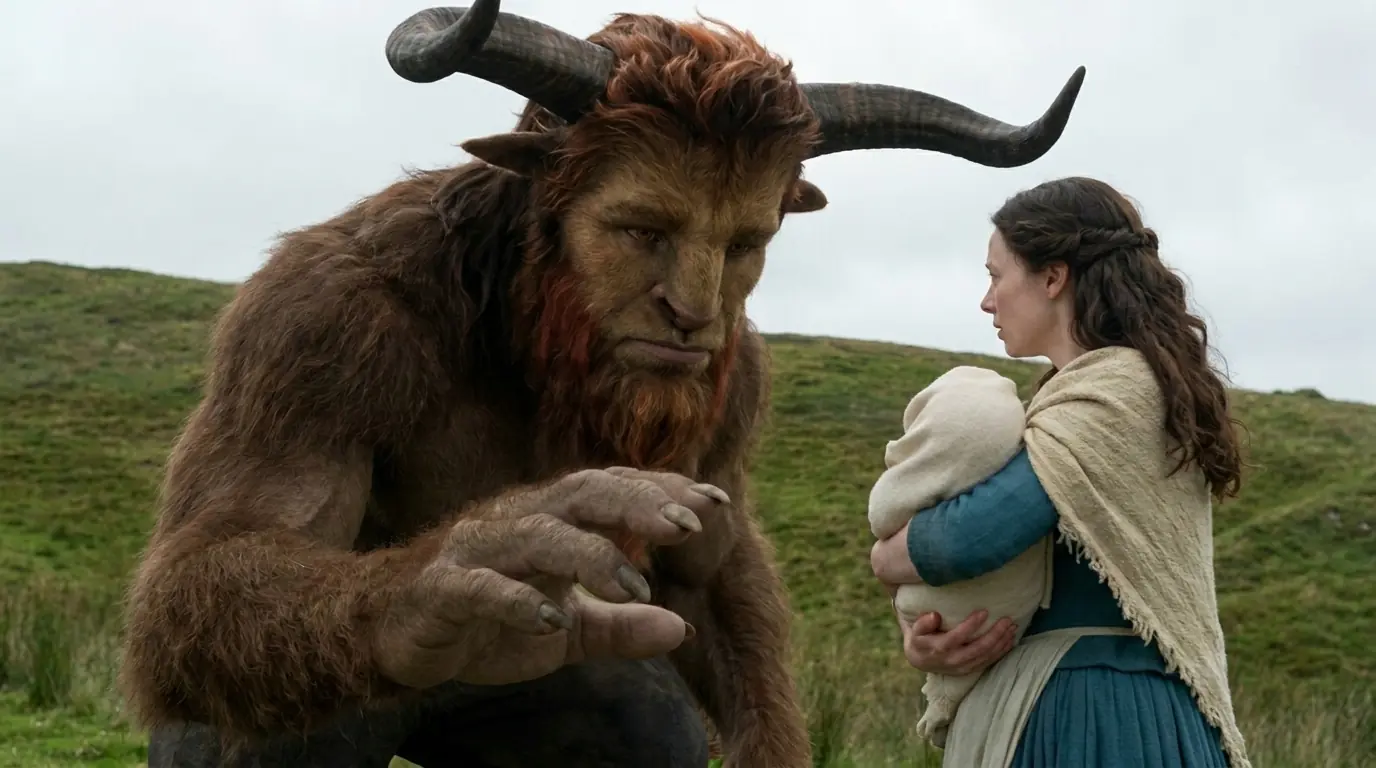
Elias slept with one fist curled under his chin. He was pale in the way of newborns who had not yet decided whether the sun was a friend. His lashes were dark against his cheeks. Mara counted his breaths the way other women counted coins.
The woven-wood fence ran crooked along the ridge, oak withies and ash poles bound with birch bark, a farmer's apology for a wall. Beyond it the wild grass thickened, and beyond that the old forest began—Blackthorn Reach, where the village children were told not to go, and where the village men went anyway when the hunting was lean. Mara had come out for the ewes. Two of them had lambed late, and the third was still heavy. She carried the pitchfork because wolves had been bold since the frost, and because her hands felt less empty with something in them.
She named the ewes under her breath as she walked—Bell, Nettie, Softmouth—the way her mother had taught her, because a named animal was harder to lose to weather or wolves or the numbness that came after too much grief. The grass wet her hem. Her beige shawl slipped, and she tugged it up with the practiced hitch of a woman who had learned to do everything one-handed. Elias made a milky sound against her breastbone. Twenty-three years old, and already she felt ancient in the places that counted: the spine that ached from carrying, the heart that flinched at quiet, the mind that kept inventing footsteps on the lane that never arrived.
Briarholt itself crouched in a fold of the valley like a creature trying not to be noticed. Twenty roofs. A well. A shrine to the Harvest Mother with its paint peeling. A reeve who meant well and a priest who visited twice a season with sermons about obedience and the dangers of the deep woods. Mara had been born here, married here, buried one child here, and birthed another while the rain wrote itself on the midwife's roof. She knew every face. She knew which husbands drank, which wives hid bruises, which boys would make good farmers and which would run to the timber camps and not come back—like Joren, Elias's father, whose letters had stopped last winter with no body to bury and no certainty to finish the mourning.
"Your da would have liked this sky," she murmured to Elias, though it was a lie told for comfort. Joren had liked clear days and loud work. He would not have liked the feeling in the air today, the pressure that made the sheep restless and the crows convene on the fence like judges.
Mara shifted the pitchfork to her other hand. Iron tines, ash handle, the tool her father had left her along with a warning: The Reach takes the careless. She had been careful for years. Careful had not saved her first baby. Careful had not brought Joren home. Careful, she was beginning to suspect, was sometimes only fear wearing a sensible dress.
She did not expect the ground to speak.
It was not speech at first. It was a vibration through the soles of her boots, a slow rhythm like a great heart deciding whether to keep beating. The ewes lifted their heads. Elias stirred and made a small sound, not quite a cry. Mara turned toward the fence.
He rose from the tall grass as if the field itself had grown a spine.
He was taller than the fence posts, taller than the hayrick by the barn road. Brown fur covered his chest and arms, thick and weathered, darker along the shoulders. Ragged trousers of some coarse weave hung from his hips, torn at the knees, stained with travel. Horns swept back from his brow in a curve that would have made a bull envious—pale bone ridged with old scars. A reddish beard framed a muzzle that was neither wholly beast nor wholly man. And his eyes—