The rain had not yet started, but the sky over Bath hung the color of old pewter, and Miss Wren Calloway walked faster than her worn half boots liked, clutching a basket of mending against her hip as though it might shield her from the cold. Her cloak had been turned twice, the hem let down until the fabric grew thin as paper, and she knew, without needing to look, that the women passing her in their bright pelisses were not looking at her at all. She had become, in the three years since her father's death, a woman people looked through rather than at. It was, she told herself, easier that way.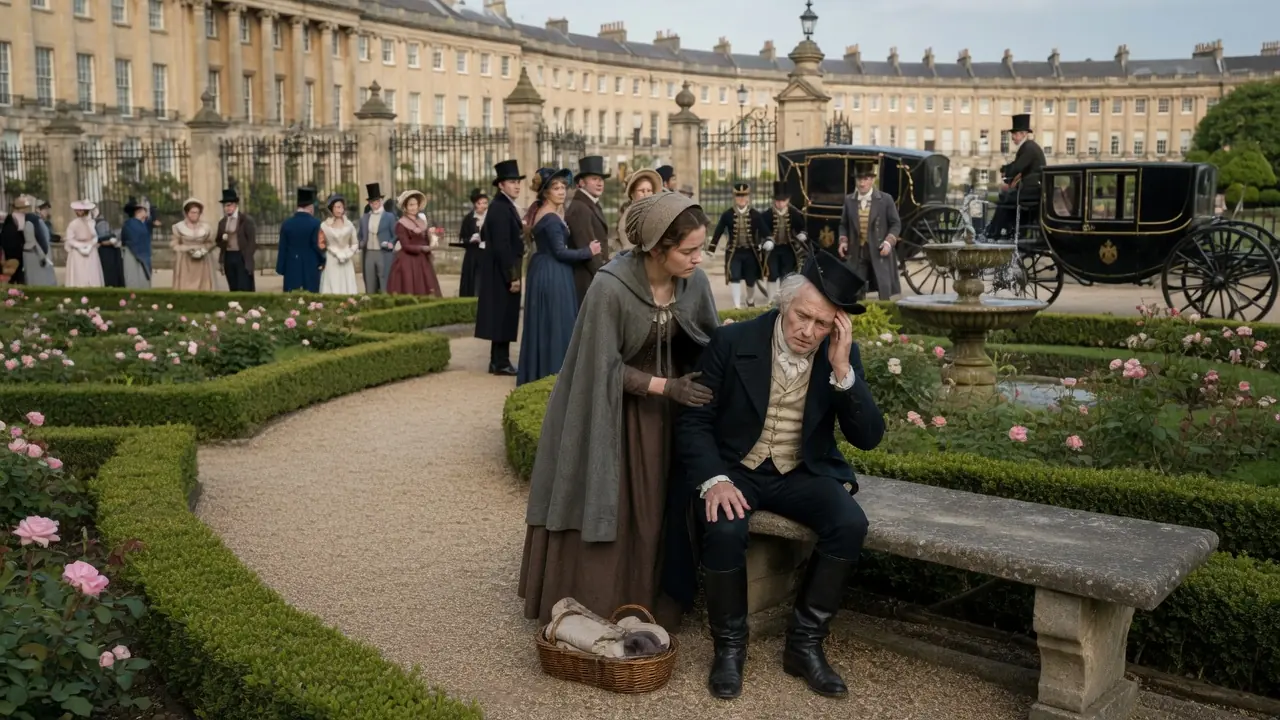
Easier to be invisible than to be pitied. She was hurrying toward Milsom Street, where Mrs. Fenwick's dress shop expected her mending by 4:00, when she saw him. An old man stood at the corner of the square, turning in a slow, bewildered circle. One hand pressed to his temple as though trying to hold a thought in place before it slipped away. He wore a coat of fine dark wool, beautifully cut but slightly askew, as though he had dressed in haste or with unsteady hands.
His silver hair was disheveled beneath a hat that sat crooked. He looked, Wren thought, like a man who had wandered out of one world and directly into another without noticing the door. Most people walked past him. A young buck in a blue coat actually laughed, murmuring something to his companion about the old fellow having taken too much sherry before noon. Wren felt her jaw tighten.
She did not know yet that this single decision to stop, to turn back, to approach a stranger no one else would trouble themselves over, would reshape the entire architecture of her life. "Sir?" she said gently, coming to stand before him so he would not startle. "Are you lost?" He turned to her with pale blue eyes that seemed, for one unsettling moment entirely without recognition of where he stood. Then something in his face eased, the way a man's shoulders ease when a familiar voice cuts through fog.
"I—" He stopped and pressed two fingers to his brow. "I was walking to the pump room. I am certain I was walking to the pump room. But this street..." He looked around at the shop fronts, at the carriages, at the gray sky.
"This is not the way."
"No," Wren agreed softly. "This is Milsom Street. The pump room is a good 10 minutes away, sir, back the way you came, past the Abbey." "Ah," he nodded, though his eyes still carried a flicker of something like fear. The particular fear of a proud man who has just discovered his own mind is not entirely to be trusted. "Ah, yes, of course. Foolish of me." "Not foolish at all," Wren said, and meant it.
But his hands trembled faintly at his sides, and his eyes kept drifting, as though his attention were a candle guttering in a draft. "Will you allow me to walk with you as far as the Abbey?" she asked. "I am headed that direction myself." This was not entirely true. It cost her a detour of some fifteen minutes, and Mrs. Fenwick did not tolerate lateness kindly.
But she said it anyway, because something in the old man's face, the quiet dignity fighting to reassert itself over his confusion, struck her as a thing worth protecting. "That is very good of you," he said and offered his arm, an old habit of courtesy that seemed to steady him even as he took it. "Very good indeed. Young people are not often so patient with old men who have lost their bearings." "I find," Wren said, matching her pace to his slower one, "that anyone might lose their bearings on occasion. It does not seem a fair thing to hold against a person." He glanced at her sideways and for a moment the fog in his eyes cleared entirely, replaced by something sharp and assessing. "You have a kind philosophy, Miss Calloway." "Wren Calloway." "Miss Calloway."
He said her name as though testing its weight. "I am obliged to you." They walked together through the thin gray light and Wren found herself speaking of small things. The weather, the shops, a dog that had gotten loose and was being chased by two red-faced boys, simply to give him something to hold onto besides his own uncertain thoughts. He answered readily enough and by degrees the trembling in his hands subsided and by the time the Abbey's great towers rose into view, he was walking with something closer to his natural stride.
"There," she said, "the pump room is just there, past the colonnade." He stopped and turned to her and his eyes, clear now, entirely present, studied her face with an intensity that made her wonder, briefly, if she had said something wrong. "May I ask you something, Miss Calloway?" "Of course." "Why did you stop? A dozen people passed me on that street, fine people, respectable people. Not one of them so much as slowed their step." Wren considered the question seriously because he had asked it seriously. "I suppose," she said slowly, "I know something of what it is to stand in a street and feel that no one sees you. It seemed a small enough thing to see you instead."
Something moved behind his eyes, not confusion this time, but a feeling too large and too sudden to entirely disguise. He pressed her gloved hand between both of his. "You are a remarkable young woman," he said. "I hope the world has occasion to notice it, whether or not it deserves the privilege." Then he was gone, moving toward the colonnade with a straighter back than she had first found him with, and Wren stood a moment in the cold watching him go before she remembered Mrs. Fenwick's mending and hurried on, already fifteen minutes late, already certain she would think no more of the encounter than any other small kindness rendered to a stranger on a gray afternoon.
She was wrong, though she would not learn how wrong for nearly a fortnight. The household of Baron Fenwick, no relation to the dressmaker, though Bath was so small that Wren sometimes confused the two families in her mind, had employed Wren these 18 months as a seamstress and occasional companion to the Baron's elderly aunt, a task that suited her particular circumstances well enough. Her father had been a country solicitor of modest means, respected but never wealthy, and his sudden death had left Wren with a small annuity insufficient to support genteel idleness. She was, by the strict accounting of society, neither servant nor lady, a species of woman the drawing rooms of Bath did not quite know how to place, and so generally declined to place at all.
She had grown accustomed to this particular invisibility. It no longer wounded her the way it had in the first raw months after her father's death, when every slight from a woman who had once called herself a friend had felt like a fresh cut. Now, she moved through Bath's genteel society the way a ghost might move through a house it once owned, present, functional, unremarked. It was therefore entirely unexpected when, some twelve days after the incident on Milsom Street, a carriage bearing an unfamiliar crest drew up outside the modest lodging house where Wren kept two small rooms with her widowed mother.
The knock that followed was crisp, official, and utterly bewildering. "Miss Wren Calloway?" The footman who stood at the door wore livery so fine that Wren's mother, peering over her daughter's shoulder, made a small sound of alarm. "I am she. I am sent by His Grace, the Duke of Ashcombe, with a request that you attend him at Ashcombe House at your earliest convenience regarding a matter of considerable importance."
Wren stared at the man. "I believe you have the wrong Miss Calloway. I am acquainted with no Duke." "I was instructed most particularly, madam, that the lady I was to find was the same Miss Calloway who assisted an elderly gentleman on Milsom Street a fortnight past on the day the rain threatened." Wren's breath caught.
"The old man, of course. I did nothing that warranted—" "His Grace was most insistent," the footman said with the particular patience of a servant long trained to deliver messages without embellishment or apology. "The carriage is at your disposal, madam, whenever you are ready." Wren's mother, a thin, anxious woman who had never fully recovered her composure since her husband's death, gripped Wren's sleeve. "A Duke, Wren? What can a Duke want with you?" "I cannot imagine," Wren said, though her mind was already turning over the memory of the old man's trembling hands, his crooked hat, the strange intensity in his eyes when he had asked her why she'd stopped. Whoever this Duke was, she suspected she was about to learn precisely who the old man had been. She dressed in her best gown, which was in truth not very good at all, a soft gray wool let out at the seams twice already, and mended so often at the cuffs that the careful stitching had become almost a kind of lace, and she went.
Ashcombe House was not, strictly, in Bath at all, but a handsome estate some twenty minutes beyond the city's edge. Its long avenue of limes leading to a facade of pale stone that seemed to Wren, as the carriage drew up before it, entirely too large for any ordinary human purpose. She had seen grand houses before, from a respectful distance, on Sunday walks with her father when he was alive. She had never been asked to walk through the front door of one. A butler received her with a courtesy so measured it revealed nothing at all of what he thought of a young woman in a gray wool dress arriving by ducal carriage, and led her through a hall floored in black and white marble, past portraits whose painted eyes seemed to Wren to follow her with faint aristocratic suspicion, and into a drawing room flooded with pale winter light.
The old man rose from a chair by the fire. He looked entirely different than he had on Milsom Street, steadier, better dressed, his silver hair combed with evident care, his blue eyes clear and sharp, and this time entirely fixed upon her. And yet it was unmistakably him. "Miss Calloway," he said, and there was real warmth in it. "You came."
"I confess I did not entirely understand the summons," Wren said, dropping a careful curtsy, uncertain of the correct address for a man she did not yet know to be a duke or something greater. "Your footman mentioned His Grace."
A faint, rueful smile touched the old man's mouth. "Forgive me. I ought to have introduced myself properly that day on Milsom Street, but I fear I was not entirely myself."
"I am Edmund Thorne, Duke of Ashcombe. Though I dare say the title matters rather less to this conversation than another fact, which is that I am also grandfather to His Royal Highness Prince Frederick. It was my grandson's household—and, I confess, my grandson's very great alarm—that set half of Bath searching for me on the day you found me wandering."
Wren felt the floor of the world tilt very slightly beneath her feet. "You are the prince's grandfather."
"I am. And I had, on the day we met, wandered from my own physician's care during what my grandson insists on calling one of my confused spells, though I prefer to think of them as merely occasional lapses in an otherwise excellent memory."
His eyes twinkled, though there was something more serious beneath the humor: an old man's private reckoning with a mind that no longer entirely obeyed him. "You found me confused, frightened, and, I do not doubt, looking exceedingly foolish on a public street."
"And you did not laugh, nor did you summon a constable to be rid of the embarrassment I represented, nor did you simply walk on as every other soul that day did. You gave me your arm and your patience, and I think something of your own dignity, without once asking who I was or what I might do for you in return."
"It was nothing, Your Grace. Any decent person would have done the same." "Miss Calloway," the Duke said, and his voice took on a gravity that silenced her protest before she could finish it. "I have lived seventy-one years, thirty of them in rooms very like this one, surrounded by people who wanted something from me. I have grown rather expert at recognizing decency when I encounter it precisely because it is so rare. What you offered me on that street was not nothing. It was, in fact, everything that is generally missing from the lives of men like myself, who are surrounded and yet very often entirely alone." Wren did not know how to answer this. She stood in the pale winter light of a drawing room larger than her mother's entire lodging house, being thanked with a sincerity so unguarded it embarrassed her more than any grand gesture could have.
"I wonder," the Duke went on before she could compose a reply, "whether you might be persuaded to visit me again. Not from any sense of obligation. I would not insult you by suggesting it, but because I confess, I have grown rather tired of the company available to a man in my situation. My grandson worries over me. My physician measures me. My household manages me. You, Miss Calloway, spoke to me as though I were merely a man who had lost his way, which is, in point of fact, precisely what I was." There was something in his face, a loneliness so carefully controlled it had nearly disguised itself as dignity, that Wren recognized instantly because she had worn the same expression herself for three years. "I should like that very much, Your Grace," she said, "if it would not be an imposition." "The imposition," said the Duke, "is entirely on my side. I intend to make full use of your patience, Miss Calloway, and I hope you will forgive me for it." She did not, in that first visit, meet the prince. She learned of him mostly through the Duke's conversation over the weeks that followed. Weeks in which her visits to Ashcombe House became, first, a fortnightly occurrence and then, by unspoken agreement, something closer to a weekly one. She would sit with the Duke in the small morning room he preferred to the grander drawing room, reading to him when his eyes tired, listening to his stories of a younger England, of wars and courts and a wife long dead whom he still spoke of sometimes as though she had nearly stepped into the next room. "My grandson does not know what to do with me," the Duke told her one afternoon as rain traced long fingers down the windowpane.
"He is a good boy, a good man I should say, though I confess I still see the child in him more often than I ought. He has been raised since the cradle to manage nations and yet he does not know how to manage an old man's failing memory. It frightens him more than any war council ever has." "Perhaps," Wren offered carefully, "because a war council can be reasoned with and a failing memory cannot." The Duke looked at her with something like surprise and then with something warmer.
"You understand a great deal for a young woman who has never, by your own account, sat in a war council or nursed a dying man." "I nursed my father," Wren said quietly. "Not through failing memory but through failing lungs. I understand something of watching a person you love become less certain of the world and being unable to do anything about it except stay." The Duke was silent a long moment. Then he reached over and pressed her hand much as he had done on Milsom Street.
"Staying," he said, "is very often the whole of what love requires. People imagine it must be grander than that. It rarely is." It was on her sixth visit that she finally encountered the prince. She had not expected him.
She had come as usual in early afternoon and had been shown into the morning room to find the Duke not alone but in conversation with a tall man in a dark blue coat standing with his back to the door. His posture so straight and controlled that Wren knew before he turned that this must be the grandson of whom the Duke so often spoke. He turned as she entered, and Wren found herself looking into a pair of gray eyes that held, in that first instant, an expression she could not immediately name. Something between surprise and scrutiny, as though he were attempting to reconcile the plainly dressed young woman before him with whatever image he had privately constructed of the person his grandfather spoke of so warmly and so often.
"Miss Calloway," the Duke said, pleasure evident in his voice. "Allow me to present my grandson, Frederick." Wren dropped into a curtsy so deep her knees protested it. "Your Royal Highness." "Miss Calloway."
His voice was low, careful, entirely without the warmth his grandfather's carried, though she thought, she could not be certain, that there was something watchful in it rather than cold. "My grandfather speaks of you often enough that I confess I expected to meet a woman rather more remarkable in appearance. I intend that as a compliment to your character, not an insult to your dress, though I am aware it may not land as one." It was, Wren thought, one of the strangest attempts at courtesy she had ever encountered. Blunt, faintly awkward, and entirely without artifice.
She found, unexpectedly, that she did not mind it. "I am not certain whether to thank you or forgive you, Your Highness." Something flickered at the corner of his mouth, not quite a smile, but its close relation. "Both, perhaps. I find myself in your debt, Miss Calloway. My grandfather has wandered from his household on four occasions this past year. Three of those occasions ended with a physician, a search party, and considerable public embarrassment for a man who values his dignity above nearly everything else. The fourth ended with you walking him calmly to the pump room and asking nothing in return. I have spent a good deal of thought wondering what manner of person does such a thing." "The manner of person who happened to be walking down Milsom Street at the right moment, Your Highness. I claim no particular virtue in it."
"And yet..." His eyes held hers a moment longer than strict courtesy required. "You have continued to visit him weekly since at some inconvenience to yourself, I am given to understand, and entirely without payment, though my grandfather has offered it more than once." Wren felt heat rise in her cheeks. "Your grandfather is not a task to be compensated for, sir. He is good company. I confess I look forward to our visits rather more than I look forward to most of my obligations."
The prince said nothing further in that moment, but Wren felt his gaze rest on her a fraction longer than politeness demanded, as though he were recalculating some private sum and arriving, to his evident surprise, at a figure he had not expected. It became, over the following weeks, a fixture of Wren's life that she should sometimes find the prince present at Ashcombe House during her visits. Never by any arrangement she was aware of, always with some plausible reason of estate business or family duty, and always, she began to notice, with an attentiveness to the room that seemed to extend well past his grandfather. He did not court her, not in any manner she could have named as courtship.
He asked her opinion on matters of estate management once, when the Duke had dozed off mid-conversation, and seemed genuinely startled by the clarity of her answer. He remarked, on another occasion, upon a book she had left on the side table, a worn copy of Cowper's poems, her father's copy, the spine cracked from use, and spoke of it with a knowledge that surprised her until she remembered that princes, too, were permitted to have private tastes. "You read Cowper," he said, turning the book over in his hands with a care that made Wren's chest tighten unexpectedly. "My father did. I inherited the habit along with the book. He writes of solitude rather better than most men who have never truly experienced it." The prince set the book down with unusual gentleness. "I have always thought there is a particular dishonesty in poets who write of loneliness from the comfort of a full drawing room. And you, Your Highness, have you experienced it? True solitude?" He looked at her for a long moment, and something in his controlled expression cracked very slightly, revealing, briefly, an exhaustion she had not expected to find beneath the polish. "I am rarely alone," he said. "I am, however, very often lonely. I have found the two conditions are not, in fact, opposites, whatever the poets would have us believe."
It was the most honest thing he had said to her, and Wren found she did not know how to answer it, except to say, quietly, "I think that is one of the truest things I have heard spoken in this house." He did not reply, but something in his face had changed by the time she left that afternoon, and Wren carried the memory of it home with her, turning it over in her mind the way one turns over a coin of uncertain value, unsure whether it was gold or merely gilt, and unsure, too, why it should matter to her at all. The Duke's health, though generally steady, was subject to sudden reversals that terrified the entire household each time they occurred. It was on a bitter evening in late winter, some 3 months into Wren's acquaintance with the family, that the worst of these reversals struck.
She had been reading to him, an old habit now, comfortable as breathing, when he stopped mid-sentence, his hand rising to his chest, his face going the color of ash. Wren was on her feet instantly, calling for the housekeeper, propping cushions behind his back, loosening his cravat with hands that shook far more than she allowed her voice to. "Your Grace. Your Grace, can you hear me?" His eyes found hers, glazed with pain and fear, and he gripped her hand with a strength that belied his apparent frailty. "Wren," he said, her Christian name, unprompted, the first time he had used it.
"Stay." "I am not going anywhere," she said, and meant it with her whole heart. The physician came within half an hour, summoned by a footman sent at a dead run, and pronounced it a seizure of the heart, not fatal, but severe, the sort of warning that demanded absolute rest and quiet for some weeks to follow. Wren did not leave his side that night, nor the following day, sitting through the long hours in a hard chair by his bed, holding his hand when he woke frightened and disoriented, reading to him in a low voice when he could not sleep.
She was present in every hour that mattered, though she had no legal claim to be present at all. It was in the gray hour before dawn on the second night that she looked up from her vigil to find Prince Frederick standing in the doorway, having evidently just arrived from London at some breakneck pace that had left the mud of the road still on his boots. He did not speak. He simply stood, watching her hold his grandfather's hand, watching the careful, unthinking tenderness with which she smoothed the blanket at the old man's shoulder.
And something in his face, in that unguarded moment before he composed it, told Wren everything she needed to know about what he felt and had perhaps felt for some time without permitting himself to examine it too closely. "How is he?" the prince asked at last, his voice rough with travel and fear. "Resting. The physician believes the worst has passed, but he must not be excited or distressed for some weeks." The prince crossed the room and stood on the opposite side of the bed looking down at his grandfather's sleeping face with an expression of such naked worry that Wren's heart ached for him.
"You did not leave him," he said, not quite a question. "I could not. Most women in your position would have sent word and gone home to their own comforts, Miss Calloway. It is not your obligation to sit through two nights in a hard chair for a man who is not your family." "He is not my family by blood," Wren said quietly, "but I do not think family is only a matter of blood, Your Highness. I think it is very often a matter of who stays."
The prince looked at her across the bed, across his sleeping grandfather, and for a long moment neither of them spoke. Whatever passed between them in that silence was not declared, not yet, but it was, Wren understood even then, the moment the ground beneath her feet had shifted permanently, whether she was prepared for it or not. The Duke recovered slowly over the following weeks, and Wren's visits continued now with an added tenderness that both grandfather and grandson seemed unable or unwilling to disguise. But recovery brought with it a return of the ordinary world's attention, and with that attention came, inevitably, the notice of those who had a vested interest in who occupied the prince's regard.
Lady Augusta Wren Fitzherbert—no relation to Wren, though the coincidence of name occasioned several cutting remarks at Wren's expense, had for some two years been generally understood in society to be the leading candidate for the prince's hand. She was beautiful in the conventional manner, wealthy, exquisitely connected, and possessed of a smile that could freeze water at twenty paces when she chose to turn its full force upon a rival. She turned it upon Wren at a small gathering the Duke insisted upon holding against his physician's advice to celebrate his recovery. A gathering to which Wren had been invited with a warmth that made her for the first time feel almost like a member of the family rather than a fortunate stranger admitted to its edges.
"Miss Calloway," Lady Augusta said, approaching with two other ladies in her wake, her eyes moving over Wren's gown, a soft blue muslin, her best, still plainly the dress of a woman with no dowry to speak of, with a showiness calculated to be noticed. "How very good of the Duke to include you. I confess I had not realized companions to elderly relations were generally invited to family celebrations. Perhaps standards have relaxed since my grandmother's day." "The Duke's kindness is well known, my lady," Wren replied evenly, refusing to grant the barb the satisfaction of a visible wound.
"Indeed, though I do hope you understand, Miss Calloway, that kindness of that sort rarely survives with reality. An old man's fondness for a pretty face that reads to him is a very different thing from a family's willingness to receive that face at its own table in its own right as more than an amusement for a convalescent." The words found their mark more precisely than Lady Augusta could have known, striking at the very fear Wren had not permitted herself to examine too closely. That whatever warmth existed between herself and this family was a fragile, borrowed thing, contingent upon her usefulness, liable to vanish the instant it ceased to be convenient.
I am grateful for whatever place I have been given, Wren said quietly. And I do not presume to any place beyond it. How sensible of you. Lady Augusta said, with a smile that did not reach her eyes, and swept away with her companions, leaving behind a silence that felt to Wren considerably louder than the conversation had been. She did not know that Prince Frederick had witnessed the entire exchange from across the room, nor that his jaw had tightened in a manner his household would have recognized, had they seen it, as a very dangerous sign indeed.
The following weeks brought a change in the household's rhythm that Wren felt before she could name it. A subtle closing of ranks, an increased frequency to the prince's presence at his grandfather's side, a watchfulness in his manner toward her that she could not decide was protective or merely curious. It came to a head on an afternoon in early spring, when Wren arrived for her usual visit to find the Duke resting and the prince alone in the morning room, evidently waiting for her. "Miss Calloway." He rose as she entered, and there was something in his bearing, a deliberateness, as though he had rehearsed what he meant to say and was now uncertain of the words after all, that made her pulse quicken with an anxiety she could not entirely explain.
"Your Highness. Is your grandfather—" "He is resting comfortably. I asked that you be shown in here first if you do not mind. I find I have something I must say, and I have been a coward about saying it for rather longer than I care to admit. Wren's heart beat unevenly. "Then say it, sir.
I have found that most things improve upon being spoken rather than carried in silence." He looked at her for a long moment, and when he spoke, his voice had lost the careful formality she had grown accustomed to, replaced by something raw, more honest. "I have watched you these past months with a care that I have not extended to any other person in a very long time, Miss Calloway. I have watched you sit through two nights in a hard chair for a man who is nothing to you by blood, ask for nothing in return, endure the casual cruelty of women like Lady Augusta with a dignity I do not think I could match in your position, and become, in the space of a single season, more essential to this family's happiness than anyone I have known in years. I do not say this lightly. I am not a man given to lightness." "I have noticed," Wren said softly, and something in her voice must have carried more warmth than she intended, because his expression eased just slightly. "I must ask you something," he went on, "and I ask it with the full knowledge that the answer, whatever it is, will change a great deal. Do you feel, is it possible that you feel anything more than duty in your regard for this family?
For me?" Wren's breath caught. She had not permitted herself to examine her own feelings too closely, had told herself, in the quiet hours of the night, that her regard for the prince was mere admiration, mere gratitude, mere proximity mistaken for something deeper. But faced now with the direct question, she found she could no longer maintain the fiction. "I feel," she said carefully, "a great deal more than duty, Your Highness. I have felt it for some time, and told myself it was foolish, that a man in your position could have no serious regard for a woman in mine, and that I ought to guard my heart accordingly.
I have not, I confess, been entirely successful in that guarding. Relief and something fiercer moved across his face in quick succession. "Then you must understand that I intend to guard nothing at all," he said. "I intend to court you openly, Miss Calloway, whatever objection society raises, and I will not pretend, for the comfort of Lady Augusta or anyone else, that my regard for you is anything less than what it is." It was, of course, not so simple as a declaration made in a quiet morning room.
The court, when word of the prince's attentions began to circulate, did not receive the news with the equanimity either Wren or Frederick might have wished. Lady Augusta's circle proved particularly inventive in their cruelty, spreading whispers that Wren had insinuated herself into the Duke's affections through calculated flattery, that she had nursed him not from tenderness, but from ambition, that a woman of her modest birth and modest fortune could have no honest motive for capturing a prince's regard beyond the obvious one. Wren bore it as best she could, though the weight of it pressed on her more heavily than she allowed anyone but her mother to see. It was one thing to endure invisibility.
It was another entirely to endure visibility of the wrong kind, to have her every gesture, her every word, dissected and reinterpreted as evidence of a design she had never possessed. The crisis came at a ball held at Ashcombe House itself, the Duke's first grand entertainment since his illness, and one at which Wren's position, elevated by the prince's open attentions, undermined by the court's persistent suspicion, was to be tested most severely. Lady Augusta, cornering her near the refreshment table with the particular boldness of a woman who believes herself about to win, delivered her cruelest blow with a smile so pleasant that several onlookers did not immediately register the venom beneath it. I wonder, Miss Calloway, whether you have considered what will become of you when the prince tires of his charitable impulse.
Men of his rank are permitted their diversions, of course, but diversions rarely become duchesses, whatever promises are made in the heat of gratitude. I should hate to see you humiliated when the season turns and his attention turns with it. The words landed in a room that had, Wren realized with mounting horror, gone rather quieter than a moment before. Several guests near enough to hear, and pretending with varying success not to have done so. Before Wren could compose a reply, a voice cut across the gathering with a coldness that silenced every remaining murmur in the room.
"I do not believe," said Prince Frederick, arriving at Wren's side with a speed that suggested he had crossed half the ballroom the instant he registered the direction of the conversation, "that gratitude has ever been mistaken by any person of sense for what I feel toward Miss Calloway. I would be obliged, Lady Augusta, if you would clarify to the room precisely what quality of hers you find so objectionable. Her honesty, perhaps, or her courage, or the fact that she sat through two nights at my grandfather's sickbed while the ladies of this court sent flowers and considered their duty discharged." Lady Augusta's composure faltered for the first time Wren had witnessed.
"Your Highness, I meant no offense." "You meant precisely what you said," the prince replied, "and I will not have it repeated. Miss Calloway's birth is modest, her fortune is smaller still. I have never pretended otherwise, nor has she. But I have searched a very great deal of this kingdom's finest drawing rooms, Lady Augusta, for a woman of genuine goodness, and I have found precisely one. I do not intend to apologize for recognizing her when I found her. And I would ask that this room extend her the courtesy it has, until now, reserved for women whose only distinction is the size of their dowry." The silence that followed was absolute. Wren, mortified and moved in equal measure, felt tears sting her eyes, not from the humiliation Lady Augusta had intended, but from the fierce, unguarded loyalty of the man standing beside her, who had chosen, in front of the entire assembled court, to defend her, rather than manage the scandal quietly, as convention would have counseled.
"Frederick," she said softly, using his given name for the first time, uncertain whether it was permitted, uncaring in the moment whether it was. He turned to her, and whatever remained of his careful royal composure fell away entirely. "I meant every word," he said, low enough that only she could hear it. "I have meant it for months. I was only waiting for the courage to say it where it could not be mistaken for a private indulgence."
The old duke, informed later that evening of the scene in the ballroom, for such news, in a house of that size, could not long remain private, summoned Wren to his morning room the following afternoon with an urgency that made her fear, briefly, a return of his illness. She found him instead in remarkably good spirits, seated by the fire with a smile that reminded her, powerfully, of the first day she had met him, confused and lost on Milsom Street, before she had known anything of who he truly was. "Wren," he said, using her Christian name as he had done since the night of his illness, "sit with me. I find I have something to say, and I have discovered, at my advanced age, that saying things promptly is a habit worth cultivating, since one cannot always rely upon having a second occasion."
She sat, uncertain what was coming, her heart still unsettled from the events of the previous evening. "I have watched my grandson," the Duke said, "carry the weight of his future upon his shoulders since he was a boy of 12, taught from his earliest years that his feelings were secondary to his duty, that his heart, whatever its private inclinations, existed to serve the crown rather than himself. I confess I contributed to that lesson more than I now wish I had. I raised him in part to believe that love was a luxury a man in his position could not afford."
"Your Grace—"
"Let me finish, my dear, for I am old and I have earned the privilege of finishing my sentences before anyone interrupts them. A faint smile took the sting from the words. "I watched him last night defend you before the very court he has spent his entire life learning to placate, and I understood, watching him, that whatever lesson I taught him in his youth, he has unlearned it entirely, and I could not be more glad of it. You did not merely find me on a street corner and walk me to the pump room, Wren.
You found, in the process, the one thing that boy needed and did not know he was permitted to want. I do not know how to thank you for that except to say that I intend to support his suit with everything at my disposal, and I hope you will do him and me, selfishly, for I have grown very fond of having you in this house, the honor of accepting him." Wren, undone entirely by the old man's tenderness, could not immediately speak. "He has not yet asked," she managed finally. "No," the Duke agreed, eyes twinkling, "but I rather suspect he intends to remedy that this very evening, and I thought you ought to have some warning so that you might compose yourself rather better than I did upon receiving news of my own engagement some fifty years ago in a garden very much like the one my grandson intends to use tonight.
The garden at Ashcombe House in the soft blue hour after sunset was fragrant with early roses and lit by lanterns strung through the branches of an old chestnut tree. And it was here, walking beside Frederick along a gravel path still warm from the day's sun, that Wren felt the final piece of the evening's design reveal itself. "My grandfather informs me," Frederick said with a wry note that suggested he was not entirely surprised by the old man's meddling, "that he has already secured your acceptance on my behalf." "He has secured nothing," Wren said, smiling despite herself.
"He has merely warned me that you intended to ask something and given me leave to prepare an answer." "And have you prepared one?" "I find I have not needed to prepare it at all. It has been ready for some time, waiting only for the question."
Frederick stopped walking and turned to face her fully, and in the lantern light, Wren saw, for the first time entirely unguarded, the full depth of what he had been carrying in silence for months.
The loneliness of a man raised to duty rather than affection, the fear of a heart he had not been taught to trust, and beneath it all, a hope so plain and so unpolished it undid her more completely than any grand declaration could have. "I do not have the words a poet would use," he said. "I have never been permitted to practice them. I only know that since the night I found you sitting with my grandfather, holding his hand through the worst hours of his illness, asking nothing and expecting nothing, I have not been able to imagine a single hour of my future that does not include you in it. I do not offer you a crown, Wren, though it comes with the bargain, and I do not offer you an easy life, for I do not think either of us has ever wanted an easy one. I offer you what is, I think, rather more valuable. A man who has watched you long enough to know precisely what he is choosing, and who chooses it with his whole heart, without reservation, without regard for what the court believes I ought to want instead."
"Will you marry me?" "Yes," Wren said, and the single word carried in it three years of invisibility, a fortnight's fortunate encounter on a gray street, months of quiet devotion built not on grand gestures, but on small, unglamorous kindnesses, and a love that had grown, as the truest kind always does, not in spite of ordinary moments, but entirely because of them.
"Yes, Frederick, with my whole heart and gladly." He kissed her then, gently, beneath the chestnut tree and its strung lanterns, and somewhere behind the lit windows of the house, an old man who had once stood lost and frightened on a street corner, watched the two figures in the garden with tears he did not trouble to hide, thinking that of all the fortunes his family had gathered across its long history, none had ever been so precious, nor so entirely deserved as the one his own confusion had, by grace and accident both, delivered into their hands. The wedding, when it came in early summer, was neither so grand as the court expected, nor so modest as Wren's own upbringing might once have predicted, but rather something new entirely, a celebration that drew in equal measure the finest families of the kingdom and the small, unassuming circle of Wren's own acquaintance. Her mother, seated in a place of honor near the front, weeping openly with a joy that needed no apology.
Lady Augusta did not attend, though whether from injured pride or genuine restraint, no one could say with certainty. And Wren found, to her own surprise, that she bore the woman no lasting resentment, only a distant gratitude that every cruelty endured along the way had only served, in the end, to prove the strength of what she and Frederick had built. The old duke gave a toast at the wedding breakfast that lasted rather longer than protocol strictly permitted, and ended with words that Wren would carry with her for the whole of her life. "I was a lost old man on a cold street, unremarkable to every eye but one. That one kindness, offered without expectation of reward, has given this family more happiness than fifty years of careful dynastic planning ever achieved. Let it be a lesson to us all that the truest fortunes are very rarely found where we are taught to look for them, but in the small, unwatched moments where a person chooses kindness simply because it is right." Wren, standing beside her husband in the soft golden light of that summer afternoon, her hand held fast in his, thought of the girl who had walked Milsom Street in a faded gray cloak, invisible to every eye that mattered, and marveled at the strange, quiet grace of a world that had, in the end, seen her after all, not for her birth, nor her fortune, nor anything she had ever possessed, but simply for the goodness she had never once thought to hide, even when no one was watching, even when she believed no one ever would. She had stopped for a lost old man on a gray afternoon because it seemed the right thing to do, expecting nothing, hoping for nothing, wanting only to ease a stranger's confusion for the space of a short walk.
It had cost her nothing but fifteen minutes and a scolding from Mrs. Fenwick. It had given her, in the end, everything. A family who loved her plainly and without condition, a husband who had chosen her with his whole unguarded heart, and the quiet, permanent certainty that she would never again have to walk through a room and feel herself unseen. The rain that had threatened Bath that first gray afternoon had never come, in the end. But the light that followed, warm and gold and entirely unlooked for, had lasted every day since.