The black medical bag had been in Calder Ror’s house for fifty-three days before he knew what it contained.
For fifty-three nights, it had rested beneath two folded winter dresses in the bottom of Lenora’s largest trunk.
For fifty-three mornings, she had dressed above it.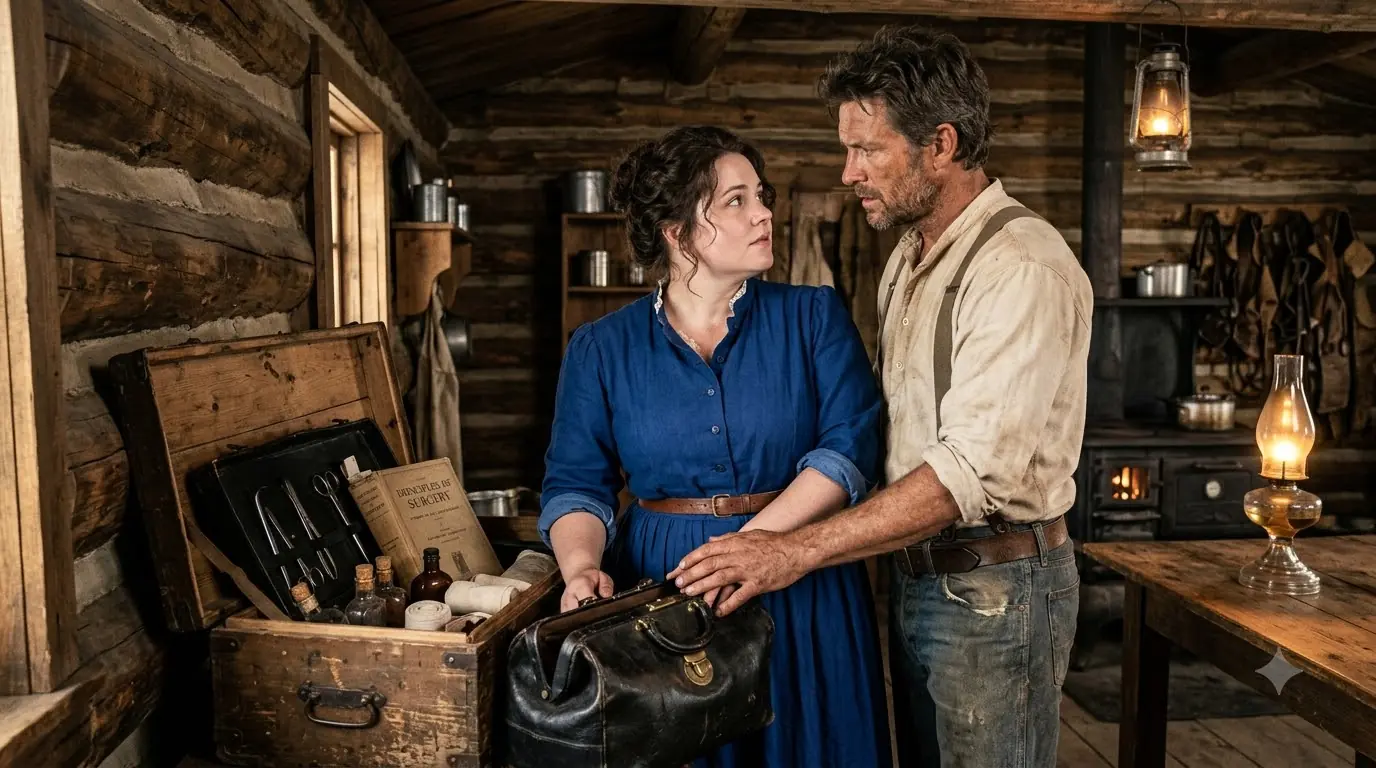
For fifty-three evenings, she had gone to bed knowing that twelve feet below her, Calder sat at the kitchen table believing his wife had been medically educated.
Not believing she was a physician.
There was enough truth in the first statement to make the omission bearable.
At least for a while.
Lenora had learned during thirty-one years of life that deception rarely announced itself as deception while a person was practicing it.
Usually, it arrived wearing the respectable clothing of caution.
Protection.
Timing.
Self-preservation.
She had told herself that she would explain after Calder knew her.
After he understood she could keep accounts.
After she proved she was not helpless.
After he understood her size did not make her weak.
After she had learned whether the still, weathered rancher who had answered a matrimonial advertisement with brutal honesty possessed the same honesty when faced with a woman who had been too frightened to offer him all of hers.
There was always another after.
Until Merritt Shaw rode into the yard bleeding through his sleeve.
Then there was only now.
Lenora heard the horse before she saw the rider.
She had been standing at the kitchen table sorting invoices into three piles: feed, equipment, and household expenses. Calder’s original system consisted of a wooden box into which every paper related to the ranch had apparently been dropped according to a philosophy best described as eventual optimism.
Lenora had spent six weeks repairing it.
The sound outside was wrong.
Not the measured arrival of a neighbor.
Not the heavy rhythm of a ranch hand finishing a ride.
Fast.
Uneven.
A horse pushed harder than sensible.
Lenora stood.
The chair scraped behind her.
By the time she reached the front porch, Merritt was pulling up.
He was twenty.
Maybe twenty-one.
Tall enough that his youth became obvious only when he smiled, which he was not doing now.
His face had gone gray.
His left hand clamped around his right forearm.
Blood had soaked the sleeve from elbow to wrist.
“Calder here?”
Lenora was already moving down the steps.
“What happened?”
“Wire.”
“What kind?”
“Fencing.”
“When?”
“Maybe fifteen minutes.”
“Show me.”
Merritt hesitated.
That tiny hesitation told Lenora more than an answer.
He looked at her dress.
At her body.
At her face.
Then toward the barn, searching for Calder.
Lenora had seen that hesitation in hundreds of variations.
She did not resent him for it.
Not now.
“Show me the arm.”
Something in her voice made him obey.
He released his grip.
Blood welled immediately.
Lenora’s entire mind changed.
The domestic calculations vanished.
Account ledgers.
Supper.
Laundry.
What Calder might think of her.
Gone.
There was only the wound.
Deep laceration across the outer forearm.
Irregular edges.
Contaminated with dirt and rust.
Active bleeding, but not arterial spray.
Tendon function unknown.
Nerve involvement unknown.
Blood loss moderate and increasing.
She looked into Merritt’s face.
“You feel faint?”
“No.”
“Liar.”
He swallowed.
“A little.”
“Inside.”
“Ma’am—”
“Now.”
Calder came around the barn at that moment.
He had heard the horse.
One look at Lenora told him more than one look at Merritt.
That would become important later.
He had never heard his wife use that voice.
Not once.
Lenora pointed toward the kitchen.
“Table.”
Calder stopped.
“What?”
“Clear it.”
His eyes shifted toward Merritt’s arm.
Then back to her.
“Lenora—”
“Clean cloth.”
The command landed with such certainty that Calder obeyed before he had time to question why.
He pushed the invoices aside.
Pulled the oilcloth covering from half the table.
Lenora guided Merritt into a chair first because he looked close to collapsing.
“Calder, pressure here.”
She folded a cloth and placed his hand over the wound.
“Hard.”
Calder obeyed.
Merritt hissed.
Lenora turned.
She walked toward the staircase.
Then stopped.
There it was.
The decision.
Fifty-three days of secrecy upstairs.
A marriage still forming.
A man whose trust she had already gambled with by withholding the one fact that had shaped most of her adult life.
And on the kitchen table, a twenty-year-old man was bleeding.
The decision lasted less than a heartbeat.
Lenora went upstairs.
She opened the trunk.
Removed the dresses.
There was the bag.
Dark leather.
Worn almost black.
Brass clasps dulled by years of use.
The handle repaired twice.
Her father had given it to her when she graduated.
He had died three months later.
She touched the handle.
“I know.”
She was not sure whether she said it to him or herself.
Then she carried the bag downstairs.
Calder saw it.
His eyes narrowed.
Not suspicion exactly.
Recognition that a missing piece had just entered the room.
Lenora set it on the table.
Opened the clasps.
Oilcloth.
Forceps.
Needles.
Sutures.
Carbolic solution.
Morphine.
Bandages.
Scissors.
A stethoscope.
Calder’s face changed.
Merritt stared.
Lenora did not look at either man.
“Boil more water.”
Calder remained still.
“Calder.”
His eyes went to hers.
For one second she saw every question.
Then he turned.
“Water.”
“Now.”
That was enough.
Lenora removed her outer cuffs and rolled her sleeves higher.
She washed her hands.
Then washed again.
She cleaned the instruments.
Merritt watched her.
“What in God’s name—”
“You can ask later.”
She pointed toward his face.
“Look at me.”
He did.
“Can you move your fingers?”
He flexed them.
Pain.
But movement.
“Good.”
“Feel this?”
She touched two points.
“Yes.”
“And this?”
“Yes.”
“Good.”
She examined the wound.
Calder returned with water.
He set it down.
Lenora looked at him.
“I need you steady.”
His gaze remained on her face.
“I’m steady.”
“I know.”
The answer came before she thought about it.
Something passed between them.
Not now.
Later.
She looked back at Merritt.
“You have two choices for pain.”
He swallowed.
“One is whiskey.”
“That’s the poor choice.”
“The other is morphine.”
Merritt stared.
“You have morphine?”
“Yes.”
“Are you a nurse?”
Lenora looked at him.
“No.”
She measured the dose carefully.
“What are you?”
“Hold still.”
Merritt glanced at Calder.
Calder’s expression gave him nothing.
Lenora administered the medication.
Waited.
Then began.
She irrigated the wound thoroughly.
Merritt cursed once.
Then apologized.
“Don't.”
“What?”
“Apologize.”
She continued.
“This is going to hurt regardless of your vocabulary.”
Calder almost smiled.
Almost.
Lenora saw it from the corner of her eye.
She began removing contaminated tissue.
Merritt’s breathing changed.
“Talk to me.”
“About what?”
“Anything.”
He looked panicked.
Lenora said:
“How old are you?”
“Twenty.”
“I thought so.”
“You guessing?”
“Your face.”
“What about it?”
“Still surprised when life hurts.”
Calder’s mouth moved again.
Merritt gave a weak laugh.
Then groaned.
Lenora kept working.
“Tell me about the wire.”
“Pulling new fence.”
“Alone?”
“Decker was there.”
“Where is he?”
“Went after the cattle.”
“Then he is an idiot.”
Merritt laughed once.
Then realized Lenora was serious.
“Probably.”
“There.”
Lenora stopped.
The bleeding had slowed.
She inspected deeper structures.
No tendon severance.
Excellent.
She began closure.
Layer by layer.
Calder held the arm exactly as directed.
No questions.
No flinching.
No watching her face instead of the wound.
That impressed her more than she wanted to admit.
Men often became strange around blood when a woman was handling it better than they were.
Some tried to help too much.
Some gave advice.
Some found chores elsewhere.
Calder simply became useful.
“Lift slightly.”
He lifted.
“More.”
He adjusted.
“Stop.”
He stopped.
Merritt’s eyelids drooped.
“Morphine?”
“Yes.”
“I like it.”
“Do not become ambitious.”
He smiled.
Lenora placed the final stitch.
Twelve.
Clean.
Even.
She sat back.
“Done.”
Merritt looked down.
“That’s it?”
“That’s enough.”
“You fixed it?”
“I closed it.”
“Different.”
He looked at her.
She pointed.
“You do not use this arm tomorrow.”
“I have work.”
“You have two arms.”
“Temporarily one is ornamental.”
Calder coughed.
Merritt looked offended.
Lenora continued.
“Clean dressing in the morning.”
“If you get fever, increasing pain, swelling, foul drainage, or a red line moving up the arm, you come back immediately.”
“Red line?”
“Immediately.”
“All right.”
“Say it.”
“I come back.”
“When?”
“If there’s a red line.”
“Good.”
Merritt looked at the medical bag.
Then Lenora.
Finally:
“Who are you?”
There it was.
Lenora dried the last instrument.
Wrapped it.
Placed it carefully inside.
She closed one brass clasp.
Then the other.
Calder stood across from her.
Silent.
Merritt waited.
Lenora looked at him.
“Dr. Lenora Voss.”
Merritt blinked.
“Doctor?”
“Yes.”
Calder’s gaze sharpened.
Merritt looked toward him.
“You knew?”
Calder did not answer.
Lenora did.
“No.”
The room changed.
Merritt felt it.
He stood carefully.
“Maybe I should…”
“Yes.”
Lenora nodded.
“You should.”
Merritt collected his hat.
At the door he stopped.
“Thank you.”
“You're welcome.”
“I mean it.”
“I know.”
He looked toward Calder.
Then wisely chose not to say anything else.
The door closed.
Silence.
Lenora stood beside the medical bag.
Calder stood on the other side of the kitchen table.
His face was unreadable.
That frightened her more than anger would have.
He looked at the bag.
At the instruments.
At her hands.
Then back at her.
“Seven weeks.”
Lenora swallowed.
“Yes.”
“You've had that upstairs seven weeks.”
“Yes.”
“How long have you been a physician?”
“Seven years.”
His jaw tightened.
“Seven years.”
“Yes.”
“And you told me you were medically educated.”
“Yes.”
“That was deliberate.”
“Yes.”
He nodded slowly.
Nothing theatrical.
No shouting.
That made every word heavier.
“Why?”
Lenora had rehearsed this answer a hundred times.
On the train.
At night.
While making bread.
While watching him repair fences.
While listening to him breathe in the room across the hall.
None of the rehearsed versions survived his face.
“Because I was afraid.”
“Of me?”
“Of what would happen after I told you.”
“That sounds like me.”
“No.”
She shook her head.
“It sounds like everyone.”
Calder’s expression changed slightly.
Lenora continued.
“When people learn I’m a physician, something happens.”
“They stop meeting me first.”
“They meet the idea of me.”
“A woman who thinks too much of herself.”
“A woman pretending to be a man.”
“A curiosity.”
“A problem.”
He looked toward her body.
She saw it.
“It happens before that too.”
Calder’s eyes returned to hers.
“My size.”
He said nothing.
Lenora continued.
“People see that before they see anything else.”
“Sometimes it becomes humor.”
“Sometimes disgust.”
“Sometimes pity.”
“Sometimes men become very careful about pretending they haven't noticed.”
“You noticed.”
Calder looked away once.
The railway platform.
Of course he remembered.
She did too.
He said:
“I did.”
The honesty hurt.
But it also mattered.
Lenora nodded.
“I saw you.”
“I know.”
“You saw me see you.”
“Yes.”
“And you still came toward me.”
“Yes.”
“That mattered.”
Calder’s mouth tightened.
“Not enough to tell me the truth.”
“No.”
There it was.
She had no defense.
Calder crossed his arms.
“You wrote that honesty mattered.”
“It does.”
“You wrote that trust has to be built before it is needed.”
“I remember.”
“I kept your letters.”
“I know.”
“Do you?”
His voice rose slightly for the first time.
“You sat across from me for fifty-three nights.”
“You let me tell you about the herd.”
“The debts.”
“My wife.”
“My failures.”
“You let me tell you things I haven't told another living person.”
“And every night that bag was upstairs.”
Lenora’s eyes burned.
She refused to look away.
“You're right.”
Calder stopped.
Maybe he expected an argument.
She continued.
“I was wrong.”
His expression shifted.
“That doesn't make the reason false.”
“No.”
“But the reason does not make the choice right.”
“No.”
He looked at her.
Lenora placed both palms against the medical bag.
“I wanted you to know me first.”
“You did.”
“I know.”
“That’s the part I didn't trust would happen.”
Calder turned away.
He walked toward the window.
Outside, evening had begun settling over the ranch.
Henry lay near the porch steps.
Cattle moved beyond the fence.
Life continued with offensive normality.
Calder said:
“Were you ever going to tell me?”
“Yes.”
“When?”
Lenora opened her mouth.
Nothing came.
He turned.
“When?”
“I don't know.”
“That means no.”
“No.”
She shook her head.
“It means I kept moving the moment.”
“After winter.”
“After I proved useful.”
“After you trusted me.”
“After something.”
“Always after.”
Calder nodded.
“That’s what I thought.”
Lenora’s throat tightened.
He picked up his hat.
“Where are you going?”
“Outside.”
“Calder.”
“I need to think.”
“Are you asking me to leave?”
His head snapped toward her.
“No.”
The answer was immediate.
Something inside Lenora loosened despite everything.
Calder continued.
“I’m angry.”
“Yes.”
“I don't know how angry yet.”
“Fair.”
“I don't know what this means for us.”
She forced herself to breathe.
“Fair.”
“But I am not throwing you out of this house because you are a doctor.”
“That would make me a hypocrite.”
He looked toward the bag.
“And after what I just watched, it would make me a fool.”
Then he left.
Lenora stood alone.
Her hands began shaking.
Not during the wound.
Not while controlling bleeding.
Not while suturing.
Now.
She gripped the edge of the table.
The medical bag sat openly before her.
That was new.
Terrifying.
There was no putting it back beneath the dresses now.
She stared at the brass clasps.
Her father had once told her:
“A medical bag is an honest thing.”
She had been nineteen.
“What does that mean?”
“It holds exactly what it promises.”
She remembered laughing.
“That's sentimental.”
“I’m a schoolteacher.”
“We live on sentiment.”
She had laughed again.
Now, twelve years later, she understood.
The bag had become the one honest thing in a house where she had been partly honest.
Lenora carried it upstairs.
She stopped beside the trunk.
Then did something different.
She did not hide it.
She placed it on the chair.
Visible.
That night Calder slept in his room.
Lenora slept in hers.
Which was not unusual.
Their marriage had begun practically.
Separate rooms.
Separate beds.
No expectation of intimacy.
But for the first time, the wall between the rooms felt deliberate rather than courteous.
Lenora slept badly.
At three in the morning she sat upright.
Listened.
No movement.
She wanted to walk across the hall.
Did not.
The next morning Calder was already gone when she entered the kitchen.
Coffee remained hot.
One cup placed beside her usual chair.
That hurt more than if he had taken the pot.
He was angry.
Still thinking of her.
Both could exist.
Lenora held the cup with both hands.
Later that morning Merritt returned.
She opened the door.
“What happened?”
“Nothing.”
“You said tomorrow.”
“I know.”
She looked at his arm.
“Then why are you here?”
Merritt hesitated.
“I told Decker.”
“Of course you did.”
“And Decker told two people.”
Lenora closed her eyes.
“How many?”
“Maybe five.”
“Merritt.”
“Maybe eight.”
She stared.
He looked apologetic.
“I got sewn up by a doctor nobody knew was a doctor.”
“That’s the kind of thing a man talks about.”
Lenora rubbed her forehead.
“What exactly did you say?”
“That you saved my arm.”
“I did not save your arm.”
“You stitched it.”
“That is different.”
“You told me to come back if the red line thing happens.”
“Yes.”
“Sounds like saving.”
“Merritt.”
“All right.”
He looked behind her.
“Calder mad?”
Lenora stared.
“That is not your concern.”
“He looked mad.”
“He was surprised.”
“He looked like the fence had insulted his mother.”
Lenora almost laughed.
She stopped herself.
“Go home.”
“You sure the arm is all right?”
“Let me see.”
She inspected the dressing.
Clean.
No excessive swelling.
Good color.
“Fine.”
Merritt smiled.
“So doctor—”
She pointed toward the yard.
“Leave.”
He left laughing.
By afternoon two people arrived.
A ranch hand with a badly swollen knuckle.
A woman carrying a coughing child.
Lenora stood at the door.
The mother said:
“Merritt Shaw said there's a doctor here.”
Lenora looked toward the barn.
Calder was repairing a hinge.
He had heard.
She knew.
He did not look up.
Lenora stepped aside.
“Come in.”
That was how the clinic began.
Not with a sign.
Not with permission.
With a coughing child in a kitchen.
The boy had bronchitis.
Early.
Treatable.
Lenora listened to his lungs.
Asked questions.
Explained.
The mother watched every movement.
“You went to school for this?”
“Yes.”
“Back east?”
“Pennsylvania.”
“How long?”
Lenora told her.
The woman looked surprised.
“Why are you here?”
Lenora looked toward the kitchen window.
Calder was visible outside.
“Marriage.”
The woman smiled.
“Must be some husband.”
Lenora almost said:
He is.
Instead:
“We're figuring that out.”
The woman laughed.
When they left, Calder came inside.
He washed his hands.
Poured coffee.
Did not mention the patient.
Lenora sat at the table.
Finally:
“Merritt talked.”
“I assumed.”
“People may come.”
“I assumed.”
“Does that bother you?”
Calder looked at her.
“The people needing medical care?”
“The house becoming a clinic.”
He considered.
“The kitchen table becoming a clinic bothers me.”
Lenora blinked.
“What?”
“I eat there.”
Despite herself, she laughed.
A short sound.
Calder looked toward his coffee.
The corner of his mouth moved.
It disappeared quickly.
But it happened.
Lenora’s chest loosened.
“Are you still angry?”
“Yes.”
“Good.”
He looked at her.
“Good?”
“I would be worried if you stopped before you actually understood what you're angry about.”
Calder shook his head.
“You are exhausting.”
“I've been told.”
He drank.
Then:
“Merritt says his arm feels better.”
“He came back.”
“I saw.”
“He talks.”
“Yes.”
A pause.
Calder said:
“My first wife died because a doctor did not listen.”
Lenora went still.
He had told her Ellen died.
Not how.
Calder looked toward the window.
“She was twenty-nine.”
“Three years ago.”
“She complained of pain.”
“Right side.”
“Fever.”
“Couldn't eat.”
“Dr. Crew said exhaustion.”
Lenora’s stomach tightened.
“How long?”
“Four days.”
Calder continued.
“She got worse.”
“I sent for him twice.”
“He came once more.”
“Said women sometimes get pains.”
“Rest.”
“By the time he realized it was appendicitis…”
He stopped.
Lenora closed her eyes.
“Perforation.”
“Yes.”
“How long after?”
“Six hours.”
“I’m sorry.”
Calder nodded once.
“He called it bad luck.”
Lenora looked at him.
Calder continued:
“Maybe it was.”
“But last night I watched you ask Merritt questions.”
“You didn't assume.”
“You kept looking.”
“You told him what you knew and what you didn't.”
“I haven’t forgotten that.”
Lenora swallowed.
Calder’s voice softened.
“I’m angry you hid this.”
“Yes.”
“But I am not angry this exists.”
He pointed upstairs.
“The bag.”
“The doctor.”
“You.”
Something passed through Lenora so suddenly she had to look down.
Calder saw.
He did not embarrass her.
Then:
“I’m going to clear the storage room.”
She looked up.
“Why?”
“For your patients.”
Lenora stared.
“What?”
“You can't keep putting bleeding ranch hands where I eat.”
“Calder.”
“What?”
“You are still angry with me.”
“Yes.”
“And you're building me a clinic.”
“Yes.”
“That seems contradictory.”
He looked at her.
“Two things can be true.”
Lenora almost smiled.
“You are learning medicine.”
“No.”
“I am learning marriage.”
The storage room became an office over three days.
Calder removed tools.
Swept.
Built shelves.
Constructed a broad examination table sturdy enough for any patient Lenora might treat.
That last part mattered to her.
He did not build a narrow delicate table.
He built something substantial.
Practical.
Unapologetic.
She stood in the doorway on the third afternoon.
Calder drove a final nail into a shelf.
“Why?”
He did not look up.
“Already told you.”
“No.”
She stepped inside.
“Why really?”
Calder set the hammer down.
He looked at her.
“Because you are good at this.”
Something in her face changed.
He continued.
“Because people need it.”
“And because you're my wife.”
Lenora stiffened slightly.
Calder saw.
“Not ownership.”
“I know.”
“I mean if you build something here, it should have a place.”
She looked toward the examination table.
No one had ever said that to her.
She had been granted temporary rooms.
Borrowed offices.
Shared spaces.
Afternoon privileges.
Half-use arrangements.
Always conditional.
Always someone else’s door.
Calder had built this one.
For her.
She touched the doorframe.
Calder watched.
“No one ever built me a room.”
His expression softened.
“Then use this one.”
Lenora looked at him.
“For how long?”
“Until the walls fall down.”
She laughed.
Then cried.
Not dramatically.
One tear.
Then another.
She turned away.
Calder immediately looked uncomfortable.
“Did I say something wrong?”
“No.”
“Then why—”
“Do not ruin it.”
He closed his mouth.
Good man.
She wiped her face.
Calder stepped closer.
Not touching.
Waiting.
Lenora looked up.
They stood perhaps two feet apart.
For weeks, attraction had existed between them like a third person neither discussed.
At the station.
The wagon.
The kitchen.
When Calder purchased the gentle mare because he had noticed Lenora struggled over long distances.
When he told Decker he could collect his pay if he ever mocked her again.
When Lenora found him shirtless once beside the pump and nearly walked into a fence post.
Neither had mentioned that.
Now they were alone in the room he had built for her.
Lenora’s eyes dropped briefly to his mouth.
Calder noticed.
Of course he did.
His voice changed.
“Lenora.”
“Yes?”
“Are you crying because of the room?”
“Yes.”
“Only the room?”
She looked at him.
“That is a dangerous question.”
He moved closer.
“You asked why I built it.”
“Yes.”
“I answered.”
“Now I have one.”
“What?”
“How long were you planning to keep pretending you don't look at me the way you do?”
Lenora’s breath caught.
There it was.
She lifted her chin.
“I could ask you the same.”
“I’m not pretending.”
“You are.”
“No.”
“Calder.”
He stepped within inches.
“Lenora.”
She could feel the heat of him.
His work shirt smelled of cedar, dust, horse, and sun.
Her hand moved almost involuntarily to his chest.
Calder went still.
Lenora immediately considered withdrawing.
He covered her hand with his.
“No.”
The word was low.
She looked up.
“No what?”
“Don't take it away.”
Her breathing changed.
Calder’s thumb moved across her knuckles.
“You told the agency you wanted a practical marriage.”
“I did.”
“No romance.”
“I said I wasn't promising romance.”
“Difference?”
“Yes.”
“Convenient.”
“Accurate.”
Lenora’s mouth curved.
Then faded as his other hand settled carefully against her waist.
Not pulling.
Asking.
She let him.
Calder watched her face.
“I’m still angry.”
“I know.”
“I don't want you thinking this fixes that.”
“I don't.”
“I may be angry tomorrow.”
“I hope so.”
He frowned.
Lenora smiled.
“Means you'll still be here.”
Something in Calder broke open.
His forehead touched hers.
For one second neither moved.
Then Lenora whispered:
“You’re looking at my mouth.”
“Yes.”
“Again.”
“Yes.”
“Is that a medical problem?”
“Could become one.”
She laughed softly.
Calder kissed her.
Slowly.
Not tentative.
Careful.
There was a difference.
Lenora had been kissed before.
Men had kissed her furtively.
Experimental.
Some with the specific quality of someone performing generosity.
Calder kissed her like he had already decided the question of whether he wanted her.
No apology.
No hesitation.
His hand at her waist tightened.
Lenora’s fingers curled into his shirt.
He pulled back first.
Barely.
“Tell me if—”
She kissed him again.
That answered it.
Calder made a low sound in his throat.
Lenora felt it through his chest.
His hand slid higher along her back.
Nothing hurried.
Nothing taken.
But there was hunger now.
Real.
The kind she had spent years believing men could not feel for a woman built like her without embarrassment attached.
Calder’s mouth moved to her cheek.
Then beneath her ear.
Lenora closed her eyes.
“Calder.”
“Hmm?”
“We're standing in my medical office.”
“You have an office now.”
“This is your argument?”
“It’s a strong room.”
She laughed against his shoulder.
Then he pulled back.
His face had changed.
Softened.
Almost boyish beneath the weather.
Lenora touched the silver beginning at his temple.
“You are still angry.”
“Yes.”
“And kissing me.”
“Yes.”
“How do you manage the contradiction?”
“Poorly.”
She smiled.
Calder looked at her with naked admiration.
Lenora became self-conscious under it.
Years of habit.
Her hand moved toward her dress.
He noticed.
“What?”
“Nothing.”
“Lenora.”
She looked away.
“You're staring.”
“Yes.”
“At all of me.”
“Yes.”
The answer landed harder than he knew.
Lenora forced herself to meet his eyes.
“You don't have to pretend.”
Calder’s expression changed.
“About what?”
She almost regretted opening the door.
“My body.”
Silence.
“There it is.”
Calder understood.
Lenora continued:
“You hesitated when I stepped off the train.”
“I saw.”
“I told you I saw.”
“Yes.”
“I am not asking you to rewrite that moment.”
“I don't need to.”
“Then tell me.”
Calder studied her.
“I expected someone smaller.”
Lenora’s throat tightened.
There.
Truth.
He continued.
“I also expected someone easier.”
She blinked.
“What?”
“Your letters sounded practical.”
“You sounded almost severe.”
“You arrive and you're…”
He stopped.
“I'm what?”
“Beautiful.”
Lenora stared.
Calder looked irritated now.
Not at her.
At the fact he apparently needed to explain something obvious.
“You're large.”
“Yes.”
“I have eyes.”
“Calder.”
“But if you think I have spent fifty-three nights in the room across from you because I find you undesirable, then you are considerably less observant than your medical training suggests.”
Lenora stopped breathing.
Calder stepped closer again.
“Do you know why I kept separate rooms?”
“Because we agreed.”
“Partly.”
“What else?”
“Because I wanted you to choose.”
The room became very still.
Calder continued:
“I asked for a wife through a letter.”
“You crossed a continent.”
“You arrived with no family here.”
“No money except what you brought.”
“No easy road back.”
“If I put you in my bed the first night, how would I know whether you were there because you wanted me or because you thought you owed me?”
Lenora stared.
Calder looked down at her hand against his chest.
“I wanted to know.”
Her voice was quieter than she intended.
“And now?”
He looked at her.
“Now you keep putting your hands on me.”
Lenora laughed.
He smiled.
Then her expression softened.
“I want you.”
Calder’s smile disappeared.
Not because he disliked the words.
Because they mattered.
“Say it again.”
She raised an eyebrow.
“Arrogant.”
“Possibly.”
Lenora stepped closer until the front of her dress touched his trousers.
“I want you, Calder.”
His hand settled around her waist.
“And not because you're my husband.”
“No?”
“No.”
“Why then?”
“Because you're infuriating.”
“Promising.”
“You built me a room while still angry.”
“Practical.”
“You defend me without treating me like I'm incapable.”
He nodded.
“You notice what I need before I ask.”
Sometimes.”
“You listen.”
“Usually.”
“And when I work…”
She stopped.
Calder waited.
“When I work, you look at me like…”
“Like what?”
Lenora looked away.
He touched her chin gently.
“Tell me.”
“Like you are proud.”
Calder’s expression softened completely.
“I am.”
That almost undid her.
He kissed her again.
Later, when darkness settled over Ror Ranch, the door between their rooms did not stay closed.
Morning found Lenora awake first.
That was unusual.
Calder usually rose before dawn.
Today he slept beside her.
One arm beneath the pillow.
The other resting heavily across her waist.
Lenora studied him.
She felt different.
Not transformed.
She was still herself.
Still thirty-one.
Still too aware of the body beneath the sheet.
Still a physician whose credentials were hidden from almost everyone in Wyoming.
Still married to a man who had not fully forgiven her.
But something fundamental had shifted.
Calder woke.
His eyes focused.
Then he remembered.
A slow smile appeared.
Lenora raised an eyebrow.
“What?”
“Nothing.”
“You look pleased.”
“I am.”
“Why?”
He tightened his arm around her.
“Doctor’s orders.”
“I issued none.”
“Then I’m acting independently.”
“Dangerous.”
He kissed her shoulder.
Lenora smiled.
Then:
“Do you regret last night?”
Calder pulled back enough to look at her.
“No.”
“Still angry?”
“Yes.”
She laughed.
“Good.”
“Why do you keep saying that?”
“Consistency.”
He groaned.
She kissed him.
Then the clinic door received its first knock at six-thirty.
Calder closed his eyes.
“No.”
Lenora sat up.
“Patient.”
“We don't know that.”
Another knock.
“Doctor?”
Calder glared at the ceiling.
Lenora laughed.
“You built the room.”
“I made an error.”
She dressed quickly.
Calder watched.
“You are enjoying this.”
“Yes.”
She pinned her hair.
He sat on the edge of the bed.
“You know, before you arrived I had quiet mornings.”
“You wrote me because you hated quiet.”
“I exaggerated.”
Lenora leaned down.
Kissed him once.
“Liar.”
Then she went downstairs.
Three months later almost everyone in the valley knew.
Dr. Lenora Voss lived at Ror Ranch.
Some said it approvingly.
Some suspiciously.
Some with amusement.
Some with open contempt.
One man said the combination of female physician and mail-order bride sounded like the beginning of a joke.
Ada Bell told him his face looked like the end of one.
Lenora liked Ada immediately.
The serious conflict arrived through Dr. Silas Crew.
He was fifty-five.
Had practiced in Red Willow for twenty-one years.
Delivered children.
Set bones.
Buried patients.
Saved others.
He was not incompetent.
That would have made everything easier.
He was experienced.
Respected.
Sometimes skilled.
Also arrogant.
Conventional.
And deeply invested in remaining the valley’s unquestioned medical authority.
When he first heard about Lenora, he laughed.
When patients began traveling to Ror Ranch, he stopped.
When Merritt displayed the neat scar on his forearm to anyone who would look, Crew became angry.
Then the rumors began.
Her degree was questionable.
Her training inadequate.
Eastern schools for women lacked standards.
She practiced without territorial approval.
Her body supposedly made frontier travel impractical.
Her marriage itself was evidence of professional failure.
Why would a successful doctor become a rancher’s wife?
Lenora heard all of it.
She kept working.
Then Crew wrote the territorial board.
That frightened her.
She hid the fear better than she used to hide the medical bag.
But Calder noticed.
He found her one evening sitting alone in the clinic.
No book open.
No patient.
Lamp burning.
Hands folded.
“You're frightened.”
Lenora looked up.
“I am thinking.”
“You only sit that still when thinking becomes fear.”
She almost smiled.
“You have become inconveniently observant.”
“Your fault.”
Calder sat opposite.
“What happens if the board rules against you?”
“I stop practicing.”
His face hardened.
“My degree is legitimate.”
“I know.”
“My training is better than Crew’s in several areas.”
“I know.”
“But he has twenty years here.”
“Friends.”
“Connections.”
“And Baltimore administrators willing to write letters describing me as difficult.”
Calder’s eyes narrowed.
“Difficult.”
Lenora smiled without humor.
“A useful word.”
“It means a woman who remembers what was said.”
“A doctor who asks for the same privileges as male colleagues.”
“A person who does not smile while being insulted.”
Calder leaned forward.
“What do you need?”
Lenora looked at him.
Not “Are you all right?”
Not “Don't worry.”
What do you need?
She loved him for asking it that way.
“I need records.”
“You have them.”
“More.”
“Every patient.”
“Diagnosis.”
“Treatment.”
“Follow-up.”
“Outcomes.”
“I need letters from people willing to describe what happened.”
“Merritt will.”
“Merritt would testify before Congress about those twelve stitches.”
Calder almost smiled.
“Good.”
“I need the Cheyenne surgeon’s letter about Garrett Finch.”
“I’ll get it.”
“And the board will need proof from Pennsylvania.”
“We can telegraph.”
“Expensive.”
“Do it.”
“Calder.”
“Do it.”
She looked at him.
“I can pay.”
“I know.”
“Then why—”
“Because you're my wife and this ranch has money.”
“That does not make it yours to spend alone.”
“Fine.”
“Our money.”
Lenora paused.
Their money.
That word had become less frightening over time.
Calder continued:
“You built this practice.”
“I built the room.”
“We both have something here.”
“Let me help defend it.”
She reached across the table.
Took his hand.
“All right.”
The board investigation lasted eleven weeks.
During those weeks Crew escalated.
Then the accident at Red Willow Creek happened.
Five men.
Overturned wagon.
Broken femur.
Head wound.
Collapsed lung.
Dislocated wrist.
Internal bruising.
Lenora treated all five in fading light with Calder beside her.
She made one mistake.
Corrected it.
Saved the man anyway.
Silas Crew arrived late enough to find the work already done.
He looked at her splints.
Her dressings.
Her sutures.
The breathing of the man Lenora had almost misdiagnosed.
He found nothing obvious to criticize.
So he criticized her authorization instead.
“You are practicing while your credentials are under review.”
Lenora stood beside the injured men.
Sweat dampened her hair.
Her back screamed.
Her hands trembled from exhaustion.
But her voice did not.
“My credentials are under review because someone questioned them.”
“That is not the same as invalid.”
Crew’s mouth tightened.
“You should know the difference.”
Calder moved slightly behind her.
Not in front.
Behind.
That mattered.
Lenora continued:
“Examine every patient.”
“I want you to.”
“Tell these men if I did something wrong.”
Crew looked at Hank Deller’s fracture.
The splint.
Alignment.
Circulation.
Then Price’s scalp wound.
Then the man with the rib injury.
Crew said nothing.
Merritt Shaw appeared from the crowd.
Rolled up his sleeve.
Held out the scar.
“You want to know if she can sew a man back together?”
Crew glared.
Merritt grinned.
“Ask my arm.”
Laughter moved through the gathered ranch hands.
Crew’s face darkened.
Lenora did not enjoy it.
Humiliation was not medicine.
She turned.
“Stop.”
Everyone quieted.
Lenora looked at Crew.
“I do not need him embarrassed.”
“I need these men transported.”
“Can you help?”
The question gave Crew a choice.
Compete.
Or practice medicine.
For several seconds pride nearly won.
Then he looked at the injured men.
“Deller goes first.”
Lenora nodded.
“Agreed.”
They worked together.
Awkwardly.
Professionally.
Crew arranged transport.
Confirmed Lenora’s triage.
He disagreed with one dressing.
She explained.
He accepted.
It was the first time the valley saw them standing in the same emergency.
That mattered more than any argument.
The board letter arrived nine days later.
Lenora opened it in her clinic.
Calder stood in the doorway.
Ada beside him.
Merritt had somehow appeared despite nobody inviting him.
Lenora read silently.
Then again.
Calder’s patience broke.
“Well?”
Lenora looked up.
“Confirmed.”
Ada smiled.
Merritt shouted.
Calder did neither.
He walked toward Lenora.
“What exactly?”
“My degree.”
“Training.”
“Legal standing.”
“All confirmed.”
“Complaint dismissed.”
Calder exhaled.
He touched her face.
Not caring who watched.
“You knew.”
“Yes.”
“But now they know.”
Lenora smiled.
“Yes.”
Ada cleared her throat.
“I will be in town before lunch.”
Lenora looked at her.
“For what?”
“To tell everyone.”
“Ada.”
“Absolutely not.”
“Ada.”
The woman was already collecting her coat.
“Modesty is useful only when nobody is lying about you.”
Merritt followed.
“I’m coming.”
“You are not helping.”
“I know people.”
“You know the saloon.”
“Exactly.”
They left.
Calder and Lenora stood alone.
He looked at her.
“You okay?”
She nodded.
Then shook her head.
Then laughed.
Then cried.
Calder pulled her into his arms.
Lenora pressed her face against his chest.
“All those years.”
“I know.”
“All those rooms.”
“I know.”
“All those men deciding before I spoke.”
“I know.”
He held her.
Lenora whispered:
“I wish my father could see this.”
Calder’s arms tightened.
“He'd be proud.”
“You never met him.”
“No.”
“But he raised you.”
“That’s evidence.”
Lenora laughed through tears.
“You've been listening.”
“Occupational hazard of marriage.”
By autumn the sign appeared.
Calder made it himself.
Plain wood.
Black letters.
DR. LENORA VOSS ROR
PHYSICIAN
Lenora stared.
“You added Ror.”
“You're married.”
“You added Voss.”
“You were Voss when you became a doctor.”
She looked at him.
“You thought about this.”
“Unfortunately.”
She touched the lettering.
“No one ever built me a door.”
Calder stood behind her.
“No?”
“No.”
“People let me use theirs.”
“Sometimes.”
“Temporarily.”
“Until someone more suitable came.”
Calder’s jaw tightened at the phrase.
Lenora continued:
“This is mine.”
“Yes.”
She turned.
He was close.
Lenora slid her arms around his neck.
Calder looked amused.
“What?”
“You have patients coming in an hour.”
“I know.”
“Very professional.”
She kissed him.
“Doctor’s discretion.”
Years passed.
The clinic expanded.
First another examination room.
Then a waiting area.
Then a small separate building beside the ranch house because Calder insisted kitchen traffic had reached levels incompatible with reasonable supper.
Ada organized supply donations.
Merritt drove quarterly medicine wagons to distant families.
Crew remained in Red Willow.
For several years he and Lenora existed in professional tension.
Then age changed him.
Humility came slowly.
The first time Crew referred a difficult pregnancy to Lenora, his note contained only four words:
Your judgment may help.
She treated the woman.
Mother and child survived.
Lenora wrote back:
Thank you for sending her early.
Nothing else.
Their relationship improved from there.
Not friendship.
Respect.
Sometimes respect was enough.
Calder and Lenora became something far deeper than either had expected from matrimonial correspondence.
They still argued.
About money.
Patients arriving during supper.
Calder’s refusal to see a doctor himself.
Lenora’s refusal to rest.
His habit of pretending ranch injuries were minor.
Her habit of diagnosing him from across rooms.
They fought once for three days about whether she should travel thirty miles during a blizzard.
Calder said no.
Lenora said a woman was in labor and hemorrhaging.
Calder finally hitched the wagon himself.
“I still think this is insane.”
“Good.”
“What is your obsession with my anger?”
“It proves you care.”
“That is medically unsound.”
“So is your shoulder.”
“My shoulder is fine.”
“You cannot lift it above your head.”
“I don't need to.”
“You own a ranch.”
“Stop diagnosing me.”
“Impossible.”
He drove her anyway.
They returned eighteen hours later with both mother and newborn alive.
Calder did not mention the argument again.
Lenora did.
Frequently.
At forty, Lenora’s medical bag finally broke.
The handle tore while she lifted it from a wagon.
She stared at the leather.
Calder looked.
“Can repair it.”
“No.”
He frowned.
“No?”
Lenora touched the split seam.
“My father saved two years for this.”
“I know.”
“He never saw me use it.”
“I know.”
“I carried it into my first hospital.”
“Across Wyoming.”
“Into births.”
“Deaths.”
“Creeks.”
“Kitchens.”
She smiled.
“I think it has worked enough.”
Calder nodded.
“What do you want to do with it?”
Lenora looked toward the clinic.
“Put it somewhere I can see it.”
He built a glass-front cabinet.
The bag sat inside.
Not hidden.
Never hidden again.
A newer medical case replaced it.
Better instruments.
Better medicines.
Years of progress.
But every young person Lenora trained heard the story of the old black bag.
Not because she romanticized secrecy.
Because she wanted them to understand what fear could make good people hide.
At fifty-one, Lenora took on an apprentice.
A young woman named Clara Mitchell.
Nineteen.
Brilliant.
Stubborn.
Daughter of a ranching family that believed medicine was unsuitable for women.
Lenora saw herself immediately.
Clara asked:
“Did you always know you belonged in medicine?”
Lenora laughed.
“No.”
“But you were a doctor.”
“Yes.”
“Then how did you not know?”
Lenora looked toward the cabinet.
“Knowing what you are capable of and believing you deserve to use that capability are different problems.”
Clara frowned.
“That sounds depressing.”
“It is.”
“Does it get better?”
“Yes.”
“How?”
“Evidence.”
Clara smiled.
“You really are obsessed with evidence.”
“I married a man who makes me prove every argument.”
From the hallway Calder called:
“False.”
Lenora shouted:
“You are eavesdropping.”
“My house.”
“My clinic.”
“Attached to my house.”
Clara covered a laugh.
Lenora rolled her eyes.
“He has been difficult for twenty years.”
Calder entered carrying coffee.
“And yet you stayed.”
“Poor judgment.”
He kissed her cheek.
Clara looked away politely.
Lenora smiled.
At fifty-seven, Lenora returned east.
Baltimore.
For the first time in twenty-six years.
Calder went with her.
The city had changed.
So had she.
The hospital where she had once been rejected occupied a larger building.
Administrator Grayson was dead.
Whitfield retired.
Dr. Ellis Pratt had become chief physician and then died of pneumonia.
The woman who had once stood outside in November cold feeling unwanted no longer existed exactly.
Lenora had become a physician whose name appeared in territorial medical reports.
Who had trained four apprentices.
Established rural supply routes.
Documented maternal outcomes across hundreds of frontier cases.
Developed sanitation protocols copied by clinics in two neighboring territories.
She was invited to speak at a medical conference.
Calder sat in the back.
Uncomfortable in a suit.
Proud.
After the lecture, a younger physician approached.
“Dr. Ror, may I ask something personal?”
“You may ask.”
“You don't have to answer.”
“Excellent understanding of consent.”
The woman smiled.
“You left Baltimore after being denied hospital appointments.”
“Yes.”
“Do you ever wish you'd stayed and fought?”
Lenora thought.
Calder watched from across the room.
“I did fight.”
“Just somewhere else.”
The physician nodded.
Lenora continued:
“For years I believed courage meant forcing closed doors open.”
“Sometimes it does.”
“But sometimes courage is building another door where people actually need one.”
She looked toward Calder.
“My husband taught me that.”
Later, walking back to the hotel, Calder said:
“I did not teach you that.”
“You literally built the door.”
“That was carpentry.”
“Metaphor survives.”
He shook his head.
She took his arm.
Baltimore streets moved around them.
Lenora stopped outside the building where Whitfield had interviewed her.
Different office now.
Same stone entrance.
Calder looked at her.
“This it?”
“Yes.”
“You want to go inside?”
“No.”
“Why stop?”
Lenora studied the doorway.
“I wanted to see if it still felt large.”
“And?”
She smiled.
“No.”
Calder squeezed her hand.
They walked on.
At sixty-three, Calder’s health began declining.
Slowly.
Heart.
Lenora knew before he did.
Of course.
He became short of breath climbing the hill behind the barn.
She watched.
Said nothing first day.
Second day.
Third.
On the fourth:
“Sit.”
Calder looked offended.
“I am standing.”
“You will sit.”
“Doctor voice.”
“Yes.”
“Unfair.”
“Sit.”
He sat.
She examined him.
The expression on her face told him enough.
“What?”
“I want you to see a specialist.”
“In Cheyenne?”
“Yes.”
“No.”
“Calder.”
“No.”
“Do not make me become unpleasant.”
“You already are.”
She stared.
He sighed.
“When?”
“Tomorrow.”
“Cattle—”
“Merritt’s son manages cattle.”
“Fence—”
“Samuel can handle fence.”
“The mare—”
“I am not discussing livestock while your heart is misbehaving.”
Calder looked at her.
“You're frightened.”
Lenora stopped.
Years earlier he had said the same when Crew attacked her credentials.
“Yes.”
He took her hand.
“I’ll go.”
The specialist confirmed cardiac disease.
Manageable.
Not curable.
Calder lived another eight years.
Eight beautiful, irritating, ordinary years.
He slowed.
Lenora did too.
They sat more.
Talked more.
Argued slightly less because both became selective about energy.
One winter night Calder found Lenora in the clinic staring at the old medical bag.
“Thinking?”
“Yes.”
“Dangerous.”
“Very.”
He sat beside her.
Lenora touched the cabinet glass.
“You know what I thought the night Merritt came?”
“What?”
“That once you saw this, you would ask me to leave.”
Calder frowned.
“I told you I wouldn't.”
“After.”
“Before I didn't know.”
“Exactly.”
He looked at the bag.
“I was angry.”
“You were terrifyingly reasonable.”
“Sorry.”
“No.”
Lenora smiled.
“That was worse.”
Calder laughed.
Then became quiet.
“Do you know what I thought?”
“What?”
“That I had married someone extraordinary and she believed I couldn't handle knowing.”
Lenora looked at him.
“I was hurt.”
“I know.”
“But then I watched you clean those instruments.”
He smiled faintly.
“You were furious and still cleaning them perfectly.”
“Tools matter.”
“You looked more like yourself than I had ever seen.”
Lenora’s eyes filled.
Calder continued:
“And I realized something.”
“What?”
“The woman in the letters was real.”
“The woman in the kitchen was real.”
“The doctor was real.”
“You hadn't invented any of them.”
“You were just terrified they couldn't exist together.”
Lenora stared at him.
Calder took her hand.
“They did.”
“They do.”
She leaned against his shoulder.
“You became wise.”
“Age damage.”
“Probably.”
When Calder died, Lenora was seventy.
He went quietly.
At home.
Their bed.
His hand in hers.
No heroic words.
No dramatic final declaration.
Just:
“Coffee tomorrow?”
Lenora smiled through tears.
“Yes.”
“Good.”
Then his breathing slowed.
Stopped.
For the first time in decades, Lenora sat alone at the kitchen table.
She hated it.
Henry had been gone many years.
Ada too.
Merritt lived but walked with a cane.
The ranch now belonged partly to younger people they trusted.
The clinic continued.
Lenora did not stop practicing immediately.
She worked another five years.
Fewer night calls.
More teaching.
More supervision.
When she finally retired at seventy-five, the valley organized a celebration.
Lenora objected.
No one listened.
Merritt, now seventy, stood before the crowd and rolled up his sleeve.
The scar remained.
“Would you stop showing that?”
Lenora called.
“No.”
People laughed.
Merritt pointed.
“This is where it started.”
Lenora shook her head.
“No.”
He looked surprised.
“No?”
She stood.
Slowly.
Walked toward the glass cabinet.
The old medical bag had been brought from the clinic.
Lenora placed one hand on it.
“This started long before Merritt decided fencing wire was stronger than he was.”
Laughter.
She looked at the crowd.
“It started with a schoolteacher in Pennsylvania who saved two years to buy his daughter a bag.”
“With professors who let a woman into rooms where many people believed women had no business being.”
“With patients in Baltimore who trusted me before trusting me was fashionable.”
“With failure.”
“Rejection.”
“Fear.”
“A train west.”
She looked toward the sign above the clinic door.
Weathered.
Repainted.
Still there.
“And a rancher who built me a room while he was still angry enough to barely speak to me.”
People laughed softly.
Lenora smiled.
“He understood something before I did.”
“That love is not the same as approval.”
“It is possible to be angry with someone and still make room for who they are.”
“It is possible to demand honesty without demanding perfection.”
“It is possible to look at a woman who has spent her life being told to take up less room…”
She paused.
“…and build her a bigger room.”
Silence.
Lenora’s voice softened.
“Calder did that.”
She touched the bag.
“And then all of you did.”
Merritt cried openly.
Denied it later.
Lenora lived to eighty-two.
Her clinic continued under Clara Mitchell, who became Dr. Clara Mitchell at forty after finally completing formal training through Lenora’s connections.
The quarterly medicine route became a permanent rural health service.
The clinic expanded.
Eventually electricity came.
Telephone.
Modern instruments.
Different medicine.
The old examination table Calder built remained in the original room long after newer ones arrived.
Nobody had the heart to remove it.
After Lenora died, her estate gave the black medical bag to the territorial medical museum on one condition.
It had to be displayed open.
Not closed.
The curator asked why.
The letter Lenora left answered:
Because I spent too many years believing the most important part of me was safer hidden. Leave the bag open.
Beside it sat a photograph.
Lenora.
Large.
Beautiful.
Older.
Gray streaking through dark hair.
Standing beneath the wooden sign.
Calder beside her.
One hand at her waist.
His face turned slightly toward her instead of the camera.
The plaque beneath the photograph did not mention the men who rejected her in Baltimore.
It did not mention Silas Crew’s campaign.
It did not mention the insults about her size.
Those were part of the story.
Not the conclusion.
The plaque read:
DR. LENORA VOSS ROR
Physician, teacher, rural health pioneer.
1882–1933
“Tell the truth. Do the work. Leave the door open.”
Visitors often asked about the door.
The curator would point toward a preserved piece of old timber mounted beside the display.
It came from Ror Ranch.
The original clinic doorway.
The one Calder built while he was still angry.
The one Lenora touched every time emotion became too large for words.
The hinges had finally worn out decades after Calder promised they would.
Lenora had been right about many things.
Medicine.
Evidence.
People.
She had also been wrong about one important thing.
She believed she needed to hide what she was until someone knew enough of her to accept the truth.
What Calder eventually taught her was harder.
A person who truly knows you does not know you because the difficult parts were introduced gently enough.
They know you because those parts were allowed to exist in the same room.
Doctor.
Wife.
Large woman.
Brilliant woman.
Afraid woman.
Brave woman.
The person who lied.
The person who confessed.
The physician whose hands never shook until after the patient was safe.
The woman who crossed a continent carrying the evidence of herself beneath two petticoats because she was terrified the world would reject what it had already rejected many times before.
Calder had every right to be angry when the bag opened.
He was.
Lenora had every reason to fear what came afterward.
She did.
But when the anger had settled enough for both of them to see clearly, the rancher did not ask his wife to make herself smaller.
He picked up a hammer.
Built shelves.
Built a table.
Built a door.
And when Lenora asked why, Calder Ror gave the simplest answer of his life.
Because you're good at what you do.
That sentence became the foundation.
The clinic came after.
The patients.
The board approval.
The reputation.
The valley.
The years.
The love.
All of it grew from something smaller.
A wounded man.
An open medical bag.
A frightened wife finally telling the truth.
And a husband who looked at the secret she had carried across a continent and decided that what frightened her most was not something he wanted hidden.
It was something he wanted given room.