The carriage wheels had barely stopped turning when Lynette Ashworth understood, with the quiet certainty of someone who had learned the lesson many times before, that she would not be seen tonight. Her mother's gloved hand had already reached past her to smooth a crease from Cordelia's sleeve. Her mother's eyes had already moved beyond her to study the great stone face of Aldercliffe Hall rising through the mist, counting windows, counting chimneys, and, Lynette suspected, counting the precise weight of the fortune that lived inside them. Nobody had looked properly at Lynette since they left Ashworth Grange that morning, and she had stopped expecting them to somewhere around the second milepost.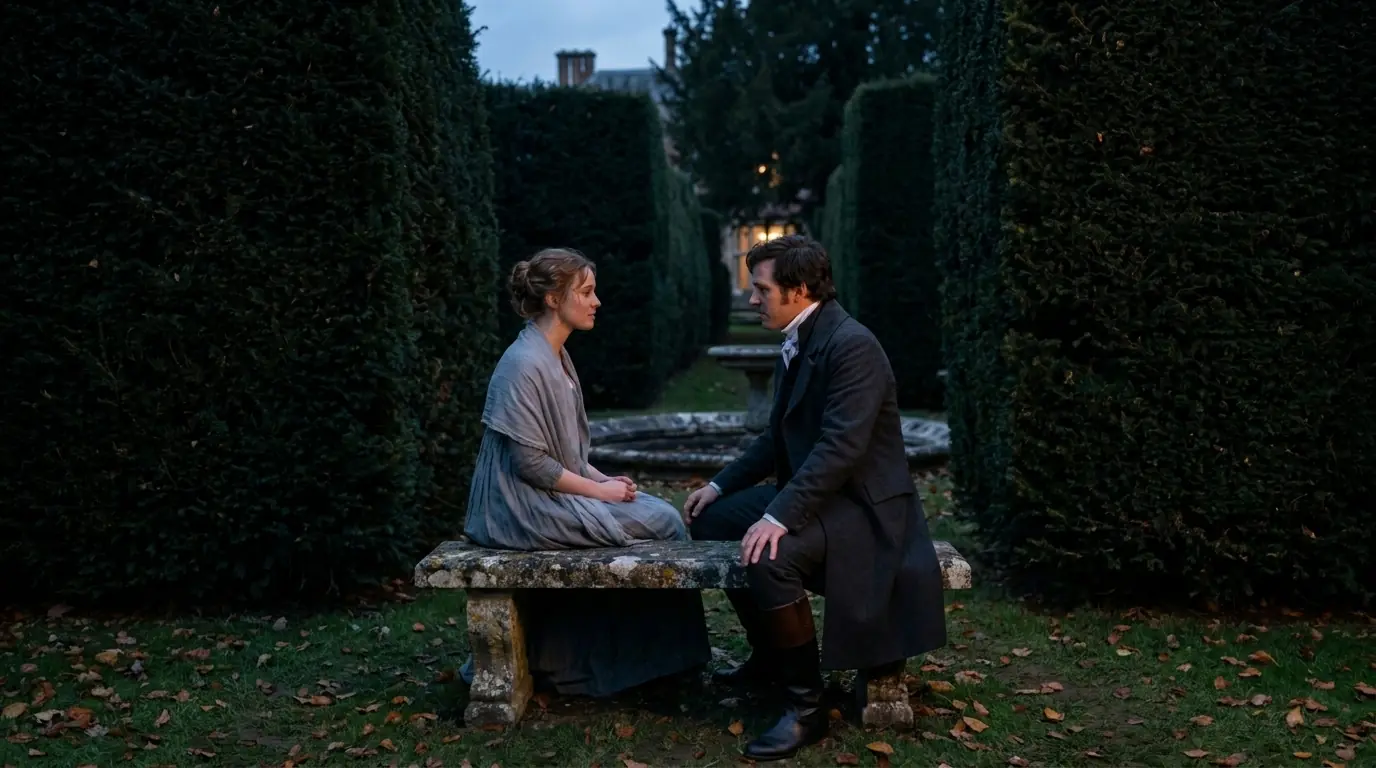
"Chin up, Cordelia," Lady Ashworth murmured, though Cordelia's chin required no correction and never had. It was the kind of chin sculptors dreamed about, set beneath eyes the color of rain-washed violets and framed by hair so fair that it seemed to hold its own private daylight, even in the gray afternoon. Lynette had spent nineteen years standing beside that face and had made a private peace with what it did to a room the moment it entered one.
"And Lynette?" Her mother did not turn around. "Do try not to wander. You know how you wander."
It was not unkind, exactly. It never was. That was the particular cruelty of it. Her mother's disappointment always arrived wrapped in the soft cloth of practicality, so that no one, least of all Lynette, could ever quite call it what it was.
You know how you wander, as though wandering were a fault of character rather than the only freedom a younger, plainer, less bankable daughter had left to her. Lynette had come to Aldercliffe Hall as furniture: the sister who would fetch Cordelia's shawl when the evening turned cool, who would sit through card games nobody wished to play with her so that Cordelia might be excused to dance, and who would smile encouragingly from the edges of ballrooms while the Duke of Aldercliffe decided which Ashworth daughter, if either, might be worth the trouble of rescuing a family from ruin.
Because that was the truth beneath the muslin and the manners. Her father had died eighteen months earlier and left behind him nothing but a portrait that did not do him justice and debts that did entirely too much justice to his gambling. Ashworth Grange was mortgaged to a degree Lynette had only half understood until she found her mother weeping over the estate ledgers at two in the morning, believing herself unheard. One advantageous marriage, one daughter, one duke, and one signature could undo eighteen months of quiet terror.
Everyone understood which daughter that marriage was meant to belong to.
Lynette climbed down from the carriage without waiting for a hand to be offered, because none would be, and stood for a moment simply looking up at Aldercliffe Hall in the softening light. It was larger than any house had a right to be, its gray stone drawn into towers and long glimmering rows of windows, its gardens rolling away in green terraces that seemed to have no end. Somewhere beyond the topiary and fountains, she could just make out the dark geometric hedges of what she guessed must be a maze.
Something in her chest loosened at the sight of it. A maze was a place with no straight lines, no obvious path, and nowhere anyone would think to look for a girl who did not particularly wish to be found.
She did not know that a man was already thinking of that very maze, and thinking of it with an intensity that would have startled her. He had been thinking of it since a chance encounter three days earlier, when Lynette had visited the grounds ahead of the formal house party and, quite by accident, he had watched her from an upstairs window kneel in the mud beside an old man's overturned wheelbarrow without a single thought for her hem.
The old man's name was Thatcher. He had served as head gardener at Aldercliffe for thirty-one years and would have told anyone who asked that the wheelbarrow had simply escaped him on the slope near the orangery, its wheel catching a root and spilling a spring's worth of transplanted delphiniums across the gravel path. What he would not have thought to mention, because it had not seemed remarkable to him at the time, was that of the four young ladies strolling the grounds that afternoon, only one had stopped.
The others had swept past with murmured sympathy, their skirts lifted carefully from the scattered soil as they resumed a conversation about the weather and the ball three evenings away. The fourth, a slight young woman in a gown that had clearly been retrimmed more than once to disguise its age, had knelt in the dirt without a word and begun gathering the broken stems. She sorted the salvageable from the lost with the quick, careful hands of someone who had done unglamorous work before and did not consider it beneath her.
"You needn't trouble yourself, miss," Thatcher had said, embarrassed.
"It is no trouble," she answered.
There was something in her voice that was neither performance nor the practiced humility of a young lady wishing to be thought sweet. It was plainer and more real, and it made the old gardener glance up at her properly for the first time.
"My father kept a garden badly," she added with the ghost of a smile, "but I learned to love the mending of things more than the growing of them."
From his window above, a man who had not meant to watch anything at all found himself unable to look away. He did not know her name. He had not yet been introduced to a single guest arriving for his own house party, having spent the better part of the day locked in correspondence with his steward over a tenant dispute he cared about far more than the ball his aunt had all but forced upon him.
But he watched a young woman with tired eyes and a mended hem kneel in the mud for a servant no one else had troubled to notice. Something in him, something that had gone quiet and careful in the two years since his brother's death and since the title had landed on his shoulders like a stone dropped from a height, stirred awake.
Later, in a manner he told himself was merely idle, he asked his aunt who the young lady in the gray-blue gown might be.
"Which one, dearest? There were four."
"The one who was not laughing with the others."
Lady Farrow gave him a long look over the rim of her teacup. She had spent forty years reading rooms for a living, and she had just read something interesting in her nephew's face.
"That will be one of the Ashworth girls. Lynette, I believe. The younger one." She paused, the silence weighted with meaning. "Not the beauty."
"I did not ask about her beauty."
"No," Lady Farrow said, setting down her cup with a faint private smile. "I noticed that you did not."
The first evening at Aldercliffe Hall was not a ball. That grandeur was reserved for two nights hence, but the supper was informal only by the standards of a household where the silver was not counted before and after every meal in case it needed to be sold. Lynette sat where she was placed, near the foot of the table beside an elderly baronet who spoke at length about drainage.
Cordelia was radiant in pale rose silk, laughing at something Lord Pelham had said, her whole face lit with an ease that came, Lynette had long ago decided, from never once doubting that a room wanted her in it. That gift was not Cordelia's fault. Lynette had tried over the years to hold on to that particular piece of fairness, because the alternative, resentment, real and corrosive, was a door she did not wish to open.
Cordelia had never been cruel to her. Not exactly. She simply did not think of Lynette very often, in the unconscious way the sun does not think of the moon. It was their mother who did the thinking on Cordelia's behalf.
During the brief interval between the fish and the fowl, Lady Ashworth leaned close under the pretense of adjusting Lynette's shawl.
"You will want to retire early tonight," she murmured. "Before the gentlemen join us in the drawing room. I have told Lady Farrow you have a headache."
"I do not have a headache."
"You will have one presently if you continue to argue with me at table."
Her mother's smile did not waver. It remained aimed down the length of the table toward the Duke's aunt, who was speaking with a gentleman no one had yet pointed out to Lynette.
"It would not do for the Duke's first impression of this family to be muddled by—" Lady Ashworth made a small, economical gesture that somehow encompassed Lynette's face, gown, hair, and existence. "A distraction."
Lynette had learned over many years precisely how much a person's chest could hurt without any visible sign reaching the face. She smiled, said something about the headache already becoming quite convincing, and excused herself before the fowl arrived.
She did not go to bed.
Instead, she slipped through the side door onto the lower terrace and passed the orangery, where a fond and foolish part of her hoped Thatcher might still be making his evening rounds. He was not, so she continued down the long gravel path she had marked that first afternoon as leading toward the maze.
The light was fading fast. The sky had become the deep bruised blue that comes just before true darkness, and the tall clipped walls of yew rose ahead like the walls of a small green city with no gates and no guards. One narrow opening cut into the hedge like an invitation.
Lynette stepped inside without hesitation, because there is a particular relief in choosing one's own confinement over one chosen by someone else. For the first time since the carriage wheels had stopped that afternoon, something in her shoulders came loose.
She had no way of knowing that she was not walking into an empty maze.
Gideon Marchmont, Duke of Aldercliffe, had come out an hour earlier, restless in the way he had been restless most evenings since his brother's funeral. No amount of estate business, correspondence, or dutiful conversation with well-meaning aunts seemed able to burn that restlessness away. It eased only in places where there were no straight lines to follow to their conclusion.
The maze had been his brother's favorite place as a boy. In the two years since his death, Gideon had come to think of it as the one part of the estate that still belonged more to grief than to duty, and therefore the one place where he could stand still without feeling the whole weight of the title pressing against the back of his neck.
He told himself he had come out tonight for the same reason he always did. He did not entirely believe himself.
He had been sitting on the stone bench at the maze's heart for nearly an hour, his coat plain and his cravat loosened, looking more like a steward or a younger son than a duke, when he heard footsteps on the gravel beyond the hedge wall. They were light, hurried, and uncertain of the turns. Something in his chest went entirely still.
He could not know with certainty that it would be her. Yet some part of him, the same part that had watched her kneel in the mud three days earlier and had not been able to look away since, had come out tonight with a hope so quiet that he had not admitted it even to himself.
He hoped that a young woman who had learned to love the mending of broken things, who had not laughed with the others, and whose eyes carried more weight than a girl her age ought to carry alone might eventually find her way to the one part of the vast, glittering house that had no interest in performance.
When she came around the final turn, saw him sitting there, and stopped with a small, startled breath, he understood with the kind of clarity that comes rarely in life and always at the least convenient moment that he had, in fact, been waiting for her.
"Oh," she said. "Forgive me. I did not realize the maze was occupied."
"It generally is not."
He rose because his mother had raised him to rise when a lady entered a room, even a room made of hedges.
"You are welcome to the solitude regardless. I was only sitting."
She hesitated at the mouth of the little clearing, clearly weighing whether propriety demanded that she retreat at once. Gideon watched the calculation cross her face with something like tenderness as she decided that propriety could, on this particular evening, be set gently aside.
"I confess I came out here to be alone," she said. "I do not suppose you would think me very rude if I sat for a moment before finding my own way back."
"I would think you very sensible. It is a good deal easier to think out here than in there." He gestured vaguely toward the lit windows of the house glowing gold beyond the dark hedges. "Fewer people telling you what to think."
Something crossed her face: surprise, and beneath it the faintest unguarded flash of relief, as though he had said aloud something she had believed no one else in the world understood.
She sat carefully at the far end of the stone bench, arranging her skirts with the automatic neatness of a woman who had spent a lifetime taking up as little room as possible.
"You are a guest here too, then?" she asked. "I had not been introduced."
"Something of the sort," he said, which was not strictly a lie. "And you?"
"Lynette Ashworth."
She said it plainly, without the small performative flourish some young ladies gave their own names, as though testing whether he would recognize it, find it wanting, and move on to more promising conversation. She simply said it and waited to see what he would do with it.
What he did was ask, with genuine curiosity, whether Lynette was a family name. She told him with a dry humor that surprised a laugh out of him, low and rusty as though the muscles required for it had gone unused too long, that she had been named for a small, plain, brown bird while her sister had been named Cordelia, for a queen.
"I spent a good many years believing my parents made an honest accounting of their daughters before the naming had even begun," she said.
"I like linnets," he replied, and meant it. "They have a very fine singing voice for a small brown bird. People forget that when they are looking at the feathers."
She looked at him then, properly looked at him for the first time, her eyes catching the last gray light of the deepening sky. Something passed between them that neither had words for yet, quiet and startled and entirely too large for a stone bench at the center of a garden maze.
"You are an unusual sort of guest," she said at last.
"So I have been told."
He did not tell her why.
They talked longer than either intended. They began with books because Lynette mentioned, almost by accident, a novel she had been reading in secret, her mother having declared novels a waste of a young lady's improving hours. Gideon had read the same book and disagreed thoroughly with her opinion of its ending. The disagreement carried them through a full quarter of an hour with the particular pleasure of two people discovering that they could argue happily.
Then they spoke of gardens because he asked whether she had learned her love of mending things from her father. Lynette answered carefully, the way a person offers a partial truth to a stranger and waits to see how much weight it can bear.
"My father loved beautiful things," she said. "He was considerably less careful about keeping them."
Gideon did not press her to explain. She noticed that he did not press, and something in her that had spent eighteen months holding its breath, waiting to be blamed, managed, or quietly filed away as the daughter who did not matter began very cautiously to exhale.
The church bell in the village beyond the park struck the half hour. Lynette rose reluctantly, aware that her absence would soon be noticed even by a mother distracted with grander concerns.
"You will be at the ball?" she asked.
"I expect I will."
"I do not dance particularly well," she said with the frank self-deprecation of a woman who had made her peace with the fact long ago. "My sister has all the grace in the family. I was given the sense instead, which is a good deal less useful at a ball."
"I find that very hard to believe."
"Which part?"
"Any of it."
The low warmth in his voice made her flush in the dark, where she told herself he could surely not see it.
He walked her to the mouth of the maze because he would not have forgiven himself for letting her cross the dark lawn alone. At the threshold, where the gravel path divided toward the house, she paused and looked back.
"I do not know your name."
He felt the lie waiting on his tongue, the easy false answer he could have given, and discovered that he did not want to give it. Not the false modesty of an invented name. Not tonight.
But neither was he ready for her to know the truth. He did not yet understand whether what had passed between them in the darkness could survive the particular weight his real name carried into every room it entered.
"Call me Gideon," he said, which was true as far as it went. "I find titles make for very poor conversation."
She smiled, a real and unguarded smile, the first he had seen from her all evening, and said that it was the wisest thing anyone had told her in a very long while. Then she left him standing at the mouth of the maze, his heart doing something it had not done in two long years, while her slight figure crossed the dark lawn toward the golden windows of the house that, though she did not yet know it, belonged to him.
Gideon stood there long after she had gone, turning over the strange certainty that had settled into his chest. He had come to the house party expecting to perform his duty and choose a bride from among the eligible daughters his aunt had assembled for his inspection. Instead, on the very first evening, in the one place at Aldercliffe that still belonged to grief rather than duty, duty and something far warmer had quietly become the same thing.
Lynette did not sleep well that night, though not from unhappiness. She lay awake in the unfamiliar bed in the small guest room she had been given, tucked near the servants' stair and noticeably smaller than Cordelia's, turning over every word Gideon had said. She tested his words the way a person tests ice before trusting it with her full weight.
He had not asked about her dowry. He had not glanced once toward the lit windows of the house to see whether anyone of consequence might be watching him speak with her. He had asked what she thought, and then, the part she kept returning to in the darkness with a small helpless smile she was glad no one could see, he had listened to the answer as though it mattered.
She told herself firmly that he was almost certainly a younger son or some land agent's relation invited to fill out the numbers at a house party heavy with eligible young ladies and correspondingly short of eligible young men. Whatever had passed between them on the stone bench was a pleasant evening's conversation and nothing more, the sort of thing a sensible woman filed away and did not build foolish hopes upon.
She told herself this several times. She did not entirely believe it.
The next morning brought the first true test of her resolve in the form of her mother's voice through the connecting door before Lynette had finished dressing.
"You were seen coming in late last night."
Lynette's hairbrush stilled. "I went out for air."
"Alone, at that hour, in the gardens of a house you have occupied for less than a day?"
Lady Ashworth appeared in the doorway already dressed for the morning in a manner suggesting she had been awake and strategizing for some time.
"Lynette, I do not ask a great deal of you. I have never asked a great deal of you. I ask only that you not embarrass this family at the one moment when embarrassment cannot be afforded."
"I embarrassed no one. I sat in a garden and thought my own thoughts, which I understand is not yet a crime, even for the daughter who does not matter."
The words came out sharper than Lynette intended. Something flickered across her mother's face, not quite guilt, because Lady Ashworth did not permit herself guilt, but something adjacent to it and quickly smoothed away.
"That is not what I said."
"It is what you meant. It is what you have meant for eighteen months."
Lynette set down the hairbrush with more care than the moment required because she did not trust her hands not to shake if she failed to concentrate on them.
"I know why we are here, Mother. I know what is being weighed, and I know which daughter is meant to tip the scale. You need not remind me every morning as though I might otherwise forget."
Lady Ashworth remained silent for a long moment. When she spoke again, her voice had lost its edge and acquired something more tired, more honest, and more difficult to argue with.
"Your father left us nothing but debts and a roof that leaks in November. Lynette, I am not asking you to disappear because I do not love you. I am asking you to disappear because I do not know how else to save this family. Cordelia's face is the only currency we have left."
It was the most truthful thing her mother had said in a year, and it hurt considerably more than the cruelty because there was no cleanly drawn villain in it to resent. There was only a frightened woman, a dead man's debts, and a daughter who had never been asked what she herself might want because there had never seemed to be room in the calculation for wanting.
"I will not embarrass Cordelia," Lynette said quietly. "I never intended to. But I will not disappear either, Mother. Not entirely. I do not think I have that left to give."
Her mother looked at her for a long moment, really looked in a way she had not for longer than Lynette could remember, then nodded once and left without another word.
Lynette sat alone at the dressing table and discovered that her hands had, after all, been shaking the entire time.
The two days before the ball passed in a blur of small mortifications and one bright secret thread running through their center like a single strand of gold in an otherwise gray weave. Lynette saw Gideon twice more before the ball.
The first time was briefly across the breakfast room, where he sat at the far end of a long table beside his aunt and did not, to her private relief and private disappointment in equal measure, so much as glance her way. The second was properly, in the walled rose garden on the following afternoon, where she had gone to escape a card game she had no interest in and found him already there, ostensibly examining a trellis and, she suspected, waiting.
"You have been avoiding me," she said without preamble, because two days of careful thought had convinced her that whatever existed between them deserved more honesty than the usual games.
"I have been managing my time carefully," he corrected with the ghost of a smile. "There is a difference, though I confess it may look identical from where you are standing."
"And what does careful management of time look like, precisely?"
"Like not making a spectacle of myself over a young lady in a house full of people who would very much enjoy watching me do it."
Something in his voice, dry but threaded with real feeling, made her breath catch.
They spoke for another half hour in the rose garden. This time, Lynette found herself telling him more than she meant to: about her father, the debts, and the particular exhaustion of being loved conditionally her entire life, loved as far as she was useful and no further.
She had not meant to say so much. She blamed the particular quality of his listening, the way he did not flinch or offer easy comfort, but simply allowed her words to land and sit between them, taking their full weight seriously.
"That is a great deal to carry," he said when she finished.
"Everyone carries something."
"Not everyone carries it so gracefully."
She looked sharply at him, searching his face for mockery and finding none. There was only careful, focused warmth, and it made her chest ache in a way she did not have a name for.
"You say a great many kind things for a man who will not tell me his last name."
Something shifted behind his eyes. She would later think of it as the first true shadow she had seen cross his face, brief and quickly mastered.
"I will tell you soon. I promise. I ask only that when I do, you remember this conversation exactly as it happened and do not let anything that comes afterward rewrite it."
It was a strange request. She turned it over for the rest of the day, unable to shake the small cold thread of unease it left behind, twined through the warmth like a single dark stitch in bright cloth.
The night of the ball arrived with the particular violence important nights always seem to bring. A burst pipe in the laundry meant half the household linens had to be pressed at speed. A missing glove sent a maid close to tears. Cordelia stood before the long mirror, radiant and nervous in equal measure, in a gown of deep sapphire silk that had cost, Lynette happened to know, more than the household's grocery bill for an entire season.
"You look beautiful," Lynette told her, and meant it, because envy and love were not mutually exclusive things.
"Do you think he will dance with me?" Cordelia asked for the fourth time that evening, twisting her gloves between anxious fingers.
Lynette felt the small, unexpected tug of tenderness she always felt when her sister's confidence cracked just enough to reveal the frightened girl beneath it. Cordelia was not unkind. She was simply young and beautiful and had been taught since infancy that beauty was the only coin she possessed. That made her, in her own way, as trapped by the calculation as Lynette.
"I think everyone will dance with you," Lynette said.
It was true, and it did not answer the question beneath the question.
Lynette's own gown was pale green silk worn to three previous seasons, taken in, let out, and retrimmed so many times that only she could have said with certainty what its original shape had been. She did not resent it particularly. She had made peace with being the daughter who wore last season's gown while her sister wore this season's.
Fastening the small string of her late grandmother's pearls at her throat, she told herself that a woman need not glitter to be worth looking at. She did not entirely believe that either, but believed it enough to walk into the ballroom with her chin level, which on nights like this was the only victory that mattered.
The ballroom took her breath away despite herself. Three great chandeliers blazed overhead. The long windows stood open to the terrace and dark gardens beyond, an orchestra tuned in the gallery, and two hundred of the county's most fashionable people glittered and murmured beneath the lights.
The entire purpose of the gathering, though no one would have said so aloud, was to determine which young lady the Duke of Aldercliffe found worth marrying.
Lynette had not yet laid eyes on the Duke. In fact, she had almost forgotten to wonder about him, so occupied were her thoughts with a man in a plain coat who called himself Gideon and refused to give her his last name.
She was scanning the crowd for that particular dark head, half hoping and half dreading to find him, when the orchestra fell silent.
The doors at the head of the ballroom opened. Lady Farrow's voice rang across the hush.
"His Grace, the Duke of Aldercliffe."
Lynette turned with two hundred other pairs of eyes toward the doorway and felt the entire floor drop away beneath her feet.
He stood framed by the doors in dark evening clothes fitted with the effortless precision of a man whose tailor did not dare be careless. His dark hair had been swept back, and his bearing was entirely different from the loose, unguarded ease of the man on the stone bench. Yet he was unmistakably, devastatingly, the same man.
Gideon Marchmont was the Duke of Aldercliffe.
The room seemed to tilt sideways. Beside her, Cordelia drew a small breath of astonished delight. Lady Ashworth released a soft, satisfied exhalation, as though eighteen months of dread had at last begun to loosen.
Neither of them knew, could possibly know, that the daughter standing frozen beside them had spent two evenings pouring her whole guarded heart out to the very man the entire ballroom had gathered to court.
Lynette had told him about the debts. She had told him about her father's failures, about being loved conditionally, and about being the daughter who did not matter. She had told the Duke, the very duke upon whom her family's future depended, every private humiliation she had never spoken aloud to another living soul because she believed him to be no one of consequence at all.
Shame arrived first, hot and total, followed almost at once by something colder and sharper. Had he known that first night in the maze? Had he sat on that stone bench and allowed her to speak so freely because he wished to see what a foolish, unguarded girl might reveal when she believed nothing was at stake?
Across the ballroom, through a sea of curtsying heads and craning necks, Gideon's eyes found hers. In the half second before Lynette looked away, she saw that he understood exactly what was passing through her mind. Whatever he saw in her face made him look, for one instant, entirely stricken.
She could not flee the ballroom outright. That would have been precisely the spectacle her mother had spent two days warning her against, and Lynette had never given Lady Ashworth the satisfaction of being proven right about her wandering.
So she stood her ground through the receiving line, through the agonizing formal introductions, and through the moment when the Duke of Aldercliffe bowed over her hand with perfect, distant courtesy.
"Miss Ashworth."
There was no trace in his voice of the low, warm laughter she had coaxed out of him two nights before.
"Your Grace."
Her own voice was equally distant and equally correct. Something in her chest cracked cleanly in two.
Over the following hour, duty performed itself around her with the terrible clarity of a play whose ending everyone in the theater already knew. The Duke danced the first set with a young lady of impeccable connections, as etiquette required. He danced the second with Cordelia.
Lynette watched her sister glow beneath his attention. She watched the entire ballroom watch them. She watched her mother's face acquire the particular luminous expression of a woman seeing eighteen months of dread finally begin to lift, and told herself fiercely that this was exactly as it should be.
This was, after all, precisely what Lynette had come to Aldercliffe to make possible.
She did not dance. She had expected not to. She had told Gideon as much in the maze, in another life that now felt as though it belonged to someone else.
She stood near the long windows instead, accepting a glass of lemonade she did not drink and watching the golden blur of the ballroom with the strange hollow calm of a person observing her own life from a slight distance.
She did not see Gideon cross the floor until he was almost beside her.
"Miss Ashworth." His tone was formal, but pitched for her alone beneath the swell of the orchestra. "Would you do me the honor of the next set?"
"I told you I do not dance well, Your Grace."
She could not keep the edge from the title or stop her eyes from sliding involuntarily toward her mother, who was watching the exchange with an expression of dawning, disbelieving hope.
"I imagine there are a great many partners here better suited to a duke's ballroom."
"I do not want a great many partners." His voice was low and urgent, entirely unlike the smooth, practiced courtesy he had shown every other young lady that evening. "I want the woman who told me two nights ago that titles make for very poor conversation. Give me the chance to prove she was wrong to think I had forgotten that the moment mine was announced."
Lynette looked at him properly, past the fine evening clothes, the dark hair, and the weight of every eye in the ballroom observing their exchange with barely disguised curiosity. Beneath all of it, she saw the same man who had sat with her in the darkness and listened as though her words mattered.
"You let me speak to you as though you were no one," she said quietly. "You let me tell you things I have never told anyone."
"I let you speak to me as though I were myself," he corrected gently, "which is a good deal rarer in my experience than being spoken to as a duke. I did not deceive you to test you, Miss Ashworth. I withheld my name because I have spent two years being courted for a title I never asked to inherit, and for one evening, one single evening, I wanted to know what it felt like to be wanted for something else entirely."
His jaw tightened.
"I should have told you sooner. I meant to tell you in the rose garden, and I lost my courage because I was afraid of exactly this look on your face."
The orchestra swelled into the opening bars of a new set. The ballroom had become quietly and intensely interested, as ballrooms always did when a duke stood too long and too close to a young lady of no particular fortune.
"Dance with me," he said again, holding out his hand. "Let the rest of the room think what it likes. I find I no longer particularly care."
Lynette looked at his outstretched hand for a long moment. She felt her mother's eyes, her sister's eyes, and the eyes of two hundred strangers fixed on the answer she was about to give.
Then, very slowly, she placed her hand in his.
The room, Lynette would think later, had never gone silent so quickly.
It should have been a triumph. In the strange arithmetic of a ballroom, a duke's public choice of partner was meant to settle questions rather than raise them. For one golden half hour, as she and Gideon moved together through the figures of the dance with a fluency that surprised them both, Lynette discovered that she had lied about dancing poorly.
She danced beautifully when she forgot to be afraid.
For the length of that set, she allowed herself to believe that something rare and true had simply and impossibly chosen her. But triumphs of that kind are rarely permitted to stand unchallenged, and the challenge, when it came, arrived from precisely the direction Lynette had least expected.
It was not Cordelia.
To her enormous and lasting credit, Cordelia watched her sister dance with the Duke of Aldercliffe with an expression that shifted over the course of the set from startled hurt to something more complicated, and finally to something almost like relief. It was as though a weight she had never asked to carry had just been lifted from her narrow shoulders by someone else's hand.
The challenge came instead from Lord Pelham, a gentleman of comfortable fortune and considerably less comfortable temper. He had spent the earlier part of the evening paying Cordelia the kind of pointed attention that suggested serious intentions, and he watched the Duke's sudden public interest in the plainer, poorer Ashworth sister with the calculating eye of a man reassessing an investment.
During the supper interval, he found Lynette near the refreshment table while her mother was occupied elsewhere and cornered her with practiced smoothness.
"A remarkable turn of events, Miss Ashworth," he said with a smile that did not reach his eyes. "One wonders how a young lady with, forgive my bluntness, so little to recommend her in the way of fortune managed to secure His Grace's particular interest so very quickly."
"I imagine His Grace makes his own decisions, my lord, regardless of what recommends me."
"Of course. Though it does make one curious."
He lowered his voice and glanced around to ensure they were not overheard.
"I understand your late father left the family in rather significant debt. Some might wonder whether a clever young lady, aware of her family's straits, might not go to considerable lengths to secure a fortune capable of resolving them. Some might even call it a scheme cleverly played."
The accusation struck like a slap because it stood near enough to one version of the truth to sting, while remaining far enough from the truth of her heart to feel like a violation. Lynette had known from the moment their carriage departed Ashworth Grange exactly what rested upon this house party. But she had not arranged that first meeting in the maze. She had not known, could not have known, who sat on the stone bench.
"You are entitled to wonder, my lord," she said, keeping her voice level through sheer force of will. "I am not obliged to satisfy you."
"No," he agreed with a thin smile. "But I imagine His Grace's aunt might feel considerably more obliged to hear the matter satisfied when the question is put to her directly. A scandal of that shape—a fortune-hunting daughter of a bankrupt estate deceiving a grieving duke into believing her affection genuine—would do a great deal of damage, Miss Ashworth, to a family that can afford no further damage at all."
He left her shaking beside the untouched lemonade. It required every ounce of composure she possessed to walk back into the ballroom with her chin level as though the ground had not shifted dangerously beneath her feet.
Once planted, the rumor grew with the terrible speed such things always possess among a crowd already primed to enjoy a scandal. By the following morning, it had threaded its way through the breakfast room in murmured fragments.
A fortune hunter, some said. A scheme arranged with her mother's full knowledge, others embellished. A girl clever enough to contrive an accidental meeting in a dark maze, knowing perfectly well whom she would find there.
Lynette heard the last version from her own mother. Lady Ashworth arrived at her door white-faced and trembling with an anger that took Lynette several confused moments to understand was not directed at her.
"They are saying you planned it," her mother said without preamble. "That you knew who he was from the very first evening and arranged to be alone with him so you might trap him into—"
She stopped, pressing a hand to her mouth.
"Lord Pelham has been most vocal on the subject. I have just come from Lady Farrow, who wished to know in the gentlest possible terms whether there was any truth in it."
Lynette's stomach dropped. "And what did you tell her?"
"I told her the truth, because it is the only weapon I have left to use on your behalf. I told her my daughter did not know the Duke of Aldercliffe from a stable hand until the moment his name was announced before the entire ballroom. I told her that my daughter has spent her whole life being taught that she was not important enough to warrant careful scheming for anything at all."
Lady Ashworth's voice cracked over the final words. Lynette realized with a second shock beneath the first that her mother was weeping, truly and openly weeping, perhaps for the first time since her husband's funeral.
"I have done you a terrible unkindness these eighteen months," Lady Ashworth said. "Lynette, I made you small because I believed it would keep this family safe, and instead I have handed a vicious man exactly the shape of story he needed to destroy you with. I am sorry. I am so sorry."
Lynette crossed the room. For the first time in longer than either could remember, she put her arms around her mother. They stood together in the cold morning light, holding each other with the particular fierceness of people who have discovered too late how much they had withheld from one another out of fear.
"We will manage it," Lynette said, though she had no idea how.
She did not see Gideon that day. A maid whispered that he had shut himself away with his aunt and solicitor to manage the sudden, delicate matter of a scandal threatening to attach itself to his household on the very weekend intended to secure his future.
Lynette told herself she understood. A duke could not simply ignore a rumor of this shape. He had tenants, estates, obligations, and a family name to consider, burdens far beyond the reach of one evening's tenderness in a garden maze.
She repeated this to herself through a long, silent afternoon spent in her room while the rest of the house party murmured below. By evening, she had not entirely persuaded herself.
At nine, a footman delivered a note requesting her presence in the library. Alone.
She went half expecting rejection and half hoping for something else, her heart beating so hard she thought he must hear it when she entered. Gideon stood beside the fire. He turned at the sound of the door, and the look on his face—raw, unguarded, and entirely unlike the composed expression he had worn in the ballroom—told her before he spoke that this was not rejection.
"I have spent the entire day being told by a great many well-meaning people that the sensible course is to distance myself from you until the rumor dies of its own accord," he said without preamble. "They say a duke cannot afford to be seen defending a woman accused, however unjustly, of scheming for his fortune. They say the wisest course, for the sake of my name, my tenants, and my aunt's peace of mind, is to let you quietly withdraw from this house party and permit the matter to fade."
Lynette's throat tightened. "Is that why you sent for me?"
"No."
He crossed the room in three quick strides. There was something fierce in his face she had not seen before, and it made her breath catch.
"I sent for you because I have spent an entire day listening to sensible people give me sensible reasons to abandon the one honest thing that has happened to me in two years of grief, duty, and careful, exhausting performance. I find that I do not wish to be sensible."
He stopped before her.
"I want to marry you, Miss Ashworth. Not because it would resolve the scandal neatly, though I imagine it might. Not because your family's circumstances move me to pity, though they do, and I am ashamed of every comfortable hour I have ever spent while a woman I care for went cold with worry. I want to marry you because you sat beside me on a stone bench in the dark and spoke to me as though I were simply a man. I have not felt like simply a man since the day my brother died and the title fell upon me like a stone. You gave that back to me. I am not willing to let sensible people talk me out of it."
Lynette stared at him, tears rising hot and sudden, unable for a moment to find any words.
"Lord Pelham will not be satisfied by a proposal," she managed at last. "He will say it proves the scheme succeeded."
"Lord Pelham," Gideon said, with a grim edge she had not heard before, "will discover that dukes, whatever their other failings, are not without resources when it comes to defending those they love. He will not trouble you again. That I promise."
His expression softened as he reached for her hand.
"But none of that is the true question tonight. The true question is only this: do you want it? Not the debts resolved or the scandal silenced. I will see to those things regardless, because it is right, and I find I am done waiting for the right thing to become convenient. Do you want me, Lynette? The man on the bench, not the title?"
She looked up at him, at the man who had listened to her broken confessions in the dark without flinching. He had waited, quite literally, in the one place at Aldercliffe that still belonged to grief, hoping a girl who had learned to love the mending of broken things might find her way there.
A certainty settled through her like warmth returning to cold hands. This was not a question that required careful weighing.
"I want the man on the bench," she said. "I have wanted him since before I knew there was anything else to want."
He kissed her in the firelit library, gently at first and then with a depth of feeling that told her more clearly than any words could have that two years of guarded grief had finally found its way home.
The public reckoning came the following morning and proved swifter and more satisfying than Lynette had dared hope. Gideon did not challenge Lord Pelham to a duel or indulge in any crude theater. He did something far more devastating to a man like Pelham: he corrected him coolly, precisely, and publicly before the assembled house party at breakfast.
The Duke of Aldercliffe stated without room for dispute that he alone had sought Miss Ashworth's company in the maze, unannounced and unrecognized. She had known nothing of his identity until it was declared before the entire ballroom. Any gentleman who continued to suggest otherwise would find himself unwelcome at Aldercliffe Hall and in every house where the Duke's good opinion carried weight.
As everyone at the table understood, that included nearly every house of consequence in the county.
Lord Pelham departed before luncheon.
That same afternoon, Cordelia sought Lynette out in the rose garden, where not so many days before Lynette had first learned that honesty could be a kind of courage. Cordelia twisted her gloves in the way she always did when nervous.
"I am glad," she said without preamble. "I know I ought perhaps to be devastated, since Mother had rather set her heart on—well, you know what she set her heart on. But I think I am glad, Lynette, and I think that surprises me more than it surprises you."
"Why are you glad?"
Cordelia looked over the roses with an expression Lynette had rarely seen on her sister's face, something thoughtful and almost sad.
"Because I have spent my whole life being told my face was the only thing that mattered about me. I have never once, not in nineteen years, had anyone look at me the way that man looked at you last night. Not for my face, but for something else entirely."
She turned to Lynette, her eyes bright.
"I think I should like to be looked at that way someday. I do not think I shall find it by being chosen for my face. I think I must be brave enough to be known first, the way you were."
Cordelia reached out and squeezed her sister's hand.
"You were always the braver one, Lynette. I only ever had the easier road to walk. I am sorry it took me nineteen years to notice."
It was, Lynette thought while blinking back sudden and unexpected tears, the truest conversation she and her sister had ever shared, and the beginning, she hoped, of many more.
The formal betrothal was announced three weeks later at a smaller, quieter gathering than the grand ball that had begun it all. Lynette and Gideon made that choice deliberately, wanting the moment to belong to them rather than to the county's appetite for spectacle.
Lady Ashworth, who had spent eighteen months learning to calculate her daughters' worth in the cold currency of debt and desperation, wept through the ceremony. For weeks afterward, she told anyone willing to listen that she had always known, always known, that her Lynette was destined for something remarkable.
Lynette forgave the small revision of history. She had come to understand that there was a particular grace in allowing people room to grow into their better selves, even when the growth came later than one might have wished. Her mother's fear, however imperfectly expressed, had never in truth been separate from love.
The debts were settled quietly, without fanfare, in the manner of a man who had learned that the finest gestures asked for no gratitude in return. The leaking roof at Ashworth Grange was repaired before the following November.
When Thatcher heard of Miss Ashworth's engagement to his master, he allowed himself, for the first time in thirty-one years of careful service, to be seen grinning like a boy across the length of the kitchen garden.
On a soft autumn evening some months after their first meeting, Gideon led his wife-to-be through the winding green corridors of the Aldercliffe maze. They returned to the same stone bench where two strangers had once sat together in the darkness, unaware of everything waiting to unfold between them.
"Do you remember?" he asked, drawing her down beside him. "You told me you hoped I would not think you rude for wishing to sit alone a moment before finding your way back."
"I remember."
"I have thought of it every day since. I think of how close I came to losing my courage in the rose garden and letting you walk away still believing yourself the daughter who did not matter."
He lifted her hand and pressed a kiss to her knuckles with a tenderness that still made her breath catch.
"I want you to know something, Lynette, and I want you to believe it entirely, because I intend to spend the rest of my life proving it true. You were never furniture in any room I have ever occupied. From the first afternoon, when you knelt in the mud to rescue an old man's spilled flowers while three other young ladies swept past without a glance, you were the only person in that garden I could not stop watching."
He held her gaze.
"I did not wait for you in the maze because I was testing you. I waited because some part of me already knew, before I had even learned your name, that you were the one person at that entire house party worth waiting for."
Lynette looked at him in the fading light. He had found her worth seeing when no one else had thought to look, and he had chosen honesty over convenience and love over the safe, sensible calculations of dukedom. For the first time in her life, she felt the full and settled certainty of being exactly and completely known.
"Then I am glad," she said softly, "that I chose this maze in which to hide."
"So am I," he murmured, drawing her close as the last light faded gold over the hedges. "So, my love, am I."
They were married the following spring in the small stone chapel at Aldercliffe. Cordelia stood as her sister's attendant in a gown of simple gray-green that Lynette had chosen herself. Lady Ashworth wept happily in the front pew, and old Thatcher watched from the back while flowers he had grown with his own hands lined every windowsill of the church.
The ceremony was neither grand nor fashionable enough to satisfy the appetite of the ton, but it suited Lynette and Gideon. He waited for her at the altar not with the remote, polished expression of a duke receiving what duty had assigned him, but as the man on the stone bench: the man who had laughed rustily over a novel's ending, listened to truths she had never spoken aloud, and chosen her before he knew whether choosing her would make his life easier or harder.
The ton talked for a full season about the extraordinary tale of the plain Ashworth sister who had hidden in a duke's garden maze and found, instead of solitude, the one man in England who had been waiting there quite patiently and quite certainly for her. Some made Lynette cleverer than she had been, others made Gideon more reckless, and a few preserved Lord Pelham's rumor in softened form because certain people preferred scandal to admitting they had judged an innocent woman badly.
Lynette found in the years that followed that she cared a good deal less for what the ton made of her story than for the simple private truth at its center. She had spent nineteen years believing herself to be the daughter who did not matter and had discovered in the deepening dusk of a stranger's garden that she had been wrong about herself all along.
She had only ever needed one person to see her clearly. It had simply taken a maze, a waiting duke, and a great deal of courage on both their parts to find that truth. Once found, neither of them ever let it go.