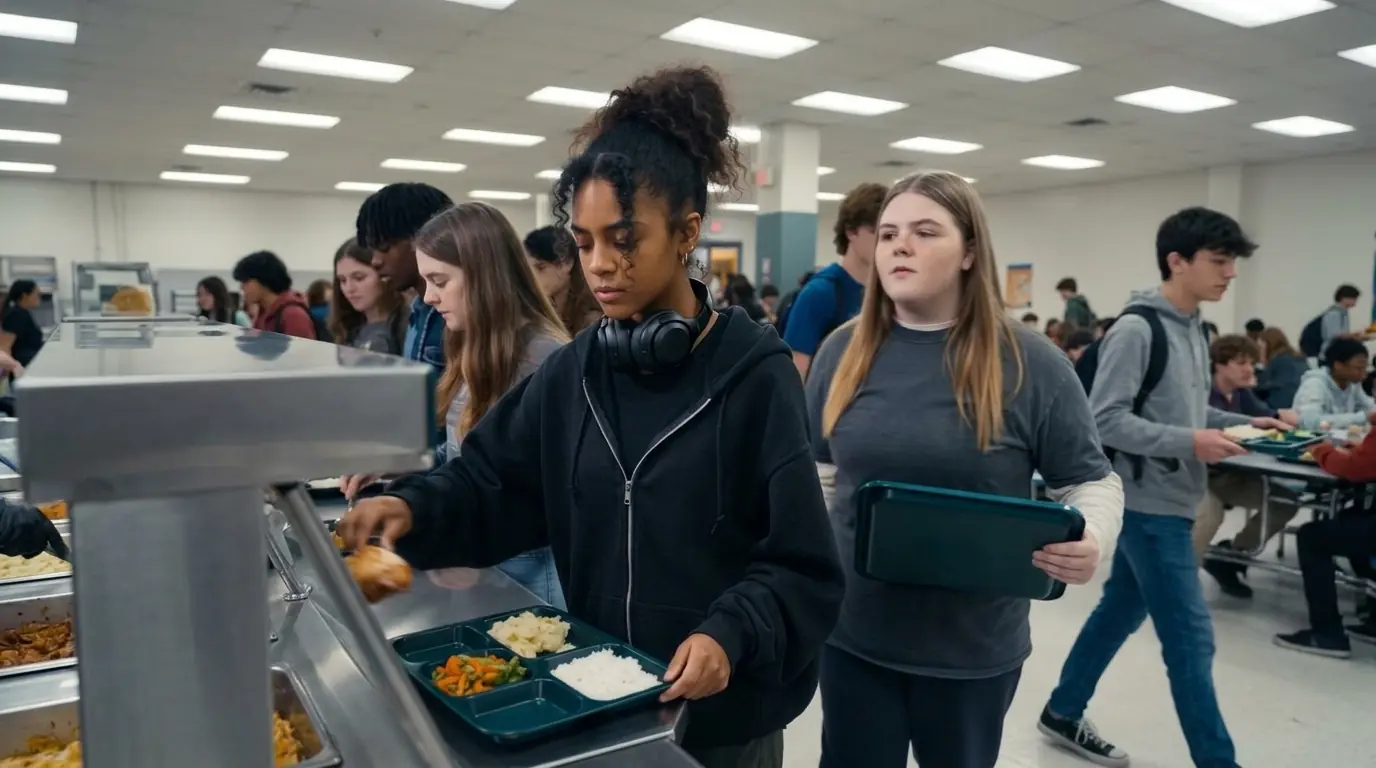
When Maya Reynolds transferred to Harrison Ridge High School in January, she made one promise to herself.
She would finish senior year quietly.
No drama, no cliques, no trying to become popular four months before graduation. She would go to class, keep her grades high enough to protect the college scholarship she was chasing, work her evening shifts at the neighborhood pharmacy, and leave Harrison Ridge in June without anybody having much to say about her.
For the first two weeks, it seemed possible.
Maya was seventeen, tall and lean, with thick black curls she usually pulled into a messy bun and a pair of black headphones that spent more time around her neck than over her ears. Her mother joked that Maya dressed as though every day had accidentally become laundry day—black hoodies, black sweatpants, black sneakers, maybe gold hoops if she felt ambitious. Maya liked it that way.
At her old school in Dayton, people knew her.
They knew she had run track since middle school, that she could solve a calculus problem faster than she could parallel park, and that she worked Saturdays because she hated asking her mother for money. At Harrison Ridge, she was simply the new Black girl standing beside the guidance counselor on a cold January morning while somebody tried to remember which locker had been assigned to her.
Maya preferred that.
Her mother, Denise Reynolds, did not.
“You’ve barely mentioned anyone at school,” Denise said one evening while cutting vegetables at their apartment kitchen counter.
“I’ve been there nine days.”
“You can meet a person in nine days.”
“I met teachers.”
“Teachers don’t count.”
“They’re people.”
“They’re employed to talk to you.”
Maya smiled and reached for a carrot.
Denise slapped her hand away.
“Wash your hands.”
“I just did.”
“You touched your phone.”
“Mom.”
“Wash them.”
Maya obeyed.
Their move to Mason Creek, Ohio, had not been optional. Denise had spent nearly two years commuting forty-five minutes each way to her job as an ultrasound technician at St. Anthony Medical Center, and when an apartment finally opened close enough for her to cut the commute in half, she took it.
It meant Maya had to leave her old high school in the middle of senior year.
It also meant Denise would finally get home before eight most nights.
Maya had told her mother the trade was worth it.
Most days she believed that.
Then she met Claire Bennett.
Claire was standing behind Maya in the cafeteria line on a Tuesday afternoon when they first spoke.
Maya was deciding whether the cafeteria’s baked chicken looked edible when a voice behind her said, “You know you’re blocking everybody, right?”
Maya glanced over her shoulder.
A heavyset white girl with long light-brown hair stood holding a turquoise lunch tray against one hip. She wore a gray T-shirt over a white long-sleeved shirt, faded jeans, and the kind of smirk that suggested the comment had been meant for more than one person.
There were two students between Claire and the next person in line.
Nobody appeared blocked.
Maya looked back at the food.
“I’ll try to recover from the embarrassment.”
The cafeteria worker almost laughed.
Claire did not.
“What?”
Maya picked up a pair of serving tongs.
“I said I’m moving.”
She placed chicken on her tray and continued down the line.
That should have been the end of it.
It was not.
Claire Bennett had attended Harrison Ridge since sixth grade. She was not a cheerleader, class president, star athlete, or anything else that would explain the amount of influence she seemed to have over certain students. What Claire possessed instead was a talent for discovering weakness and making other people laugh at it before the person being targeted could decide how to respond.
She had friends in every grade.
Not close friends, necessarily.
An audience.
That was more useful.
Claire could walk into a cafeteria, point at somebody’s shoes, say two words, and cause six people to laugh. She knew which freshmen were desperate to belong, which seniors enjoyed cruelty as long as it arrived disguised as a joke, and which teachers would rather say ignore her than spend an afternoon documenting a complaint.
Maya learned most of that from Jordan Kim, the boy assigned to the desk beside hers in AP Statistics.
Jordan had watched Claire stare at Maya for nearly an entire class period after the cafeteria exchange.
“You make friends fast,” he said.
Maya looked at him.
“What?”
“Claire.”
“I don’t know Claire.”
“She knows you.”
“That sounds ominous.”
“It’s not ominous.”
Jordan thought about it.
“Maybe a little.”
Maya went back to her worksheet.
“What did I do?”
“You didn’t react.”
“To what?”
“Her.”
Maya laughed.
“That’s a thing?”
“At this school? Sometimes.”
She assumed Jordan was exaggerating.
Then little things started happening.
Claire would pass Maya in the hallway and say, “Dayton,” instead of using her name. When Maya asked why, Claire said she had forgotten it.
Someone took Maya’s water bottle from a library table and placed it in a trash can.
A photograph appeared on a student-run social-media account showing Maya sitting alone at lunch with her headphones around her neck.
WHEN YOU THINK YOU’RE TOO COOL TO TALK TO ANYBODY.
Jordan showed her the post.
Maya shrugged.
“I look good.”
“That’s your takeaway?”
“The lighting is decent.”
“They’re making fun of you.”
“I’m devastated.”
Jordan studied her.
“You really don’t care?”
Maya locked his phone and handed it back.
“I care about people I like.”
That answer eventually reached Claire.
Maya never learned who repeated it.
The following afternoon, Claire sat down across from her in the cafeteria without asking.
Two girls came with her.
Maya recognized one as Lexi Morgan, a sophomore who seemed to laugh whenever Claire looked in her direction. The other was Hannah Price, a senior with dark hair who mostly stared at her phone.
Claire rested both forearms on the table.
“So you don’t care about people here?”
Maya continued eating.
“I didn’t say that.”
“You said you only care about people you like.”
“That’s usually how caring works.”
Lexi laughed.
Claire looked at her.
Lexi stopped.
Maya noticed.
That was the first time she understood the relationship.
Claire was not simply funny.
People around her waited for permission to decide what was funny.
“You think you’re better than everybody?” Claire asked.
“No.”
“You act like it.”
“How?”
“You barely talk.”
Maya blinked.
“That’s the complaint?”
Claire leaned back.
“I’m just saying, people think you’re rude.”
“Which people?”
Claire gestured vaguely at the cafeteria.
“People.”
Maya looked around.
“Can you point them out? I’d like a survey sample.”
Hannah covered a smile with her hand.
Claire saw it.
Her face changed.
Maya recognized the shift immediately.
This conversation had never been about learning anything.
It was supposed to end with Maya embarrassed.
Instead, Claire had become the person being laughed at.
Maya picked up her tray.
“Have a good lunch.”
She walked away.
For the rest of January, Claire left her alone.
Then February changed the situation.
Harrison Ridge required every graduating senior to complete forty hours of community service. Most students treated the requirement like an inconvenient box to check, but Maya had already accumulated more than one hundred hours at Riverbend Community Pantry, where she had volunteered with her grandmother since freshman year.
The service hours mattered because Harrison Ridge offered one Thompson Civic Leadership Scholarship each spring.
Fifteen thousand dollars.
Maya needed it.
Denise never said college money frightened her, but Maya had seen the spreadsheets open on the family laptop.
Tuition.
Housing.
Books.
Transportation.
Even after financial aid, the numbers looked like something designed to make working families quietly panic.
The Thompson scholarship could change her first year completely.
So when guidance counselor Mrs. Patel encouraged Maya to apply, she did.
Claire applied too.
Maya discovered that fact only because Claire announced it during Government class.
“My mom says Thompson looks amazing on college applications,” Claire told the teacher.
The teacher smiled.
“It’s a strong award.”
“I’ve basically got it if my service hours go through.”
Maya kept reading.
She did not care.
Then Mrs. Patel called her into the counseling office three days later.
“Do you know anything about the student volunteer program at Crestwood Animal Shelter?”
Maya frowned.
“No.”
“Have you ever volunteered there?”
“No.”
Mrs. Patel turned her computer slightly.
“Maya, your name is listed as a witness on a volunteer verification sheet.”
Maya stared.
“What?”
She leaned closer.
There it was.
MAYA REYNOLDS.
Typed beneath a statement verifying that several Harrison Ridge students had completed Saturday service shifts at Crestwood.
Claire Bennett’s name appeared near the top.
Maya laughed once.
“I’ve never been to Crestwood.”
Mrs. Patel’s expression became serious.
“Do you know who might have used your name?”
“No.”
Then Maya remembered something.
Two weeks earlier, Claire had asked during lunch whether Maya had already turned in her service verification.
At the time, the question had seemed random.
Now it did not.
Mrs. Patel asked whether Maya would provide a written statement.
Maya did.
That afternoon, the school contacted Crestwood.
The shelter confirmed that several reported Saturday shifts had never occurred.
The signatures were false.
Claire had submitted thirty-two service hours she had not completed.
So had two other students.
All three were removed from Thompson Scholarship consideration.
Claire was also required to complete replacement service hours before graduation.
By Monday morning, everyone knew.
Maya walked into school and felt it immediately.
People stared.
Jordan met her near the front doors.
“You should probably know something.”
“That sentence never brings anything good.”
“Claire says you got her disqualified.”
Maya stopped.
“I didn’t even know she used my name until Patel showed me.”
“I know.”
“She forged my name.”
“I know.”
“So how did I get her disqualified?”
Jordan shrugged.
“Reality has not traditionally slowed Claire down.”
Maya started walking again.
Claire was waiting near Maya’s locker.
Lexi stood beside her.
This time there was no smile.
“You happy?”
Maya opened her locker.
“About what?”
“Don’t.”
Maya looked at her.
“You’re going to need to be more specific.”
“You told Patel I faked my hours.”
“She showed me a form with my name on it.”
“You could’ve said you forgot signing it.”
Maya stared at her.
Claire actually believed that.
“You wanted me to lie?”
“You didn’t have to make it some huge thing.”
“You used my name.”
“It was a signature.”
“It wasn’t my signature.”
“It wasn’t hurting you.”
Maya closed her locker.
“That’s not your decision.”