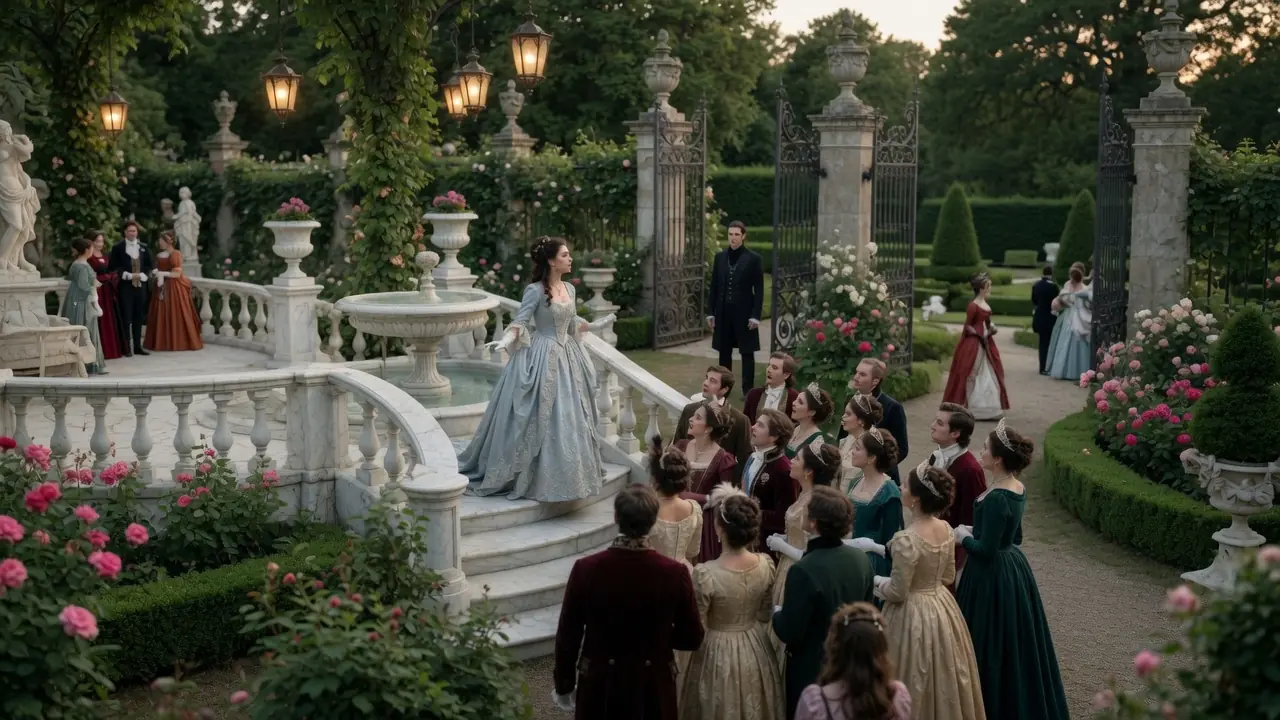
Fine, I shall marry the next man who walks through those doors. Lady Evelyn Hartwell’s voice echoed across the royal gardens beneath glowing lanterns as shocked aristocrats turned toward her in silence. After years of hearing she was too outspoken, too difficult, too much for any respectable husband, something inside her had finally snapped. Laughter exploded around the fountain. A duchess nearly spilled champagne. Someone shouted that she should at least choose a wealthy man.
Evelyn lifted her chin higher, reckless and furious, and suddenly beyond caring. Then the garden gates opened, and the laughter died instantly, because the man walking through the iron gates was not a charming stranger, but Duke Arthur Blackstorm, the coldest and most feared man in England, a duke so emotionally untouchable that society believed he would rather duel Parliament itself than fall in love. And somehow the terrifying Duke was now looking directly at her, as though she had just ruined his entire life.
The royal garden party had already exhausted Evelyn Hartwell long before the disaster began. Lanterns glowed above the palace roses. Musicians played soft waltzes beside marble fountains, and England’s aristocracy wandered through the gardens pretending to enjoy one another. Evelyn preferred honesty, which according to society was her greatest flaw.
“Lady Evelyn,” Lord Pemrook said, with the confidence of a man moments from humiliation, “a husband would greatly soften your temperament.” Clara nearly inhaled champagne incorrectly. Evelyn smiled politely, dangerously politely. “How fortunate for men,” she replied. “Without marriage, women might accidentally develop personalities.” A nearby viscount coughed into his drink.
Pemrook laughed weakly, still foolish enough to continue. “A peaceful household depends upon structure. A wife naturally requires guidance.” “Guidance,” Evelyn repeated. “You speak about marriage as though women are poorly behaved horses.” Several nobles turned toward them immediately. Clara quietly stepped backward for safety. Pemrook smiled with tragic determination. “My point is simply that gentlemen prefer softer women.”
“And yet,” Evelyn replied, “you continue speaking to me voluntarily.” Clara folded herself against the fountain, laughing. That should have ended the conversation. Unfortunately, Evelyn had spent years enduring the same criticism wrapped in different polite phrases—too outspoken, too spirited, too difficult. Society did not truly dislike intelligent women. It simply preferred them quieter.
Tonight, beneath the lantern light and endless parade of exhausting aristocrats, something inside Evelyn finally snapped. She handed Clara her drink, then climbed onto the marble fountain steps. “Oh no,” Clara whispered. “Too late.” The nearest violinist stopped playing as conversations dissolved across the gardens. One by one, heads turned toward Evelyn, standing above the crowd in pale blue silk and visible irritation.
“Very well,” she announced dramatically, “since England appears more distressed by my unmarried state than by war, famine, or terrible poetry.” Laughter spread immediately. Evelyn pointed toward the wrought iron garden gates. “I shall marry the next man who walks through those doors.” The crowd exploded. A duchess nearly dropped her champagne. Someone applauded. An elderly countess looked moments from religious revelation. “At least choose a wealthy one,” someone shouted. “I have standards,” Evelyn called back. Clara covered her face with both hands because she was laughing too hard to survive gracefully.
Evelyn felt suddenly triumphant, reckless, alive. “There,” she declared. “The matter is solved.” Then the gates opened. The laughter faded first, not all at once. Gradually, uneasily, a strange stillness swept through the garden as footsteps echoed slowly against stone. Evelyn turned toward the entrance and immediately reconsidered every decision she had made since childhood.
Duke Arthur Blackstorm stepped through the gates beneath silver lantern light, wearing black evening attire touched faintly by rain, tall, composed, impossibly calm. He carried the kind of quiet authority that made entire rooms rearrange themselves instinctively. The most feared man in England had just walked directly into her public marriage threat. Wonderful. Absolutely wonderful.
Nobody answered. Several nobles became deeply interested in nearby flowers. Evelyn descended slowly from the fountain steps, aware that death might now be preferable. “A misunderstanding,” she said. Arthur glanced toward the crowd. “It appears unusually public for a misunderstanding.” “That,” Evelyn admitted, “is unfortunately true.” Something shifted briefly in his expression, not amusement exactly, but dangerously close.
“And the gates,” he asked calmly. Evelyn considered fleeing England entirely. Instead, she inhaled slowly and answered with what dignity remained available to her. “I may have announced my intention to marry the next man who entered the garden.” Silence followed. Clara made a faint sound resembling spiritual collapse. Arthur blinked once. “I see.”
“In my defense,” Evelyn added quickly, “society had been irritating me clearly, and technically you were not supposed to arrive.” “I apologize for disrupting your strategy.” Several nearby nobles looked emotionally unstable because the Duke of Blackstorm was joking. Not smiling, not laughing, but unmistakably joking. This alone qualified as a historic event.
Whispers spread immediately. “She chose Blackstorm. The Duke of Blackstorm. This feels romantic. It feels fatal.” Arthur exhaled softly like a man realizing his peaceful evening had been professionally ruined. Evelyn crossed her arms defensively. “For the record, this is not an engagement.” “No?” he asked mildly. “Absolutely not.”
“Interesting,” she narrowed her eyes. “You seem very calm for someone publicly proposed to by a stranger.” “I survived Parliament,” Arthur replied. A laugh escaped her before she could stop it. The sound seemed to surprise both of them. For one brief moment, his expression changed completely. The cold restraint softened slightly, revealing something unexpectedly human beneath all that terrifying composure.
Then suddenly, he laughed quietly, briefly, but unmistakably. The entire garden froze in collective shock because nobody had heard Arthur Blackstorm laugh. Certainly not over a reckless woman threatening accidental marriage beside a fountain. Arthur recovered almost immediately, composure sliding back into place like armor. Still, the damage was done. The crowd now looked one heartbeat away from announcing wedding dates.
Arthur inclined his head politely. “I believe I should leave before tomorrow’s newspapers become unbearable.” “Too late.” Evelyn already knew tomorrow would ruin her life. He turned toward the gates, then paused. Without looking back, he said quietly, “For what it is worth, Lady Evelyn.” She blinked. “Yes?” “Your declaration was considerably more entertaining than the party.” Then he disappeared into the night.
The gates closed behind him and the royal gardens exploded. “He laughed. The Duke laughed at her. They are absolutely in love. Someone tell London immediately.” Evelyn covered her face with both hands. “I am leaving the country.” Clara looked delighted. “Oh no,” she said. “You are absolutely staying.”
By the following morning, England had abandoned reason entirely. Three newspapers announced Lady Evelyn Hartwell’s engagement before breakfast. One claimed she had captured the famously untouchable Duke of Blackstorm through bold romantic strategy. Another described the fountain incident as the beginning of a legendary aristocratic romance. The third was somehow worse. “The Iron Duke finally chooses a bride.”
Evelyn lowered the newspaper slowly and considered setting fire to civilization. Across the breakfast table, her younger brother Thomas looked delighted beyond recovery. Clara had arrived uninvited at dawn specifically to enjoy the disaster and was currently eating pastries with the emotional investment of a theater audience. Lady Hartwell, meanwhile, appeared one unpleasant sentence away from fainting.
“Evelyn,” her mother said carefully, “please explain why all of London believes you are marrying the Duke of Blackstorm.” Evelyn folded the paper with exhausted dignity. “Because London is deeply committed to delusion.” Thomas grinned. “Personally, I admire the efficiency. Most women struggle for years to secure a duke. You accidentally threatened one beside a fountain.” She threw a strawberry at him. He caught it triumphantly. Clara sighed happily. “This family handles crisis beautifully.”
Evelyn reached for more tea before society itself killed her. Unfortunately, the butler entered before she could recover emotionally. His expression carried the strained horror of a man approaching dangerous news. “Your ladyship,” he announced carefully, “a carriage has arrived.” Lady Hartwell blinked. “At this hour?” The butler swallowed. “It bears Blackstorm colors.”
Silence detonated across the breakfast room. Thomas whispered reverently, “Oh, this is magnificent.” Evelyn closed her eyes. “No.” Footsteps echoed moments later through the corridor outside, steady, measured, confident enough to belong to only one man in England. Arthur Blackstorm entered the breakfast room, wearing dark morning attire, and the expression of someone professionally exhausted by human behavior.
The atmosphere shifted instantly. Servants straightened. Lady Hartwell forgot breathing briefly, and Evelyn became painfully aware that the Duke looked even more unfairly handsome in daylight. This felt unnecessary. “Lady Hartwell,” Arthur greeted politely. “Your Grace.” Then his gaze settled on Evelyn. “Lady Evelyn.” “Your Grace.” Thomas nearly fell out of his chair, laughing. Arthur ignored him with admirable discipline.
“Public gossip will intensify unless we redirect it strategically,” he continued. “Therefore, I propose a temporary arrangement.” Evelyn narrowed her eyes. “I already dislike this sentence.” “We appear together publicly for several weeks, enough to stabilize the rumors and discourage further inventions.” Thomas leaned forward eagerly. “This is how every romantic disaster begins.” “You are no longer welcome at breakfast,” Evelyn informed him.
Arthur looked toward her calmly. “It is the most practical solution.” That was the problem. It was practical, and somehow that made it infinitely more dangerous. Three evenings later, Evelyn arrived at the Royal Opera wearing pale green silk and emotional regret. The moment she stepped from her carriage, conversation rippled through the courtyard like wildfire. Opera glasses appeared instantly. Whispers followed her across the marble entrance steps. Apparently, England now viewed her as the heroine of an ongoing national romance. Wonderful. Absolutely wonderful.
Clara adjusted her gloves beside her. “They are behaving as though you eloped with royalty.” “Give them until tomorrow,” Evelyn muttered. “By then, I shall probably be carrying the Duke’s tragic heir.” Then the crowd shifted. The energy changed so suddenly Evelyn felt it before turning. Arthur crossed the courtyard beneath silver lantern light, dark coat moving sharply against the rain-polished stone. He carried himself with the same calm authority that made politicians fear him, and noble women lose coherent thought. Several women visibly forgot breathing.
Evelyn irrationally wanted to roll her eyes at them, which felt concerning. Very concerning. The Duke stopped before her. “Lady Evelyn.” “Your Grace.” “You appear alarmed.” “I was enjoying six uninterrupted minutes without scandal.” “Ambitious.” Arthur offered his arm while half the courtyard emotionally collapsed around them. Evelyn eyed him suspiciously. “You understand this guarantees another week of gossip.” “Refusing would guarantee two.” Annoyingly, he was correct.
Inside the opera house, nobles parted around Arthur instinctively. Conversations lowered whenever he passed. Evelyn watched the reaction with fascination. “Do people always behave as though you might declare war unexpectedly?” she asked quietly. “Only during social events.” She laughed before stopping herself. Arthur looked faintly satisfied by that. Again concerning.
Then Lady Beatrice approached. Jewels glittered around her throat with enough intensity to blind passing sailors. “My dear Evelyn,” she said sweetly, “how extraordinary that impulsive behavior has become such an effective path toward nobility.” There it was, the insult beneath the perfume. Several nearby aristocrats leaned closer discreetly. Evelyn prepared herself for another exhausting conversation.
Then Arthur spoke quietly, calmly, dangerously. “I was unaware,” he said, “that Lady Evelyn required assistance attracting attention.” Silence spread instantly. Beatrice faltered. Arthur continued smoothly. “Considering half the kingdom already discusses her constantly.” A viscount inhaled champagne incorrectly nearby. Evelyn stared at Arthur in surprise because that had not been politeness, that had been protection, and somehow he looked entirely unbothered by it.
Lady Beatrice retreated moments later with remarkable speed. Outside the opera house later that evening, rain shimmered silver beneath the lanterns while carriages rolled through the wet streets below. Evelyn paused beside her carriage. “You did not need to defend me earlier,” she said quietly. Arthur looked down at her. “Lady Beatrice was irritating.” “Liar.” The word escaped before she could stop it.
Silence settled gently between them. Then unexpectedly, Arthur smiled. Small. Real. Entirely devastating. “You are unusually fearless,” he observed. “No,” Evelyn replied softly. “I simply speak before thinking.” “I noticed.” She stepped backward toward the carriage, then slipped. Rain-slick stone shifted beneath her shoes as the world tilted sharply sideways, and Arthur caught her instantly, one arm around her waist, strong, steady, dangerously close.
The rain softened around them. Evelyn became suddenly aware of everything at once. His hand at her waist, the warmth beneath his coat, the way his gaze held hers beneath silver lantern light. Neither moved immediately. Neither seemed capable of it. For one impossible second, the rest of the world disappeared completely. Then a carriage horse sneezed violently nearby. Evelyn jumped. Arthur stepped back at once. The moment shattered, probably for the best.
“Good night, Lady Evelyn,” he said quietly. “Good night, Your Grace.” But long after her carriage disappeared into the rain, Arthur Blackstorm remained standing motionless in the opera courtyard, and for the first time in years, the famously untouchable Duke looked deeply, seriously troubled.
By the second week of England’s favorite romantic scandal, respectable society had reached several dramatic conclusions regarding Lady Evelyn Hartwell and the Duke of Blackstorm. The first was that Evelyn had somehow enchanted the coldest man in England. The second was that Arthur Blackstorm appeared deeply inconvenienced by it. And the third, which delighted society most, was that neither of them seemed capable of stopping whatever this had become.
At present, Evelyn considered the entire situation ridiculous, mostly because she had spent the last ten minutes arguing with the Duke about swans. “They are violent creatures,” she informed him while crossing Lady Danrey’s rose gardens carrying a plate of pastries with alarming authority. Arthur walked beside her with the calm expression of a man enduring highly specific suffering. “They are decorative.” “They chased a bishop into a lake.” “That was one swan.” “That swan had leadership qualities.” Arthur glanced toward the distant pond where an enormous white swan was currently terrorizing a servant carrying flowers. “Fair point.”
Evelyn laughed immediately. The sound escaped her too easily around him now. That was becoming dangerous. The spring garden party unfolded around them beneath warm sunlight and climbing roses while aristocrats drifted through flower arches pretending not to stare openly at the Duke following Evelyn from conversation to conversation with suspicious consistency. Everywhere they walked, whispers followed. Evelyn ignored them expertly.
He noticed everything about her lately. The way her eyes brightened before she laughed. The tiny pause before she said something reckless. The fact that crowded rooms became tolerable when she stood inside them. Deeply inconvenient observations. “You are staring again,” Evelyn said. “You continue behaving distractingly.” “That is not a real criticism.” “It is becoming one.” To his annoyance, she looked pleased by the answer.
Clara appeared moments later, carrying champagne and dangerous excitement. “There you are,” she announced. “Three duchesses are currently debating whether the Duke looks at Evelyn romantically or possessively.” Arthur looked mildly offended. “There is apparently a difference,” Clara added helpfully. Evelyn nearly choked, laughing. Then Clara noticed Arthur casually taking a pastry from Evelyn’s plate without asking.
Silence followed. Evelyn stared at him. “You stole that.” “You were distracted.” “That does not make it legal.” Clara’s eyes widened slowly with delighted horror. “Oh no,” she whispered. Evelyn narrowed her eyes suspiciously. “What now?” “You behave like a married couple already.” Arthur nearly inhaled pastry incorrectly. Evelyn looked personally betrayed by reality. “That is absurd.” “Is it?” Clara asked sweetly. “You argue constantly, steal each other’s food, and the Duke watches every man who speaks to you like he is considering legal execution.”
Arthur looked away immediately, which unfortunately confirmed everything. Before Evelyn could recover, Lord Adrien Witmore approached across the gardens, young, charming, and smiling directly at Evelyn. Arthur disliked him instantly. The feeling arrived with startling speed and absolutely no logic whatsoever. Witmore bowed elegantly. “Lady Evelyn.” “Lord Witmore.” “I hoped to find you today.” Something unpleasant settled beneath Arthur’s ribs. Sharp. Unfamiliar. Highly irritating.
Witmore continued smiling warmly toward Evelyn. “You disappeared after the opera before I could congratulate you.” “On what precisely?” Evelyn asked. “Capturing England’s most elusive duke naturally.” Arthur’s expression cooled noticeably. Witmore either failed to notice or possessed extraordinary courage. Possibly both. “I assure you,” Evelyn replied dryly, “nothing about this situation was planned.” “Still,” Witmore said smoothly, “I always admired women bold enough to frighten society.”
Arthur disliked him more with every sentence. Then Witmore offered Evelyn his arm. “Would you walk with me?” Silence drifted softly through the rose gardens. Evelyn glanced toward Arthur instinctively, and for the first time since meeting him, she saw something unmistakable in his expression. Jealousy. Not dramatic, not wild, worse, controlled jealousy. The kind a disciplined man tried very hard not to reveal.
Suddenly, Evelyn understood why society enjoyed this scandal so much. Because watching the Duke of Blackstorm lose emotional composure was genuinely fascinating. “I am already walking with someone,” she replied. Witmore finally acknowledged Arthur directly. The younger man’s confidence weakened immediately. Arthur said nothing. He did not need to. Witmore retreated shortly afterward with the expression of a man reconsidering several life choices.
The moment he disappeared, Evelyn turned slowly toward Arthur. “That,” she said carefully, “was jealousy.” “No.” “You answered too quickly.” Arthur remained silent, which was answer enough. A slow smile appeared on Evelyn’s face. To his growing frustration, she looked delighted. “You are becoming unreasonable, Your Grace.” “Increasingly.” The warmth behind her smile softened unexpectedly, and for one dangerous second neither looked away.
Then chaos arrived again. A small, muddy white dog burst through the flower hedges and launched itself directly onto Arthur’s expensive black coat. The surrounding nobles froze in horror. The dog barked triumphantly. Muddy paw prints covered the Duke instantly. Evelyn burst into helpless laughter. Real laughter. Bright enough to turn heads across the gardens.
Arthur looked down at the creature now enthusiastically climbing him, then slowly back toward Evelyn. She was still laughing, cheeks flushed pink, eyes bright with amusement. Beautiful. The realization struck him with alarming force. Not merely attractive. Beautiful in the devastating way sunlight felt beautiful after too much winter. Dangerous realization.
The dog barked again. Arthur should have pushed it away immediately. Instead, he let it remain because Evelyn was laughing. An elderly duchess nearby looked moments away from fainting. By evening, new rumors had already spread through the ballroom. Apparently, the Duke smiled at Evelyn constantly. He allowed animals to attack him for her amusement, and he now looked emotionally unstable whenever another man approached her. Most of these claims were exaggerated. Unfortunately, not all of them.
Later that night, Evelyn escaped onto a moonlit balcony, searching for silence. Music drifted softly behind the ballroom windows while silver light spilled across the palace gardens below. “You disappeared,” she turned. Arthur stood near the balcony entrance, watching her quietly. Of course he did. “You move like aristocratic vengeance,” she informed him. “Only socially.” She laughed softly and leaned against the marble railing beside him.
For several moments, neither spoke. The silence between them no longer felt awkward. Now it felt full. Charged somehow. “You dislike parties,” Evelyn observed. “Intensely. Then why attend so many lately?” Arthur answered before caution stopped him. “Because you are there.” The words settled softly between them. Evelyn turned toward him slowly. Moonlight silvered his face while distant music faded into softness around them.
“That,” she said quietly, “is a very dangerous thing to say to me.” “I know.” “You are supposed to be emotionally restrained.” “You make that difficult.” Her heartbeat betrayed her instantly. So did his. For one suspended moment, neither moved. Arthur’s hand shifted slightly across the railing toward hers. Not touching. Almost. Then, “Lady Evelyn.” Both closed their eyes briefly.
Clara burst onto the balcony, looking emotionally victorious. “There you are. The queen wishes to meet the couple currently destroying political productivity across England.” Evelyn laughed helplessly. But Clara stopped suddenly because she noticed the way Arthur was looking at Evelyn. Warm. Private. Entirely unlike the feared Duke of Blackstorm society knew. And for the first time, even Evelyn began to understand something dangerous. This no longer felt temporary. It felt inevitable.
Evelyn expected Blackstorm House to feel intimidating. She did not expect it to feel lonely. The enormous estate stood beneath gray spring skies like something built specifically to frighten tax collectors. Dark stone walls stretched endlessly behind iron gates, while towering windows reflected silver morning light with severe aristocratic judgment. “It looks,” Evelyn said carefully as the carriage stopped, “like the home of a man who threatens furniture emotionally.”
Arthur stepped from the carriage beside her. “That is an unnecessarily specific accusation.” “You own a house with opinions.” “I own a house with structure.” “You own a fortress pretending to be civilized.” To her satisfaction, the corner of his mouth moved slightly. “Progress. Inside.”
Blackstorm House was magnificent in the coldest possible way. Marble floors echoed beneath every footstep. Massive portraits stared down from shadowed walls while servants moved through the corridors with terrifying efficiency. Nobody laughed. Nobody even spoke above polite murmurs. But Evelyn looked around slowly, then directly at Arthur. “Have you considered opening curtains at any point in the last decade?” “The sunlight already enters.” “The sunlight appears frightened.” One nearby footman accidentally laughed. Arthur turned toward the sound. The poor man nearly died instantly.
Evelyn smiled innocently and continued into the library. That, unfortunately for Arthur, became the beginning of complete domestic collapse. The library itself was enormous. Dark shelves stretching toward painted ceilings. Military histories arranged with terrifying precision. Heavy curtains muting half the daylight. Evelyn stared around in disbelief. “You live like a widowed emperor.” “I live peacefully.” “You alphabetized political warfare.” “It is practical.” “You hid poetry behind financial records.”
Arthur froze. Evelyn stood atop the rolling library ladder, triumphantly holding a slim, leatherbound poetry collection in the air. “Uh-huh.” This was catastrophic. Nobody touched the Blackstorm library. Nobody reorganized it. And absolutely nobody discovered the hidden poetry. Yet Evelyn had accomplished all three within fifteen minutes.
“You own romantic literature,” she announced dramatically. “I lost a bet.” “You annotated the pages.” “That feels invasive.” Evelyn laughed softly while climbing down the ladder, carrying several books against her chest. Sunlight spilled through the tall windows behind her, catching gold inside her curls. Arthur noticed immediately. He noticed everything about her now. The way she smiled before laughter arrived. The way rooms changed once she entered them. The way Blackstorm House itself already felt less silent. Deeply inconvenient observations.
“You are staring again,” Evelyn said. “You continue reorganizing my existence.” “That seems dramatic.” “You moved philosophy beside military strategy.” “They needed emotional support.” Arthur looked toward the shelves suspiciously. The library already appeared warmer somehow. Alive. As though the house itself had finally exhaled. Dangerous development. Very dangerous.
Later that afternoon, the queen arrived unexpectedly, or rather unexpectedly for Arthur. Evelyn claimed immediately that the queen absolutely planned this ambush in advance. “I knew she was emotionally unstable,” Arthur muttered while servants scrambled through the entrance hall. “You are her majesty’s favorite romantic entertainment,” Evelyn replied cheerfully. “This is your punishment.”
The queen entered Blackstorm House with the delighted expression of a woman arriving at live theater. “My favorite almost engaged couple,” she announced. “We are not almost engaged,” Arthur said immediately. The queen looked at him kindly. “Of course, dear.” Evelyn nearly laughed herself unconscious. Tea was served shortly afterward in the drawing room where the queen spent twenty uninterrupted minutes emotionally terrorizing Arthur for her personal enjoyment.
“You smile now,” she observed. “I always smiled.” “Like a hostage, perhaps.” Evelyn choked on tea. The queen continued calmly. “Your servants look less frightened too.” “That cannot possibly be connected.” “Your gardener informed me you voluntarily planted roses last week.” Arthur looked genuinely betrayed. “Why does my gardener speak to the monarchy?” “Because everyone in England discusses your emotional collapse.” Evelyn turned away before laughing directly into the furniture.
The queen watched both of them with infuriating satisfaction. Then her expression softened unexpectedly as she glanced around the room. “You know,” she said quietly, “this house finally feels lived in.” The words settled gently into the silence. Arthur looked toward Evelyn instinctively. She stood near the window, laughing softly with one of the maids about something involving disastrous flower arrangements. Warm sunlight spilled around her, while the servants nearby smiled openly in ways Arthur had never seen before, and suddenly he understood exactly what the queen meant.
Blackstorm House no longer felt cold when Evelyn occupied it. The realization struck him with dangerous force because it was not the flowers, not the open curtains. Her. Only her. That evening after dinner, Evelyn wandered into the kitchen entirely by accident and immediately became involved in helping the cook destroy a pudding recipe. Arthur discovered her there half an hour later, dusted lightly with flour, while the entire kitchen staff attempted unsuccessfully not to laugh around her.
“You invaded my kitchen,” he observed. “The pudding fought bravely.” One maid burst into helpless laughter. Arthur should have been annoyed. Instead, he found himself watching Evelyn smile beneath the warm kitchen lights while servants gathered around her comfortably, naturally, happily. Nobody in Blackstorm House behaved naturally around him, but around Evelyn they breathed easier. So did he. The realization unsettled him more than anything else had.
Later, long after the servants retired and the house quieted once more, Arthur found Evelyn alone in the library, rearranging flowers beside the windows. The curtains remained open now. Moonlight silvered the bookshelves softly. “You changed the house,” he said quietly. Evelyn glanced toward him. “That sounds dangerously close to gratitude.” “It was an observation.” “You hated half my adjustments.” “You placed gardening books beside military history.” “They balance each other emotionally.”
Arthur moved closer slowly. The laughter between them softened naturally into silence, not awkward silence, something warmer, the kind that no longer required constant wit to survive. “You know,” Evelyn said softly, “this house is not nearly as frightening as people believe.” “That is because you are unusually fearless.” “No,” she replied quietly. “I simply think lonely things deserve warmth.”
The words moved through him with devastating precision, because somehow Evelyn Hartwell had looked directly through every carefully built wall he possessed, and treated the emptiness beneath it like something worth saving. Arthur’s gaze held hers steadily, and for one suspended moment the rest of the world disappeared again. No newspapers, no scandal, no watching aristocrats, only moonlight, silence, and the impossible warmth she had carried into his life.
Then suddenly, a loud crash echoed from somewhere downstairs. Both blinked. Arthur closed her eyes briefly. “The pudding survived,” Evelyn whispered. “Clearly not.” She burst into laughter again, and Arthur realized with terrifying clarity that Blackstorm House no longer felt like a prison when she was inside it.
By the fifth week of England’s favorite romantic catastrophe, society had surrendered completely, but no longer speculated about whether Duke Arthur Blackstorm loved Lady Evelyn Hartwell. Now they discussed it with the calm certainty usually reserved for weather and political scandal. The queen openly referred to Evelyn as our future Duchess. Three newspapers tracked Arthur’s emotional deterioration with scholarly dedication. One particularly dramatic article claimed the Duke had developed visible softness around the eyes as though affection were a contagious illness. Evelyn framed that article immediately. Arthur pretended outrage. His staff stopped believing him days ago.
Blackstorm House itself had transformed beyond recognition. Flowers appeared regularly now because Evelyn claimed dark corridors caused spiritual collapse. The servants laughed openly when she visited. Even the library looked warmer beneath open curtains and afternoon light. For years the estate had felt imposing, and Arthur knew exactly why.
One evening he stood near the library doorway while Evelyn sat beside the windows laughing softly with Mrs. Pembroke over another failed attempt at baking. Flour dusted one sleeve of her dress. One of the maids was openly smiling. The cook looked emotionally attached to her already, and Arthur suddenly realized something terrifying. He could no longer imagine Blackstorm House without her inside it.
The realization arrived quietly but completely. “You are doing it again,” Clara announced from nearby. Arthur looked toward her cautiously. “Doing what?” “Looking at Evelyn as though she personally restored meaning to your existence.” Arthur considered denial. Unfortunately, Evelyn laughed at that exact moment, and the sound undid every remaining defensive instinct he possessed. Clara sighed dramatically. “Oh dear, you truly are gone.” Arthur did not argue, because for the first time in years, he no longer wished to.
The final royal reception of the season arrived several evenings later. Beneath silver lanterns and warm spring skies, the palace ballroom glittered with candlelight while nobles drifted through music and conversation carrying enough gossip to destabilize governments. Everywhere Evelyn walked, people smiled knowingly. One elderly duchess squeezed her hands and whispered tearfully, “You made him look alive again.” The words followed Evelyn long afterward. Because beneath all the laughter and scandal sat something unexpectedly tender. Arthur had not merely fallen in love. He had returned to life. The realization frightened her slightly, mostly because she had done the same.
Later that evening, overwhelmed by music, attention, and relentless aristocratic observation, Evelyn slipped quietly from the ballroom into the gardens. Cool night air greeted her instantly. The palace music softened behind towering windows while moonlight silvered the marble paths below. Then she stopped walking because she recognized the garden immediately. The fountain still stood beneath climbing roses. Lanterns glowed softly against the hedges and the iron gates waited at the far end exactly as they had the night everything changed.
Evelyn laughed softly under her breath. “Well,” she murmured. “This feels emotionally threatening.” “You often speak to architecture.” She turned immediately. Arthur stood several feet away near the garden entrance, watching her quietly. Of course he did. “You move like aristocratic vengeance,” she informed him. “Only socially.” She laughed softly and leaned against the marble railing beside him.
For several moments, neither spoke. The silence between them no longer felt uncertain, only full, as though everything important already existed there. “You caused national hysteria here,” Arthur observed quietly. “You looked ready to arrest someone.” “That possibility existed briefly.” She laughed softly. Then the sound faded because Arthur was looking at her differently tonight. Not careful. Just honest. Evelyn’s heartbeat quickened instinctively.
Arthur glanced once toward the iron gates behind him, then back at her, and suddenly she understood. “Oh no,” she whispered immediately. A faint smile touched his mouth. “You recognize the symbolism.” “You are about to become unbearably dramatic.” “Possibly.” Before she could stop him, Arthur stepped back toward the gates, the exact same gates he had entered weeks earlier by accident. Only tonight, nothing about him was uncertain.
Moonlight silvered the iron bars while lanterns glowed softly through the garden. Arthur paused at the entrance, then deliberately walked through the gates again. The same path. The same garden. But now everything between them had changed. Evelyn felt tears sting behind her eyes before he even reached her.
“You are impossible,” she whispered, laughing softly through emotion. Arthur stopped before her beneath the lantern light. “Several weeks ago,” he said quietly, “you promised to marry the first man who entered this garden.” Evelyn smiled helplessly. “That was before I realized the man was emotionally exhausting.” “Unfortunately for you,” he murmured, “I became attached.” Her heart nearly stopped entirely.
The humor softened from his expression slowly, leaving only sincerity behind. “You walked into my life and ruined every careful plan I ever made,” he admitted quietly. Evelyn’s laughter disappeared completely. “My house is louder now.” He stepped closer. “My staff smiles.” Another step. “I attend parties voluntarily, you poor man.” A faint smile appeared briefly, then faded beneath deeper emotion. “And somehow,” Arthur said softly, “you made all of it feel natural.”
The garden blurred around her. Lanterns glowed softly beside the fountain while moonlight touched the marble paths, but all Evelyn could truly see was him. This terrifying man, who now looked at her with something unbearably vulnerable. Arthur’s voice lowered. “I do not know exactly when I began loving you.” Her breath caught sharply. “Only that I cannot remember peace before you anymore.”
That sentence shattered her completely. Tears filled her eyes instantly. Arthur looked mildly alarmed. “You are crying.” “You said emotional things unexpectedly.” “I believe proposals require emotional honesty.” “Well, now I look unstable. Entirely undone. You are never again allowed to negotiate marriages.” “Agreed.” Evelyn pulled him into a kiss before he could recover further.
Moonlight shimmered across the fountain behind them, while palace music drifted softly through the gardens, and somewhere beyond the hedges, England undoubtedly continued emotionally collapsing over their romance. But neither of them cared anymore, because the most feared duke in England had fallen hopelessly in love with the woman who accidentally proposed to him beside a fountain. Society never recovered. Neither did he. Fortunately, he no longer wished to.
The wedding nearly caused national collapse. Three duchesses argued over flower arrangements for two consecutive hours. One bishop cried openly during the vows. Thomas earned an alarming amount of money from illegal betting pools regarding specifically how quickly the Duke of Blackstorm would begin looking emotionally devoted during the ceremony. The answer, unfortunately for Arthur’s dignity, was immediately. By the time Evelyn walked down the aisle, the terrifying Duke of Blackstorm looked like a man prepared to personally challenge fate itself if it inconvenienced his wife. Clara described the expression as romantically catastrophic. She was correct.
Married life proved deeply unsuitable for Arthur’s former reputation. The once-feared duke now attended garden parties voluntarily, tolerated floral arrangements, smiled in public, and once threatened a viscount for making Evelyn cry during an argument about architecture. Most shocking of all, Blackstorm House became happy. The servants laughed more. The halls felt warm, and every room Evelyn entered somehow stopped feeling lonely afterward.
Years later, society still told the story of the reckless young woman who accidentally proposed marriage beside a fountain. Some called it fate, others called it destiny. The queen called it the only useful political event of the decade. Arthur preferred a simpler explanation. One evening, long after the scandal faded into legend, Evelyn asked quietly whether he regretted walking into that garden. Arthur looked at her across the library she had reorganized against his will years earlier and answered with complete honesty. “Not even once.”