The morning mist had not yet lifted from the hedgerows of Hartwell Manor when Iris Fenwick knelt in the wet grass, her skirt soaking through, her hands cupped around a trembling sparrow whose wing hung wrong against its small gray body. She had risen before the household, as she always did, slipping out through the servants' door because it was the only door that did not creak. And she had found the bird lying beneath the old yew hedge, its breath quick and frightened. One eye turned up toward the brightening sky as though asking whether this too would be taken from it.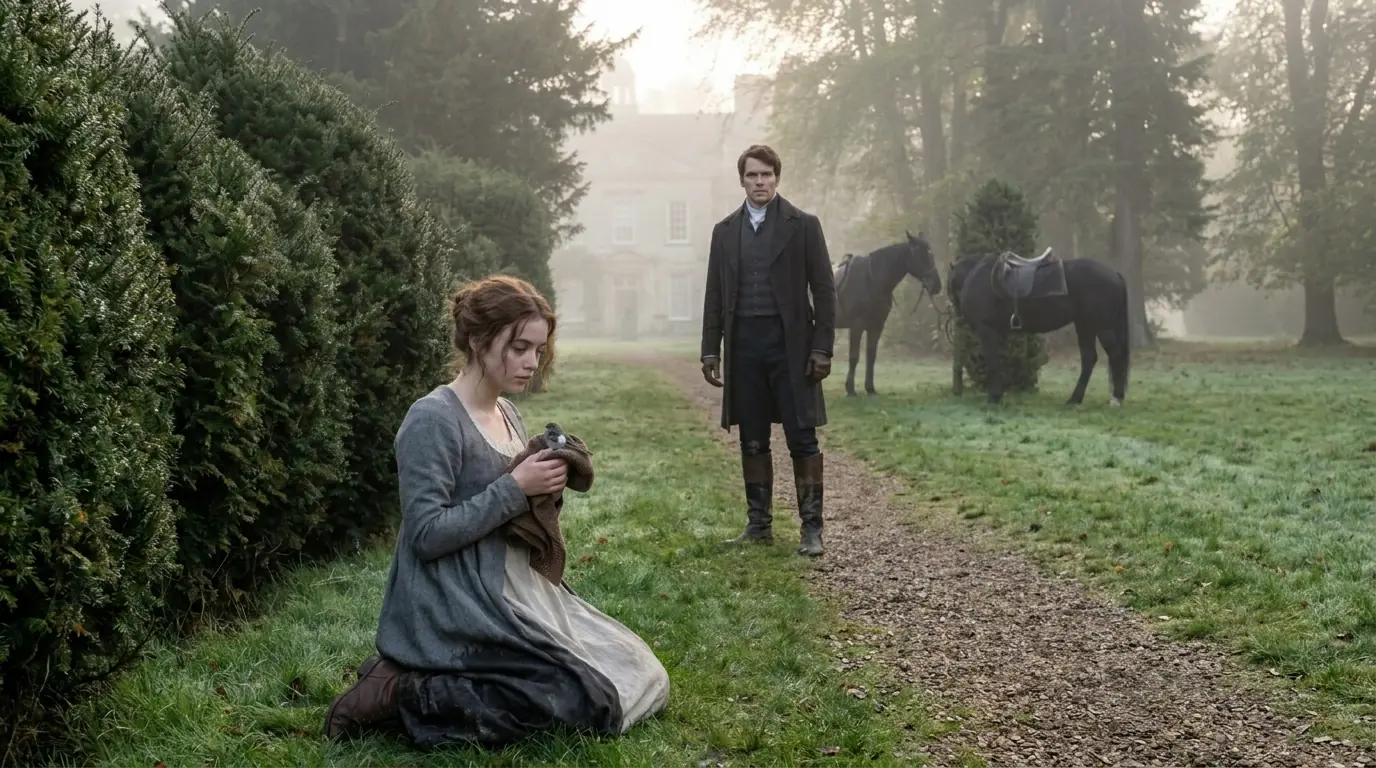
"There now," she whispered, drawing off her shawl to wrap around the small shivering body.
"You are not alone." "I have you." She did not know that a man stood twenty paces behind her, half hidden by the hedge, watching.
He had arrived at Hartwell before dawn, on horseback, without ceremony, without the carriage and outriders that would have announced him to the entire county before he had so much as removed his gloves. He had wanted, for one quiet hour, to be no one, to walk the grounds of the estate where he was expected to choose a bride as though he were merely a traveler who had lost his way, and to see what sort of house it truly was before the house dressed itself up to be seen by him. He had not expected to find a woman on her knees in the mud at first light, murmuring comfort to a dying bird as though the whole of her heart were bent toward its small suffering.
He did not move. He did not speak. He only watched the line of her back, the care in her hands, the low, steady voice she used, the voice of someone who had learned, perhaps painfully, how gentleness ought to sound.
"You are trembling worse than the bird," he said at last, because he could not stop himself, and his voice was quiet enough not to startle her further, though it startled her all the same.
She turned, and for one unguarded moment he saw her face clearly, not beautiful in the practiced, polished way of the young ladies who would soon be presented to him in drawing rooms across London, but striking in a way he could not immediately name. Her eyes wide and gray-green, and entirely without the calculation he had come to expect from strangers.
"Forgive me," she said quickly, rising halfway before remembering the bird in her hands and sinking back down again.
"I did not hear you approach. You gave me a fright." "It seems I am the intruder here, not you," he said.
"This is your garden." "It is my aunt's garden," she corrected, and something flickered across her face too quickly for him to read.
Not quite bitterness, but close to its shadow.
"I am only permitted to walk in it before the family wakes." He studied her a moment longer than was proper.
Her gown was serviceable rather than fine, mended at the cuff with careful, nearly invisible stitches. Her boots were not new, and yet she knelt in the mud without a thought for either, entirely absorbed in the small, broken thing in her hands.
"The wing is fractured," she said, more to herself than to him, running one finger with impossible gentleness along the bird's side.
"But not the bone that matters most. If I can keep it warm and still, it may yet mend." "You know a great deal about birds." "I know a great deal about being overlooked," she said, and then, as though hearing her own words for the first time, color rose swiftly into her cheeks.
"Forgive me. That was not meant for a stranger's ears." "I am glad you said it all the same," he said, and meant it more than he expected to.
She looked up at him then, truly looked, taking in his plain dark coat, his mud-spattered boots, the horse he had left tethered at the edge of the wood, and something in her posture eased, as though she had decided he was safe precisely because he did not look like a man who mattered.
"You are not from the house," she said.
It was not quite a question.
"No," he said, which was true, and let her draw her own conclusions, which were not.
"The Fenwick Arms, though it has nothing to do with my family beyond the shared name and an old debt of gratitude no one troubles to remember anymore. You may find better hospitality there than you would find at this house, if I am honest, which I am told is a fault of mine." He almost smiled.
"Is honesty accounted a fault where you come from?" "In this house it is accounted an inconvenience," she said, "which amounts to the same thing when one has no fortune to make forthrightness charming." He did not know, in that moment, that he was speaking to a woman who had been told a hundred times over the past six years that she spoke too plainly, dressed too plainly, hoped too plainly for a girl in her circumstances.
He knew only that she made him want to keep talking, though he had come to Hartwell Manor for exactly the opposite purpose, to observe in silence, to judge in silence, and to leave if the house proved what he suspected it to be, without ever revealing who he truly was. His name was Julian Ashgrove, ninth Duke of Rothermere, and he had lost, eighteen months prior, both his father and the last of his patience with women who smiled at his title before they had troubled to learn his face. The wound had a name, though he rarely spoke it. Lady Cordelia Vane.
She had accepted his proposal with tears of apparent joy and broken the engagement three weeks later for a marquis with twice his income, and she had done it so publicly, so carelessly, that half of London had watched him absorb the humiliation over a single ruinous evening at the opera. His composure, the only thing he had left to salvage, he had sworn, kneeling alone in his father's empty study afterward, that he would never again let a woman's affection be shaped by what she believed his name could purchase for her. So, when his aunt, the formidable dowager duchess, had informed him that a suitable match had been arranged with a Miss Camilla Pemberton of Hartwell, a young lady of excellent connections and, by every report, considerable beauty, he had agreed to the visit on one condition only.
He would arrive a full day before he was expected, unannounced, and see the house and its inhabitants as they truly were, not as they would present themselves once they knew a duke stood in the room. He had not expected the first true thing he saw at Hartwell to be a woman on her knees mending a broken wing.
"You should go in before you catch your death," she said, rising now with the bird cradled carefully against her breast, tucked inside the folds of her shawl.
"Truly, the Fenwick Arms will give you a fire and a decent breakfast, and neither of those things is on offer here for a stranger who arrives before the family has decided whether you are worth the trouble of receiving. Is that how it is decided? Worth?" Something in his tone made her look at him again, more carefully this time, though she could not have said what she was searching for.
"That is how everything is decided in this house," she said quietly.
"I learned it early. And you? How were you decided?" The question landed somewhere he had not intended it to land, and he saw it strike her, saw the small flinch she tried to hide by adjusting the shawl around the bird.
"I was decided to be useful," she said.
"It is not the worst fate. There are women in far crueler houses than this one." "That is not an answer to whether it is a good fate." "No," she agreed, with a faint unexpected smile that transformed her face entirely, warming it the way morning sun warms cold stone.
"It is not, but I find that expecting little leaves more room for surprise. And you have surprised me this morning, sir, though I could not say precisely how." She curtsied, brief and unpracticed, the curtsy of a woman who rarely had cause to use one, and turned to carry the wounded sparrow toward the kitchen garden, where she meant to make it a nest of straw and warmed cloth in the old potting shed, away from the cats and the notice of the house.
He watched her go until the mist swallowed the hem of her gray gown, and he did not move from beneath the yew hedge for a long while afterward, turning over in his mind the strange unsettling fact that in the space of ten minutes an unnamed woman in a mended gown had told him more true things than any woman in London had told him in eighteen months. He did not yet know her name. He intended, when he rode on to the inn to wait out the remaining hours until his official arrival was expected, to learn it. He did not yet know that her name was Iris Fenwick, niece and ward to Lady Pemberton, cousin to the celebrated Camilla Pemberton he had been sent to court, and that within the walls of Hartwell Manor she occupied a position lower than the housekeeper's, though she bore the family name and sat when permitted at the family table.
Her father, a scholar of modest means and immodest debts, had died when she was 16, leaving her mother's sister, Lady Pemberton, as her only refuge. Lady Pemberton had taken her in with the particular generosity of a woman who wished the world to see her charity, and never wished to pay its true cost. And for six years Iris had earned her keep as an unpaid companion, a mender of gowns, a keeper of accounts, a silent shadow at the edge of every gathering where her cousin Camilla shone. Camilla was two years younger than Iris, and possessed of the sort of golden effortless beauty that made rooms fall quiet when she entered them.
She was not unkind by nature, but she had been raised to believe that kindness toward Iris was a form of condescension, rather than an obligation of family, and so she offered it only when it cost her nothing, and often forgot to offer it at all. Lady Pemberton had spent a fortune she did not entirely possess on securing Camilla's introduction to society, and the arrival of the young Duke of Rothermere, newly come into his title and reputed to be seeking a wife before the season properly began, represented the culmination of every hope and every debt the family had accumulated on Camilla's behalf.
"You will keep to the north wing while his grace is here," Lady Pemberton informed Iris that same morning, over a breakfast Iris was not invited to sit for.
"I will not have you underfoot, gawking at a duke like some milkmaid who has never seen a gentleman before."
"I have no wish to gawk at anyone, Aunt," Iris said, folding linens at the sideboard, because standing idle in Lady Pemberton's presence was its own small offense. "I shall keep to my duties, as I always do."
"See that you do. And for heaven's sake, do something about your hands. You have been grubbing in that garden again. I can smell the earth on you from here. A duke will not wish to be reminded that there is a poor relation skulking about the grounds like a stray cat."
Iris said nothing, because there was nothing to say that would not somehow be turned into further proof of her ingratitude. She had learned long ago that silence cost her less than defense.
Camilla drifted into the breakfast room a moment later in a dressing gown of pale rose silk, her golden curls still loose about her shoulders, and pressed a careless kiss to her mother's cheek before helping herself to chocolate.
"Is it true the duke is reputed handsome?" she asked, settling into her chair with the languid confidence of a girl who had never once doubted her own worth in a room.
"It is true he is reputed rich," Lady Pemberton said, "which is a far more useful quality in a husband, though I am told he is not unpleasant to look upon either. You will wear the blue silk when he arrives, Camilla, and not the yellow. The blue becomes you better, and I will not have you looking sallow before a man who could restore this family's fortunes with a single word to his solicitor."
Iris kept her eyes on the linens and said nothing, though something in her chest had gone tight and strange since her encounter in the garden, a feeling she could not name and did not trust herself to examine. Folding the last of the napkins with hands that smelled faintly of earth and feathers, she told herself that it did not matter in the least what sort of man the Duke of Rothermere turned out to be, because whatever he was, he was not for her.
She had not the faintest notion that the stranger she had scolded for standing about in the wet grass, the man she had directed toward the Fenwick Arms with such easy, unguarded frankness, was the very man her family had spent six months maneuvering to secure.
The Duke of Rothermere arrived at Hartwell Manor formally the following afternoon with a carriage, outriders, and all the ceremony his aunt had insisted upon. Iris was folding linens in the small chamber off the servants' stair when she heard the commotion below: the crunch of wheels on gravel, Lady Pemberton's voice pitched high with excitement, and Camilla's laughter drifting up the staircase like a bell.
She was not summoned to the drawing room. She had not expected to be. Instead, she went to the narrow window at the end of the upstairs corridor, from which one could see a slice of the front drive if one stood at the correct angle—a habit she had developed over years of being present in the house without being present in its life.
She watched a tall figure in a dark blue coat descend from the carriage. She watched Lady Pemberton curtsy so low it seemed her spine might crack and Camilla extend a gloved hand with practiced grace. Iris could not see his face clearly from that distance, only the set of his shoulders and the easy, unhurried way he moved.
She thought nothing of it beyond mild curiosity until he turned his head slightly to survey the front of the house. Something in that turn, some quality of stillness, struck her with a jolt she could not immediately explain.
It could not be. She told herself quite firmly that it could not be and went back to her linens with hands that were not quite steady.
It was, of course, precisely him.
Julian had spent the previous day at the Fenwick Arms exactly as she had suggested, nursing a tankard of indifferent ale beside a decent fire. From the innkeeper's wife, a talkative woman fond of family history, he had learned that the young lady he described—gray-green eyes, quiet voice, kind to broken things—could only be Miss Iris Fenwick, the poor niece who had lived at the manor since her father's death and who was, by the innkeeper's wife's own account, treated little better than an upper servant despite her birth.
He had turned this information over for the whole of that night and arrived at Hartwell the following day with a private resolve he confided to no one, not even his own valet. He would not correct the household's assumption that he had come only to see Miss Camilla Pemberton.
He would let them believe precisely what they wished to believe. In the meantime, he would learn what manner of house this truly was and what manner of woman Iris Fenwick truly was before he allowed anyone—his aunt, Lady Pemberton, or his own long-guarded heart—to decide his future for him.
He was shown into the drawing room, made his bows, admired Camilla's undeniable beauty with the polite, distant appreciation of a man cataloging a painting rather than falling in love with a woman, and accepted Lady Pemberton's effusive hospitality with the practiced patience of a man who had spent a decade being courted for his title rather than his character.
"You must forgive our modest household, Your Grace," Lady Pemberton said, pouring tea with hands that trembled slightly with excitement. "We are not so grand as London, but I hope you will find us hospitable."
"I have already found Hartwell's hospitality quite memorable," he said, and something in his voice made Camilla glance up with fresh interest.
Though she could not have known he was thinking of a woman kneeling in the mud with a broken bird cradled against her heart.
"You are too kind, Your Grace," Lady Pemberton said.
"We have taken great pains to ensure your visit is a comfortable one." "And have all members of your household been informed of my arrival?" he asked, with studied casualness.
Watching Lady Pemberton's face for the flicker he half expected. It came, small and swift.
"All who need concern themselves with it, Your Grace. We have a niece living with us, my late sister's daughter, but she keeps to her duties and will not trouble you." "I should like to meet the whole of the family all the same," he said.
"I find I am curious about households in their entirety, not merely their most polished corners." Lady Pemberton's smile tightened almost imperceptibly.
"Of course, Your Grace, if you wish it. Though I confess Iris is a plain, retiring sort of girl, not accustomed to society. I would not wish her dullness to burden your visit." "I am rarely burdened by honesty," he said, having encountered so little of it lately, and something in his tone closed the subject in a way that left Lady Pemberton uncertain whether she had pleased him or not.
Which was, in fact, precisely his intention. Iris was summoned that evening at last to sit at the family table for dinner, a rare occurrence reserved for occasions when Lady Pemberton judged that an extra unremarkable body at the table might round out the numbers without drawing attention from Camilla's brilliance. She entered the dining room in her one good gown, a soft gray-blue that had belonged to her mother and had been let out and taken in so many times over the years that it no longer quite fit any single occasion. And she saw him the moment she crossed the threshold.
Saw the stranger from the garden seated at Lady Pemberton's right hand. Dressed now in fine dark clothes that could not disguise the face she had already memorized without meaning to. Her breath left her all at once. He rose as a gentleman does for any lady entering a room and their eyes met across the length of the table and she saw in his expression not triumph not amusement at her expense but something almost like an apology quickly veiled.
"Miss Fenwick," Lady Pemberton said, with the brittle brightness of a woman performing warmth she did not feel, "you will make your courtesy to His Grace, the Duke of Rothermere." Iris curtsied.
Her knees did not entirely obey her.
"Your Grace," she managed.
"Miss Fenwick," he said, and his voice was perfectly correct, perfectly courteous, and utterly unreadable to everyone at the table but her.
Because only she understood the terrible private joke contained in his use of her name when the day before he had let her believe he did not know it. And she had told him quite freely, quite foolishly, that honesty was accounted an inconvenience in this house. She sat where she was directed at the foot of the table, as far from him as the arrangement of chairs allowed, and she ate almost nothing, her mind turning over every word she had spoken to him in the garden, the shawl, the bird, the bitter little confession about being decided to be useful, replaying each sentence now with mounting horror at what he must think of her. He had let her scold him.
He had let her direct him toward an inn like a common traveler, while all the while he was the very man her aunt had been polishing the house for weeks to receive. She could not decide whether she was more humiliated or more furious. And beneath both feelings, unwelcome and impossible to suppress, ran a third current entirely. The memory of how he had looked at her in the mist, as though she were the first true thing he had seen in a very long time.
She would not allow herself to feel flattered by a duke's deception. She told herself this firmly, twice, over the fish course, and did not believe herself either time. After dinner, when the gentlemen did not linger long over their port, because there was only one gentleman, and he professed himself eager to see the famous Hartwell rose garden by moonlight, a request Lady Pemberton received with barely suppressed glee, already composing in her mind the notice she would send to the London papers announcing an understanding between her daughter and the duke, Iris slipped away toward the kitchen garden to check on the sparrow, grateful for any excuse to escape the drawing room and the weight of everyone's expectant glances toward Camilla. She did not expect to find him there ahead of her, standing beside the potting shed with his hands clasped behind his back, looking for all the world as though he had been waiting.
"You might have told me," she said, before she could stop herself, forgetting entirely that one did not address a duke in tones of open accusation.
"I might have," he agreed.
"I chose not to." "Why? Because you spoke to me as a person, Miss Fenwick, and not as a title," he said.
"I have had a great deal of the latter and vanishingly little of the former, and I confess I was not eager to surrender it so quickly." She wanted to remain angry.
It would have been simpler to remain angry, but something in his voice, low and unguarded in the darkness of the garden, made the anger falter.
"You let me believe you were a stranger who had lost his road," she said.
"I was a stranger who had lost his road," he said.
"I am still not entirely certain I have found it." "That is a very poetic evasion, Your Grace." "It is also true." He took a step nearer, close enough that she could see, even in the moonlight, the seriousness in his face.
"I came to Hartwell to observe a house I had been told held a suitable bride for me. I did not expect to find, in the first hour of my arrival, the only honest conversation I have had in eighteen months. I am sorry for the deception, Miss Fenwick. I am not sorry for the conversation." "The bird," she said, because she could not think what else to say, and because it was easier than examining the way her heart had begun to beat too quickly.
"How does it fare, do you suppose?" "I have not yet checked it this evening. Shall we look?" They knelt together at the edge of the potting shed, and she drew back the cloth to reveal the sparrow sitting upright now in its nest of straw, wing bound with a strip of linen, eyes bright and alert in the lantern light she had left burning low.
"It will fly again," she said softly, and there was such quiet, fierce gladness in her voice that he found himself watching her face rather than the bird, unable to look away.
"You care a great deal for small, broken things," he said.
"I understand them," she said.
"It is not the same as caring, though I suppose the two often travel together." "I think it is very nearly the same thing," he said.
And something passed between them in the lantern light that neither of them named aloud, though both of them felt it settle, quiet and unmistakable, into the space between their shoulders.
"You must not come to find me like this again, Your Grace," she said at last, rising and brushing the earth from her skirts, though her voice lacked any real conviction.
"My aunt has arranged everything so carefully for Camilla. It would not do for anyone to see us together and imagine something that is not there." "Is nothing there?" he asked, and the question hung in the cool night air far longer than either of them expected.
"There cannot be," she said.
"You know that as well as I do. I have no fortune, no connections, nothing to offer a man of your position beyond honest conversation. And honest conversation, however pleasant, does not secure a duchy." "You assume I am looking to secure a duchy rather than a wife," he said.
"I find those are not always the same undertaking, whatever my aunt believes." She did not answer him.
She could not without saying something she was not ready to say, and so she curtsied, briefer and more unsteady than before, and left him standing alone beside the potting shed with the lantern light flickering over his face, watching her go for the second time in as many days and understanding, with a clarity that unsettled him more than Lady Cordelia Vane's betrayal ever had, that he had not come to Hartwell Manor to fall in love. And yet here he stood, entirely undone by a woman in a mended gray gown who tended broken wings before dawn. The days that followed unfolded with the particular torture of proximity and pretense. By day, the household orbited around Camilla, who wore the blue silk as instructed, laughed at the Duke's every remark with practiced delight, and grew daily more confident that the match her mother had engineered was as good as settled.
Julian was courteous to her, attentive in the manner society demanded, and privately found her conversation as pleasant and as forgettable as a well-arranged bouquet. By early morning, before the house woke, he found excuses to walk the grounds, and more often than not, he found Iris there before him. Tending the sparrow, gathering herbs for the still room, or simply walking alone in the gray hour that was, she confessed to him one dawn, the only hour of the day that belonged entirely to herself.
"You will be missed at breakfast if you linger," she warned him, though she did not seem eager for him to leave.
"I find I am rarely missed at anything," he said.
"So long as Miss Pemberton is present to be admired in my stead." "That is unkind." "It is not unkind, it is merely true, and you have taught me to value the distinction," he said.
And she laughed despite herself. A real laugh, unguarded and warm, and he thought that he would give a great deal to hear it again. They spoke of small things at first, the sparrow's progress, the names of the flowers in the overgrown corner of the garden Iris had claimed as her own small kingdom, the books she had inherited from her father, and read by candle stub, because Lady Pemberton considered reading past dark a wasteful extravagance of tallow. But small things gave way, as they always do between two people who have begun to trust each other. To larger ones.
"My father was a scholar," she told him one morning, sitting on the low stone wall at the edge of the orchard while he stood nearby, unwilling to sit beside her lest a gardener or maid glimpse them and carry tales to the house.
"He believed knowledge was the only inheritance worth leaving a daughter since fortune so rarely survives a generation. He was wrong about the fortune. He left me none at all. But he was right about the rest." "What did he teach you?" "Latin. Though I have little use for it now beyond reading the inscriptions on garden sundials. Astronomy, which I have found more useful since the stars do not care whether one is rich or poor and looking up at them of an evening has always made my troubles feel smaller." She smiled faintly.
"And he taught me that a person's worth is not decided by the room they are permitted to sit in." "Your aunt does not share that philosophy." "My aunt believes worth is decided entirely by the room and further by the chair within it and further still by whether one is offered tea or merely permitted to pour it." There was no self-pity in her voice, only a dry weary honesty that he had come to recognize as entirely her own.
"I do not resent her for it. She has given me shelter these six years which is more than many would have done. But I have stopped expecting anything further and I find that expectation, once surrendered, is a lighter burden to carry than one might think." "I do not think you have surrendered as much as you believe," he said quietly.
"A woman who kneels in the mud before dawn to save a bird has not surrendered her heart at all. She has simply learned to hide it very well." She looked at him then, startled, as though he had reached into some private chamber of herself and found the one door she had thought no one could see, and for a long moment neither of them spoke.
And the silence between them was fuller and more dangerous than any words could have been. It was Camilla who noticed first, as beautiful women often notice such things before anyone else does, that the Duke's eyes strayed too often toward the far end of any room in which her cousin happened to be standing. And that his attention, when it returned to her, carried a faint and unmistakable distraction it had not carried in the first days of his visit.
"You have been walking early," she said to Iris one morning, watching her cousin's cheeks color with a warmth that had nothing to do with the fire.
"The gardener says he has seen you more than once near the orchard wall, and not always alone." "I walk every morning, Camilla, as I always have. You have simply never troubled to notice before now." "I am noticing now," Camilla said, and there was an edge in her voice that had not been there before.
A first thin crack in the golden confidence she had always worn so easily.
"Mama has staked everything on this match, Iris. Do you understand what it would mean for this family if it failed? The debts, the house. You of all people ought to understand what it is to have nothing. And I would think you would not wish that fate on anyone, least of all me." "I have done nothing to endanger your match," Iris said, though even as she said it, she felt the lie settle uneasily in her chest, because she could not, in honesty, say her heart had done nothing.
"See that you continue to do nothing," Camilla said, and left the room without her usual careless grace.
And Iris stood alone by the window for a long while afterward, turning her cousin's words over and over, feeling for the first time the full weight of what she had allowed herself to hope for, however silently, however hopelessly. That evening, Lady Pemberton summoned Iris to her private sitting room, a summons that never in six years had produced anything but instruction or reprimand. And Iris went with a heart already braced for the worst.
"I have observed a certain forwardness in your behavior of late," Lady Pemberton said without preamble, not looking up from her needlework.
"Early walks, lingering conversations. I am not a fool, Iris, whatever you may think of me." "I have done nothing improper, Aunt." "Improper is a matter of consequence, not intention," Lady Pemberton said, setting down her needle at last and fixing Iris with a look of cold, calculating clarity.
"Let me be plain with you, since plainness is the only language you seem to respect. If the Duke's regard for Camilla is disturbed in any fashion by your presence in this house, you will not remain in it. I have given you shelter out of Christian duty, but duty has limits, and I will not see my daughter's future, this family's future, undone by a poor relation who has forgotten her place. Do you understand me?" "I understand you perfectly, Aunt," Iris said, and her voice, to her own surprise, did not shake.
"Good. Then you will keep to the house until His Grace departs, and you will not walk in the garden at that hour again." Iris curtsied and left the room, and it was only once she had reached the privacy of her own small chamber under the eaves that the tears came, hot and furious and humiliating.
Not because she had been threatened. She had absorbed threats before and knew how to carry them. But because for the first time in six years, something had begun to bloom in the shuttered rooms of her heart and she was being told in the plainest possible terms that she had no right to let it. She did not walk in the garden the following morning, nor the one after that.
Julian noticed her absence immediately and it troubled him far more than he expected. He waited in the gray light by the orchard wall for three consecutive mornings and on the third, when she did not come, he went in search of her instead and found her at last in the small still room off the kitchen grinding herbs with more force than the task required. Her eyes red-rimmed in a way she tried unsuccessfully to hide when he entered.
"You have been avoiding me," he said.
"I have been obeying my aunt," she corrected, not looking up from the mortar and pestle.
"There is a difference, though I do not expect you to understand it having never in your life been made to choose between your own wishes and your own survival." The words came out sharper than she intended and she saw them land.
Saw something flicker across his face that might have been hurt and she softened at once ashamed of her own cruelty.
"Forgive me. That was unjust." "It was not entirely unjust," he said quietly.
"I have never wanted for survival. I have only wanted these past eighteen months for someone to want me and not merely my title. And I had begun to think that an impossible wish until I met a woman kneeling in the mud who scolded me for standing about in the wet."
"Your Grace—"
"Julian," he said.
"When we are alone, I would have you call me Julian, if you are willing."
"I am not willing to endanger everything my aunt has built for Camilla," she said, though the words cost her more than she let show. "Nor am I willing to become the sort of woman society whispers about—the poor cousin who set her cap at a duke and ruined her family's chances out of vanity. I have watched women ruined for less. I will not be one of them."
"Is that truly what you fear? Society's whispers? Or is it something closer to home?"
She set down the pestle at last and looked at him fully. Beneath the careful composure she had spent six years perfecting, he saw something raw and frightened.
"I fear hoping," she said simply. "I have learned very thoroughly what it costs to hope for things that are not meant for women like me. It is easier, it is safer, to expect nothing at all."
"And if I told you," he said, stepping nearer, close enough now that she had to tip her head back to hold his gaze, "that I have begun to think you are exactly the sort of woman meant for a man like me, whatever my aunt or yours might believe?"
"I would tell you that dukes do not marry poor relations with mended gowns and no dowry, whatever pretty things they say in still rooms at dawn."
"Then I shall have to prove you wrong," he said, "however long it takes."
She did not answer him. She could not, because her heart was beating too loudly for words, and because Lady Pemberton's threat hung over every moment they stole together like a blade waiting to fall, and because some old, well-worn part of her still did not believe, however much she wished to, that a man like Julian Ashgrove could truly want a woman like her for anything more than the novelty of her honesty. The blade fell three days later, and it fell in the form of Camilla who had grown desperate enough in her jealousy to act rather than merely suspect. She had seen from an upstairs window Julian and Iris standing together near the orchard wall in the last light of evening.
Their heads bent close in conversation and though she could not hear what passed between them she saw enough. Saw the way he looked at her cousin, a way he had never once looked at her, to understand with sudden and devastating clarity that she had already lost something she had not yet had the chance to properly want. She went that same night to her mother and told her everything embellishing where the truth was insufficient to secure the response she desired. And Lady Pemberton's fury when it came was cold and absolute.
The following morning before Iris had even risen two trunks stood packed and waiting in the front hall and Lady Pemberton informed her with the flat finality of a woman who had made an irreversible decision that she was to be sent that very day to a distant cousin in the north a Mrs. Aldous of Witcombe who required a companion and had agreed out of family obligation rather than affection to take her in.
"You will leave before his grace rises," Lady Pemberton said.
"I will not have this family's future undone by your foolishness, and I will not hear another word of protest. You have caused enough harm already."
"I have done nothing."
"You have made my daughter's fiancé look at you as though she does not exist," Lady Pemberton hissed.
"Do not insult me by pretending ignorance. You will go to Witcombe, and you will not write or seek out His Grace to say your farewells. Otherwise, I promise you, Iris, that you will find yourself with nowhere in England willing to take you in at all."
Iris stood very still, absorbing the full weight of the threat and understanding with terrible clarity that her aunt held every advantage—her shelter, her reputation, her very name—and that resistance would cost more than she alone could afford to pay.
"May I at least know," she said quietly, "whether Camilla is truly engaged to him, or whether this is merely your hope dressed up as certainty?"
"It will be settled within the week," Lady Pemberton said.
"Do not imagine your absence will change that. If anything, it will hasten it." Iris was placed in the carriage before the sun had fully risen, her two trunks strapped behind, and as the wheels turned onto the drive, she looked back once at the house, at the window of the small chamber under the eaves that had been, for six imperfect years, the only place she had ever called her own, and she did not see because she was not permitted to see the figure who came running from the stables a moment too late, calling her name into air already empty of her.
Julian had risen early, as he always did now, hoping to find her by the orchard wall, and had instead found the stable boy gossiping with the under-groomsman about Miss Fenwick's sudden departure for the north, sent off before dawn on Lady Pemberton's express orders. And something in his chest had gone cold and then violently, unmistakably urgent, and he had run, a duke running, undignified and uncaring of dignity, only to reach the drive in time to see the carriage already turning onto the main road, too far to hail, too far to stop. He stood there a long moment, breathing hard, and then he turned back toward the house with an expression that made the stable boy take an involuntary step backward because it was the expression of a man who had just understood with total and terrible clarity exactly what he had allowed to happen through his own hesitation and exactly what he intended to do about it.
He found Lady Pemberton in the breakfast room, composed and satisfied, already discussing with Camilla the arrangements for an engagement ball to be held within the fortnight.
"Where is Miss Fenwick?" he asked without preamble without the courtesy his rank usually commanded from him by habit.
Lady Pemberton's composure flickered just slightly.
"She has gone to stay with a cousin in the north, Your Grace. A long-standing arrangement. Nothing to concern yourself with."
"I do not believe that is the truth," he said.
"And I would ask you not to insult me further by repeating it."
The room went very still.
Camilla's teacup paused halfway to her lips.
"Your Grace," Lady Pemberton began, "I hardly think—"
"I have spent the better part of two weeks in this house," Julian said, and his voice, though quiet, carried the unmistakable authority of a man who had grown thoroughly tired of being managed, "observing not merely the young lady I was sent to court, but the household that surrounds her."
"I have observed a great deal, Lady Pemberton. I have observed how your niece is treated, spoken to, dismissed, and now, it seems, sent away entirely the moment her presence became inconvenient to your plans for your daughter."
"She is a poor relation, Your Grace. Nothing more."
"She is the finest woman I have met in this house, or in any house I have entered in eighteen months of tiresome courtship," he said.
Camilla's face went white, then red, then very carefully blank.
"And I intend to find her. I intend to make my regard for her known publicly and unmistakably, in whatever fashion will best repair whatever harm your family's cruelty has already done her."
"You cannot mean to disgrace my daughter before the whole county," Lady Pemberton said, her voice rising toward panic now, all pretense of composure abandoned.
"I mean only to correct a very great injustice," Julian said. "Whatever disgrace follows, madam, you have brought upon yourselves."
He left the breakfast room without further ceremony, calling for his horse before he had even reached the front hall, and rode north that same morning with nothing but the direction the stable boy had overheard, and a growing desperate fear that he had already lost, through his own slowness to act, the one thing in eighteen months of loneliness that had felt entirely, unmistakably real. The road to Witcombe was long, and the carriage that carried Iris away from Hartwell Manor moved slowly through country lanes still churned from recent rain. And she sat inside it with her hands folded in her lap, and her eyes dry, because she had promised herself, somewhere in the cold hour before dawn, that she would not weep over a man who had never truly been hers to lose.
She told herself this many times over the course of the journey, and believed it a little less each time she told it. She thought of the sparrow, left behind in its nest of straw with no one to check on its progress, and hoped absurdly that one of the under gardeners might think to look in on it. And she thought of the orchard wall in the gray morning light, and the sound of Julian's voice saying her name as though it were something precious, rather than something merely useful. And she pressed her gloved hands hard against her eyes and told herself once more that it did not matter because it could never have mattered because dukes did not marry poor relations, whatever gentle things they said in still rooms at dawn.
The carriage stopped for the night at a coaching inn some thirty miles short of Witcombe and it was there, in the crowded common room, exhausted and heartsore and trying very hard to eat a meal she had no appetite for, that she heard hoofbeats in the yard outside, fast and hard ridden, and told herself firmly that it meant nothing, that travelers arrived at inns every hour of the day, and did not look up until a voice she knew better than her own said her name from the doorway, breathless and disheveled and utterly without ducal composure. "Iris." She rose so quickly her chair scraped back against the floor and every head in the common room turned and she did not care because he was there, mud-spattered and wind-blown and looking at her as though she were the only person in the entire crowded room, in the entire county, in the entire world.
"You should not have come," she said, though her voice betrayed her utterly, cracking on the words.
"It will only cause talk." "Let it cause talk," he said, crossing the room in three strides and stopping before her, close enough that she had to tip her head back to meet his eyes, exactly as she had done in the still room, though everything between them felt entirely different now.
"I have spent eighteen months guarding myself against exactly this—against wanting something so plainly and completely that I could not hide it from a single soul who cared to look. I am done guarding myself, Iris. I rode three hours to tell you so."
"Your Grace—your engagement."
"There is no engagement," he said. "There was never an engagement, whatever your aunt chose to believe or claim. I came to Hartwell to observe, not to promise. What I observed from the very first morning in a garden at dawn was a woman who tended broken things with more tenderness than I have been shown by anyone since my mother died. I do not want Camilla Pemberton's beauty, however considerable it may be. I want the woman who scolded me for standing about in the wet grass and told me, without knowing who I was, more honest truths in ten minutes than London has managed to tell me in a decade."
The common room had gone entirely silent around them. Every traveler and every innkeeper's servant was listening openly now, but neither of them noticed or cared.
"You let me believe you were nobody," she said, and there were tears on her face now, though she could not have said when they had begun to fall.
"You let me speak so freely, and all the while, I fell in love with you for exactly the reason you spoke so freely," he said. "Because you did not know to guard your words around me."
"Because you treated me as a man, not a title, before you had any notion I possessed one. Iris, I have been offered a hundred practiced smiles by women who knew precisely what my rank could purchase for them. You offered me the truth, unasked, before you knew I was worth courting at all. Do you understand what that is worth to a man who has been betrayed by pretty lies?"
"I understand," she whispered, "that I have spent six years being told my worth was decided by the room I was permitted to sit in. I do not know how to believe, all at once, that a duke has ridden three hours in the mud to tell me otherwise."
"Then let me spend longer than an evening proving it," he said, and sank, unthinking of his rank or the watching room, onto one knee before her, exactly as she had once knelt in the wet grass over a broken bird. "I am not asking you to believe it all at once, Iris."
"I am asking you to let me try. Come back to Hartwell with me, not as your aunt's ward, not as anyone's poor relation, but as the woman I intend to marry, if you will have me. Trust that a man who loved you before he ever gave you his name is not a man who will abandon you now that you know it."
The common room erupted into astonished murmurs. Somewhere behind the bar, the innkeeper's wife pressed both hands to her mouth. Iris stood in the middle of it all, looking down at a duke on his knee in a coaching inn thirty miles from anywhere, and felt, for the first time in six long years, the strange and terrifying weight of being wanted entirely for herself.
"Yes," she said, and her voice, though quiet, carried clearly through the silent room.
"Yes, Julian, I will have you." He rose and drew her into his arms without a thought for propriety, and the room burst into applause, travelers and servants alike swept up in the unlikely romance unfolding before them.
And Iris laughed through her tears, a real laugh, the same warm unguarded laugh he had first coaxed from her by the orchard wall, and thought that she had never in her life felt so entirely and unaccountably happy. They returned to Hartwell together two days later, and the household that greeted them was very different from the one Julian had left in such urgent haste. Word of the duke's declaration had traveled ahead of them, as such things always do, carried by innkeepers' gossip and passing travelers until it reached Hartwell itself in a form considerably more dramatic than the truth. In this rare instance, however, the truth required no embellishment.
Lady Pemberton received them in the drawing room with the particular ashen composure of a woman watching 6 months of careful scheming collapse in the space of a single sentence. And Camilla stood beside her mother with her golden beauty dimmed by something that looked, for the first time in her sheltered life, like genuine grief, rather than mere vanity wounded.
"Your Grace," Lady Pemberton began, attempting still to salvage some remnant of the arrangement she had built her family's hopes upon, "surely there has been some misunderstanding." "There has been no misunderstanding, Lady Pemberton," Julian said, with Iris's hand resting steady in the crook of his arm, "beyond your own. I came to Hartwell to find a wife of character, and I have found her. Though I confess I nearly lost her through my own slowness and your considerable cruelty. I will say this once, and I trust I need not repeat it. Miss Fenwick will be treated, from this hour forward, with the honor and courtesy owed to the future Duchess of Rothermere, both by this household and by every household in the county that hopes to remain in my acquaintance. I would ask you to consider very carefully whether you wish to be numbered among them." Lady Pemberton's face went through several complicated shades of color before settling, with visible effort, into something resembling contrition.
"Of course, Your Grace. We are overjoyed for Iris's happiness." "I am glad to hear it," Julian said, though his tone made clear he believed the sentiment rather less than he pretended to.
Because I intend Iris's happiness to be a considerable and permanent feature of this family's future, whatever adjustments in behavior that may require. Camilla, to her credit, was the first to move, crossing the room to take Iris's hands in her own with an expression that suggested she was only now, belatedly, beginning to understand what her cousin's six years at Hartwell had actually cost her.
"I am sorry, Iris," she said quietly, low enough that only Iris could hear.
"I did not see you. I do not think I ever truly saw you, and I am ashamed of it now."
"You see me now," Iris said gently, because forgiveness, she had learned that week, was a lighter burden to carry than resentment, and she found she had no wish to enter her new life carrying old weights she did not have to.
"That is enough of a beginning, I think." The wedding took place at Hartwell's small stone chapel, a little more than two months later, in early autumn, with the leaves just beginning to turn gold along the orchard wall, where Julian and Iris had first exchanged confidences in the gray hours before dawn.
The sparrow, fully mended and long since released, had built its own nest that summer in the eaves of the potting shed, and Iris took it as a private, sentimental sign that broken things, given patience and tenderness, could learn to fly again after all. Lady Pemberton, chastened by the very public reversal of her fortunes, and unwilling to risk further offense to a duke who had proven himself far less biddable than she had first assumed, treated Iris thereafter with a wary, careful courtesy that fell short of warmth, but no longer resembled cruelty, either. And Camilla, in the years that followed, became something almost like a true sister to Iris. Humbled by the lesson of that single autumn into a kindness she had never before troubled to practice.
Julian stood at the chapel door as his bride approached on the arm of an elderly cousin who had agreed, for want of any closer family willing to give her away with genuine affection, to perform the office. And he thought, watching her walk toward him in a gown of soft dove gray trimmed with small embroidered birds, her own design, her own quiet joke, understood by no one in the chapel but the two of them, that he had never in his life seen anything so entirely unmistakably right.
"You are not wearing blue silk," he murmured when she reached him at last, and she laughed.
The same warm, unguarded laugh that had undone him from the very first morning.
"I was never meant to," she said.
"I was always meant for this."
And in the quiet golden light of that autumn afternoon, with the whole of the county watching, and no one left to tell her that her worth was decided by the room she was permitted to sit in, Iris Fenwick became the Duchess of Rothermere, chosen not for her fortune, nor her beauty, nor her name, but for the plain, unguarded honesty of a woman who had knelt in the mud one morning to mend a broken wing, never once imagining that in doing so, she had already begun to mend her own. They lived, in the years that followed, a life neither of them had quite dared to imagine during the separate loneliness of their youth. His life had been shadowed by a title that had taught him to distrust affection.
Her life had been shadowed by poverty that had taught her to distrust hope. Together, they built a household at Hartwell and later at Rothermere itself, where broken things—whether birds, hearts, or reputations—were always given the patience and tenderness to mend. Iris kept, for the rest of her life, a small aviary in the gardens of Rothermere House, where injured birds brought to her by tenants and villagers alike were nursed back to strength and eventually released. In time, it became a quiet legend of the county that the Duchess of Rothermere had a particular gift for mending broken wings.
Though those who knew the full story understood that the gift had always run both ways. And on certain gray mornings when the mist had not yet lifted from the hedgerows and the household still slept the Duke of Rothermere would rise early and walk unannounced to find his wife already kneeling in the garden tending some small trembling creature with the same quiet murmured comfort he had first overheard from behind a hedge so many years before. And he would stand a moment in the mist watching her thinking that he had crossed half the county on a lie of silence to find her and would gladly cross the whole of it again a thousand times over for the privilege of loving a woman who had never once in all the years he knew her needed a title to teach her how to be kind.