Clara froze mid-sentence. She was sitting on the edge of her chair in the Duchess's drawing-room, halfway through an interview for a vague, secretive position, when the heavy double doors swung open without warning. A man propelled himself into the room. The sight struck her like a physical blow: the broad shoulders filling the door frame, the dark, brooding expression carved into a face that had once been—and still was, beneath its severity—extraordinarily handsome. And the wheelchair.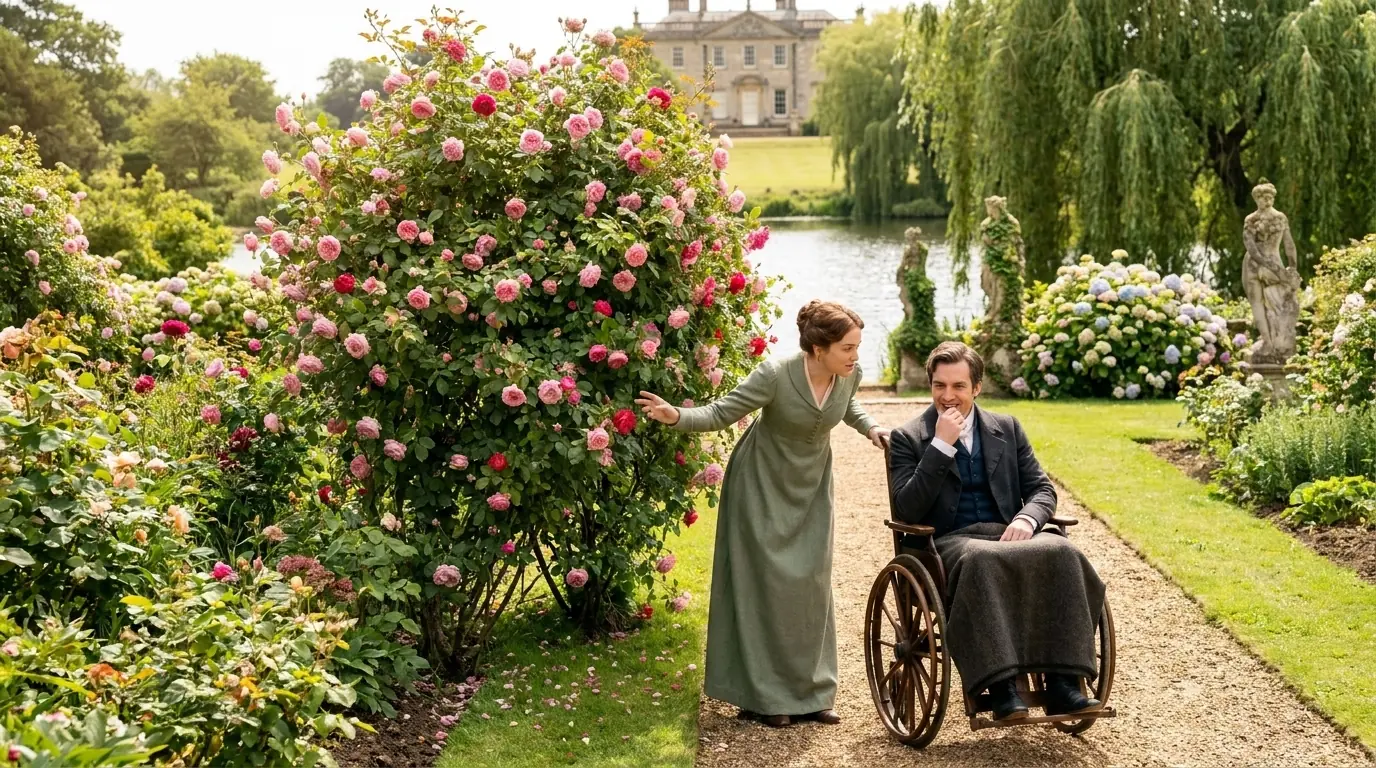
The thick woolen blanket draped over his motionless legs. The white knuckles gripping the wheels. The missing pieces snapped together in an instant. The terrified staff. The vaguely worded advertisement that had mentioned only a need for someone with experience in private care, someone unafraid of difficult temperaments.
She wasn't simply looking at the reclusive Duke everyone whispered about in the village. She was looking at the very man she had ruthlessly scolded not 15 minutes ago. Clara had been hopelessly lost. The west wing of Danhill Hall was a labyrinth of identical oak-paneled corridors, each one darker and colder than the last. She had taken three wrong turns past the same portrait of a disapproving ancestor twice, and was rapidly approaching the kind of anxiety that would cause her to be late, a thing she refused to be on the single most important morning of her life.
She pushed open a heavy door and found a study. It was vast and oppressive, and smelled of old paper and extinguished fires. Late morning light fell in slanted columns through half-drawn curtains. And in the far corner, in a towering wingback chair positioned entirely away from the door, sat a man. His back was to her.
Completely, deliberately to her. Clara assumed he was the estate manager, or perhaps an arrogant relative lingering after a weekend visit. She stepped forward. "Excuse me, sir. I seem to have lost my way. Could you direct me to the Duchess's drawing-room?" The man did not move.
He did not turn his head. He gave absolutely no indication that he had heard her speak. Clara frowned, stepping closer. "Sir, I only require a quick direction." Silence.
Deep, suffocating, intentional silence. The air in the room felt heavy, stagnant, as though it had not been disturbed in days. Most people would have retreated, mumbled an apology to the back of that chair, and fled the corridor. But Clara was not most people. She had spent the previous three years caring for her father after the riding accident that had stolen the use of his left leg, and for a time, most of his will to live.
She had sat with him through the rages and the weeping and the long, terrible silences. She had learned the difference between grief that needed space and anger that needed confrontation. And she recognized, without any doubt at all, exactly which one this was. This was not a man in quiet pain. This was a man throwing a silent tantrum, wielding his own stillness like a weapon to drive the world away.
Clara had no patience for it. "I see," she said. Her voice rang out crisp and uncompromising in the heavy quiet of the room. "You must forgive my intrusion. I had assumed I was speaking to a gentleman. It seems I was mistaken." The shoulders in the wingback chair stiffened barely, but she caught it.
Not a slam exactly, but with precisely enough force to make her feelings known. Now, facing the man whose face she had never actually seen in the study, Clara felt her heart hammer wildly against her ribs. The Duke of Danhill brought his wheelchair to a halt in the center of the room. He had, by all accounts, spent two years systematically driving away every nurse, valet, and physician his mother had brought to his door. His reputation in the household was not one of sadness.
It was one of scorched earth. The Duchess sat completely frozen, her teacup suspended halfway to her lips, her expression that of a woman watching a catastrophe unfold in exquisite slow motion. But the Duke did not look at his mother. His hollow, exhausted eyes moved immediately, with unerring precision, directly to Clara. The silence was absolute.
Clara waited for the order to leave, for the dismissal, the cold fury, the public humiliation she had apparently spectacularly earned. She kept her chin level. She kept her eyes steady. She would not look away, and she would not apologize for speaking plainly to a man who had refused to show another person the basic courtesy of acknowledgement. He stared at her.
A long, measuring, complicated stare. A muscle moved in his jaw. And then, something entirely unexpected, the very corner of his mouth twitched. Not a smile, but the ghost of something that had once been one. He shifted his gaze to his mother and delivered two quiet, absolute words.
"Hire her." Without waiting for a response, the Duke turned his wheels sharply and rolled back out into the corridor, leaving the doors wide open and a stunned, ringing silence in his wake. The Duchess set her teacup down very carefully. She looked at Clara. Clara looked at the empty doorway. "Well," the Duchess said at last, with the exhausted composure of a woman who had long since stopped being surprised by her son.
"It appears the position is yours." The Duke's quarters were the darkest rooms in the house. Not because the sun refused to find them. They faced southeast, and on a clear morning the light would have flooded every corner. But the curtains were always drawn. The heavy velvet drapes had not been fully opened in two years, according to the housekeeper, who had confided this in a whisper with the expression of a woman confessing a sin.
On her first morning, Clara arrived at precisely seven o’clock, knocked twice, and entered without waiting for a response. The Duke was not asleep. He was sitting up in the dimness, his dark hair disheveled, the remnants of last night's untouched dinner tray still on the side table, watching her come in with the expression of a man who had resigned himself to another irritation. "You are going to open those curtains," he said before she had reached the foot of his bed.
His voice was low and rough from disuse, but the authority in it was undimmed. "I forbid it." "Good morning, Your Grace," Clara said pleasantly. She crossed to the window and opened the curtains. The morning light crashed into the room. The Duke turned his face sharply away, raising one hand against the brightness with a low, savage sound that was not quite a word.
"That," he said when he had recovered, "was a direct disregard of an explicit instruction." "I have found that light assists considerably with morning routines," Clara replied, moving to the side table to assess the untouched dinner tray. "You did not eat your supper." "I was not hungry." She looked up. "Your body cannot recover on stubbornness alone, Your Grace. Stubbornness requires fuel, the same as everything else." He stared at her. Clara stared back with a particular brand of serene, immovable patience she had spent three years perfecting on her father.
It was a look that communicated, without any hostility at all, that she had absolutely nowhere else to be and no intention of moving. The Duke looked away first. He did not apologize or concede anything aloud. But when Clara returned twenty minutes later with a fresh tray, he ate. It was not a victory, exactly.
It was the opening move. The first 2 weeks were a war conducted in near silence. The Duke tested her with every weapon in his considerable arsenal. He refused meals, refused his medicine, spoke to her in clipped, withering monosyllables, or not at all. He dismissed her from the room without cause, and rang for her at two o’clock in the morning for things he did not actually need, apparently to see if she would come at the inconvenient hour.
She came. Every time. Without complaint, without reproach, without the wounded expression he seemed to be deliberately attempting to produce. "You are annoyingly difficult to offend," he said one evening, roughly a fortnight into her employment, watching her refold a blanket he had shoved to the floor.
"My father would be delighted to hear that," Clara said. "He tried for 2two years with very little success." A pause. It was the first personal thing she had offered him. He absorbed it with the careful, still attention of a man cataloging an unexpected detail. "Your father?" His voice was neutral.
"You have experience with illness?" "With injury. He lost the use of his left leg three years ago." "A riding accident?" She smoothed the blanket. "He spent the first year being extraordinarily angry about it." "And the second year?" "The second year he was angry at himself for wasting the first." She glanced at him then, a brief, measured glance. It took a third year to find his way back to something resembling himself. The Duke said nothing.
But something shifted in the quality of his silence, less like a wall and more like a door slightly ajar. Clara picked up the empty tray and went to the door. "Good night, Your Grace." "What did he do?" the Duke said suddenly. "The man in the second year, when he was angry at himself." Clara paused with her hand on the door.
She considered the question honestly. "He told me," she said quietly. "Eventually. All of it. The fear and the grief for the life he'd expected to have and the fury at his own helplessness. And I think she chose her words carefully. I think the telling of it was the beginning of the way out because once it was spoken aloud, it lost some of its power to suffocate him. She opened the door. I am a very good listener, Your Grace, if you ever find yourself wanting to speak." She left him in the lamplight staring at the wall with an expression she could not quite read.
The battle over the medicine was the one that nearly broke her. The estate doctor had prescribed a tincture for nerve pain, the source Clara had gathered from careful observation and the very occasional unguarded word from the Duke himself of the worst of his suffering. The legs that would not move still hurt. That was the particular cruelty of his condition and it had made the dark room darker in a way she was only beginning to understand. The problem was that the Duke refused the tincture with a ferocity that bordered on theatrical.
"It makes me stupid," he said flatly on the fourth day of her presenting it and him pushing it aside. "I will not be made stupid." "It reduces pain," Clara said. "It reduces everything. My thoughts go sideways. I cannot read. I cannot think. I cannot—" He stopped, jaw tight.
"I will not." Clara set the bottle down. She sat in the chair beside his bed, which she had quietly claimed as her own over the past weeks, and looked at him directly. "What do you do?" she asked carefully, "When you can read and think, what do you do with those hours?" The question clearly caught him off guard. He looked at her as though it were a trap. "I used to" He stopped again.
"I managed the estate, correspondence, the tenants, the accounts." A pause that had something raw inside it. "Before." "And now you manage nothing," Clara said, not unkindly, "because you are in too much pain to concentrate, and you refuse the one thing that relieves the pain because you are afraid it will take your mind from you. So you have neither your body nor your mind, and you sit in the dark with both." He looked at her with an expression that was not quite fury and not quite devastation. "A reduced dose," Clara said, "half of what the doctor prescribed, enough to take the edge from it, not enough to cloud you. Try it for one week. If your mind suffers, I will never raise it again." A long silence. "one week," the Duke said at last.
The words fell like stones, reluctant and heavy. "one week," Clara agreed. By the end of the week, he had asked for writing paper. He had begun to draft a letter to his estate manager, the first in two years. Clara had found him at his desk at three o’clock in the afternoon, bent over the correspondence with frowning concentration, entirely unaware of her presence in the doorway. She had stood there for a moment longer than was strictly necessary, watching the lamplight fall across his bent head, and felt something quiet and complicated move through her chest that she did not entirely examine.
She went back into the corridor and closed the door softly and told herself it was simply the satisfaction of work done well. It took three more weeks of relentless, unyielding stubbornness, most of it his, but Clara finally got him out of the dark. She didn't ask permission. She had learned with some efficiency that asking permission produced refusals. One crisp, bright afternoon, three weeks after the medicine truce, she simply appeared in the doorway with his outdoor coat over her arm and said, with the tone of someone announcing an unremarkable appointment, "The South Terrace. Ten minutes." He grumbled.
He said it was too bright. He said the gravel would be uneven for the wheels. He said he saw no possible reason to move from a perfectly adequate room. Clara laid his coat across the arm of the wheelchair, stood beside it, and waited with the expression of a woman who had already heard every version of this argument and found none of them convincing. He got into the chair.
She wheeled him out through the French doors and onto the sprawling South Terrace. And then, as his curses about the glare of the sun became slightly less frequent, she kept going along the winding gravel paths between the beds of late season hydrangeas, past the overgrown stone statues, half reclaimed by ivy, toward the great lake that glittered at the far end of the property. She talked the whole way, not about him or his health or his recovery or any of the laden airless subjects that had defined their days together. She talked about the absurdity of the gardener's apparent philosophy, a sort of radical non-interventionism, she suggested, a deeply held belief that nature knew best and should be left entirely to its own conclusions. She talked about the local vicar, whose hat was of such aggressively unfashionable proportions that it had to be a matter of conviction.
She recounted her own spectacular collision with a stone bird bath on her first morning, which she had somehow failed to see despite its being neither small nor quiet in color. The Duke said nothing. But after the third story, his grip on the armrests had loosened slightly. They reached the lake at last. The water was flat and brilliant under the afternoon sun, catching the light in long, shifting ribbons.
Clara stopped the chair at the edge of the path where the gravel gave way to close-cropped grass and the willows trailed their long fingers into the water. "Your head gardener," Clara mused, surveying the scene beside him, "is either a genius of the untamed aesthetic or he has been sleeping on the job for the better part of a year. That rose bush over there looks absolutely feral." The duke stared out at the water. He tried very hard to maintain his scowl. She could see the effort of it in his jaw, in the set of his shoulders.
He failed. A sound broke from his chest—low, rusty from long disuse, and entirely involuntary. A genuine laugh, brief and startled, as though it had escaped before he could stop it. He snapped his mouth shut the moment it came, looking almost alarmed by his own reaction. Clara stopped.
She turned her head slowly and looked down at him. The afternoon light fell across his face at an angle that stripped away the severity, the exhaustion, the two years of accumulated bitterness. He was turned slightly in the chair, eyes still wide with the surprise of himself, and in that unguarded instant, he looked not young, exactly, but open. As if a window had been thrown wide in a room that had forgotten windows existed. He looked up at her, found her already watching.
The silence between them was different from every other silence they had shared. It was not his fortress or her patience. It was simply two people standing in the same light, seeing each other plainly. Clara felt it, a slow, warm, entirely inconvenient awareness settling low in her chest. She was his employee.
She was here to see to his health and his comfort and his gradual re-emergence into the world. She was not here to notice the particular way the sun caught his eyes or the quiet wonder in his expression as he looked at her. But she noticed, and she found, after a moment, that she could not produce the professional distance she reached for. Instead, a genuine smile came, warm and unguarded and entirely her own. The Duke absorbed it the way a man absorbs sunlight after a long winter.
He studied the curve of it, the brightness in her eyes, and then the rigid set of his shoulders melted away, and he smiled back. A real smile, devastating and quiet, and directed entirely at her. No words. The willows rustled, the water glittered. Something permanent and irreversible had just shifted between them, and they both knew it, and neither of them said so.
Clara looked back out at the lake after a moment, and resumed talking about the rose bush. But her voice, she noticed, was slightly less steady than usual. It became a ritual without either of them declaring it one. After the lake, he began to request her company in the evenings, not in the capacity of a carer, the nights were managed well enough by the household, but simply as a presence. He had begun working through his estate correspondence again, seriously and methodically, rebuilding two years of neglect one letter at a time.
Clara would sit in the chair on the opposite side of the desk with a book, reading without speaking, and he would write. The silence in those evenings was entirely different from the siege silences of the first weeks. This was the silence of two people comfortable enough to share a room without filling it. Sometimes he would read a passage from a letter aloud to her, not because he needed guidance, but because he was thinking through it, and she had proven, on several occasions, to have an alarming instinct for what was and was not being said in formal correspondence. "She had grown up reading convoluted missives," she explained when he pointed this out.
"One develops a facility for decoding what professionals are reluctant to state plainly. He began to speak to her in fragments, then in longer passages, the way she had told him her father had spoken. The fear, the grief, the particular humiliation of a man who had always commanded a room, suddenly unable to command his own body. The morning of the accident, the first time a physician had used the word permanent. Clara listened. She did not offer solutions or false comfort or the anxious reassurances that he had come to dread from the people who loved him. She listened the way one listens to music, with full attention, without trying to interrupt or interpret. And when he had finished, she would sometimes be quiet for a while and then say something measured and true that he had not thought of himself. The elderly estate doctor stepped out of the Duke's quarters with the careful movements of a man who had just witnessed something he was not certain he could explain. He pulled the heavy mahogany door shut behind him and stood in the corridor, removing his spectacles and polishing them slowly with his linen handkerchief. A habit Clara had noticed that indicated deep thought. The Duchess and Clara had been waiting near the window. The Duchess wrung her hands in her lap, a nervous habit two years in the making. "Well, doctor?" the Duchess asked, her voice tight. "Has there been any change?" The doctor replaced his spectacles. He looked between the two women with a small bewildered smile. "Your grace," he said, addressing the Duchess, "in 40 years of practice, I have learned to be cautious about words like miraculous, but his color is improved, his appetite has returned, His pulse is steady and strong.
He shook his head slightly. "He still complains about my instruments—yes, he always has—but his eyes are clear. For the first time in two years, your son looks like a man who intends to remain among the living." He paused. "I do not know what has changed. I know only that it has." The Duchess let out a sound that was somewhere between a gasp and a sob.
Her composure, so carefully maintained through two years of watching her son disappear into the dark, shattered entirely. She pressed her trembling hand to her lips, her eyes filling with tears she made no attempt to suppress. She turned to Clara. She did not speak. There were no words for what passed between them in that moment.
The Duchess looking at the young woman in the plain practical dress who walked into this house six weeks ago and somehow, without fanfare or ceremony, found the door in the dark that two years of professional care had failed to locate. She reached out and took Clara's hands in both of hers and squeezed them and said nothing at all. Clara felt the tears threaten and blinked them back and squeezed the Duchess's hands in return. A month after the doctor's visit, the Duke made a decision that sent the entire household into a quiet frenzy of excitement. He ordered the carriage brought around.
Clara had been in the library when the footman found her wide-eyed with the news. She had taken a moment to compose herself before going to find the Duke in his study, where he was seated at his desk with an expression of deliberate casualness that fooled no one. "The village road," he said before she could speak. "An hour, no more. And before you raise an objection, I am not asking." "I wasn't going to object," Clara said.
He looked at her with mild suspicion. "You always object." "I object to things that are bad for you. Fresh air and motion are not bad for you." She paused. "I was simply going to say that the curtains on the east side of the carriage tend to stick and may require some persuasion." Something moved through his expression—warmth, amusement, and the shadow of gratitude, all compressed into a flicker.
"Then let us go," he said. The heavy velvet curtains, which had always been drawn across the carriage windows like morning shrouds, were pulled wide open. Clara sat across from him on the journey out, her hands folded in her lap, watching him watch the world come back. He sat tall, his cane resting beside him, his face turned toward the glass. The countryside opened up around them, the long stone-walled roads, the October gold of the tree lines, the distant blue of the sea glinting at the end of the coastal lane.
He breathed it in with a kind of careful deliberateness, as though relearning the habit. He did not wave. He did not nod. But he did not look away. He looked, Clara thought.
And then stopped thinking it quite so plainly, because the thought led somewhere she was not permitted to go. He looked, for the first time since she had known him, like himself. Whoever that was. Whoever he was becoming. They did not stop in the village.
They did not need to. As the ducal carriage rolled through the square, the crest unmistakable, the profile of the man at the window undeniable, the reaction was immediate and human and oddly moving. Merchants paused mid-transaction. Children stopped in the street. A woman coming out of the draper's shop pressed her hand to her chest and stared.
Rumors in the countryside moved faster than horses. Within 3 days, the whispers had traveled the forty miles to London and arrived in the grand townhouse of the Duke's third cousin, Arthur Caldwell. Arthur had spent two comfortable years in the role of presumed heir, borrowing against a future title, conducting himself with the easy confidence of a man whose fortune was merely delayed. He had visited Danhill Hall twice in those years, both times with the solicitous manner of a relative concerned for a beloved cousin's welfare, and both times with the shrewd eyes of a man calculating how much longer the invalidity might reasonably persist. The news that the Duke had left the estate grounds upright in an open-curtained carriage, looking, according to every account, disturbingly well, sent a cold wave of alarm through Arthur that he recognized immediately and privately as the feeling of an anticipated inheritance beginning to recede.
A recovering Duke could marry. A married Duke could produce an heir. An heir made Arthur Caldwell nothing more than a distant relation with expensive habits and a great deal of debt. Arthur packed his bags that afternoon. He descended upon Danhill Hall with the performance of a man overjoyed by wonderful news.
He embraced the Duchess. He declared himself overcome with relief. He spoke of his cousin's recovery in the tones of a man whose fondness had always been beyond question and watched the household receive him warmly and smiled and observed everything with the careful cataloging attention of someone who already knew the shape of the problem he had come to solve. It took him less than a day to find it. He watched from the upper gallery that evening as Clara pushed the wheelchair along the gravel path below.
He watched the Duke say something and Clara's head tipped back with laughter, bright and unguarded. He watched the Duke's expression as he looked up at her. Not the expression of a man tolerating a useful employee, but the focused, illuminated attention of a man who has found something he did not expect and is still quietly astonished by it. Arthur's smile thinned. If he wanted to secure his future, he had one target.
He had to remove Clara. Arthur found his moment the following evening. The Duke was resting after a long afternoon of correspondence. He tired more easily than he would admit and Clara had learned to watch for the particular set of his jaw that meant he was pushing himself beyond what was sensible. She had extracted herself on the pretext of fetching a book.
She was reaching for a volume on an upper shelf when the library doors clicked shut behind her. She turned to find Arthur leaning against the closed door, arms crossed, wearing the expression of a man who has rehearsed his lines. "Miss Clara," he said warmly, pushing off the door and moving into the room with the confident, circling energy of a man accustomed to owning every space he entered. "The household speaks of nothing but you. You have made quite a remarkable impression." "I simply do my job, sir." Clara kept her hands still and her voice even.
She had disliked him the moment he arrived. She had said nothing because disliking the Duke's cousin on instinct was not a professional opinion she was entitled to offer, but she had watched him, and what she had seen confirmed the instinct thoroughly. "Come now." Arthur stopped a few feet from her, looking her over with an appraisal that had nothing warm in it. "You are a clever girl. You must see how this appears. A common caretaker suddenly becomes the sole companion of a lonely, desperate man. It is a comprehensible situation. I am not here to judge it." He smiled.
"I am here to be practical." He reached into his coat and produced a heavy velvet coin purse. He placed it on the nearest reading table with a deliberate, weighted sound. "There is enough in that purse to establish you very comfortably. A new position in a household of your choosing. A contribution to your father's care." His voice dropped, the pleasantness draining out of it.
"Take it. Leave tonight. Tell him the burden became too much. He will be devastated for a month, and then he will recover. You will have done him the service of not allowing him to embarrass himself over a woman he considers entirely beneath his station." Clara looked at the purse, then at Arthur.
"And if I refuse?" His expression shifted to something harder. "Then I will ensure you are dismissed without a character. A word in the right ear—theft, impropriety, any number of things—will be easy to whisper and nearly impossible to disprove. You will leave this house unemployable, your reputation destroyed, and your father without care or income." He tilted his head. "I am trying to be generous, Miss Clara. You would be wise to accept generosity when it is offered." Clara was quiet for a moment.
Then she stepped forward, picked up the book she had come to fetch, and moved around him with the same unhurried composure she had used to step around his cousin on her first morning in the house. "You mistake me for someone easily frightened," she said at the door. "I answer to the Duke and the Duchess, not to a man who appears only when he smells an inheritance. Good evening, sir." She opened the door and walked out, leaving him alone with his coin purse in the dark. She walked back to the Duke's study.
She stood outside the door for a moment, her heart hammering, her breath uneven. She smoothed her expression. She went in, set the book on the desk, and resumed her chair with the serenity of a woman who had not just been threatened with ruin. She said nothing. She would not frighten him.
She would not give Arthur the satisfaction. But she understood with cold clarity that the threat was real and that Arthur would not abandon it simply because she had. Three days later, Clara was summoned to the grand drawing room. She knew before she reached the door. She could not have said how.
The footman who delivered the message would not meet her eyes. The corridor felt wrong. Too quiet, the way a house goes quiet when something bad is about to happen inside it. She opened the drawing-room doors and understood. The Duchess stood by the fireplace, her face drained of color, clutching a handkerchief so tightly her knuckles were white.
Standing across from her, impeccably composed, was Arthur. And on the polished mahogany table between them, placed with ostentatious deliberateness, lay the Duchess's diamond-encrusted necklace. "Enter, Miss Clara," Arthur said, with the solicitous gravity of a man performing deep reluctance. Clara stepped into the room. "Your Grace?" She addressed the Duchess only.
"You sent for me." "A maid was sent to refresh your quarters this morning," Arthur began before the Duchess could speak. "She found this beneath your floorboards, poorly concealed, I am sorry to say." "I have never seen that necklace in my life," Clara said. Her voice was steady. Her hands were not. "I did not take it." "Of course you say that," Arthur sighed with the practiced sorrow of a man for whom sympathy was a tool.
He turned to the Duchess. "I warned you, Aunt. Bring a desperate girl into a house of this kind, surround her with wealth beyond anything she has known. It is not a moral failing. It is simply—" " I am not a thief." Clara's voice came out sharper than she intended.
She pulled it back. "Your Grace." She looked at the Duchess. "You know me. You know my character." The Duchess's eyes moved between Clara and the necklace and Arthur, anguished and helpless, wanting to believe and afraid of the evidence. "I have sent for the magistrate," Arthur said, dropping the sympathy like a mask, "he will be here within the hour." There it was.
The cold certainty of it settled into Clara's stomach like a stone. The magistrate—a working-class woman accused of theft in a house of this standing with a titled gentleman providing the testimony. It did not matter that she was innocent. In a county magistrate's court, what mattered was the word of an the honorable Arthur Caldwell against the word of a caretaker from the village. She would be arrested.
She would be tried. She would be made an example of, just as he had promised, and there was nothing she could do. She had no proof. She had no power. She had only her word, and her word was not enough.
Arthur stepped toward her, his voice dropping to a whisper for her ears alone. "You should have taken my money, little bird. Now, you leave in irons." Then came a sound at the doors. Not the creak of wheels, but a heavy, deliberate footstep, followed by the measured strike of a cane on marble, and then another step. Clara turned toward the doorway.
Her breath stopped entirely. A shadow fell across the threshold. And then a man stepped through it. He was gripping the doorframe with one hand, a silver-tipped cane in the other. He was breathing hard, his face set with a particular ferocity of a man who has demanded something extraordinary of himself and refuses to acknowledge the cost of it.
His knuckles were white on the frame. His posture was not quite steady. But he was standing. The Duke of Danhill was standing in the doorway of his own drawing-room, upright on his own two feet for the first time in two years. The Duchess made a sound that was barely human.
Arthur stumbled backward as though he had been struck, all the blood leaving his face at once, leaving him a peculiar, satisfying gray. "C-cousin," Arthur managed. "You—you are walking." The Duke did not look at him. He took one slow, grueling step into the room, then another. The cane struck the marble, and his boots scraped, and the silence was so complete that every sound of his crossing the room was enormous, and every person in it was holding their breath.
He stopped in front of Clara. He placed himself between her and his cousin, deliberately, entirely. She could see the fine tremor in the arm that held the cane, the effort it was costing him, the controlled ferocity with which he was overriding it. He looked at Arthur over her shoulder. "You will send a rider to intercept the magistrate," the Duke said.
His voice had none of the weakness of his body in it. It was absolute. "You will pack your trunks. You will be off my lands before the sun sets." "I am reporting a theft," Arthur sputtered. "The woman is a criminal. You cannot simply—" "You planted evidence in her room because she refused to be bought," the Duke said quietly.
"You have spent six months treating my estate as a personal fund while waiting for me to die, and you have spent the last three days attempting to remove the one person in this house with enough spine to treat me as something other than an inconvenience." He paused. "You will not speak of her again." "She is a servant," Arthur said, desperation making him reckless. "She is common. She has no place in your life beyond her function. You cannot allow a cripple's loneliness to—" "She is my fiancée." The words fell into the room like a stone into water.
Clara felt the sound of them against her ribs, felt the breath leave her body entirely. The Duchess's handkerchief dropped to the floor. "You are speaking to the future Duchess of Danhill," the Duke continued, his voice very quiet now, and therefore very final. "And you will leave this house immediately. If I hear your name again in connection with hers, in any context, in any county, you will find that I am considerably less incapacitated than you imagined." Arthur looked at his cousin's face.
He looked at the Duchess. He looked at Clara. He left. His footsteps echoed down the corridor, fast, graceless, entirely stripped of their earlier performance, and then the outer doors of the hall thudded shut, and he was gone. The Duchess slipped out of the room without a word, gesturing to the footman to follow her, pulling the doors gently shut behind her.
She had the instinct of a woman who understood that some moments required privacy. The Duke and Clara were alone. The adrenaline that had carried him across the room began visibly and rapidly to retreat. He swayed. Clara was already moving.
She crossed the distance in three steps and got her hands around his arm, her shoulder under his, taking his weight before his knees could betray him. He let her. For just a moment, he leaned into her entirely, forehead coming to rest against her temple, a long, shuddering exhale escaping him. Two years of fighting everything and everyone and himself compressed into a single breath released. "You absolute fool," Clara whispered, and her voice was not steady at all.
"You could have hurt yourself. You should have sent for the footman. You should have—" "I was not going to send a footman," he said against her hair. "You could have called out from the corridor." "Clara." Something in the way he said her name, just her name, the same way he had said it that night in the study, plain and direct and nothing professional in it at all, stopped her.
He straightened. She helped him to the table where he could rest his weight, and he turned to face her. She was close, closer than the situation required. She didn't step back. "Fiancée," Clara said.
The word came out smaller than she intended. "You called me your fiancée." "I did—to prevent your arrest." He looked at her for a long moment. The exhaustion was written into every line of his face, but his eyes were entirely awake, the dark, focused, specific attention he gave to things that mattered. "Is that what you think?" he asked quietly.
Clara swallowed. "It is the logical explanation." "Who told you to look for the logical explanation," he interrupted, "when someone is standing in front of you telling you something true?" She stared at him. Her heart was hammering in a way that had nothing to do with the crisis that had just resolved itself and everything to do with the proximity of him, the look on his face, the terrible, careful hope in it. "I have been trying," he said, "to find the correct moment to say this for approximately a month, and I have concluded that there is no correct moment, and that I am therefore going to say it now, at the worst possible time, which I suspect is very like me." He paused.
"I am in love with you. I have been since the day you scolded me in my own library for having the audacity to ignore a stranger, and I do not intend to stop." Clara felt the words land in her chest like light through a window. "You are a duke," she said, and her voice was barely above a whisper. "I am your employee. I am—" "You are the woman who opened my curtains without permission, and argued with me about medicine, and made me laugh at a rose bush," he said, and the corner of his mouth curved.
"You are the woman who stayed when every other person I drove away left. You are the woman my household adores, and my mother has already, I suspect, begun planning a wedding she has not been invited to plan." His hand came up and took hers carefully, the way he had reached for her that first night at the lake's edge. "Clara, if you send me back to the dark, I will go. I will not make you anything you do not wish to be, but I meant every word I said to Arthur, and I want you to know it as the truth." Clara looked at their hands, at his face, at the man he was, not the brittle, fortress-bound figure she had found in the dim room, but the man who had emerged from those weeks like something that had learned to grow toward light. The man she had, helplessly and without permission, fallen entirely in love with.
"You are going to be insufferable if I agree," she said. "You are already insufferable about most things." His smile broke fully across his face, wide and real and devastating. "Undoubtedly," he said. She closed the distance. The kiss was not graceful.
She was trembling slightly and he was still unsteady and his cane clattered to the floor somewhere in the first moment of it and neither of them noticed. It was warm and quiet and deeply certain, the way two people kiss when they have been trying not to for weeks and have finally, mercifully, given up the effort. When they broke apart, she pressed her forehead against his shoulder and felt under her hands the slow, steady return of his breathing to something normal. "Insufferable," she murmured into the lapel of his coat.
"Without question," he agreed, his arms tightening around her.