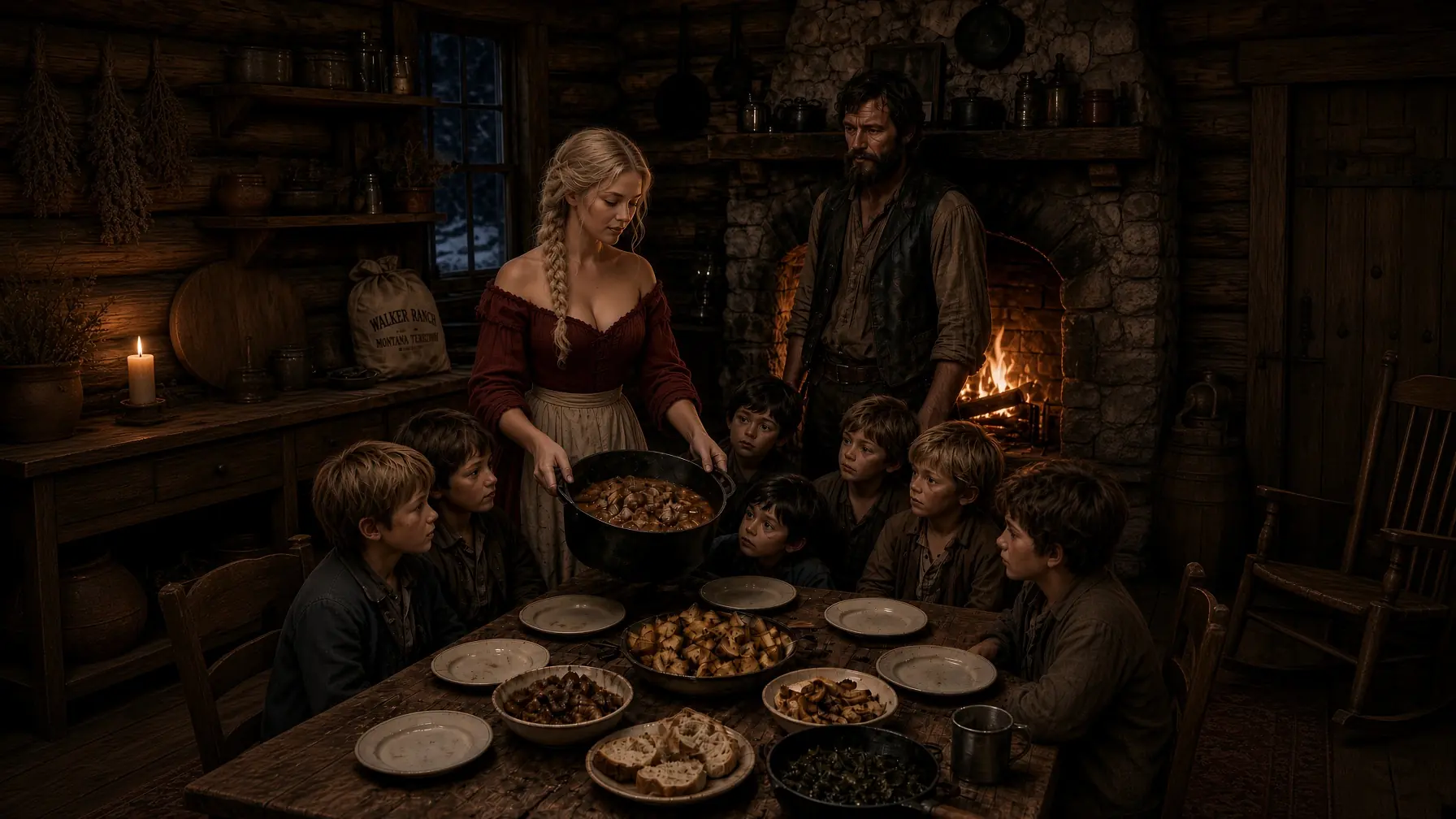
Emily Carter pressed her only good dress flat against her stomach with both hands staring at the door of a house she had never seen before belonging to a man she had never met in a territory so far from Boston that the city felt like something she had dreamed once and forgotten. She was 29 years old. She had $12, one suitcase, and a marriage certificate signed by a man named Jacob Walker, a man who had not even come to the station to meet her. Nobody had. The wagon driver said nothing the entire 4 miles from Millhaven Station to Walker Ranch.
He kept his eyes on the road and his jaw tight, and when he finally pulled the horses to a stop in front of a weathered gate, he set Emily's suitcase in the dirt without being asked and climbed back onto his seat before she had even steadied herself on the ground. "This it? " she asked. "Walker Ranch," he said. That was all. She watched the wagon roll away until it disappeared behind the tree line, and then she stood alone in the Montana afternoon with her suitcase at her feet and a silence so complete she could hear her own heartbeat.
The house in front of her was large once. She could see that. Wide porch, two stories, a stone chimney running up the left side. But the porch railing sagged in two places. One of the shutters on the upper window hung crooked on a single hinge.
The yard between the gate and the front steps was not a yard at all. It was a graveyard of broken tools, a rusted watering trough tipped on its side, and a child's wooden toy horse half buried in the mud as though it had been dropped there years ago and nobody had thought to pick it up. Emily picked up her suitcase. She walked to the front door. She knocked.
Nothing. She knocked again louder. A long pause. Then boots on a wooden floor, heavy and unhurried, and the door swung open. The man standing in the frame was tall and lean, in the way that hard work and harder winters made men lean, not thin, but stripped down to what was essential.
Dark hair pushed back from a face that had forgotten how to arrange itself into any expression other than endurance. He looked at her the way a man looks at a problem he has been handed and has not yet decided whether to solve or set aside. "You're the woman from Boston," he said. "Emily Carter," she said. "Emily Walker now, I suppose. " He said nothing for a moment.
His eyes moved to the suitcase in her hand, then back to her face. "Jacob Walker. " He stepped back from the door. Not a welcome, exactly, more like a permission. "Come in. " The inside of the house hit her the moment she crossed the threshold. Not a smell, not quite, but a feeling.
The feeling of a place that had been lived in hard and maintained barely and loved not at all recently. A coat rack by the door held six boys' jackets in various states of destruction. The floor runner was worn down to threads at the center. The parlor to her left had furniture covered in dust and a fireplace that looked like it hadn't been lit in months, despite the chill in the air. "Your room is at the top of the stairs. " Jacob said, already walking away from her toward the back of the house.
"Second door on the right. Boys know you're coming. Supper's their responsibility tonight. I've got work in the barn. " She stood in the entry hall holding her suitcase. "Mr.
Walker. " He stopped, turned halfway. "How old are they? " she asked. "Your sons. " He looked at her as if the question surprised him, though she could not say why it would. "Ethan's 17," he said. "Then 16, 14, 12, 9, and the youngest just turned 6 last month.
"Six boys," she said. "Six boys," he confirmed. And then he walked out the back door, and she heard it close behind him, and she was alone in the entry hall of her new home with her suitcase in her hand and not a single soul to show her where anything was. She stood there for 10 seconds, then she set her suitcase by the coat rack, straightened her back, and walked toward the sound of voices at the far end of the hall. The kitchen was chaos.
The boy she would later learn was Thomas, 9 years old, serious-faced, wearing an apron three sizes too large, tied twice around his narrow waist, was standing on a stepstool in front of the stove with a cast-iron skillet in his hands and genuine terror in his eyes. Smoke was rising from the skillet. Not an alarming amount, but enough that the smell of something scorching had already filled the room. Two older boys sat at the kitchen table watching him with the particular brand of interest that older brothers reserve for catastrophes in progress. A younger boy, maybe six, sat on the floor near the wood pile playing with a collection of pine cones arranged into some private architecture.
And somewhere behind her, she heard the sound of feet on the stairs, and two more boys appeared in the kitchen doorway. Stopped when they saw her and stared. Nobody spoke. Thomas turned from the stove, saw her, and nearly dropped the skillet. "You're not supposed to be in here," said the oldest boy at the table.
He had his father's jaw and his father's eyes and all the authority of a young man who had been in charge of things he should never have had to be in charge of. "This is our kitchen. " "I'm Emily," she said. "I'm your We know who you are. " His voice was not cruel. It was something more difficult than cruel. It was simply closed.
"We've had women come before. They don't stay. " She looked at him. What's your name? A pause. Ethan.
How many women came before me, Ethan? He blinked. He hadn't expected her to ask that. Two, he said. One stayed 4 days.
One stayed 11. And what made them leave? Another pause. The boy at the table beside Ethan. 16, she would learn named Samuel, let out a short breath that might have been a laugh.
Thomas on the stepstool had turned fully around now, the skillet forgotten, watching her like she was something he needed to categorize before he knew what to do with her. Everything, Ethan said finally. Everything made them leave. Emily nodded. She looked at the skillet.
What's in there? Potatoes, Thomas said quietly. I was trying to fry them, but I think I burned them. Can I look? He moved aside without answering, which she took as yes.
She crossed to the stove, looked down into the skillet. The potatoes were cut too thick and browned unevenly on one side, not ruined, not yet, but heading there. She looked around the kitchen. She found the pantry door opened. It stood in front of it for a moment just looking.
Dried beans, half a sack of flour, some bacon ends wrapped in cloth, a crock of lard, two onions, a jar of something preserved that she couldn't immediately identify, and on the bottom shelf, six more potatoes. She turned back to the kitchen. All of them were watching her now. Ethan and Samuel at the table, Thomas on his stepstool, the two boys who had appeared in the doorway, and the small one on the floor who had abandoned his pine cone city and was looking at her with enormous solemn eyes. What's your name?
She asked the small one. Eli, he said, barely above a whisper. Eli, can you do me a favor and go tell your father that supper will be ready in 1 hour? Eli looked at Ethan. Ethan looked at Emily.
He doesn't like to be interrupted in the barn, Ethan said. He can eat or not eat, Emily said. But either way, supper will be ready in 1 hour. Will you tell him? Another long look from Ethan.
Then barely perceptibly a nod. Eli scrambled to his feet and ran for the back door. Emily took off her traveling coat, hung it on the back of a chair, rolled up her sleeves, and went back to the pantry. She did not ask permission. She did not explain herself.
She simply began. She sliced the potatoes thin, which was the first thing Thomas had gotten wrong, and she got them back in the skillet with a proper amount of lard and the heat at a proper level. And while they cooked, she soaked the dried beans in water. Not for tonight, but so they'd be ready for tomorrow, because she was already thinking about tomorrow. And she found a mixing bowl and started on a simple bread.
Nothing complicated. Just flour and lard and salt and water, worked until it was smooth, because a meal without bread was just food. But bread made it a supper. She worked in silence for a while. The boys watched.
Then Samuel, the 16-year-old, who had the look of someone who had decided 3 months ago that the world was a disappointment and hadn't found reason to revise his opinion, said from the table, "You're not going to last. " She didn't look up from the bread dough. "What makes you say that? " "Because nobody does. This place is" He stopped, started again. "It's hard here. The winters are bad.