Zara Washington noticed the pointing finger before she noticed the woman attached to it.
It hovered six inches from her face.
Perfect manicure.
Small diamond ring.
Controlled tremor caused not by fear, but anger.
“Security,” the woman said, without taking her eyes off Zara, “I asked you to remove her.”
The marble lobby of the Grand Meridian Manhattan became quieter.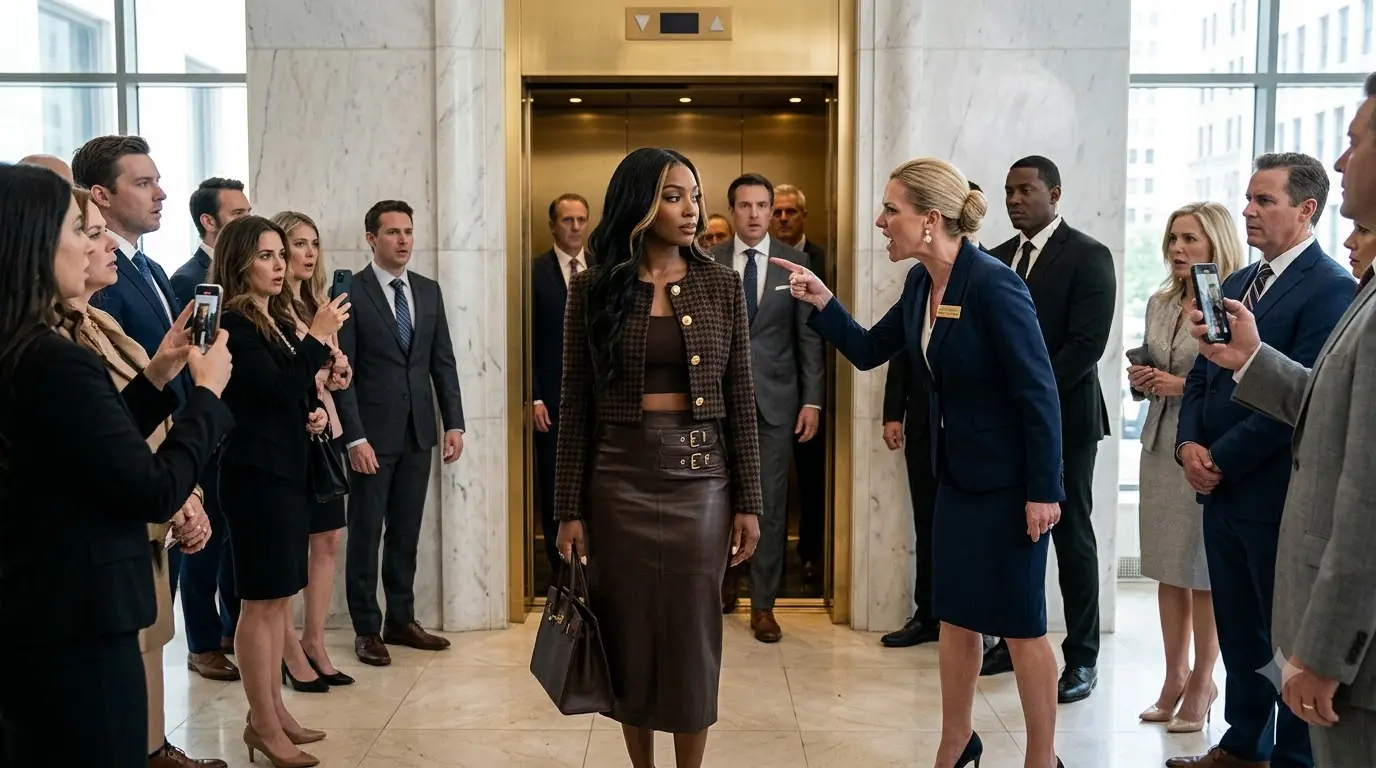
Not silent.
Luxury hotels were almost never silent.
There was always something.
Rolling luggage.
Elevator chimes.
Soft conversation.
Crystal glasses touching at the bar.
A pianist somewhere near the restaurant entrance playing music nobody consciously listened to.
But conversation around the gold elevator bank had begun thinning because people sensed conflict.
They always did.
Zara stood motionless.
She was thirty-six years old, tall, composed, and dressed in shades of dark chocolate brown that had been selected that morning simply because she liked them.
A cropped houndstooth jacket with polished gold buttons.
Fitted brown top.
High-waisted leather midi skirt with two narrow buckle details at the waist.
Dark pumps.
Gold earrings.
Bracelets.
Rings.
Long black hair falling almost to her waist, with two light face-framing streaks that made her features even more striking.
A structured leather handbag hung from one hand.
Nothing about her appearance looked careless.
Nothing looked inexpensive.
Yet Brittany Coleman had apparently decided within fifteen seconds that Zara did not belong in the hotel.
Zara wanted to know why.
That was why she had not identified herself.
Not yet.
Brittany stood directly between Zara and the executive elevator bank.
Forty-four.
Blonde hair pulled into a tight bun.
Navy management suit.
Pearl earrings.
Gold name badge.
Perfect posture.
Her badge read:
BRITTANY COLEMAN
GENERAL MANAGER
Zara had seen her photograph before.
Performance reports too.
Strong occupancy.
Excellent event revenue.
Above-target premium-suite conversion.
Corporate events growing.
Guest satisfaction officially rated at 92%.
A top performer.
On paper.
Then complaints began reaching headquarters.
Not enough to destroy a score.
Just enough to bother Zara.
A Black physician said she had been directed toward the service elevators while waiting for a colleague.
A Hispanic family said the front desk questioned their reservation three separate times after they arrived for a wedding.
A delivery executive wearing casual clothes said security followed him through the lobby even after he showed identification.
An older woman said she was asked whether she was “sure” she had an executive-floor booking.
Two younger Black businessmen claimed they had been denied access to the lounge until a white colleague arrived.
Each complaint could be explained individually.
Busy day.
Communication error.
Security procedure.
Reservation confusion.
Staff judgment.
Misunderstanding.
Hotels generated thousands of interactions every week.
Some went badly.
That happened.
But Zara had built her career around patterns.
Patterns rarely announced themselves loudly.
They appeared quietly in repeated excuses.
So she came personally.
No advance notice.
No executive delegation.
No corporate car waiting at the curb.
No assistant beside her.
She entered through the main doors at 2:18 p.m.
At 2:19, a doorman greeted the white couple walking three steps behind her before greeting Zara.
At 2:20, a lobby host asked whether she needed directions.
Zara said she was going to the executive level.
The host looked surprised.
Then said:
“Are you attending an event?”
“No.”
“Meeting someone?”
“No.”
“Do you have an appointment?”
Zara had smiled.
“I do not need one.”
The host became uncomfortable.
He radioed someone.
At 2:22, Brittany Coleman arrived.
She approached with the brisk confidence of a person accustomed to being obeyed.
“Good afternoon.”
“Good afternoon.”
“I’m Brittany, the general manager.”
“I know.”
That had made Brittany pause.
“May I ask your name?”
“Zara Washington.”
Recognition should have happened then.
It did not.
The Grand Meridian founder’s photograph appeared inside internal annual reports.
Training videos.
Corporate communications.
But most employees did not spend their days studying ownership.
And Zara had changed her hairstyle since the most recent corporate portrait.
She did not blame Brittany for failing to recognize her.
Recognition was not the test.
Behavior was.
Brittany asked:
“Who are you here to see?”
“I’m going upstairs.”
“To which floor?”
“Forty-two.”
That was the executive administration level.
Brittany’s eyes narrowed.
“The forty-second floor is restricted.”
“I know.”
“Do you have a meeting?”
“No.”
“Then I’m afraid you cannot access that elevator.”
Zara looked at the executive elevator.
“I can.”
Brittany smiled with professional patience.
“No, ma’am.”
Zara held her gaze.
“Are you refusing me access?”
“I’m explaining hotel procedure.”
“Which procedure?”
“Restricted floors require authorization.”
“Correct.”
Brittany seemed relieved.
“Then we agree.”
“Yes.”
Zara reached for her handbag.
Brittany raised one hand immediately.
“Please don’t.”
Zara stopped.
“Don’t what?”
“Reach into your bag.”
Two security guards approaching from the lobby noticed the movement.
Zara slowly lowered her hand.
Interesting.
She said:
“I was retrieving my access credential.”
Brittany glanced toward security.
“You should have presented it at reception.”
“Nobody asked.”
“That is not what my staff told me.”
Zara looked toward the lobby host.
He looked away.
Brittany continued:
“My understanding is that you bypassed normal check-in procedure and attempted to enter a restricted area.”
“I walked toward an elevator.”
“An executive elevator.”
“Yes.”
“For guests with authorized access.”
“Yes.”
“And you are not registered in our system.”
Zara smiled slightly.
“That would be difficult.”
Brittany frowned.
“Why?”
“I don’t usually make reservations for my own office.”
Brittany interpreted the sentence as sarcasm.
Her expression hardened.
“Ma’am, this isn’t going to become an argument.”
Zara looked around.
“I agree.”
“Good.”
“Then let me use the elevator.”
“No.”
The answer came quickly.
Too quickly.
Zara studied her.
“What would convince you?”
“Identification.”
Zara again reached toward her handbag.
Brittany’s eyes flicked toward security.
“Slowly.”
That word changed something.
Zara stopped.
“Excuse me?”
“I said slowly.”
One of the security guards, a tall Black man named Andre Lewis, looked uncomfortable.
The other, a white man named Paul Keegan, stood farther back.
Zara looked at Brittany.
“Did you tell the couple who just entered the executive lounge to move slowly when they reached into their bags?”
Brittany frowned.
“What couple?”
“The man in the gray suit and woman in the cream coat.”
“I wasn’t speaking with them.”
“Exactly.”
Brittany’s face tightened.
“That has nothing to do with this.”
“It may.”
“No.”
Brittany crossed her arms.
“You are making this unnecessarily difficult.”
Zara almost laughed.
“Am I?”
“Yes.”
“Because I asked to access a floor I am authorized to access?”
“Because you refuse to follow simple instructions.”
Zara looked toward Andre.
He avoided her eyes.
She understood why.
He was an employee.
Brittany was general manager.
Hierarchy worked quickly.
A group of wealthy guests gathered near the flowers beside the elevator bank.
One woman lifted her phone.
A man whispered something.
Another guest smiled as though they expected entertainment.
Brittany noticed the audience.
Something about her posture changed.
Her voice grew slightly louder.
“This hotel has standards.”
Zara went still.
There it was.
“Standards.”
“Yes.”
“What standard am I violating?”
Brittany looked at her clothing.
Only briefly.
But Zara saw it.
Then Brittany said:
“You entered a restricted area without authorization.”
“I haven’t entered anything.”
“You attempted to.”
“I walked toward an elevator.”
“You were told to stop.”
“After I arrived.”
“Exactly.”
Zara tilted her head.
“You keep describing normal movement as misconduct.”
Brittany laughed once.
“See? This is exactly the problem.”
“What problem?”
“Your attitude.”
Nearby guests were listening openly now.
Brittany turned slightly toward them.
Theater.
Zara recognized it immediately.
Some managers became more careful when people watched.
Others became more performative.
Brittany belonged to the second category.
She gestured toward security.
“Remove her from the elevator area.”
Andre hesitated.
“Ms. Coleman—”
Brittany looked at him.
“I gave you an instruction.”
Andre’s jaw tightened.
Zara raised one hand.
“Don’t touch me.”
Brittany said:
“Nobody needs to touch you if you cooperate.”
Zara stared.
The sentence was polished enough to sound reasonable.
That made it worse.
“Cooperate with what?”