"The beauty is the one in blue, Your Grace," said Mr. Ledbury, leaning so close that his breath stirred the wine in the glass. "The other one merely pours." Allaric, Duke of Staveley, did not turn his head. He had been in the Ledbury drawing room for eleven minutes, and in that time he had been offered a daughter, the way a horse coper offers a mare: teeth shown, paces named, price implied, and never spoken. He let the silence sit until Mr. Ledbury's smile began to sweat at the edges.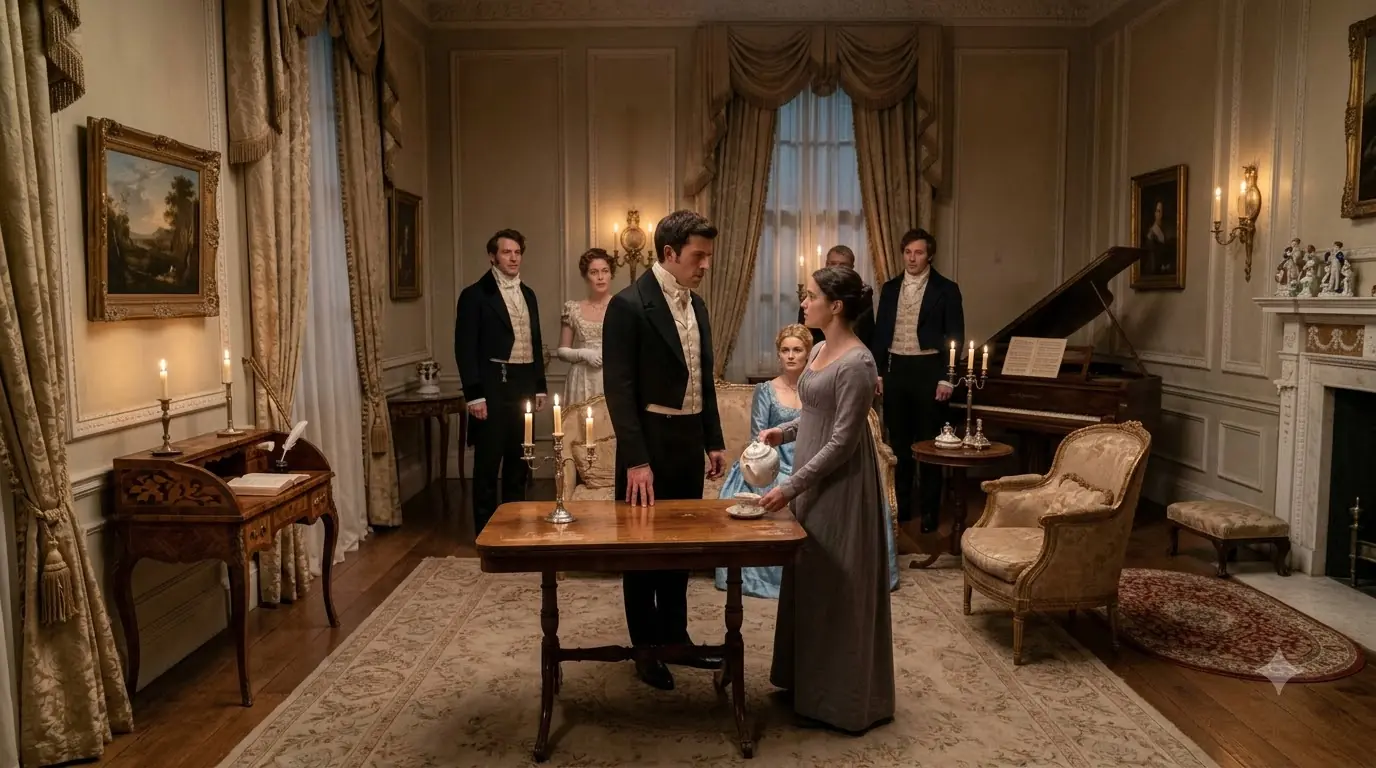
"Then the other one," Allaric said, "shall be very useful to me. My throat is dry." The room laughed because rooms always laughed when he spoke, whether or not he had said anything amusing. Delphine Ledbury laughed loudest.
A bright rehearsed cascade that she had clearly practiced at a pianoforte and a looking glass. She was, he granted, beautiful: gold-shot hair, a swan’s throat, a gown of celestial blue silk that had cost more than the roof over it. She turned her head to catch the candlelight the way a coin is turned to catch a buyer, and behind her at the tea table, half swallowed by the shadow of the window curtain, stood a young woman in gray. She did not look up. She was pouring a steady and hurried stream, the porcelain spout held so precisely that not one amber drop struck the tray.
Her sleeves were plain. Her hair was pinned without artistry and had escaped anyway, one dark strand curling at her nape. There was a small darn on her cuff, mended with such neat, patient stitches that a man would have to look for it. And all looked and found it, and something inside his chest turned over like a page. Two months, two months of inquiries of a discreet man in Bath and a bribed clerk in a coaching office, and a name he had almost despaired of ever fixing to her face.
And here she was pouring tea in her father's parlor, invisible to every soul in the room. "Honoria," her mother said, not unkindly, in the way one speaks to a footman one is fond of. "The Duke." The young woman came.
She carried the cup on its saucer with both hands and her eyes on the carpet. She stopped at a respectful distance and said, "Your Grace," in a low voice that was neither timid nor bold. And she waited. Allaric took the cup.
He did not need to look at her hand to know it. He had held it once in the rain, with the world turning gray at the edges of his sight, short nails, a callous at the base of the forefinger from a pen. A thin white scar along the thumb from a kettle or a knife, or some other small domestic violence that no lady of quality was ever supposed to meet. She did not know him. That much was plain.
She had seen a man in a mud-spattered greatcoat with blood in his hair in the dark in a downpour, and she had seen him for perhaps three-quarters of an hour, and he had given her a false and modest name, and she had never once asked him for another. She looked at him now with the polite blankness of a woman who expected nothing, and had learned to expect it very early. "Thank you," he said. She inclined her head and withdrew to the tea table, and Delphine Ledbury sat down at the pianoforte, and the evening proceeded exactly as the Ledburys intended it to proceed, and Allaric drank his tea, and did not taste it at all.
He had been thrown that night in March on the Marlay Road. It was a stupid business, and entirely his own fault. He had ridden out from an inn at dusk against the advice of the ostler, because he had been in a temper. His cousin had written to him about the Staveley succession again, and his solicitor had written to him about the Staveley rents, and the whole weight of his name had been sitting on his shoulders for so many years that he had wanted for one hour to be nothing but a man on a horse in the wind. The mare shied at a fallen bough.
He remembered laughing, though it hurt. He remembered that she had not screamed or wrung her hands or run for a man. She had set the lantern on a stone, put her shoulder under his arm, and hauled him, a man of thirteen stone, up the bank by main strength and stubbornness, and when he sagged against the gate she had propped him there, taken the shawl from her own shoulders, folded it into a pad, and pressed it hard to the cut over his ear, and held it there in the rain for a quarter of an hour without once complaining of the cold. "You are bleeding a great deal," she had said quite calmly, which is good.
It means it is a scalp wound and not your skull. Head cuts are vain things. They make more noise than they are worth. You speak, he had said, as though you have seen a great many of them. My father keeps hunters and no sense, she had said, and he had laughed again.
And she had told him not to because it made the bleeding worse. She had walked him half a mile to a cottage where a carter’s wife took him in, and she had paid the woman. He had seen it, a coin out of a purse so thin that the coin must have been a third of it. And she had refused twice to take his own money in return. And when he had asked her name, she had hesitated and said, "It does not signify, sir," and gone out into the rain.
He had lain awake all that night in a stranger's cottage, with his head throbbing, and the shawl still in his hand. It was worn gray wool, mended at one corner with small neat stitches. He had it yet. It lay in the drawer of the writing desk at Staveley Hall, folded beneath the deed of the estate, and there were nights when he opened that drawer for no reason at all. He had told her his name was Vane.
It seemed a courtesy at the time, to spare her the awkwardness of a title in a ditch. He had come to regard it since as the single most useful lie of his life, because it meant that for three-quarters of an hour a woman had been kind to him without knowing that kindness to him could be turned into money. Nobody had done that in nineteen years. "Your Grace is very quiet," said Mrs. Ledbury at supper with a laugh like a dropped flat iron. "Delphine, sing for His Grace."
"She has a lovely voice. Everyone says so." "Everyone is too kind," said Delphine, rising at once. Allaric said, "I should be glad of it."
And watched over the rim of his glass, as Honoria Ledbury rose, without being asked, carried her sister's music to the instrument, set the candles at the proper angle, turned the pages at the proper moments, and returned to her chair at the edge of the room, where nobody thanked her, and nobody looked at her, and where she sat with her hands folded and her back straight as a lance. The song was pretty, the singer was pretty, and the whole of Allaric’s attention was fixed on a woman in gray, who was quietly moving a fire screen two inches, so that the heat should not scorch her mother's ankles.
He stayed four days at the inn at Marlay and called at Ledbury Grange on each of them, and in four days he learned the shape of the household as a general learns ground. Mr. Ledbury was a gentleman of ancient name and no money who had spent forty years being owed things by the world and was now determined to collect. Mrs. Ledbury had one strategy and one asset, and the asset was her elder daughter, and the strategy was to spend that daughter as dearly as possible. Delphine was not wicked. That was the pity of it.
She was merely a woman who had been told from the cradle that her face was the family's only fortune and had come to believe quite sincerely that a fortune ought to be envied and that anything which did not glitter did not exist. And Honoria, the younger by two years, and older than all of them, was the one who did the fetching. She fetched the shawls. She fetched the drops for her mother's headache and the paper for her father's letters and the sheet music. And she sat up with the housemaid who had the fever.
And she poured the tea, always the tea, at every hour of every visit. And when Delphine said something clever at her expense, the room laughed, and Honoria's mouth moved in a small, courteous curve that had no more feeling in it than a curtsy. Once, only once, on the third day, Allaric saw the curve go crooked. Delphine had been describing with great animation the shocking figure her sister had cut at the Marlay Assembly last winter. In gray, she said, in gray, Your Grace at a ball.
I told her she looked like a governess who had lost her charges and did not much regret it. The room laughed. Mr. Ledbury laughed. Honoria stood at the tea urn with her back to them and Allaric, who was standing nearer to her than anyone realized, saw her hand tighten on the handle until the knuckles went white, and then saw her deliberately, patiently loosen it again, one finger at a time, because a broken urn would have to be paid for. "I am fond of gray," Allaric said.
The laughter stopped as though a door had shut. "Your Grace jests," said Mrs. Ledbury. "Seldom," he said. He crossed the room, and he took the cup that Honoria had just filled, and for one instant, one, she looked up at him.
Gray eyes, tired at the corners, and behind the tiredness, something quick and dry and entirely unbroken, like a blade left in a hedge that has not rusted after all. "Your tea, Your Grace," she said. "You always know precisely how much sugar," he said. "How does that come about?"
She looked back down. "You take one lump and do not stir it," she said. "You have taken one lump and left it unstirred for four days. It is not a difficult sum, Your Grace."
She went back to the urn. Allaric stood in the middle of that shabby gilded hungry room with a cup in his hand and the discovery plain as a bell that in four days not one other person in this house had noticed what he took in his tea and that the woman they all agreed was worth nothing had made a study of him out of nothing more than the habit of being useful. He set the cup down.
Sunday there was to be a dinner. Half the county was coming to see the Duke of Staveley propose himself to the beautiful Miss Ledbury. Allaric went back to the inn, and sat a long time by the fire, and thought about a folded gray shawl in a drawer at Staveley Hall, and how a man might make himself understood in a room full of people determined not to understand him. The Ledburys had hired plate. Allaric noticed it as soon as he entered the dining room.
The epergne was too new, the candelabra too bright for a house whose stair carpet had been worn to the canvas. They had borrowed a manservant as well, and put him in a livery a size too large, and there were four-and-twenty covers laid for a family that habitually dined on five. They had spent in one evening what they did not have on the strength of what they had not yet been given. "Your Grace will take Delphine in," said Mrs. Ledbury in a voice of iron velvet.
He took Delphine in. She was radiant and she was frightened. And all who had spent nineteen years learning to read the faces of people who wanted something from him could see both. She talked through three courses about horses she had never ridden and operas she had never seen, and he answered civilly, and twice he made her laugh, and each time she glanced down the table at her mother for approval, like a girl reciting. At the far end past the borrowed epergne, Honoria Ledbury sat between the curate and a deaf widow and ate almost nothing and made the widow smile four separate times.
"My sister is very quiet," said Delphine, following his eyes. "She is not out properly. Mama thought it hardly worth the expense." "Not worth the expense?"
Allaric repeated. "You must not think us unkind." Delphine dropped her voice into a confiding sweetness. "It is only that Honoria is not the sort of woman anyone looks at. She knows it herself."
"She says she would rather be useful than admired. Is that not a wonderful thing to be able to say?" "It is a wonderful thing to be forced to say," said Allaric. Delphine's laugh faltered, found no purchase and died.
After dinner, the company went through to the drawing room, and the doors were folded back, and the candles were lit. Every candle in the house, he judged, and some bought on credit, and the county of Marlay arranged itself in a horseshoe of silk and speculation to watch a duke choose a wife. The tea things came in. They came in on a great Japan tray, and it was Honoria who carried it, because it had never once occurred to any person in that house that she would not, and she set it down on the table by the window, and began, in her gray gown, in her plain sleeves, with her back half turned to the room, to pour. Mrs. Ledbury steered him toward the sofa, where Delphine sat framed in candlelight like a portrait of herself.
Mr. Ledbury talked very loudly about settlements in the abstract. Lady Coyne, who had come nine miles to see it, held her lorgnette at the ready. The room was hot and bright and hungry, and every eye in it was on the beautiful sister, and Allaric, Duke of Staveley, rose from the sofa, and walked away from her, across the whole length of the carpet to the tea table by the window. He heard the room go quiet behind him. He did not care.
Honoria had not seen him come. She was filling the cups in their order, her head bent, one dark strand loose against her neck. And when she reached for the tongs, he was near enough to see the mended cuff and the small white scar along her thumb. "Yours is poured, Your Grace," she said without looking up.
"One lump, unstirred. It is by your hand." He did not take it. He set his fingers on the edge of the table, and he leaned down near enough that the candle flame on the tray leaned with his breath.
He said very quietly so that it went to her and to no one else. "I came for you." The teapot stopped slowly, so slowly that he heard his own heart count it. Honoria Ledbury lifted her head.
Her eyes came up to his gray and wide and utterly bare of the polite blankness she had worn for four days, and in them he saw in order, incomprehension, then alarm. Then a swift, savage, terrible hope snuffed out so fast that he wanted to put his hand through the window. "Your Grace mistakes the sister," she said in a whisper. "Delphine is at the sofa." "Staveley does not mistake," he said.
"It was raining. There was a ditch on the Marlay Road, a mare that shied, and a man bleeding at the ear who told you his name was Vane." He watched the color go out of her face and then come flooding back. "You gave him your shawl.
"You would not take his money. You would not even give him your name. It has taken me two months and a good deal of expense to find out what you would not tell me in a quarter of an hour." The pot trembled in her hand. He put out one finger, one only—decorum was a thin thing, but he held to it and steadied the base of it against the tray, and his knuckle touched the side of her wrist, and neither of them moved for the space of her breath.
"You are the Duke of Staveley," she said. "Yes." Her voice failed. She began again. "You came here to court my sister."
"I came here," said Allaric, "because it was the only door in England through which a man might enter this house without frightening you out of it, and because your father would not have let me pass the gate to speak to the daughter who pours." He straightened. "I have paid four days for this quarter of an hour.
"Do not spend it telling me my business." And then the room arrived. Mrs. Ledbury had crossed the carpet with a look of glassy heat. "Honoria, do not detain His Grace with the tea.
"Delphine has been asking for you, Your Grace." "We are all, madam," Allaric said. One word. He had a voice that had stopped a bolting carriage once, and he did not raise it now, but Mrs. Ledbury stopped as though she had walked into a wall, and behind her the whole bright room stopped with her.
Mr. Ledbury with his mouth open on the word settlement. Lady Coyne with her lorgnette half lifted. Delphine risen from her sofa with her hand at her throat and the candlelight still doing exactly what she had arranged for it to do. And no one at all looking at her. "I have not been detained," said Allaric.
"I have been served for four days in this house by the only person in it who has troubled to learn how I take my tea." He turned. He looked at Delphine and he was not cruel because there was no honor in being cruel to a woman who had been made what she was. "Miss Ledbury, you have been very civil to me. I owe you the truth in return, and here it is.
"I never asked for your hand. I never intended to ask for it, and I permitted your mother to believe otherwise for four days because it served me. That was ill done. The fault is mine, and I will not have it laid at your door in any drawing room in this county. But it is your sister I came for."
He heard the sound the room made. It was not a gasp. It was worse. It was the low, delighted, indrawn hiss of thirty people receiving a story they would be telling for twenty years. "This is absurd," said Mr. Ledbury, going scarlet.
"Honoria? Honoria has nothing. She has no portion, no accomplishments, no—Your Grace, forgive me, but you cannot have looked at her." "That," said Allaric, "is the whole of the difficulty, sir.
"Neither have you." He turned back to the tea table. She was not there. The window was open behind the curtain, and the curtain was still moving, and the cup of tea stood on the tray, one lump, unstirred, and Honoria Ledbury was gone out into the dark of the terrace and the garden beyond, where the March wind was coming up off the fields. He went after her.
He went through the window like a boy in front of thirty people, and the last thing he heard from that room was Lady Coyne’s lorgnette hitting the floor.
The terrace was black and cold. The garden was a long, unkempt slope of wet grass, and at the bottom of it, by the broken sundial, a gray shape stood with its arms wrapped about itself and its head down. "You will take a chill," Allaric said. "Go back, Your Grace."
She did not turn. Her voice was steady, and it was in pieces. "Go back and tell them you were making sport. They will forgive you. They will forgive a duke anything.
"And by Michaelmas, it will be a very funny story. And Delphine will marry Sir Roland Pace. And I shall pour the tea at the wedding breakfast." "No, Honoria."
She turned. There were no tears on her face. That was what undid him, that she had not permitted herself even that. She stood in the wet grass in a gown the color of ash, with the light from the drawing room windows falling in long gold bars across the lawn between them, and she looked at him the way a woman looks at a bridge she has been told will not hold her weight. "Do you know what you have done?" she said.
"You have made me visible in there, in front of Lady Coyne and the whole county. And tomorrow you will go back to Staveley Hall, where you have three hundred servants and a park a man cannot walk across in a day, and you will forget the name of this house within a fortnight, and I will still be here, and my mother will not speak to me for a year. And my sister—" Her breath caught at last. "My sister will never forgive me for a thing I did not do."
"Do you understand what you have cost me for a whim?" "A whim?" Allaric said. "What else could it be?"
He came down the slope to her. He stopped at the distance propriety allowed and not one inch nearer, though every bone in him leaned. "You held a shawl to a stranger's head for a quarter of an hour in the rain," he said, "and paid a carter’s wife out of a purse you could not spare, and would not give me your name because you thought a name like yours could be of no possible interest to a man like me. I have been Duke of Staveley since I was nineteen years old, Miss Ledbury.
"I have been flattered every day of my life and I have not been shown kindness once without a price named since my mother died. Do not tell me what it cost you. Tell me what you think it cost me to find you." The wind came up off the fields and took the light out of the drawing room windows as the curtains were pulled shut one by one by the Ledburys so that the county should not see. She did not answer him that night.
She said only, "It is late, Your Grace," and went up the wet lawn to a house that had closed its curtains against her, and Allaric stood by the broken sundial in the dark for a long while before he walked back to the inn.
He did not go to Ledbury Grange in the morning. He sent his card, and it came back. He sent it again on Tuesday, with a letter, a plain letter in his own hand, unsealed with any crest, addressed to Mr. Ledbury, and requesting formal leave to pay his addresses to Miss Honoria Ledbury. It came back likewise and the servant who carried it looked at the ground and said with real misery. "The master says there is no Miss Honoria at home, Your Grace, and—" The servant’s mouth worked.
"She has been three days in her room, Your Grace. She takes her meals there." Allaric went back to the inn and for the first time in nineteen years discovered the precise limits of what a dukedom could buy. It could buy a house.
It could not open a door that a small vain man had bolted out of spite. It could buy the good opinion of a county, and by Wednesday the county's opinion had turned in a way that even Allaric had not intended. The story had run through Marlay like fire through stubble, and it had not run in Delphine Ledbury's favor. She had been the beauty, and beauties are forgiven only so long as they are winning. Lady Coyne told everyone she had always thought Miss Delphine’s manner wanted heart.
Mrs. Fanshaw recalled a dozen cruelties. And on Thursday, Sir Roland Pace, who had hovered about Delphine for two seasons, and would certainly have offered by summer, took a sudden interest in the fisheries of Scotland, and left the county. Allaric heard it, and felt no satisfaction whatever. He had wanted one woman. He had not wanted to break a family across his knee to get her, and the ugly truth of it sat in him all Thursday, like swallowed lead.
On Friday, a note came to the inn. It was written on the back of a page torn from a household account book because there was no paper to spare and the hand was small and neat and it said, "Your Grace, come at three. Bring nothing. Do not send your card. Send yourself. H.L." He was there ten minutes before. She met him in the front hall and she did not take him to the drawing room. She took him to the kitchen passage and through it to the stillroom at the back of the house where the pans hung and the last of the winter apples lay in straw and the low afternoon sun came through a small dusty window and lay across a scrubbed deal table.
"They are all out," she said. "Papa has gone to Marlay to see what may be saved and Mama is in her bed and Delphine is walking in the orchard, which she has not done since she was fifteen. I have perhaps an hour." "Miss Ledbury—" "You will let me speak first," she said, "because I have been three days finding the words, and if you interrupt me, I shall lose them."
He inclined his head and set his hat on the table and waited. She stood with her hands folded, as she had stood at the edge of every room in her life, and then quite deliberately she unfolded them. "For four-and-twenty years," she said, "I have been told what I am by people who had no reason to lie to me because there was nothing to be got by lying. I am not beautiful.
I am not accomplished. I have been useful, and I have been glad to be useful, because usefulness was the only coin I was ever given, and a woman must have something to spend." Her chin came up. "And then a man leaned over a tea tray in front of the whole of this county and said four words to me and I have not slept since.
"Because if it is true, Your Grace, then everything they have told me for four-and-twenty years is false and I do not know how to live in a world so arranged. And if it is not true, if it is pity or a whim or some great man's amusement, then you will have unmade me for nothing. And I would rather you had left me at the tea table until the day I died." The sun through the little window found the loose strand of hair at her neck and turned it the color of chestnut.
"So you will tell me plainly," said Honoria Ledbury, "and you will tell me here in a stillroom with no candles and no county watching, and nothing whatever to be gained by pretty speaking. What am I to you?" Allaric had rehearsed nothing. He found that he did not need to. "You are the only person alive," he said, "who has ever seen me when there was nothing to be had from seeing me."
She went very still. "You did not know my name," he said, "and you knelt in a ditch. You had no shawl to spare, and you gave it. You had a purse with perhaps three shillings in it, and you spent one on a stranger.
"And when he offered you gold, you were offended by it. And you walked home two miles in the rain in your gown, and you never told a living soul. Because it did not occur to you that it was anything." He took one step toward her. "I have been hunted since I was nineteen, by mothers, by daughters, by men who wanted a canal cut across my land.
"There is not a smile in London I have not paid for. And then on a black road in March, with my head open and my horse gone, a woman put her shoulder under my arm and told me not to be vain about it."
"Your Grace—" "Allaric," he said. "You have had my blood on your hands, madam.
"You may have my name." She made a small sound and pressed the back of her wrist to her mouth and turned away toward the window, and her shoulders went once hard. He crossed the stillroom. He did not touch her.
He stood behind her, a foot away, and said to the back of her neck in the low afternoon light. "Marry me." "You cannot want this," she said to the glass. "The world will say you have run mad.
"They will say the Duke of Staveley was taken in by a plain girl with a teapot. They will say it once," said Allaric. "And then they will look at my wife, and they will look at their own, and they will hold their tongues." She turned around and Honoria Ledbury, who had poured and fetched and stood at the edge of the room for four-and-twenty years, reached out quite steadily and put her hand flat against his chest over the heart as though she were feeling for the truth of it the way she had once felt for the shape of a wound in the dark.
"Then yes," she said. He covered her hand with his own. He lifted it and turned it and pressed his mouth to the small white scar along her thumb and neither of them said anything at all for some time in the stillroom in the sun.
They were married in June and not quietly. Allaric had considered quietly. He had considered a license and a private chapel and the whole business done before the county could sharpen its tongue and had rejected it in an hour because a private wedding is what a man arranges when he is ashamed. And he intended that no soul in England should ever be able to say the Duke of Staveley had married in the dark. So it was the banns on three Sundays in the parish church at Marlay with the doors standing open. It was Lady Coyne in the third pew with her lorgnette.
It was Mr. Ledbury considerably shrunken giving away a daughter he had valued at nothing to a man who had valued her everything. And Allaric, watching him fumble the words, felt the last of the lead go out of him, because the punishment of a small man is simply to be seen small, and it was enough. And it was Delphine in the front pew in a gown three seasons old, because she had refused the new one that had been Honoria’s doing. "You will settle something on my sister," she had said in the stillroom before ever she said yes to the settlements on herself.
"After what she has said of you in this house?" "Especially after that." Honoria had not raised her voice. "She was taught that her face was all she had, Allaric, by the same people who taught me that I had nothing. We were both of us told a lie. Hers was only the prettier one. She is one-and-twenty and she is frightened.
"And you have taken away the only thing she was ever told to be. If we leave her with nothing, she will marry the first man who offers and he will be a bad one. Settle a portion on her. Let her choose." He had looked at her for a long moment.
"You are aware," he had said, "that she will not thank you." "That," said Honoria, "is rather the point of it." Delphine had come to her sister's room the night before the wedding. Allaric had it from Honoria afterward in the plain unadorned way she told everything.
That Delphine had stood in the doorway and said, "You gave me a portion." And Honoria had said yes. And Delphine had said, "You should not have." And then had sat down on the end of the bed and cried for an hour and had said at the end of it, "I do not know how to be anything but what they made me."
And Honoria had said, "Neither did I." One begins by being useful to somebody. She did not marry a bad man. She married three years later a physician in Bath with no title and a good deal of sense.
And she wrote to her sister every month for the rest of her life. And there is no doubt whatever that the letters were the making of her.
Staveley Hall took the new duchess as ground takes rain. Allaric had expected to have to fight for her, had braced himself in the first weeks to stand between his wife and every raised eyebrow in the county. He was not required to. She walked into the great hall, looked up at three hundred years of Staveley faces glowering out of their frames, and said, "They are all of them very cross, Allaric.
"We shall want more candles." And the butler, a man of granite, who had served two dukes, made a sound that had not been heard out of him in living memory. She knew the housekeeper's name in a day, and the whole staff’s names in a fortnight. She found the ledgers, and she found the leak in them. She said nothing about it to a soul but her husband. She rode out with him to the flooded cottages at Thornbury in September in an old gray habit, and knelt on a wet floor and bound a carter’s hand, quickly, competently, telling him not to be vain about it, and by Christmas the tenants of Staveley would have gone through fire for their duchess, which was rather more than they had ever been prepared to do for the Duke.
And Allaric, Duke of Staveley, who had been feared for nineteen years and loved by nobody, made his devotion so plain and so public that it became a byword. He danced the first dance with her at the Marlay Assembly in gray, because she wore gray, and he told Lady Coyne so when she asked, he said his wife's name at his own table more often than was fashionable. He hung no portrait of her in the long gallery among the glowering Staveleys, but one made for his study instead, where he might see it every day. In it she is holding nothing at all, no fan, no flowers, no teapot, because she had at last no one left to serve.
On their first anniversary, he gave her a small locked box, and in the box was a folded gray shawl, worn wool mended at the corner with small neat stitches. Beneath it a paper in his own hand. She read it and looked up at him and laughed and then did not laugh. It said only, "I came for you."