She lost everything because of one sentence in The Times. His name, her shame, no explanation. Five years later, she arrived at his manor under a false name in a servant’s dress, and she had one purpose: destroy him. What she didn’t expect was the truth.
The carriage wheels cut through gravel as Ravenwood Manor emerged from the autumn mist, its stone facade catching the last amber light of day. Vivian pressed her gloved fingers against the window glass, her breath fogging the pane. Five years. Five years since the world had decided she no longer deserved a future she’d been promised.
The memory still burned. The announcement in The Times, crisp and final. The engagement between His Grace, the Duke of Ravenwood, and Miss Vivian Hargrove is hereby dissolved at the request of the Duke. No explanation.
No courtesy. Just the weight of collective pity falling upon her shoulders as London’s drawing rooms whispered her shame into teacups. She straightened her spine, smoothing the gray wool of her governess dress. The fabric was coarse against her skin, deliberately so.
Every discomfort was a reminder of her purpose, a tether to keep her anchored when sentiment threatened to drift in. The arrangement had been made entirely by correspondence, her father’s solicitor and the Duke’s, documents exchanged across London without a single drawing room introduction, without the exchange of miniature portraits, without the formal dinners that typically preceded such contracts. She had been 17 and recently returned from the continent, her father eager to secure the match before the season's end. They had never met.
Not once. The engagement had been ink and ambition, dissolved before it could become flesh and breath. That was the only way he could fail to recognize her now. She had been a name on a contract, nothing more.
And names, she’d learned, were remarkably easy to change. The carriage lurched to a stop. Through the window, she watched a footman descend the steps, his movements practiced and efficient. This was not the homecoming she’d once imagined in fevered girlhood dreams.
There would be no announcement of her arrival, no flowers arranged in the hall. Instead, she would slip into his household like smoke, invisible, necessary, utterly forgettable. The head housekeeper, Mrs. Blackwood, met her at the servants’ entrance.
The woman was all sharp angles and sharper eyes, the sort who missed nothing and judged everything. Vivian had learned long ago that servants saw far more than their employers realized. They were the true custodians of household knowledge, and Mrs. Blackwood, with her iron-gray hair and pursed mouth, was clearly the fortress of this domain.
"Miss Hartwell," the housekeeper said, consulting a letter, "you come with references from the Ashworth household." The name was a fiction, meticulously verified through a solicitor's careful arrangements. Vivian had become adept at building false women. It was easier than dismantling the real one. "I do," Vivian replied.
Her name, her real name, she had buried entirely. She had chosen Mary Hartwell for its plainness, its forgettable Anglo-Saxon solidity, nothing in it to snag a memory, nothing to make a man pause and wonder. She’d spent months practicing this version of herself, stripping away the refined cadence of her speech, learning the modest downward glance of a woman accustomed to service. "I'm prepared to begin immediately." Mrs.
Blackwood's assessment was thorough and unflinching. Her gaze traveled from Vivian's bonnet to her boots, cataloging, calculating. Whatever she found seemed satisfactory, for she nodded once. "The schoolroom is on the third floor.
The young master is seven. He's had three governesses in as many years. They all found him difficult." There was a hint of something, amusement perhaps, or warning, in her tone. "His Grace takes his education seriously, though he rarely involves himself directly.
You'll report to me regarding the boy’s progress. Any concerns go through the proper channels. You do not approach His Grace unless absolutely necessary. He values his privacy." Vivian's pulse quickened at the mention of him.
She forced her hands to remain steady as she accepted the keys Mrs. Blackwood pressed into her palm. Cold iron, heavy with purpose. "I understand," she said.
The servants’ corridors were narrow and dim, lit only by the occasional candle in a wall sconce. Vivian climbed the backstairs, her footsteps muffled by the worn carpet, and felt something shift inside her chest. This was real now, not the planning, not the months of preparation in her aunt's modest townhouse, not the careful arrangements made through intermediaries. She was here, in his house, breathing the same air.
The schoolroom was modest, a desk, a globe, shelves lined with books and slates. A window overlooked the gardens, now fading into winter's approach. She set her small trunk beside the narrow bed and sat on its edge, her hands folded in her lap. The boy, Thomas, arrived an hour before dinner, escorted by a nursemaid.
He was small for his age, with dark hair and eyes that held a peculiar weariness, the look of a child who’d learned early that adults were unreliable. He regarded her with open suspicion. "You’re the new governess," he said, not a question. "I am.
He would have been 2 years old when our engagement was dissolved, a child born into a family she had almost joined." That particular grief had a specific texture, not sharp, but heavy, like wet wool. "Did you have a devil's temper?" she asked carefully. "Or did she simply lack the patience to understand you?" Something flickered across his face, surprise perhaps. He was not accustomed to being asked such questions.
"I don’t know," he admitted finally. "Then perhaps we’ll discover it together," Vivian said, "but not tonight. Tonight you’ll show me the schoolroom, and I’ll show you that I'm not easily frightened." A ghost of a smile touched his mouth. Dinner was taken in the servants’ hall, a long table where the household staff assembled in strict hierarchical order.
Vivian was seated near the bottom, her position as new governess placing her in that peculiar liminal space between servant and something slightly more. She ate quietly, listening to the murmur of conversation, the gossip that flowed as freely as the wine at the head table where the butler presided. "His Grace has been in a mood since the London season ended," one of the housemaids said to her neighbor. "Won’t attend the Ashworth ball, won’t receive callers, just locks himself in the library with his books and his brandy." "Can’t blame him," another voice replied, "after what happened with" The speaker caught herself glancing toward Vivian.
A new face, a stranger, not to be trusted with the household secrets. But Vivian's attention had already snagged on those words. A mood. The library.
She filed the information away like a jeweler examining a stone, turning it to catch the light. Later, as she lay in the narrow bed of her small room, she stared at the ceiling and allowed herself to think of him, the Duke, the man who dissolved their engagement before they’d ever been in the same room, the man she’d come here to wound, to humiliate, to make feel even a fraction of the shame she’d endured. She’d imagined him a hundred times, arrogant, cruel, the sort of man who’d discard a woman for sport. The papers had been kind enough to speculate.
Some said he’d taken a mistress, others whispered of gambling debts or some scandal she was being shielded from. London’s imagination had been mercifully creative, but she’d seen him today, just for a moment, as he’d crossed the entrance hall while she was ascending the backstairs. He hadn't seen her. Why would he?
She was no one now, just a gray figure in a gray dress. Yet, in that brief glimpse, she’d caught something unexpected, a weariness that seemed to live in his shoulders, a tightness around his mouth that suggested pain rather than malice. He’d looked, absurdly, like a man carrying something very heavy. Vivian turned onto her side and squeezed her eyes shut.
It meant nothing. Weariness could be affectation. Pain could be self-inflicted. She had not come here to sympathize with him.
She had come here to make him remember the name he had discarded, to understand what he’d done, to feel the weight of his carelessness. And then she would leave, taking with her the satisfaction of his regret. That was the plan. That was the only plan that mattered.
She held onto that thought as sleep finally claimed her, a small, cold comfort in the darkness. Three weeks into her tenure, Vivian had mapped the manor’s rhythms like a general studying enemy terrain. She knew that the Duke took his breakfast at 8:00, that he spent his mornings in the estate office, that between 4:00 and 6:00 he withdrew to the library, a room she had yet to enter, though she’d memorized the location of every corridor that led to it. Thomas had begun to soften toward her, though soften was perhaps too generous a word for the weary truce they’d established.
He no longer tested her patience with deliberate misbehavior. Instead, he developed a habit of watching her with an intensity that reminded her uncomfortably of his uncle. "Why do you never smile?" he asked one afternoon, his slate forgotten on the desk before him. Vivian was arranging fresh flowers in a vase by the window, a task she’d assigned herself, a small rebellion against the gray uniformity of her position.
The question caught her unprepared. "I smile when there’s reason to," she replied, focusing on the placement of a pale rose. "My father used to say that smiles are the currency of happiness," Thomas said, "that you must spend them freely or they lose their value." The past tense was deliberate. Vivian had learned through listening that the boy’s father, the duke’s brother, had died in a riding accident 2 years prior.
That Thomas had been sent to Ravenwood to be raised by an uncle who’d never wanted children, never wanted the responsibility, never wanted much of anything except to be left alone. "Your father sounds as though he was a wise man," she said carefully. "He was." Thomas’s voice had grown small. "But he's dead now, so it doesn't matter what he was." Vivian set down the vase and turned to face the boy fully.
His chin was tilted upward with the defiant pride of a child determined not to cry, and something in her chest twisted with an unfamiliar ache. "It matters," she said, "what people were, what they believed. It doesn't die with them. It lives in the people they loved.
In you." Thomas blinked rapidly, his eyes suddenly bright. He turned away to his slate, but not before Vivian saw his hand tremble slightly as he picked up his pencil. That evening, as she helped him prepare for bed, he asked, "Will you stay? Even when you get angry with me?" The question was so small, so desperately vulnerable, that Vivian nearly broke her own careful distance.
She settled for smoothing his dark hair back from his forehead, a gesture that felt both dangerous and necessary. "Yes," she promised. "I will stay." It was a lie, of course. She would leave as soon as her purpose was fulfilled.
But in that moment, looking at this child who’d been abandoned by circumstance alone, she found herself hoping that her departure might somehow be gentler than the others. The library revealed itself to her by accident. She’d been searching for a particular volume on classical history that Thomas had requested. Mrs.
Blackwood had mentioned it might be in the main library, though she’d cautioned that it was His Grace’s private domain and not to be disturbed. The housekeeper had added, almost casually, that she did not patrol that wing after 9:00 in the evening. The duke preferred the corridors left silent when he read late. It was the kind of information offered without suspicion, yet it lodged in Vivian's mind like a key that had found its lock.
Vivian waited until she knew he was occupied with estate business in the office three floors below. The library door was unlocked. Of course it was. He had nothing to fear from servants.
The room was vast, cathedral-like in its proportions, with floor-to-ceiling shelves that climbed toward a coffered ceiling. Afternoon light poured through tall windows, illuminating dust motes that drifted like tiny constellations. The air smelled of leather and old paper and something else, something that might have been him. She moved through the stacks with the reverence of someone entering a sacred space.
The collection was extraordinary, not merely extensive, but thoughtfully curated. She found volumes in French and Italian alongside the expected English texts. There were marginalia in the pages, careful notes in a precise hand that she recognized, impossibly, as his. He read.
He thought. He engaged with ideas. It was harder to hate him when confronted with evidence of his mind. She located the history volume and was turning to leave when her eye caught on a portrait above the fireplace, a younger man, dark-haired and smiling with an ease that seemed foreign to the household now.
The resemblance to Thomas was unmistakable. The boy’s father, then. And beside him, in a smaller frame, a woman with kind eyes and a gentle expression, the duchess, perhaps, his mother. Vivian's fingers traced the edge of the mantelpiece, not quite touching the frames.
She was so absorbed in study that she nearly missed the sound of footsteps in the corridor. She moved quickly, tucking the volume under her arm, but not quickly enough. The door opened and the duke entered. For a moment, neither of them moved.
He stood in the doorway, his coat discarded, his shirt sleeves rolled to the elbows, a casual dishevelment that seemed entirely at odds with the formal man she’d glimpsed in the halls. His dark eyes registered surprise, then something that might have been irritation. "The library is not part of the servants’ quarters," he said. His voice was lower than she’d expected, and there was no particular anger in it, merely a statement of fact.
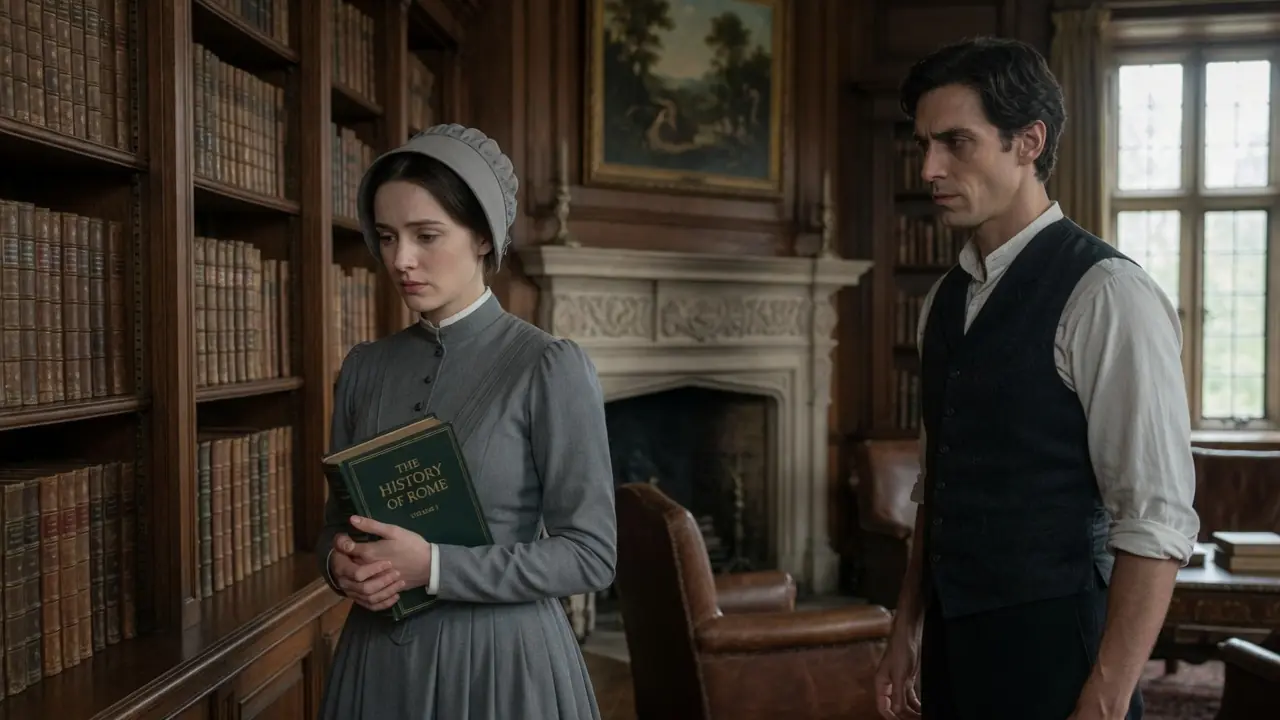
Vivian's heart hammered against her ribs. This was the closest she’d been to him since her arrival, close enough to see the faint shadow of beard along his jaw, the precise line of his mouth, the exhaustion that lived in the set of his shoulders. "I apologize, Your Grace," she said, keeping her gaze lowered in the manner of a proper servant. Young Master Thomas requested a volume on Roman history.
The housekeeper indicated it might be here." She extended the book toward him, a peace offering. For a long moment, he didn’t take it. Instead, his gaze moved across her face with an intensity that made her skin prickle with awareness. She forced herself to remain still, to present nothing but the bland exterior she’d constructed.
He was looking at a woman named Mary Hartwell. That was all he saw, all he could see. Finally, he accepted the volume. "In future, you may request such items through Mrs.
Blackwood," he said. "She will retrieve them for you. This room is not to be entered without permission." "Of course, Your Grace." She moved to pass him, to escape the suffocating proximity of his presence, but he spoke again. "What is your name?" The question hung between them like a held breath.
"Hartwell, Your Grace." "Miss Hartwell." "And you were previously employed by the Ashworth family?" "Yes, Your Grace." He studied her for another moment, and she felt the fragile web of her deception tremble slightly. Did something flicker in his expression? Did he sense something amiss? She’d been so careful, so thorough in her preparations, but standing before him now, she felt exposed in ways she hadn't anticipated.
"Thomas speaks well of you," he said finally. "That is unusual. I trust you will continue to earn his regard." "I shall endeavor to do so, Your Grace." He stepped aside, allowing her passage. As she moved past him, she caught the scent of him, soap and something darker, something that reminded her of autumn rain and old wood.
It was a smell that would haunt her later, in the solitude of her small room, when she allowed herself to remember that he was human, fallible, capable of kindness. That night, she wrote in the journal she kept hidden beneath the floorboards, "He is not what I expected. This troubles me more than his cruelty would have." She underlined the sentence twice, as if emphasis might make it true, as if repetition might transform observation into permission. But the truth remained stubborn and unwelcomed.
The man she’d come to destroy was proving far more complicated than the righteous anger she’d carried for 5 years could accommodate. November descended upon Ravenwood with the weight of early winter. The gardens transformed into studies of gray and amber, and the manor’s corridors grew colder, requiring fires in nearly every room. It was during these darker hours that the duke’s nocturnal habits became apparent to Vivian.
She discovered it by chance, or perhaps not by chance at all, for there was a part of her that had begun to seek him out, to trace the invisible paths of his solitude. She’d been unable to sleep, troubled by a letter that had arrived that morning bearing her aunt's seal. The words had been carefully neutral, but the subtext was clear. "How much longer do you intend to remain?
The whispers have not subsided. Your prolonged absence only deepens speculation." Vivian had burned the letter in her candle flame, watching the paper curl and blacken, but the anxiety had lingered like smoke. She’d risen near midnight and made her way downstairs, thinking that perhaps the kitchen might yield warm milk, or at least the solace of movement. The library door was open.
Light spilled into the corridor, candlelight, warm and inviting. She should have turned away. Every principle of self-preservation urged her to retreat to her room and maintain the careful distance she’d imposed between herself and this man. Instead, she found herself drawn toward it like a moth to flame, aware, even as she moved, that she was crossing a threshold from which there might be no return.
The duke sat in a leather chair near the fireplace, a volume open on his lap, a glass of brandy untouched on the side table. He was dressed in a dark robe, his hair disheveled in a way that suggested he’d run his fingers through it repeatedly. He looked, in that moment, like a man wrestling with something that had no name. He didn’t look up as she entered, though she was certain he’d heard her.
The silence stretched between them, taut with possibility. "The boy had a nightmare," Vivian said, offering explanation though none had been requested. "I came seeking something to calm him, a story, perhaps, something to ease his mind." It was partly true. Thomas had indeed cried out in his sleep, and she had comforted him, but she could have managed his distress without venturing into the manor’s depths.
The Duke finally looked up. In the firelight, something shifted in the lines of his face, a quality she’d not seen before, something unguarded and almost raw before he reassembled the walls. "There is a collection of Aesop's Fables on the third shelf," he said, gesturing vaguely. "The illustrations are rather elaborate.
Children find them soothing." She moved toward the indicated shelf, hyper-aware of every step, every breath. The books were exactly where he’d indicated, and she selected one bound in soft green leather, its pages gilded at the edges. "Thank you," she said, and turned to leave. "Miss Hartwell." She stopped.
The sound of her false name in his voice carried a strange resonance, hollow in the way of a bell struck off-center. "You read," he continued. It was not a question. She turned back slowly.
"I do, Your Grace. There is a particular quality to the way you move through this room, as though you understand what it holds. Most servants regard libraries as obstacles to navigate around." Vivian's mouth had gone dry. This was dangerous, this observation, this attention.
She had become too comfortable, too careless in her movements. "I was fortunate to receive some education," she said carefully, "before circumstances changed." Something shifted in his expression, a question forming behind his eyes. He rose from his chair with a fluid grace that contradicted the weariness she’d observed in him. "What circumstances?" he asked.
The question was deceptively simple. It was also impossible to answer truthfully. Vivian forced herself to meet his gaze, to present the calm facade that had become her armor. "The usual ones, Your Grace.
A family’s reduced circumstances, the necessity of finding employment." He studied her with an intensity that felt like examination under a microscope. She could see him cataloging details, the refinement of her speech despite her attempts at suppression, the way her hands moved with the grace of someone trained in drawing rooms, the intelligence that flickered behind her carefully maintained servile demeanor. "You are not what you present yourself to be," he said finally. Vivian's heart seized.
This was the moment she had feared, the unraveling of everything she’d constructed. She should run. She should confess. She should do something other than stand frozen before him like a creature caught in lamplight.
"I am precisely what I present myself to be," she replied, and the words carried an edge of truth that surprised them both. "A woman in service, a woman who requires employment to survive. Is that not enough?" Something flickered across his face, not anger, but something more complex. Disappointment, perhaps, or recognition of a kindred pain.
"It should be," he said quietly. "God knows it should be." He turned away from her then, moving back to his chair. The moment of openness sealed away as though it had never existed. But Vivian remained standing in the center of the room, the book of fables clutched against her chest, understanding with sudden clarity that she was not the only one wearing a mask in this house.
The Duke was imprisoned by his own walls just as surely as she was imprisoned by her elaborate deception. Over the following weeks, the library became their unspoken meeting place. Not deliberately arranged, there were no notes, no signals, no acknowledgement of intention, yet Vivian found herself descending the stairs near midnight with increasing frequency, and the Duke’s habit of late-night reading seemed to coincide precisely with her arrivals. They developed a strange choreography of proximity and distance.
He would read while she selected volumes. She would sit in a chair at the far end of the room while he occupied his place near the fire. Sometimes hours would pass in silence, broken only by the turning of pages and the occasional shift of a log in the fireplace, but gradually, almost imperceptibly, the distance between them diminished. One night, he left a book on the small table beside her chair, a volume of poetry by Keats, marked at a particular page.
She read the lines he’d selected, and her breath caught at their resonance. "A thing of beauty is a joy forever. Its loveliness increases. It will never pass into nothingness." She understood in that moment that he was communicating something to her, not in words, but in the careful selection of verse, in the vulnerability of revealing what moved him.
The next evening, she left the book in the same place, open to a different passage. "What is this that robs me of rational thought? What spell has been cast upon my careful mind?" When she entered the library the following night, the volume was gone. In its place lay a letter, sealed with wax but unsigned.
Her hands trembled as she broke the seal and read the single line written in his precise hand. "I am beginning to understand that some deceptions are born not of malice, but of necessity. I wonder what necessity has brought you here." Vivian sat in the darkness long after the candles had burned low, the letter pressed against her heart, understanding with terrible clarity that the game she’d come to play had transformed into something far more dangerous than revenge. She was beginning to care for the man she’d come to destroy, and he was beginning to see through the woman she’d pretended to be.
December brought frost that transformed the manor grounds into a landscape of crystalline beauty. The gardens that Vivian had observed in autumn's decline now glittered under sheets of ice, and the world seemed to contract into smaller, more intimate spaces. It was in this season of confinement that the veil of her deception began to fracture. The first crack appeared on a Tuesday morning when Mrs.
Blackwood summoned her to the housekeeper’s parlor with an expression that suggested nothing good could come of the meeting. "A letter has arrived," the older woman said, holding up an envelope addressed to Miss Vivian Hargrove, care of the Ashworth residence. It was misdirected by the post. The Ashworth butler forwarded it here assuming it was for you." Vivian's blood had turned to ice.
The handwriting was her aunt's, the seal unmistakable. She’d been so meticulous in her arrangements, yet somehow a single letter had breached her defenses. "I can explain," she began, but Mrs. Blackwood raised a hand.
"I don’t require explanations," the housekeeper said, though her eyes held questions that burned like coals. "But His Grace may. You would be wise to consider whether your position here can withstand scrutiny." The letter remained in Vivian's possession, but the threat hung over her like a sword suspended by a single thread. She moved through the following days in a state of heightened anxiety, aware that exposure was no longer a distant possibility, but an imminent certainty.
That night she descended to the library with the intention of leaving a note, a confession of sorts, an attempt to control the narrative before it spiraled beyond her reach. She would explain herself. She would offer some version of the truth that might make her deception seem less monstrous than it was, but the Duke was waiting for her. He stood by the window, silhouetted against the moonlit garden, and she understood immediately that the fragile equilibrium they’d maintained had shifted irrevocably.
He knew. Not everything, perhaps, but enough. "Your name is not Hartwell," he said without preamble. His voice was steady, but beneath it something strained.
Anger, yes, but also something that sounded like hurt. There was no point in denial. The web she’d woven had already begun to tear, and attempting to shore it up would only prolong the inevitable collapse. "No," she said, "it is not." "Who are you?" The question was simple.
The answer was not. Vivian moved to the fireplace, needing the warmth of it, needing something to anchor her to the world as it shifted beneath her feet. "My name is Vivian Hargrove," she said, and the words felt like stepping off a precipice. "Five years ago, you dissolved our betrothal contract without explanation or courtesy.
You made me a cautionary tale in London’s drawing rooms. I came here to understand why you deemed me so unworthy of even a letter." The silence that followed was absolute. She could hear the tick of the clock on the mantelpiece, the soft crackle of the fire, the sound of her own breathing, each noise magnified in the vacuum of his nonresponse. When he finally spoke, his voice was barely above a whisper.
"Vivian Hargrove." He said her name as though it were a spell, an incantation that might summon something lost. He moved toward her slowly, and she braced herself for anger, for recrimination, for the justified fury of a man who’d been deceived. Instead, he looked at her, truly looked at her, and something in his expression crumbled like ancient stone. "My God," he breathed, "what have I done?" The question hung between them, weighted with implications she didn’t yet understand.
Vivian watched as he moved away from her, his hand pressed to his forehead, his shoulders rigid with tension. "I did not reject you." The words came out ragged, stripped of his usual precision. Not the speech of a man composing himself, but of a man finally laying something down after years of carrying it. "I was God, I was forced.
My father’s debts. The men he owed were dangerous, Vivian. Not creditors, criminals. And they had studied our betrothal contract very closely.
They understood that your family’s connection to ours would drag you into the same pit. They made it explicit." His jaw worked. "If I proceeded with the marriage, your father would be ruined alongside mine. Perhaps worse.
I couldn’t I couldn’t allow them to reach you." Vivian felt the ground shift beneath her understanding. Everything she’d constructed her revenge upon, the assumption of his callousness, his casual cruelty, was built on a foundation of ignorance. "Why didn’t you explain?" she asked. Her voice came out smaller than she intended.
He let out a short, broken exhale, not quite a laugh. "Because explaining meant telling you that my father was a debtor to criminals. That the name you were about to take would make you a target. I told myself I was protecting you." He pressed a fist briefly to his mouth, then lowered it.
"The truth is, I was also protecting my own shame. I chose your social sacrifice over my integrity. I told myself it was noble." His voice dropped to nearly nothing. "It wasn’t." He moved closer, and she could see the cost of his confession written across his features, the tightness around his eyes, the way his hands were not quite still at his sides.
"I have thought of you every day for 5 years," he continued. "I imagined you happy, married to someone worthy, building a life untouched by the corruption that surrounds me. And instead, you came here seeking vengeance against a man who had already condemned himself to far worse punishment than you could ever devise." Vivian's carefully constructed justifications for her presence began to dissolve. The anger that had sustained her through months of preparation, the righteous indignation that had made her deception feel noble, all of it crumbled in the face of this revelation.
"I didn’t know," she whispered. "No," he agreed. "You didn’t. And I have no right to ask your forgiveness for keeping that knowledge from you." He reached out, his hand hovering between them as though uncertain whether he had the right to touch her.
She could see the question in the stillness of his fingers, the vulnerability of a man who’d spent 5 years behind walls only to have them breached by the very person he’d tried to protect. "Why did you stay?" he asked. "Once you understood that I was not the villain of your narrative, why did you remain?" Vivian opened her mouth to answer, but the truth was too complicated, too dangerous, because she’d begun to care for him, because Thomas needed her, because the man she’d come to destroy had somehow become the man she most wanted to understand. "I don’t know," she said finally, and it was the most honest thing she’d spoken in months.
He lowered his hand, and she saw the resignation settle into his features, the understanding that she could not give him what he was asking for. Not yet. Perhaps not ever. "Then I will not ask you to stay," he said quietly.
"But I will ask you to believe this. Whatever deception has passed between us, my regard for you is not among them. It is the only truth I have left to offer." He turned away from her then, and Vivian stood alone in the library as the fire burned low, understanding that she had come seeking revenge and found instead the far more complicated terrain of love, a landscape where the lines between victim and villain blurred into insignificance, and the only certainty was the ache of knowing that some wounds could not be healed by exposure alone. The next morning, she found a letter on her pillow written in his hand.
"I have arranged for your departure. A carriage will be ready whenever you wish to leave. I will not keep you here against your will, though I confess that I wish you would stay. But that choice, like all the others that have brought us to this moment, must be yours alone." Vivian held the letter, feeling the weight of decision pressing down upon her.
She could leave. She could return to her aunt's house and resume the life of a woman whose reputation had been salvaged by obscurity. She could walk away from the man who’d broken her heart before she’d even met him, and in doing so, perhaps protect herself from the far more devastating possibility of breaking it again. Or she could stay and face whatever consequences awaited her in a house where deception had transformed into something that might, against all odds, become truth.
Vivian did not leave. She’d stood in her small room for hours, her trunk open on the bed, her few possessions arranged in neat rows, the gray dresses that had become her uniform, the book she’d borrowed from the library, the journal hidden beneath the floorboards that contained the full record of her deception. Everything was prepared for departure, everything except her will. By evening, she’d unpacked it all again.
The decision was not made consciously, but rather discovered in the moment when she realized she could not bear to leave Thomas without explanation, could not abandon the boy who’d begun to trust her, who’d stopped having nightmares, who’d learned to smile with something approaching genuine joy. That was the excuse she offered herself, that her staying was an act of kindness toward a child, not a capitulation to the man who’d written her that letter with a hand that trembled. But she knew the truth. The truth lived in the quickening of her pulse whenever she heard his footsteps in the corridor, in the way her breath caught when she glimpsed him in the halls, in the ache that had taken residence in her chest since the night he’d revealed the truth of his choice.
She’d come to Ravenwood seeking to wound him. Instead, she’d allowed him to wound her, or perhaps more accurately, she’d allowed herself to be healed by him, which was infinitely more dangerous. The library became a different space after that night. The careful choreography of their midnight meetings transformed into something more deliberate, more charged with intention.
He would be waiting for her now, sometimes with a book selected specifically for her, sometimes with nothing but his presence and the unspoken question that hung between them like incense. Three nights after his letter, she found him standing at the window when she entered. The moonlight caught the line of his profile, and she was struck again by how little resemblance he bore to the monster she’d imagined. He was simply a man, complicated, flawed, bearing the weight of choices made under duress, carrying the burden of secrets kept for someone else's protection.
"You did not leave," he said, not turning from the window. "No." "Why?" It was the question he’d asked before, the one she’d been unable to answer. But time and proximity had clarified something in her, had stripped away the layers of justification until only honesty remained. "Because I could not," she said.
"Because staying felt like the only choice that made sense, even though it makes no sense at all." He turned then, and she saw in his expression a vulnerability that matched her own, the look of a man who’d spent years building defenses only to discover that they were useless against the one person they’d been built to exclude. "I have spent 5 years telling myself that I acted honorably," he said. "That by breaking our engagement, by allowing you to fade from my life, I was protecting you from the corruption that surrounds me. But the truth is far less noble.
I was protecting myself from the possibility of losing you. I was a coward, and I called it virtue." Vivian moved toward him, drawn by a gravity she could no longer resist. "You were a man in an impossible position." "That does not excuse the pain I caused you." "No," she agreed. "But it explains it.
And perhaps explanation is the beginning of forgiveness." He reached for her then, his hand cupping her cheek with a tenderness that made her throat tighten. His thumb traced the line of her cheekbone, and she felt the touch reverberate through her entire being, not as conquest or claim, but as a question, a plea for permission to bridge the distance that had separated them for so long. "I do not deserve your forgiveness," he said softly. "Perhaps not," Vivian replied.
"But I am offering it nonetheless." When he kissed her, it was not the violent claiming she might have expected from a man of his station and strength. Instead, it was a question asked in the language of touch, tentative, seeking, almost reverent. His lips moved against hers with the care of someone handling something precious and fragile, and she understood in that moment that he was asking permission for far more than a kiss. He was asking permission to matter to her.
He was asking permission to be loved. She answered by drawing him closer, by allowing her hands to trace the line of his shoulders, by surrendering to the ache that had lived in her since the moment she’d first seen him in the entrance hall. The kiss deepened, became something more urgent, more real. And in its urgency, Vivian felt the last remnants of her constructed deception fall away.
She was not here seeking revenge anymore. She was here because this man, this complicated, flawed, fundamentally decent man, had somehow become essential to her survival. When they finally separated, he rested his forehead against hers, his breathing uneven. "I cannot offer you what you deserve," he said.
"My name carries scandal. My family’s reputation is tarnished beyond repair. My father is dead, but the debts he incurred remain. Everything about me is compromised.
"And yet you offer me honesty," Vivian replied. "After 5 years of silence, you offer me truth. That is more than most men would manage." "It is not enough." "Then what would be enough?" she asked, pulling back slightly to meet his eyes. He studied her face as though memorizing it, as though afraid that she might disappear if he looked away.
"Everything. I would ask for everything. Your trust, your companionship, your willingness to build something new in this house that has been haunted by regret for so long." The proposal was not made with the formal precision of a betrothal offer. There were no bended knees, no elaborate speeches designed to impress.
Instead, it was offered as a question, as a possibility, as an invitation to step into unknown territory together. "I cannot promise that this will be simple," Vivian said carefully. "I cannot promise that I will not have moments of anger when I remember what was taken from us. I cannot promise that the woman you knew before will return because she no longer exists.
"I do not want the woman I knew before," he replied. "I want the woman standing before me now, the one who came seeking vengeance and found instead the capacity for compassion, the one who has taught my nephew to laugh, the one who has filled this house with light that I thought had been extinguished years ago." Vivian felt something shift within her. Not the dissolution of her anger, but its transformation into something else entirely. The rage that had sustained her through months of deception had been burned away, leaving in its place a tenderness that felt almost unbearable in its intensity.
"I will stay," she said. "Not as a governess, not as a servant, but as someone who chooses to be here with you, building whatever this becomes." He pulled her close again, and she rested her head against his chest, listening to the steady rhythm of his heart. Outside, the winter wind rattled against the windows, but within the library, there was warmth, the warmth of the fire, the warmth of his arms around her, the warmth of a future that had seemed impossible mere weeks before. It was not the resolution she’d imagined when she’d first arrived at Ravenwood.
It was not the triumph of revenge or the satisfaction of seeing him brought low. Instead, it was something far more complicated and far more precious, the possibility of transformation, of two people broken by circumstance learning to be whole together. As the night deepened around them, Vivian allowed herself to believe that perhaps some deceptions, when stripped away, revealed not lies, but truths that had been hidden all along. Perhaps some rejections, when understood in their full context, became not cruelties, but sacrifices made in the name of love.
And perhaps, just perhaps, the woman who had come to destroy the Duke of Ravenwood had instead found the only thing that could save her, the knowledge that she was worthy of being chosen, not despite her flaws, but because of her capacity to understand them in others. January arrived with a silence that seemed to hold its breath. The manor settled into a rhythm that felt almost suspended between seasons, as though time itself had paused to allow for the delicate reconstruction of lives that had been fractured by circumstance and choice. Vivian moved through the household in a state of careful equilibrium.
To the servants, she remained Miss Hartwell, the governess whose competence had earned her a permanent position. To Thomas, she was the woman who’d become something between teacher and mother, who’d filled the void left by his father’s death with patient kindness and genuine affection. To the Duke, she was becoming something far more complex, a partner in the slow work of rebuilding trust, a witness to his vulnerability, a woman who’d chosen to stay despite having every reason to flee. But the equilibrium was fragile, dependent upon the continued silence of those who might expose her true identity.
The first threat came in the form of a visitor. Lord Ashworth arrived on a gray afternoon, his carriage bearing the crest of one of the county's most prominent families. Vivian learned of his arrival through the servants’ gossip that flowed through the manor like water through a sieve. She understood immediately what his presence signified.
The references she’d used to secure her position at Ravenwood had been forged through a solicitor's arrangements. If Lord Ashworth and the Duke compared notes about the governess who’d supposedly served the Ashworth household, the entire constructed narrative would collapse. But there was something else she hadn't fully reckoned with until she heard his name spoken aloud in the servants’ hall. Lord Ashworth had been a close friend of her father’s, not an acquaintance, a friend, the kind who had stood at her father’s funeral, who had written her mother a letter of condolence in his own hand.
If he walked into a room where she stood, he would know her before she had drawn a second breath. There would be no mistaking the daughter of a man he’d known for 30 years, regardless of the gray dress or the lowered voice. She found the Duke before Lord Ashworth could find her. He was in his study, and she saw his expression shift the moment she entered, from administrative concentration to something far more guarded, then immediately to concern.
"Lord Ashworth," she said without preamble, closing the door behind her. "His arrival presents a complication I had not fully anticipated." Understanding moved across his face. He rose immediately, moving to stand beside her. "Your references were fabricated.
But there is more." She steadied herself. "Lord Ashworth was my father’s friend. He will recognize me on sight." The Duke stood in silence for a long moment, then pressed his hand flat against the glass of the window as though grounding himself. "Then we must tell him the truth," he said.
"That will destroy what remains of your reputation. A Duke harboring a woman who came under false pretenses, who infiltrated his household with deliberate deception. My reputation has already been destroyed by my own actions." He turned to face her, and his voice carried something she had not heard before, not resignation, but resolve. "By my cowardice 5 years ago, by my silence, what further damage can honesty inflict that dishonesty has not already done?" Vivian moved toward him, needing to be close enough to see the sincerity in his eyes.
"You would expose yourself to ridicule, to the judgment of society?" "I would expose myself to the truth," he corrected. "And I would do it gladly if it meant protecting you from bearing the weight of this alone." He took her hands in his, and she felt the steadiness in them, not the stillness of a man suppressing emotion, but of a man who had finally chosen his ground. "You came here seeking vengeance," he continued, "but somewhere along the way you chose compassion instead. You chose to stay.
You chose to build something new rather than destroy something old. That is not deception, Vivian. That is transformation." The conversation with Lord Ashworth took place in the drawing room, with the Duke standing beside her like a shield, like an anchor, like a man who’d finally decided that his own integrity mattered more than society's judgment. The older man’s eyes found Vivian the moment she entered.
There was no moment of confusion, no polite uncertainty. He saw her immediately, saw through the gray dress and the bound hair and the posture of service, and his face moved through recognition, then a swift, sharp grief, then something careful and still. The Duke explained the situation, not with excuses or justifications, but with a clarity that suggested he’d been preparing for this moment since the night Vivian had revealed her true identity. He spoke of the broken engagement, of the circumstances that had forced it, of Vivian's arrival and the slow unfolding of understanding between them.
Lord Ashworth listened without interrupting. When the Duke finished, the older man was quiet for a long moment. "I knew your father, Miss Hargrove," he said, finally addressing her directly. "I knew him well enough to know that he would have wanted this resolved with honesty rather than continued concealment." His gaze moved to the Duke.
"And I knew your father well enough to understand what kind of debts he left behind. This situation did not arise from malice. It arose from a cascade of other men's failings." He paused again, the kind of pause that filled the room. "I see no reason why I should not confirm that Miss Hartwell, or rather Miss Hargrove, came to us with excellent character and served with distinction before accepting a position elsewhere.
Memory is a curious thing, particularly when one has as many household matters to attend to as I do." His tone held the faintest note of dry humor. "I trust that you will handle this situation with the discretion it deserves. London’s drawing rooms are hungry for scandal, and I’ve no desire to feed that appetite." After he’d left, Vivian and the Duke stood together in the drawing room as the afternoon light faded into evening. "We cannot continue as we have been," the Duke said finally.
"Hiding in libraries, speaking in whispers, pretending that you are merely a servant in this house. "What are you suggesting?" Vivian asked, though she thought she already knew. "That we stop pretending. That we stop hiding.
That we allow people to know that you are here as something more than a governess, that you are here as someone I have chosen, someone I intend to build a future with. "Society will not accept it easily," Vivian said. "A duke and a woman of compromised reputation." "Your reputation will be rehabilitated by the simple fact of my choosing you publicly," he interrupted. "That is the privilege of my position, and for once, I intend to use it for something that matters." He drew her close, and she rested her head against his shoulder, understanding that they had crossed another threshold.
The deception that had brought her to Ravenwood was dissolving, being replaced by something far more dangerous and far more real, the possibility of genuine love built not on the foundation of revenge, but on the solid ground of mutual understanding and choice. Outside, the winter evening deepened into darkness, and within the manor, the shape of their future began to emerge. Not in grand gestures or elaborate plans, but in the quiet certainty that they had both been given something precious, the opportunity to choose each other again, knowing fully who they were and what they’d endured to reach this moment. Spring arrived at Ravenwood like a benediction, transforming the frost-locked gardens into riots of color and fragrance.
The roses that had been dormant beneath snow and ice emerged with a ferocity that seemed almost defiant, as though determined to reclaim the landscape from winter's grip. Vivian stood at the window of what had become her study, a room the duke had insisted she claim as her own, and watched the gardens bloom with the same sense of wonder she’d felt watching her own life transform from the gray monotony of deception into something vivid and alive. Three months had passed since Lord Ashworth’s visit, three months of carefully managed appearances designed to prepare society for what was coming. The duke had begun attending social functions again, and Vivian had accompanied him, not as a servant, but as a guest.
Her presence explained by the simple truth that she was a family acquaintance whose circumstances had required temporary discretion. It was a delicate fiction, but it served its purpose. The invitations had begun to arrive in earnest after the duke had mentioned in conversation with several prominent matrons that he was considering marriage. The speculation had been immediate and vicious, whispers about why he’d waited so long, whether he was capable of fidelity, but alongside the scandal came something more useful, curiosity. hungry to know who would finally claim the Duke of Ravenwood, and that hunger could be turned in service of acceptance.
Thomas had thrived during the transformation. The boy who’d arrived at Ravenwood as a withdrawn, difficult child had blossomed under consistent affection and structure. He’d begun to smile freely, to engage with his lessons with genuine enthusiasm, to speak of the future with hope rather than resignation. Vivian watched him in the schoolroom and saw not the orphaned child he’d been, but the man he was becoming, kind, thoughtful, capable of understanding complexity and nuance in ways that suggested he would be far better equipped to navigate the world than either his uncle or his father had been.
"You are thinking very hard about something," a voice said from behind her. Vivian turned to find the duke standing in the doorway, and even after 3 months of increased proximity, her heart still quickened at the sight of him. He’d taken to visiting her study in the afternoons, a habit that had begun innocently enough, but had evolved into something far more intimate. Conversations that ranged across philosophy and literature, politics and personal history, the careful excavation of two people learning each other's depths.
"I was thinking about how much has changed," she said. "How different this all feels from the woman who arrived here with a heart full of vengeance." He moved into the room, closing the door behind him with deliberate care. The gesture was becoming familiar, a signal that he was stepping out of his public role and into the private space they’d created together. "That woman was necessary," he said, moving to stand beside her at the window.
"She was the only version of you who could have survived what needed to happen, but I confess I prefer the woman standing before me now." "Even knowing that I came here to destroy you?" "Especially knowing that," he replied, "because it means you chose to stay despite having every reason to leave. It means your regard for me was earned through understanding rather than bestowed through ignorance." He took her hand, and she felt the familiar warmth of his touch, the way it seemed to anchor her to the present moment, to the reality of what they’d built together. "I have something for you," he said, drawing a small velvet box from his pocket. Vivian's breath caught.
She knew what it contained before he opened it, had been expecting it in some sense since the night he’d kissed her in the library, but expectation did nothing to diminish the impact of seeing it, a ring of extraordinary beauty, a sapphire surrounded by diamonds, crafted with an elegance that suggested it had been made specifically for her. "I cannot offer you the betrothal you were promised 5 years ago," he said quietly. "That woman, that version of you deserves to remain in the past, but I can offer you this, a choice made freely, with full knowledge of who I am and what I’ve done, a choice to build something new, something real, something that honors both the pain we've endured and the possibility of joy we might yet discover." He lowered himself onto one knee, and Vivian felt tears blur her vision, not tears of sadness, but of a relief so profound it felt like drowning and surfacing simultaneously. "Vivian Hargrove," he continued, "will you marry me?
Not because society demands it, not because honor requires it, but because you choose to." She pulled him to his feet and kissed him before he could say another word, pouring into that kiss 5 years of longing, 3 months of rediscovery, and the infinite possibility of a future that had seemed impossible mere months before. The wedding took place in spring in the small chapel on the Ravenwood estate, with only those closest to them in attendance. Thomas stood beside his uncle as witness, his face solemn with the importance of the occasion. Vivian's aunt was there, tears streaming down her face as she watched her niece reclaim not just her reputation, but her agency, her power, her right to choose her own destiny.
Lord Ashworth sat in the third pew, his expression one of quiet, settled satisfaction, the look of a man who had helped correct an old wrong and felt no need to speak of it. The vows were simple and profound. The duke promised honesty above all else, not the polished, rehearsed honesty of a man performing virtue, but the raw, costly honesty of someone who had learned, through years of silence and loss, that truth was the only foundation upon which anything lasting could be built. Vivian promised the same and meant it in ways she could not have articulated when she’d first arrived at Ravenwood in her gray dress, with her false name, and her heart full of righteous fury.
When the chaplain pronounced them married, the duke did not kiss her with performance or display. He simply turned to face her, and the look in his eyes, unguarded, entirely open, stripped of every wall he’d spent a lifetime building, was worth every painful step of the road that had led them here. Thomas threw a handful of rose petals so enthusiastically that several landed in the chaplain's hair. Nobody mentioned it.
The London season that followed was predictably a battlefield. Society's appetite for scandal had not diminished, and the revelation of Vivian's deception, her months at Ravenwood under a false name, her history with the duke, provided extraordinary fuel for the drawing-room fires that burned through May and June. Vivian had expected this. She had steeled herself for the whispers, the cold shoulders at card parties, the calculated cuts delivered by women who had once been cordial and now found condescension more advantageous.
What she had not expected was how little it would wound her. She stood at the duke’s side at the first major gathering they attended as a married couple, a ball at the Pembridge townhouse hosted by a family whose opinions carried significant social weight, and felt something she could not immediately name, not defiance, exactly, not indifference, something more like the particular freedom that belongs to a person who has already survived the worst they could imagine. She had been publicly humiliated at 19. She had spent 5 years in the shadow of another family’s shame.
She had arrived at Ravenwood with nothing but false papers and genuine fury, and somehow, through a series of events she could not have scripted, had emerged with a husband who looked at her as though she contained the full inventory of everything he’d ever needed. What, precisely, could a drawing-room whisper do to a woman like that? "They are staring," the duke said quietly, his hand resting at the small of her back with a possessive ease that felt less like ownership and more like anchor. "They were always going to stare," Vivian replied.
"Let them." He pressed his lips briefly to her temple, a gesture so small and so intimate that several onlookers visibly bristled at its impropriety, and she felt him smile against her hair. The first woman to approach them was the Countess of Belgrave, a figure of considerable influence whose approval or disapproval could tilt the balance of an entire season. She was tall, silver-haired, and possessed of the kind of expression that suggested she had witnessed every variety of human folly and found most of it mildly entertaining. "Your Grace," she said to the Duke, then shifted her gaze to Vivian with an assessment that was thorough and entirely unhurried.
"And the new Duchess?" "Lady Belgrave," Vivian replied meeting her gaze without blinking. "I knew your mother," the Countess said after a pause that had been long enough to make lesser women flinch. She had precisely your quality of stillness, the kind that suggests intelligence rather than vacancy." Another pause. "I find I prefer intelligence." She inclined her head, a small gesture, but observed by every pair of eyes in the room and moved on.
Vivian exhaled slowly. "That," the Duke said, his voice very low and very dry, "will have been noted by everyone present. Will it be enough?" "For some. The rest will require time." He turned to face her and the look in his eyes held a steadiness she had come to rely upon.
"We have time." They did. The thought settled into her chest like a stone dropped into still water, the ripples spreading outward, calm and inevitable. Thomas adjusted to his new circumstances with the adaptability of a child who had already survived profound disruption and emerged against considerable odds fundamentally intact. He called her Vivian in private, which she permitted, and Your Grace in public, which they had negotiated with the seriousness of a minor diplomatic treaty.
He took the modification of his domestic world, the shift from governess to aunt, from temporary presence to permanent fixture, with a pragmatic equanimity that suggested he had on some level expected it. "I knew," he told her one afternoon, seated across from her in the schoolroom that had become their shared territory, his hands wrapped around a mug of chocolate, "before Uncle told me I could tell you weren’t really a governess." Vivian set down her book. "What gave me away?" He considered this with the gravity of a judge weighing evidence. "The way you moved through the library," he said finally.
"You touched the books like they belonged to you. Servants don’t do that." He paused. "Also, you corrected my Latin in exactly the way my tutor used to before he left. And he was educated at Oxford.
Governesses from reduced families don’t usually know Cicero well enough to correct inflection." Vivian stared at him. He took a serene sip of his chocolate. "Thomas," she said slowly, "how long have you known?" "Since about the third week," he replied, "but I decided it didn’t matter. You stayed when you were angry at him.
That seemed important." She found she had no adequate response to this. She reached across the table and pressed his hand and he permitted the contact with the dignified restraint of a boy who had decided that emotional demonstrations were, in appropriate circumstances, acceptable. "You are," she said carefully, "entirely too perceptive for 7 years old." "I’ll be 8 in November," he said. "I expect I’ll be worse by then." Summer settled over Ravenwood with a generosity that felt almost apologetic, as though the landscape itself were offering recompense for the gray austerity of the months that had preceded it.
The gardens that had lain dormant through Vivian's arrival and survival and transformation erupted in rose and lavender and honeysuckle, filling the corridors with a sweetness that seemed to breathe through the stone walls. She walked those corridors differently now. Not as a spy mapping enemy terrain, not as a servant who moved along the edges of rooms, not even as the cautious woman who had spent months maintaining the careful fiction of her false identity. She walked through Ravenwood as its mistress, as a woman who belonged, and the belonging felt not like victory, but like rest.
The Duke found her one evening in the rose garden at the hour when the light turned amber and the air went still. She was standing near the arbor where the climbing roses had reached full bloom, her face tilted upward, eyes half closed, simply feeling the last warmth of the day against her skin. She heard his footsteps on the gravel path and did not turn. She knew the particular cadence of him, had memorized it in the months when she’d been listening for threats and had continued memorizing it in the months when she’d been learning to love him.
He stopped beside her and for a long while neither of them spoke. The silence between them had changed entirely from the fraught, loaded silences of their first weeks. This one was comfortable, inhabited, the silence of two people who had no remaining need to perform for each other. "I have been thinking," he said at last.
"That does not surprise me." A low sound that might have been a laugh. "I have been thinking about what brought us here, the precise sequence of events, the choices made and unmade." His shoulder pressed against hers warm and solid. "If my father had not incurred those debts, I would not have broken the engagement. If I had not broken the engagement, you would not have come here under false pretenses.
If you had not come here under false pretenses, we would have met as strangers in some drawing room and I would have approached you with all the charm and none of the honesty I’ve recently acquired." Vivian turned to look at him. The amber light caught the lines of his face, the strong jaw, the dark eyes, the mouth that had learned over these months to express what lay behind it. "And?" she said. "And I find myself grateful," he said, "for a disaster that led here, which is not something I anticipated feeling at any point in my life." She took his hand, not with the tentative quality of their early proximity, but with the assurance of a woman who knew she was allowed.
His fingers closed around hers with the same sureness. "You were never going to be a simple man," she said, "and I was never going to be a simple woman. Perhaps we required a sufficiently complicated path to find each other." He raised her hand and pressed his lips to her knuckles, a gesture she had seen him make at social functions, formal and graceful, but here now, in the privacy of the garden with no one watching, it carried a different weight entirely. It was not performance, it was acknowledgement.
It was his way of saying, "I see you, I choose you, I am grateful for you." She understood him well enough now to translate his silences. "There is one more thing," he said, his voice dropping slightly. She waited. "I owe you a public moment," he said, "not merely the quiet chapel ceremony, not merely Lord Ashworth’s polite misdirection.
Society was present for the dissolution of what we were supposed to become and society deserves to witness what we have become instead." He held her gaze. "When the autumn season opens, I intend to make an announcement at the Belgrave Ball, a formal introduction of the Duchess of Ravenwood, done properly, done publicly, done in a way that leaves no room for ambiguity about my choice or my regard." Vivian felt something loosen in her chest, a tension she had not known she was still carrying. The first engagement had been dissolved publicly, his name printed in the Times above her shame. The correction deserved equal weight.
"You don’t have to do that," she said. "I know," he replied. "That is precisely why I intend to." She leaned into him then, her head against his shoulder, and felt him adjust his posture to accommodate her, a small automatic shift that spoke of habit already formed, of a man who had reorganized himself around her presence so thoroughly that the adjustment was now instinct. The rose garden held the last of the evening light.
Somewhere in the manor behind them, Thomas was almost certainly engaged in some form of scholarly mischief that would require gentle correction in the morning. The household moved around them with the settled rhythms of a place that had found, after years of gray isolation, something approaching peace. Vivian thought of the woman who had stepped out of a carriage in autumn fog, her spine straight and her purpose cold, and her heart armored against the man she’d come to wound. She could still feel that woman inside herself, the anger, the hurt, the 5-year wound that had calcified into something that had looked, from a distance, remarkably like strength.
But what she had learned in the long months between that arrival and this evening was that real strength did not require armor. Real strength was the capacity to remain open after being broken, to choose when choosing felt impossible, to stay when leaving would have been easier and safer and infinitely more sensible. She had come to Ravenwood to make the Duke of Ravenwood feel the weight of a woman he had discarded. Instead, she had taught him and herself what it meant to be chosen freely, fully, and without reservation.
The roses bloomed on around them, extravagant and unhurried, as the last light of the day made everything gold. The announcement appeared in the Times on the 14th of October in the society pages between an account of a hunt ball and a report on parliamentary proceedings. His Grace, the Duke of Ravenwood, is pleased to announce the formal introduction of his wife, Vivian, Duchess of Ravenwood, formerly Miss Vivian Hargrove of the Hargrove family of Wiltshire. The Duchess will be received at the Belgrave Autumn Ball, where His Grace intends to present her to society with the full honors befitting her station.
No further commentary was offered. None was needed. The drawing rooms of London, deprived of the scandal they had anticipated, found themselves faced with something considerably more disarming, a love story. And love stories, however inconvenient their origins, have always been far more difficult to condemn than to celebrate.
End.