A drop of walnut juice to stain the teeth. A corset laced entirely wrong to warp the spine. For three grueling years, Lady Genevieve Harrington poisoned her own reflection to escape a monster’s bed. It was a flawless deception until a duke with predator’s eyes noticed she was faking a limp.
In the gilded, glittering world of 1815 London, high society beauty was the only currency a woman truly possessed. It was her armor, her dowry, and her fate. Lady Genevieve Harrington had been blessed with an abundance of it. Raven-dark hair that caught the candlelight. Skin as luminous as spun sugar. And eyes the piercing, vivid blue of a summer storm. When she made her debut at the tender age of seventeen, she was declared the diamond of the season. And that was precisely the problem.
Her beauty had attracted a monster. Her father, Lord Richard Harrington, was a man whose noble lineage was vastly eclipsed by his towering gambling debts. He had practically lived at White’s Club, betting away the family fortune on the turn of a card and the speed of a horse until nothing remained but the deed to a crumbling coastal estate in Cornwall. Enter Baron Horatio Walcott. At sixty-two years old, Walcott was thrice the age of Genevieve. He was a wealthy, cruel, and corpulent man whose two previous wives had met sudden, deeply suspicious ends.
One had reportedly fallen down a short flight of carpeted stairs, breaking her neck. The other had drowned in an ornamental garden pond barely a foot deep. When Lord Richard lost his final thousands to the Baron, Walcott offered to forgive the debt and pay off the rest of Harrington’s creditors. In exchange, he demanded the Harrington coastal estate and Genevieve’s hand in marriage. Her father had signed the betrothal contract before the ink was even dry. Her mother, Lady Constance, had merely advised her daughter to close her eyes and think of the family.
Trapped in a gilded cage with a death sentence hanging over her head, Genevieve made a desperate, radical decision. If her beauty was the bait that had lured the beast, she would slaughter it herself. With the help of her fiercely loyal maid, Martha, Genevieve orchestrated her own ruin. Two weeks before the wedding, she feigned a sudden violent illness. The doctor, heavily bribed with the last of Genevieve’s secret savings, diagnosed her with the Cornish sweats, a rare contagious fever. For a month, she was quarantined.
She brushed ash and soot into her eyebrows to make them appear thick and unkempt, and she painted dark, bruised circles under her eyes with ground charcoal. Her crowning glory, her raven hair, was mercilessly chopped into uneven, jagged lengths, which she coated in heavy pomade until it looked stringy, dull, and entirely unwashed. She chewed on a carefully measured mixture of walnut husks and licorice root every morning, which stained her perfect teeth a sickly, decaying yellow. Finally, she wore gowns made of heavy, drab bombazine and coarse wool cut completely without shape, making her look bloated and entirely devoid of a womanly figure.
The ruse worked perfectly. When Baron Walcott came to call on his recovering bride, he took one look at her blotchy, limping, foul-smelling figure and physically recoiled in disgust. A vain man obsessed with beautiful possessions, the Baron was utterly repulsed. However, Walcott was also immensely greedy. He wanted the coastal estate included in her dowry, which he could only claim upon marriage. Unwilling to touch the hideous creature she had become but refusing to break the ironclad contract and lose the land, Walcott suspended the engagement. He informed her desperate parents that he would wait for the foul humors to leave her body and for her beauty to return.
For three years, it never did. Genevieve lived in a self-imposed purgatory. From the ages of seventeen to twenty, she subjected herself to the physical pain of the twisted corset, the burning of the nettle soap, and the intense isolation of being a pariah. High society cruelly dubbed her the Harrington hag. Former friends turned their backs on her, whispering behind their ivory fans whenever she entered a room. Young men who had once composed sonnets to her eyes now crossed the street to avoid catching her supposed affliction.
It was a lonely, excruciating existence. But to Genevieve, the pain was a sweet salvation. Every stinging hive on her face was a shield. Every limp was a step away from Walcott’s bed. She spent her days reading in the shadowed corners of the library, cultivating her mind while the world ignored her completely. But in the spring of 1815, her fragile peace shattered. Baron Walcott’s financial schemes had recently required a massive influx of capital, and he needed the Harrington coastal lands to build a profitable shipping port. His patience had finally run out.
He sent a terrifying letter to Lord Richard. He would wait no longer. Disease or no disease, ugliness or no. The wedding would take place at the end of the London season. He intended to marry Genevieve, lock her away in the countryside, and take the land. Terrified, her parents dragged Genevieve back to London for the season. Their frantic, desperate hope was that somehow some other wealthy gentleman might take pity on her and offer for her hand before Walcott could claim her, thereby shifting the debt. It was a fool’s errand.
No man of means would look twice at the hunched, blotchy, dull-haired woman in the shapeless gray gowns. Genevieve was completely out of time. The marriage was set for mid-July. She had only weeks left before she would be handed over to a man who had likely murdered two women and would not hesitate to make her his third. The grand ball at the Duke of Devonshire’s London estate was a suffocating sea of silk, perfume, and ambition. Three hundred members of the ton waltzed beneath thousands of dripping wax candles, completely oblivious to the desperation radiating from the dark corner of the conservatory.
Genevieve sat obscured behind a massive potted fern wearing a hideous mustard yellow gown that Martha had deliberately tailored to make her look twenty pounds heavier. Her skin burned from the nettle soap, and the uneven corset dug brutally into her ribs, making every breath a shallow, painful gasp. She kept her head down, praying the shadows would swallow her whole. Walcott was in attendance tonight. His predatory gaze swept the room, occasionally locking onto her with a look of profound, chilling disgust.
Across the ballroom, standing near the grand arched doorways, was a man who belonged to an entirely different world. Dominic Wentworth, the Duke of St. Ives, had just returned to England after five years of brutal, bloody conflict on the Iberian Peninsula. He had served under Wellington, surviving musket fire and cavalry charges, only to be summoned home to inherit a dukedom after his older brother succumbed to cholera. Dominic was not a gentleman of polite drawing rooms. He was a warrior hardened by death and deeply cynical of the frivolous, perfumed society he was now forced to rule.
He was devastatingly handsome but in a harsh, unforgiving way. Tall, broad-shouldered, with a sharp jawline and hair the color of midnight. But it was his eyes that unsettled people. They were a pale, piercing gray, the color of winter ice. They were the eyes of a sniper trained to scan a chaotic battlefield and instantly detect the slightest anomaly: a broken branch where an enemy hid, a glint of steel in the tall grass. He hated the season. He hated the ambitious mothers parading their daughters in front of him like prized fillies.
Tonight, seeking a moment of respite from the suffocating onslaught of matrimonial traps, Dominic slipped away from the dance floor and strode toward the quiet shadows of the conservatory. He did not intend to look at the woman in the mustard dress. He had noticed her earlier, of course. Everyone had. The whispers of the Harrington hag had reached his ears within ten minutes of his arrival. He felt a fleeting, detached pity for her, but nothing more, until she dropped her fan.
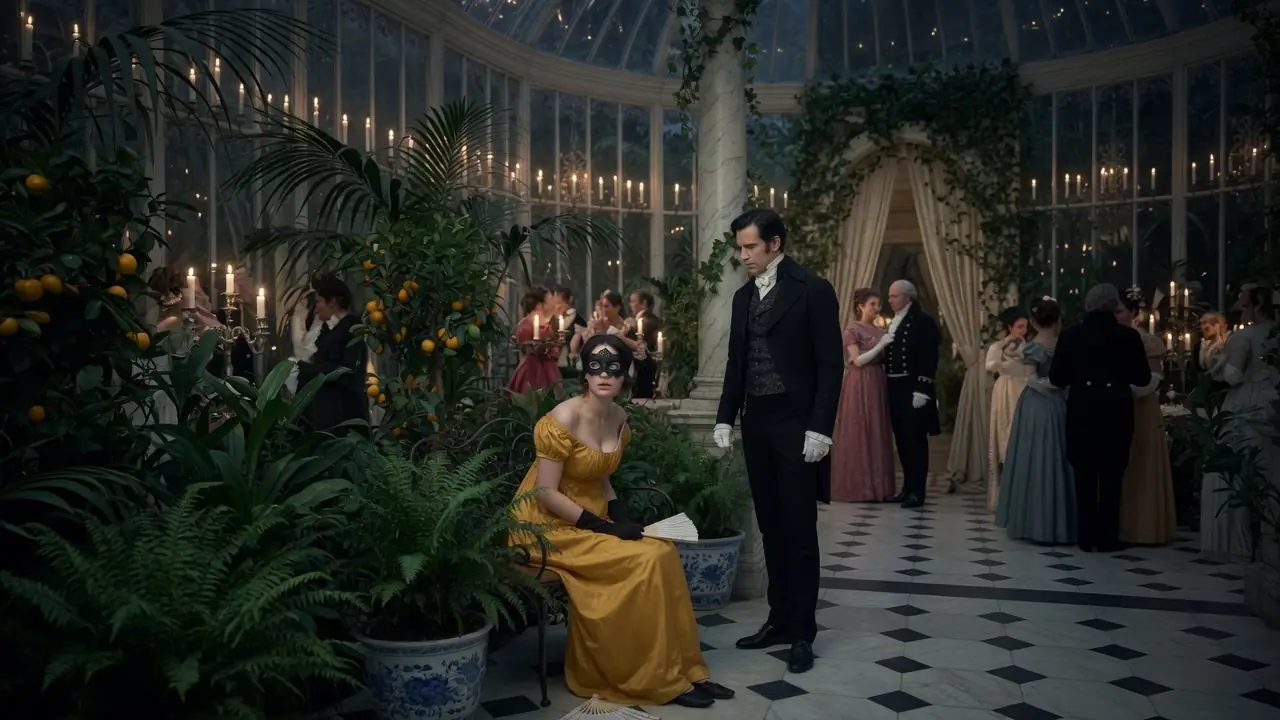
Genevieve had been nervously clutching a heavy ivory fan when Walcott suddenly stepped into the conservatory’s entrance. Panic, raw and instinctive, spiked in her chest. Her fingers spasmed, and the fan clattered onto the marble floor. For a fraction of a second, instinct overrode three years of careful training. Forgetting her bowed left shoulder and her twisted spine, Genevieve moved. She didn’t awkwardly bend from the waist as she usually did. Instead, she dropped into a perfect, fluid crouch, her movements possessed of an elegant, athletic grace.
Her left hand darted out, snatching the fan with lightning speed, and she straightened up just as smoothly. It took less than two seconds. To a normal observer, it would have been nothing. But Dominic Wentworth was not a normal observer. He had frozen just a few feet away, obscured by a marble pillar. His gray eyes narrowed, locking onto her. That was not the movement of a crippled woman, he thought, the strategic part of his brain instantly engaging. The fluidity of her spine, the effortless strength in her supposedly weak shoulder, it was a physical impossibility for someone with the afflictions the rumor mill claimed she had.
Intrigued and possessing a hunter’s patience, Dominic did not move. He watched her from the shadows. A few moments later, Genevieve, believing she was alone, raised a hand to her face to wipe a bead of sweat from her brow. She used a linen handkerchief. As the fabric dragged across her temple, Dominic’s sharp vision caught something extraordinary. The weeping sore on the side of her forehead, a hideous angry red blotch, smudged. And beneath the smear of red, the skin was perfectly smooth, pale, and flawless.
Dominic’s breath hitched slightly. It was a disguise. The ugly, hunched, diseased spinster was a complete fabrication. But why? What could possibly drive a woman to endure the mockery and disgust of polite society? To turn herself into a pariah on purpose? The puzzle was infinitely more fascinating than any painted debutante in the ballroom. Stepping out from behind the pillar, Dominic walked purposefully toward the potted fern.
Genevieve heard the heavy, measured footsteps and immediately slumped her left shoulder, twisting her face into a pained expression, and ensuring her lips were parted to show her stained teeth. “Lady Genevieve Harrington, I presume,” a deep, resonant voice rumbled above her. She looked up, her heart performing a terrified flutter against her bruised ribs. The Duke of St. Ives was staring down at her. Up close, his sheer physical presence was overwhelming. He smelled of leather, sandalwood, and a crisp, cold wind, a stark contrast to the cloying perfumes of the ballroom.
“Your Grace,” she mumbled, forcing her voice to sound raspy and weak. She awkwardly curtsied, exaggerating her limp. “You should not linger. My affliction is offensive to the eyes, and some say it is catching.” Dominic did not recoil. Instead, he stepped closer, invading her personal space. He looked down at her with an intensity that made her skin prickle with genuine heat, not just the burn of the nettles. “I have survived French artillery, cholera camps, and three bayonet charges, Lady Genevieve,” Dominic said smoothly, his gray eyes tracking the subtle, panicked pulse beating rapidly at the base of her throat. “I highly doubt your affliction will be my undoing.”
“You are bold, Your Grace,” she deflected, turning her face away so he couldn’t inspect her skin too closely. “But I prefer my solitude.” “And you have constructed a magnificent fortress to ensure it,” he replied softly. Genevieve froze. Her eyes darted back to him, wide and guarded. “I do not know what you mean.” Without asking permission, Dominic reached out and gently took her left hand, the hand connected to her stiff shoulder. Genevieve tried to pull away, feigning pain, but his grip, though gentle, was made of iron.
He slowly turned her hand over. He wasn’t looking at the coarse, oversized glove she wore. He brought her wrist closer to his face. Genevieve’s breath stopped. “Fascinating,” Dominic murmured, his thumb brushing over a tiny, exposed patch of skin just above her glove line where the harsh lye soap hadn’t reached. It was soft as velvet. He leaned in, his face mere inches from hers. She expected him to smell the rancid pomade in her hair, the bitter walnut oil. Instead, a slow, dangerous smile curved his lips. “Nettle ash and spirit gum,” he whispered so low only she could hear. “A clever concoction. But you missed a spot of the lye on your neck and your left shoulder. It seems to heal miraculously when you drop a fan.”
Panic, cold and absolute, flooded Genevieve’s veins. The room seemed to tilt. For three years she had fooled her parents, society doctors, and a murderous baron. And this man had unraveled her entire existence in three minutes. She tried to yank her hand away, dropping the raspy voice entirely. “Let me go,” she hissed, her true voice clear, musical, and trembling with terror. Dominic released her hand, immediately holding his palms up in a gesture of surrender, though his eyes burned with a terrifying intellect. He had seen the genuine terror in her eyes. This wasn’t a childish prank. This was survival.
“I will not expose you, Lady Genevieve,” he said, his tone shifting from amused to deadly serious. He glanced over his shoulder, following the trajectory of her earlier fearful glances, and spotted Baron Walcott glaring at them from across the room. The puzzle pieces violently snapped together in the duke’s tactical mind. “You are hiding from him,” Dominic stated, a dark, dangerous protective instinct suddenly flaring to life in his chest. Genevieve looked up at the towering, terrifying Duke, realizing with a sickening certainty that her fate was no longer in her own hands. The lie was dead. And if she didn’t trust the predator standing in front of her, the monster across the room would finally devour her.
The silence in the conservatory stretched, pulled taut as a bowstring. Genevieve stared into the ice-gray eyes of the Duke of St. Ives, her pulse hammering against her ribs. She was entirely at his mercy. A single word from him to the gossiping aristocrats beyond the ferns and her three years of agonizing sacrifice would be obliterated. “You know nothing of my situation, Your Grace,” Genevieve whispered, her voice trembling but lined with a fierce, desperate defiance. “I know that Baron Horatio Walcott is a predator,” Dominic replied, his voice dropping to a low, lethal register. He did not step back. “I know his first wife, Lady Helena, supposedly tripped on a staircase, though the coroner, a man deeply in Walcott’s debt, ignored the defensive bruising on her forearms. I know his second wife drowned in a puddle. And I know that General Sir Thomas Picton, my former commanding officer, suspected Walcott of smuggling gold bullion to French privateers off the coast of Cornwall to fund his gambling debts.”
Genevieve gasped, her eyes widening. “Cornwall. But that is where your father’s last remaining estate is located,” Dominic finished smoothly. The tactical map of the situation had illuminated perfectly in his mind. “Let me guess. Your father owes Walcott a staggering sum. Walcott demanded the coastal estate to secure his treasonous smuggling routes. And he demanded you as a trophy to seal the deed. But when you contracted the Cornish sweats, he postponed the wedding, unwilling to saddle himself with a diseased bride until he absolutely had to.” “He sent a letter three days ago,” Genevieve confessed, a tear cutting a clean pale track through the charcoal dust beneath her eye. “He intends to force the marriage by the end of the season, disease or no. He needs the land now. He will marry me, lock me in the country, and I will inevitably suffer a tragic accident before the year is out.”
Dominic’s jaw tightened. He had spent five years slaughtering men on the Iberian Peninsula to protect England only to return and find monsters wearing silk cravats operating freely in London’s drawing rooms. He looked at the trembling, brilliant, fiercely resilient woman before him. She had disfigured herself, endured the scorn of an entire city, and lived in physical agony for three years just to survive. She possessed more courage than half the officers he had commanded. “You will not marry him,” Dominic stated, the words ringing with absolute, immovable authority. “I have no choice. The betrothal contract is ironclad.” “Contracts can be broken, Lady Genevieve. Especially when they are superseded by a higher claim.”
Dominic stepped back, pulling a silver pocket watch from his waistcoat. He checked the time with maddening calm. “In two days, Lord Castlereagh is hosting a grand masquerade at Vauxhall Gardens. Walcott will be there, and so will your father. You will attend.” “As what?” she asked bitterly, gesturing to her hideous mustard gown. “The Harrington hag?” “No.” Dominic’s predatory smile touched the corners of his mouth. “As the future Duchess of St. Ives.” Genevieve’s breath left her lungs in a rush. “You are mad. You do not know me.” “I know that you are a survivor. I need a wife to satisfy the crown and get the matchmaking mothers of the ton off my back. You need protection, and your father needs his debts paid to a man who will not murder his daughter. I possess wealth that makes Walcott look like a street beggar.”
Dominic extended his hand, palm up. “I will buy your father’s debt. I will take the Cornwall estate to block Walcott’s treasonous supply lines. And I will take you as my Duchess. But you must trust me.” It was a devil’s bargain. Trade one terrifying, powerful man for another. But as Genevieve looked into Dominic’s eyes, she saw no cruelty, no greed. She saw the calculating, protective gaze of a soldier offering his shield. Slowly, carefully, she placed her hand in his. “What must I do?” “Go home,” Dominic instructed. “Burn the nettle soap. Wash the ash from your hair. Let your skin heal. In two days at Vauxhall, you will drop the masquerade.”
For forty-eight hours, the Harrington townhouse was a fortress of frantic secret restoration. The moment Genevieve returned, she locked her bedroom door, threw the twisted corsets into the fireplace, and watched them burn. With Martha’s tearful assistance, she spent hours soaking in hot baths laced with rosewater and soothing oat milk, gently scrubbing away three years of grime, spirit gum, and charcoal. The yellow stains on her teeth were polished away with baking soda and crushed sage. Her skin, free from the burning lye, calmed from an angry red to a flushed, healthy porcelain. Her raven hair, though still short from her jagged cuts, was washed until it shone like spun silk, styled by Martha into elegant, face-framing curls woven with tiny diamond pins.
When Genevieve looked in the mirror on the evening of the Vauxhall masquerade, she did not recognize the woman staring back. The frightened seventeen-year-old girl was gone. The hunched, ugly spinster was dead. In their place stood a woman of twenty, forged in the fires of her own resilience, radiating a breathtaking, untouchable beauty. She wore a gown of deep midnight blue velvet, cut perfectly to accentuate her natural, graceful curves, with a simple black silk half mask resting in her gloved hands.
Across London, beneath the lantern-lit trees of Vauxhall Gardens, the trap was already snapping shut. Baron Walcott had cornered Lord Richard Harrington near the grand pavilion. Flanked by two ruthless-looking barristers, Walcott’s face was purple with rage. “I’m calling the debt due tonight, Harrington,” Walcott spat, slamming his silver-tipped cane into the gravel. “I have the magistrate’s order right here. You will sign over the Cornwall estate this instant, and the wedding will take place tomorrow morning by special license.” “I cannot. If your wretched daughter is rotting from the inside out, I will have what is mine.”
Lord Richard was pale and trembling, the reality of his gambling finally crushing him. “Walcott, please, I beg of you, give me a month.” “He will give you nothing.” A cold, resonant voice cut through the damp night air. The crowd of aristocrats drawn by the commotion parted like the Red Sea. Dominic Wentworth, the Duke of St. Ives, strode into the clearing. He wore stark, impeccably tailored evening blacks, moving with the lethal grace of a hunting panther. Walcott sneered, though a flicker of unease crossed his piggish eyes. “This is none of your concern, Your Grace. This is a private matter of debt and betrothal.”
“Actually, Baron, it is entirely my concern,” Dominic said smoothly, stopping mere feet from the older man. “You see, Lord Harrington’s debts have already been settled. In full. By me.” A collective gasp rippled through the onlookers. Walcott froze. “Impossible. The betrothal contract is null and void,” Dominic interrupted, his voice echoing loudly enough for the entire pavilion to hear. “A man cannot marry a woman who is already wed.” Before Walcott could sputter a furious denial, a carriage pulled up to the edge of the gravel path. The footman opened the door, and Genevieve stepped out into the glow of a hundred paper lanterns.
A profound, absolute silence fell over the gardens. The ton stared, their jaws slack. They recognized the midnight blue eyes. They recognized the Harrington features. But this could not be the hag. This radiant, ethereal creature moving with the fluid grace of a queen could not be the limping, diseased pariah they had mocked for years. Genevieve walked straight to Dominic’s side. She did not slump. She did not limp. She held her head high, the lanterns catching the brilliant shine of her raven hair and the flawless pale perfection of her skin.
Walcott’s jaw practically hit his chest. His eyes bulged as they raked over her, realizing with a sickening jolt how utterly he had been fooled. The repulsive creature he had avoided touching for three years was entirely a fiction. The sheer intoxicating beauty of the woman before him ignited a sudden violent greed in his chest. “Genevieve,” Walcott breathed, taking a step toward her, his hands trembling. “You… you are healed. The contract—” “Do not take another step toward my wife,” Dominic commanded softly. The absolute lethality in his tone stopped Walcott dead in his tracks.
“Wife?” Walcott shouted, his face turning a dangerous shade of crimson. “She is betrothed to me. This is fraud.” Dominic reached into his breast pocket and produced a folded piece of parchment bearing the heavy wax seal of the Archbishop of Canterbury. “A special license, Baron, signed and witnessed this morning. The debt is paid. The Cornwall estate now belongs to the Duchy of St. Ives, which is incredibly unfortunate for you, considering what is currently happening on its shores.” Walcott’s face drained of all color. “What do you mean?”
“I mean,” Dominic said, his ice-gray eyes boring into the Baron, “that an hour ago Bow Street runners, accompanied by a detachment of the King’s Dragoons, raided the hidden coves of the Harrington estate. They found your French privateer contacts. They found the smuggled gold bullion. And they found your ledgers.” The two barristers standing behind Walcott instantly stepped away from him, recognizing a sinking ship. “Treason, Walcott,” Dominic whispered loud enough only for the Baron and Genevieve to hear. “The penalty is the noose.”
Two Bow Street runners emerged from the crowd, flanking the terrified Baron. As Walcott was dragged away screaming obscenities and thrashing against his captors, the crowd of aristocrats erupted into a chaotic frenzy of whispers and shocked exclamations. Genevieve stood frozen, the overwhelming rush of relief making her light-headed. The monster was gone. The cage was broken. Three years of torment had ended in a matter of minutes. She swayed slightly, her knees going weak.
Instantly, Dominic’s strong arm was around her waist, pulling her flush against his solid chest. His grip was warm, anchoring her to the earth. She looked up at him, her blue eyes wide, searching his sharp features. “You did it,” she breathed. “You actually saved me.” Dominic looked down at the woman in his arms. He had married her to thwart a traitor and save a victim, a purely tactical maneuver. But as he felt the fierce, rapid beating of her heart against his, and looked into the eyes of the bravest woman he had ever met, the tactical part of his brain quietly surrendered.
“No, Genevieve,” Dominic murmured, raising his free hand to gently brush a soft raven curl behind her ear, marveling at the flawless skin he had first glimpsed in the conservatory shadows. “You saved yourself the moment you decided to fight him. I merely provided the artillery.” He offered her his arm, his ice-gray eyes softening into something warm and dangerously possessive. “Shall we take a turn about the gardens, Your Grace? I believe London is finally ready to meet my Duchess.” Genevieve smiled, a genuine, radiant expression that had not touched her face in three long years. She slipped her arm through his. “I would like that very much, Dominic.”