Marcus Reed heard the splash before he understood what had happened.
It was not the ordinary splash of someone diving into his backyard pool.
It was heavier.
Metallic.
A violent crash followed by the unmistakable sound of something large breaking the surface.
Marcus was standing inside the screened porch carrying a glass of iced water when he stopped.
For half a second he simply listened.
Then came the second sound.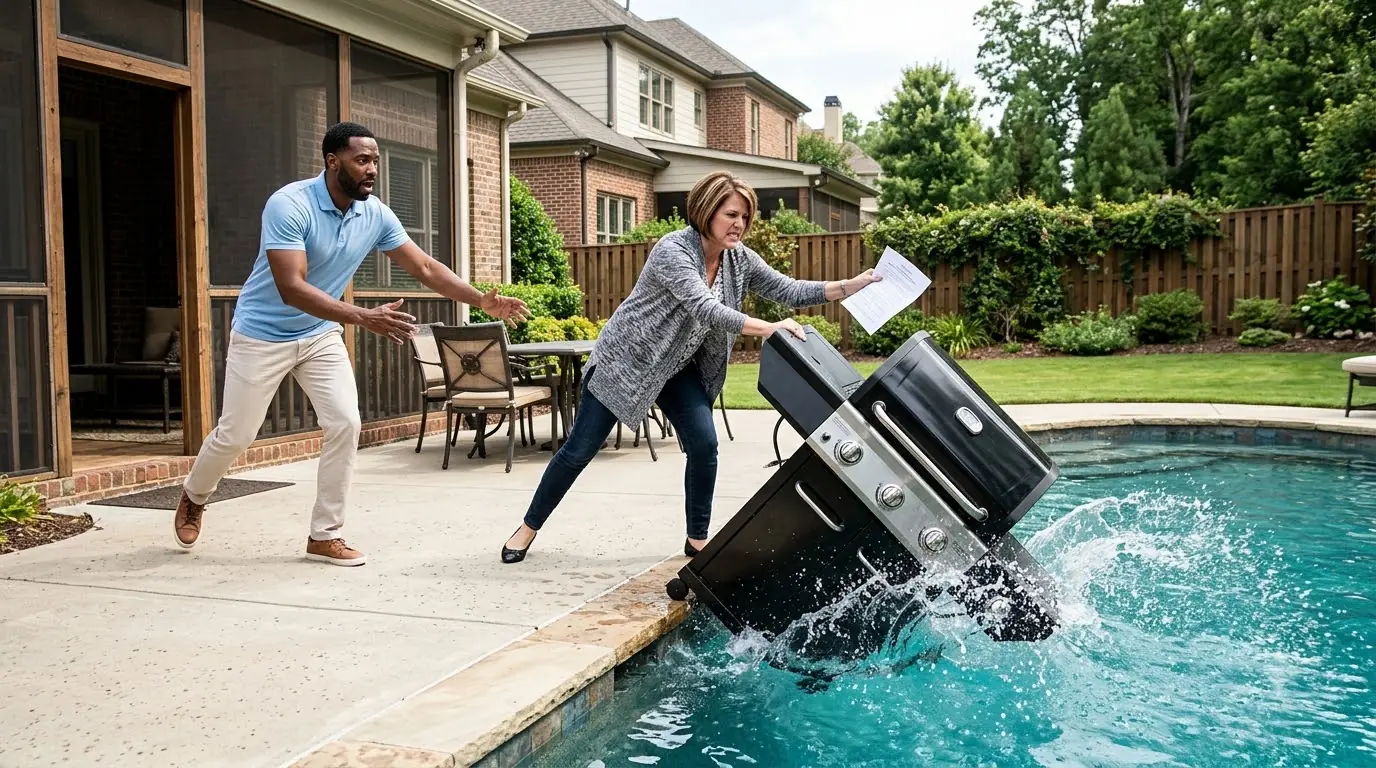
A woman's voice.
Loud.
Sharp.
Satisfied.
“That should solve the problem.”
Marcus set the glass down.
Walked through the porch door.
And stared.
His black propane grill was in the swimming pool.
Not beside it.
Not tipped against the coping.
In it.
The grill had landed sideways in the shallow end, one wheel still visible above the churning turquoise water while the lid hung open beneath the surface. A steel utensil tray drifted near the steps. Two cooking tools floated toward the filter intake.
Standing beside the pool was Karen Whitmore.
Fifty-two years old.
White American.
Short highlighted brown hair shaped into the careful style she wore to every neighborhood meeting.
Gray patterned cardigan.
Dark jeans.
Black flats.
A silver watch on one wrist.
And in her left hand, a white sheet of paper she was holding as though it were a court order.
Marcus stared at the pool.
Then at Karen.
Then at the side gate behind her.
It stood open.
He had not invited her inside.
Karen mistook his silence for shock.
She lifted the paper higher.
“I warned you.”
Marcus finally spoke.
“You pushed my grill into my pool.”
Karen's expression tightened.
“Don't make this dramatic.”
Marcus looked back at the grill.
A large bubble escaped from underneath the lid.
He returned his eyes to her.
“I don't think I'm the one making it dramatic.”
She waved the paper.
“This equipment has been in violation for eleven days.”
Marcus said nothing.
Karen continued because people like Karen often mistook silence for permission.
“You received written notice.”
“No.”
“You absolutely did.”
“No.”
She held the page toward him.
“You were given a compliance order requiring removal of unauthorized outdoor cooking equipment visible above the approved fence line.”
Marcus looked at the fence.
Six-foot cedar.
His grill was shorter.
He looked back.
“Visible to who?”
Karen blinked.
“What?”
“The grill.”
“You said it was visible above the fence.”
“Yes.”
“It wasn't.”
Karen's jaw tightened.
“That isn't the point.”
Marcus almost smiled.
It was always interesting when the point changed.
He walked toward the patio table.
His phone sat there on a small charging stand.
The backyard security camera mounted beneath the porch roof faced the pool.
Karen followed his eyes.
For the first time, her confidence changed.
Only slightly.
Then it returned.
“Recording me doesn't change association rules.”
Marcus picked up his phone.
Checked the camera application.
Recording active.
Good.
He put the phone back down.
“Which association rule?”
Karen slapped the page with two fingers.
“Section fourteen.”
“What does section fourteen say?”
She stared at him.
“You received the notice.”
“You brought a copy.”
“Read it.”
Karen seemed offended by the request.
“You expect me to stand here and explain rules you've already ignored?”
Marcus looked toward the pool.
“Yes.”
She unfolded the paper.
“Outdoor cooking stations, freestanding appliances, smokers, grills, or similar equipment may not be permanently positioned in locations visible from common areas without architectural approval.”
Marcus nodded.
“My grill was on wheels.”
Karen paused.
“And?”
“Not permanent.”
“You left it there.”
“On my patio.”
“For weeks.”
“Yes.”
“That makes it permanent.”
“No.”
Karen's voice rose.
“Marcus, this is exactly the problem with you.”
He became still.
“With me?”
“You argue every technical detail instead of cooperating.”
“I asked you to explain why you threw my property into water.”
“I removed a violation.”
“You destroyed property.”
Karen scoffed.
“The grill isn't destroyed.”
Marcus looked at the submerged control panel.
Then at her.
“You want to test that theory?”
She ignored him.
“I gave you plenty of opportunities.”
“When?”
“The association mailed you.”
“Show me.”
Karen waved the paper.
“This.”
“That's in your hand.”
“A copy.”
“Show me proof the original was mailed.”
Her expression hardened.
“I don't carry administrative records around people's yards.”
Marcus nodded slowly.
“You do carry their grills into swimming pools.”
Karen's face flushed.
“I did not carry anything.”
“Right.”
“You pushed it.”
“Because you refused to comply.”
Marcus took one slow breath.
He had lived in Stonehaven Estates, outside Raleigh, North Carolina, for eight months.
Bought the house after fifteen years working in commercial building management and facilities consulting.
Four bedrooms.
Three bathrooms.
A screened porch.
A pool.
A backyard large enough for weekend cookouts.
The house was not absurdly expensive by local standards, but it represented something Marcus had wanted for years.
Privacy.
He had spent most of his adult life living in apartments, traveling for projects, renting temporary homes, and dealing with other people's rules.
When he bought the property, he read every document.
Survey.
Deed.
Title report.
Restrictions.
Utility easements.
County tax map.
No HOA membership agreement.
No association assessment.
No architectural-review covenant tied to his parcel.
That was not unusual.
Stonehaven Estates had been developed in phases.
The original subdivision dated to 1998.
A homeowners association formed in 2004 when a second phase was built.
Several older parcels along Juniper Ridge Drive and Maple Court had never been annexed.
Marcus's home was one of them.
His closing attorney, Nina Patel, had highlighted that fact.
“The neighborhood will look like HOA.”
“Most houses are HOA.”
“Yours is not.”
Marcus remembered asking twice.
“So nobody can fine me?”
“Not through that association.”
“County rules still apply.”
“City ordinances.”
“Recorded restrictions on your deed.”
“But Stonehaven Homeowners Association?”
“No jurisdiction over this parcel unless you voluntarily join.”
Marcus had no intention of joining.
Not because he hated HOAs.
Because he hated ambiguity.
He had spent too many years negotiating contracts to confuse neighbor preference with legal obligation.
The first letter from Stonehaven HOA arrived three weeks after he moved in.
WELCOME TO STONEHAVEN.
It included a community newsletter and instructions for registering on the association portal.
Marcus threw nothing away.
He scanned it.
Then emailed the management company.
My property at 1842 Juniper Ridge Drive does not appear to be within the association boundary. Please confirm no account has been opened in my name.
The reply came two days later.
Correct. Your parcel is not currently assessed by Stonehaven HOA. No owner account exists.
Marcus saved that too.
Then Karen Whitmore introduced herself.
She came to the door carrying a blue folder.
“I'm neighborhood compliance chair.”
Marcus smiled politely.
“Nice to meet you.”
She looked over his shoulder into the house.
“You're renovating?”
“Painting.”
“We have approved exterior colors.”
“Interior.”
“Oh.”
She sounded disappointed.
Then:
“You should still register.”
“With?”
“The HOA.”
“My property isn't in it.”
Karen gave the patient smile people used when they believed someone had misunderstood something simple.
“Technically some of the original homes weren't included in the first declaration.”
“Correct.”
“But everyone participates now.”
Marcus waited.
Karen continued:
“For consistency.”
“Voluntarily?”
“Well.”
“Is it voluntary?”
She shifted the folder.
“The neighborhood operates better when everyone follows the same standards.”
“That wasn't my question.”
Karen's smile disappeared slightly.
“Yes.”
“It's voluntary.”
Marcus nodded.
“Then I'll pass.”
That was the first time Karen decided he was difficult.
She did not say it.
Not yet.
Over the next eight months, she found reasons to stop.
Trash bins visible from street for forty minutes after collection.
A contractor van parked overnight.
Garden edging she considered “commercial looking.”
Two patio chairs she could supposedly see through the gate.
A basketball hoop Marcus never owned.
That last one interested him.
The notice referenced:
1842 Juniper Ridge Drive.
Marcus's address.
But the attached photograph showed a house with blue shutters.
His had black shutters.
He emailed the association.
They apologized.
Clerical error.
Fine.
Mistakes happened.
Then another letter arrived about landscaping.
Marcus responded with the same question each time.
Please identify the recorded covenant granting Stonehaven HOA jurisdiction over this parcel.
Nobody did.
Usually the issue disappeared.
Karen did not.
She believed uniformity was a virtue.
Marcus believed authority needed paperwork.
Those two philosophies could coexist peacefully if the first person respected the second.
Karen did not.
Three weeks before the grill incident, Marcus hosted a small birthday dinner for his younger sister.
Eight guests.
Music low.
Cars parked legally.
Food on the grill.
At 7:14 p.m., Karen appeared outside the side fence.
She did not ring the front bell.
She spoke through the gate.
“You can't have that there.”
Marcus looked around.
“What?”
“The grill.”
He almost laughed.
“I'm cooking.”
“I can see that.”
“Then what are you asking?”
“That equipment isn't approved.”
“By who?”
“The architectural committee.”
Marcus turned a steak.