The coat rack in the Doyles' mudroom had seven hooks, and for eleven months Lucy Ostrowski had known which one was hers.
It was the last one, closest to the closet door, the one with the slight downward bend. Her father had screwed the rack into the wall the week she moved in, a long board of honey-colored oak with black iron hooks, because, he said, a house with four people in it needed more than a closet. Dana had stood in the kitchen doorway with her arms folded and said, "It's a mudroom, Russ, not a train station," and he had kept drilling.
Four people. Lucy had counted that too. Her father, Dana, Paige, and her. It sounded like a family when you said it fast.
The walls of the mudroom were a soft, chalky blue, the color of a robin's egg that had been left out in the rain. Dana had picked it. She had picked everything in the house: the patterned wallpaper in the den, little gold medallions on a cream field; the boots on the rubber tray, lined up by size like a choir; the glass-paned front door. Outside, through the glass, the day was the flat gray of a dish towel. Snow had been coming down since breakfast, not hard, just steadily, as if somebody up there had a job to do and meant to finish it.
Lucy came downstairs at a quarter to two because her grandmother's car would turn onto Larch Court at two exactly, and she liked to be at the door when it did. Grandma Irene had visits every other Saturday. That was the arrangement, written down on a piece of paper in a lawyer's office in Menomonie that Lucy had not been allowed to read. Every other Saturday, two to six, and Irene was never late, not even in the ice storm in February, when she had come creeping up the block in her old Buick with the hazards blinking because she said she had promised.
Lucy reached for the last hook.
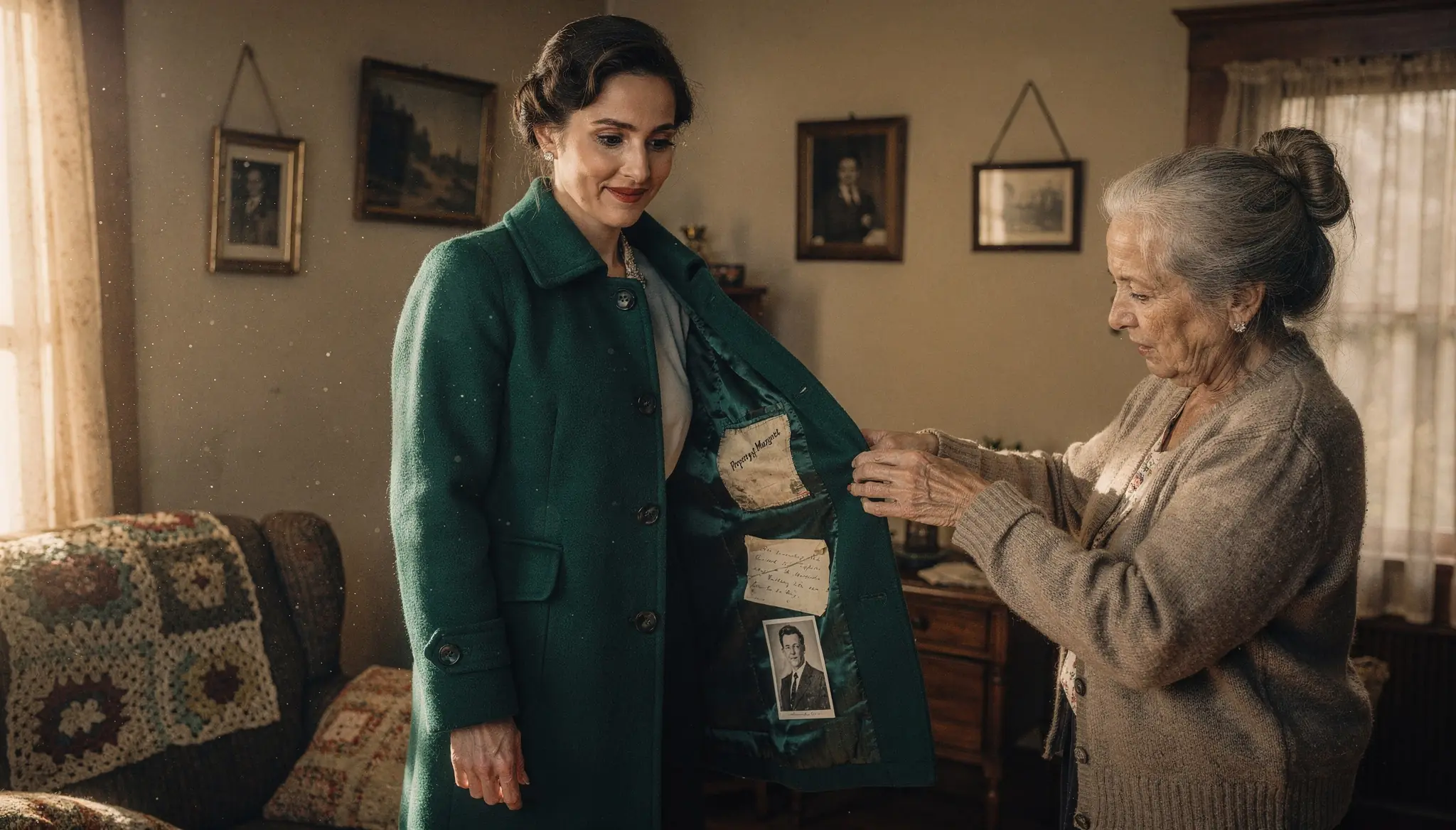
The green coat hung there, where she always left it. Dark green wool, the deep, almost-black green of pine trees at dusk. It had big horn buttons and a belt that tied rather than buckled, and in the right pocket there was still a single cough drop in a wax paper twist that Lucy had not been able to make herself throw away. It was too big for her. The sleeves came down past her knuckles. She wore it anyway, to the bus stop and back, every school day since January, and sometimes, when nobody was home, she sat in the corner of the den couch with her knees pulled up inside it, and breathed.
It still smelled like her mother, a little. Less every month. Lavender soap and car heater and something underneath that was just Winnie, that had no name. Lucy rationed it. She did not bury her face in the collar more than once a day.
Her fingers had just closed on the wool when a hand came over her shoulder and took it.
"I'm wearing this," Paige said.
Lucy turned around. Her stepsister, her half sister, the girl she was supposed to call her sister and mostly didn't call anything, stood behind her in a striped long-sleeve shirt and jeans, her hair twisted up in a tortoiseshell claw clip, a few loose pieces falling around her face in the way that took her twenty minutes in front of the bathroom mirror to make look like it took none. Paige was sixteen, seventeen on Wednesday. She had a car, technically their father's old Corolla, and a boyfriend named Tanner who played hockey, and a way of looking at Lucy as if Lucy were a stain on a shirt she liked.
"Give it back," Lucy said.
"I'm going to Tanner's. Mine's got salt all over it." Paige was already shrugging into it, one arm, then the other. The coat fit her better than it fit Lucy. That was the first awful thing. The sleeves stopped at her wrists. The shoulders sat where they were supposed to sit. She tied the belt in a loose knot and turned toward the long mirror by the closet and lifted her chin.
"That was my mom's," Lucy said. Her voice came out thin and high and she hated it.
"I know whose it was." Paige smoothed the lapels. She looked at herself, a long look, and then she smiled, and it was not a nice smile. "It looks better on me."