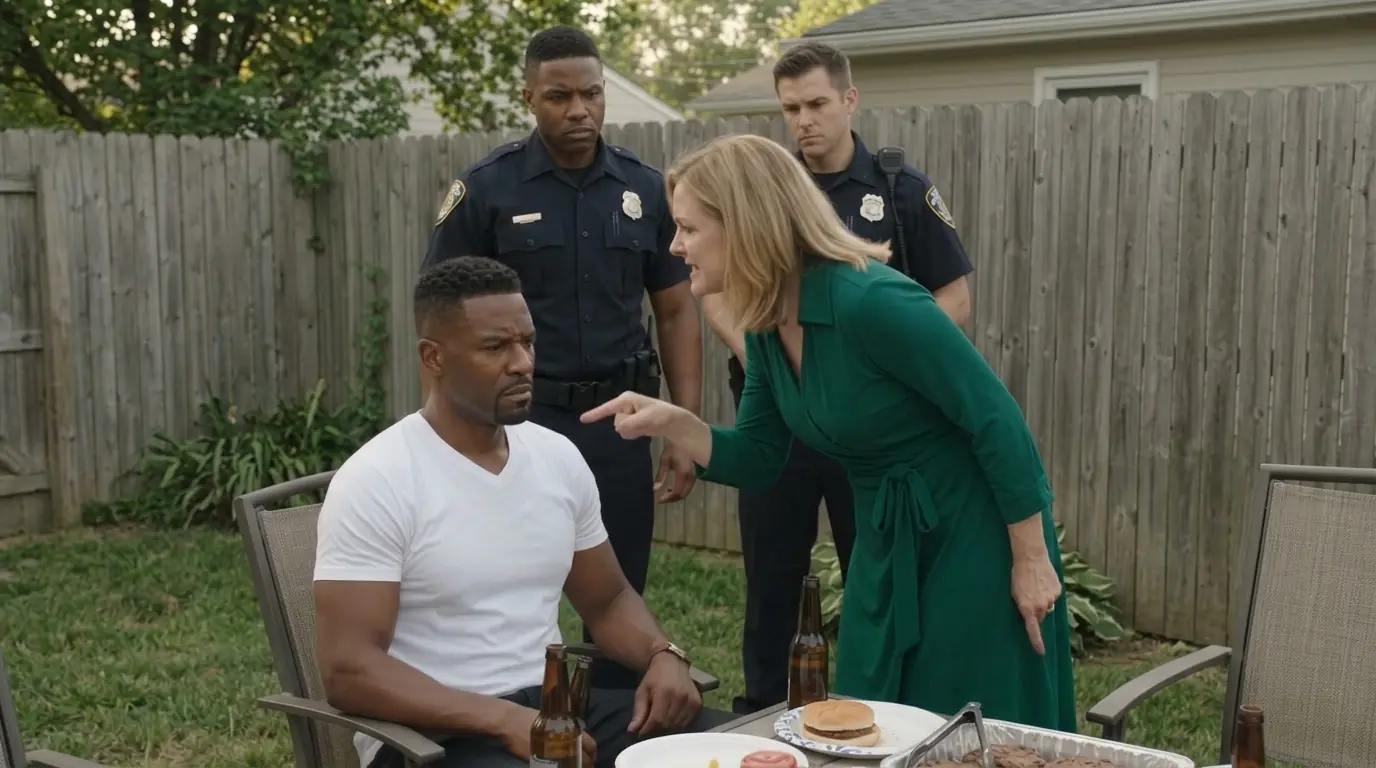
The first thing Carol Hensley told the 911 dispatcher was that four dangerous men were gathering behind a house in Meadow Ridge Estates. She said alcohol was involved, drugs might be present, and the men had become aggressive when she tried to investigate a neighborhood complaint. What Carol did not mention was that she was standing inside the fenced backyard of the man she was reporting. She had opened his side gate without permission, walked twenty feet across his lawn, and then called police because he told her to leave.
My name is Marcus Holloway, and at the time I had owned 742 Willow Bend Drive for a little less than four months. I was forty-two years old, finally living in the kind of quiet suburban house I had spent most of my adult life saving for, and that Saturday afternoon I was standing beside a propane grill with a spatula in one hand and half a beer in the other. My friends Terrence Boyd, Luis Alvarez, and Cameron Price were sitting around the patio arguing about whether the Cincinnati Bengals would disappoint the entire state before December. According to Carol Hensley, that scene required three patrol cars.
“Yes, they’re still here,” she said into her phone while staring directly at us. “They keep watching me, and I don’t feel safe.” Cameron slowly lowered the cheeseburger he had been eating and said, “Ma’am, we’re watching you because you walked into his backyard.” I pointed the spatula at him and said, “Cameron, stop helping.”
Carol paced across my grass as though she had been assigned jurisdiction over every blade. She wore white tennis shoes, navy trousers, and a light green polo embroidered with the Meadow Ridge Homeowners Association logo, while a laminated badge reading BOARD PRESIDENT hung from a lanyard around her neck. “I am the HOA president,” she told the dispatcher, loud enough for us to hear, “and I came here because multiple residents complained about suspicious activity.” Terrence looked toward the surrounding houses and quietly asked, “Multiple residents where?”
Luis shook his head. “Nobody say another word.” That was good advice because sirens were already on the way, and I had no interest in giving Carol a sentence she could detach from its context and rearrange later. The thing that bothered me most was not that she called police. It was how quickly she had turned ordinary details into criminal language simply because she wanted them to sound dangerous.
Four friends became a group of suspicious men. A few beers became public intoxication, a sports argument became aggressive yelling, and a private backyard became a location where we apparently needed permission to exist. I had spent enough of my professional life listening to people describe the same event in wildly different ways to understand the power of wording. Carol understood it too, whether consciously or not.
I had bought the house because I wanted boring. After years of apartments, noisy neighbors, shared walls, parking arguments, and rent increases that arrived like annual threats, I wanted a mortgage, a garage, a small fenced yard, and one decent tree large enough to shade the patio. The house was not impressive, but it belonged to me. My mother cried the first time she saw it because she knew exactly how long it had taken to get there.
The kitchen had one drawer that stuck every time humidity rose. The upstairs bathroom fan sounded like a lawn mower, and the garage door needed a second push on the remote before it fully closed. I loved all of it. I wanted somewhere I could come home, close the door, and let the rest of the world solve its own problems until morning.
That Saturday was supposed to be the first real cookout. Terrence brought steaks and immediately overcooked two of them, Luis arrived with store-bought potato salad he insisted came from his aunt, and Cameron contributed beer because apparently planning side dishes was beneath him. By three-thirty, we had eaten too much and were debating sports, old movies, and whether Cameron had ever actually been good at basketball. There was no music loud enough to carry beyond the fence, no shouting before Carol arrived, and nobody had blocked a driveway.
I first noticed her about twenty minutes before she opened the gate. Her home sat diagonally behind mine across a narrow greenbelt, so the upper half of one bedroom window was visible above the fence line, and I saw curtains move more than once. Luis noticed too and said, “Somebody’s watching us.” Terrence looked toward the fence and asked, “Maybe she wants a burger?”
The gate latch clicked before any of us could answer. Carol stepped inside without knocking, calling out, or waiting for permission, then stopped on the patio and looked at the bottles on the table. “I knew it,” she said. Those were the first words Carol Hensley ever spoke to me.
I put the spatula down and asked, “You knew what?” She ignored the question and looked from Terrence to Luis, then Cameron, then finally back at me with an expression that lingered a little too long. “You’re the new owner,” she said. At the time, I assumed she was simply adjusting whatever picture she had built in her head.
“That’s right,” I answered. Carol nodded slowly and began explaining HOA rules about outside gatherings, guest parking, noise, landscaping, and “community standards” with the confidence of somebody reading a criminal code. I told her I had already read the bylaws. Her mouth tightened immediately.
“Then you know disruptive gatherings aren’t allowed,” she said. I looked around at three friends, four patio chairs, one cooler, and a grill. “There are four of us,” I said. Carol pointed toward the beer bottles and replied, “You’re drinking.”
“Adults can drink on private property,” I said. Carol responded that alcohol was prohibited whenever it contributed to a nuisance, and Terrence glanced toward Cameron’s bottle and said, “He’s been drinking the same beer for forty minutes.” Carol snapped, “Nobody asked you.” Luis stood simply because Carol was blocking the cooler, and she immediately backed away.
“There,” she said. Luis stopped. “There what?” Carol pointed toward him and said, “That aggressive behavior.”
I told Luis to sit down, and he did without argument. Then I looked at Carol and said, “You need to leave my property.” She blinked as though I had said something bizarre. “I’m the association president.”
“That does not give you permission to enter a fenced backyard,” I said. Carol replied that she was investigating a complaint, so I asked who had complained. “That information is confidential,” she said. I told her she was welcome to investigate it from the sidewalk.
Her expression changed. “You don’t understand how Meadow Ridge works.” I said, “I understand trespassing.” Carol stared at me for another second, pulled out her phone, and said, “Fine, then I’m calling police.”
Cameron quietly whispered, “Please do.” I closed my eyes and told him to stop. Carol dialed anyway. Five minutes later, sirens turned into our subdivision.
All four of us changed instinctively. Beer bottles went onto the table, hands stayed visible, and nobody moved toward the gate while the cruisers approached. Terrence said quietly, “Marcus handles it.” Cameron asked what we were supposed to do if Carol kept lying, and Luis answered, “That’s why Marcus talks.”
Two patrol cars stopped outside my house, followed by a third seconds later. The first officer through the gate was young enough that his uniform still looked newly issued, and behind him came Sergeant Victor Ramsey, a veteran patrol supervisor with gray beginning to show in his beard. Carol rushed toward them and said, “Thank God, they threatened me.” Victor raised one hand and told her to slow down.
He looked around carefully. Four Black men, four chairs, food, beer, one grill, no damaged property, no visible weapons, and no scene remotely resembling the dispatch description. Then his eyes reached me, and there was the smallest pause before his expression returned to neutral. Carol noticed it immediately.
“Sir,” Victor said, “this your residence?” I answered yes and confirmed I owned the property. He asked whether I had invited Carol inside. I said no.
Victor looked toward her. “Ma’am, why did you enter the yard?” Carol answered, “I’m HOA president.” Victor calmly said, “That wasn’t my question.”
“There was a disturbance,” Carol said. Victor asked what disturbance she had personally observed before entering the property. She hesitated, then said we were shouting and drinking. Cameron muttered, “Bengals discussion gets emotional,” and the younger officer looked down to hide a smile.
I stared at Cameron until he stopped. Victor asked whether anyone had threatened Carol before she entered, and she answered that our behavior itself had been threatening. He asked what behavior. Carol said drinking, profanity, and men standing around.
“Drinking isn’t a threat,” Victor said. Carol looked offended. “You weren’t here,” she replied. Victor nodded and said, “Correct, which is why I’m asking questions.”
He asked me whether I had directed Carol to leave. I said yes. She immediately interrupted and claimed I had no authority to remove an HOA official during an investigation. Victor turned toward her and said, “He owns the property.”
Carol stared at him. “You know him.” Victor did not react. “I have met Mr. Holloway before.”
“There,” Carol said, almost triumphantly. “That explains this.” Victor asked what exactly she believed it explained, and she accused him of refusing to act because he knew me personally. He told her he was acting by directing a person without permission to leave private property.
“You’re taking their side,” Carol said. Victor answered, “I’m applying property law.” She pointed toward us and said, “They’re intimidating me.” He asked for the exact threat again, and she could not provide one.
Before leaving, Carol looked directly at me. “This is not over.” Victor sighed and said, “Ma’am, leave the property now.” She slammed the side gate hard enough to shake the latch.
The officers remained another twenty minutes. They took statements, photographed the patio, documented the number of guests, and gave me an incident number. Before Victor left, he quietly said, “Keep everything.” I asked whether he believed Carol would continue, and he looked toward her house and said, “People who announce something isn’t over usually intend to prove it.”
By eight that evening, the Meadow Ridge Residents Facebook group contained a post from Carol. The title read COMMUNITY SECURITY WARNING — 742 WILLOW BEND DRIVE, with my full address written in capital letters. She claimed a group of intoxicated men had gathered at the residence, mentioned suspected gang activity and possible narcotics, and described herself as having narrowly avoided an escalating confrontation. Then she suggested the responding officers had personal connections to “members of the group” and therefore refused appropriate enforcement.
Comments appeared quickly. People thanked Carol for protecting the neighborhood, complained that property values depended on maintaining standards, and said families should not have to fear walking near their own homes. One resident wrote that she had walked past my property earlier and seen nothing unusual. Carol replied, “You did not witness what happened once I entered.”
Technically, that statement was true. Carol preferred claims constructed from fragments that were individually defensible but collectively dishonest. I learned that very quickly. I took screenshots of every post, comment, timestamp, and edit.
The next morning, an official violation notice was taped to my front door. It accused me of hosting an unapproved gathering, violating community noise restrictions, and leaving prohibited recreational equipment visible from neighboring property. The “equipment” consisted of folding chairs, grilling utensils, and a cooler. Each violation carried a daily fine.
I called Luis. He arrived before lunch carrying coffee and a printed copy of the HOA bylaws because Luis had a personality disorder that made him genuinely enjoy reading governing documents. He sat at my kitchen table, turned several pages, and said, “The first one is garbage.”
The association required advance approval only when more than ten outside guests attended a gathering. I had three. Noise violations required independent confirmation after nine-thirty at night, and our cookout ended before dinner. Temporary outdoor furniture currently being used was specifically exempt from equipment restrictions.
“So they’re all nonsense,” I said. Luis closed the book and replied, “That isn’t the important part.” He tapped the violation letter and said, “Someone is building a paper trail.”
That sentence stayed with me. One bad complaint can look petty, but five notices create the appearance of a pattern even if every individual notice is weak. People see a stack of documents and assume volume means credibility. Carol seemed to understand that perfectly.
I appealed by certified mail. No social-media rant, no angry phone call, and no threats about lawyers. I quoted the bylaws, attached photographs, included the police incident number, and listed witnesses. Then I waited.
Four days later, another notice arrived. Trash containers allegedly remained visible outside approved collection hours, even though the timestamp on my doorbell camera showed they were at the curb during the permitted window. Three days after that came a guest-parking violation for Terrence’s truck. He had left hours before overnight restrictions began.
Then Carol cited grass height. I paid a landscaping company to measure it and put the result in writing. Fully compliant. Every notice eventually failed, but the envelopes kept coming.
The practical cost was small at first. The emotional cost was not. I started feeling tension every time I opened my mailbox, and I noticed cars slowing near my house in ways I probably would not have noticed before.
Neighbors changed too. Not everybody, but enough. A man who had waved every evening when I first moved in began giving me a stiff nod, and a woman across the street suddenly called her daughter inside whenever my friends arrived. One delivery driver looked at my house number and asked, “Is this the place with that gang complaint?”
That one stuck with me. At work, my name meant something specific because I had spent years building a reputation around it. In Meadow Ridge, Carol had created another version of me before half the residents had even introduced themselves. Then she contacted my employer.
My supervisor called me into his office on a Tuesday afternoon. His name was Deputy Chief Raymond Ellis, and he shut the door before saying, “We received a citizen complaint.” I answered, “Carol Hensley.”
Raymond’s eyebrows rose slightly. “You already know.” I handed him the incident report, screenshots, violation letters, and certified appeals before he finished opening the folder. He read quietly for several minutes.
Carol claimed I had used professional influence to avoid arrest during the cookout. She also accused me and three “unknown associates” of intimidating her. Department policy required an internal review, and I understood why. I still hated that one person could create work simply by writing a confident accusation.
Raymond eventually looked up. “This appears straightforward.” I said, “She isn’t trying to win one complaint.” He waited.
“She’s trying to create enough paper that nobody cares which accusation started everything,” I said. Raymond nodded slowly and closed the folder. “Then make your records better than hers.”
That became my rule.
I installed cameras at the front door, driveway, side gate, and rear patio. Nothing pointed toward anybody’s windows, nothing recorded beyond what was necessary, and every camera remained clearly on my property. For almost a week, they captured squirrels, delivery vans, tree branches, and me forgetting where I had left the garbage can.
Then my phone vibrated at 11:26 on a Thursday night. BACKYARD MOTION DETECTED. I opened the feed and saw a man in a dark hooded jacket standing beside my outdoor air-conditioning condenser with a short pry bar. Before I could decide whether I was misunderstanding the image, he swung.
Metal buckled. He struck the condenser again, then again, damaging the outer housing and fan guard. I ran downstairs. Terrence, Luis, and Cameron happened to be at my house again because Luis was helping organize records for an upcoming HOA appeal meeting.
We reached the back door together. I opened it and yelled, “Hey.” The man turned, and the motion light caught part of his face before he sprinted toward the fence.
Terrence immediately moved. I caught his arm and said, “Don’t.” He looked at me like I had lost my mind.
“He’s getting away,” Terrence said. I answered, “Let him.” The man sprayed one word in red paint across the siding before climbing the fence: RAT.
Nobody joked after that. Cameron stared at the wall while Luis called police. I stood beside the damaged condenser with anger pressing so hard behind my teeth that my jaw hurt.
Cameron touched my shoulder. “Don’t touch anything.” I looked at him and said, “You’re telling me that?”
“You look like a man who might forget,” he answered. He was right.
Responding officers photographed tool marks, footprints, paint, the damaged unit, and the fence line. My camera footage showed the entire incident, while a neighbor’s doorbell camera captured a dark SUV entering Meadow Ridge minutes before the vandalism and leaving shortly afterward. Part of the license plate was visible. That became far more useful than chasing the man.
Detective Nina Patel was assigned to the case. She asked whether anyone had a reason to target me, and I told her about the ongoing HOA dispute. She asked specifically about threats. I mentioned Carol telling me the situation was not over, but I also made clear I had no evidence connecting her to the vandalism.
Nina appreciated the distinction. “Suspicion is fine,” she said. “Conclusions come later.” I liked her immediately.
Something else bothered me. The word RAT implied the vandal knew enough about my profession or previous work to describe me that way, yet Carol’s public posts had only vaguely mentioned police connections. My exact job had never been announced during the backyard call. I told Nina.
Three days later, Cameron called me. “Sit down,” he said. I told him I hated calls that began like that.
Police had identified the SUV as belonging to a private security company called RidgeLine Protective Services. A former employee named Calvin Pike had access to the vehicle around the time of the vandalism. That name meant something to me.
Five years earlier, I had worked a regional narcotics investigation involving counterfeit prescription pills, fentanyl, and distribution networks operating across central Ohio. One defendant was twenty-eight-year-old Brandon Hensley. Carol’s son.
Brandon was not the head of the network. He was deeply involved enough that controlled purchases, messages, payment records, and surveillance linked him to repeated distribution activity. He eventually accepted a plea agreement and received a federal sentence. Two years later, he died in custody after complications from an undiagnosed medical condition.
I remembered the sentencing hearing. A blond woman in the gallery had cried, shouted that investigators framed her son, and accused everyone involved of destroying an innocent man. Carol Hensley. Suddenly, I understood the expression she wore when she first entered my backyard and said, “You’re the new owner.”
She had recognized me.
Carol had not been discovering who lived at 742 Willow Bend Drive. She had been confirming it. My arrival in Meadow Ridge had not been random to her.
Then Cameron told me the second part. Calvin Pike had once been a lower-level associate of Brandon’s, cooperated with investigators, and received a shorter sentence. After release, he eventually worked for RidgeLine Protective Services. Everything was beginning to connect.
Terrence wanted to cross the greenbelt and confront Carol immediately. Luis told him no before I could. Terrence looked at both of us as if restraint had become stupidity.
“She’s been targeting Marcus because of that old case,” Terrence said. Luis replied, “Probably.” Terrence nearly shouted, “Probably?”
Luis stayed calm. “What we believe and what police can prove remain two separate things.” I nodded. “He’s right.”
Waiting felt passive. It was not. Sometimes waiting means refusing to destroy the strongest case available because anger wants a faster answer.
The HOA meeting took place eleven days later. Carol had encouraged high attendance because she planned to discuss what she called “a serious pattern of security concerns.” Fifty-two homeowners showed up, nearly half the association.
Carol sat at the front table wearing a navy blazer and pearls. She looked composed, prepared, and completely unaware of how much the criminal investigation had progressed. The meeting began with landscaping contracts, clubhouse repairs, and mailbox replacements before Carol finally reached the subject everyone had come to hear.
“We need to address repeated disturbances connected to one residence,” she said. She listed unauthorized gatherings, police involvement, intimidation, and possible abuse of professional relationships. Several residents looked toward me in the third row.
A woman named Ellen Burke raised her hand. “Were any of the HOA violations upheld?” Carol paused and said the reviews were continuing.
The treasurer immediately said, “That’s not accurate.” The room shifted slightly. Three notices had already been dismissed.
Another homeowner asked whether police cited anyone during the cookout. Carol said she remained concerned about officer neutrality. Someone asked why.
“Because the responding supervisor personally knew the homeowner,” Carol said. Then she looked directly toward me. “Residents deserve to understand who has moved into this community.”
I stood. “My name is Marcus Holloway, and I purchased 742 Willow Bend Drive in June.” The room became quiet.
“Most of you have heard a version of what happened in my backyard,” I continued. “You heard there were gang members, drugs, threats, and police refusing to act.” Several people nodded.
I had requested the 911 recording through proper channels and received a releasable copy. With the board secretary’s permission, I played it. Carol immediately objected.
Ellen said, “I want to hear it.” Other residents agreed. Carol sat down.
Her own voice filled the clubhouse. There are several dangerous men behind the house. Then came references to gangs, drugs, intoxication, and fear.
The dispatcher asked whether anyone threatened her. Carol said no but insisted their behavior felt dangerous. The dispatcher asked whether weapons were visible. No.
Then came the important question. “Are you currently on the property?” Carol paused before admitting she had entered because she was HOA president. People throughout the room turned toward her.
When the recording ended, I placed the patrol report beside the laptop. No disturbance observed, no threats reported by independent witnesses, no criminal activity, and caller remained on private property after the homeowner directed her to leave. The room went quiet.
A resident near the rear asked, “Why did you tell Facebook you barely escaped?” Carol answered that the recording did not capture how intimidating we had been. Ellen replied, “But it captures you entering his yard.”
Carol stood. “You’re all missing the bigger issue.” She pointed toward me and said the responding sergeant already knew me.
Before I could answer, the clubhouse door opened. Sergeant Victor Ramsey walked in beside Deputy Chief Raymond Ellis and Lieutenant Denise Carter from Professional Standards. Carol stopped speaking.
Raymond addressed the board. “Mrs. Hensley filed a complaint alleging Mr. Holloway used law-enforcement status to influence responding officers.” Murmurs moved through the room.
He continued. “Because Mr. Holloway authorized disclosure of certain findings relevant to the complaint, I can clarify the preliminary review.” Then he looked toward me.
“Detective Marcus Holloway has served with the Franklin County Metropolitan Police Department for eighteen years.”
The room changed instantly.
Carol’s expression froze.
Raymond looked toward Terrence. “Lieutenant Terrence Boyd, Patrol Operations.” Then toward Luis. “Detective Luis Alvarez, Major Crimes.”
Finally Cameron. “Cameron Price, Cyber and Digital Investigations.”
Every man Carol had publicly described as possible gang members was a law-enforcement officer.
Nobody laughed.
That mattered to me.
Carol recovered first. “I knew it,” she shouted. “That proves exactly what I said.”
She looked around the clubhouse. “Police protecting police.” Victor stepped forward.
“I was not at the cookout,” he said. “I responded to the 911 call.” Carol insisted he already knew me.
“Yes,” Victor said. “I did.” Then he added, “If Mr. Holloway had been an electrician, a teacher, a mechanic, or unemployed, I still would have directed you to leave his private property after he withdrew permission for you to remain.”
Lieutenant Carter opened a folder. “Your complaint alleged Detective Holloway identified himself as law enforcement and used that position to avoid enforcement action.” Carol nodded.
“The evidence shows the opposite,” Carter said. “He never identified himself as an officer, never displayed credentials, never contacted responding officers before arrival, and never attempted to direct the patrol response.” She added that body-camera footage showed me deliberately allowing responding officers to handle the incident without interference.
Carol’s face tightened. “Of course your own department cleared him.” Lieutenant Carter answered, “The review includes body-camera evidence, dispatch records, independent witnesses, and written statements.” Then she closed the folder and said, “The allegation was not sustained.”
The clubhouse door opened again. Detective Nina Patel entered.
I had not known she was coming.
Carol looked toward her.
Nina stopped several feet from the board table. “Mrs. Hensley, I need to speak with you after this meeting.”
Carol immediately said, “I don’t know anything about what happened to his house.” The room became silent.
Nina paused. “I didn’t say what I wanted to discuss.” Carol realized her mistake one second too late.
Before anyone could react further, HOA treasurer Margaret Sloan stood with a thick binder. “There is another board issue that needs to be addressed before this meeting ends.” Carol turned toward her.
Margaret explained that she had reviewed recent security spending after the vandalism. Two payments had been made to RidgeLine Protective Services during the quarter. One corresponded to a legitimate patrol contract.
The second did not.
“How much?” someone asked. Margaret answered, “Seventeen hundred fifty dollars.” Carol immediately called it emergency consulting.
Margaret asked for the contract. Carol said there had not been time.
“Board approval?” Margaret asked. Carol said she had emergency authority.
Margaret shook her head. “Anything above seven hundred fifty dollars requires two executive signatures.” Then she held up the payment request and said, “This has only yours.”
Detective Nina Patel spoke. “Mrs. Hensley, investigators identified the individual recorded damaging Mr. Holloway’s residence.” Carol’s hands closed around the edge of the table.
“His name is Calvin Pike,” Nina continued. “He previously worked for RidgeLine Protective Services.” Carol shook her head.