The Sable Creek schoolhouse stood by itself on a low knoll above the dry fork, and in the last week of September the light came at it from every side. It came off the pale grass and the sand of the wash and through the cracks between the boards, so that a child on the back bench could watch gold blades of dust turning in the air. The building had never been painted. It had been built in the fall of 1874 out of lumber hauled forty miles from the railroad, and twelve summers had cooked it the color of a biscuit crust.
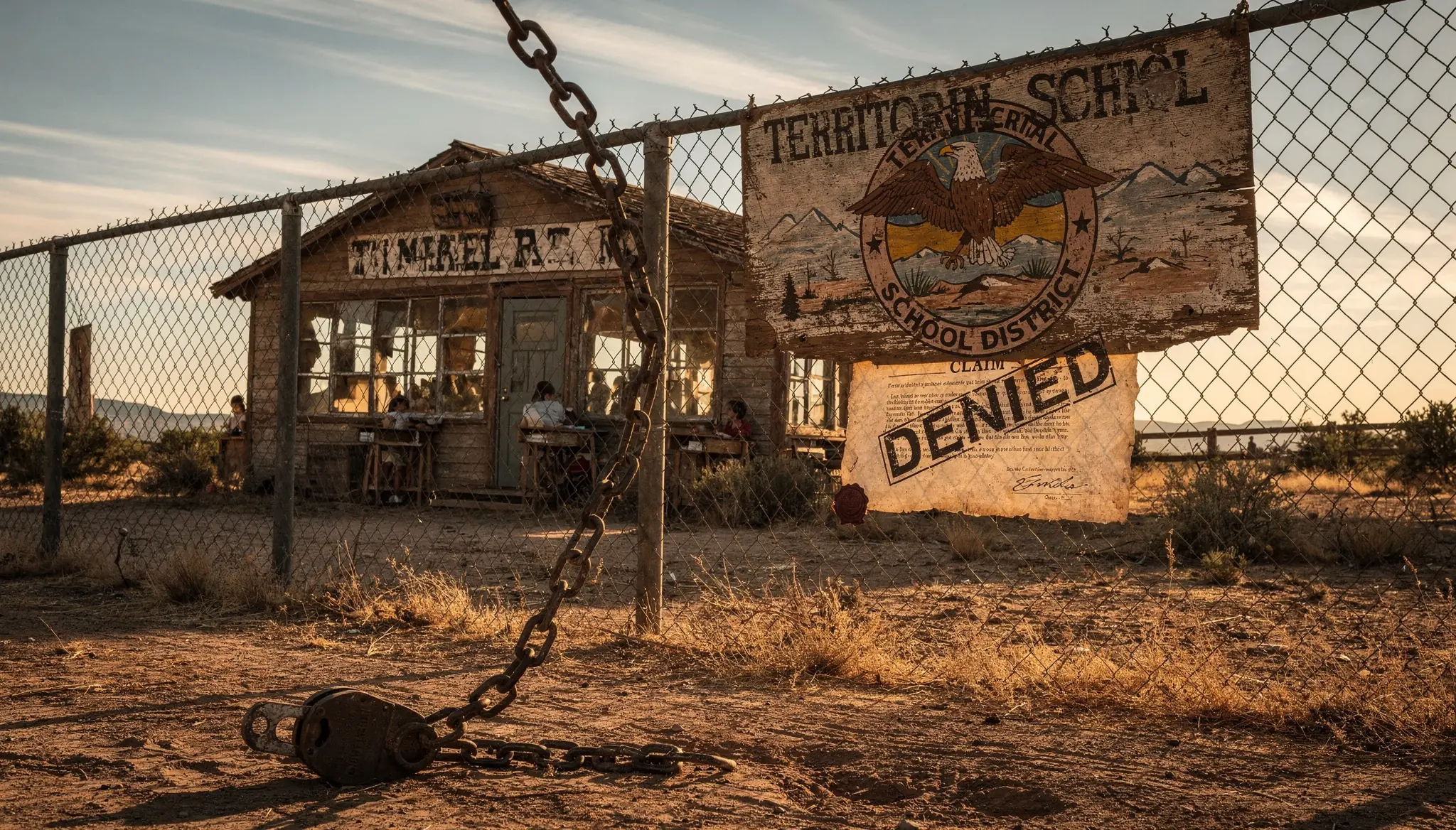
Cora Lindqvist arrived at a quarter to seven, as she did every school day, and unlocked the door with the iron key she wore on a ribbon around her neck. She was twenty-four. She had come out from the normal school in Delaware, Ohio, three years before with one trunk and a firm idea that a schoolroom was the one place on earth where every child was owed exactly the same. She still believed it, not as a hope but as a thing she had stood in, like weather.
She went to the big window on the south side, the one that had never had glass in it. The district had ordered a pane twice; both had broken on the way, and the board had voted that the Lord evidently meant Sable Creek to have air. In September it was simply a wide square of sky with the dry fork in the middle of it, and the cottonwoods along the far bank gone yellow at the tips, and beyond them the brown hills rolling west toward nothing at all.
On the inside of the window frame, at the height of a child's chin, were the names. Initials went back to the first term: a lopsided J.F. and 1874, an H.L. with a heart, a row of tally marks some boy had kept for the days until harvest. Cora's rule was one mark per child, on the last day. She had seen grown men come in at spring program and run their thumbs along the wood until they found themselves.
She took the deed out of her desk drawer and unfolded it on the sill.
She wanted it in her hand when Mr. Whitcombe came. She had been told, in a letter delivered by a cowhand on Saturday, that there would be a hearing on the ground at ten o'clock and that the school's interest must be "plainly and firmly represented."
The deed conveyed to School District Number Three of Harlan County, for the sum of one dollar and the love of learning, a lot of two acres "in the Northeast Quarter of Section Fifteen, Township Nine North, Range Fourteen West," together with the building and improvements thereon. It was signed by Abner Pruitt, president of the Pruitt Land and Cattle Company, and witnessed by Horace Whitcombe, then chief clerk of the office of the Surveyor General of the Territory. Folded inside it was a plat of the township, drawn in brown ink on heavy linen paper, with the section lines ruled clean as a ledger and the dry fork wandering through them like a loose thread. Someone, years ago, had drawn a small circle in red around the square that meant the school. At the bottom was the seal of the Territory, pressed into the paper so deep she could feel it from the back with her fingertip: a plow, a buffalo, a rising sun, and the words around the rim.
She had never had cause to doubt it. It had been there before she was. Forty-one children had passed through the room, by the old enrollment books, and some of them had children of their own on the benches now.
The children came at half past seven: the Ferris twins, the Lindahl boys on one horse with August, whom everyone called Gus, steering, the Okerlund girls, the Bishop children, and last of all Hannah Garrity, walking alone up the wash with her lunch pail swinging and her bonnet hanging down her back by its strings.
"Miss Lindqvist," said Nell Ferris, before she had her slate out, "Pa says the Indians are coming to take the school."
"Your father is mistaken," said Cora. "Nobody is taking the school. There is a meeting about a survey line. Grown people will talk, and then they will go home. We will have arithmetic until nine and then I am going to let you out early, and you are all going to go straight home and not hang about the yard. Is that understood?"
"Yes, Miss Lindqvist."