Montana Territory, 1888.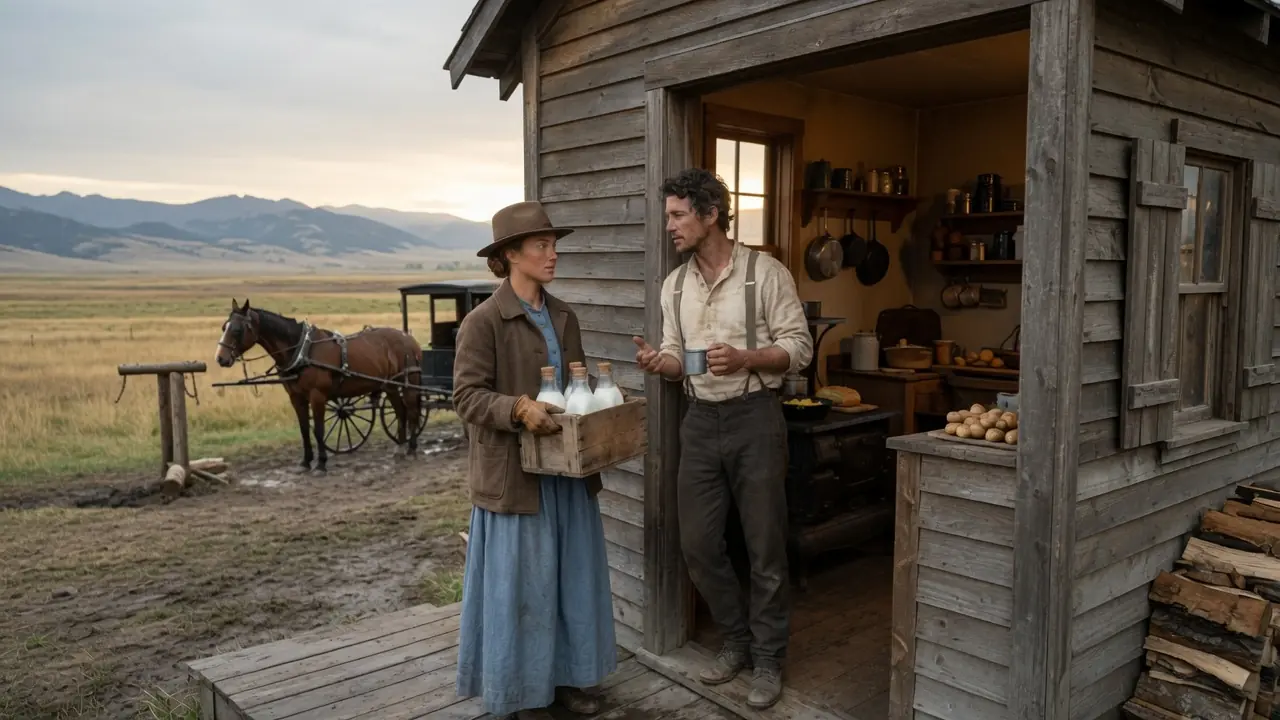
Eliza Marlowe was on the road before the sun, and this was nothing new. It had been her life for two years, since her father died in the spring of 1886 and left her six cows, forty acres, a mother whose health had never fully recovered, and a debt she'd been paying down month by month without asking anyone for help. She didn't know it yet, but the winter of 1886 had only been the start of the trouble.
The winter that followed, the one everyone in the territory still talked about, the one that killed cattle by the thousand in the snow, had wiped out half the small operations in the valley. The neighbors who survived it knew exactly who had bought up their land for pennies on the dollar afterward. One of those buyers was Gideon Rusk. Eliza carried her bottles in a wooden crate she'd built herself from boards salvaged off a fallen barn.
To keep the milk from turning in the summer heat, she kept it in a small milk house built over the creek behind the barn. Running water underneath, shade above, the only icebox a family like hers could afford. That was how it was done in Montana, and it worked. The route took three hours on a good morning, nine stops, starting with the Hendersons at the north end of the valley.
The list had changed the month before. The Boone property had sat empty for three years since Owen Boone had been accused of stealing cattle off the Henderson ranch and disappeared before the matter could be settled. Six weeks earlier, his younger brother had arrived from somewhere nobody quite knew and started putting the place back together. She knocked twice.
No one answered either time. On the third Tuesday of September she knocked again and this time the door opened. The man was twenty-eight, with dark, curling hair and the look of someone who'd been up for hours, flour on his shirt and coffee in his hand. "Fresh milk," she said, holding up the crate. "Ten cents a bottle." He looked at the crate.
He looked at her. "I'll take two," he said. "If you join me for breakfast." She looked at the flour on his shirt, the coffee in his hand, the cold morning behind her. Three hours of her route were done, and she had nowhere she needed to be for the next hour.
"I've got eggs on," he said, "and bread that just came out." She went in. It was not a ten-minute visit. The Boone property wasn't what Eliza expected. The kitchen was clean, the iron pans scoured and hung by size, the smell of coal grease replaced by wood ash soap and fresh coffee.
"You're Owen's brother," she said. "I am. Nathaniel." "Eliza Marlowe. My family runs the dairy on the south end of the valley."
"I know," he said. "I've seen the wagon."
"You've been here six weeks."
"I've been learning how this valley works," he said.
"Who talks to whom? It's easier to understand a place before you try to be part of it." She ate the eggs, which were good, and the bread, which was better than good, and drank the coffee, which was the best she'd had since her father died. She didn't say any of that. She said, "What happened to Owen?" His face went still, like a door someone holds before deciding which way to swing it.
"He was accused of stealing twelve head off the Henderson ranch three years ago," he said. "He didn't do it." "How do you know?" "Because I know my brother. And because those twelve head turned up the following spring, branded a different way, on a property that got bought up not long after by a man who had every reason to want Owen discredited." "What man?" "Gideon Rusk." Eliza went quiet.
"I know that name," she said. She didn't tell him everything that morning. She told him the surface of it, that Rusk ran the mercantile in Cedar Falls and had a hand in half the valley's business, and that his name had a way of turning up in transactions no one could quite explain. She didn't tell him about the debt.
That was her own business, and she'd been carrying it alone for two years. She left the Boone place forty minutes after she arrived. "Same time Thursday?" Nathaniel asked at the door. She looked at the empty bottles in her crate.
"You only took two." "I'll need more by Thursday," he said. "I'm planning to bake again." On the drive home, she thought about Rusk, about Owen, about twelve head of cattle and a man well connected enough that nobody asked hard questions. She thought about her own debt and who held it.
A question she'd been putting off for months because some answers, once confirmed, can't be unconfirmed. She decided she was going to find out who owned the Marlowe note.
Thursday, she came with four bottles. He'd put together a real breakfast, bacon, biscuits, eggs done a different way than Tuesday. "You planned this," she said. "I knew you were coming," he said.
"Seemed reasonable to be ready." This was not a man who needed four bottles of milk. "I've been baking," he said, and left it at that. She looked at him a long moment.
"Nathaniel, why did you come back here?" He thought about it. Not the quick answer, the true one. "Because Owen's somewhere out there and whatever was done to him was done here.
And the only way to fix it is to be where it happened and understand it well enough to undo it." He looked at his coffee. "And because the property's ours and I'm not going to let it be anyone else's." "That's three reasons," she said. "It is.
The third one's what got me out of bed this morning." She almost smiled. He saw it start and she saw him see it, which was enough to make her look at her biscuit instead. They talked for an hour. When she stood to leave, he walked her to the wagon.
"Saturday, same time?" "I don't run deliveries on Saturday," she said. "I know," he said. "I wasn't asking about the milk." She got in the wagon and drove home and sat in the barn five minutes after unhitching the horse, thinking about a man who'd said, "I wasn't asking about the milk," like it was the plainest thing in the world.
She told her mother she'd be out Saturday morning. Her mother, who'd watched her daughter leave before dawn for two years without once complaining, said only, "Take the good shawl." Eliza took the good shawl. She confirmed it on a Monday at the county recorder's office in Cedar Falls. The original note had been held by the First Agricultural Bank of Cedar Falls.
It had been transferred fourteen months ago to Gideon Rusk. But there was something else in the file. Something the clerk had no reason to point out and she nearly missed. Buried in her father's original loan papers from 1885 was a co-signer clause.
The name on it, faded almost to nothing, was the same one. Gideon Rusk. That meant Rusk had known about the debt, the spring, and the property's value since before her father died. It meant he'd held a financial interest he'd never disclosed to the family he was quietly buying out.
Under territorial law, a co-signer who purchased a note without disclosing that conflict to the original borrower wasn't operating in some gray area. It was fraud, plain and documented, right there in his own signature. She stood at the counter a long time, walked out onto the boardwalk, and did the arithmetic. The interest rate on a transferred note ran different from what the bank charged.
The final payment she'd planned for March wouldn't be enough. Eight months, if she was lucky. She thought about the spring on the east edge of the Marlowe property, running clean sixty years, and how, under Montana territory water law, it was worth more than the forty acres above it. Because whoever held the water rights controlled everything built downstream.
She thought about Rusk's mercantile, two miles downstream of that spring. She understood. She didn't tell Nathaniel. Not yet.
It was her problem, and she'd been handling things alone for two years.
Nathaniel Boone had been doing some digging of his own. He'd been working the problem for weeks, not out of vague suspicion, but the way you solve anything worth solving. Going back to the start and reading it all in order. The start was the Henderson ranch, fall of 1885.
The twelve head turned up the following spring on a small property in the North Valley, one that was absorbed into Rusk's holdings not long after, sold for well under what the land was worth. The owner left the territory fast, and no record explained why. The brand on the recovered cattle was the Boone mark, altered, an extra iron worked into the design in a way that took knowledge of the original to disguise it properly. The man who'd reported the theft to the territorial marshal wasn't Henderson.
It was Rusk, who had no cattle on that range and no obvious reason to be counting someone else's herd. He'd simply mentioned in passing seeing the Boone brand where it had no business being. The marshal's original investigation had been thin, no warrant, no witnesses taken, the case closed the moment Owen ran. Nathaniel spent three weeks writing letters to anyone who'd been in the valley in 1885.
Two people wrote back. One, a woman in her 60s who'd lived there for decades, had seen Owen the night before the cattle went missing, miles from the Henderson range, helping pull a stuck wagon off the South Road with four other men who could vouch for him. None of that had ever made it into the marshal's file. Nathaniel knew it wasn't enough on its own to reopen anything.
He'd need the territorial marshal to agree to a formal review with a warrant to examine the county's branding records, which would take weeks. He wrote to the marshal's office in Helena requesting exactly that and attached the names of his witnesses. The answer came back in October. The marshal would come to Cedar Falls in person with authority to examine the brand records and take depositions.
That was the same week Nathaniel went to the county recorder's office himself, the same Monday Eliza had gone, neither of them knowing the other was there. He told her on a Saturday what he'd found about the debt and the spring because it was her situation and she had a right to the shape of it. She listened without interrupting. "I knew about the debt," she said when he finished.
"Found out Monday." "And you didn't say anything?" "It's my problem. I was handling it." "You've been handling it alone for two years," he said. "That doesn't mean nobody else can help." "I don't want charity." "It isn't charity," he said.
"I've got contacts at two ranches in the North Valley who'd buy straight from you if you could expand production. That's a market, not a favor. I've also got an empty barn with room for four more cows. In exchange, you tell me everything you know about Rusk's dealings in this valley." She considered it.
She was practical. She'd built her own delivery crate out of scrap lumber and reworked her route three times to save time. The offer made the kind of sense things that are worth doing tend to make. "All right," she said.
Rusk heard about the marshal's inquiry sooner than anyone expected. A clerk at the recorder's office owed him favors going back years. He didn't back off. Rusk had come through the die-up of '87 by buying land from desperate people, and he wasn't the kind to fold over one old witness and a stack of paper.
He started a rumor that Nathaniel Boone had an interest in the Marlowe place beyond what it looked like, and that the interest had a name, the spring. And he did more than talk.
One night in October, two men working for Rusk came out to the Marlowe property line. They hadn't come to burn anything or steal anything. They'd come to measure. They drove stakes into the ground along the creek that fed Eliza's milk house, close enough to the spring that the meaning wasn't lost on anyone.
One of them knocked down a section of the stock fence on his way out, letting two cows loose on the road. Not an accident, a message. Eliza found the stakes the next morning in the dark out looking for the missing cows. She stood over them a long time before she pulled each one out of the ground.
She didn't tell her mother. She told Nathaniel, and this time she didn't hesitate. He looked at the stakes on the kitchen table. "That's not a rumor," he said.
"That's intimidation, and intimidation leaves a trail a rumor doesn't." He brought the stakes to the marshal, still in Cedar Falls reviewing Owen's case. The marshal examined them, noted the maker's stamp burned into the wood, the same lumber mill that supplied Rusk's mercantile, and added it to what he was already building.
Even so, for two weeks, Eliza stopped delivering to the Boone place. She left the bottles at the gate and drove on. She told herself it was caution, that she couldn't afford to be tied to a land dispute with Rusk watching every move she made. It was easier to say that than to admit she was afraid.
Not of Nathaniel, but of what it would cost to keep getting closer to someone and lose him and the spring both to the same man. He left the payment in the envelope every time and didn't push.
On the fifteenth day, he came out to the road. "I know you heard the rumor," he said. "And I know the stakes scared you.
I want to tell you one thing and then I'll go back inside and whatever you decide after that is yours to decide." He held her eyes. "I found the spring in the county records two weeks before I knew about your debt. I found the debt after that, and then I understood Rusk's plan. I didn't help you because of the water.
I helped you because the same man who ruined my brother's life is trying to ruin yours. And staying quiet about it wasn't something I was willing to do." She stood there holding the empty bottles. "The spring's yours," he said. "It'll stay yours.
I've got no interest in your forty acres or your water right or anything on the Marlowe place except the woman who delivers milk before sunup and builds her own crates and won't take help without making the trade fair." She was quiet a moment. "I owe you an apology," she said finally. "I knew you well enough to know better.
I took the easier answer." "The easier answer is the one that doesn't make you look straight at something," he said. "You look at everything straight on. It's one of the things I—" He stopped. He hadn't meant to say that much.
"Come have breakfast," she said. "It's your route." "I'm done with the route today," she said. She opened the gate.
He held it for her.
Nathaniel brought everything to the Cedar Falls community meeting in November. The witness from the South Road, the altered brand records, the suspicious land sale in the North Valley, the hidden co-signer clause in the debt, and the stakes bearing the mill's stamp. By then, the territorial marshal had a warrant signed in Helena, not to arrest Rusk on the spot, but to formally summon him to answer for fraud on the debt, and to reopen the Henderson cattle case for good. Rusk knew the meeting was coming.
He came anyway. Not coming would have meant admitting something he hadn't decided yet that he'd lost. When Nathaniel finished, Rusk stood. "Old papers worth nothing," he said, voice dry.
"An old woman swearing she saw a man on a road three years back in the dark isn't proof of anything in a territorial court." "Maybe not alone," the marshal said from the back of the room, holding up the warrant. "But alongside an altered brand, a land sale that doesn't add up, and a co-signer clause you kept from your own borrower, it's enough to bring you to Helena to answer for fraud, formally, on the record." Rusk looked around the room. Sixty people who'd known him twenty years looking back at him now the way a community looks at someone it's realized it trusted too long.
There was nowhere for him to go, and no one left to stand up for him. He sat, silent, knowing the summons would be carried out whether he cooperated or not. He rose again only when the marshal walked him to the door. The room stayed quiet.
Then the school teacher, who'd been in Cedar Falls longer than anyone in it, said, "Well, does anyone have other business?" And the meeting went on, because a community goes on.
Owen Boone came back in December. He'd been in Oregon under another name since he ran. Not out of guilt, but because with no proof in his favor, staying meant a noose or a cell for something he hadn't done. Nathaniel's letter took weeks to find him.
He arrived on a Tuesday, the day of the Boone delivery. Eliza was at the gate when his wagon came up the road, and from fifty feet away, she watched two brothers see each other for the first time in three years. She set the crate down and drove home. She cried in the barn for twenty minutes.
She hadn't done that since her father's funeral. Then she washed her face and went to check on her mother. Nathaniel came by that afternoon. "He's home," Nathaniel said.
"Thinner and angrier than I expected, which is actually a good sign. I'm glad he's back. He wants to meet you." "He's heard plenty about the dairy."
She looked at him. "Eliza Marlowe," he said.
"I've been baking bread Tuesdays and Thursdays since September. I've had the coffee ready before you got here every time. I spent three months finding out exactly what trouble you were in and doing something about it. Not for the spring, not for the land, for you.
I'd like to court you properly, if that's something you'd consider." She thought about the bread, getting better every week, about the coffee, always ready. "Nathaniel," she said, "I've been considering it since the first Thursday." He almost laughed. It came out as the smile she already knew, the one that changed his whole face.
They were married in April in the Cedar Falls church, the valley going green with the thaw. The whole community turned out. After seeing Rusk brought down in November and spending the winter understanding just how long he'd been working them over, Cedar Falls had been ready to celebrate something simple since December. Owen stood at the front of the church.
He and Nathaniel had been working the property together since December. It had always gone better that way between the two of them. He'd met Eliza on a Wednesday afternoon in the dairy barn and told his brother, "Well, you always did have good sense about the things that matter." Eliza's mother sat in the first row. Her health had picked up since November, not dramatically, but in the way it does when a worry someone's been carrying finally lifts.
After the ceremony, Owen found his brother outside. "I'll be needing more milk," he said. "Ten cents a bottle," Eliza answered. "I'll take whatever you've got, within reason." "There's no within reason," Nathaniel said.
"She's got the spring." Owen looked at the mountains. "That she does," he said, and went off to talk to someone else.
The dairy grew, slow, careful, the way things that last tend to grow. By the next spring, Eliza had ten cows and a proper barn Nathaniel and Owen had raised over three weekends in February. By the second year, she had a standing contract with two hotels in Cedar Falls and a reputation that had taken two years to build and would take a good deal longer for anyone to unseat. The spring on the Marlowe place, now by law the Boone place, too, ran clean, same as it had for sixty years.
The water rights sat properly recorded at the territorial office. No one questioned them. Gideon Rusk was taken to Helena to answer the charges not long after the November meeting. The case dragged through the winter.
He never came back to Cedar Falls. No one ever heard from him again.
On a Tuesday morning in the second spring after the wedding, Eliza loaded her crate into the wagon before sunup. Nathaniel came out with two cups of coffee and handed her one. "Same route?" he asked. "Same route." "I'll have breakfast ready when you get back." She climbed up and looked out at the dark valley ahead.
The same route her father had started, the one she'd kept alone for two years and since kept with someone else. "Nathaniel," she said. He was still on the porch. "Thursday's bread," she said.
"It was better than the week before." "I know," he said. "I changed the ratio." "Don't change it again," she said. "It's right." "It is," he agreed.
She drove off down the road. The Montana morning opened up around her, vast and cold, just starting to turn from black to the first dark blue of day. And everything, the route, the dairy, the spring, the man on the porch with his coffee, was exactly where it was supposed to be.