The first thing Adrian Cole noticed about Hawthorne Ridge was how quiet it was. Not peaceful exactly, but controlled. Lawns were clipped to the same height, garbage cans disappeared before sunrise, and even the maple trees seemed spaced according to some neighborhood committee’s idea of symmetry. It was the kind of suburb where people paid a premium for the illusion that nothing unpredictable could ever happen.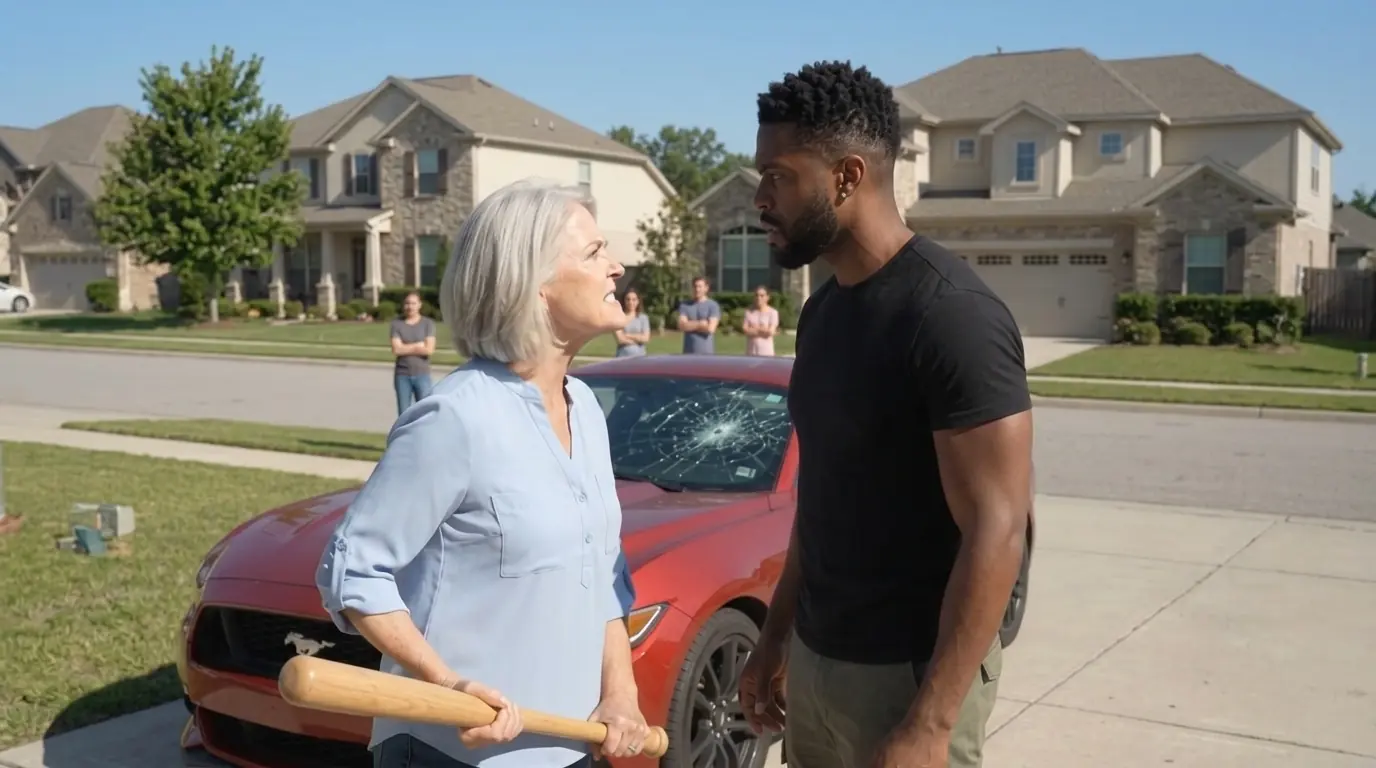
Adrian liked quiet. After fourteen years in the military, including deployments that had taught him the difference between silence and safety, he wanted a place where mornings began with coffee instead of radios. At forty-one, he had enough money saved to buy a house without financing, enough scars to stop caring what strangers thought of him, and enough experience to understand that peace was something you built carefully. Hawthorne Ridge seemed like a good place to try.
His house sat at the end of a gently curving cul-de-sac outside Raleigh, North Carolina. Two stories, gray brick, black shutters, three-car garage, small fenced backyard with a line of pine trees behind it. Adrian paid cash after selling his stake in a cybersecurity company he had started with two former service members. He did not advertise that fact because he had never understood why adults felt obligated to explain what they could afford.
Most neighbors welcomed him politely.
A retired teacher named Carl Bennett waved from two doors down. A young couple across the corner brought peach cobbler the weekend Adrian moved in. The father of a teenage boy asked whether Adrian knew anything about weight training after seeing him carry a refrigerator dolly alone. Adrian figured the neighborhood might actually work.
Then there was Vivian Price.
Vivian lived directly across the street in a white colonial with blue shutters and enough landscaping lights to guide small aircraft. She was fifty-three, chair of Hawthorne Ridge’s architectural committee, unofficial ruler of the neighborhood Facebook group, and the kind of woman who said “standards” when she meant control. Her husband, Gordon, owned several auto parts stores and spoke most often after drinking.
Vivian introduced herself on Adrian’s third day.
She crossed the street while he was unloading tools from his truck and stopped at the end of his driveway without stepping onto it. Her smile was polished, but her eyes moved over him in a way that felt more like inspection. Adrian had been looked at that way in stores, hotels, airports, and places where somebody decided his presence needed explaining before his behavior did.
“You’re the new owner?”
“That’s me.”
“Adrian Cole?”
“Yes, ma’am.”
Vivian’s smile tightened at the ma’am.
“We’re very particular here.”
Adrian glanced around.
“I noticed the grass.”
She did not laugh.
“Hawthorne Ridge has rules.”
“Good thing I can read.”
That was the first time she disliked him openly.
The HOA notices started two weeks later.
His trash bins remained visible until eight fifteen one morning instead of seven thirty.
A shrub beside the porch extended approximately four inches over what Vivian called the preferred line.
His garage door stayed open while he cleaned shelves one Saturday afternoon.
Then came a letter regarding “excessive exterior lighting” because Adrian installed a motion sensor near the side gate.
Each notice carried Vivian’s name somewhere at the bottom.
Adrian responded to every one calmly.
He moved the trash cans.
Trimmed the shrub.
Closed the garage when he finished.
Adjusted the sensor angle.
He refused to give her the conflict she seemed to be searching for.
That only made her more interested.
One evening, Adrian was washing his truck when Vivian stopped beside the sidewalk.
“You know some people find those cameras uncomfortable.”
Adrian looked toward the security camera above his garage.
“It watches my driveway.”
“It catches part of the street.”
“Public street.”
Vivian folded her arms.
“People don’t like feeling watched.”
Adrian shut off the hose.
“Funny.”
Her eyebrows lifted.
“What is?”
“I’ve felt watched since the day I moved in.”
She understood.
Neither needed to explain.
Vivian left without another word.
For several months, things remained mostly irritating rather than dangerous.
Anonymous noise complaints appeared whenever Adrian had friends over, even when everyone was inside before ten. Somebody reported his work van as a commercial vehicle despite three other contractors in the neighborhood parking identical vans overnight. His mailbox was mysteriously knocked sideways twice.
Adrian installed another camera.
The incidents stopped.
Vivian hated the cameras more after that.
Then, in early June, Adrian bought the car.
It was a metallic blue Chevrolet Corvette Z06 with black wheels, a car he had wanted since seeing one on a magazine cover during his second deployment. He waited years until buying it felt like enjoyment instead of proving something. When he finally drove it home, the engine rolled down the hill with a deep mechanical growl that made several kids come outside.
Adrian smiled all the way into the driveway.
He parked, shut the engine off, and sat behind the wheel for a moment.
No desert.
No helmet.
No supervisor.
No debt.
Just his driveway.
His car.
His life.
Then Vivian’s front door opened.
Adrian saw her reflection in the side mirror before she spoke.
She stood on her porch with both arms crossed.
He climbed out.
“Afternoon.”
Vivian stared at the Corvette.
“That is incredibly loud.”
“It gets quieter when the engine stops.”
“I could hear it from inside my kitchen.”
Adrian looked at her house.
“You live across the street.”
“That’s exactly my point.”
He opened the garage.
Vivian descended her steps.
“This neighborhood has noise rules.”
“So check the meter.”
Her face hardened.
“You think everything is a joke.”
“No.”
Adrian placed the keys on a shelf.
“I think my car being audible for twelve seconds isn’t a crisis.”
She crossed to the edge of the road.
“People move here because we value peace.”
Adrian leaned against the garage frame.
“So did I.”
“You don’t act like it.”
He looked at her.
“What does that mean?”
Vivian gestured toward the car.
“That.”
Adrian waited.
She continued.
“Flashy cars. Cameras everywhere. Friends coming over at all hours.”
“My friends were here twice.”
“Some of us care about the character of this community.”
There it was.
Not yet the sentence.
But close.
Adrian studied her.
“What character?”
Vivian’s mouth tightened.
“You know what I mean.”
“No.”
He folded his arms.
“I’d like to hear you explain it.”
She glanced toward neighboring houses.
Curtains had begun moving.
Nobody came outside.
Vivian lowered her voice.
“This used to be a quiet, established neighborhood.”
“Still looks established.”
“Before people started treating it like a place to show off.”
Adrian nodded toward the Corvette.
“You think I bought that for you?”
Her cheeks colored.
“I think people who need attention usually find expensive ways to ask for it.”
Adrian smiled.
“I bought it because I wanted it.”
“How nice.”
“It is.”
Vivian stared at him.
“You always have an answer.”
“I usually know why I’m doing things.”
She took another step toward the street.
“People like you come into communities like this and think money means you can behave however you want.”
Adrian’s expression changed.
Not much.
Enough.
“People like me?”
Vivian hesitated.
The second lasted too long.
Adrian pushed off the garage frame.
“Go ahead.”
“I mean people who are new.”
“No.”
His voice remained calm.
“That isn’t what you meant.”
Vivian’s jaw tightened.
“You’re looking for racism because it gives you an excuse to be disrespectful.”
“I haven’t accused you of anything.”
“You implied it.”
“You did the work yourself.”
Her face flushed.
“You do not belong here with that attitude.”
The sentence landed between them.
Adrian looked at the house he had paid for.
Then at the woman standing across from it.
“Actually, title company says I do.”
Vivian’s eyes narrowed.
“You know exactly what I mean.”
“That’s the problem.”
Adrian turned toward his garage.
Vivian called after him.
“You think money makes you equal to people who built this neighborhood.”
He stopped.
Then looked back.
“I don’t need money to be equal to you.”
That was the moment Vivian stopped seeing him as a neighbor she disliked.
He became an enemy.
The next morning, Adrian received three HOA citations.
One involved the Corvette.
The rules contained nothing prohibiting sports cars, but the notice claimed the vehicle created an “aesthetic disturbance” when visible from the street.
Adrian read it twice.
Then laughed.
He forwarded it to the HOA management company.
They withdrew it within six hours.
Vivian did not appreciate being overruled.
Three days later, she marched across the street while Adrian was replacing shelves inside the garage.
He heard her shoes before seeing her.
Sharp steps.
Fast.
Angry.
She stopped halfway up his driveway.
“You complained about me.”
Adrian kept tightening a bracket.
“I asked whether that citation existed in the rules.”
“You embarrassed me in front of the management company.”
“You embarrassed yourself.”
Vivian took another step.
“You think because you can pay cash for a house and buy cars like that, you understand this community?”
Adrian set down the wrench.
“Get off my property.”
She blinked.
“What?”
“You’re on my driveway.”
“I’m speaking to you.”
“You can do it from the sidewalk.”
Her eyes hardened.
“This is exactly the attitude everyone is talking about.”
“Who’s everyone?”
She hesitated.
Adrian nodded.
“Thought so.”
Vivian moved closer to the Corvette.
The garage door was open, and sunlight rolled across the blue paint.
She pointed at it.
“You brought this thing in here knowing it would provoke people.”
Adrian stared at her.
“It’s a car.”
“It represents exactly the problem.”
“What problem?”
“You.”
The word came out before she could soften it.
They looked at each other.
Adrian spoke quietly.
“You should leave.”
Vivian laughed.
“Or what?”
“I call the police for trespassing.”
“You would call police on me?”
“You’re on my property after being told to leave.”
The irony almost amused him.
Vivian stepped toward the Corvette.
“You want drama so badly?”
Adrian said nothing.
Then she kicked the front tire.
Not hard enough to damage anything.
Hard enough to make the intention clear.
Adrian straightened.
“Don’t touch my car.”
Vivian looked at him.
Then slapped her palm against the hood.
Once.
Twice.
“Vivian.”
Third time.
Adrian moved.
He caught her wrist before the fourth strike and pushed her backward one step.
Not hard.
Not violent.
Just enough to create space.
Vivian lost her footing anyway.
She dropped onto the driveway and screamed.
The sound was immediate.
Huge.
Designed.
“My arm!”
Adrian released her instantly.
His hands went up.
Vivian rolled onto one hip and cradled her wrist.
“You assaulted me!”
“No.”
“You pushed me!”
“You were hitting my car.”
“You attacked me!”
Adrian looked toward the neighboring houses.
Curtains moved.
A door opened.
Then Vivian screamed a name.
“Gordon!”
Her husband came outside before she called twice.
He was fifty-seven, thick through the chest, red-faced from either alcohol or blood pressure, wearing jeans and a golf shirt stretched tightly over his stomach. He saw Vivian on the ground.
Then Adrian.
His entire body changed.
“What did you do?”
Adrian stayed where he was.
“She came onto my property and started hitting my car.”
Gordon marched across the street.
“You put your hands on my wife?”
“She wouldn’t stop.”
Gordon stepped onto Adrian’s driveway.
Vivian sobbed behind him.
“He shoved me.”
Adrian looked at her.
“You walked here.”
She ignored him.
Gordon came within several feet.
“You think you can hurt women?”
Adrian’s voice stayed even.
“Your wife isn’t hurt.”
Vivian gasped dramatically.
Gordon pointed a finger.
“Watch your mouth.”
“Get off my property.”
“You don’t give orders to me.”
“This is my driveway.”
Gordon moved closer.
“Not for long if you keep acting like this.”
Adrian noticed the beer on his breath.
He also noticed Gordon’s right hand closing repeatedly.
Fist.
Open.
Fist.
Old habits returned.
Adrian shifted his stance without thinking.
Gordon saw it.
Something in him interpreted readiness as challenge.
“You think that military background scares me?”
Adrian said nothing.
Gordon laughed.
“Vivian told me about you.”
“I’m sure.”
“Walking around like you’re better than everybody.”
“No.”
Adrian looked toward Vivian.
“I walk around like nobody here owns me.”
Gordon’s face tightened.
“That’s your problem.”
“What is?”
“You don’t know when to back down.”
Adrian almost smiled.
“You came to my house.”
Gordon stepped close enough that Adrian could smell the beer more clearly.
“You should have kept your head down from the start.”
Adrian’s eyes hardened.
“Say that again.”
Gordon stared.
Vivian spoke from behind him.
“He thinks everybody is racist.”
Adrian looked at her.
“I think you are.”
She went silent.
Gordon shoved one finger against Adrian’s chest.
Adrian glanced down.
Then back up.
“Don’t touch me.”
“What are you going to do?”
Adrian stepped backward.
Not because he was afraid.
Because the nearest security camera had a wider angle if Gordon moved another three feet.
“Nothing if you leave.”
Gordon laughed.
“Coward.”
Adrian held both hands loosely at his sides.
“I’m not throwing the first punch.”
That sentence enraged Gordon.
Maybe because it sounded confident.
Maybe because it suggested Adrian already knew there would be one.
Gordon swung.
The punch was wide and ugly.