The horse screamed before Sadie ever saw it, a sound sharp and terrified tearing through a storm that had already swallowed the road, the fence line, every familiar shape of her father's ranch. No rider with sense would be out in weather like this. She went anyway. Late November 1881, Judith Basin, Montana. Sarah Sadie Harland was 29 and alone at Harland Ranch.
Her father Wesley had died in September and she'd left his coat on its peg, his mug on the shelf, his auger on the bench, his chair angled toward the stove, exactly as he'd left them, as if some part of her still expected him to walk back through that door before supper. The cattle huddled behind the barn wall. The snow wasn't falling anymore. It was being flattened and swept across the ground by wind ripping off the northwest ridge. Sadie had already tightened the shutters, twisted wool into the cold gap along the sill, banked the stove.
The spring box had been slowing for days and the cattle still needed water. She was turning back toward the cabin after checking the trough when the horse cried out again beyond the fence. She took the lantern from its hook, looped a rope over one shoulder, and pushed back into the storm. The mare stood beyond the cottonwood fence, reins dragging through the snow, pressed against the rails. She could have run.
She hadn't. A man hung sideways from the saddle, one boot trapped in the stirrup, his left shoulder sagging at a bad angle, blood dried black along one trouser leg. Sadie touched his neck. A pulse answered, weak but steady. She couldn't carry him.
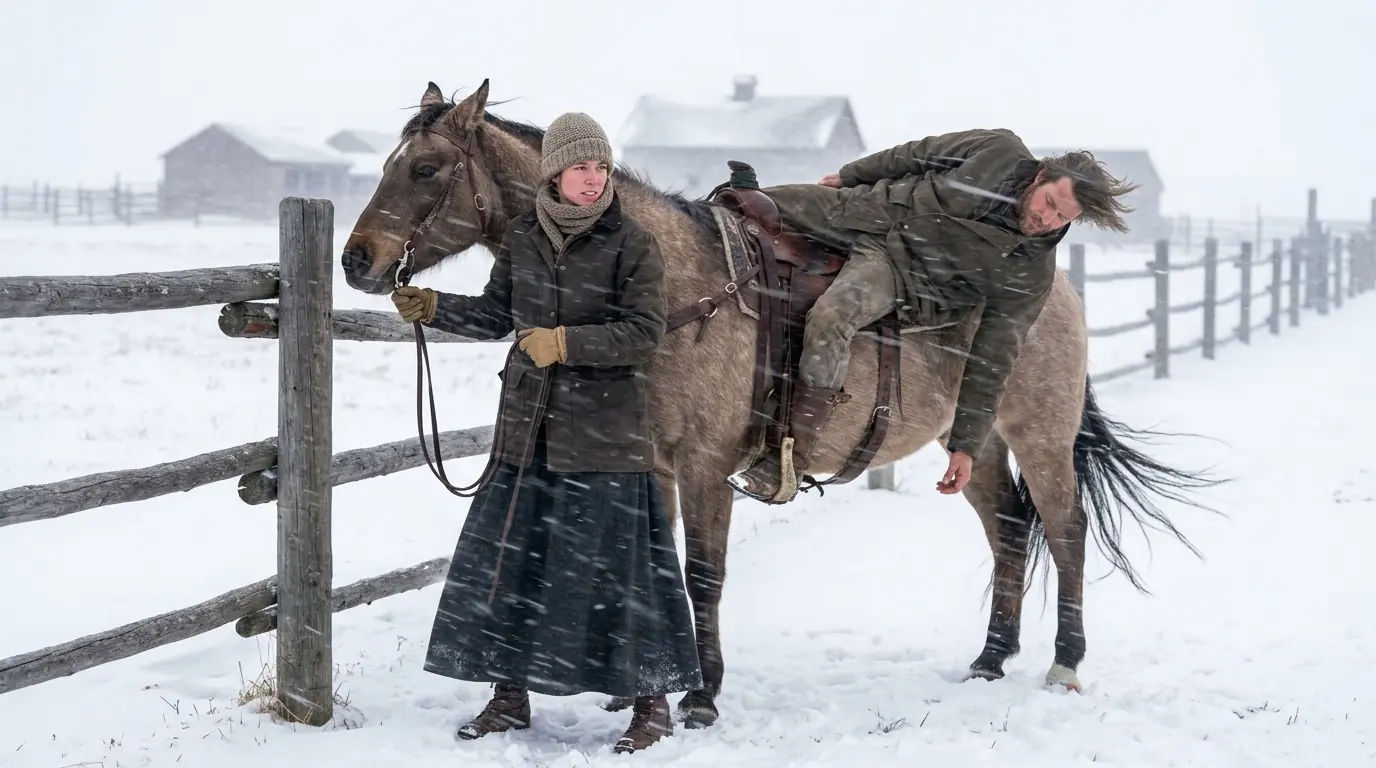
She tied the rope around his chest, passed it over the saddle horn, took some of his weight, freed the trapped boot. He slid down slowly instead of falling. She spread an empty feed sack over folded canvas, rolled him onto the porch, dragging him toward the porch, the mare following as far as the gate. Inside, firelight reached across the doorway. Fresh blood had soaked through his trouser leg.
The cold was no longer the greatest danger. Sadie cut the frozen cloth away from his thigh. The wound was deep, but the blood didn't pulse. That gave her time. She boiled water, let it cool, washed away the dirt and dried blood without digging into the torn flesh.
Clean cloth over the wound, pressed until the bleeding slowed, tied firmly in place. His shoulder worried her next. It sat wrong, and forcing it back might do more harm than leaving it. She folded a strip of wool into a sling and bound his arm against his body. She wrapped heated stones in cloth, set them near his chest and sides.
When he stirred enough to swallow, she gave him warm broth, a little at a time. Only then did she pull her coat back on. The mare was waiting in the barn. Sadie removed the saddle, ran her hands down its legs, found no serious injury, pushed hay into the manger. Before dawn, the stranger opened his eyes.
He saw the barn shape through the window. His face loosened. He breathed out and closed his eyes again. Sadie stayed beside him until his breathing settled. Then she looked across the stove.
Wesley's chair stood empty, turned toward the door, exactly where she'd left it after the funeral. For the first time since September, another man was sleeping under her father's roof. The storm held for 3 days. By the second morning, the stranger could stay awake long enough to speak. His name was Elias Boone, 34, a horse buyer and breaker who'd spent years moving between ranches, freight camps, and stockyards.
He offered little more unless Sadie asked. She answered the same way. Elias didn't need many questions to understand the cabin. One plate remained apart from the others. Wesley's saddle gathered dust in the barn.
The ranch ledger stopped for several days after September. When Sadie opened it to count winter expenses, he caught one figure before she closed the book. $3,160. The haystack told him the rest. He'd also noticed the loose brace on the north barn wall, the cold slipping through the northwest sill, the broken latch on the feed chest. His left arm was useless, but his right still worked.
He found a scrap of hardwood and carved a new catch with Sadie's knife. When he reached towards Wesley's auger on the bench, his hand stopped. May I? Sadie looked at the tool, then at him. She nodded.
That evening, she served supper without mentioning the repair. Elias found more broth in his bowl than he had the night before. He noticed that, too. Outside, the wind kept pressing at the walls. Inside, neither of them found much reason to fill the silence.
The basin stayed closed beneath snow, and Elias recovered by degrees. His shoulder still wouldn't bear weight, so he worked around it, replacing the bent lantern hook near the door, shaving the cracked edge off of Sadie's axe handle, whittling a wooden peg for a loose harness strap, adjusting the door latch until it caught without being lifted. Sadie spent those hours mending tack and dividing the remaining hay by animal and week. They rarely spoke unless the work required it. At night, they sat on opposite sides of the stove.
One evening, Elias looked through the window towards the barn. Why does it sit crooked to the cabin? It isn't crooked. Sadie set down the strap she was stitching. Wesley followed the slope when he built it.
The northwest ridge complicates everything. Wind might seem to come straight across the basin, but snow shows where the air slows, curls, drops what it's carrying. She pointed toward a pale ridge forming beyond the corral. Snow tells more truth than wind does. Elias said nothing.
He rose, crossed to the window, watched the drifting line, studied where snow gathered behind the fence, and where ground stayed bare. Then he returned to his chair and picked up the wood he'd been shaping. Sadie went back to her stitching. The stove settled between them. The silence inside the cabin didn't feel like something that needed fixing.
On the fourth morning, the wind dropped. Blue showed between broken clouds. Elias tested his shoulder before breakfast. It still hurt, but he could hold the reins. The pass may look open before it is, Sadie said.
I know. He had horses promised along the Fort Benton route. A buyer was waiting, and waiting men eventually bought elsewhere. Sadie understood that kind of obligation. She didn't ask him to stay.
Elias saddled the mare slowly, mostly with his right hand. Before mounting, he crossed to the barn and drove a second spike beside the loose north brace. "It'll hold for now. That brace needs more than one nail. "I know.
There was nothing else to settle. He mounted. The mare stepped through the gate and turned toward the basin road. Saudie stood in the doorway until horse and rider became a dark shape against the snow. He never looked back.
She went inside before the shape disappeared. Later, checking the barn, she found the hammer he'd used returned to the exact spot beside the auger where Wesley always kept it. Saudie stood there a moment. Then she picked it up and moved it to the other end of the bench. The ranch went quiet again.
Nothing important had changed. Cattle to feed, ice to break, wood to cut, fences buried beneath snow. And yet, Elias had left small changes behind him. The lantern stayed straight on its new hook. The axe handle no longer rubbed Saudie's palm raw.
The feed chest closed with one push. A harness strap that used to fall behind the bench now hung from a wooden peg. Each repair saved only seconds. Together, they made his absence harder to ignore. One evening, lifting the stew pot, Saudie filled a bowl without thinking.
She reached for another. Filled that one, too. Her hand stopped. Steam rose between the two bowls while the fire cracked behind her. She poured the second serving back into the pot, washed the bowl, dried it, placed it on the shelf above the others.
Morning came cold. Work answered it. Ice from the trough, the thin flow from the spring box. The haystack measured again, the ration reduced slightly. Deadfall down from the cottonwoods by rope, pregnant cows checked twice a day.
Every new drift near the barn approach cut down before the wind packed it hard. Her gloves split at the fingers. The north brace creaked whenever the wind strengthened. Winter had no interest in who had stayed or who had gone. January was hard.
February was worse. Cold settled over Black Alder Creek and stayed there. One calf went down trembling and Sadie moved it to the corner with the least draft, spread dry hay beneath it, covered its back with an old wool blanket. That night the north wall groaned. The brace Elias had warned about had loosened again.
She cut a cottonwood pole, set it diagonally against the frame, drove an iron spike home. Rough work. It only had to hold. After midnight, the wind shifted cutting cold across the calf's corner. She hung a reed mat between two posts blocking the low draft while leaving an opening above.