By eight-thirty on Wednesday morning, almost everyone at Iron Ridge had stopped noticing Walter Hale.
That was exactly what he wanted.
For five days, the sixty-eight-year-old man had pushed a gray maintenance cart through the industrial training center wearing navy coveralls, scratched safety glasses, and a faded employee badge identifying him simply as:
WALTER H.
FACILITIES SUPPORT
He emptied trash.
Changed damaged light bulbs.
Tightened cabinet hinges.
Replaced frayed extension cords.
Swept rubber pellets from the training floor.
Carried boxes nobody else wanted to carry.
People spoke around him as though he were furniture.
That was useful.
Very useful.
Iron Ridge was one of the most respected industrial emergency-response training centers in Colorado.
Private companies sent employees there to learn confined-space rescue, fall protection, machinery isolation, emergency evacuation, industrial first aid, and high-risk equipment procedures.
The facility had contracts with mines, power companies, construction firms, shipping companies, and several large manufacturing corporations.
Its brochures showed smiling instructors in spotless gear.
Its website promised:
DISCIPLINE. SAFETY. PROFESSIONAL EXCELLENCE.
Walter had spent the week discovering those three words did not always describe the same place.
The first day, he watched an instructor ignore a trainee who complained that a harness buckle would not close properly.
The instructor eventually replaced it only after another trainee pointed out the same defect.
The second day, Walter found a damaged electrical lead coiled behind a cabinet after a maintenance request had supposedly been completed.
The third day, he overheard two trainers joking about a participant who had stopped a drill after feeling dizzy.
“Guy needed attention.”
“Some people aren't built for pressure.”
The fourth day brought something more troubling.
Walter watched senior instructor Derek Vaughn review a training report with a younger instructor.
The original note read:
Exercise stopped after participant reported loose anchor connection.
Derek crossed it out.
He replaced it with:
Exercise paused due participant uncertainty regarding correctly secured equipment.
Walter kept sweeping.
The younger instructor asked:
“Wasn't the anchor actually loose?”
Derek answered:
“Maintenance tightened it.”
“After the stop.”
“Exactly. Problem solved.”
“But he was right to stop.”
Derek looked at him.
Then:
“You want every nervous employee shutting down an exercise because something feels wrong?”
The younger instructor did not answer.
Derek continued:
“Write the report so it reflects the training issue.”
Walter had heard enough.
Not to make a final conclusion.
But enough to continue looking.
He was not actually a custodian.
Walter Hale was a senior field inspector assigned to the Colorado Workplace Training Standards Bureau, a fictional civilian oversight agency responsible for auditing private high-risk training facilities.
Iron Ridge's annual inspection had originally been scheduled for October.
Then three anonymous complaints arrived within six weeks.
One claimed instructors punished participants who called safety stops.
Another described damaged equipment returning to service before formal inspection.
The third alleged that trainee injury reports were being rewritten to make instructors look less responsible.
None included enough detail to justify immediate enforcement.
So Walter proposed something unusual.
A disguised observational audit.
The bureau approved.
Iron Ridge's executive director, Daniel Cross, knew.
Only Daniel.
Not department heads.
Not instructors.
Not maintenance staff.
Walter was given cover credentials and placed into the facilities schedule.
Five days.
Observe normal behavior.
Document.
Do not interfere unless immediate danger existed.
Walter preferred that method.
People were very careful when an inspector carried a clipboard.
They became far more honest when they believed the inspector was changing light bulbs.
The one person who complicated the plan was Mara Ellison.
Walter noticed her Tuesday afternoon.
Thirty-one years old.
Brown hair tied into a low ponytail.
Brown work jacket.
Dark gray cargo trousers.
Tan boots.
She was one of Iron Ridge's newer instructors, transferred six months earlier from a manufacturing-safety program in Oregon.
She taught equipment stabilization, emergency movement, and practical hazard assessment.
Walter first saw her arguing with Derek beside a storage rack.
Not shouting.
That made it more interesting.
Derek held a yellow inspection tag.
Mara held a cracked lifting hook.
She said:
“This doesn't go back into rotation.”
Derek replied:
“The crack is surface scoring.”
“No.”
“You did magnetic testing?”
“No.”
“Then you don't know.”
Mara looked at him.
“Exactly.”
Derek frowned.
“What?”
“If we don't know, it stays out until inspected.”
“We need it tomorrow.”
“Then use another.”
“Every other hook is assigned.”
“Then change the drill.”
Derek laughed.
“You've been here six months.”
Mara's expression remained calm.
“The metal doesn't know how long I've worked here.”
Walter nearly smiled.
Derek did not.
He leaned closer.
“You think every uncertainty is a crisis.”
“No.”
“I think unknown load-bearing damage is an unknown.”
“That is what inspection is for.”
Derek took the hook.
Mara grabbed the red out-of-service tag before he could remove it.
“Don't.”
His face hardened.
“Excuse me?”
“Do not return that to equipment storage.”
A few people nearby noticed.
Derek hated audiences when he was not controlling them.
Walter had already learned that.
Derek looked around.
Then back to Mara.
“Fine.”
He dropped the hook onto the maintenance cart.
Walter's cart.
“Old man.”
Walter looked up.
“Get that checked.”
Walter nodded.
“Yes, sir.”
Derek walked away.
Mara stayed.
She looked at Walter.
“Sorry.”
“For?”
“He talks to everybody like that when he's angry.”
Walter smiled faintly.
“Doesn't bother me.”
“It bothers me.”
Interesting.
She picked up the hook.
Placed it carefully in a red maintenance bin.
Then wrote:
DO NOT RETURN TO SERVICE BEFORE FORMAL INSPECTION.
Signed:
M. ELLISON
Walter watched.
Mara noticed.
“What?”
“Nothing.”
She smiled.
“You're staring.”
“Thinking.”
“About?”
“Whether people read red tags around here.”
Mara laughed.
“Not as often as they should.”
Then she walked away.
Walter wrote her name in his private notebook that evening.
Not because she had done something heroic.
Because she had protected a process when she believed nobody important was watching.
Wednesday morning began with lighting maintenance in Warehouse Four.
A fluorescent fixture above the equipment demonstration lane had been flickering for two days.
Facilities manager asked Walter to inspect it.
Perfect cover.
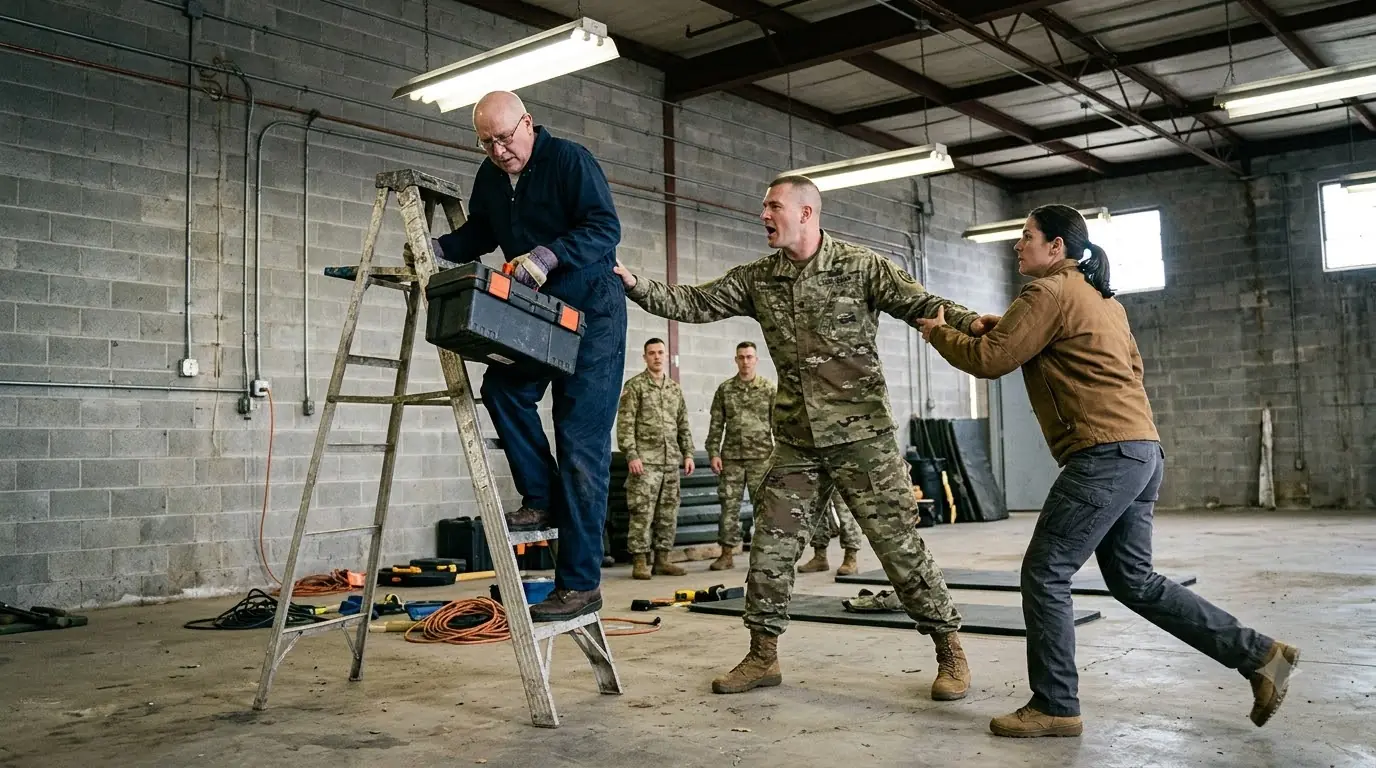
He wheeled out an aluminum step ladder.
Toolbox.
Replacement ballast.
Wire tester.
At 8:41, Warehouse Four held eighteen trainees and four instructors.
Derek Vaughn led the session.
Mara stood at the side reviewing equipment checklists.
Two junior instructors prepared cases.
Walter positioned the ladder beneath the light.
He checked power isolation.
Set ladder feet.
Climbed.
The fixture sat nearly twelve feet above the concrete.
Walter had repaired more complicated things in real facilities inspections, but he moved deliberately.
He had no interest in creating his own accident.
Below, Derek explained load transfer.
His voice carried.
“When something fails, hesitation gets people hurt.”
Walter removed the light cover.
Derek continued:
“You make decisions.”
“You commit.”
“You finish the movement.”
One trainee asked:
“What if the equipment condition changes halfway?”
“Then adjust.”
“What if you're unsure?”
Derek looked at him.
“Uncertainty is not an emergency.”
Walter's hands stopped for half a second.
That phrase.
Again.
Mara heard too.
She looked up from her checklist.
Derek noticed.
“What?”
Mara shook her head.
“Nothing.”
“Say it.”
She looked toward the trainees.
“Uncertainty can be enough to pause if the uncertainty involves a critical safety condition.”
Derek's expression hardened.
“That isn't what we're teaching.”
“It is written in the stop-work policy.”
Derek laughed.
“Here we go.”
Several trainees looked down.
They had seen these arguments before.
Mara said:
“You asked.”
“No.”
“I asked if you had something to say.”
“Not for a policy lecture.”
Walter continued working.
Listening.
Derek turned back to the group.
“Real emergencies don't wait for everybody to feel comfortable.”
Mara answered:
“Stop-work authority isn't about comfort.”
Derek spun.
“Ellison.”
“Enough.”
She stopped.
Not because she agreed.
Because the trainees no longer benefited from the argument.
Walter respected that too.
Five minutes later, the fixture bracket shifted.
He reached toward it.
A small metal washer slipped.
It fell.
Ping.
Concrete.
Derek looked up.
“What are you doing?”
Walter said:
“Replacing the ballast.”
“Now?”
“Yes.”
“We're running a class.”
“Facilities request.”
Derek stared.
“Can you finish later?”
Walter looked at the open fixture.