I.
The last passenger coach of the Kittredge Western's Number Four ran warm in the morning, and it smelled of coal smoke, lemon oil, and the oranges a drummer had been peeling since Pueblo.
Sunlight came through the right-hand windows in long slanted bars, and the dust in it turned slowly, gold and unhurried, as if the car were a church and the dust had nowhere else to be. Walnut paneling gleamed between the windows.
Brass sconces with fluted glass shades trembled on their brackets with every joint in the rail. The seats were a red so deep it was nearly black in the shadows, velvet worn pale on the armrests where twenty years of elbows had rested.
Outside, the prairie went on in tawny folds toward a line of mountains so far off they looked painted on the sky, their peaks already white though it was only the first week of October.
Gabriel Tolliver sat with his back to the forward bulkhead so he could see the rear door. He had chosen the seat in Pueblo at a quarter past six, before the car filled, and he had not moved from it except once, at Colorado Springs, to step onto the platform and watch a brakeman walk the length of the train and look, for a long moment, at the couplings behind the last coach. Then Gabriel had come back in, taken off his hat, set it on the seat beside him, and opened a book he did not read.
He was thirty-eight years old. He wore a long dark-grey wool overcoat unbuttoned over a dark vest, a white shirt starched that morning by a laundress in Pueblo who had charged him double, and a dark cravat tied without vanity. A silver watch chain crossed his vest. He had a soldier's stillness, which is not the same as calm, and a habit of looking at a thing until it told him something.
Across the aisle sat a young woman in magenta.
She was perhaps twenty-four, pale, with dark hair pinned up under a hat of the same vivid berry color as her dress, a curl of dyed feather sweeping back from its brim. The dress was velvet-trimmed at the cuffs and collar, with a column of small covered buttons down the bodice, and she wore white kid gloves that she had not removed even to eat the roll she had bought at the depot. Her eyes, when they lifted from the window, were a startling light blue. She had looked at Gabriel exactly once since Pueblo, a frank, measuring look that a lady was not supposed to give a colored man on a public train, and then she had gone back to the mountains.
Behind her, an older man with a grey beard and a bowler hat dozed against the window with an orange peel in his lap. Two rows behind him, a woman of sixty or so in a brown dress with a jet brooch at her throat knitted something grey and long.
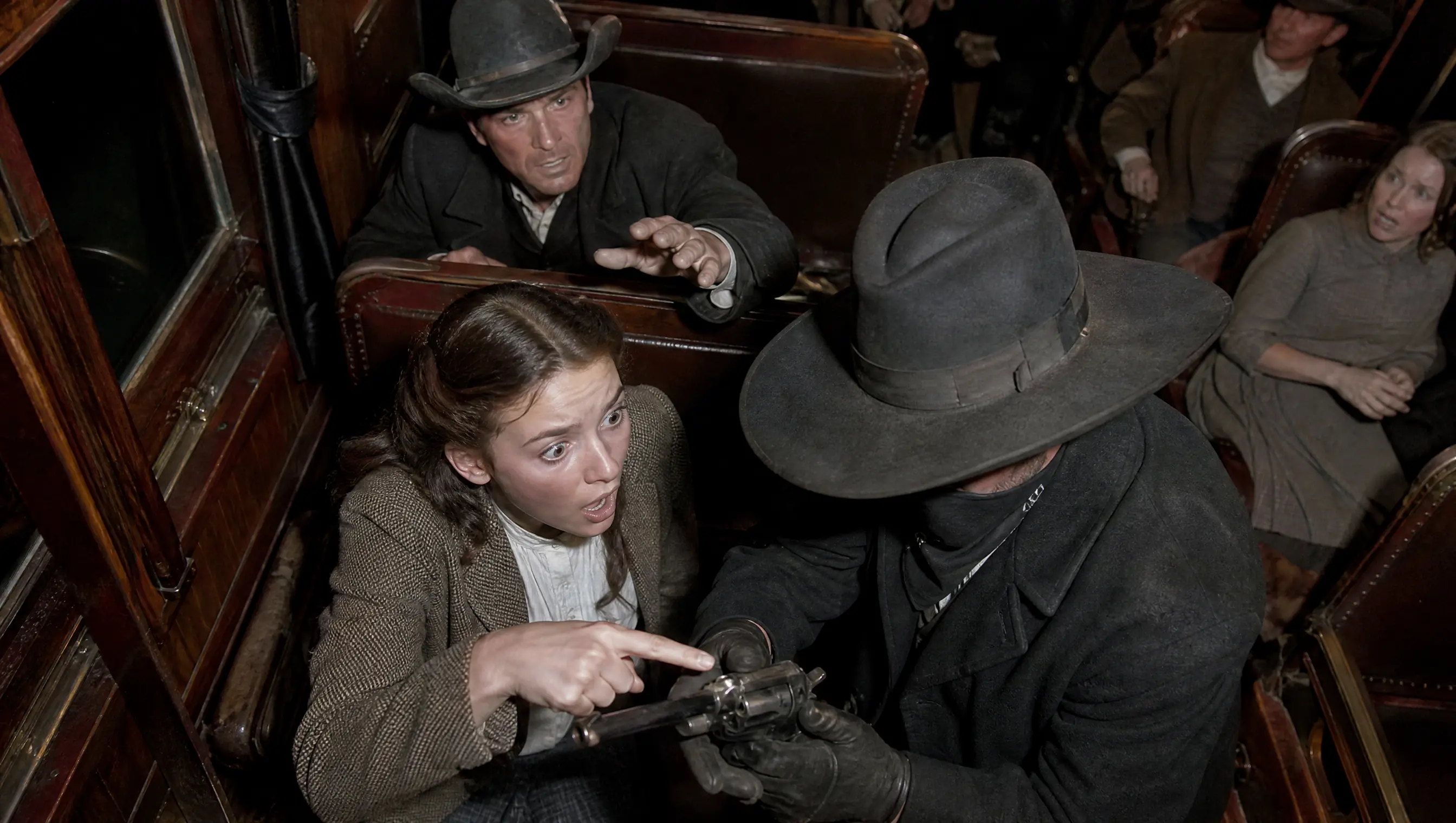
At twenty minutes to ten the rear door banged open.
Wind came in first, loud and full of cinders, and then two men. The first wore a brown wide-brimmed hat and a tan duster that swung around his boots, a dark shirt under it, a brown bandana pulled up over his nose. Above the bandana his eyes were blue and very steady. He held a dark revolver at the level of his belt. The second man was dressed nearly the same and stood behind him in the doorway with a shotgun, his shoulders filling the frame.
"Hands where I can see 'em."
The drummer woke with a sound like a hiccup and put both hands up so fast the orange peel flew. The woman in brown dropped her knitting and lifted her hands to the height of her chin, her mouth open and soundless. Two cattlemen at the front of the car raised theirs. A boy of ten, traveling with no one Gabriel could see, raised his and looked thrilled.