There were moments in life that announced themselves before they arrived: a door opened, a letter appeared upon a silver tray, a carriage stopped unexpectedly before the house. And then there were moments that entered quietly, wearing the familiar face of someone you loved, and changed everything before you understood that anything had changed at all.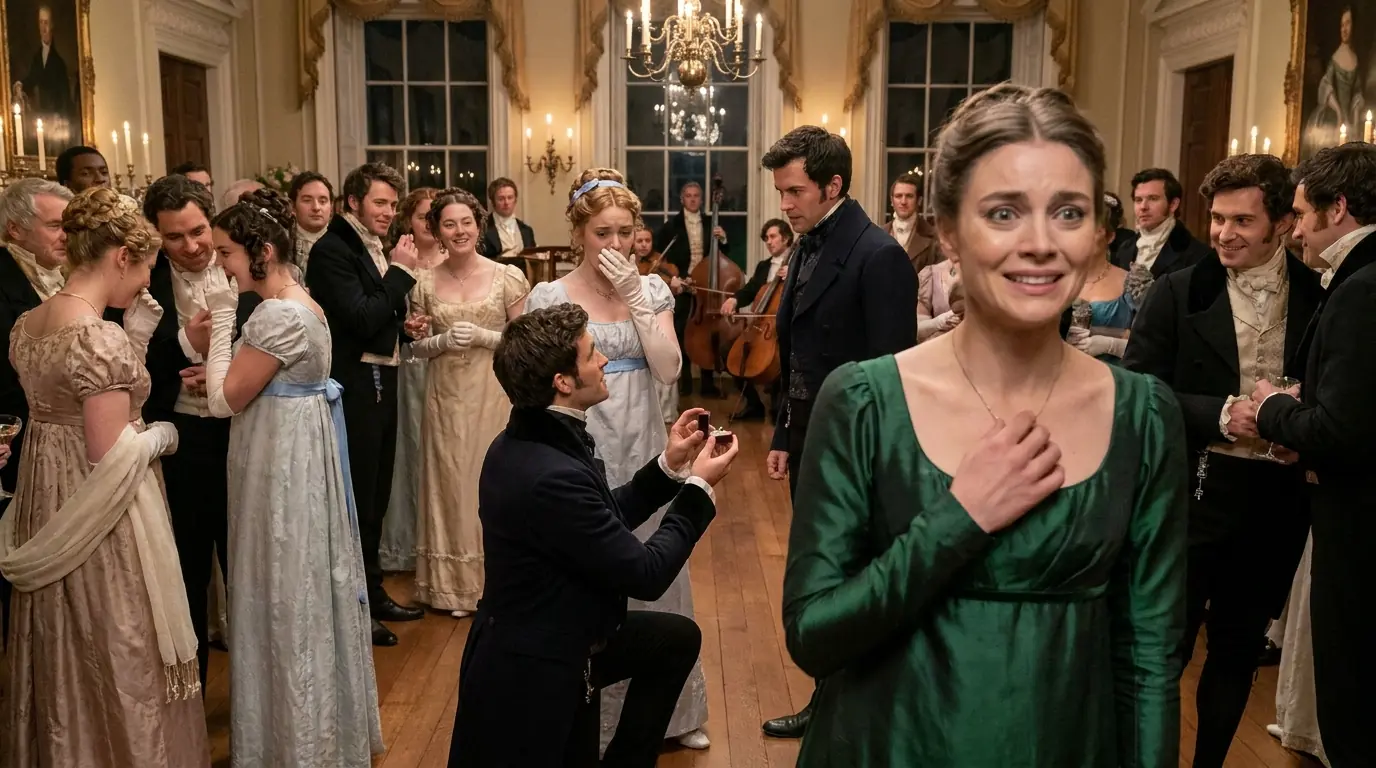
For Caroline Everly, it began with a ring she was never meant to wear.
Three evenings before the 1st of December, Samuel Hartley leaned across the small table between them and said with an expression so badly arranged into casualness that Caroline nearly laughed, "I have bought something."
They were sitting in the morning room at Everly Park, although morning had disappeared more than an hour earlier. Rain tapped softly against the tall windows. The fire had burned down to a comfortable red glow, and Caroline's mother was occupied at the writing desk near the opposite wall, answering an invitation with the grave attention Lady Everly generally reserved for correspondence she intended to decline.
Samuel had been part of Caroline's life for so long that no one thought anything of finding him there. He had grown up six miles away. He had fallen out of the old cedar tree at Everly Park when he was eleven and broken his wrist. At fifteen, he had taught Caroline to fish badly. At seventeen, she had taught him to dance considerably less badly. At twenty-three, when his father died and Samuel inherited Hartley Grange, along with more responsibility than he had expected, Caroline had been the person to whom he admitted that he was frightened.
Now he was thirty. Caroline was twenty-eight, and somewhere during the years between fishing badly and discussing estate accounts by the fire, she had fallen in love with him.
Samuel did not know. At least, Caroline did not think he knew; she had never told him. She had simply waited for the friendship between them to become what she had quietly convinced herself it was already becoming.
"What have you bought?" she asked.
Samuel looked toward Lady Everly. Caroline followed his glance. Her mother did not lift her head.
"You may whisper," Lady Everly said. "I shall hear you perfectly well regardless."
Samuel laughed. Caroline smiled. That was how it always was at Everly Park: people came through the door and became part of the household before they had quite decided whether they meant to.
"Well?" Caroline prompted.
Samuel leaned closer. "A ring."
For one extraordinary second, every sound in the room seemed to withdraw: the rain, the fire, the scratch of her mother's pen. Caroline looked at him. Samuel was smiling—not broadly; Samuel never smiled broadly when he was nervous. The left corner of his mouth lifted first, and his thumb moved absently over the edge of his cuff.
Caroline knew these things. She knew how he took his coffee. She knew he disliked being congratulated before something was accomplished. She knew that he lied badly, but concealed worry well. She knew that when he was truly pleased, he looked down before he looked up.
And now he was looking down at his hands, because he had bought a ring.
Caroline's heart began beating so hard she wondered whether her mother could hear that, too. "A ring?" she repeated.
Samuel nodded. "A rather expensive one."
"How ruinous."
"Enough that I have decided affection is an unnecessarily costly condition."
Caroline laughed, although she could barely feel herself doing it. "For whom?"
His eyes lifted. There was mischief in them. "That would rather destroy the point of a secret."
"You have never kept a secret successfully in your life."
"I have kept this one for—how long? Eleven days. An unprecedented achievement. I am proud of myself."
Caroline lowered her gaze to the teacup in her hands. Eleven days. Had he bought it after their ride to Milford? He had been strangely quiet that afternoon. Had he chosen it after asking her two weeks earlier whether she preferred emeralds to sapphires? Her breath caught.
He had asked her that. They had been discussing Cecilia Morton's new necklace at the time, and Samuel had said—what had he said? "Diamonds always seem rather cold to me." Caroline had replied that a stone was not responsible for the imagination of the man buying it. Then Samuel had asked which she would choose. She had said sapphire.
Dear God, was it a sapphire? She wanted to ask. She dared not.
Samuel sat back. "I intend to settle the matter soon."
"How soon?"
"Before Christmas."
Caroline looked at him. He smiled again. And because hope is sometimes most dangerous when it has been waiting patiently for years, Caroline did not ask the one question that would have saved her weeks of imagining: Is it for me?
Instead, she smiled. "I hope she says yes."
Samuel's expression softened. "So do I."
Lady Everly's pen stopped moving only for a moment. Then it continued. Caroline did not notice. She was already imagining Christmas differently: not with garlands or candles or snow, but with a name—Caroline Hartley. She had never allowed herself to think it quite so plainly before. Now she did, and once she had, it became remarkably difficult to stop.
Had Caroline Everly been a woman impressed by titles, she might have noticed Nicholas Ravenscroft much sooner. Most women did.
Nicholas, seventh Duke of Rivenhall, had spent the better part of fifteen years being noticed whether he wished it or not. At thirty-six, he had long ago accepted that entering a ballroom caused a small but measurable alteration in its atmosphere: mothers became alert, daughters became graceful, men with dubious investments became friendly, men with unmarried sisters became friendlier. Nicholas found the entire process exhausting.
He was not the wealthiest duke in England, though he was wealthy enough for the distinction to be academic. He was not the most politically ambitious, although his speeches in the Lords were listened to with an attentiveness that irritated several men who had been speaking there longer than he had been alive. And he was not, despite what was said about him, particularly frightening. He simply disliked fools.
Unfortunately, fools had proved abundant.
His reputation had grown from there. There were stories: Rivenhall had destroyed a man's career over breakfast; Rivenhall had once made a viscount apologize to his own footman; Rivenhall had refused the daughter of an earl so coldly that she married an Italian count within six months. The first story was inaccurate—it had happened after breakfast. The second was true. The third was nonsense: Lady Marianne had never wished to marry Nicholas, and the Italian count possessed a vineyard, excellent manners, and considerably more charm than Nicholas believed himself to have. She had done very well, but reputations were rarely interested in accuracy.
Caroline Everly, however, appeared barely interested in his reputation at all. That was not why Nicholas loved her; it was merely the first thing he noticed.
They had met properly two years earlier at a dinner in Bath. Nicholas remembered the evening because Lady Henshaw had spent most of it attempting to seat him beside her eldest daughter. Through a combination of strategic rearrangement and what Nicholas suspected was the deliberate removal of a place card, she succeeded.
Then Caroline Everly arrived late. Not fashionably late—actually late. A wheel had come loose from her parents' carriage. Her hair was imperfect. Her hem was damp. She entered apologizing to the hostess and laughing at something her father had said behind her. Nicholas looked at her. She did not look at him. That alone was unusual enough to earn a second glance.
Halfway through dinner, a gentleman began explaining agricultural rents to Sir William Everly with the confidence of a man who had never managed an acre. Caroline listened for several minutes.
Then she said pleasantly, "Mr. Compton, have you ever had a tenant?"
"No."
"Land?"
The gentleman hesitated. "My family has always maintained a house in town."
Caroline nodded. "How fortunate for agriculture."
Nicholas nearly choked on his wine. She heard him. Their eyes met across the table. For one instant, Caroline looked horrified that a duke had overheard her. Then she saw that he was trying not to laugh. Her own mouth twitched.
That was the beginning. Not love—Nicholas was too old to mistake amusement for destiny. But he noticed her afterward, and the more he noticed, the more difficult not noticing became.
Caroline was pretty, though London contained prettier women. She had warm brown hair that never remained entirely obedient to pins, clear gray-green eyes, and a face whose beauty changed with thought. When she was listening, she looked almost severe; when she laughed, she became younger; when she was angry, her left eyebrow lifted before she spoke. Nicholas learned that last detail after watching her demolish a gentleman's argument about female education.
He learned other things, too: she preferred walking to riding when she wanted to think; she read history with a pencil in her hand; she loved music, but played the pianoforte only adequately and knew it; she never pretended to admire something merely because everyone else did; she was kind to servants without performing kindness for observers; she loved her father loudly and her mother quietly; she had an unfortunate tendency to rescue injured birds; and she loved Samuel Hartley.
Nicholas discovered that part approximately six months after discovering that he loved her. It had been unpleasant. He had not required a confession; Caroline's face told him. Whenever Hartley entered a room, she noticed. Whenever Hartley spoke, some private attention inside her turned toward him.
Nicholas had watched them together often enough to understand the shape of their intimacy: old jokes, shared memories, comfort, history—all the things a title could not purchase.
So Nicholas did what pride initially told him was dignity and affection eventually taught him was respect: he stepped aside. Not literally—their social circles crossed too often for that. He spoke to Caroline when they met, danced with her occasionally, argued with her frequently, thought about her far more than was useful. But he did not court her. He had no intention of making her heart a contest between a duke and the man she already loved. If Caroline wanted Samuel Hartley, Nicholas would not place a coronet on the opposite side of the scales and ask her to weigh them.
And Caroline, infuriatingly, never seemed remotely tempted to do so herself. That made him love her more. It also made matters considerably worse.
The engagement was to happen at Ashford House. Caroline did not know that. What she knew was that Lady Ashford had invited forty people to an evening of cards, dancing, and music on the first Friday of December. Samuel would be there. Cecilia Morton would be there. Nicholas Ravenscroft would also be there, though this fact occupied approximately no space in Caroline's thoughts.
Cecilia arrived at Everly Park that afternoon to dress with her. They had been friends for seven years. Cecilia was twenty-seven, fair-haired, bright-eyed, and possessed of a temperament so naturally affectionate that strangers told her secrets in shops. Caroline loved her.
This mattered. Later, when she tried to understand why that evening had hurt so much, Caroline would be grateful that jealousy had not been given anywhere clean to land. Cecilia was not a rival; she was her friend. She had never knowingly taken anything from Caroline. She had simply been loved by the man Caroline loved. There was a difference.
But at 4:00 that afternoon, Caroline knew none of this. Cecilia stood before the mirror in Caroline's bedchamber while a maid adjusted the pale blue ribbon at her waist.
"Too much?" Cecilia asked.
Caroline looked up. "You have asked that four times, and you have not answered properly."
"You look beautiful."
Cecilia turned. "Beautiful enough for what?"
A faint blush appeared. Caroline noticed it, then misunderstood it completely. "Is someone expected to admire you tonight?"
Cecilia became very interested in her glove. "I should hope several people admire me, otherwise I have endured pins for nothing."
Caroline laughed. "You are impossible."
"So are you. Why are you wearing gray?"
"It is silver."
"It is gray with ambition."
Caroline looked down at her gown. "It is perfectly respectable."
"That is precisely the problem." Cecilia went to Caroline's wardrobe before she could object.
"No."
"Yes, Cecilia."
"You have a green gown."
"I have several."
"The dark one."
"It is too formal."
"It is magnificent. Those are not mutually exclusive." Cecilia pulled it free: deep green silk. Caroline had worn it only once. Samuel had not seen it. The thought came before she could prevent it. Cecilia held the gown against her. "This."
Caroline looked at herself in the mirror, then at Cecilia. "Why are you so determined?"
"Because one never knows what may happen at an evening party."
Caroline's heart gave a foolish leap. Did Cecilia know? Had Samuel told her? Perhaps everyone knew except Caroline. Perhaps this was all being arranged around her. She felt suddenly warm.
"You are behaving strangely."
"So are you."
"I'm standing still."
"Suspiciously."