The scullery door at Ottershaw Park had a latch that could be lifted in silence if you knew the trick of it, and Jacintha Pinnock had known the trick of it for two years. She let herself out into the grey-gold half-light before six, a shawl over her shoulders and a cracked blue-rimmed saucer held flat under it, and she crossed the wet flags of the kitchen yard with the unhurried competence of a woman committing a very small crime for the hundredth time. The crime was this.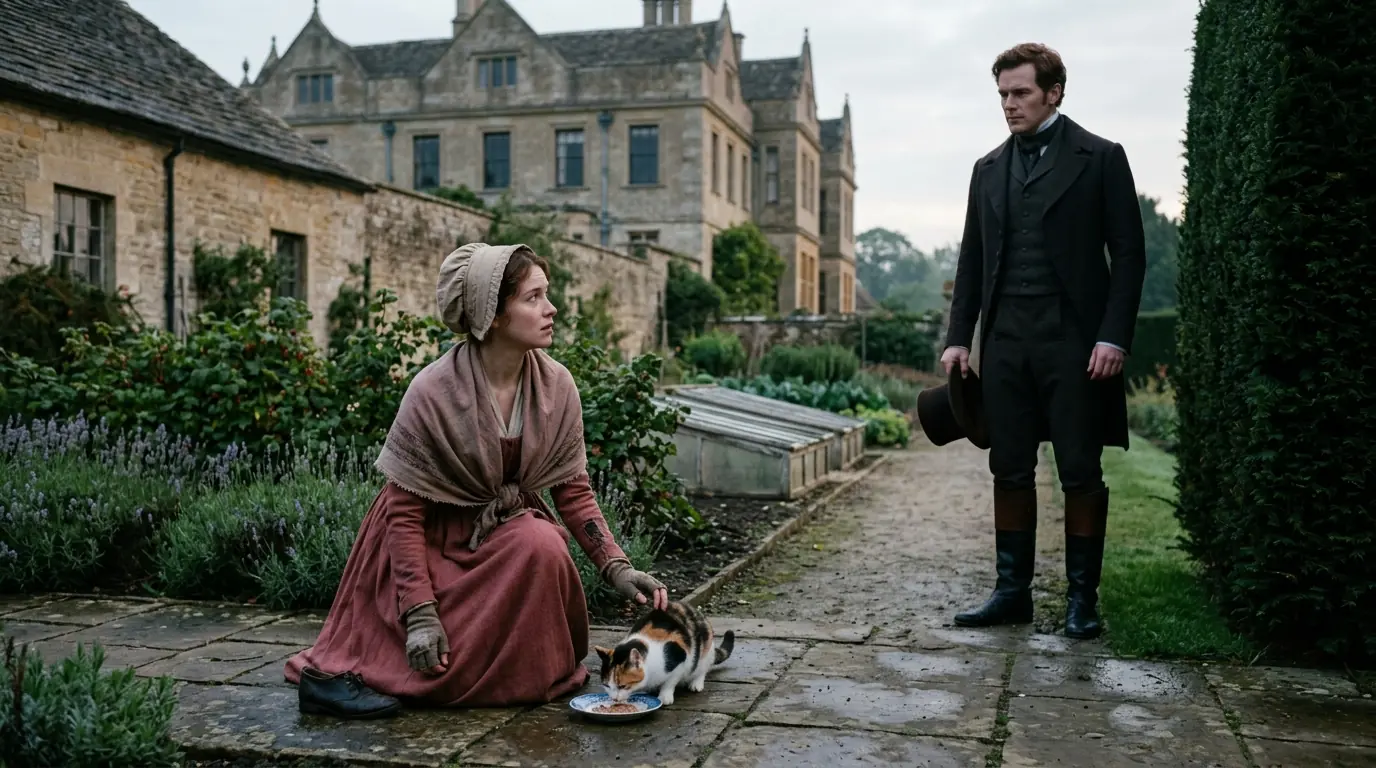
Mr. Cyril Farrant, the late Duke's nephew, who managed the household and its purse, had posted an edict in the servants' hall the winter before: no strays to be harboured about the offices; vermin found upon the premises to be destroyed.
Jacintha was seven-and-twenty, the Dowager Duchess's paid companion at twenty pounds a year and her keep, and a companion dismissed without a character had few roads left in England worth the walking. She weighed all of that every morning, and came out anyway, carrying half her own supper on a saucer. She had done the sums often enough. Her father had been rector of Abbotsmead, a scholarly, unworldly man who died with his affairs unsettled, and his daughter had come down the long slide from gentleman's daughter to paid companion in a single winter: too well born for the kitchen, too poor for the drawing room, belonging to neither. Below her present rung came governessing for strangers, then shirts at sixpence the piece, then the parish. She fed the cat anyway. What she loved, she fed, and she asked leave of nobody.
She set it down at the scullery step and clicked the china once against the stone. The cat did not come when called. Jacintha had tried calling, early on, and felt a fool. Gooseberry came for the click of the saucer, and came now, out of the currant bushes, low and quick, a small calico with a white bib and a splash of orange over the left eye. She ate crouched, shoulders up, watching the middle distance. When the saucer was clean, Gooseberry stood, put her tail up like a flag, and pushed her head once against Jacintha's knuckles. That was the whole of her thanks. Then she was gone along the wall.
Behind them both the great house stood dark. Fires were laid in two rooms only, by order of economy. The old Duke was six months dead. The new one kept to his own wing and was seen, the maids said, at windows. It was a house that had been told to be cold, and had obeyed.
Jacintha bent for the saucer and stopped. Beside the step, wrapped in coarse paper and tied with string, lay a parcel. She opened a corner of it. Trimmings from the game larder — rabbit, a little venison, more meat than her saucer had carried in a week. Parcels had come at odd intervals for nearly two years, lately oftener; this was the third that month. The cook, she decided, straightening. The cook had a soft heart under all that flour, and a soft heart thanked was a soft heart frightened off. She would keep it to herself. She tucked the parcel under her shawl beside the saucer and went in.
A week later the weather turned kind, and she grew bold with it. The kitchen-garden lay open to the early sun, lavender rows steaming faintly, the wall-fruit warming, and Jacintha carried the saucer out to a broad flagstone by the cold-frames, the light being too good to waste on a dark step. Gooseberry was already there, stretched on the warm stone. The saucer clicked. The cat ate. Jacintha knelt in her rose-madder wool with the sun on her face and let herself, for one unguarded minute, be happy. The cat finished, sat, and began on her white bib.
The Duke of Ottershaw came around the yew hedge with his hat in his hand. He stopped. She froze on her knees, one hand still out. She knew only the plain shape of her situation: the edict in the servants' hall, the saucer in plain sight, and the master of Ottershaw standing ten feet away in the morning light. And Gooseberry, finished, trotted directly past his boots, head high, carrying in her teeth a twisted white paper spill she had stolen from heaven knew where, tail up, entirely unembarrassed, a small thief leaving the scene at a walk because running was beneath her.
The Duke watched the cat out of sight. Clifford, Duke of Ottershaw, was three-and-thirty and six months in the title: a tall man, broad through the shoulder, with dark auburn hair and a face the county called cold. Jacintha had been three years in the house and had heard his voice perhaps a dozen times.
"What do you call it?" he asked.
"Gooseberry, your Grace." Her own voice came out steadier than she had any right to expect. "For her eyes. She is not mine."
"No," he said. He looked at the saucer on the flag, and at the mended forefinger of her glove, and she saw him do the arithmetic of it, plainly, in the open. "She appears to be her own." He did not name the edict. He did not say the word stray, or the word vermin, or the word rule. "Is she wild, or only unowned?"
"Unowned, your Grace. Two years this autumn she has come to that step, and she was starving when she started." The truth, then, all of it; she had decided in one heartbeat that a lie would be worse. "She is an honest animal. She has yet to pretend, even once, that she likes me for myself."
"And what is she fed on?"
"My supper, your Grace. Part of it."
Something crossed his face at that, quickly, and was put away. He stood a moment longer in the sun, hat in hand, and Jacintha knelt with her livelihood balanced on a saucer and watched him decide something she could not yet read.
"The mornings are the best of this house," he said at last. "I find I walk at this hour." He inclined his head — to her, or possibly to the cat's departed tail — and walked on down the lavender row.
He had said not one word that bound him. She knelt on the warm stone with her heart going hard and understood that everything now depended on what a silent man chose to do with what he knew.
What he did was quieter than anything she had braced for. The days went by, the summons stayed unwritten, the edict stayed posted and unenforced, and Jacintha went on feeding her lodger and began, cautiously, to breathe.
Her days belonged to the Dowager. Griselda, Dowager Duchess of Ottershaw, was seventy-four and sat straighter than any woman in the county, silver hair dressed high, black eyes quicker than the room. Farrant's economy had reduced her to two rooms and a fire that might be lit after nine, and she garrisoned those two rooms.
"Well," she said each morning, "and how does that disreputable animal?"