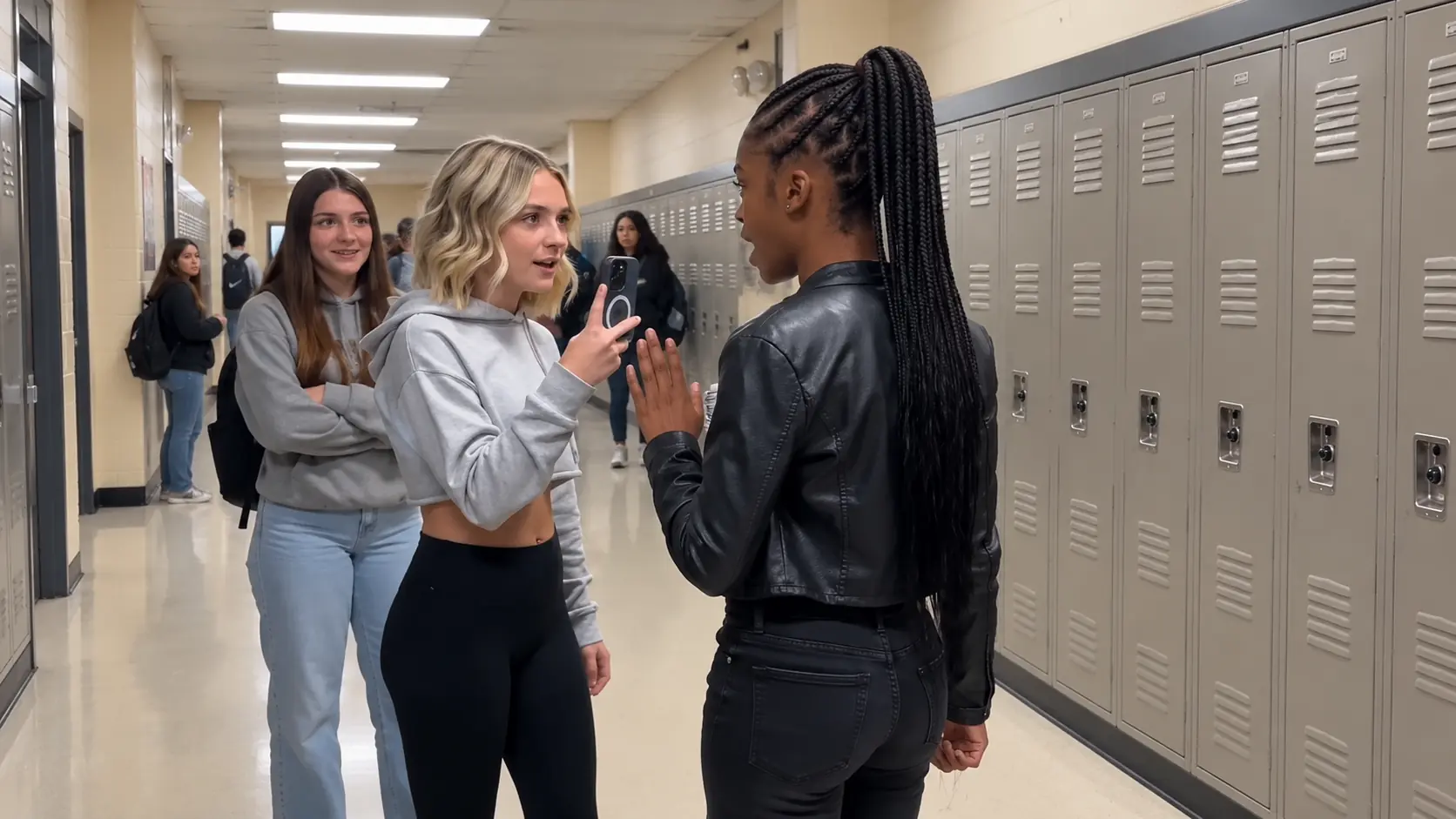
At 11:18 on a Wednesday morning, Alana Price stood at her locker at Grant Park High School with a notebook tucked beneath one arm and her black backpack hanging open beside her. She had just finished chemistry and was searching for a folder she was certain she had packed when she felt that strange sensation people sometimes get before they know someone is watching them. Alana looked over her shoulder and saw Brooke Caldwell standing about fifteen feet away, smiling into a phone held upright in one hand while an iced coffee rested in the other. Brooke was not checking messages.
She was filming Alana.
Two girls stood behind Brooke, trying not to laugh.
Alana closed her locker slowly.
Brooke kept recording.
Neither girl knew yet that the next twenty seconds would spread across Grant Park faster than any video Brooke had ever posted.
But the story did not begin in that hallway.
It began five months earlier, when Brooke Caldwell discovered that making people uncomfortable could make her popular.
Grant Park High sat in a growing suburb north of Atlanta, a sprawling brick school with nearly two thousand students, three crowded parking lots, and long beige hallways lined with gray metal lockers. It was the kind of school where nearly every teenager carried a phone and almost every embarrassing moment had the potential to become public before the final bell. Students filmed football games, hallway dances, cafeteria arguments, teacher impressions, outfit checks, and one another.
Most of it disappeared within a day.
Brooke figured out how to make hers stay.
She was eighteen, blond, confident, attractive in the effortless social-media way that required considerable effort, and always seemed to be carrying either her phone or a large iced drink. During junior year, she began posting short videos under the name Brooke On Campus. At first, they were harmless: asking students to rate cafeteria food, guessing teachers from old yearbook photographs, stopping couples to ask who had texted first, or convincing friends to try strange vending-machine combinations.
Students loved them.
By the beginning of senior year, Brooke had more than forty thousand followers across several platforms.
Teachers knew about the account.
Most thought it was funny.
Principal Harold Jennings once appeared willingly in a video tasting five brands of hot sauce while students counted how long he could avoid reaching for milk. The football coach participated in another. Brooke’s media teacher even encouraged her to submit some of the work with college applications because she was considering studying digital communications.
Then harmless stopped getting enough views.
The change happened gradually.
A video titled WHO ACTUALLY LIKES YOU? showed Brooke asking students to name their best friend and then surprising them with recordings of that friend giving a different answer. Another series involved secretly filming students dancing with headphones on. The clips were funny when the person laughed too.
Not everybody laughed.
Brooke learned that embarrassed reactions often performed better.
So she started chasing them.
Alana Price could not have cared less about Brooke’s account.
At seventeen, Alana was already tired of the idea that high school was supposed to be the most interesting place in the world. She was a senior, played varsity basketball, worked two evenings a week at her aunt’s accounting office, and spent most of her free time applying to universities. Her mother, Renee Price, taught third grade at an elementary school across town, while her father, Derrick, drove city buses and had worked the same early route for almost fifteen years.
The Prices were not wealthy.
They were comfortable only because both parents had become exceptionally good at planning.
Alana understood the value of that stability because she had watched her parents build it slowly.
She also understood that graduation mattered more than social ranking.
Her closest friend, Maya Turner, frequently accused Alana of being eighty years old inside a seventeen-year-old body.
“You leave parties at ten.”
“I like sleep.”
“You organize your backpack by subject.”
“That’s called being able to find things.”
“You read restaurant menus before we arrive.”
“That is called preparation.”
Maya would shake her head.
“Grandma.”
Alana accepted the insult proudly.
That was why Brooke initially found her boring.
The two girls shared no classes.
Brooke spent most lunches near the center cafeteria tables surrounded by people; Alana ate with teammates or used lunch to finish homework. They had attended Grant Park together for almost four years without exchanging more than a few sentences.
Then Brooke filmed Noah Bennett.
Noah was a freshman.
He was fourteen, painfully shy, small for his age, and had recently become responsible for helping his mother after she was diagnosed with multiple sclerosis. Almost nobody at Grant Park knew that. Students mostly knew him as the kid who carried too many books, wore the same brown jacket every day, and rarely spoke unless a teacher called on him.
One Friday, Brooke found Noah standing near the cafeteria vending machines.
She was filming a series called WHAT’S IN YOUR POCKET?
Students were supposed to agree before participating.
At least that was how Brooke later described the rules.
Noah did not understand he had joined anything.
Brooke walked toward him recording and asked, “What’s the weirdest thing you carry every day?” Noah looked confused, tried to walk around her, and Brooke followed. One of her friends laughed and said he looked terrified.
That should have been the moment Brooke stopped.
Instead, she reached toward the outside pocket of Noah’s backpack.
Noah jerked away.
A small plastic medication organizer fell onto the floor.
Several pills scattered across the tile.
Noah immediately dropped to his knees.
“Don’t touch those.”
Brooke pointed the camera downward.
“What is that?”
Noah’s face turned red.
“They’re my mom’s.”
The laughter stopped.
Brooke kept recording.
Alana happened to be leaving the cafeteria.
She saw Noah crawling beneath a table trying to collect the pills while Brooke’s phone remained pointed toward him.
Alana walked directly into the frame.
“Turn that off.”
Brooke lowered the phone slightly.
“We’re making a video.”
“He doesn’t want to be in it.”
“You don’t even know what happened.”
“I know he’s on the floor picking up medication while you’re filming him.”
Noah looked toward Alana.
His eyes were wet.
“Please make her stop.”
That sentence ended the discussion.
Alana stepped between Noah and the camera.
“Delete it.”
Brooke stared at her.
“Excuse me?”
“He said stop.”
“You don’t get to tell me what to do with my phone.”
“No.”
Alana held her gaze.
“He does.”
Brooke looked around.
Students were watching.
That mattered.
She smiled.
“Relax. I wasn’t going to post him.”
“Then deleting it should be easy.”
Someone behind Brooke muttered, “Just delete it.”
Another student agreed.
Brooke’s smile tightened.
She tapped her phone several times.
“Gone.”
Alana turned toward Noah.
She helped collect the remaining pills.
Neither noticed Brooke had only deleted the clip from her camera roll.
It remained in the recently deleted folder.
That evening, a shortened version appeared on Brooke’s private story.
The clip stopped before Alana entered.
It showed Noah backing away, the medication falling, and Brooke saying, “Bro, what are you carrying?”
The caption read:
WHEN THE QUIET KID HAS SECRETS.
Someone screen-recorded it.
By Saturday morning, Noah had received dozens of messages.
One accused him of selling pills.
Another asked whether his mother was an addict.
Noah’s mother called the school.
The situation became serious very quickly.
Alana learned about it Monday morning when Noah’s older sister found her near the gym.
“Were you there?”
“Yes.”
“Did he tell her not to film?”
“Yes.”
“Would you tell the principal?”
Alana did not hesitate.
“Yes.”
Principal Jennings interviewed students.
Brooke insisted the video had been uploaded accidentally and argued that she removed it after twenty minutes.
That did not explain the caption.
It did not explain why she kept a clip she had promised to delete.
Most importantly, it did not change the fact that Noah never consented.
Grant Park suspended Brooke’s media privileges for one month.
She was removed temporarily from the morning-announcement production team and prohibited from filming students during school hours.
The punishment was modest.
Brooke treated it like exile.
Her college application portfolio depended heavily on school-based content. She had planned to submit the announcement program as evidence of leadership. Now another student would direct several episodes without her.
Brooke blamed Alana.
She found her outside basketball practice.
“You happy?”
Alana looked around.
“About what?”
“You got me banned from media.”
“I gave a statement.”
“You told Jennings I kept filming.”
“You did.”
Brooke laughed bitterly.
“You make it sound like I attacked him.”
“I didn’t say that.”
“You told them he asked me to stop.”
“He did.”
“Everybody was filming.”
“You were the one who posted it.”
Brooke stepped closer.
“It was twenty minutes.”
“That was enough.”
“You think you’re some kind of hero because you stood in front of a camera?”
Alana adjusted the strap on her gym bag.
“No.”
She looked at Brooke.
“I think Noah asked you to stop.”
Then she walked into the gym.
Brooke stood outside long after the door closed.
From that point forward, Alana became content.
Not publicly at first.
Brooke was still under restrictions.
Instead, she began making small jokes around friends.
If Alana passed in the hallway, Brooke would hold up an imaginary camera and whisper, “Careful, media police.”
Her friends laughed.
Alana ignored it.
At lunch, Brooke once loudly asked whether everyone had signed a release form before sitting near Alana.
Ignored.
Someone placed a homemade NO FILMING sign on Alana’s locker.
She removed it.
Maya became increasingly angry.
“You understand she wants a reaction.”
“I know.”
“So give her one.”
“That is the opposite of how that sentence works.”
“She’s annoying.”
“She wants me annoyed.”
“You are annoyed.”
“Internally.”
Maya stared.
“You need therapy.”
“Probably.”
For almost a month, Alana’s refusal to engage worked.
Then Brooke’s media restriction ended.
She returned to the announcement team.
Her first new video received fewer than ten thousand views.
The second barely passed six thousand.
Brooke became convinced her audience had moved on during the month she could not post from school.
She needed something big.
Her friend Kara Mills suggested a confrontation series.
The concept was simple.
Approach someone who had criticized Brooke, ask provocative questions, and see how long it took before they became angry.
Brooke called it SAY IT TO MY FACE.
The first two students knew beforehand.
Their reactions were partially staged.
The videos performed well.
Brooke wanted something real.
That was when Alana’s name came up.
Kara hesitated.
“She won’t do anything.”
“That’s why it’ll be funny.”