At 9:42 on a Tuesday morning, Evelyn Brooks walked into Hale Motor Group’s flagship Atlanta showroom carrying a handbag she had owned for nineteen years.
Nobody noticed her.
That was exactly what she wanted.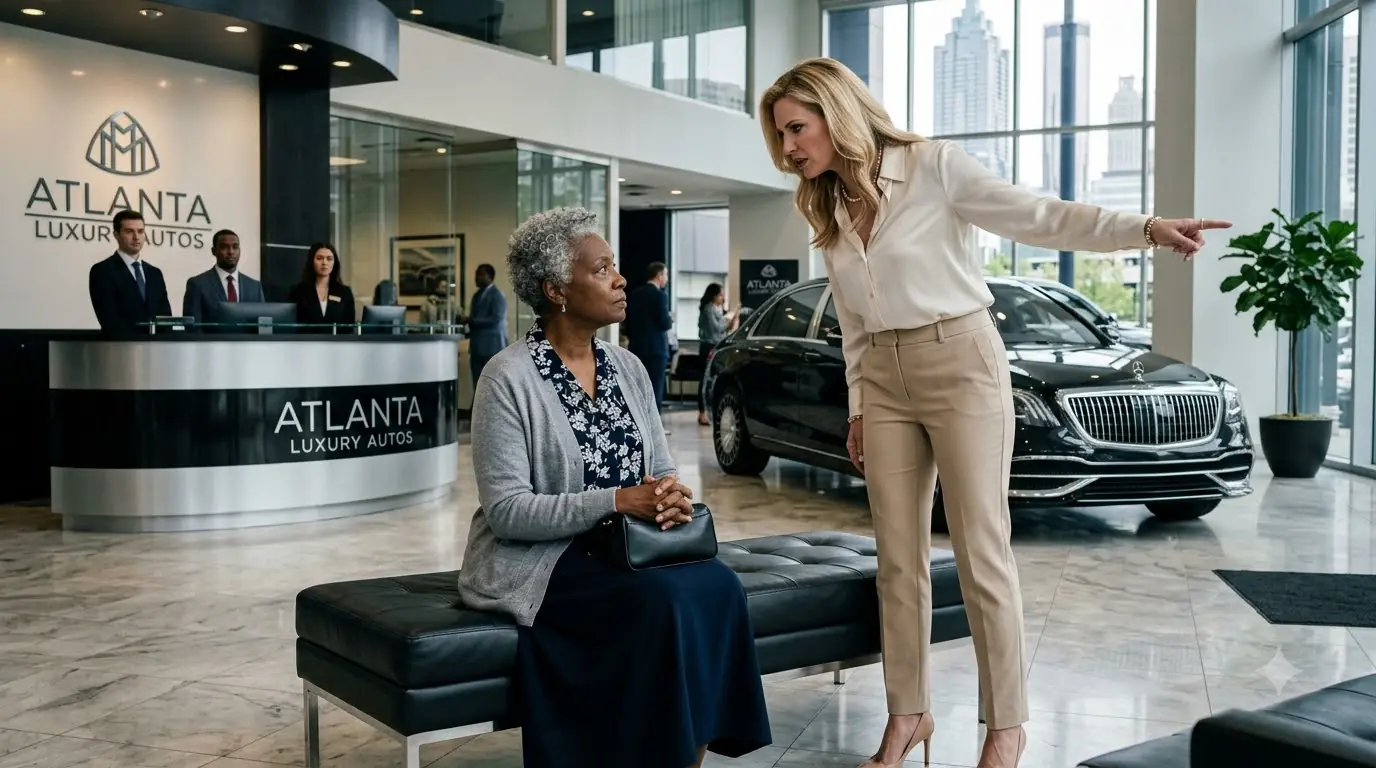
The showroom occupied almost thirty thousand square feet of polished stone, smoked glass, black marble, and soft recessed lighting. Luxury sedans sat beneath carefully positioned spotlights. Floral arrangements rose from tall black vases. Coffee was served in porcelain cups instead of paper. Every desk had been positioned so a salesperson could see the entrance before a customer had taken ten steps.
The building had been designed to make people feel that money mattered.
Evelyn knew.
She had approved the architectural plans herself.
Twenty-three years earlier, Hale Motor Group had been one struggling dealership outside Decatur.
Now it operated thirty-eight stores across six states.
European luxury brands.
High-end SUVs.
Performance cars.
Certified pre-owned divisions.
Leasing centers.
Fleet operations.
A financing arm.
And, according to the latest valuation, more than four billion dollars in combined assets, contracts, inventory, land, and enterprise value.
Evelyn controlled fifty-eight percent of it.
The public rarely saw her.
That was partly intentional.
Her late husband, Jonathan Hale, had been the face of the company during its first decade. Tall, charismatic, white-haired even in his forties, Jonathan loved cameras, ribbon cuttings, charity dinners, television interviews, and handshakes.
Evelyn preferred spreadsheets.
Contracts.
Service records.
Customer complaints.
Employee turnover reports.
After Jonathan died eight years earlier, she became chairwoman and chief executive.
Yet the photographs corporate communications preferred still showed her in tailored suits, silk scarves, pearls, and perfectly styled silver hair.
Nobody associated the seventy-two-year-old woman in a soft gray cardigan, patterned blouse, long dark skirt, old black loafers, and worn brown handbag with the polished official portrait hanging in the headquarters conference room.
Again, exactly what she wanted.
She crossed the showroom slowly.
A receptionist looked up.
Then down.
No greeting.
Evelyn noticed.
A young salesman glanced at her from behind a desk.
His eyes moved toward her cardigan.
Her handbag.
Her shoes.
Then away.
Evelyn noticed that too.
She walked toward a black luxury sedan positioned near the center floor.
Price:
$168,900.
She did not care about the car.
She cared about how long it would take anyone to ask whether she needed assistance.
She checked the small watch beneath her sleeve.
9:43.
A couple entered behind her.
White.
Probably early forties.
The man wore a navy sport coat.
The woman carried a designer handbag.
Within eleven seconds, a salesman approached.
“Good morning. Welcome to Hale.”
Evelyn looked toward them.
The salesman smiled.
Offered coffee.
Asked what brought them in.
Another employee opened the passenger door of the display car for them.
Evelyn remained alone.
9:46.
She moved toward the reception counter.
The receptionist was typing.
Evelyn waited.
Thirty seconds.
Then:
“Excuse me.”
The receptionist looked up.
“Yes?”
“I was hoping someone could answer a few questions.”
“What kind of questions?”
“About purchasing.”
The receptionist’s expression shifted.
Not much.
Enough.
“New or used?”
“New.”
“Which model?”
Evelyn pointed toward the black sedan.
The receptionist looked at the vehicle.
Then Evelyn.
“That's one of our premium models.”
“I know.”
“Prices begin above one hundred fifty thousand.”
“I know.”
The receptionist hesitated.
Evelyn waited.
Finally:
“Do you have an appointment?”
“No.”
“We’re fairly busy this morning.”
Evelyn looked around.
Seven salespeople.
Three customers.
“Are you?”
The receptionist’s face tightened.
“I can see whether someone becomes available.”
“Thank you.”
She returned to typing.
No call.
No message.
No attempt.
Evelyn moved toward a black leather bench near the display floor and sat.
She placed her handbag on her lap.
Folded her hands over it.
Waited.
9:51.
One salesperson walked past.
9:53.
Another.
9:55.
A service adviser entered the showroom, saw Evelyn, smiled politely, then disappeared through another door.
9:57.
A young Black sales associate approached from the far side of the floor.
Maybe twenty-six.
Name badge:
TASHA GREENE
She had taken only three steps toward Evelyn when a voice called:
“Tasha.”
The young woman stopped.
A tall blonde woman stood beside the main reception counter.
Forty-five.
Ivory silk blouse.
Tailored beige trousers.
Nude heels.
Long styled hair.
Sharp face.
Controlled posture.
Miranda Hale.
No relation to the founding family despite the surname coincidence.
She had been showroom director for eighteen months.
Evelyn recognized her immediately.
Corporate file photograph.
Outstanding quarterly revenue.
Low discount percentages.
High finance penetration.
Excellent luxury accessory sales.
Customer satisfaction reported at 96.8 percent.
Too excellent.
That was why Evelyn was there.
Miranda pointed toward a man near the rear display.
“Mr. Prescott needs someone.”
Tasha looked toward Evelyn.
Then Miranda.
“I was just going to—”
“Mr. Prescott.”
Tasha paused.
Then nodded.
“Yes, ma'am.”
She walked away.
Evelyn watched.
Miranda saw her watching.
Their eyes met.
For a second, Evelyn expected the director to approach.
She did.
Not immediately.
She adjusted several papers.
Spoke to the receptionist.
Checked something on a tablet.
Then walked across the showroom.
Her heels clicked against the polished floor.
She stopped several feet from Evelyn.
“Can I help you?”
No smile.
Evelyn looked up.
“I hope so.”
“Were you waiting for someone?”
“No.”
“Picking up a vehicle?”
“No.”
Miranda’s eyes moved toward the handbag.
“Service department is around the side.”
“I’m here to purchase.”
Miranda paused.
“What?”
“A vehicle.”
The director looked toward the black sedan Evelyn had indicated earlier.
Then back.
“What kind?”
“That one interests me.”
Miranda followed her gaze.
Her expression almost became amusement.
“The Asterion Regent?”
“Yes.”
“That model begins at one hundred sixty-eight thousand nine hundred before options.”
“I saw the window sheet.”
Miranda stared.
Then:
“Are you looking for information for someone else?”
“No.”
“A family member?”
“No.”
Evelyn’s voice remained gentle.
“For myself.”
Miranda inhaled slowly.
Something about that answer seemed to annoy her.
“Do you have financing arranged?”
“I haven't decided how I intend to pay.”
The director’s lips tightened.
“Then perhaps we should establish a realistic budget first.”
Evelyn looked at her.
“Perhaps you should show me the vehicle first.”
Miranda stared.
Nearby, the receptionist looked up.
The young salesman from earlier turned slightly.
He pretended to reorganize brochures.
Evelyn noticed.
Miranda lowered her voice.
“Mrs…”
“Brooks.”
“Mrs. Brooks.”
“Ms.”
Miranda nodded sharply.
“Ms. Brooks.”
“This dealership specializes in a very particular level of client service.”
“I’m aware.”
“These vehicles require substantial financial qualification.”
“I’m aware.”
“If you’re simply browsing—”
“I said I am considering purchasing.”
Miranda's expression hardened.
Evelyn continued:
“I would like to see the vehicle.”
For several seconds neither woman moved.
Then Miranda gave a short breath through her nose.
“Fine.”
She turned.
“Come with me.”
Evelyn remained seated.
Miranda looked back.
“Are you coming?”
“In a moment.”
The director looked irritated.
Evelyn opened her handbag.
Not because she needed anything.
Because she wanted to see where Miranda's eyes went.
They went inside immediately.
The bag contained:
Wallet.
Reading glasses.
Notebook.
Tissues.
A small pill organizer.
No designer logos.
No obvious wealth.
Evelyn took out her reading glasses.
Miranda's posture changed again.
More certain.
She had categorized Evelyn.
That was becoming clear.
Old.
Modest.
Probably limited money.
Perhaps lonely.
Possibly confused.
Someone who might wander into expensive places simply to look.
Evelyn had spent decades watching salespeople classify customers.
Good salespeople used categories to understand needs.
Bad ones used categories to determine dignity.
The distinction was everything.