The rain had stopped an hour before, but the road to Ashford Hollow still ran with mud thick enough to swallow a boot whole, and Margarite Hartley walked it anyway, because no one else in her family would think to carry bread to old Mrs. Fenwick on a day like this. She had wrapped the loaf in a cloth still warm from the hearth, tucked a wedge of cheese beside it, and set out before her mother could ask where she was going, because if her mother knew, she would say the bread was needed for supper, and supper in the Hartley house always mattered less than Cassandra's happiness. She was nineteen years old, plain by her mother's own repeated verdict, and so accustomed to being the daughter no one looked at twice that she had stopped expecting anyone to. Her hair was the color of wet sand.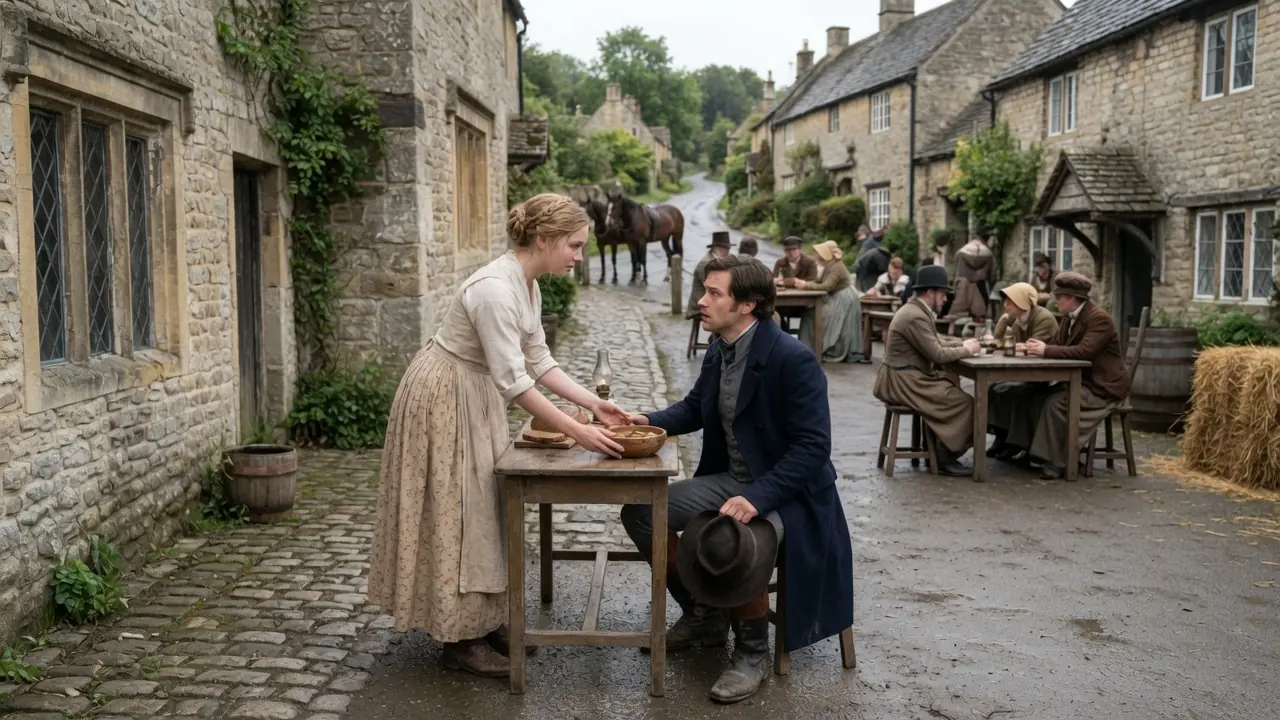
Her hands were rough from work a lady's hands were not meant to know, and her gowns were always the ones let out from Cassandra's old ones, taken in at the waist and let down at the hem. Because a new gown for the second daughter was money the family did not have and attention the family did not think she deserved. She rounded the bend past the old stone bridge and stopped. A man sat slumped against the trunk of a fallen oak at the edge of the road, his coat torn at the shoulder, his boots crusted with mud so thick they had lost their shape, and his face turned toward her with the particular stillness of a man too proud to ask for help, and too exhausted to refuse it if it came.
He did not look like a gentleman. He looked like a man the road had chewed and spat back out. And for one careful moment Margarite considered walking past him the way any sensible woman alone on a country lane would walk past a stranger. Then she saw his hands trembling where they rested on his knees, and she thought of her father, three years gone now, and how he had always said that a person's worth showed clearest in the moment no one was watching to reward them for kindness.
“You look as though the road has not been generous to you,” she said, and her voice came out steadier than she felt.
The stranger's eyes lifted to hers, gray and sharp, despite the exhaustion carved into his face. And something in that gaze unsettled her before she understood why.
It was not the look of a beggar.
It was the look of a man taking careful measure of her, cataloging her, though she could not have said what he hoped to find.
“Generous is not the word I would choose,” he said, and his voice, low and unexpectedly cultured, did not match the state of his coat at all.
“I was set upon two days past.”
“My horse bolted.”
“My purse went with the men who took it.”
“And I have walked since, hoping to find an inn that would extend credit to a stranger's word.”
“No inn in this county extends credit to anyone's word, sir, stranger or otherwise.”
She knelt without quite deciding to kneel and unwrapped the cloth in her basket.
“But I have bread and cheese, and I think you need it more than Widow Fenwick needs it today, though I shall have to explain myself to her all the same.”
He watched her break the loaf in half with something that might have been disbelief.
“You do not know me.”
“I could be anything.”
“A thief, a deserter, a man running from a debt of his own making.”
“You could be,” she agreed, and pressed the bread into his hands before he could refuse it a second time.
“But a thief does not sit still and wait to be discovered. And a man running from his own debts does not look so ashamed to accept a stranger's bread.”
“Eat, sir.”
“We can discuss my poor judgment of character after you've stopped shaking.”
He ate slowly with the careful restraint of a man who had learned somewhere that hunger displayed too plainly was its own kind of shame. And she sat beside him on the wet log because it did not seem right to stand over a man while he ate like a duchess overseeing a servant's meal. She asked him nothing more than his comfort required. She did not ask his name because names invited obligations and she had learned young that kindness given freely without expectation of thanks or reward was the only kindness that did not curdle into resentment later.
“You did not ask what I am,” he said finally when the bread was gone and some of the gray had left his face.
“Most would have asked by now whether I have family, whether there is a reward for my safe return.”
“Would the answer change whether you needed bread?”
“No,” he said.
“It would not.”
“Then I did not need to ask.” She rose, brushing the mud from her skirts, already calculating how she would explain the missing loaf to her mother, already deciding she would simply say nothing and accept whatever scolding came.
“There is an inn three miles on past the mill.”
“Tell them Margarite Hartley sent you and that she will settle the difference on market day if her word still carries any weight with them.”
“Margarite,” he repeated as though testing the shape of it.
“And will your family not wonder where their bread has gone, Miss Hartley?”
“My family wonders a great many things about me, sir.”
“This will hardly be the first.”
She left him there on the fallen oak with the last of the cheese still in his hand, and she did not look back, because looking back felt like asking for something she had no right to want. She did not yet know that the man she had just fed with her family's bread was Julian Ashworth, ninth Duke of Ravensmore, and that he had spent the last two days deliberately unwashed, deliberately without escort, deliberately playing the part of a ruined traveler, for reasons that had nothing to do with any robbery at all. She did not know that he had chosen the road past Ashford Hollow on purpose, because his grandmother, before she died, had made him promise one thing above all others, that he would not choose his duchess from a ballroom full of women who already knew his title, his fortune, and the particular weight of what a coronet of strawberry leaves could buy them.
He would find her first as a nobody. He would learn what she gave when giving cost her something, and bought her nothing. Only then, his grandmother had said, gripping his hand with the last of her strength, would he know if a woman loved the man or merely the duke. He had been testing that promise for six weeks across three counties, and in six weeks he had been turned away from doorsteps, sneered at by upper servants who mistook his shabby coat for vagrancy, and once nearly set upon by dogs.
He had begun privately to wonder if his grandmother's faith in ordinary kindness had been the wishful sentiment of a dying woman rather than a truth the world still contained.
Then a girl in a mended gown had knelt in the mud without hesitation and broken her family's bread for a stranger who offered her nothing in return.
And Julian Ashworth sat very still on the fallen oak long after she had gone, and felt for the first time in longer than he could name, something loosen in his chest that he had not realized was clenched. He finished the cheese slowly. Then he rose and began to walk, not toward the inn she had named, but toward Ashford Hollow itself, because he had already decided, with the swift and dangerous certainty of a man unused to being denied what he wanted, that he was not finished with Margarite Hartley yet.
The Hartley house sat at the edge of the village, a handsome enough structure gone slightly threadbare at the edges, its garden overgrown in the corners where there was no longer a gardener to keep it. Its curtains had faded beneath a sun no one had thought to shield them from in years. It had been a fine house once, when Margarite's father lived, and it remained fine enough now to host the ambitions Mrs. Hartley still nursed for her elder daughter, ambitions that had narrowed in recent months to a single glittering possibility.
“The Duke of Ravensmore is expected in the county within the fortnight.”
Mrs. Hartley announced at supper that evening, layering the words with the reverence she usually reserved for scripture. Lady Petworth had it from her sister in town. He is to stay with the Ashcrofts before the county ball, and he is by every account in want of a wife. Cassandra Hartley, golden-haired and lovely in the effortless way that made other women's efforts look like labor, set down her fork with the particular grace she had cultivated since girlhood, knowing precisely how a gesture landed on watching eyes.
“A duke,” she said, testing the word as though it might taste of something.
“Mama, do you think he might actually attend the assembly?”
“He will attend, and you will be presented to him, and you will wear the blue silk, because blue has always suited you better than it has ever suited anyone else in this county.”
Mrs. Hartley's gaze slid briefly, dismissively, toward her younger daughter.
“Margarite, you will assist with the preparations.”
“There is a great deal to be done before the ball, and heaven knows Cassandra cannot be troubled with the mending, while she is occupied with more important matters.”
Margarite did not look up from her plate. She had long ago learned that arguing with her mother's arithmetic of daughters, one worth investing in, one worth using, only prolonged the sting of it.
“Of course, mama.”
“You are a good girl,” her mother said, in the particular tone she used when good girl meant useful girl, and turned back to Cassandra with the bright, hungry attention she never spent on anyone else.
“Now, the blue silk wants a new trim, and I think perhaps pearls at the throat. Don't you agree, darling? A duke will have seen every fashionable gown in London. We must give him something he has not seen.”
Margarite finished her supper in silence, and thought, without any particular bitterness, only a tired and familiar resignation, that she would spend the coming fortnight stitching pearls onto her sister's gown, while the household orbited entirely around a man none of them had yet met. And she did not think of the stranger on the road again, until she was nearly asleep. And even then she thought of him only as a small warm secret. A kindness given and finished with no possible bearing on anything that came after.
She was wrong, though she would not learn how wrong for some days yet.
The stranger appeared again three days later, and this time he was not on the road at all, but standing at the edge of the village green in a coat that fit him properly, his boots clean, his bearing entirely changed. Though she did not recognize him at first because she had not truly looked at his face on the road so much as at his hunger. It was only when he spoke and she caught the particular low note of his voice that recognition arrived like a small cold shock.
“Miss Hartley.”
He inclined his head and there was something careful in the gesture, something watching to see how she would respond.
“I owe you a debt I have not yet repaid.”
“You are looking considerably better than when we last spoke, sir.”
She kept her tone light, though her mind was already working through the discrepancy between the ragged traveler on the fallen oak and the well-dressed gentleman before her.
“Now, I take it the inn extended you the credit I promised on your behalf.”
“The inn did more than that.”
“I found my horse had been recovered by a farmer some miles distant, and my circumstances have improved considerably since we parted.”
He did not offer his name, and she did not ask for it a second time, though the omission sat oddly between them.
“I wish to thank you properly.”
“You fed a stranger on the strength of nothing but your own judgment.”
“And I have thought of little else since.”
“It was bread and cheese, sir, not a coronation.”
“It was more than that, and I think you know it, or you would not have given it so freely.”
His gray eyes held hers a moment longer than propriety strictly allowed, and Margarite felt the small, unfamiliar flutter of being truly looked at, rather than looked past, for what might have been the first time in her adult life.
“May I walk with you a little way?”
“I find myself curious how a young lady who kneels in the mud for strangers spends the rest of her days.”
She should have refused. A young woman did not walk unchaperoned with a man whose name she did not know, whose circumstances she could not verify, whose sudden transformation from ruin to respectability, she could not entirely account for. But there was something in the careful way he asked, as though her answer mattered to him more than propriety would suggest it ought, and she found herself saying yes before she had properly weighed the wisdom of it. He called himself Julian Vane and told her he was a gentleman of modest means traveling the county on family business and she believed him without troubling to examine the story too closely because she had no particular reason yet to suspect it was a careful and deliberate lie.
They walked the lane past the mill and he asked her questions no one had asked her in years.
Not about her sister's beauty, not about the family's diminished fortunes, but about what she thought, what she read, whether she found the county dull, whether she had ever wished to see London.
She answered honestly because it did not occur to her to do otherwise.
And somewhere in the course of that walk, she said something that made him laugh.
A genuine startled laugh, as though laughter itself were a rusted mechanism he had not exercised in some time, and the sound of it settled into her memory in a way she did not examine too closely either.
“You are not at all what I expected,” he said when they had nearly reached the turn back toward the village.
“What did you expect, Mr. Vane?”
“I hardly know.”
Someone smaller, perhaps, someone who had learned to make herself smaller, given how your family speaks of you. He caught himself, as though he had said more than he intended, and a shadow of something wary crossed his face.
“Forgive me, that was presumptuous.”
“You have been speaking to my mother then or someone who has heard her speak of me.”
Margarite kept her voice light, though the observation landed somewhere tender.
“I assure you, sir, I gave up trying to be anything other than what I am some years ago.”
“It is considerably less exhausting than the alternative.”
“I think,” Julian said slowly, “that it is the rarest thing I have encountered in a very long time.”
They parted at the edge of the green, and Margarite walked home with her thoughts in a state of unfamiliar disorder. Turning over the strange, careful attention of a man who called himself modest, but carried himself, she realized only now, replaying the walk, like someone accustomed to being obeyed rather than questioned. She did not yet understand what that meant. She only knew that something in her, some door she had long ago and quite deliberately shut, had opened a crack, and she was not entirely certain how to close it again.
Julian Ashworth returned to his rooms at the Ashcroft estate that evening, in a state he did not care to examine too closely, either, and found his cousin Frederick waiting with the particular knowing look of a man who had guessed more than he had been told.
“You've been gone the better part of a week,” Frederick said, pouring two glasses of brandy without being asked.
“The Ashcrofts are beginning to wonder if you've abandoned the whole scheme. Lady Ashcroft has already begun matching you to three separate heiresses over dinner, none of whom have the slightest idea you've spent the last several days sleeping in barns.”
“I found what I was looking for.”
Julian took the glass, but did not drink from it, turning it instead between his fingers and watching the candlelight catch and scatter through the amber liquid.
“Or I believe I have. I cannot yet be certain.”
“Found what precisely, a wife or merely a diversion?”
“I do not yet know the difference, and that is precisely the trouble.”
Julian set the glass down untouched.
“There is a young woman in Ashford Hollow, Frederick.”
“Her family thinks little of her. Her own mother speaks of her as though she were furniture, useful but unremarkable, while the elder sister is polished and paraded like the last treasure in the house. And this girl—Margarite, her name is—fed a starving stranger on a muddy road without asking his name or his purse, and asked him nothing in return but that he eat before he collapsed.”
“You told her nothing of who you are.”
“I told her I was a gentleman of modest means called Vane.”
Julian's jaw tightened.
“Grandmother made me promise Frederick before she died.”
“She made me swear I would not choose a duchess from among women who already knew what a duke was worth to them.”
“I have spent six weeks discovering exactly what that promise costs a man.”
“And I very nearly gave it up as a fool's errand until three days ago.”
“And when you tell her the truth? When she learns that Mr. Vane, modest traveler, is in fact Julian Ashworth, Duke of Ravensmore, invited to this very county for the express purpose of choosing a bride at the assembly ball her own mother is currently starving herself over?” Frederick's eyebrow rose with the particular skepticism of a man who had watched his cousin make exactly one grand romantic gesture in his life, and watched it end in disaster.
“You do recall what happened the last time you concealed your name from a woman who came to care for you.”
Julian's face closed like a door.
“That is not a fair comparison, is it not?”
“You courted Lady Rosamund under a false name for 3 months, and when the truth came out, she called you a liar to your face in front of half of London and married the Earl of Dunmore within the season out of spite.”
“You told me yourself you had never felt so thoroughly a fool.”
“Rosamund never once asked who I was without first asking what I was worth.”
“That is the difference, and it is the whole of the difference.”
Julian rose and crossed to the window, looking out over the dark lawn toward the lights of the village. He could not see it from here, but he knew it lay somewhere beyond the hedgerows. “Margarite Hartley did not ask my name on the road. She asked if I was hungry.”
“When I meet women in ballrooms, Frederick, they ask my name before they have finished their curtsy.”
“I am tired of being wanted for the title, before I am known as the man.”
“Then tell her soon,” Frederick said.
“Before the not-telling becomes its own kind of lie, too large to survive the reveal,” he added more gently. Julian did not answer because he knew his cousin was right, and knowing it did nothing to make the confession easier to imagine.
The days that followed unfolded in a pattern Margarite did not consciously plan, but nonetheless found herself arranging her errands around. Mr. Vane, it seemed, took his exercise along the very lanes she walked to deliver mending, to visit the sick, to fetch what small comforts her mother's household required. And their meetings acquired the practiced casualness of two people, who both knew precisely when and where the other would appear, and pretended, for the sake of propriety, that each encounter was accidental. He asked about her father, and she found herself telling him things she had not said aloud since the funeral.
How her father had taught her to read Latin because he believed a mind mattered more than a marriage.
How he had died of a fever that took him in eleven days, and how her mother's grief had curdled in the years since into a fierce and narrow determination that at least one daughter would marry well enough to restore what the family had lost.
He asked about Cassandra, and Margarite spoke of her sister with more tenderness than bitterness, because whatever unfairness existed between them had never truly been Cassandra's doing, only their mother's arithmetic, and Margarite had made her peace with that particular unfairness long ago, or told herself she had.
“You do not resent her,” Julian said once on an afternoon when the autumn light slanted gold through the trees and made the whole lane look gilded.
“Your sister, most would in your position.”
“Resentment is exhausting, and I have found I have very little energy to spare for it.” Margarite considered the question more honestly than her light tone suggested.
“I resent sometimes the arithmetic that decided Cassandra was worth investing in and I was worth using.”
“But that is my mother's failure of imagination, not Cassandra's failure of character. She did not choose to be born first or fair-haired or easy to love in the way the world rewards easily.”
“I try to remember that you are a remarkably generous judge of people who have not always been generous to you.”
“I find it is easier to be generous than to carry the alternative.”
She glanced at him sideways, and something in his expression—a kind of stillness, a listening quality she had come to recognize as particular to him—made her ask before she could stop herself, “Why does it matter so much to you, Mr. Vane?”
“How I regard my own family?”
He did not answer immediately, and in the pause she watched something war behind his eyes. Some decision weighed and not yet made.
“Because I find,” he said carefully, “that how a person speaks of those who have wronged them tells me more about their character than any account of their virtues could.”
It was not a full answer, and she knew it was not.
But she did not press further, because pressing felt like it might unbalance something that had, without her quite noticing, become precious to her. She had begun, she realized, somewhere in the second week of their careful half-accidental meetings, to think of Mr. Vane's company as the brightest part of her days, and the realization frightened her rather more than it pleased her, because a woman, like herself, plain, poor, unremarkable by her own family's repeated verdict, had learned young not to want things she could not keep.
The county ball was announced for the last Thursday of the month, and the Hartley household transformed itself into a battlefield of silk and temper in the days leading up to it. Mrs. Hartley oversaw the alteration of Cassandra's blue gown with the focused intensity of a general planning a campaign, while Margarite sat in the corner of the sewing room stitching pearls along a neckline she would never wear, her fingers moving with the mechanical patience of long practice.
“You will attend, of course,” her mother said, not quite as a question.
“Though I hardly think there is much point in a new gown for you. The gray will do well enough. No one will be looking at you regardless, and it would be a waste of good fabric to pretend otherwise.”
“The gray will do very well, mama.”
Margarite did not look up from her stitching, though something in her chest tightened at the casual cruelty of it, delivered as it always was, without any apparent awareness that it was cruelty at all.
“I have no ambition to be looked at.”
“That is a sensible attitude, and I am glad you have it.”
“Cassandra will need someone steady beside her, someone to manage her wrap and her fan while she dances, and you have always been so reliable in that capacity.” Mrs. Hartley held the blue silk up to the window light, admiring the way it caught the sun.
“The Duke of Ravensmore arrived at the Ashcrofts three days past, I am told.”
“Lady Petworth says he is reputed to be difficult to please. Cold, even, though I cannot imagine any man remaining cold in Cassandra's presence for very long.” Margarite's needle paused very briefly over the fabric, though she could not have said why the mention of the Duke's arrival should catch her attention at all. She thought with a small private smile she kept carefully hidden of Mr. Vane, and hoped he might find some excuse to attend the ball as well, though a man of his modest means seemed an unlikely guest at so grand an occasion.
She did not yet understand how thoroughly those two thoughts, the Duke and Mr. Vane, were about to collide.
Two days before the ball, Margarite walked the lane toward the mill with a basket of mending for old Mrs. Fenwick, and found Julian waiting at the fallen oak, where they had first met. Though his expression when she came near was graver than she had yet seen it.
“I must tell you something,” he said without preamble.
“And I fear it will change how you regard me, though I hope it will not change it entirely.” Her stomach dropped with the particular cold certainty of a woman who has sensed somewhere beneath her own hopes that a reckoning was coming and had simply chosen not to look at it directly.
“You are married,” she said, because it was the worst thing she could imagine, the thing that would explain the careful evasions, the unnamed family business, the sense she had sometimes caught of a man holding something back.
“No. God, no.”
A flicker of something like relief crossed his face at the chance to deny that much.
“At least it is not that. It is—”
He stopped, visibly gathering himself, and in the pause a rider appeared at the bend of the lane, one of the Ashcroft grooms, cantering hard. He called out before he had fully reined in, “Your Grace!”
“Forgive the intrusion, but Lord Ashcroft asks that you return at once.”
“There is a matter of some urgency regarding the ball arrangements that requires your immediate attention.”
The word landed in the quiet lane like a dropped glass, and Margarite felt the shape of it settle over her slowly, terribly, as she watched the color drain from Julian's face and understood in the space of a single breath precisely what it meant.
“Your Grace,” she repeated very quietly, and the two syllables tasted like ash.
“You are the Duke of Ravensmore.”
“Margarite, do not.”
Her voice came out steadier than she felt, though her hands had begun to tremble around the handle of her mending basket.
“Do not use my given name as though nothing between us requires explaining.”
“You let me believe you were a man of modest means.”
“You let me tell you things I have told no one about my father, about my sister, about my own family's contempt for me, while you stood there knowing the whole time that you were the very man my mother has spent a fortnight preparing my sister to marry.”
“I did not set out to deceive you for cruelty's sake.”
His voice was low, urgent, and there was real anguish in it, though she was too stunned yet to trust the sound of it.
“My grandmother made me promise before she died that I would not choose a wife from among women who already knew my title before they knew my character.”
“I have spent six weeks testing that promise across three counties, turned away from doorsteps, treated with suspicion and contempt by people who saw only a ragged stranger until you knelt in the mud and fed me without asking my name.”
“So I was a test.” The words came out flat, and something in her chest had gone very cold and very still. The particular stillness of a wound too fresh yet to properly hurt. “An experiment in whether a poor, plain, overlooked woman could be trusted to behave decently to a stranger because you had grown weary of women who flattered you for your title.”
“It began that way.”
“I will not lie to you and pretend otherwise.”
“Not now.”
“Not after everything else.”
Julian took a step toward her, and she took a matching step back, and something in his face fractured at the small distance she had placed between them. “But it did not remain that way, Margarite. Somewhere in these past weeks, it stopped being a test and became the truest thing I have felt in years.”
“I did not plan to feel anything for you.”
“I certainly did not plan for it to matter this much.”
“But it does, and I have been a coward for not telling you sooner. I am telling you now badly, with a groom waiting on his horse and no time at all to say it properly.”
“You have had a fortnight to tell me properly, Your Grace.”
She used the title deliberately now, like a blade, and watched it land.
“You chose instead to let me walk beside you, to let me speak of my family's failings, to let me believe—” Her voice caught, and she hated herself for the catch, hated that it revealed how much of her had already foolishly, dangerously begun to hope.
“It does not matter what I believed.”
“It was foolish of me to believe anything at all.”
“It was not foolish.”
His voice had gone rough.
“It was the most honest thing that has happened to me in years, and I will not let you call it foolish merely because I handled the truth of it badly.” The groom cleared his throat, apologetic, but insistent, and Julian's jaw tightened with a particular frustration of a man caught between two obligations, neither of which he could set aside.
“I must go. Lord Ashcroft would not send for me over a trivial matter. But I am not finished with this conversation, Margarite, and I beg you not to decide anything final about me until I have had the chance to say the rest of it properly.” He mounted behind the groom's lead horse, and was gone before she could answer, and Margarite stood alone in the lane with her basket of mending, and the wreckage of a fortnight's careful secret happiness, and did not move for a long while, because she did not yet trust her legs to carry her home without betraying. In the shake of her steps, how thoroughly the ground beneath her had shifted, she told no one.
What was there to tell?
That the ragged stranger she had fed on the road, the modest Mr. Vane she had walked with in secret, half in love before she had properly admitted the word to herself, was in fact the Duke of Ravensmore, the very man her mother had spent a fortnight preparing to present her sister to. The man whose favor might restore the family's fortunes entirely. The man who had, by his own admission, begun his interest in her as an experiment in ordinary virtue. There was no version of that story her mother would receive with anything but fury, or her sister with anything but heartbreak, or the whole county with anything but scandal.
And Margarite Hartley had learned young that the safest thing a woman in her position could do with a wound too large and too strange to explain was to bury it and carry on. She carried on. She finished the pearls on Cassandra's gown. She pressed the gray dress her mother had deemed sufficient for her own appearance at the ball and did not weep over the unfairness of it because weeping over gowns felt like the smallest and least honest of all the griefs available to her that week.
The night of the ball arrived cold and clear, the kind of crisp autumn evening that made candlelight glow warmer in every window, and the Ashcrofts' great hall filled with the particular glittering energy of a county certain that something momentous was about to occur. Margarite stood at the edge of the room in her gray gown, unremarked and unremarkable, exactly as her mother had predicted, watching Cassandra move through the crowd in blue silk and pearls, luminous, laughing, exactly as bred and polished for this moment, as a prize mare led into the ring. She did not expect to see Julian at all. She had told herself in the days since the lane that she would not seek him out that whatever had grown between them belonged now to a life she had briefly foolishly imagined and must now set aside.
And she had nearly convinced herself of the wisdom of that resolution when the doors at the far end of the hall opened and the room's whole attention turned as one like a field of flowers following the sun toward the man who entered. He wore black and silver, his bearing entirely transformed from the ragged traveler on the fallen oak, entirely transformed even from the careful warm Mr. Vane who had walked beside her in the autumn lanes. And Margarite understood, watching him now, framed by candlelight and deference, and the particular hush that greets true power entering a room, precisely how impossible the gulf between them truly was. Lord Ashcroft made the introductions and Mrs. Hartley propelled Cassandra forward with the barely restrained urgency of a woman who had waited her whole maternal life for exactly this moment and Margarite watched from the edge of the room as her sister curtsied before the Duke of Ravensmore.
Radiant, hopeful, utterly unaware that the man before her had spent the last fortnight walking country lanes with her overlooked younger sister, and calling himself by another name entirely. Julian's eyes found Margarite across the room before he had finished acknowledging Cassandra's curtsy, and something passed over his face. Relief, longing, a plea she could read even at that distance that made her chest ache with a feeling she refused to name. She looked away first because looking at him felt like reopening a wound she had only just begun to close, and she busied herself instead with fetching a glass of ratafia for a guest who had not actually asked for one, simply to have somewhere to direct her hands and her eyes.
Miss Hartley. She turned and found him beside her, having crossed the entire glittering room in the time it took her to pour a drink no one wanted, and the sheer audacity of it, the Duke of Ravensmore, having just been presented to the county's most celebrated beauty, abandoning that beauty's company to seek out her plain, overlooked younger sister, sent a ripple of confused murmuring through the nearest cluster of guests.
“Your Grace.”
She kept her voice low, aware of the eyes already turning toward them.
“I think you have mistaken which Hartley daughter you were meant to be speaking with.”
“I have made no mistake at all.”
His voice was quiet, but carried the particular steadiness of a man who had decided finally and completely to stop being careful.
“I have spent six weeks searching this county for a woman who would give without counting the cost.”
And I found her on a muddy road with a basket of bread for a stranger she owed nothing.
“I am not interested in correcting that discovery merely because propriety suggests I ought to have found her in a ballroom instead.”
“You cannot say such things here.”
Her cheeks had gone hot, and she was aware with mounting horror that her mother had noticed the exchange, and was making her way across the room with a particular gliding urgency of a woman sensing catastrophe.
“My mother, my sister, I intend to say a great deal more than this before the evening is through, Margarite, and I would rather say it honestly and publicly than continue the cowardice of concealment that has already cost us both a great deal of unnecessary pain.”
He held out his hand, formal, deliberate, an invitation that every eye in the room could see and interpret exactly as it was meant to be interpreted.
“Will you dance with me?”
The hall had gone very quiet around them, the musicians faltering mid-phrase as the whole assembly turned to watch, and Margarite stood frozen between the hand he offered, and the mortified fury already gathering on her mother's face, and understood that whatever she chose in the next moment would be remembered and discussed in this county for years to come. She thought of the fallen oak, and the bread she had broken without asking his name. She thought of the weeks of careful half-hidden happiness and the fortnight of grief since the lane. She thought of her mother's arithmetic, the daughter worth investing in and the daughter worth using.
And she thought with a clarity that startled her, that she was tired, genuinely finally tired of being the daughter who stepped aside so someone else's happiness could proceed unobstructed. She placed her hand in his. The murmur that rose through the hall was immediate and enormous, and Mrs. Hartley's face when Margarite dared glance toward it, had gone through several shades of white and red in the space of a few seconds. But the music resumed, uncertain at first, and then gathering confidence, and Julian led her onto the floor, as though the entire assembled county did not exist, as though nothing in the world mattered beyond the particular careful distance of a formal dance, and the words he had not yet finished saying.
“I should have told you the moment I recognized what I felt,” he said, low enough that only she could hear it over the music.
“I let my grandmother's promise become an excuse for my own cowardice.”
And I am sorrier for that than I know how to properly say, but I am not sorry for what grew between us, and I will not pretend otherwise merely because it is inconvenient for half this room to witness it.
“You have humiliated my sister.”
The words came out unsteady because even now, even with his hand warm against hers, and his eyes fixed on her face, as though she were the only person in the hall, she could not entirely set aside the guilt of it. She has spent a fortnight preparing for this evening, believing you might choose her.
“I never gave your sister cause to believe I would choose her.”
“Your mother's hopes were her own construction, built on rumor and ambition, not on anything I said or did.”
His grip on her hand tightened, gentle but sure.
“I will not apologize for failing to want what your mother decided I should want.”
“I want you, Margarite.”
“I have wanted you since a road in the rain, before I knew what your name would come to mean to me.”
“And I am done pretending otherwise for the comfort of a room that never troubled itself to see you at all until tonight.” The dance ended, and the hall did not so much applaud as exhale, a collective release of breath held too long, and before Margarite could gather herself to respond, her mother arrived at last, breathless, her voice pitched low but furious.
“Margarite, a word, if you please.” Mrs. Hartley's smile aimed at Julian was brittle enough to shatter.
“Your grace, you must forgive my daughter.”
“She has clearly overstepped. And I assure you, my elder daughter, Cassandra—”
“Your elder daughter is a lovely young woman, Mrs. Hartley, and I wish her every happiness, though I am afraid it will not be happiness found with me.” Julian's voice remained perfectly courteous, though there was steel beneath it now. The particular immovable steel of a man no longer willing to be managed.
“I have spent a fortnight in the company of your younger daughter under a name that was not my own, precisely so that I might learn her character without the distortion of my title.”
“I found in her more grace, more generosity, and more genuine goodness than I have encountered in a decade of London seasons, and I intend to make my regard for her known publicly and permanently, beginning tonight.”
Mrs. Hartley's mouth opened and closed without sound, the whole architecture of her ambition collapsing in real time before the assembled county's fascinated eyes. And it was Cassandra arriving at her mother's side with her color high, but her composure remarkably intact, who spoke into the silence that followed.
“Mama.” Cassandra's voice was quiet, but carried.
“I think we ought to congratulate my sister rather than continue standing here making a scene of ourselves.”
“Cassandra—” Mrs. Hartley began, but Cassandra continued.
“I danced with three perfectly pleasant gentlemen tonight who did not once look at me the way his grace has just looked at Margarite across an entire ballroom.”
Cassandra's smile when she turned it on her sister held none of the resentment Margarite might have feared and instead something warmer, something almost like relief, as though a weight she had not known she carried had just been set down.
“I confess I am not half so wounded as you seem to expect me to be, mama.”
“I had begun to suspect this past week that whatever the Duke felt when he looked at our family, it was never quite aimed at me.”
Margarite felt something in her chest loosen at her sister's words, a tenderness that cut through even the strangeness of the moment, and she reached for Cassandra's hand and found it offered before she had fully extended her own.
“I did not seek this,” she said quietly to both of them, and to the whole watching room if it cared to listen.
“I promise you that. I fed a stranger on a muddy road because he was hungry, not because I imagined he was a duke, and I have spent the past fortnight more frightened of what I felt than certain of it.”
“And are you certain of it now?” Julian asked, and the question, quiet as it was, seemed to still the entire room around them.
Every guest held their breath for her answer. Margarite looked at him at the man who had eaten her family's bread with trembling hands and thanked her without knowing her name, who had walked beside her through weeks of careful autumn afternoons, and made her feel for the first time in longer than she could remember, entirely and specifically seen, and found that the fear that had gripped her in the lane two days past had quieted into something steadier, something that felt less like falling and more like arriving.
“I am certain that I do not care for your title,” she said, and a ripple of startled laughter moved through the nearest guests.
“I care that you sat on a fallen oak and told me the truth about your hunger before you told me the truth about your name, and that when the truth finally came, however badly and however late, you told it anyway, in front of an entire ballroom, rather than let it remain a comfortable secret.”
“I think that costs a man something.”
“I think it is worth trusting.”
“Then let me spend the rest of my life earning that trust properly,” Julian said, and took her hand again.
This time, he took it not for a dance but simply to hold it, in full view of the county that had spent a fortnight looking straight through her.
“Beginning with an apology to your family for the deception,” he continued, “and ending, I hope, wherever you will allow it to end.” The ball resumed around them eventually. Gossip already spreading through the hall in eager, delighted waves. But Margarite scarcely noticed the watching eyes anymore, because for the first time in her life, she was not standing at the edge of a room, hoping to go unnoticed.
She was standing at its very center, chosen plainly and publicly by a man who had known her first without a title to hide behind, and she found that she did not want to be anywhere else.
The weeks that followed brought their own complications. Mrs. Hartley's wounded pride required careful managing, and the county's gossip took some time to settle into anything resembling grace, and there were quiet, difficult conversations between Margarite and Cassandra, in which old, unspoken resentments were finally set into the light, and gently put to rest. But through all of it, Julian remained exactly what he had promised at the ball, steady, honest, unwilling to let his rank smooth over what plain truth required. He told her in the quiet weeks of their courtship, about his grandmother, about the promise made at her deathbed, about the loneliness of a decade spent wondering whether anyone would ever want the man beneath the title rather than the title itself.
She told him in turn about the years of her mother's arithmetic, the daughter worth investing in, and the daughter worth using, and how she had built, brick by careful brick, a private dignity that did not depend on anyone else's notice to remain whole.
She told him once, on a walk past the very fallen oak where it had all begun, the leaves gone gold and falling around them, “I think we were each searching for the same thing without knowing the other was searching too.”
“You wanted to be loved for the man and not the duke.”
“I wanted to be seen at all.”
“I do not think either of us expected to find it on a muddy road in the rain.”
“I have decided,” Julian said, drawing her hand through his arm as they walked, “that muddy roads are considerably more romantic than any ballroom I have ever attended, whatever the poets may claim to the contrary.”
They were married the following spring in the small stone chapel at Ashford Hollow rather than the Grand Cathedral in town, because Margarite had asked for it quietly, and Julian had granted it without a moment's hesitation, understanding by then precisely what it meant to her to be married among the people who had known her longest, in the place where her father's memory still lingered kindly in every corner. Cassandra stood beside her sister at the altar, radiant in a gown of her own, choosing rather than her mother's, and Mrs. Hartley, whatever grievances she still nursed privately, wept with what appeared to be genuine joy when the vows were spoken, because whatever else had been true of her arithmetic. She had never truly wished either daughter unhappy, only measured their worth by a scale the world had taught her to trust more than her own heart. Margarite Hartley became Duchess of Ravensmore before a chapel full of villagers who had known her until very recently only as the plain and useful second daughter, the one who mended and fetched and gave without expectation of return.
And if there was a particular satisfaction in watching those same villagers curtsy to her now, she found standing at the altar with Julian's hand steady in hers, that she did not much care for the satisfaction of it at all. She cared only that the man beside her had first loved the version of her that no title could improve and had chosen, when the truth of his own name finally came, to prove that love in front of anyone who cared to watch rather than let it wither quietly in the safety of concealment.
“You once told me,” Julian said to her much later, on the evening of their wedding, when the guests had gone and the great house had settled into its particular hush, “that you did not need to know a man's name to know he was hungry.”
“I have thought of that more than almost anything else you have ever said to me.”
“And what have you concluded from all that thinking, Your Grace?”
“That I would rather be known hungry and true than full and false in any circumstance you care to name, for the whole of whatever life remains to us.” He drew her close, and the candlelight caught the gold of her wedding ring, plain and unadorned, chosen deliberately over anything grander, because she had asked for exactly that, and he had understood by then precisely why it mattered to her.
“You fed a stranger on a muddy road, Margarite, and asked nothing in return. I intend to spend the rest of my life making certain you never regret the asking of nothing, because I mean to give you everything regardless.”
Outside, autumn had turned fully toward winter. The fallen oak on the lane to Ashford Hollow stood bare and patient against the coming cold, exactly where a girl with a basket of bread had once knelt beside a stranger and changed, without ever intending to, the whole remaining shape of both their lives.
And if, in later years, the story of the Duke, the bread, and the muddy road became something the county told at firesides on winter evenings, embellished here and there with each retelling, Margarite never much minded the embellishments because the heart of it, a kindness given freely and a truth told honestly, however late, remained in every version entirely and satisfyingly true.