"Do not apologize, Miss Granville," said the man in the doorway.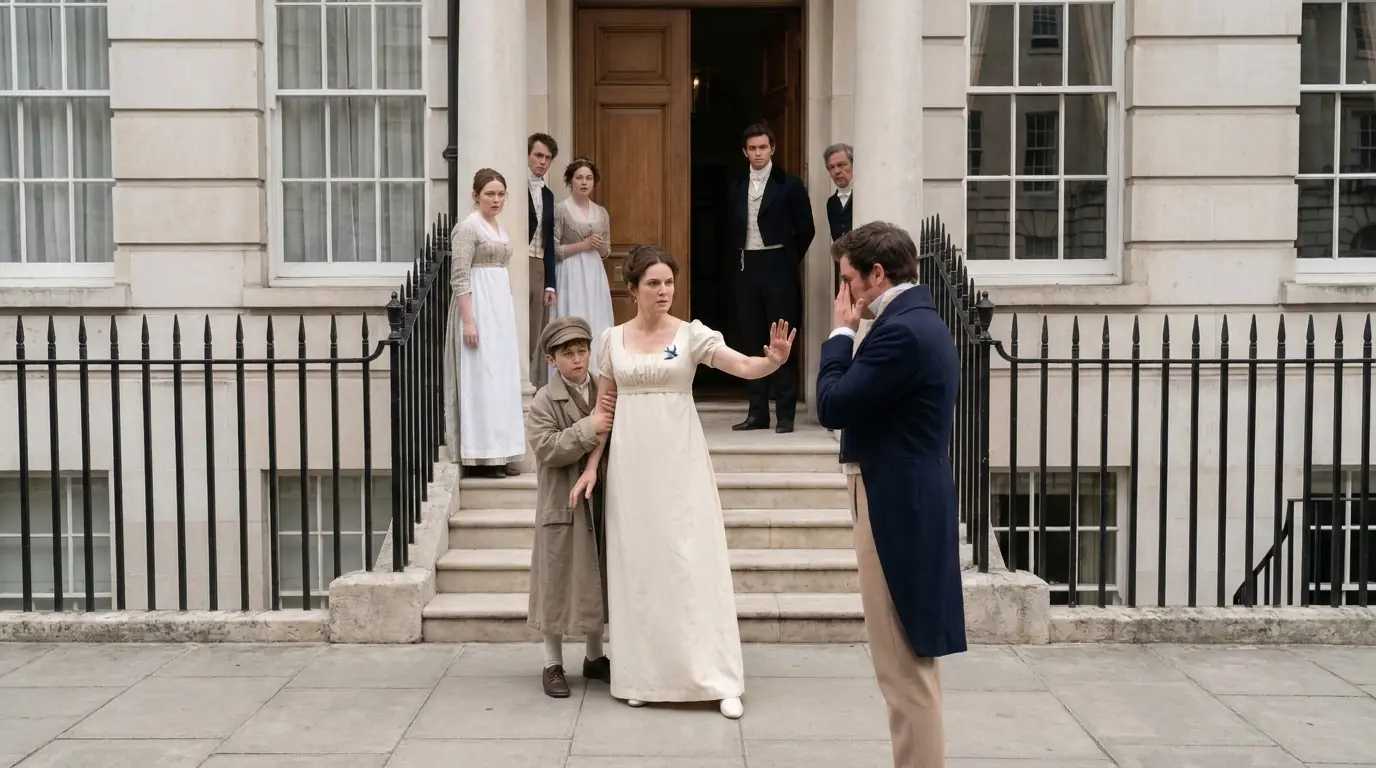
Anne still had one arm flung protectively across the servant-clad boy. Lord Algernon Brandon stood three paces away, holding his reddening cheek where her palm had struck him. The Duke of Yourbridge looked from Brandon to the child and said, with unnerving calm, "The boy you defended is my son."
Instead of running to his father, the child tightened both hands in the folds of Anne's cream gown. That frightened grip disturbed her more than the Duke's revelation. The Mayfair steps were warm beneath the afternoon sun, yet Anne felt suddenly cold. Her palm burned, and the blue enamel swallow pinned at her collar hung crooked, one wing loosened during the struggle.
Behind the Duke, servants and guests stared as though Anne had overturned the entire house. A moment earlier, Brandon had kicked a small figure dressed in an oversized servant's coat. Anne had not asked the child's name. She had simply stepped between them and struck before the boot could fall again.
Now the man she had slapped was a peer, the child was a duke's son, and the Duke's face revealed nothing.
"Your Grace," Brandon stammered. His outrage had transformed too quickly into fear. "The woman is deranged. She flew at me without cause. No doubt she arranged this little spectacle to catch your notice."
The onlookers' shock sharpened into calculation. A poor relation might be useful for years and condemned in a breath. Anne touched the damaged swallow and summoned the bright, capable smile by which she had survived Sophronia's tempers and society's casual humiliations. It came, though it cost her.
She did not ask the Duke to believe her. She looked down at the boy instead.
"Are you hurt?"
He shook his head. His gaze darted toward Brandon and then away. He still did not move toward his father.
The Duke noticed. Anne saw it in the slight tightening beside his mouth.
"Close the doors," he said.
The footmen obeyed at once.
"Everyone who witnessed the matter will come into the morning room. No one leaves until I have heard what occurred."
His voice was quiet, the voice of a man who expected the world to arrange itself at command. As the doors shut, Anne understood that he had postponed judgment, not ruin.
Lady Cordelia, the Duke's widowed sister and hostess, took her place near the mantel, looking ready to object personally to every lie. Sophronia Sinclair sat on the sofa behind a lace handkerchief. Anne had served as her beautiful half-sister's companion since their mother's death, and Sophronia's humiliation appeared deeper than Brandon's injury.
The Duke stood behind the boy without touching him.
"This is Lord Nathaniel Fenwick," he said. "My son. He was meant to be in the garden with his attendant."
Anne folded her hands over her skirts so no one would see their tremor. The Duke had accepted Cordelia's invitation to meet Sophronia. London expected a widower of his rank to marry again, and Sophronia possessed every accomplishment London admired. Anne had struck a peer before the very man her sister hoped to marry.
"He misunderstood an instruction to move," Brandon said, pacing as if motion might restore his authority. "The child scarcely speaks, and this companion of yours, Miss Sinclair, leapt at me like a fishwife. Impoverished women have employed stranger tricks."
Sophronia lowered the handkerchief just enough to look wounded by association while keeping her pleasant expression in place.
Anne said, "I saw a grown man kick a child. I stopped him. Had I known the boy was a duke's son, I would have done precisely the same. A boot does not fall more lightly upon a servant."
Brandon gave a short laugh. "You hear her, Your Grace? Incorrigible."
The Duke's gaze passed over Anne and settled on Nathaniel's hand. The boy had released her gown only to take hold of two of her fingers. Whenever Brandon spoke, his shoulders drew inward. Whenever Anne spoke, he looked up.
"You have explained what my son misunderstood," the Duke said to Brandon. "You have not once asked him what he saw. Miss Granville is the only person in this room who has asked whether he is injured."
Brandon's mouth tightened. "Your Grace, you cannot be considering the word of a paid companion over mine."
"I am considering your eagerness to provide my son's answer before he gives it."
The room went still.
Brandon's face hardened. "The papers will have this by morning. A duke's son wandering in livery. A violent woman installed in his sister's house. Your late wife's family already believes the boy neglected. This will serve them nicely."
The late duchess's brother had long urged that Nathaniel be placed with his maternal grandparents and had begun speaking of Chancery and neglect. He was unlikely to succeed, but the accusation alone could wound the boy for years.
The Duke raised one hand. "My carriage will take you home, Brandon."
"You dismiss me at your peril."
"I dismiss you because you have frightened my son."
"You will regret this afternoon, Miss Granville."
Anne smiled at him brightly, almost kindly. "I already regret that I had only one free hand, my lord."
Cordelia made a small sound that might have been a laugh. Sophronia shut her eyes.
When Brandon had gone, the Duke turned to Anne.
"My household requires a temporary governess," he said. "Lady Cordelia resides at Yourbridge House during the season, so your presence will be entirely proper. Six weeks. You will be paid, lodged respectably, and protected from any claim that you contrived the encounter."
It was strategy, not kindness. Appointed governess, Anne ceased to be a reckless companion seeking a Duke's notice. She became a woman charged with his son's care. The Duke was building a wall around the scandal, and Anne would be one of its stones.
Her smile did not move. "I am grateful, Your Grace. My wages are to be paid weekly to a banker in my own name. I am free to leave at the end of six weeks. And the money I have saved toward a schoolroom for servants' children remains mine, without expectation or interference."
His eyes narrowed a fraction. A woman in her position was expected to weep at rescue. Anne preferred terms.
"Agreed."
"Then I accept."
He gave one curt nod. The bargain was made.
As Nathaniel's fingers tightened around hers, Anne wondered why a child bearing one of England's greatest names had believed a servant's coat safer than his own.
Yourbridge House was an argument in favor of order. Clocks agreed. Doors opened before hands reached them. Footmen crossed the corridors without seeming to breathe. Cordelia occupied the east apartments, making Anne's residence proper, while Mrs. Hale received her with the grave courtesy offered to a temporary difficulty and recited the household rules.
"When does Lord Nathaniel climb trees?" Anne asked.
Mrs. Hale blinked. "I beg your pardon?"
"I shall discover it."
Anne unpacked three gowns, copied lessons, and placed on her desk the account book that held every shilling saved for her future schoolroom. She pinned the damaged swallow to her collar. It had belonged to her mother, and a worn crest marked the back, too faint to read.
On her second morning, Nathaniel entered the schoolroom before the bell. He wore a dark blue jacket suited to his rank and held something tightly in one fist. When he opened his hand, the missing piece of blue enamel lay in his palm.
"I found it beneath the steps," he whispered.
It was the first time Anne had heard his voice.
She accepted the broken wing as carefully as if it were a jewel. "Thank you."
His gaze fell at once, as though speaking had been an error. Anne set the enamel piece on the table between them.
"My mother called this swallow a truth token. Whoever holds it may speak without interruption. The rule applies to everyone."
She slid it toward him.
Nathaniel stared at the small blue wing. "Even you?"
"Especially me."
He picked it up. For several breaths, he said nothing. Anne opened the primer and waited without pretending not to wait.
"I did not misunderstand Lord Brandon," he said at last.
Anne kept her hands still.
"Thomas dropped a tray in the passage. Lord Brandon caught him by the collar and said he would have him whipped, though Thomas does not belong to him. Thomas was crying."
Nathaniel's thumb moved over the enamel.
"I told him to hide in the pantry and lend me his coat. I thought I could stand where he had been. If Lord Brandon tried again, I would take off the cap and tell him who I was. I thought he would be ashamed."
Anne's chest tightened.
"But he did not look at my face before he kicked me."
A nobleman had failed to see a child because he believed the child a servant. Nathaniel had learned in one blow that rank did not make cruelty more observant.
"And then Miss Granville struck him," said a voice from the corridor.
The Duke stood at the open door.
Nathaniel went pale. His fingers closed around the token, but Anne did not rise.
"Lord Nathaniel has the swallow, Your Grace."
The Duke's gaze moved from her to his son. Humphrey Fenwick's face was severe, his shoulders too still and his eyes too watchful. Yet Nathaniel's fear shifted something behind that severity.
"What else did you see?" he asked.
Nathaniel looked at the blue wing in his hand. "Anne stood in front of me before she knew my name."
When the clock struck eleven, the Duke should have returned to his study. Instead, he sat in a child-sized chair opposite them.
"May I join the reading lesson?"
Anne's smile slipped in surprise. "Only if you do not supply Lord Nathaniel's answers."
"So I begin under warning."
"You begin like every other pupil."
Nathaniel made a sound almost like laughter.
The Duke stayed.
That afternoon, Nathaniel apologized to Thomas in the kitchens for taking his coat and frightening him. The Duke watched from the doorway without correcting the words or hurrying the silence. Anne noticed and changed Nathaniel's lessons. Instead of repeating a tale's stated moral, he described what the character had actually seen and whether courtesy required agreement.
At first, he answered in fragments, then in sentences. The Duke appeared often at the schoolroom door and listened where Nathaniel could see him. At breakfast, Nathaniel once paused over a word for so long that Humphrey drew breath to provide it. Anne merely touched the handle of her teacup.
The Duke stopped.
The silence stretched until Nathaniel found the word himself.
Afterward, when the boy had gone, Anne said, "You waited."
Humphrey folded his newspaper. "I am learning that silence and listening are not the same act."
The answer warmed her more than it should have.
On the fourth morning, a brass brazier glowed in the draftiest corner of the schoolroom. Anne stopped beside it and held her reddened fingers toward the heat. No servant would have altered the room without instruction.
That same day, a receipt arrived from a respectable banker confirming that her first week's wages had been deposited in her own name. They had not been handed to Sophronia, withheld against expenses, or delayed until gratitude could be measured. Every term Anne had spoken in Cordelia's morning room had been remembered.
She placed the receipt inside her account book. For one unguarded moment, the bright smile came without effort.
At dinner, Humphrey asked why she wanted a schoolroom.
"A child who can read a notice is harder to cheat," Anne said. "A maid who keeps accounts need not trust every figure placed before her. A boy who writes his own name is harder to erase."
"You have planned it carefully."
"I have had years in which planning cost less than hope."
The next morning, unused slates appeared with a note claiming Cordelia had found them in a cupboard. Cordelia had never discovered anything in a cupboard in her life. Anne suspected Humphrey, thanked his sister, and said nothing.
Their warmth remained contained within proper rooms and defensible words. Yet Anne learned to recognize his tread before anyone else's. He knew she took no sugar and that she rubbed the swallow when a room became unkind. A duke did not look at a companion, she reminded herself. He looked at a solution.
The reminder became harder to believe.
Late on a Tuesday night, a cry broke the order of Yourbridge House. Anne was still awake, copying a reading passage by candlelight. She hurried to the nursery and found Nathaniel upright in bed, sobbing for his mother.
Humphrey reached the doorway moments later in a hastily tied dressing gown. His face had lost all color. He looked at Anne, and the command in his eyes was instinctive: soothe him, repair this, do what I cannot.
Anne remained beside the bed.
"He did not call for his governess, Your Grace."
Humphrey went rigid.
"He called for his father."
The boy's sobs filled the room.
"I cannot," Humphrey said. The words were almost soundless.
Anne's heart hurt for him, but she did not move aside. "You can sit beside him."
"I do not know what to say."
"Then say nothing. Stay."
For one moment, she thought he would retreat into rank. Instead, he crossed the room and knelt beside the bed. His hand hovered over Nathaniel's, then settled.
The boy looked at their joined hands and flung himself from the mattress. Humphrey caught him, folding around his son as though holding him against a storm. Anne stepped into the shadows and stayed there until Nathaniel's breathing slowed and Humphrey laid him back beneath the blankets.
When the Duke left the nursery, Anne followed him into the dim corridor. He stopped beside the wall and said nothing for a long time.
"My wife died of a fever after Nathaniel was born," he said at last. "She begged me not to let the physician bleed her again. He was celebrated, and I believed reputation must mean competence. I told her to endure one more treatment. She died before dawn."
Anne did not deny his part in it. He would have heard such kindness as false.
"I replaced tutors, nurses, even physicians because suspicion feels safer than reliance," Humphrey continued. "If I trust no one, no one can fail him through my error."
His order was not pride. It was penance made into a household system.
"Suspicion did not comfort Nathaniel tonight," Anne said. "You did."
His jaw tightened.
"He does not need a father who never chooses wrongly. He needs one who remains when the choice becomes difficult."
Humphrey lifted his head. For the first time since Anne had met him, his face was not softened but exposed.
He reached into the pocket of his dressing gown and drew out the blue swallow brooch. The broken wing had been restored. The pin was straight, and the enamel polished, though not made new.
"I sent it to a jeweler," he said. "I ought to have asked."
Anne touched the repaired edge with one fingertip. "You preserved the wear."
"You hold it there when you are trying not to show that a room has wounded you."
She looked at him. He had seen that.
"May I?" he asked.
Anne nodded.
Humphrey fastened the swallow at her collar. His knuckles brushed the base of her throat so lightly she might have imagined it, had every nerve not answered. He lowered his hands at once.
"Thank you for making me stay," he said.
Anne's cheerful mask did not return. She had no need of it in the quiet corridor.
The following afternoon, Cordelia's man of business arrived with a printer's proof folded beneath his coat. The paragraph was to appear in a widely read morning paper. It accused Anne of coaching Nathaniel, arranging the scene on Cordelia's steps, and securing a governess's position in order to supplant her own sister in the Duke's household.
It described her as violent, designing, and hungry for rank. Brandon's name appeared nowhere, but his hand was everywhere.
Humphrey summoned Anne to the study.
"The paper will be on every breakfast table tomorrow," he said, pacing behind the desk, each turn exact. "Your patroness has already been approached. Nathaniel's uncle will use the allegation to renew his demands. You cannot remain here while this spreads."
Anne stood before him with her hands folded. "What do you propose?"
"A carriage leaves at dawn. You will go to a dower house on my northern estate. Cordelia's former companion lives nearby. You will be safe, fully paid, and beyond Brandon's reach until the season ends."
He believed he was offering protection. Anne heard exile.
Her smile appeared, smooth, useful, and empty. Humphrey stopped pacing when he saw it.
"No," she said.
"Miss Granville—"
"You call it safety because exile is quieter than belief."
His expression closed. "I will not stand by while London tears you apart."
"You will send me away before London has the chance."
"I am trying to preserve your name."
"My name has never preserved me."
The smile vanished. Anne took one step toward the desk. She did not raise her voice. Years of swallowed anger made quietness more dangerous than shouting.
"Every household has valued me while I smiled, mended what was torn, remembered what others forgot, and made myself easy to keep. The moment truth becomes inconvenient, I become the inconvenience. If I leave tomorrow, Brandon will say I fled because I was exposed. Sophronia will return to society. Your household will recover. I alone will carry the stain."
Humphrey's hand tightened against the desk.
"You have nowhere else," he said, and the regret in his voice nearly undid her.
"I have my own hands. I have twelve pupils who do not yet exist. I have your son watching whether courage survives its first cost."
Her breath shook once.
"I will not teach him to speak and then disappear because a lord dislikes what he says."
The room was silent.
Humphrey came around the desk and stopped two paces away. He did not reach for her or offer money as though poverty were the whole of her fear.
"You are right," he said.
Anne had prepared for argument. The admission struck deeper.
"I was removing the risk instead of choosing whom to trust. Stay through Cordelia's Midsummer Assembly. Stand beside me. I will not hide you, and I will not speak in your place."
She searched his face. "Even if Nathaniel's family threatens Chancery?"
"Even then."
"Even if your friends withdraw?"
"They may discover the door."
A laugh almost rose in her throat. It emerged as one uneven breath.
"Then I will stay."
Outside the half-open door, Cordelia saw Anne touch the repaired swallow. The movement turned the brooch, exposing the worn crest engraved upon its back. Cordelia's expression changed. She said nothing then, but that evening she asked Anne, very casually, whether the brooch had belonged to her mother.
The paper appeared the next morning. The punishment was precise. Ladies who had greeted Anne at church looked through her. A milliner refused Sophronia's account and made certain Anne heard why. Mrs. Pember, who had promised fifty pounds toward the schoolroom, withdrew it until Anne's position became respectable.
Anne read the note once, folded it, and placed it in her account book beside the banker's receipt. At lessons, she asked Nathaniel to read aloud. Her voice did not shake.
That afternoon, Brandon appeared beyond the railings of Yourbridge House as Nathaniel and Anne returned from the square. He raised his voice for the passing carriages.
"Well, boy," he called, "has your governess taught you the next part? Tears at the proper moment, perhaps?"
Nathaniel froze.
Humphrey came down the front steps before Anne could turn. He moved fast enough that the footman behind him nearly stumbled. The Duke placed himself between Brandon and the child.
"You will not address my son."
Brandon smiled. "You cannot command the whole of London, Yourbridge."
"No. Only this house, this pavement, and every servant under my protection. Threaten one of them again, and I will ensure every club and drawing room knows precisely why you were barred from my door."
The heat beneath Humphrey's restraint was unmistakable. He did not strike Brandon. He did not need to.
Brandon glanced at Anne. "Tomorrow night at Lady Cordelia's assembly, I shall ask Miss Granville for the apology she owes me. My invitation was issued weeks ago. If it is withdrawn now, everyone will know you fear what I might say."
Humphrey's shoulders went still.
Anne stepped beside him. "The invitation will stand."
Both men looked at her.
"If Lord Brandon wishes to demand my apology before witnesses," Anne continued, "he may hear my answer before witnesses."
Brandon's confidence faltered for one instant. Then he bowed and walked away.
Humphrey turned to Anne. "I could have him excluded."
"I know."
"You need not endure a public trial to prove courage to Nathaniel."
"It is not courage if I am never permitted to choose the cost."
His gaze held hers.
"Anne," he said.
It was the first time he had used her Christian name. The sound of it in his voice was more intimate than touch.
"The carriage remains at your disposal until tomorrow evening," he said. "Not as an order. As a choice."
"I will be at the assembly."
"I know."
Sophronia had watched from the doorway, but she did not immediately approach them. That evening, she entered Anne's room holding a sealed note between two fingers as though it had soiled her gloves.
"Brandon sent this."
Anne looked up from the torn cuff of her cream gown, which she was mending for the assembly. Sophronia laid the letter upon the table.
"He says that if I contradict him tomorrow, he will tell every paper that I helped you arrange the incident. He says no respectable gentleman will risk marrying a woman connected to such a scheme."
Anne read the page. Brandon had used courtesy as a sheath for every threat. He advised Sophronia to keep her half-sister silent for the sake of her own future.
"You need not involve yourself," Anne said. "No one expects you to defend me."
Sophronia stared at her. "He threatens me, and you still try to spare me."
"You have more to lose, and you have spent years losing things on my behalf."
Anne returned her attention to the needle. "That was my position."
"No." Sophronia's voice sharpened. "That was my convenience."
The admission made Anne's hand still.
Sophronia took up Brandon's letter and tore it once, then again.
"He believes I shall sacrifice you because I have always permitted you to be sacrificed." Her face flushed, not prettily but honestly. "He is mistaken."
Anne looked at her sister.
Sophronia lifted her chin. "You will not stand alone tomorrow."
It was not an apology for every year Anne had spent fixing gowns, soothing tempers, and receiving blame. It was perhaps the first act from which an apology might someday grow. Anne accepted it as such.
Lady Cordelia's Midsummer Assembly returned them to the house where the scandal had begun. Candles burned in the chandeliers while musicians tuned beneath the gallery. Every conversation altered when Anne entered the upper hall.
She had refused the new gown Humphrey offered to provide. Instead, she wore the same plain cream dress she had worn on the steps. The torn cuff had been mended so neatly that only she knew where Brandon's hand had caught it. The blue swallow rested at her throat.
She chose not to disguise the woman London had condemned.
At the foot of the staircase, Humphrey waited in formal black. He did not come up to fetch her as though she might retreat. He waited where she could decide whether to join him.
Anne descended. He offered his arm, and she took it. His sleeve felt steady beneath her fingers.
Together, they entered the ballroom.
Several guests turned their shoulders. Others stared openly. Mrs. Pember lowered her fan and looked away.
Humphrey guided Anne to the center of the room and stopped. Brandon stepped from the crowd before the first set could be announced. Wine had reddened his face, but his voice carried cleanly.
"Your Grace, do you truly intend to parade this woman before us? She assaulted me, coached your son, and used the confusion to gain a place under your roof."
He turned to Anne.
"I require an apology, Miss Granville. Confess that you staged the affair, and I may be persuaded to let the matter rest."
Humphrey's arm hardened beneath her hand.
Anne released him. He looked at her once and then stepped back. That was his part of the promise.
She walked forward alone.
"I will not apologize to you, Lord Brandon."
Her voice carried through the ballroom. The brightness she had worn for years was gone. What remained was quieter and stronger.
"I saw a grown man kick a frightened child. I believed the child to be a servant. I stood between you and him before I knew his name. Learning that he was a duke's son does not improve my action or excuse yours. I would do the same again."
A murmur moved through the room.
Brandon laughed too loudly. "A noble performance. The boy has been taught his lines."
Anne turned toward Nathaniel. He stood beside Cordelia near the edge of the dance floor, pale but upright.
Anne unpinned the swallow. She crossed the room, knelt before him, and placed it in his palm.
"This belongs to you for as long as you require it," she said.
The room was quiet enough to hear the candles spit.
"You may speak, remain silent, or leave. Whatever you choose, you will not lose my affection."
She rose and stepped away.
Nathaniel looked at Brandon. Then he looked at his father.
Humphrey gave no signal. He stood where Anne had left him and allowed the choice to remain Nathaniel's.
Nathaniel closed his fingers around the blue enamel.
"I borrowed Thomas's coat," he began.
His voice was small. No one interrupted.
"Lord Brandon caught Thomas by the collar after Thomas dropped a tray. He said he would have him whipped. I told Thomas to hide and give me the coat because I thought Lord Brandon would stop if he knew I was a lord."
Nathaniel swallowed.
"He did not look before he kicked me. Anne stood in front of me before she asked who I was."
Brandon's face changed.
"This is absurd," he said. "A child's invention."
"No, my lord," said another voice.
Thomas stood near the servants' door with Mrs. Hale behind him. His face was white, but he stepped into the ballroom.
"It was my coat," he said. "Lord Nathaniel took my place because Lord Brandon threatened me. Miss Granville could not have planned it. She had never seen me before that day."
The servants along the wall lifted their eyes. For the first time, the room was required to see them.
Sophronia moved next. She wore rose silk and carried Brandon's torn letter folded inside one gloved hand.
"His Grace came to my sister's house to call upon me," she said. "Anne did not know he had accepted the invitation. She had no possible reason to expect his notice."
She held Brandon's gaze.
"And when Lord Brandon discovered that I might contradict him, he attempted to frighten me into silence. His mistake was believing every woman in this room values his approval more than the truth."
A dowager near the musicians closed her fan. Mrs. Pember looked directly at Brandon. One by one, the bodies nearest him shifted away.
Brandon appealed to the Duke. "Yourbridge, surely you will not allow servants and frightened children to condemn a peer."
Humphrey stepped forward then.
"They have not condemned you," he said. "They have described you."
The words fell with lethal calm.
"You struck downward because you believed no one of consequence was looking. Miss Granville proved you mistaken. You will leave my sister's house. You will not be received in mine, nor in any house that values my friendship."
Brandon looked around. No one offered him an arm or even the mercy of looking away. As he passed the servants, three met his eyes.
He left without another word.
The silence afterward felt different. Not empty. Released.
Humphrey did not follow Brandon with his gaze. He turned to Anne.
"I told you once not to apologize," he said, clearly enough for everyone in the room to hear. "I repeat it now."
Anne stood with her hands at her sides, no duke's arm beneath them and no token in her grasp.
"London may decide that your ignorance of Nathaniel's rank excuses what you did. I believe it proves your worth. You saw someone powerless and protected him before rank could make the act advantageous."
His gaze moved briefly across the watching room.
"Let no one present mistake Miss Granville's courage for ambition. She defended a servant when she believed no duke would ever know her name."
The public judgment had been answered.
Cordelia gave a small signal to the musicians. The first notes of a country dance rose beneath the gallery, tentative at first and then steady. Conversations began again in low currents as guests shifted away from the center of the floor.
Humphrey offered Anne his arm. "Will you walk with me?"
She placed her hand upon his sleeve.
He led her only as far as the deep window recess at the edge of the ballroom. The velvet curtain and stone embrasure softened the noise behind them. Cordelia remained nearby with Nathaniel, close enough to lend propriety but far enough to grant them privacy.
Humphrey turned toward Anne. When he spoke again, his voice belonged only to her.
"I employed you because I feared scandal. I trusted you because of what you did when no reward was possible."
The control in his face did not vanish. It opened just enough for her to see what it had guarded.
"I love you because you taught my son to speak and taught me to remain long enough to listen."
He held out his hand between them.
"Anne, will you do me the honor of becoming my wife?"
No hundred faces heard the question. No social triumph could answer it for her.
For years, Anne had believed usefulness was the rent she paid for shelter. Humphrey was offering himself after she had been seen at her most difficult, not merely her most useful.
Still, she would be heard.
"On two conditions, Your Grace."
A rare warmth entered his eyes. "Only two?"
Nathaniel made a muffled sound behind Cordelia's skirts.
"Nathaniel's voice is never again to be treated as disobedience merely because it is inconvenient. And the schoolroom remains my work, not a decoration upon the Yourbridge name and not a charity to be opened or closed according to fashion."
"I agree."
"You have not heard the accounts."
"I shall hear them whenever you choose to show me."
"And if I refuse your money?"
"I shall attempt to survive the disappointment."
Anne's smile came then. Not the bright shield, but her own.
She placed her hand in his. "Yes."
Humphrey closed his fingers around hers and bowed over her hand with a reverence that made her throat ache. Cordelia looked resolutely toward the dancers. Nathaniel did not pretend not to watch. In his open palm, the swallow caught the candlelight.
Humphrey straightened. "May I have this dance?"
"You have not yet proved you can follow."
"Then I must choose an excellent teacher."
When they left the window recess together and stepped onto the floor, the room required no announcement to understand that Humphrey Fenwick had chosen her.
Brandon withdrew his complaint rather than face Nathaniel, Thomas, and the footman who had witnessed the kick. The late duchess's brother abandoned his talk of Chancery when Nathaniel's growing steadiness became impossible to deny. Mrs. Pember's fifty pounds returned with an apology.
Anne sent both back.
"The school may accept a subscription next year," she told Cordelia, "after Mrs. Pember has learned that respectability is not a weather vane."
Cordelia pretended not to smile.
After the engagement, Cordelia asked to examine the swallow. Its worn crest led her solicitor to an old parish register and a sealed marriage settlement. Anne's mother had lawfully married Sir Edmund Granville before his death, though his family had concealed the marriage. The settlement provided a modest annuity to a surviving daughter.
Anne read the letter twice. It gave her money, an undisputed name, and proof that her mother had not lied. It did not create the value others had failed to see.
Humphrey received the news without triumph.
"I am pleased for your mother," he said. "And pleased that the schoolroom will torment fewer of my ledgers."
"It will not touch your ledgers at all."
"So you have informed me."
He had asked for her before the register was found. Anne loved him more for never mentioning that fact.
By autumn, Anne had leased an unused lodge near Yourbridge village with her annuity. The agreement bore her own name, and Humphrey altered no line after she approved it. The school served children in the morning and older pupils in the evening. Thomas trained in the estate office and attended arithmetic lessons.
Sophronia sent books instead of gowns and learned the pupils' names.
On the morning before Anne's wedding, the schoolroom smelled of chalk, damp wool, and newly cut wood. Twelve slates waited upon the desks. Anne lifted a box of primers and felt the weight pull at her shoulder.
By habit, the bright smile arose before anyone could notice.
Humphrey stood by the window. He noticed.
"Are they too heavy?" he asked.
Anne almost said no. Then she let the smile go.
"Yes."
The word felt more intimate than her declaration in the ballroom.
Humphrey did not take the box until she released it. Then he carried it to the front table.
"Where?" he asked.
"Beside the slates."
He placed it there. Help given because she had named what she needed.
They were married the following day in the estate church, with Cordelia, Sophronia, Nathaniel, Thomas, and half the household crowded into the pews. Humphrey's hand remained steady beneath Anne's as they signed the register.
The public opening of the schoolroom took place the next morning. Parents stood along the walls. Servants who had once lowered their eyes now met Anne's openly. Mrs. Hale inspected the benches and pronounced them adequate, which from her amounted to celebration.
Nathaniel stood before the first row of pupils. The blue swallow lay in his palm.
"This token belongs to the speaker," he told them. "No one may interrupt. Not even a duke."
Humphrey, standing beside Anne, inclined his head in solemn agreement.
Nathaniel began the first reading passage. His voice trembled on the opening line, steadied on the second, and carried clearly through the third.
Anne touched the bare place at her collar.
Humphrey slipped his hand into hers, not to speak for her and not to hold her up, but simply to stand where she could feel that he had stayed.
The swallow belonged to whoever needed courage next.
Anne's hands were empty.
For the first time, that did not mean she had nothing.