The slap was loud enough to stop a lawn mower two houses away. Caroline Hargrove staggered backward across her driveway, pressed one hand against her left cheek, and stared at Julian Mercer as though he had just attacked her in broad daylight.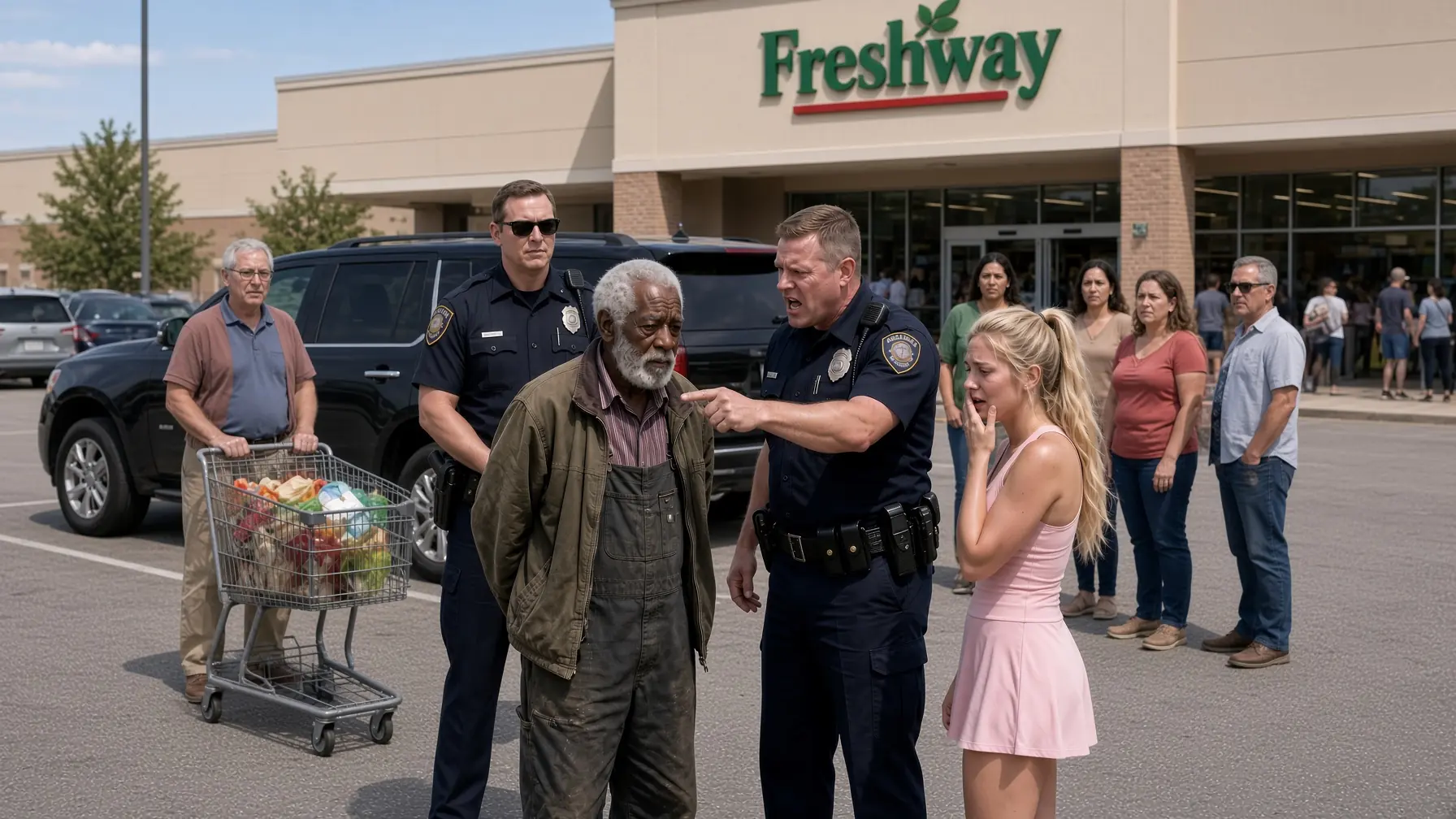
“Stay away from me,” she screamed, raising her voice so the entire block could hear.
“He hit me because I told him to get off my property.”
Julian did not move. He stood near the edge of the sidewalk with both hands open and visible, one palm still raised from the moment he had asked Caroline to step back. At sixty-six, he had spent too many years in federal courtrooms to underestimate how quickly one panicked movement could become somebody else’s version of the truth. “Mrs. Hargrove,” he said evenly, “you know I never touched you.”
Caroline’s eyes filled with tears almost instantly. The tears looked convincing, but the expression behind them was something Julian had seen on witnesses who knew exactly where a story needed to go next. She pulled out her phone, tapped 911, and transformed her voice into a frightened whisper. “Please send somebody quickly. My neighbor just struck me in the face, and I’m afraid he may do it again.”
The neighborhood around them looked almost absurdly peaceful. Cedar Grove Estates sat outside Atlanta behind stone entrance columns, trimmed hedges, ornamental ponds, and houses large enough that the garages resembled small storefronts. Every lawn seemed to stop at the same height, every mailbox followed the same approved design, and the neighborhood association sent reminders about everything from holiday decorations to trash cans being visible five minutes too long. People paid a premium to live somewhere that looked controlled.
Julian had spent the previous fifteen minutes helping seventy-year-old Teresa Morales move a massive glazed planter away from the edge of her driveway. Teresa had undergone knee surgery the year before and remained stubborn enough to insist she could move anything herself until Julian caught her trying to drag the thing with a towel. He rolled up the sleeves of his blue button-down shirt, helped reposition the planter, and was walking home when Caroline came storming from her driveway. The Georgia heat had already left damp patches under his arms, making him look far less formal than most of the neighbors were accustomed to seeing him.
“Excuse me,” Caroline called sharply. Julian turned, expecting a question about parking or perhaps Teresa’s planter.
Instead, Caroline pointed toward a row of rose bushes enclosed behind a decorative iron border. “I watched you walk through my flower bed.” Julian looked at the roses and then back toward her.
“I haven’t been in your yard.” Caroline took another step toward him. “Those roses were imported from France, and one of them has been damaged.”
Julian glanced toward the plants again. They were several feet inside her property line and showed no obvious damage from where he stood. “I was helping Mrs. Morales beside her driveway,” he said. “I stayed on the sidewalk.”
“Don’t lie to me.” Caroline’s voice climbed quickly. Across the street, Helen Porter stopped watering her hydrangeas and looked up.
A landscaping teenager named Isaiah Brooks turned off his hedge trimmer. A mail carrier slowed his truck. The block began paying attention.
Julian sensed almost immediately that the argument was not really about roses. Caroline’s anger had too much direction. Each time she raised her voice, she repositioned herself slightly closer to the front entrance of her home.
Julian followed the movement with his eyes. A doorbell camera sat beside the front door. Caroline was guiding the confrontation toward its field of view.
“You need to stop moving toward me,” Julian said. Caroline ignored the request and jabbed one finger toward his chest. “People like you come into communities like this and think the rules don’t apply.”
The phrase landed exactly as Julian expected it to. People like you. Caroline did not explain what she meant, and she did not have to.
Teresa hurried from the neighboring driveway. “Caroline, what are you doing?” Caroline spun toward her.
“Stay out of this.” She pointed back toward Julian. “Unless you want to explain why you’re helping someone trespass.”
“Trespass?” Teresa stared at her. “He was helping me move a planter.”
Caroline laughed coldly. “Of course you’d say that.” Julian raised one hand between them.
“Enough.” His palm faced outward. “Mrs. Hargrove, step back.”
That was the moment Caroline had apparently been waiting for. She raised her own right hand and slapped herself hard across the left side of her face. The sound cracked across the driveway.
Then she stumbled backward as though Julian’s open palm had struck her. “He hit me!” she screamed. “Oh my God, he hit me!”
Julian froze. Teresa’s mouth fell open. Isaiah, twenty feet away, had already been filming.
“What are you doing?” Teresa shouted. Caroline clutched her cheek.
“Did you see that?” she cried toward the neighboring homes. “He attacked me in my own driveway.”
Julian kept his arms away from his body. “Do not come near me again,” he said. “And do not say I touched you.”
Caroline was already dialing 911. Her performance shifted from outrage to terror so smoothly that Julian understood how dangerous the next few minutes could become. She sobbed into the phone, described Julian as an aggressive neighbor, and repeated that he had struck her when she confronted him about property damage.
Teresa stepped closer. “Tell them you slapped yourself.” Caroline turned on her.
“You’re lying for him.” Teresa stared at her in disbelief. “I watched you do it.”
Caroline’s tears stopped for half a second. That brief pause told Julian more than the crying ever could. Then her face twisted back into wounded disbelief.
“How dare you.” Caroline pointed toward Teresa. “You saw him threaten me.”
“No.” Teresa’s voice hardened. “I saw you manufacture an assault.”
More neighbors appeared. Some held phones. Others stood with folded arms, already trying to decide which person looked more believable.
Julian had watched similar things happen inside courtrooms. Facts rarely arrived alone. They arrived surrounded by tone, clothing, status, fear, memory, loyalty, and whatever assumptions people brought into the room before the first word was spoken.
Caroline knew that. Julian suspected she was counting on it.
Three minutes later, police sirens entered Cedar Grove Estates. Two patrol cars stopped near Caroline’s driveway, and Sergeant Mark Dalton stepped out of the first before the second car fully stopped. Dalton was broad through the shoulders, in his mid-forties, with the impatient gait of a man already annoyed about having been called there.
Officer Evan Pierce emerged from the second cruiser. He was younger and looked immediately from Caroline to Julian, then toward Teresa and the growing number of neighbors. Dalton barely looked anywhere except Caroline’s reddened cheek.
“Thank God,” Caroline cried, moving toward him. “That man attacked me.”
Dalton looked toward Julian. “Sir, turn around.”
Julian did not move. “Officer, am I being detained?”
Dalton’s hand moved toward his cuffs. “You’re about to make this worse.”
Julian kept his voice level. “I am asking whether I am under arrest or being detained.” Dalton stepped closer.
“Hands behind your back.” Officer Pierce shifted uncomfortably.
Teresa called from the driveway, “She hit herself.” Dalton ignored her.
“I saw it.” Teresa stepped forward. “She slapped herself and then started screaming.”
Dalton’s eyes stayed fixed on Julian. “Last warning.” Julian watched him reach for his wrist.
“Sergeant Dalton,” he said quietly, “before you put those cuffs on me, I recommend that you verify my full name.” Something in his tone finally interrupted the officer’s momentum.
Dalton frowned. “Name.” Julian answered, “Julian Anthony Mercer.”
Then he added, “The Honorable Julian Mercer.” Pierce looked toward him.
“You’re a judge?” Caroline immediately interrupted.
“Don’t let him scare you with a title.” She pointed toward Julian. “Powerful people always think they can intimidate everyone.”
Pierce walked back toward his cruiser and called dispatch. Julian remained exactly where he was. Dalton’s grip stayed near the cuffs but no longer closed around them.
The radio response came quickly. Pierce listened, then slowly turned toward Dalton. “Sergeant.”
“What?” Dalton asked.
Pierce stepped closer and lowered his voice. Whatever he said changed Dalton’s expression. Julian recognized the transition from certainty to discomfort.
Julian Mercer was not a local traffic judge or a retired attorney using an honorary title. He had served for twenty-three years on the federal bench in the Northern District of Georgia, after working as a federal prosecutor and civil-rights attorney. His name had appeared in national newspapers during corruption cases involving mayors, contractors, and public officials.
Dalton cleared his throat. “All right, Judge.” Julian’s eyes narrowed slightly.
“My title does not determine whether I committed an assault.” Dalton looked away.
Caroline jumped back into the conversation. “Exactly. Look at my face.”
She pointed toward the red mark she had created herself. “He hit me.”
Julian turned toward Pierce. “Interview Teresa Morales.” Then he nodded toward Isaiah.
“And interview the young man recording by the landscaping truck.” Dalton glanced at Isaiah.
“The kid can wait.” Isaiah’s shoulders tightened.
Julian noticed.