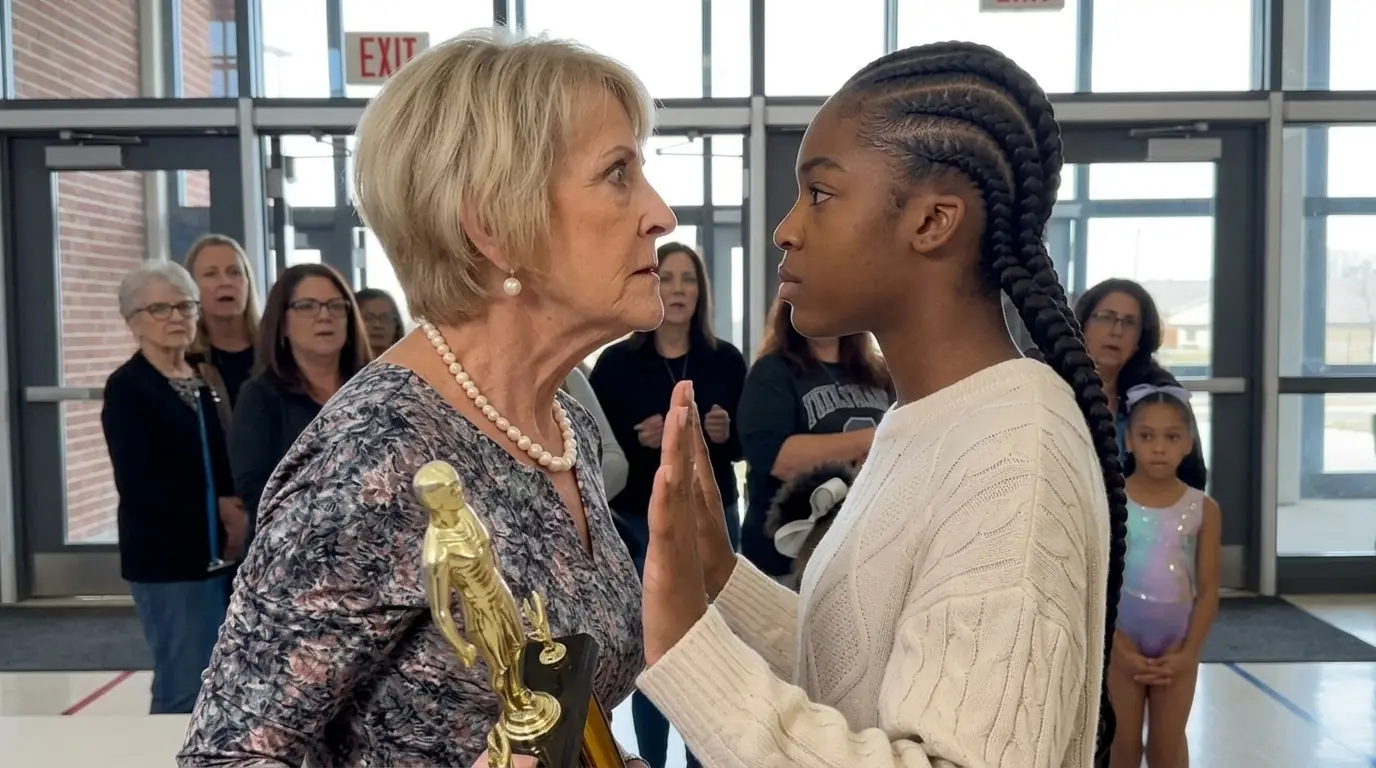
The first thing eight-year-old Lena Carter asked after winning the biggest trophy of her life was whether she could hold it in the car on the way home. She stood beneath the bright lights of the Eastbrook High School gym with tears drying at the corners of her eyes, a rainbow-colored gymnastics leotard sparkling beneath an oversized warm-up jacket. The trophy was almost half her height, with a gold gymnast mounted above two dark-red columns, and Lena held it against her chest as if somebody might tell her the whole afternoon had been a mistake. Less than five minutes later, somebody did.
But the story had started long before a grown woman put her hand on that trophy.
Six months earlier, nobody outside one neighborhood gym in Dayton, Ohio, knew Lena Carter’s name. She trained three evenings a week at Southline Youth Athletics, a converted warehouse squeezed between a tire shop and a church food pantry. The mats were patched, the balance beams had been purchased secondhand, and during winter practice the coaches sometimes wore sweatshirts because the building’s heating system had moods of its own. Lena loved every inch of it.
Her older sister, Taryn Carter, was usually the person sitting on the folding chair beside the entrance waiting for practice to end. Taryn was twenty-one, studying elementary education at Wright State and working weekend shifts at a grocery store to help their mother with bills. She had been eleven when Lena was born, old enough to remember bottles, diapers, first steps, and the exact night their father left and stopped pretending he intended to come back. Somewhere along the way, sisterhood had quietly acquired responsibilities neither girl had chosen.
Their mother, Monica Carter, worked overnight at a distribution center outside the city. She slept while the girls were at school, left for work shortly after dinner, and measured most weeks by overtime opportunities. Monica hated missing Lena’s practices, but gymnastics was expensive even at Southline, and every additional shift kept another month of tuition paid. Taryn became the person who learned how to tighten Lena’s ponytail, sew loose rhinestones onto competition leotards, and tell whether “my ankle hurts” meant injury or nerves.
Lena was not the kind of child adults immediately described as fearless. She was shy around strangers, hated speaking in front of classrooms, and once cried because a substitute teacher pronounced her last name incorrectly three times. But the second her bare feet touched a gymnastics floor, something changed. The girl who barely raised her hand in school would sprint toward a tumbling pass as if gravity had personally insulted her.
Coach Marisol Vega noticed first.
“She doesn’t know she’s good yet,” Marisol told Taryn one evening while Lena practiced cartwheels on a strip of blue floor. “That’s actually a gift.”
Taryn watched her sister land awkwardly and immediately try again.
“Why?”
“Because right now she loves the work more than she loves being praised for it.”
Marisol had coached long enough to know that could disappear quickly. Youth sports had a way of turning children’s joy into adult competition before anybody admitted it was happening. Parents tracked scores, posted rankings, argued about judges, bought private lessons they could not comfortably afford, and sometimes reacted to eight-year-olds losing as if scholarship committees were hiding beneath the bleachers.
The Carter family had no money for that world.
Lena’s competition bag was a hand-me-down from another gymnast. Taryn bought used warm-up pants through a parent Facebook group, and Monica sometimes paid meet fees in two installments. Lena did not know any of this because the adults around her worked hard to make sure she only knew where to stand when her name was called.
By February, Coach Marisol believed Lena was ready for the Midwest Rising Stars Invitational.
It was one of the largest independent youth meets in the region, hosted every spring inside Eastbrook High School’s gymnasium. More than two hundred young athletes came from clubs across Ohio, Indiana, and Kentucky. There were team banners, professional photographers, livestream cameras, long tables covered with trophies, and enough nervous parents to fill the bleachers before nine in the morning.
The entry fee alone made Taryn wince.
Monica saw the number and remained silent for a long time.
Then she asked, “Does she have a real chance?”
Taryn smiled.
“That’s not a safe question to ask around Coach Marisol.”
Monica laughed.
Marisol answered it anyway.
“Yes.”
That was how Lena’s name ended up on the Level Four registration list.
It was also how the Carters first encountered Diane Holloway.
Diane was fifty-eight, blond, carefully dressed, and one of those volunteers who somehow moved through an event as though she owned more of it than the people actually in charge. Her granddaughter, Sophie Holloway, trained at North Valley Elite, the most expensive gymnastics club in the county. Sophie had won the Rising Stars all-around title the previous year.
Diane had told nearly everyone that she expected a repeat.
She helped at the registration desk because North Valley supplied volunteers in exchange for discounted team fees. She arranged trophies, checked wristbands, directed families to warm-up areas, and frequently reminded people that she had “been part of this meet for seven years.” Nobody had officially given Diane authority over scoring or athletes.
That detail did not appear to matter to Diane.
The first problem happened at check-in.
Taryn arrived with Lena at seven fifteen in the morning, carrying a garment bag, backpack, two bottles of water, and a travel mug of coffee she had forgotten to drink. Monica had worked overnight and promised to arrive before the first rotation if her replacement came on time. Lena stood beside Taryn wearing Southline’s black-and-purple tracksuit and bouncing lightly on her toes.
Diane looked at the registration sheet.
“Southline?”
“Yes,” Taryn said.
Diane looked toward Lena.
“She’s Level Four?”
“Yes.”
“How old?”
“Eight.”
Diane stared at her again.
“Do you have proof?”
Taryn frowned.
“Proof of her age?”
“We’ve had category issues.”
Taryn looked at the parents checking in beside them.
Nobody else had produced a birth certificate.
“What kind of proof do you need?”
Diane tapped the keyboard.
“Birth certificate would be ideal.”
“I was told we needed her membership card.”
“That may work.”
Taryn handed it over.
Diane examined the card longer than seemed necessary.
Lena squeezed her sister’s fingers.
Eventually Diane returned it.
“Fine.”
Taryn smiled without warmth.
“Good morning to you too.”
They walked away.
Lena waited until they were out of hearing distance.
“Did I do something wrong?”
Taryn stopped.
“No.”
“Why did she ask my age?”
“Because some adults enjoy asking questions they already have answers to.”
Lena frowned.
“That doesn’t make sense.”
“Congratulations. You understand adults.”
Lena smiled.
The moment should have disappeared.
Instead, it became the first piece of a pattern.
During warm-ups, Southline was initially directed to a floor area near the main equipment. Ten minutes later, Diane approached Coach Marisol and said their group needed to move because North Valley had been assigned the space. Marisol produced the schedule showing Southline’s name.
Diane barely looked at it.
“There was a change.”
“Who changed it?”
“Meet staff.”
“Which meet staff?”
Diane’s expression tightened.
“Do you really want to make this difficult?”
Marisol folded the schedule.
“No. I want you to tell me who changed my warm-up assignment.”
A different volunteer eventually arrived.
There had been no change.
Southline stayed.
Taryn watched Diane walk away.
“She likes us.”
Marisol did not smile.
“She likes being obeyed.”
The competition began at nine.
Lena’s first event was vault.
She landed slightly forward.
Not terrible.
Not great.
When the score appeared, she was fourth.
Sophie Holloway was first.
Diane stood near the awards table clapping loudly.
Lena looked toward Taryn.
Taryn gave her two thumbs up.
On bars, Lena improved.
She hit every transition and stuck the dismount clean enough that Coach Marisol slapped both hands together before the judges finished writing. Her score moved her into second overall.
Sophie remained first.
Then came beam.
Beam had been Lena’s enemy for most of the season. She could perform the routine perfectly twenty times in practice and suddenly wobble the moment judges appeared. Two weeks earlier, she had fallen during an in-house mock meet and cried in the bathroom afterward.
Marisol had followed her.
“You know what the beam wants?”
Lena sniffed.
“What?”
“For you to be scared of falling.”
Lena wiped her face.
“That’s mean.”
Marisol smiled.
“So don’t give it what it wants.”
At Rising Stars, Lena climbed onto the beam.
Taryn stopped breathing normally.
Monica had arrived twelve minutes earlier and sat beside her, still wearing the sweatshirt she used for work. Neither woman spoke.
Lena began.
Mount.
Turn.
Leap.
Cartwheel.
Nothing spectacular.
Nothing unstable.
She reached the final series.
Back walkover.
Step.
Dismount.
Her feet hit the mat.
Did not move.
For half a second, Lena herself looked surprised.
Then she smiled.
The judges gave her the highest beam score in her division.
Monica screamed.
Half the Southline parents jumped.
Taryn covered her face with both hands.
Diane Holloway did not clap.
The final event was floor.
This was Lena’s favorite.
The music started with a sharp violin note, and the shy little girl who worried about speaking too loudly disappeared. Lena moved across the floor with confidence Taryn rarely saw anywhere else. Her final tumbling pass landed near the corner.
She saluted.
The audience applauded.
Her score appeared.
9.625.
Coach Marisol turned toward the scoreboard.
Then toward Taryn.
“Oh, wow.”
“What?”
“If my math is right—”
“Don’t say it.”
“I think she won.”
Taryn looked toward Lena, who was already asking another gymnast whether they could trade snacks.
She laughed.
“Don’t tell her.”
Final scores were posted twenty minutes later.
LEVEL FOUR — AGES 8–9
1. LENA CARTER — SOUTHLINE YOUTH ATHLETICS
2. SOPHIE HOLLOWAY — NORTH VALLEY ELITE
The difference was 0.075.
Less than one tenth.
Sophie cried when she saw it.
Not loudly.
She simply turned toward her mother and buried her face against her.
Lena noticed.
Her excitement disappeared immediately.
“Is she okay?”
Taryn looked at Sophie.
“She wanted to win.”
“I didn’t mean to make her sad.”
“You didn’t.”
“But I won.”
“That’s not the same thing.”
Lena thought about it.
Then she walked toward Sophie.
Taryn almost stopped her.
She decided not to.
Lena stood several feet away.
“Your floor was really good.”
Sophie looked up.
Her eyes were red.
“Thanks.”
“You did that thing with the split jump better than me.”
Sophie wiped her face.
“My coach makes me practice it every day.”
“That sounds horrible.”
Sophie laughed.
Just a little.
Diane saw them talking.
She walked over immediately.
“Sophie, your team is waiting.”
Sophie nodded.
Lena smiled.
“Good job.”
Diane looked at Lena but did not respond.
She led her granddaughter away.
Taryn watched.
Something in the older woman’s expression bothered her.
Awards began at eleven forty.
Rows of athletes sat on the gym floor while families crowded behind barriers. Trophies glittered across a long black-covered table near the stage. A volunteer called placements from sixth through first.
When Lena’s name was announced, she froze.
“Go,” Taryn whispered.
Lena ran toward the podium.
The first-place trophy was enormous.
A volunteer handed it to her.
Lena’s eyes widened.
The room erupted in applause.
Monica cried.
Taryn recorded with one hand while crying with the other.