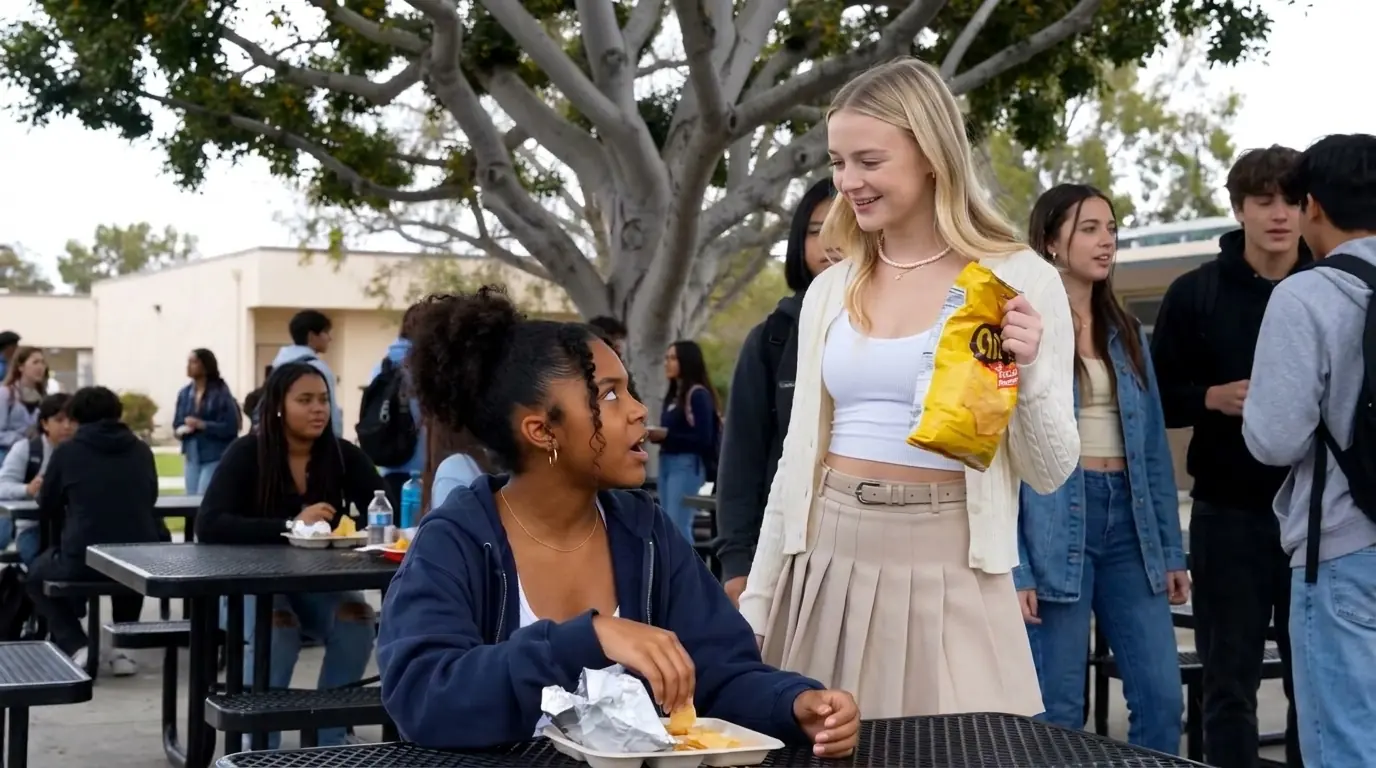
At 12:17 on a warm Thursday afternoon, Nyla Bennett sat alone beneath the largest sycamore tree in the courtyard of Fairmont Ridge High School, eating from a yellow bag of chips while everyone else moved around her. She wore gray sweatpants, a fitted white tank beneath an open navy hoodie, small gold hoops, and the tired expression of someone trying to enjoy ten quiet minutes before fifth period. Her phone was face-down on the metal picnic table, her backpack rested beside one sneaker, and she had almost finished eating when a shadow stopped behind her. Nyla did not look up until a manicured hand reached across the table and snatched the bag away.
Sloane Whitaker lifted the chips like she had just won something. She was blonde, eighteen, dressed in a cream cardigan, white fitted top, pleated beige skirt, pearl necklace, and heels that looked more appropriate for brunch than a public high school courtyard. Two girls stood behind her watching, one holding an orange drink and the other already smiling because they knew exactly why Sloane had crossed the courtyard. Sloane looked into the bag, looked at Nyla, and shook it lightly in front of her face.
“Hungry?” Nyla asked.
Sloane smiled. “I just wondered why you keep taking things that don’t belong to you.” Nyla looked from the chips to the metal table beneath them, understanding immediately that this had never been about food. Nearly two months earlier, the school had officially ended an unofficial lunch tradition that Sloane had treated like a birthright, and the table beneath the sycamore had been at the center of it. Now Sloane had decided a bag of chips was going to settle an argument the administration already had.
To anyone who later watched the video, the story seemed to begin right there. They saw Sloane take the snack, Nyla finally stand, the blonde girl crowd her space, and a confrontation turn physical while dozens of students watched from the surrounding tables. What the cameras could not show was how many times Nyla had already chosen not to fight about that same piece of courtyard. They could not show how ridiculous a metal picnic table had become once status, pride, and senior tradition were attached to it.
The trouble started the previous September, less than three weeks after Nyla transferred to Fairmont Ridge. Her mother, Monica Bennett, had accepted a nursing-management position in San Diego County, forcing them to move from Sacramento before Nyla’s senior year. Nyla hated the timing but understood the reason, because Monica had spent six years working night shifts and weekends for the promotion. Starting over at eighteen was inconvenient; watching her mother finally get a schedule that allowed dinner at home felt worth the inconvenience.
Fairmont Ridge looked like the kind of Southern California school television shows always exaggerated. Half the campus was outdoors, palm trees lined the walkways, classrooms opened onto covered breezeways, and lunch happened around a wide central courtyard filled with black metal picnic tables. Students wore sweatshirts in seventy-degree weather, teachers complained whenever morning temperatures fell below sixty, and nearly everyone carried a giant insulated water bottle. Nyla noticed all of that before she noticed the seating hierarchy.
The table beneath the sycamore looked no different from the others. It was slightly larger, shaded for most of lunch, and positioned close enough to the center courtyard that anyone sitting there could see almost everything happening around them. On Nyla’s fourth day, she watched a sophomore sit there with two friends, only to have three seniors approach and tell them they needed to move. The younger students gathered their lunches immediately without arguing.
Nyla asked her new friend Serena Cho why. Serena stared at her as though she had asked why classrooms contained desks and said, “That’s the senior table.” Nyla looked at the identical black metal frame and asked whether the school had assigned it. Serena laughed and explained that no administrator had ever approved anything; graduating classes had simply claimed the shaded table for years, and within the senior class itself, everyone understood which group normally got it.
That group belonged to Sloane Whitaker.
Sloane was not officially the most powerful student at Fairmont Ridge, because high schools did not have titles for social power. She was president of the senior activities committee, had been elected homecoming queen the year before, and seemed to know everybody from football captains to office secretaries. Her mother chaired multiple parent fundraisers, her older brother had been student body president five years earlier, and Sloane had grown up hearing stories about Fairmont traditions as though the family had inherited part of the campus.
The shaded table had been one of those traditions. Sloane’s brother had sat there, then his friends, then older students Sloane admired, and by the time she became a senior she considered the transition automatic. Nobody signed a document. Nobody needed to.
Students simply knew.
Nyla thought the entire arrangement was stupid but mostly harmless. There were plenty of tables, and she usually ate with Serena near the science wing anyway. She had no interest in arriving at a new school and turning lunch seating into a personal cause. If everyone wanted to pretend one table belonged to a tiny monarchy, Nyla was happy to eat somewhere else.
Then she met Evan Ramos.
Evan was a freshman, small for fourteen, permanently carrying too many books, and painfully uncomfortable around older students. Nyla knew him because Monica had become friends with Evan’s mother at the hospital. Their younger children attended the same middle school, and Monica had asked Nyla to make sure Evan was surviving his first semester.
Most days he was.
One Tuesday in October, Nyla found him standing near the courtyard trash cans with his lunch still in his hands. He looked embarrassed, and behind him Sloane’s friend Cassie Bell was wiping the senior table with a napkin while several seniors laughed. Nyla asked what happened.
Evan said nothing.
A sophomore sitting nearby answered instead. “They made him move.”
Nyla looked toward the table. “Why?”
Cassie heard and turned. “Because he was sitting there.”
“That explains the location.”
Cassie laughed. “It’s senior space.”
Nyla looked at Evan. “Were there seniors sitting there when you sat down?”
He shook his head.
Sloane arrived before the conversation went further. She carried a clear cup of iced coffee and wore the same pleasant expression she used whenever teachers were nearby. “It’s not a big deal,” she said. “Freshmen have like twenty other tables.”
Nyla looked at the empty seats beneath the tree. “Then you have twenty other tables too.”
The courtyard reacted before Sloane did.
Several people nearby laughed.
Sloane smiled more tightly.
“You’re new.”
“I noticed.”
“You probably don’t understand how things work.”
Nyla nodded toward the metal bench. “It’s a table.”
That sentence traveled farther than Nyla expected.
By the end of lunch, students had repeated it in three different classrooms. Serena heard a sophomore say it in algebra and immediately texted Nyla: You have accidentally declared war on suburban royalty. Nyla responded that if Fairmont Ridge’s government could be overthrown by one sentence about patio furniture, it probably deserved to fall.
She still did not sit there.
The confrontation should have faded.
Instead, Sloane took it personally.
For her, the table was not really a table. It was evidence that people understood who belonged where without needing to be told. Freshmen moved because seniors had once moved for people above them, and someday the freshmen would get their turn.
Nyla’s refusal to respect that arrangement sounded to Sloane like disrespect for everyone who did.
The next incident happened a week later. Evan and two freshmen sat at the table again because every other shaded table was full. Sloane walked over with Cassie and another friend, Megan Price, and told them to leave.
This time Evan hesitated.
Sloane reached down and picked up his unopened juice bottle.
“Need help packing?”
That was when Nyla entered the courtyard.
She had not intended to become involved. She simply recognized Evan’s red backpack and saw the expression on his face. Nyla walked over, took the bottle gently from Sloane’s hand, and placed it back beside Evan’s lunch.
“He can sit here.”
Sloane stared at her.
“Excuse me?”
Nyla looked around the courtyard.
“Is there a sign?”
“You seriously want to do this again?”
“No.”
Nyla sat beside Evan.
“I want to eat.”
Serena nearly choked trying not to laugh from another table.
Sloane stood there for several seconds. A teacher supervising lunch looked over, making an argument less attractive. Finally Sloane smiled, said, “Enjoy it,” and walked away with her friends.
From that day forward, Nyla became part of the argument whether she wanted to be or not.
Students started intentionally sitting beneath the sycamore because somebody had finally challenged the tradition. Some did it because they genuinely wanted the shade. Others did it because watching Sloane become irritated made lunch more entertaining.
That irritated Nyla too.
“I’m not leading a table revolution,” she told Serena.
Serena opened a yogurt.
“Too late.”
“I sat down.”
“Rosa Parks also—”
“Do not finish that sentence.”
Serena laughed so hard she dropped her spoon.
The school became involved in November after a freshman parent complained. Her daughter had been ordered away from the table and later mocked on social media for “forgetting her grade level.” Assistant Principal Daniel Foster interviewed lunch supervisors and several students.
Nyla was one of them.
Foster asked what she had personally seen.
Nyla described Sloane’s group moving Evan twice.
Nothing more.
She told him the tradition had probably existed before anyone currently attending Fairmont Ridge, and she did not believe Sloane had invented it. She also said students were clearly afraid of being embarrassed if they refused.
Foster thanked her.
Two days later, administrators announced that all courtyard seating was open to all students regardless of grade. Lunch supervisors were instructed to intervene if students were pressured to move from unassigned tables. The announcement never mentioned Sloane.
It did not need to.
Everybody knew what had triggered it.
Sloane blamed Nyla immediately.
She waited near the lockers after fourth period.
“You reported the table.”
Nyla closed her locker.
“I answered questions.”
“You knew what would happen.”
“I hoped adults would discover tables are public.”
Sloane folded her arms.
“You could’ve stayed out of it.”
“I tried.”
“No, you didn’t.”
Nyla looked at her.
“I sat down twice.”
“You made it a thing.”
“No.”
Nyla slung her backpack over one shoulder.
“You made it a thing when you started checking birth certificates before lunch.”
A boy passing nearby laughed.
Sloane’s eyes narrowed.
Nyla saw it and regretted the joke immediately, not because it was wrong, but because public embarrassment seemed to affect Sloane differently from private disagreement.
“Whatever,” Nyla said.
She started leaving.
Sloane called after her, “You think being new means you can come here and change everything.”
Nyla turned.
“Maybe things that fall apart because one new person questions them weren’t that strong.”
Then she walked away.
For several weeks, the retaliation stayed small.
Cassie would loudly ask whether Nyla had permission before sitting down.
Megan once placed a homemade RESERVED FOR NYLA sign at the sycamore table.
Somebody left a plastic crown inside Nyla’s locker.
She threw it away.
Serena wanted to report the jokes.
Nyla refused.
“They’ll get bored.”
“They’ve been doing this for a month.”
“Rich people have long attention spans.”
Serena stared.
“That may be the strangest sociological theory I’ve ever heard.”
Still, Nyla preferred ignoring them.
She had bigger things to think about.
College applications were due. Monica was still learning her new hospital position, and Nyla spent several evenings each week helping her twelve-year-old brother Jordan with homework while their mother stayed late. She also trained twice a week at a boxing gym because it was the one routine she had insisted on keeping after the move.
Boxing had belonged to Nyla long before Fairmont Ridge.
Her father, who lived in Sacramento, had taken her to a neighborhood gym when she was thirteen because she had been struggling with anxiety after their divorce. Nyla was never interested in tournaments, but she loved the discipline of training. Footwork forced her to remain present.
Hands up.
Chin down.
Breathe.
Do not chase anger.
Her coach in San Diego, Ruben Martinez, repeated another rule constantly.
“If you can leave, leave.”
Nyla thought it sounded obvious.
She would understand later why it was not.
January brought rain, then warm weather, then the strange California winter rhythm Nyla still had not learned. The senior-table controversy mostly disappeared as college decisions and spring events took over. Underclassmen regularly sat beneath the sycamore now.
Sloane stopped moving them.
At least when teachers were nearby.
Nyla assumed the resentment had faded.
Then the senior activities committee lost another privilege.
For years, the committee had been allowed to reserve the center courtyard during two senior lunch events before graduation. After complaints about the seating culture, Principal Marsha Bell decided the events would instead use the athletic quad where more students could attend.
The decision had practical reasons.
Sloane heard only one.
Nyla.
“She took the table, now we lose senior lunch too,” Cassie said in the committee room.
Sloane did not correct her.
That mattered.
Stories become stronger when nobody challenges the convenient parts.
By February, Sloane had convinced herself that Nyla had deliberately targeted senior traditions because she resented arriving late to Fairmont Ridge. It explained everything more comfortably than admitting administrators had reviewed the practices themselves.
One afternoon Sloane approached Nyla outside English.
“Why do you hate seniors?”
Nyla stared.
“I am one.”