By nine-thirty on Saturday morning, the red ribbon had already become the most photographed object in Wake County.
It stretched across the new entrance of the Harbor House Children’s Community Center, bright enough to stand out against the pale stone building, the green trees, and the blue September sky.
Volunteers had tied oversized bows at both ends.
A row of folding chairs faced the entrance.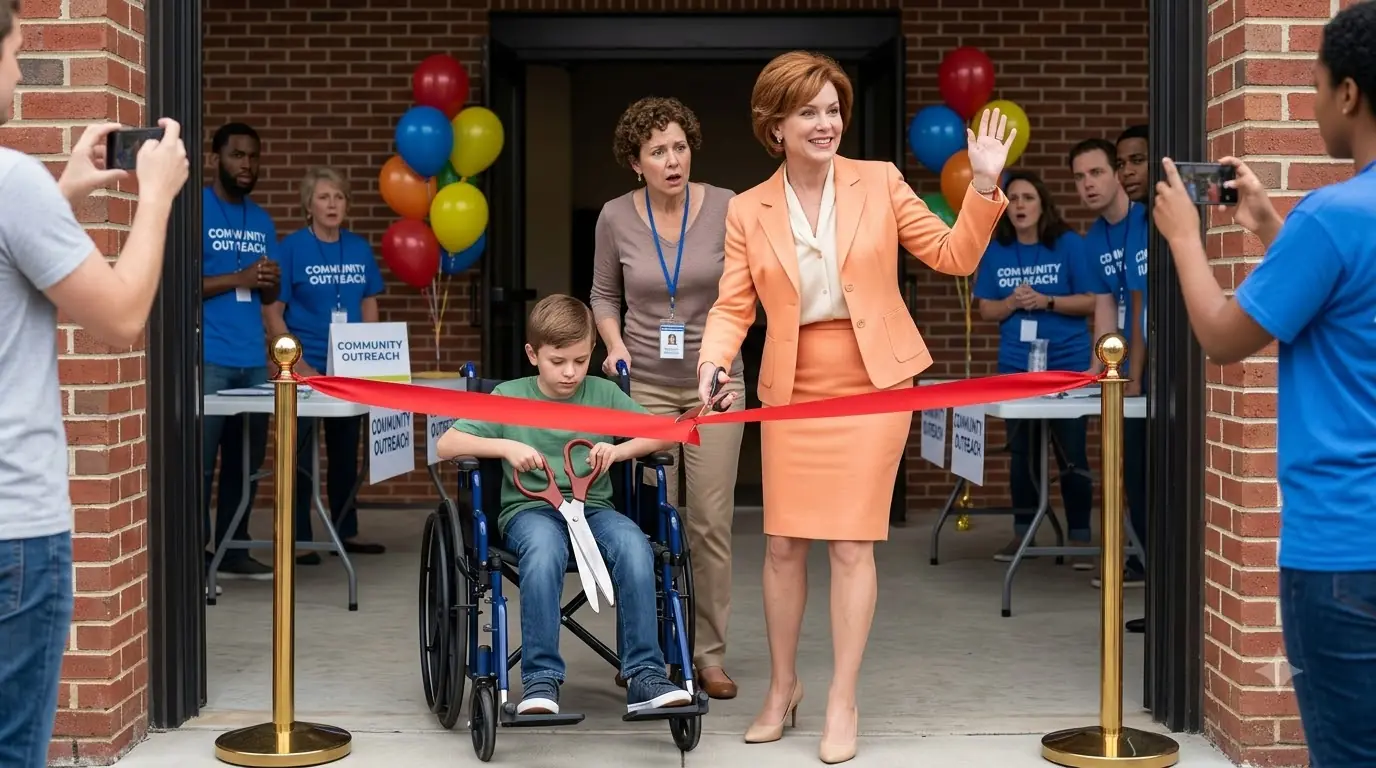
White tents covered tables with lemonade, fruit cups, cookies, printed programs, and information about the center’s after-school tutoring, family support services, adaptive recreation programs, and free weekend workshops.
Children chased bubbles across the grass.
Parents talked beneath shade tents.
A local high-school jazz group tested microphones near the small stage.
Everything looked cheerful.
Organized.
Almost effortless.
Dr. Maya Brooks knew better.
Nothing about Harbor House had been effortless.
Not the building.
Not the funding.
Not the permits.
Not the accessibility design.
Not the endless meetings with contractors who seemed to believe that installing a ramp was enough to call a place accessible.
Not the fire inspections.
Not the insurance.
Not the volunteer screening.
Not the late-night arguments about whether the sensory room needed another emergency exit.
Not the six months Maya spent convincing county planners that the drop-off lane needed wider turning space.
Not the three times she made the architect move a drinking fountain because the original location looked accessible on paper but became nearly impossible to approach once benches were installed.
A ribbon could make years of work look like one pretty morning.
Maya did not mind.
Pretty mornings were good.
Especially when children were involved.
She stood near the entrance wearing a navy polo with the Harbor House emblem embroidered over the left chest, black trousers, simple sneakers, and a small wireless microphone clipped near her collar.
At forty-three, Maya had spent almost twenty years working in nonprofit education and family-support programs.
She had learned several things.
People loved opening ceremonies.
People hated budgets.
Everyone wanted to fund visible things.
Nobody wanted to fund maintenance.
And the people most eager to stand in photographs were not always the people who had stayed when the cameras disappeared.
She checked her phone.
9:34.
The ribbon cutting was scheduled for ten.
Her assistant, Lena Ortiz, approached holding a clipboard.
“County commissioner is here.”
“Good.”
“Fire chief too.”
“Good.”
“Three school-board members.”
“Expected.”
“Channel Eight sent a reporter.”
Maya frowned.
“We didn’t invite television.”
“I know.”
“Who did?”
Lena looked toward the parking lot.
Maya followed her eyes.
A white luxury SUV had just pulled into the front row.
Maya closed her eyes for half a second.
“No.”
Lena whispered:
“Yep.”
Karen Whitmore stepped from the passenger side.
She wore peach.
Of course she wore peach.
A fitted peach-orange skirt suit, cream blouse, beige heels, pearl earrings, styled auburn hair, and sunglasses large enough to suggest she had arrived somewhere significantly more exclusive than a children’s center in suburban North Carolina.
A young man climbed out from the driver’s side carrying a professional camera.
Another woman followed holding a phone on a stabilizer.
Maya stared.
“She brought a media team.”
Lena nodded.
“Looks like it.”
Maya exhaled.
“Where is Daniel?”
“Checking sound.”
“Find him.”
“You want security?”
“Not yet.”
Lena started away.
Maya said:
“And Lena?”
She stopped.
“Yes?”
“Do not let Karen anywhere near Ethan before I talk to her.”
Lena nodded.
That was the real concern.
Not cameras.
Not attention.
Ethan.
Ten-year-old Ethan Cole sat beneath the shade tent near the ribbon, talking with his mother and carefully opening and closing the oversized ceremonial scissors the center had ordered specifically for the event.
The scissors were absurd.
Red handles.
Polished silver blades.
Almost two feet long.
They were mostly symbolic.
A volunteer would keep one hand nearby to help control them during the actual cut.
Ethan found them hilarious.
Earlier that morning, when Maya handed them to him, he had said:
“These are definitely made for giants.”
Maya answered:
“Very formal giants.”
He laughed.
Ethan used a lightweight blue wheelchair with black wheels.
He was quick with it.
Faster than several volunteers had learned the difficult way.
He had dark-brown hair, thoughtful gray-green eyes, and the serious expression of someone who wanted adults to explain things properly rather than simplify them.
Maya liked that about him.
She first met Ethan eighteen months earlier during a design workshop.
Harbor House did not exist yet.
The project was only a set of architectural drawings and a fundraising problem.
Maya had invited local families to inspect the plans.
Most adults commented on parking, bathrooms, classroom size.
Ethan stared at the recreation courtyard for five minutes.
Then asked:
“Where do you race?”
The architect blinked.
“Race?”
“Wheelchairs.”
Silence.
Ethan pointed.
“This path is too narrow if two people want to pass.”
The architect smiled politely.
“It meets code.”
Ethan answered:
“Code doesn’t race.”
Maya nearly laughed.
The path was widened.
That one sentence eventually became a philosophy for the whole building.
Code is the minimum. People are the point.
Ethan never knew that phrase was repeated during design meetings.
He certainly did not know why the center had chosen him for the ribbon cutting.
Maya had told him only part.
“You helped design it.”
Ethan protested:
“I complained about the sidewalk.”
“You improved the sidewalk.”
“That’s different.”
“Exactly.”
His mother, Rachel Cole, knew more.
Much more.
And she had spent the morning fighting tears.
Maya saw Karen approaching.
She intercepted her twenty feet before the ribbon.
“Karen.”
Karen removed her sunglasses.
“Maya.”
Her smile was bright.
Artificially bright.
“This looks wonderful.”
“Thank you.”
Karen looked beyond her.
At Ethan.
At the ribbon.
At the crowd.
Then back.
“I assume someone saved me a chair in front?”
Maya paused.
“There’s open seating.”
Karen smiled as though Maya had made a joke.
“I mean with the sponsors.”
“There isn’t a sponsor section.”
“Oh.”
Karen glanced at her camera operator.
He was already filming.
Maya lowered her voice.
“Why did you bring a camera crew?”
“Documentation.”
“For?”
“My foundation.”
Maya’s face stayed neutral.
Karen continued:
“You know how these things work.”
“I do.”
“Donors like seeing impact.”
Maya nodded.
“Actual donors usually do.”
The smile vanished from Karen’s face.
Only for a second.
Then returned.
“I’m not doing this today.”
“Good.”
“Because today should be positive.”
“I agree.”
Karen stepped closer.
“Did the board receive my revised pledge?”
“Yes.”
“And?”
Maya looked at her.
“Karen.”
“What?”
“You were notified this morning.”
“I was notified that legal wanted more time.”
“No.”
“You were notified that the board declined the donation.”
Karen’s jaw tightened.
“That decision isn’t final.”
“It is.”
“No board rejects two hundred and fifty thousand dollars.”
Maya kept her voice low.
“We rejected conditions attached to it.”
Karen laughed softly.
“Conditions?”
“You wanted naming rights.”
“That’s normal.”
“You wanted control over event photography.”
“Also normal.”
“You wanted all educational programs to display your foundation logo.”
“That is called recognition.”
“You wanted your representative added to the operating committee.”
“Accountability.”
“You wanted veto rights over future partnerships.”
Karen stopped smiling.
“That is not how I phrased it.”
“That is how the contract reads.”
Karen’s camera operator shifted slightly.
Maya noticed.
So did Karen.