Rosamund's Ride
She took the horse at midnight and rode north. She expected pursuit. She did not expect a duke.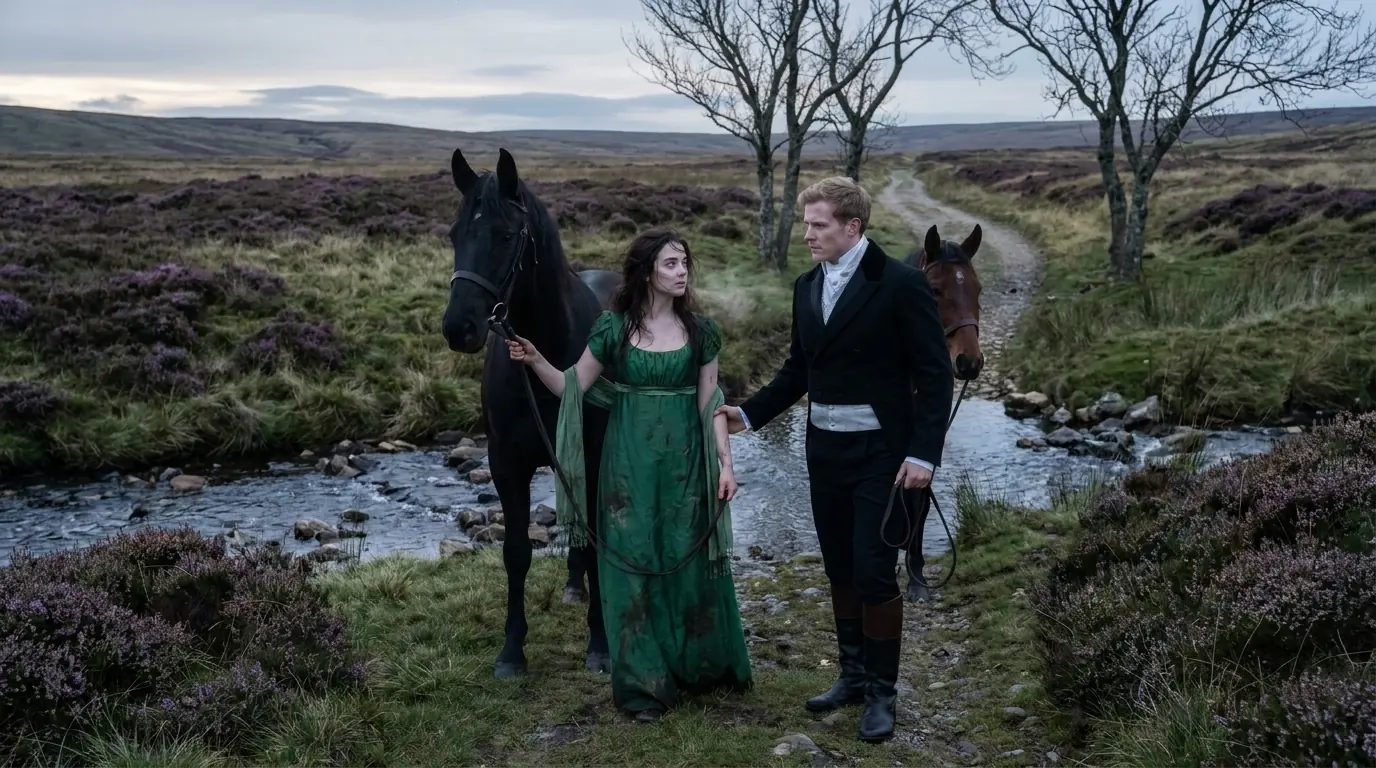
Chapter 1: The Flight
Hark Castle, Yorkshire — October 1815.
The night Rosamund Windham decided to ruin herself, the ballroom at Hark Castle smelled of hothouse lilies and too many candles. She had thought about this day in the abstract for 6 months, had sewn £30 into her petticoat hem in April, on a gray afternoon when her father came home from York with that particular brightness in his eyes, the brightness that meant he had either won at the tables or had convinced himself he was about to. She had done the work herself, slowly with stitches so small that no one would see it in the candlelight when she danced. At first the Hark Castle assembly had seemed like any other.
She stood near the east windows with a glass of ratafia she had not touched. Dark-haired and slight, with large dark eyes, a mouth men noticed, and a face her father had called her best asset, she watched the door. The dancing had been underway for 2 hours. The ballroom was not large, but Sir Edmund Vere had opened every connecting room, and the effect was of one long candlelit sweep from the entrance hall to the conservatory doors, warm with music, the press of bodies, and the particular restless heat of an autumn assembly, when everyone had been indoors too long.
Rosamund knew most of the faces. She had grown up among them, had danced with their sons, befriended their daughters, and eaten their suppers for 19 years. And tonight she stood apart from all of it with her untouched glass and her careful smile and watched the door. It was then that she noticed the Duke of Thorne.
He stood near the fireplace at the far end of the room, standing apart from the crowd, not conversing with anyone, simply present in the way that powerful self-contained men sometimes were, as though the room had arranged itself around them without being asked. His dark hair framed a strong, unreadable face set with steel-blue eyes. He wore his evening clothes with the ease of a man who gave them no thought, and as a duke, had no need to. He was perhaps 30, perhaps a little younger.
He was, Rosamund thought, exactly the sort of man one's eye returned to without permission, which was irritating. Three years ago, she had met him once, briefly at a shooting party at Hark Castle before his father's death. He had been a Marquis then, not yet a duke, and she had thought him cold. She had not changed her opinion.
There was something in the set of his shoulders, the unhurried way he moved his gaze across the room, that suggested a man entirely accustomed to getting what he wanted, and equally accustomed to wanting only what he had already decided was worth the effort. He looked once in her direction. Rosamund looked away. She became aware of Lord Farrow's presence before she saw him.
The room grew briefly, measurably quieter when he entered. The kind of quiet that happened when someone entered whose presence required acknowledgement, even from people who preferred not to acknowledge it. When she turned toward the door, there he was, the Earl of Farrow, blonde and well-made, a man of perhaps 45, who wore his age as he wore everything else, with the quiet excellence of old money and older confidence. He had pale blue eyes that moved across the room with the unhurried certainty of an assessor who already knew the value of everything in it.
Those eyes found her father, and then a half second later, they found her. She had promised herself she would not flinch. She held his gaze for exactly the time courtesy required, then looked away, back toward the east windows, back toward the night beyond the glass, and she breathed very slowly and thought, "Not yet. Not tonight. He has not come to take you tonight."
But her hands, she noticed, had tightened on the stem of her glass. Lord Farrow crossed to her father, and her father turned with a smile that did not reach his eyes, and the two men spoke in low voices, while the music played on, and the dancers turned, and no one paid them any particular attention. Rosamund watched them closely.
Six months of practice had made her very good at it. Her father laughed at something. It was the laugh he used when he was nervous. A little too quick, a little too bright.
It was the laugh of a man who needed to believe that everything would be all right. She set down her glass. She needed air. She moved away from the east windows through the edge of the dancing, past the card room where the older gentleman had retreated, toward the corridor that led to the balcony.
The corridor was quieter. A footman passed with a tray. She stepped aside and walked on, and that was when she heard them. Her father's voice, low and slightly unsteady, and Lord Farrow's, beneath it, perfectly calm.
She stopped. The door to the small anteroom was not quite closed. She could not see them. She stood very still in the corridor with her back to the wall and her heart striking loud and slow against her ribs and she listened.
As to the date, her father was saying, "I had thought perhaps in the spring."
"November," said Lord Farrow.
A pause.
"November is very soon," her father said. "Rosamund has—"
"I have been patient, Windham." Lord Farrow's voice was pleasant.
That was the most frightening thing about it. It contained no threat at all. I paid the sum we agreed in August. It is now October.
I see no reason to delay further. No, of course not. November. Then, her father said at last,"Though the banns—"
"I have already spoken to the rector," said Lord Farrow.
There was more. Something about settlements, something about the journey south. But Rosamund had stopped hearing it. She was aware of the wall at her back, the music from the ballroom distant now, the curious lightness in her head that was not faintness, but near enough to it that she would not permit herself to wait and find out.
She tried not to think of Lord Farrow. She had heard the whispers, the careful half-sentences passed between women at assemblies like this one, raised brows and lowered voices, two wives who had died under mysterious circumstances, and a parade of female staff who had fled in the night without a character and would not say why. She loathed the way his eyes moved over her, not with desire exactly, but with the cool appraisal of a man examining something he had already purchased. The way he took every opportunity to touch her, always entirely correct, always a moment too long, and left her wishing the length of England between herself and him.
According to what she had just heard, she would be his wife in 4 weeks. Her hand went to her throat, to the cool weight of the pearls she wore, and she thought of her mother, dead 12 years, and tried to remember her face. With one hand against the wainscot, she steadied herself, then walked back down the corridor without running, because running would be noticed, and through the kitchen passage, where the smells of roast meat and hot gravy and woodsmoke replaced the lilies of the ballroom, and past the kitchen itself, where the cook was directing three girls in an atmosphere of controlled crisis. She hurried through the scullery door, pausing only at the row of pegs beside it to take a dark wool cap too large for her and tug it over her head, then rushed into the night.
The cold hit her like a hand pressed flat against her face. She stood in the kitchen yard and breathed it in, cold and stone, and somewhere beneath it the smell of horses. And she looked up at the sky, clear and cold, the moon full above the moor, and she thought, "Four weeks. No, I will not marry him." Knowing she would leave one day was one thing.
The moment of realization that it was now, that it was tonight, was something else entirely. She was grateful for the £30 sewn into her petticoat hem, but it did not make up for the absence of a warm cloak. She had only the thin silk wrap from the ballroom, and the night was colder than she had anticipated. She looked toward the moor and tried to calculate the distance to the nearest village, and in which direction, when a low whinny carried across the yard.
A horse. The stable stood opposite. She approached, quiet and cautious. It was faintly lit within, and she could hear the shift and stamp of animals in the dark, the occasional blow of breath.
She was an excellent horsewoman. Her father had given her that at least. She could hear a conversation somewhere towards the back between the Hark Castle grooms in the low murmur of young men with time to fill. She slipped past the first stall.
She passed a grey mare who lifted her head and decided Rosamund was uninteresting, then an older gelding who did not stir, and stopped at the third stall. He was magnificent and powerfully built, 17 hands at least, and black as the night outside, with an eye that caught the lamplight and reflected it back at her with what she chose to interpret as intelligence rather than malice. He was watching her. He watched her the way very large, self-contained creatures sometimes did: without alarm, without particular welcome, simply taking note.
"Hush!
I am not going to hurt you, and you are not going to hurt me.
We have an agreement," she said softly.
She put her hand flat to his nose, the way her father had taught her, and felt him breathe against her palm, hot and grass-scented and alive. He did not bite her. She took it as encouragement. His tack was on the rail outside the stall, saddle and bridle both.
It was heavy, and she was in an evening gown, and her arms were shaking slightly. Cold or fear, or both. But she had saddled horses in worse conditions, and she did it quickly and quietly. And when she was done, she stood for a moment with her forehead against his neck and breathed.
"Edinburgh," she thought.
Aunt Margaret, she is old, and she barely knows me, and she may turn me away, but she might not. How far it was, or in which direction, she did not know. It was not much of a plan. She unlatched the stall and led him out through the stable door and across the kitchen yard.
He came willingly enough, which she took as a second encouragement. The scullery door opened, and she froze. It was a young maid emptying a pot, who startled when she saw Rosamund, her eyes wide, taking in the evening gown and the horse. Rosamund put her fingers to her lips and shook her head.
The girl held her gaze for a moment, then stepped back inside without a word. She mounted from the paddock fence, hitching her green skirts up with a practicality she suspected would have horrified society, and settled into the saddle. The horse shifted beneath her, a great restless rolling of muscle, and then steadied as though he too were making a decision. She touched her heel to his flank, and off they went.
The grounds of Hark Castle fell away behind her. The lights of the house shrank and were gone as she crested the first rise at a hard gallop. And then there was nothing ahead of her but the dark and the wide Yorkshire road and the rushing weight of the cold October night air against her face and her mount beneath her moving like a tide, powerful, rhythmic, entirely sure of himself. She was terrified and exhilarated in equal parts.
For 6 months she had endured uncertainty. Now at last she was in motion. The moon was gone. The stars gave just enough light to see the road.
She leaned forward over Lucifer's neck and let him run, and she did not look back, and the pearls at her throat caught the starlight, and then the darkness took them, too. And she rode north into the night. She did not let herself think about what she had left behind. She did not let herself think about what she was riding toward.
She thought only of the horse beneath her and the road ahead and the cold, clean, necessary fact of speed.
November, Lord Farrow had said, "Not this November, not any November ever." She rode on through the night.
Chapter 2: Lucifer
She rode until the sky began to gray. Her hairpins had given way long ago, and her long hair had come loose and streamed behind her. The moon was high and full, flooding the moor with cold silver light, every rise and hollow visible, the road a pale ribbon ahead of her, the heather dark on either side. It was not the kind of night that hid you.
It was the kind of night that showed you clearly to anyone who cared to look. She would have preferred not to travel by the road, but though the full moon brightened the moor, it did not reveal its dangers. Heather concealed ruts and ditches, wet ground gleamed harmlessly until a horse stepped into it. The road was exposed, but it was clear, firm, and known.
It was not dawn yet, not truly, but the darkness had thinned from black to a deep uncertain blue, and the stars were fading one by one into the pale margin at the horizon. She could see the road properly now, and the moor on either side of it, and the long dark undulation of the Yorkshire hills, and she became aware, as the cold settled deeper into her bones, that she had been riding hard for several hours. She slowed him to a canter, then a trot. He objected briefly.
She felt it in the set of his neck, the irritable flick of his ears, but he submitted, which she took as a mark in his favor. Beneath a stand of ash trees, where a stream crossed the road, she brought him to a halt. Her hands were shaking. She had not noticed while they were in motion, but now, in the sudden stillness, she could feel it.
The fine continuous tremor of cold and fear she had not until now permitted herself to feel. She dismounted carefully, her green skirts catching on the pommel as she slid down, and stood for a moment with one hand on the horse's flank to steady herself. Her legs trembled beneath her, muscles unused to riding a stride, and hours of tension besides. The horse turned his great head and looked at her.
"Water," she told him, and led him to the stream. While he drank, she looked back down the road, empty. The pale gray light showed nothing but Heather and the distant bulk of the hills. No one in pursuit of her.
Not yet. Her fingers went to the hollow of her collarbone, the familiar weight she had placed there with such deliberate care that evening, and found nothing but cold skin. The clasp had given way somewhere on the road. She had not felt it go.
She had been too intent on the horse, the darkness, the distance opening up behind her, and somewhere between her castle and here her mother's pearls had fallen into the night. There was no use dwelling on the loss, but they had been very dear to her, and she stood for a moment with her wet hand pressed to the hollow of her throat where they had been. Then she turned back to the stream and scooped up some water for herself. She was attempting to calculate the distance to the next village when she heard the hoofbeats.
A single horse coming fast from the south, too fast for the hour and the place. Every muscle in her body went still. Out of the gray dawn came a dark horse and its rider, a man who might have stepped from one of the Gothic tales she was fond of. He was riding hard, but not at a full gallop.
One part of her mind noted it. The rest was occupied with the simple fact that there was nowhere to run. For a moment he looked at her across the road. The moonlight was full on her face.
She watched him take in the evening gown, the wet slippers, the waistlength hair she had no hope of concealing, and the precise moment his expression shifted from uncertainty to recognition. Lady Rosamund Windham. It was not a question. On horseback in the gray pre-dawn light, with his jaw set and his steel blue eyes fixed on her, he was considerably more imposing than he had been at the Hark Castle ball.
Get away from that horse. His voice was quiet. She was already learning that this did not indicate calmness. He was thirsty.
I stopped to let him drink. He looked at her for a moment.
You stopped, he said with the careful precision of a man keeping a firm grip on himself.
To water a horse you stole. I prefer to think of it as borrowed. He was off his horse in a single motion. She barely saw it happen and across the road before she had taken more than one step back.
His hand closed around her wrist. He drew her away from the horse's side with a controlled force that stopped just short of hurting her and made very clear that he could. He was looking down at her, half a head taller, she noted, with the part of her mind still capable of noting things, and his eyes this close were a dark stormshadowed blue."Why did you steal my horse?" She was very aware of his hand around her wrist."I did not steal it.
I borrowed it and I had my reasons. You also took my saddle. Her eyes went to the horse, then to him, then back to the horse. The extraordinary black animal who had come willingly out of his stall for her and carried her north through the dark without once attempting to kill her."His name," said the Duke of Thorne, watching her face,"is Lucifer." She had known who he was.
She had not known, had not stopped to think whose horse she had taken."Oh," she said.
It was not, she felt, her finest moment. He released her wrist, not because she had pulled away. She had not, and pressed one hand flat against his brow, and stood very still for a moment."At least you have good taste in horse flesh." "He was the finest horse in the stable.
I knew that much." That is a point in your favor.
He lowered his hand. Well, Lady Rosamund, what the devil possessed you to steal my horse. I am going to Edinburgh. The stream ran on.
Lucifer cropped the grass. Indifferent.
In an evening gown, said the Duke of Thorne.
On my horse, without a proper cloak, a maid, or as best I can judge, any clear plan. I have a plan, Lady Rosamund. His voice had the patience of a man to whom patience was not entirely natural. You are standing beside a stream in dancing slippers on a Yorkshire moor.
What you do not have, so far as I can tell, is any reasonable means of reaching Edinburgh. He looked at her. What happened? She had not prepared for that quiet, careful question.
Down the road she looked south toward Hark Castle and everything she had left behind. I overheard my father and Lord Farrow in the anteroom. Lord Farrow has already paid my father for the privilege of marrying me. The wedding is to take place in 4 weeks.
The stillness that came over him then was a different quality from before, not the stillness of a man controlling his temper. Something colder than that. I see there were houses in London that Farrow was known to frequent. The women there had no recourse and no one to speak for them.
And what was done to them stayed within those walls except when it reached other men through other channels. He had heard of it. He looked at her young and afraid in the gray October dawn, and something settled in him with the cold certainty of a decision already made. She looked back at him.
His face had settled into that strong, unreadable expression she had observed from across the ballroom. His eyes were doing something she could not quite name. I would be grateful if you would allow me to continue. You may have Lucifer back this moment.
I never intended to keep him, but I cannot go back. No. The word landed quietly and did not move. You have no right to stop me.
Lady Rosamund, something in his voice. Not quite amusement. I meant that you cannot continue north alone. Not as you are.
I am more capable than you think. Your grace, I have funds. Whatever funds you carry, it will not be enough. I passed two men at the first crossroads.
They had stopped at the inn there. A pause.
They asked if I had seen you.
She looked at him, this large self-contained man, and tried to understand what he was. He reached for Lucifer's reins. Come, we cannot stay here. Come where?
He looked at her, storm blue eyes, steady and direct. Why are you helping me? Because Lord Farrow is not a man I would wish any woman married to. And because you stole my horse with considerable nerve, and I am not entirely without admiration for it.
He did not look at her as he said this.
I have a property thirty miles north. There is a housekeeper in residence. You will have a woman to receive you. After that, we will determine what is to be done.
She looked at him. A duke, which meant power, a stranger, which meant risk. She had no way of knowing what his word was worth. He reached into his coat and held something out.
Her mother's pearls lay across his palm. She could not speak for a moment. I found them on the road half a mile south. She took them.
The clasp was broken. She closed her fingers around them and let the memory of her mother embrace her."Thank you," said Lady Rosamund Windham, and took the hand he held out to her.
Chapter 3: The Fleece
The temptation to sleep was almost overwhelming. Rosamund did not permit it. She had not fallen off a horse since she was 7 years old, and she was not going to begin now. But she came close twice in the gray light of early morning.
Close enough to feel herself sway in the saddle. Close enough to grip the bay's mane and recite to herself with quiet ferocity all the reasons she could not afford to arrive at an inn yard unconscious on a horse. The horse, for his part, seemed to understand. He settled into a long, easy walk, and she rode in the particular stillness of someone held upright by Will alone."The inn is only a few miles," the Duke called from Lucifer beside her.
Rosamund was too tired to reply. The Fleece Inn was a small stone building set back from the road, its yard already busy with the early business of morning. A groom came out for the horses. The Duke dismounted first, then turned to assist her.
Her legs, when they finally met the ground, did not even feel like legs.
Standing in the inn yard in her mud hemmed evening gown, she said nothing.
The Duke spoke to a groom in a low voice. Coins changed hands. Two stable lads emerged to take the horses, and she heard him give instructions for an oat mash and a rub down for both animals. The Duke secured them a private parlor at the back of the inn, off the kitchen passage.
Not a grand room, but warm, with a fire already lit, and a window that looked onto a kitchen garden. There was a table, two chairs, and a wooden bench with a faded cushion. Rosamund sank gratefully into a chair. The warmth reached her all at once.
She had not realized how cold she had become.
"Food," said the Duke.
She realized he was speaking to the innkeeper's wife, who looked at Rosamund in her rather worse for wear evening gown, and the Duke in turn weighed them both and chose not to comment."Whatever is hot and tea?" "For two," the innkeeper's wife said with a certain look."For two," he said, pressing enough coins into her hand to make her eyes widen.
The woman gave a low curtsy and left. Rosamund had seen the look.
She knew perfectly well what would be said in the kitchen before the morning was out.
She had known when she left the assembly what her flight would cost her. An innkeeper's wife's reaction at a common inn was merely the proof of it. The fire crackled. Outside the window, a cat was making its careful way along the kitchen garden wall toward a sparrow, which saw it coming and flew off.
The ordinariness of it was a comfort. The food, when it came, was everything the fleece was known for. Thick cut ham glistening from the pan, eggs fried in butter, a half loaf of bread still warm from the oven, and a crock of salted butter. Rosamund ate without ceremony, too hungry to care.
The tea was strong and very hot, and she sighed with delight as she sipped it with milk and sugar. She became aware that the Duke was watching her as she helped herself to another slice of ham."When did you last eat?" "Yesterday, before the assembly." "It was refreshing to see a woman with an appetite," he thought.
He was used to seeing women eat like birds in his company. He smiled at her and gave a small nod of approval. When the plates had been cleared, he strode to the window, then turned and looked at her directly."Now tell me what happened." "I already told you." "You told me the bare facts.
Tell me the rest." Rosamund wrapped both hands around her cup."The problems started with my father's debts.
I cannot tell you the full extent of them. He has never told me. And there came a point when I stopped asking. What I know is what I have seen.
He has been to London four times this year. Each time he takes paintings, good ones, the kind that have hung in the hall for generations. Each time he comes back, he looks a little older than when he left. She paused.
Last winter we sold the East Wings furniture. This spring, the London house. She kept her voice level. My father is not an inherently cruel man.
He is not the sort to sell his daughter's future without being driven to it. That he accepted Lord Farrow's offer tells me there is very little left. She went on,"Lord Farrow has been married twice. Both wives died within two years of the wedding." She kept her voice level."That may mean nothing.
Women do die." She looked at the fire, but there are whispers in the town of women who have left his household without warning, without references, and will say nothing afterwards of why.
And then there is the way he looks at me. I cannot describe it precisely, but when you have seen it, it is quite enough to make your decision for you." A shiver ran through her.
She kept her voice steady.
He said nothing.
He simply listened and did not look away. She found it more steadying than she had expected. The fire settled. Outside, a cart went past on the road.
She made herself look at him. His jaw had tightened. That she thought was for Lord Farrow. But his eyes, when they met hers, held something quieter.
Sympathy for her. That is what I'm running from. What a man like that does once he has his wife behind closed doors and no one looking. He regarded Lady Rosamund across the table and knew he was not going to return her.
Not to Lord Farrow, not to her father. Whatever came next, it would not be that. Lord Farrow will not stop looking. Men of his ilk do not accept losing what they have already paid for.
She flinched. Which means I cannot remain here for long. I need to reach Edinburgh. She looked at him steadily.
My mother's aunt lives there. She is old and barely knows me, and she may not take me in, but she is the only family I have that may not send word to my father. Unfortunately, I did not bring her direction to the ball, but I know her family name is Burns. There were several practical objections.
An elderly aunt of uncertain disposition, a ruined evening gown, two hundred miles of road. He kept them to himself. He was about to call for more tea when he heard voices in the passage. Male voices, two of them, not the idle talk of travelers, but the focused, patient inquiry of men who were looking for something.
He had heard that tone before in another country, in another kind of pursuit. Three strides to the door. He opened it a hands width. In the passage, the innkeeper's wife stood with two men in plain riding coats.
He caught snatches of the conversation. A young woman, dark hair, traveling alone.
No one like that around here, the woman said pleasantly and loudly.
Only a party of wool merchants. Come, will you have some ale, something to eat? He closed the door quietly. Some men are looking for you.
We are leaving. Rosamund leapt to her feet, her tiredness forgotten. But how?
Through the window, he said grimly.
She crossed to it and looked out at the kitchen garden below, and then stood very still. On the other side of the door, 10 ft of corridor away, she could hear one of the men speaking again. The Duke knew that they would not stop until they had checked every room and spoken to every person who had stopped at the inn since nightfall. He could only hope that they had taken up the offer of refreshment.
He carefully eased the window open and dropped into the kitchen garden, soft ground four feet below, turned and reached up. Rosamund came over the sill without hesitation and landed in his arms. They were moving toward the gate before she had found her footing. He pulled off his cloak and put it around her shoulders.
Cover your hair. She drew it up over her head without argument. They made it to the stables, and he concealed Rosamund inside while the horses were saddled quickly. More coins into the stable boy's hand.
The horses were brought out to the back of the stables out of view from the yard. The stable boy had set the mounting block beside the bay. The Duke shook his head. She rides the stallion.
The boy looked uncertain, but nodded. Rosamund said nothing as she gathered her skirts and mounted, but she noticed and filed it away carefully, that he had put her on the stronger horse, not the borrowed bay: Lucifer, who knew the North Road and could outrun anything Farrow's men were likely to be riding, something settled in her chest, warm and unexpected. Before they moved off, the Duke leaned from the saddle and spoke to the boy in a low voice."You did not see this woman leave the inn this morning." His eyes moved to the second boy."Is that understood?" Both boys nodded.
What felt like an eternity was only a few minutes and then they were on their way. The cold hit her like a wall after the warmth of the inn. She had forgotten in the hour inside how her body had felt before. The soaked slippers, the gown that had been wet and dried and was now soiled and damp with the kitchen garden mud, the deep settled chill that lived somewhere between her shoulder blades and refused to leave.
Lucifer moved beneath her like something certain, and she fixed on that, his rhythm, his warmth, the uncomplicated fact of forward motion. We cannot take the road. Not with those men behind us. There is a track across the moor.
Longer and harder going, but it keeps us clear of them.
What is your estate called?
Thorncroft. And how far is it? 25 mi at pace. She was entirely in his hands now.
Whatever kind of man he proved to be, she would find out at Thorncroft. She found she was not afraid.
Then we had better make haste, said Rosamund, and gave Lucifer his head.
Chapter 4: Beckside
The track climbed steeply north of the inn. Switch backing through Bracken and Heather before opening onto the top of the moor in a wide gray sweep of sky. Below them, where the road ran, a cart moved in the distance. Nothing else.
Rosamund pulled the Duke's cloak closer. She had told him it was not necessary. She had been wrong. Do you spend much time at Thorncroft?
Some, and the rest, London, when required. The bay moved steadily beside Lucifer as she considered this. The two horses had reached some accommodation during the ride, the bay deferring to Lucifer's lead with sensible good grace. I begin to think you consider information a limited resource.
I have been told that. Does it not trouble you? the Duke was quiet for a moment. Not the silence of a man who did not know what to say, but the silence of a man choosing what to say.
No. Rosamund looked at him. She had seen men look at her the way Lord Farrow did, with calculation, with ownership, with a kind of insolent certainty. The Duke did not look at her that way, not in any way she recognized.
There was no performance to him, no effort to impress or intimidate. He simply was what he was, and appeared entirely indifferent to whether she found that adequate. To her mild annoyance, she found that she did. You are not afraid of very much.
No. What is it like? He turned to look at her properly then, and for a moment she saw something in his face that might, in another man, have been amusement. I might say the same of you.
I am afraid of a great many things. I have simply learned not to let them rule me. The silence that followed was different from the silences before it. This silence she found, she did not want to break.
They had been riding for two hours when the Duke slowed. Rosamund drew Lucifer up beside him. Below them, where the Mor track curved east and the road was visible as a gray thread between stone walls, a figure moved. A single rider moving north at a steady, unhurried pace.
The Duke watched. The rider did not look up, too far away for features, but something in his posture, the particular stillness of a man with a purpose he had no need to hurry, made the back of Rosamund's neck prickle.
The Duke said nothing.
He looked north, then east. Then he nudged the bay forward. Rosamund touched her heel to Lucifer's flank and followed. They pushed the pace.
The east track dropped into woodland. Birch and ash, the ground soft with leaf fall, branches thickening overhead as the path narrowed. Lucifer moved well, picking his footing with the shoress of a horse that had seen worse conditions. It was the speed that caused it.
They were moving fast, too fast for a narrowing path, and the branch came from the left, low and unexpected, catching Rosamund across the arm with a force she had no time to avoid. For one suspended moment, there was nothing beneath her. Then the ground arrived. She was aware of the impact of breath gone, of cold leaves against her face, and then almost immediately of the Duke's voice taught in a way she had not heard before, shouting out her name.
Lady Rosamund, I am perfectly fine. She began and stopped. Her arm was wet. She looked at it in the gray light and found the dark spreading stain with a detached sort of interest.
The branch had been dead, old wood and bark, and the gash along her left forearm was not deep enough to be dangerous, but was certainly deep enough to require attention. The Duke crouched beside her. He had been off his horse before she had finished rolling. It is not as bad as it looks.
Oh, without speaking he examined the arm. Then he unwound his cravat and bound the wound with the quick economical movements of a man who had done this before and in worse circumstances. With his hand under her elbow, she got to her feet, her arm announcing itself in earnest, and the ground having made its acquaintance with her body in a way she would feel for days. Lucifer stood a few paces away, watching her with his dark eyes.
There is a friend a few miles east of here. He looked at her arm. You will ride with me? I can manage.
You will ride with me? He repeated. She looked at her arm and at the res she would have to hold. Very well.
The Duke lifted his saddle bag from the bay and slung it across Lucifer's withers, then tied the bay's res to it. He put his hands to her waist and lifted her onto Lucifer. Then he swung up behind her, took the res and put one arm around her. They moved through the wood.
Rosamund holding the pommel with her good hand and keeping her injured arm close against her side. Neither of them spoke. The wood thinned around them, opening onto rough pasture, and the afternoon light came low and gray through the branches. In spite of the cold and the pain, she was aware in a way she did not examine of the warmth of him.
Beckside announced itself as lamplight through trees, warm and yellow in the failing light, the kind of light that promised fire and shelter and people who were glad to see you. The house was low and long, built of good Yorkshire stone, with windows that caught the last of the light. The yard was swept, the wood pile neatly stacked against the far wall, and smoke rose from two chimneys. It had the look of a house that knew exactly what it was, and took considerable pride in it.
Hugh Marsden opened the door himself, a broad, fair-haired man of about the Duke's age, with a square, open face that wore its good nature without apology, and eyes that had seen too much to be easily surprised. Those eyes swept once, quickly, completely across the Duke's evening clothes, Rosamund's ruined gown, her bandaged arm, and the general appearance of two people who had not slept since the previous night.
Hugh said nothing of what this told him, and then,"Good God, man, come in." Hugh's wife appeared from the passage behind him.
Louisa Marsden, small and pretty, with bright green eyes and the countenance of a woman who was happily settled and saw no reason to hide it. She took one look at the makeshift bandage on Rosamund's arm, marked with blood, and said, "Come with me." In a tone that was warm, and admitted no argument.
The room brought her to smelled of beeswax and lavender.
She called for a maid to build up the fire.
Then without comment, she removed the makeshift bandage, though her hands paused briefly on the fine white linen, and something in her expression suggested she had noted exactly what it was. A basin of hot water followed, and she cleaned the wound with hands that were efficient and very gentle. It has been so long since we have seen Adrien. Louisa smiled and tied off the bandage with a neat knot.
There. It will not require stitching. She looked at what was left of the evening gown. I will find you something to wear and have a bath drawn.
A small pause. It is good to see him with someone. Rosamund opened her mouth to explain the precise nature of her acquaintance with the Duke, and found she did not quite know how to do it."We are not," she began.
Of course, said Louisa pleasantly, and went to see about both.
Adrien. It was the first time Rosamund had heard his name.
It suited him, she thought, though she could not have said precisely why.
Two boys carried up a deep copper tub with the quiet efficiency of a well-run household. After several trips for hot water, it was ready. Rosamund lowered herself into it and sat quite still for a moment, aware of something very close to tears. Partly grief for what she had left behind, but also relief.
36 hours of cold and fear and endurance dissolving all at once in the steam. There was a soft cloth and a soap that smelled of lemon, and she made use of both. A young maid came to wash her hair. She worked a preparation through it, something fragrant with rosemary and good soap, massaging it from root to end with a thoroughness that Rosamund found very pleasant.
The rinse came warm and slow, poured carefully from a jug. Her hair was wrapped in a towel. Wearing a borrowed shift, she sat in a comfortable chair close to the fire, while the maid combed it out in patient sections. The warmth of the fire was on her face.
The comb moved steadily through her hair as it dried. When it was done, she climbed into the bed, deep and warm and smelling of clean linen, and was asleep before the maid had left the room. Sometime later, she came down to dinner in the borrowed wool dress, dark blue and warm, a few inches too short, but a considerable improvement over the ruined gown, and she was glad of it. Louisa had supplied hairpins.
The maid had dressed her hair simply but well. The Duke looked at her when she entered. The sleep had put color in her cheeks and a brightness in her dark eyes, and whatever was in his expression when he saw her, she could not read precisely, but he did not look away, which she found she noticed. Dinner was laid in the small dining room, candlelit, warm, and cheerfully disordered by a rather large pile of fabric at one end of the long table.
Hugh glanced at the fabric."Still there, I see." "It will find its way to the window when I have time," Louisa said."It has been looking for it since August," Hugh said to no one in particular."September," said Louisa with a laugh that Hugh returned.
The food was simple and excellent. A clear soup, a saddle of mutton that had clearly been raised on good Yorkshire grass, root vegetables roasted dark at the edges, and bread still warm from the oven. After the long day they had, Rosamund thought she had rarely in her life enjoyed a meal so much, and said so, which pleased Louisa enormously. Hugh had produced a claret of considerable quality, and the conversation moved easily.
He and the Duke fell into the shorthand of old soldiers, names and places traded in the low economical way of men who had been there and did not need to explain it. Spain, the winter of 1812. Someone called Reeves, who had apparently done something in a vineyard near Salamanca that remained by mutual agreement unspecified. Louisa, it turned out, had opinions about everything from the difficulty of keeping stone houses warm in October to the particular unreliability of the local lending library, and expressed them with a dry precision that made Rosamund laugh more than once.
They found without any effort at all that they got along extremely well, the kind of easy accord that usually takes months and occasionally never comes at all. Rosamund watched the Duke across the table and noticed that he had also had a bath and a change of clothing. Hugh's, presumably, and had shaved. He wore no cravat, his having found another use for it.
He was, she found, rather strikingly handsome. It made him considerably more difficult to dismiss."You must ride very well," Louisa said to her.
Hugh says Adrien would not put just anyone on Lucifer. Rosamund glanced at the Duke. He was looking into his glass."Lucifer and I have come to an understanding, rather like Adrien," said Louisa in a low tone meant only for her ears, making Rosamund blush.
Louisa smiled, then immediately changed the subject.
At some point, Hugh refilled her glass and asked her opinion of Yorkshire in autumn.
She gave it honestly, and he laughed. A large warm sound that suited him exactly. She found herself talking easily about nothing in particular and discovered that nothing in particular was at that moment the finest thing in the world. It was towards the end of the meal that the door opened to admit a nursemaid carrying Master Marsden.
8-month-old Hugh had been named for his father and had the same warm brown eyes which fixed on Hugh Senior with immediate purpose. The baby reached out to his father delightedly in expectation of a good bounce on his knee. Hugh obliged with the unself-conscious ease of a man entirely comfortable making himself ridiculous in company.
He is a fine boy, the Duke said.
Hugh and Louisa received this with the quiet satisfaction of parents who know it to be true and are nonetheless pleased to hear it said. Eventually, with Louisa's help to balance him against her injured arm, Baby Hugh was deposited into Rosamund's lap. He regarded her with large, considering eyes. Rosamund tickled him under the chin, then made him laugh by hiding her face behind her hand.
Across the table, the Duke was watching her, not in his usual way, but with something that might have been reconsideration. She did not look at him. The baby had transferred his attention to the candlelight and was regarding it with complete fascination. Later, when Rosamund was making her way upstairs, she heard the Duke's voice below addressing Hugh.
There was a rider on the southern track. I could not be certain he was looking for her, but I would rather not risk it. She heard Hugh's voice. How long do you wish to stay?
A day, perhaps? Two. A silence, then you know you need not ask. It struck her how thoroughly she had forgotten for the span of one warm evening the danger she was in.
It was a sobering thought.
Chapter 5: Thorncroft
Two days later the morning was gray and cold with frost on the grass and a thin mist lying in the hollows of the pasture. Rosamund stood in the yard while the horses were brought out. Louisa's old cloak, warmer than the Dukes, pressed on her without discussion, pulled close against the October air.
They had said their goodbyes to baby Hugh inside where it was warm.
He had received the news of her departure with his customary gravity, the round, serious eyes taking her in one last time, forming and holding his opinion as he always did. She thought she would miss his dear little face rather more than was strictly sensible. The leave was brief. Louisa pressed a cloth wrapped parcel into Rosamund's good arm, bread and cold mutton, practical as everything else about her, and held her hands for a moment.
You will write.
I shall from Edinburgh, Louisa said, and held her hands a moment longer.
Hugh and the Duke said their goodbyes in the way of men.
Very little said, a handshake held a beat longer than necessary, something passing between them in a look that needed no words. Then the horses were moving through the gate and north along the track, and when Rosamund looked back, Hugh and Louisa were still standing in the yard, watching them go. Rosamund faced forward. Are we going to Thorncroft first or directly to Edinburgh?
Thorncroft. He did not look at her. There are arrangements to be made. Your aunt's direction, for one, I have the means to locate it.
We can manage things from a position of considerably greater safety than the open road. She considered this. It was entirely reasonable. And after Thorncroft, one thing at a time.
And what of Lord Farrow's men? How can we be certain they did not follow us here? Her hand moved involuntarily to her injured arm. Well enough to ride, she had found, but not yet what it had been.
Hugh has had men watching the roads. They have not been seen. The silence that followed was not uncomfortable. She had become without quite knowing when rather better at his silences.
Is Thorncroft a very large estate? Yes, there are 40 members of staff. He paused. And my sister?
You have a sister? Arabella. She is 12. Something softened in his expression.
Small, but she caught it. She will be enthusiastic to have your company. It was, she found, a reassuring thought. They had ridden slowly, the pace her arm required, and it was past noon when Thorncroft announced itself first as Parkland, ancient oaks in the October light, golden and still, with a river running through the hollows below.
Then, at the crest of a long rise, the house came into view. It was very large, built in the previous century in honey-colored stone that had weathered to a deep gold gray with a long facade of tall windows and a portico that belonged to a house entirely confident of its own consequence. It sat in the landscape as though the landscape had arranged itself accordingly."Goodness!" "Yes," said the Duke, with the indifference of long familiarity.
The drive curved through the park, past a stone bridge over the river, and through a second gate with a lodge whose chimney smoked cheerfully. Lucifer's hooves rang on the gravel as they came into the forecourt. Grooms appeared, three of them, and took charge of the horses. The great door was opened by the butler before they had quite reached the front steps.
A tall spare man who bowed and said, "Your grace!" with the economy of someone who had done it 10,000 times.
Behind him stood the housekeeper, Mrs. Hartley. She was a compact woman of about 60, with iron gray hair, and an expression of complete composure. The composure, Rosamund thought, of someone tested so many times that the outcome was no longer in question.
Her eyes swept over Rosamund. No maid, no luggage, in a single unhurried assessment. Mrs. Hartley.
He said it as a man says the name of someone who has known him since he was a boy. This is Lady Rosamund Windham. She has an injury to her arm that wants attention. Your grace.
She turned to Rosamund. My lady, rooms will be prepared within the hour. The still room has a preparation for the arm if my lady will permit. Then from somewhere inside came the sound of rapid footsteps and a high, clear, carrying voice calling, "Is that Adrien, Miss Doddd?
It is Adrien." They had barely stepped inside before a girl appeared at a pace that was technically not running and deceived no one.
Dark hair escaping its ribbon. Her governess, a thin, patient woman in gray, three steps behind and already resigned to it.
You said you were going to London after the assembly, Miss Doddd.
He said London.
The Duke said nothing.
He simply put his arms around her. Arabella. His voice was quiet, but his expression was entirely different from anything she had yet seen in him. Open, warm, almost young.
I am here. Why have you no cravat? My luggage is at Hark Castle. Why is your luggage at?
Her sentence trailed off as she noticed Rosamund. Who are you?
She asked with the perfectly natural directness of a girl of 12 entirely unencumbered by social caution.
This is Lady Rosamund Windham, a guest who has had a difficult few days, an injured arm, and does not need to be interrogated on the front steps."What happened to your arm?" said Arabella.
I was not paying sufficient attention and a branch knocked me from Lucifer. Arabella stared at her. You were riding Lucifer? I was.
You said he wasn't a proper mount for a lady to ride, she said to her brother.
Lady Rosamund is quite exceptional, as you will see.
He caught Rosamund's eye as he said it, and the corner of his mouth moved just barely.
She found she needed to look at something else entirely. Arabella turned to Rosamund."Does it hurt very much?" "Rather a lot, yes," she said it lightly.
But it was true."I am very sorry," said Arabella, with the absolute sincerity of someone who meant it entirely.
Then, as if she could not help it, the sympathy gave way to something that looked very much like delight. You must come and see my pony Acorn. She is very fine. Adrien gave her to me on my 11th birthday.
I am 12 now. Do you like ponies? Arabella. I am sure Lady Rosamund would be delighted to make Acorn's acquaintance after she has had her arm seen to and some rest.
Tomorrow then, said Arabella with the heir of someone securing a promise.
I wonder what room Mrs. Hartley will give you. I hope it is close to mine. The room Mrs.
Hartley gave her was on the first floor, south facing with windows that looked over the park toward the river. A good fire, a writing table, curtains that kept out the cold, a bed made up with lavender-scented linen. Mrs.
Hartley asked what she required."A change of clothes," Rosamund said."If it is not too much trouble." "It was not," Mrs.
Hartley said, any trouble at all?
A woman from the stillroom came with warm water and a preparation that smelled of herbs Rosamund could not name, something green and sharp, not unpleasant. The bandage was changed with efficient, impersonal kindness. Her arm, freed from the old dressing, felt lighter. Mrs.
Heartly produced from somewhere in the depths of Thorncroft a plain wool dress in dark gray that fitted tolerably well. When the maid withdrew, Rosamund dressed slowly, her arm still tender, the fresh shift, the clean stockings, four days had made these feel like considerable luxuries. The petticoat she kept back, ££30 sewn into the hem since April, tucked now beneath the folded linen at the bottom of the chest. If it became necessary.
Edinburgh was not so very far. Rosamund crossed to the window and looked out over the park, nearly as far from Edinburgh as the night she left. That was the honest calculation. In a house belonging to a man she barely knew, in clothes that were not her own, a healing arm, and a situation that had not resolved itself in any way she could identify.
And yet from somewhere below came the sound of Arabella's voice, clear and cheerful, apparently inexhaustible. Her thoughts kept returning to his face when Arabella had appeared, the composure giving way just for a moment to something she suspected very few people had seen. I had not known he could look like that. I'm not sure I was meant to see it.
Outside the park lay quiet in the October light. Dinner was laid in a smaller room than the great dining room. The Duke had ordered it so she discovered on his own initiative, and Arabella was permitted to join them, a concession that made the girl visibly triumphant. Miss Doddd says I must not ask about your circumstances, Arabella said, settling into her chair with the air of someone establishing terms.
So I shall not. But I wish you to know I am very glad you are here. And I think you are very pretty.
Arabella said the Duke.
That is not asking about her circumstances.
Miss Dodd said nothing about gladness or about being pretty.
Rosamund looked at the Duke who appeared to be studying the ceiling with considerable interest. I am glad to be here.
Rosamund said.
Thorncroft is very beautiful. Isn't it?
Arabella said with a proprieatorial warmth that was entirely charming.
Adrien never says so. He says it requires a great deal of upkeep. It does. But it is beautiful.
Yes, it is. He raised his glass to Rosamund just slightly across the table. She felt her face warm. Her hand found her wine glass.
Later, in the quiet of the south-facing room, with the fire burning low and the park dark beyond the windows, Rosamund sat at the writing table and thought about what came next. Edinburgh was still there. Aunt Margaret was still there. Lord Farrow was still there.
Her father's debts were still there, and the agreement he had made with a man she would not marry. And yet, the particular quality of the fear had changed, not gone. She was not foolish enough to suppose it gone. But something in it had shifted.
The open road in October in an evening gown was one kind of danger. This was something quieter and harder to name. Somewhere in this house was a 12-year-old girl who had been in the hours since her arrival, more genuinely kind than most people managed in a considerably longer acquaintance, and who had promised her an introduction to her pony tomorrow. Somewhere in this house was the Duke of Thorne, who had given her his cravat for a bandage, and ridden through the wood with his arm around her, and who had agreed that Thorncroft was beautiful.
While looking at Rosamund. He had promised to find her aunt's address.
He had not said what would happen after that.
Edinburgh, she thought, with rather less conviction than she would have liked. One thing at a time.
Chapter 6: At Home
Arabella appeared at her door at 8. Rosamund heard the footsteps before the knock, which she was beginning to recognize as the standard warning, already dressed for riding, and the look of someone who had been waiting since dawn to do this, and had only managed to hold themselves back this long.
You said you would come and see Acorn.
Good morning, Arabella. Good morning.
You said you would come and see Acorn.
Rosamund put down her teacup. So I did. The stables at Thorncroft were, like everything else at Thorncroft, larger than strictly necessary and immaculately kept. Arabella led the way with the authority of a girl who had been walking this path since she could walk.
Miss Doddd trailing at a distance that suggested she had long since given up, pretending she could influence the pace of these expeditions. Acorn was in the third box from the end. A chestnut mare of 13 hands, her coat the warm brown of a ripe Acorn, and the kind of steady, alert expression that told an experienced eye a great deal. Rosamund put her hand out.
Acorn investigated it with unhurried thoroughness, and then permitted her presence."She likes you," Arabella said, with the satisfaction of someone whose faith had been vindicated.
Rosamund ran a hand along Acorn's neck, checked her feet without thinking about it, and watched her movement as the mare shifted in the box. She is exactly what she should be. Arabella's expression was that of someone who had heard only what she already knew. You must know a lot about horses.
Most people just say she is sweet. You actually looked at her properly. From her coat pocket, Arabella produced three carrots with the quiet satisfaction of someone who has planned ahead and is glad of it. Acorn received them happily, one at a time, and Arabella watched her work through each one with the expression of a proud parent.
A groom quickly saddled Acorn and led her to the schooling ring. Arabella mounted Acorn with his assistance, and Rosamund settled at the fence to watch. Arabella's seat was good. It was clear from the first circuit that Arabella and Acorn understood each other.
She had a natural confidence in the saddle and a rapport with Acorn that a year had made surprisingly deep. Her hands were not yet everything they might be, but she would grow into them. Arabella brought Acorn round toward the first jump, a modest post and rail at the far end of the ring. The approach was steady, the distance not quite right.
Acorn met it gamely anyway and they landed on a good stride. Arabella looked immediately to Rosamund."Well, your distance was a little long on the takeoff.
Try again." Arabella tried again.
The distance was right. Better. Much better again. They went round three more times before Arabella pulled up, flushed and pleased, and Rosamund became aware that someone was standing beside her at the fence.
He had come so quietly she had not heard him. The Duke stood with his arms resting on the top rail, watching his sister circle at a rising trot, and said nothing."She has a good seat," Rosamund said after a moment.
She was afraid of the jumps before she got Acorn. Refused entirely. Last spring something changed. I still do not know what.
He did not elaborate. Perhaps she just needed the right horse. I believe Acorn was the perfect birthday gift. In the ring, Arabella noticed her brother.
She pulled up immediately."Adrien, watch," she said with the absolute confidence of someone who has already decided something would go well.
Arabella turned Acorn, collected her, and came at the jump from a better angle than she had managed all morning. The mayor rose and cleared it neatly. Arabella looked to the fence. The Duke smiled.
That was perfect, Bells. Arabella beamed and drew up by the fence."Do you think Papa would have approved?" he would have said again.
Arabella laughed, and Rosamund found herself joining in. The question of clothing was raised by Mrs. Hartley the next morning with the quiet efficiency of a woman who has allowed a problem all the time it requires and has decided it can wait no longer. Lady Rosamund, she said in the corridor outside the breakfast room, I have taken the liberty of sending to the village.
Miss Peele, a dress maker who makes for most of the houses in this part of the county, will attend at 11. Rosamund opened her mouth to say that it was not necessary."It is entirely necessary," said Mrs.
Hartley, in exactly the tone she would have used to say it was going to rain, and continued down the corridor. Arabella, who had heard this exchange from the breakfast room, appeared in the doorway with the expression of someone who has just been handed an unexpected gift."May I come, too?" "What if I said no?" "Then I would come anyhow!" Arabella grinned and Rosamund laughed in spite of herself.
Miss Peele was a small, capable woman who worked in near silence and had brought an impressive quantity of fabric samples in a basket that proved to contain considerably more than it appeared. She had Rosamund measured within 10 minutes, took note of her coloring with a single assessing glance, and spread three lengths of wool across the back of the chair. A morning dress, a walking dress, and a day dress to start. Something warmer if you are to be out much.
That will be more than and two evening gowns, said Arabella.
Arabella. Adrien has people to dinner. You cannot wear the same dress every time. I am only a guest.
I do not require that Amber one, said Arabella, pointing at one of the fabrics with complete authority.
Miss Peele looked at Rosamund.
Rosamund looked at the amber wool, which was extremely handsome, and said nothing.
At this point, the Duke appeared in the doorway, apparently on route to somewhere else entirely. He took in the scene, the fabric spread across every surface, Miss Peele's basket, Arabella's expression of absolute command, and was visibly and briefly considering retreat.
Adrien said Arabella, come and say whether the green or the amber.
They are both perfectly fine. Whatever Lady Rosamund prefers. A pause. Mrs.
Hartley will settle whatever is needed. He looked at Rosamund once, without expression, and left.
The amber and the green, said Arabella to Miss Peele, with the air of someone dictating terms.
And a riding habit. She rides very well. Arabella, that is entirely true.
You have no clothes, said Arabella, with the serene reasonleness of the completely correct.
You cannot wear that same dull dress everyday. Rosamund had no answer to this. She was aware, in a part of herself she preferred not to consult, of precisely what this looked like. A man paying for an unmarried woman's wardrobe had a name for it, and the name was not charitable.
She knew it, and she accepted the gift anyway, because Arabella was entirely correct. She needed her own clothes. She stood in the middle of the room while Miss Peele's measuring tape moved efficiently around her, and looked at the fabric spread across the chairs, amber, green, dove gray, a wool so fine it caught the morning light, and said nothing at all. The days that followed settled into a rhythm she had not anticipated and did not quite know what to do with.
Arabella was a reliable constant at the stables every morning in the library after her lessons when permitted at dinner with a full account of her opinions on the cook's puddings, the hierarchy of Thorncroft's dogs, and the particular injustice of French irregular verbs. The Duke received all of this with the expression of a man who had made his peace with his sister's vivacious personality long ago. Arabella Rosamund found was extremely good company. She had a way of pulling people into conversations they had not intended to join.
Rosamund found herself appointed impartial judge in a dispute between Arabella and Miss Doddd whether Arabella's French might be improved by reading French novels. Miss Doddd's position was that Arabella did not yet have sufficient French for French novels to be of any practical use, and besides, she was too young to be reading novels in any language. This was almost certainly correct.
The Duke, invited by Arabella to settle the matter, said he had no opinion.
Arabella did not believe him. He then observed that French novels had never done him any particular harm. This settled nothing and delighted Arabella completely. One evening after dinner, the Duke read by the fire while Arabella attempted to teach Rosamund chess."You have changed the rules," he said without looking up from his book."I am improving them," said Arabella.
He set his book down. He looked at the board, then at Rosamund."Shall we?" Arabella removed herself to the sofa with the expression of someone who has arranged exactly this outcome, and is very pleased about it.
The Duke was winning. Rosamund knew this by her dwindling number of pieces on the board. At some point, the fire had burned low, and Arabella had fallen asleep, her feet tucked under her, her book face down beside her. Neither of them had noticed.
I think that is enough for tonight. Rosamund looked at the board, then at him. Were you about to win? As a gentleman, I cannot say.
A gentleman would have let me win. He began resetting the pieces. You may have another chance to triumph over me tomorrow. Rosamund caught herself smiling before she had decided to.
The question came on a Wednesday afternoon, or perhaps a Thursday. The days had begun to blur in a way she was not being careful enough to prevent. They were in the library, Arabella on the window seat with a book she was not reading, Rosamund at the writing table working on a letter to Louisa. How long are you going to stay?" Arabella asked.
She said it without approach or ceremony, the way she said everything, as though it had simply been waiting its turn. She did not look up from her book. Rosamund set down her pen. The honest answer was that she did not know that she had arrived with no plan beyond the next hour and the next hour had become a day and the day had become a week and she had not looked beyond it because looking beyond it meant thinking about what came after Edinburgh.
Her father's reply to the Duke's letter. The fact that she was here in a house that was not hers, in a life that was not hers, wearing dresses that had been made for her in wool, the color of autumn. I am not sure. Arabella looked at her.
Then she went back to her book.
I hope it is a long time, she said quietly.
It was offered the way Arabella offered most things, directly without softening as a simple fact. Rosamund looked down at her letter. Something had shifted in her chest, not painfully, but unmistakably. She waited until she was certain her voice would do what she intended."Thank you, Arabella." Arabella glanced up briefly, then went back to her book.
Rosamund picked up her pen and found she had nothing to write.
Chapter 7: The Storm
Arabella had French that morning, which meant the house was quieter than it had become over the past week. The Duke had gone out early on estate business. Rosamund had heard his horse on the gravel from her room.
She ate breakfast alone. The table laid as neatly as always, the coffee hot. A view of the park through the tall windows. The sky was the color of pewter, low and still, with the particular quality of a morning that has not yet decided what it intends to do.
She had grown accustomed, she realized, to the sound of Arabella on the stairs. After breakfast, she sat in the morning room for a while and did very little. The fire was lit. There was a book on the table she had been meaning to return to the library.
She did not open it. She was not, she told herself, doing nothing. She was simply not doing anything in particular. At 10, she put on her coat and went out.
The greenhouse was warm and still and smelled of earth and growing things, a different world from the gray morning outside. She had discovered it on her second day at Thorncroft and had returned most mornings since. The long glass panels, the orderly rows of late season plants, the particular quality of light when there was no direct sun, and everything was softly and equally lit. She stayed longer than she had intended.
Rosamund walked back to the house by the garden path, taking the long way around. The morning had stayed gray, the air cold and still, with the particular stillness that precedes a change in weather. Her arm barely achd now. In another week, there would be nothing left to show for it.
She came in through the front door and was crossing the hall when she saw it. On the table where outgoing correspondence was set to await collection, lay a sealed letter directed to the right honorable Viscount Windham. Her father. Rosamund stood quite still for a moment.
The Duke had spoken of writing to her aunt in Edinburgh.
He had said nothing, nothing at all, about her father.
Rosamund turned away from the table. The study door stood 2 in open. From within came the Duke's voice, low, unhurried, the voice of a man in conference with his secretary or his man of business. Most of the words were indistinct.
Only one passage carried clearly through the gap in the door. She cannot remain here indefinitely. The pieces arranged themselves with horrible clarity. The letter to her father, the voice through the door.
He meant to send her back. Rosamund turned and went upstairs. She spent the morning in her room. In the afternoon, Arabella came, and she went with her because she could not think of a reason not to, and because there was no use in thinking about what could not be changed until she had decided what to do about it.
Arabella showed her the portrait gallery, and explained at length which ancestors she found interesting, and which ones she did not.
Rosamund listened and said the right things, and thought about the road north.
£30, a carrier to the nearest town, a coach to Edinburgh. It was not impossible. Dinner was the hardest part. The dining room was quiet without Arabella.
No questions, no observations, no voice filling the spaces between courses. Only the two of them, and the candlelight, and the sound of rain beginning against the windows.
Rosamund answered when spoken to, and kept her eyes carefully elsewhere.
Once, near the end of the meal, she was aware of his gaze resting on her a moment longer than it needed to. Rosamund reached for her wine glass. When she looked up again, he had turned away. She waited until the house had been quiet for an hour.
The petticoat was where she had left it, folded at the bottom of the chest, with her £30 intact. She changed back into the dress she had arrived in now freshly laundered. The gray gown from Mrs. Hartley she left folded on the chair.
The amber and the green dresses she left hanging. Thorncofts. She had thought briefly about borrowing a horse. There were many horses in the large stable to choose from other than Lucifer.
But the Duke had once accused her of being a horse thief, and she would not prove him right, not even now, not even to get away. The back stairs were unlit. She felt her way down one step at a time, one hand on the wall, listening to the house breathe around her. At the bottom, the service door was unbolted.
In the yard near the stables, stood a covered cart. She had noticed it that morning on her way back from the stables, and a quiet word with her maid had revealed that it would be heading to the village at first light. If she could slip out before the driver arrived, and conceal herself beneath the canvas, she would be in the village long before anyone at Thorncroft thought to come to her room. It was not without risk.
If the driver had caused to lift the canvas before he left, to add to the load, or simply to check it, the plan would end before it had begun. She allowed herself to consider this for exactly as long as it took to confirm that she had no alternative. Then she set it aside. She was halfway across the yard when the first rumble of thunder came.
At dinner, he had told himself it was nothing, that she was tired, that it had been a strange few days, and people were entitled to their silences. After dinner, he had bid Rosamund good night, gone to his study, and tried to read. At 10:00, Mrs. Hartley appeared in the doorway on her evening rounds.
Mrs. Hartley, would you look in on Lady Rosamund? I should like to know she has everything she needs. Of course, your grace.
She was gone perhaps 5 minutes. When she returned, her expression was as composed as ever. But something in it made him set down his book before she had spoken a word. Lady Rosamund is not in her room, your grace.
Her outdoor things are gone. She has taken nothing that was not hers when she arrived. He started in the house. Her room was empty.
The bed untouched. The candle burned to nothing. He checked the library, the morning room, the corridor to the kitchen. She was not in the house.
He let that settle and found it settled badly. He stood for a moment in the doorway to the kitchen yard, rain driving sideways across the flagstones. Somewhere behind him a clock struck 11. He took the lantern from the hook by the door and went out.
The garden first, the paths, the terrace, the greenhouse she had taken to spending her mornings in. Dark and empty. He went on toward the stable block. The horses were restless in the storm.
Lucifer put his head over the box door and regarded him with curiosity. All the horses were accounted for. She had not taken one. The yard was black and streaming with water, his lantern barely cutting the dark.
A cart stood near the stables, its canvas shifting once, then again, in a way that had nothing to do with the wind. He pulled it back. Rosamund looked up at him from among the sacks, wet through with the expression of a woman who has been caught and knows it and has not yet decided what to do about that. A long moment passed, Lady Rosamund, your grace.
A flash of lightning lit the sky. Will you come inside? I believe," said Rosamund, with such dignity as the situation permitted, that I would prefer to continue to the village."This cart is not going to the village.
It is carrying supplies to the men working on the north wall. It will not leave the estate." A pause.
Rosamund had nothing to say to that. He held out his hand. She considered it for a moment, and then she took it. The fire in the study was still burning.
He brought her there and poured her a glass of brandy which she did not refuse.
Then he asked why she had tried to leave.
She could have deflected. She considered it. And then she told him of the letter on the hall table directed to her father. The voice through the study door.
One sentence and nothing more. She cannot remain here indefinitely. The conclusions she had drawn and the plan she had made on the strength of them. When she finished, there was a short silence.
You would have left without a word on the basis of one sentence. I had also seen the letter to my father. I was not working entirely without information. Something moved in his expression.
She could not quite read it. Then he crossed to the desk. When he returned, he held a single folded sheet."This is a copy of the letter I sent to your father," he said, and held it out.
She took it. For a moment, she did not open it. Then she did and read aloud."My lord, I write to you on a matter of some consequence, and I trust you will receive this communication in the spirit in which it is intended.
It has come to my attention that your daughter, Lady Rosamund, is contracted to marry Lord Farrow, and that a debt owed by your estate forms the basis of this arrangement. Before any such matter can be considered settled, I believe it my duty to acquaint you with certain facts regarding Lord Farrow's character, which I think you will wish to know. Four years ago, Lord Farrow was engaged to Miss Frances Fenton, daughter of Sir James Fenton of Derbyshire. That engagement was dissolved at considerable financial cost to the Fenton family following conduct on Lord Farrow's part, which caused Miss Fenton to refuse, absolutely, and irrevocably, to proceed with the marriage.
The particulars of that conduct I am prepared to set before you in full should you wish to examine them. I have them on reliable authority and am prepared to provide documentation. I write further to make you the following offer. I am prepared to discharge your debt to Lord Farrow in its entirety on the single condition that you withdraw your consent to the proposed match and release Lady Rosamund from any obligation toward him.
No other condition is attached to this offer. You will be under no obligation to me. I trust, my lord, that you will give this matter the consideration it warrants. I remain, my lord, your most obedient servant, Thorne.
When she reached the end, she did not speak immediately. The fire burned. The rain moved on the windows. You say you are prepared to provide proof.
Do you have it? Not yet. I have the account on reliable authority. Obtaining something that cannot be questioned, something he cannot discredit, will take a little longer.
I mean to secure it. You did not tell him where I was. No, I did not. He will suspect it.
Yes, he will. It must be faced sooner or later. What I heard through the door was the tail end of a longer conversation with my secretary about the fact that there are decisions that will need to be made before the week is out. It was not about you.
Or rather, it was not only about you and not in the way you thought. Rosamund looked at the fire. I should have spoken to you before drawing conclusions. Yes, you should have.
It was not said unkindly.
She almost wished it had been. She nodded suddenly very tired. At the door, she stopped. I am sorry for not trusting you.
Something in his expression shifted just slightly. Do not apologize. You have had little reason until now to trust the men around you. She lay awake for a long time.
That a man whom she had barely known would offer to discharge that debt in full, without being asked and without condition was something she had no framework for. And then she thought of how he had appeared with a lantern in the rain to find her. She fell asleep before she had finished thinking about it.
Chapter 8: The Pursuer
Some days had passed in the particular quiet of a house, waiting for something to happen.
Rosamund had walked in the park, gone riding with Arabella, and written a letter to her aunt that for now could not be sent. The Duke had made inquiries, and until a direction came back, there was nothing to do but wait. Thorncroft had a rhythm to it. Breakfast, mornings in the greenhouse, Arabella at her lessons until 3, and at liberty afterward, then dinner, and she had fallen into that rhythm, as one falls into any pattern that offers itself.
It was easier than thinking. The Duke was occupied with estate matters during the day. At meals they were civil and occasionally more than civil. There was a conversation about the park that genuinely engaged her and another about the horses that Arabella had started and never ended.
But he had said nothing yet of what he intended for her.
She was aware of it between them whenever they were together.
The thing not said waiting.
One morning a letter was brought to him at the breakfast table. The first time she had known it to happen since arriving at Thorncroft.
He read it without expression and said nothing.
She did not ask. That silence, too, settled into the weight of everything between them, left unsaid. A few days later, the Duke's solicitor arrived from York. His name was Mr.
Makepiece, a compact man, precise in his dress and his movements, who had managed the Thorn Estates for 11 years, without once being surprised by anything. That had ended."The difficulty," Makepeace said, spreading the relevant papers across the desk,"is that Lord Farrow is technically correct.
The betrothal agreement is independent of the debt. Your offer to discharge the debt is gracious, your grace, but it does not dissolve a signed contract." Lord Windham would need to formally withdraw his consent, and even then Lord Farrow could pursue a breach of promise action against him regardless.
Could he win it?
Asked the Duke.
He could make it expensive. A pause and unpleasant. Vic, Count Windham does not, by all accounts, enjoy unpleasantness. There is also the matter of the Fenton engagement.
Were that information to become known, Lord Farrow might find it prudent to withdraw rather than invite scrutiny of his own conduct. Adrien was quiet for a moment. I will need to speak with Lord Windham in person. Yes, your grace.
Makepeace gathered his papers. I would not delay. Lord Farrow strikes me as a man who moves quickly when he has reason to. The morning after Makepeace departed, a carriage appeared in the forecourt.
Rosamund and Arabella were returning from the stables when the carriage came into view, dark, wellappointed, with two outriders and drawn by four matched bays. Thorncroft did not often have visitors. Rosamund stopped on the gravel path. Something cold moved through her.
Arabella had already moved forward, drawn in by the horses."Oh, look at them.
Are they not beautiful?" She glanced back at Rosamund."They are all matched exactly." "Indeed," said Rosamund.
She was not looking at the horses. A footman met her at the front door. His grace would be glad of your presence in the drawing room, my lady. Arabella looked up at her."But we were going to do the paper shadows later," said Rosamund."I promise." Arabella went upstairs.
From within the drawing room came the sound of voices, one of them the Dukes, low and controlled, the other she recognized at once. She hesitated only a moment, then drew herself up and opened the door. Lord Farrow stood by the fireplace. His eyes moved to her the moment she entered the room.
His coat was super fine, perfectly cut, a man who had never needed to explain himself, not what she would have called dangerous if she had not known better. His expression did not change. Lady Rosamund, I am relieved to find you well. It is a pity I cannot say the same.
Lord Farrow, the Duke's voice was steady. You will state your business. His manner remained entirely pleasant. My business is straightforward, your grace.
I have here a document of betrothal agreement signed by Viscount Windam, duly witnessed and dated. It is legally binding. Lady Rosamund is contracted to be my wife. I have come to escort her home.
The Duke looked at him steadily. There may be a difficulty. Lady Rosamund is my fianceé. The words fell into the room like a stone into still water.
Rosamund did not move. The declaration reached her slowly as though from a great distance. His fiance and she had one clear suspended moment in which she could have spoken.
Could have said that is not so.
Could have looked at Lord Farrow and said plainly,"There is no engagement.
Whatever the Duke of Thorne has told you, I have agreed to nothing." She held her tongue."I was not aware," Lord Farrow said after a moment of a prior engagement."Nevertheless, she is engaged to me now," the Duke said.
Lord Farrow looked at Rosamund as though the Duke had not spoken. Lady Rosamund, perhaps you would care to speak privately. Lady Rosamund has nothing to add. The Duke's voice had not changed.
You are in my house, Lord Farrow. I suggest you remember it. A pause. Lord Farrow picked up his hat.
I shall verify this engagement with Lord Windham before proceeding further. Your grace's word carries considerable weight. I would not dream of doubting it. He paused at the door.
But should it emerge that Lord Windham contracted his daughter while she was already pledged elsewhere, the recourse available to me will prove considerably more expensive than his debts. I am patient, your grace, and patience has its own rewards. You are welcome to attempt whatever recourse you consider appropriate. Lord Farrow bowed to the Duke first and then to Rosamund as was proper.
Lady Rosamund, I look forward to our next meeting. She did not say a word. The door closed behind him. The silence that followed was a different thing entirely.
The drawing room was quiet. Outside was the sound of Farrow's carriage on the gravel retreating."I owe you rather more than an explanation," the Duke said."Yes," said Rosamund."You do." the Duke crossed to the window and stood looking out over the park and began to speak.
Her father had accepted the offer to settle the debt and written back to say so, but Lord Farrow had made clear the betrothal contract stood independently and could only be dissolved with his consent, which he had declined to give. The Duke feared what came next. Now that Farrow knew precisely what was intended, he would go to her father directly and apply every pressure available to him. Why did you not tell me when the letter came?
There was nothing to be done until Makepiece had seen the papers. She looked at him. That does not mean that there was nothing to tell. He did not reply, which was, she thought, answer enough.
What you said to him about us being engaged?
Is it certain? Yes. Yes. I shall need your father's formal consent and a special license.
I intend to reach him before Farrow does. She looked at him directly. There is one more thing you require, your grace. What is that?
My consent. Did she detect a flush in his cheeks? I beg your pardon. There was no opportunity.
She raised an eyebrow. Perhaps now would do. He crossed to where she stood and then to her considerable surprise he went down on one knee and took her hands in both of his. Lady Rosamund.
He looked up at her.
I am asking you now as I should have asked you before.
Will you do me the honor of becoming my wife? Rosamund looked down at the man who had stripped off his cravat to bind her arm, who had held her steady with his arm around her mile after mile, who had brought her to Thorncroft and made it a refuge, who had offered to discharge her father's debt and never once let her feel the weight of it, who had gone out in a thunderstorm with a lantern to find her. I did not contradict you in front of Lord Farrow. I do not intend to contradict you now, your grace.
Yes, I will marry you. She smiled. He rose. He was still holding her hands.
For a moment, neither of them spoke. It occurred to Rosamund that she was engaged properly, willingly to this man, and that the drawing room looked exactly the same as it had 5 minutes ago, which seemed improbable.
I ought to have asked you sooner.
Yes, you should have. But I find I do not mind how it was done. Something shifted in his expression. Not quite a smile, but near enough.
I confess I found the expression on Lord Farrow's face rather enjoyable. As did I. Arabella will be delighted. Rosamund smiled.
I have always longed for a sister. Now it seems I am to have one. For a moment, neither of them moved. Then the Duke set down her hands.
Farrow will go directly to your father. We need to reach him first. We leave within the hour. 20 minutes was all the packing took.
At the bottom of her trunk, she placed her mother's pearls wrapped carefully in a handkerchief. Then she went downstairs. The Duke and Arabella were both in the hall when Rosamund arrived. From Arabella's expression, the news had only just been delivered."Is it true that you are to marry my brother?
Will we truly be sisters?" "Yes, we will," said Rosamund.
The smile that crossed Arabella's face was the smile of someone who had wanted something for a long time and had now been told they would have it. Then her expression shifted. Why are you leaving? May I come too?
Not yet. There is business to attend to first. Dull business. Letters and solicitors and a great deal of sitting about.
I do not mind sitting about. Arabella, you mind it very much. But you will come to London for the wedding. I promise you.
This gave Arabella a pause. The wedding. She suppressed a smile and resumed her expression of dignified disappointment. Then she stepped forward and put her arms around Rosamund briefly, tightly, without ceremony.
You will write everyday. And I am sorry about the paper shadows. The Duke turned to his sister. He took her hand briefly.
Belle, when you come to London, I shall buy you the prettiest dress in the city to wear to the wedding. Arabella regarded him with great seriousness. It had better be very pretty."You have my word." Miss Dodd touched Arabella's arm gently.
Arabella stepped back and composed herself entirely."Very well, I shall wait." the Duke offered Rosamund his arm."Shall we?" The carriage was waiting for them in the forecourt.
A second carriage stood behind it, the trunks loaded, and her maid already settled inside. The Duke had not wasted the hour."How much time do we have?" she asked as the Duke settled across from her."Not enough.
We will make it so." She looked back through the window.
Arabella was standing on the front steps, very straight, one hand raised in farewell. Rosamund had not expected the tears. She turned away from the window before they fell.
The Duke said nothing, but he reached across and took her hand.
Thorncroft disappeared behind the trees.
Chapter 9: The Crossroads
They had been traveling for 3 hours. Outside the road stretched through the Yorkshire dark hedros, the occasional pale gleam of a farmhouse window, nothing beyond. Do you think he will stop for the night?
Asked Rosamund.
The Duke turned from the window. Farrow will not expect us to move tonight. He will pace himself. We will not.
She nodded and turned back to her own window. She had expected to find the hours in the carriage difficult, the closeness, the dark, the weight of everything that had happened since morning. Instead, she found herself suspended in something that was not quite ease, but was close enough to be surprising. The carriage was well sprung.
The road was decent, and the silence between them was not the silence of two strangers enduring proximity, but the silence of two people who had run out of the need to explain to one another. She thought about the Duke's declaration in the drawing room, the words and the stillness that followed, Lord Farrow's face when they landed, the Dukes which had shown nothing at all. And she had come to understand that with him this was answer enough. She thought about Arabella on the front steps growing smaller as the carriage moved.
She had not expected her tears. She had not expected to find it quite so hard to leave. She thought about the Duke on bended knee making his proposal. How earnest he had looked, sincere, and perhaps just a little nervous.
The thought made her smile quite as it had at the time. She could still see his expression when she did. There was something she needed to ask him. She had decided somewhere before the first hour was out, not now.
There was too much road still to cover and too much urgency in every mile. But she would ask, and she would not accept the first answer he gave her, which would be the expedient one. She had learned over several weeks at Thorncroft that the Duke's first answer was rarely the whole of it. That behind the controlled surface there was usually something more if you knew how to look for it.
Outside the dark moved past.
Inside the Duke watched the road and said nothing, and the silence continued to be somehow sufficient.
She looked at him across the carriage, the stillness of his profile in the dark, the controlled quiet of someone who spent a great deal of time alone with his own thoughts and had made his peace with it. She had spent more hours in carriages than she cared to count, and had never particularly minded them. She minded this one least of all. Sometime later, the Duke reached into his coat and set a small pistol on the seat beside her.
She looked at it, then at him. I would rather you did not need it. So would I. She picked it up and checked it without thinking.
It was loaded. She tucked it into her muff and turned back to her window, and neither of them spoke again for some time. She had nearly nodded off when the shot came without warning. A crack in the dark, and then the coachman's cry, and the carriage swung hard as the horses shied.
The Duke's hand was on her shoulder before she had understood what she had heard, pressing her down below the level of the window. Outside, men were shouting and hooves struck the road. Not one horse, several, and the carriage rocked to a stop. The Duke was out before she had steadied herself.
She heard his voice, sharp, commanding, and then other voices, and then sounds she understood without seeing. She raised herself carefully and looked out of the window. Two men had him, one at each arm. He was fighting, but the road was dark and the footing poor, and his coachman was slumped on the box, and his two outriders were nowhere to be seen.
She opened the carriage door and stepped down into the road. The nearest man turned at the sound. When he saw her standing alone in the road, he grinned, a gap tothed grin that told her precisely what she was worth to him. Let him go.
The man took a step toward her. Come along quietly, my lady. The hat left his head before he had finished speaking. Nobody moved.
The next shot will not be the hat. The Duke broke free. What followed happened quickly. He overpowered one of them.
One of the outriders stepped from the dark and took the other. The third ran. He was not pursued. The road was quiet.
The Duke came to her.
He said nothing.
His eyes went over her in the way she had come to know, quick and systematic. Then, just briefly, his hand came up and touched her cheek, and was gone before she had quite registered it. I am all right. The coachman needs attention.
He was looking back at the box. There is an inn at the crossroads, not far. Then let us go. She climbed back into the carriage.
Only when the door had closed and the dark settled around her did she permit her hands to shake in earnest, looking down at the pistol still in her lap, then setting it carefully aside and folding her hands and looking out at the road. She had known when she raised the pistol that she would fire if she had to. She had not until this moment examined why. Outside, the Duke spoke quietly to his outriders.
The captured man would be taken to the local magistrate. Finally, the carriage moved, and the lights of the crossroads appeared ahead in the dark, and Rosamund looked out at them and thought, "That is done." The local physician was sent for the moment they arrived at the inn, who dressed the coachman's arm and declared him to be a lucky man.
The Duke spoke briefly with the magistrate, a man who asked only what was necessary, and returned with a folded note which he handed to Rosamund. It was a London address written in a labored hand with the spelling of a man for whom letters did not come easily. But the address itself she recognized, Lord Farrow's primary residence. He will reach London ahead of us now.
Yes, he had already secured them a private parlor. We may as well eat. While they waited for their food, they sat by the fire, and the inn settled quietly around them. The ordinary sounds of a busy inn at rest, unhurried and warm, entirely unlike the road they had just left.
The horses were being seen to by the ostler, and the outriders were eating in the public room. Her maid had been given a room of her own. She had been badly shaken, having arrived in the second carriage to find the aftermath of something she had not witnessed, and could only partly understand. A serving maid appeared with supper.
Nothing elaborate, but hot and well prepared. Soup, cold meat, bread, and a small pie, honest food, and after the night they had better than a banquet. After dinner, the Duke stood and went to the window. His hands were very still.
They were always very still. But there was something in the line of his shoulders that had not been there before. She understood that he was not as composed as he appeared. That small crack in the surface steadied her more than any reassurance could have done.
It was good, she thought, to know that the night had affected him, too. He will try again. Perhaps he is not a man accustomed to plans failing. He did not turn from the window.
In London, I have rather more than outriders. It was time to leave. The horses would be ready. Dawn was not far off, and every hour counted.
But she had decided something, and she found she could not let it pass. I want to ask you something. He turned. The fire had burned low.
Outside the sound of fresh horses crossing the yard. In the drawing room, you declared me your fiance without asking me first. She held his gaze.
If Lord Farrow had never come, would you have asked me at all?
He looked at her directly, the look she had spent weeks learning to read, the one that was not distance, but its opposite, held in careful reserve.
Yes, I would have asked you.
I had been watching you at Hark Castle. You are a very beautiful woman. But what Farrow saw and what I saw were not the same thing. But he was quiet for a moment.
You had the courage to flee when there was no other option left to you. You stole my horse in an evening gown in the dark without hesitation. There are officers I served with who would not have had the nerve. I have not often felt what I would call admiration.
I have felt it these past weeks. And then I watched how Arabella grew attached to you as I have done. That told me the rest. It was simple and honest.
She sat with it for a moment. A man like him could have given her any number of answers, careful ones, qualified ones, ones that looked like honesty without being it. He had given her none of those. He had given her the plain truth without ornament, and she knew exactly what to do with it.
She stood. There was nothing more to say. Not here, not in a coaching in parlor with a 100 miles still to cover. Something had shifted between them, and they both felt it, and neither of them tried to name it.
There would be time enough for that. For now, this was enough. We should go. Yes.
They came out into the yard. The coachman had been settled inside the second carriage with her maid, one of the outriders taking the box in his stead. To the east, the sky had the first gray suggestion of dawn. They traveled through the rest of the night without stopping.
The darkness beyond the windows deepened and then gradually softened at its edges. Rosamund slept for an hour, perhaps two, against the cushioned seat, and when she woke, the Duke was still awake, watching the road with the patient attention of a man who had trained himself to need very little sleep."You should sleep later." She studied him in the gray early light, the steadiness of him, the way he had pressed her down below the window without a word in the first second of the attack before she had understood what was happening.
She thought of a thunderstorm and a lantern, a cravat stripped off without being asked.
Miles of road with his arm keeping her steady. He was a man who showed what he meant through what he did, and she knew now through what he said when pressed. She was beginning, she thought, to speak both languages. She did not say so.
She looked back out at the road, and the sky continued to lighten at its edges, and London lay somewhere ahead of them in the pale morning.
Chapter 10: His Horse
London came to them at dusk, as great cities do by degrees. First came the smell, smoke, river water, and something close and unnameable beneath it. Then the sounds, wheels striking stone, voices spilling from doorways, the fading calls of street sellers packing up for the evening.
By the time they crossed the bridge, the river below was dark, broken with wavering reflections, and London had gathered itself into night. Rosamund sat up straighter. She was very tired. She had slept in fits through the afternoon, waking to find the Duke watching the road each time, as if quite capable of going without rest indefinitely.
The carriage stopped."My house," said the Duke.
Four stories of pale dressed stone, tall sash windows, iron railings running the full width of the facade stood before them. The door opened before the carriage had quite come to a full stop. A butler and two footmen calmly appeared as though the Duke's arrival at this hour with no notice whatsoever was precisely the sort of occurrence they had long since made their peace with. Rosamund turned to the Duke.
What happens now? His expression darkened. Tomorrow morning I call on Lord Farrow. Morning came gray and still.
Rosamund had slept deeply, which surprised her, and woke much later than usual. The Duke had already gone. The room she had been given was quiet, its windows looking onto a walled garden that must have been lovely in summer, but now looked cold and bare. Rosamund washed and changed, and ate her breakfast mechanically, hardly noticing what it was.
She wished she had pressed him for more detail the night before. Now she was alone with her fears, imagining dark scenarios, with each one worse than the one before it. Knowing that Lord Farrow was the kind of man that would send hired men to kidnap her did not help. What might such a man might do when cornered?
At length she thought of the small park she had glimpsed from the carriage the night before. A square of bare trees and gravel walks that seemed better in that moment than another hour alone with her own thoughts. She put on her pelisse and went downstairs. She stepped outside into the cool morning air and stopped.
Two men stood on the pavement at the foot of the steps, one to either side of the iron railings. They were not servants and they were not idling. Their coats were plain, their posture watchful, their eyes moving steadily along the street in the particular way of men paid to notice things. The nearer of the two gave a slight nod as she appeared."Bow Street, my lady," he said, as if answering a question she had not yet asked."the Duke engaged us this morning.
He has asked that you remain within doors for the present, for your safety," he said.
Bow Street. She had heard of the runners, London's law officers, men who could be engaged privately for matters that warranted more than a footman at the door. Rosamund looked at him, then she looked at the park across the street, the bare trees, the gravel walks, the ordinary day going on without her. I see.
She went back inside. By noon, she could no longer sit still. She had tried, had returned to her room, had stood at the window, had spent a quarter of an hour in the passage outside the library without any particular purpose.
None of it answered.
In the end, she was in the entrance hall, pacing the length of it, which she knew was undignified, and could not stop. She heard the carriage before she saw it, the particular sound of it turning into the street, the change of pace, the horses pulling up. Rosamund stopped pacing. The door opened.
She crossed the hall without thinking, without any clear recollection of having decided to move. And when the Duke stepped inside, she went straight to him, not gracefully, not with any of the composure she had maintained for 3 days, and his arms came round her before she had quite arrived."I was so afraid," she said into his coat.
His hand moved once across her hair. Steadying, deliberate. It is settled, all of it. After a moment, he drew back, looked at her face with the careful attention she had come to expect from him, and said, "Come, sit down." The small sitting room was quiet, the fire burning low.
Rosamund sat. The Duke did not. He stood a moment in the center of the room, then moved to the window, and she understood he was ordering his thoughts before he gave them to her. Farrow will not pursue the matter further.
He has agreed in writing to release the betrothal contract and to make no further claim on you or on your father. Rosamund's breath caught. Truly, he is not a fool. He understood the strength of the case against him.
The matter of his broken engagement to Miss Fenton. You read that in the letter I sent your father. I had men making inquiries from some time before we left Thorncroft. This morning, on my way to call on him, I stopped at the Bow Street office to collect the last of it.
I have the particulars in writing from a source he cannot discredit. He was quiet for a moment. The men on the road were a difficulty of Farrow's own making. Whatever their instructions, it cannot be established that their object was you alone.
I was in that carriage, and an action that might otherwise be settled quietly becomes considerably less manageable when it can be construed as a threat to a peer of the realm. The man taken on the road can place Farrow's name and instruction directly behind what was attempted, and that together with the Fenton documentation, left his choice very simple. His reputation, his liberty, or his distance. Rosamund became aware in the silence that followed that her hands had been clenched in her lap since she sat down.
She opened them slowly. Something she had been braced against for weeks, without quite knowing until now that she had been bracing, had been just now set down. And what now? For a moment, he simply smiled at her.
Now we have a wedding to arrange. A few days later, her father arrived at the Duke's invitation. The sound of his carriage in the street reached Rosamund before she saw him. She stood at the window and watched him descend and found herself looking for the signs she already knew.
The particular set of his coat when he was braced for something, the way he held his hat, those small things by which a daughter knows her father. It had been less than a month since Hark Castle, and yet he had aged. His color was poor. He moved like a man who had not slept easily in some time.
Rosamund had asked to see her father alone.
The Duke had agreed without question. Her father was standing when she came in, hat in hand. He turned toward the door with a slight stiffness that suggested he had been standing in that exact position since he heard her footstep in the passage. The look of a man who had decided how he meant to face this and was determined to manage it.
Then his knees made the decision for him. He sat down abruptly, pressed the hat between his hands, and looked at the floor. I know what Farrow is. I knew.
I told myself it was rumor, but I knew.
Rosamund stood for a moment and said nothing.
The expectation had been something sharp and clean. Fury, or the satisfaction of having been proved right, or grief, the uncomplicated grief of a daughter betrayed. What she found instead was harder to name, the particular exhaustion of a thing finally said that has been unsaid for too long. Rosamund sat down across from him.
You are in a great deal of debt. It does not excuse my conduct. I am not excusing it. I am trying to understand it.
A long moment passed.
His eyes, her eyes, people had always said, were very tired.
Your mother would have stopped me. She had no patience for self-deception in herself or in anyone else. He turned the hat slowly in his hands. I have not seen things clearly since she passed.
For the first time, he met her eyes directly. I am sorry, Rosie. Please forgive me. Rosamund took his hands in hers.
I forgive you, Papa. We shall never speak of it again. When she could again trust her voice, she told him that the Duke would need to speak to him about the formal arrangements. Her father was quiet for a moment.
I have nothing to settle on you. No portion. I have nothing left. I know, and so does the Duke.
She let that sit for a moment. He will speak to you himself about the formal arrangements, but you should know that your debt to Lord Farrow has been discharged, and he has agreed in writing to dissolve the betrothal contract. Lord Farrow will make no further claim on you. Something in his face gave way entirely.
Thank God. After a moment, he reached into his pocket. I almost forgot about these. He held out a small paper packet.
Rosamund opened it and went still. Pearl earrings, small, perfectly matched to the pearl necklace at her throat, which now bore a new clasp. They were your mothers. Years ago, when things were very bad, I took them to a pawnbroker in York.
I could not afford to redeem them, but I kept up the payments enough to stop them being sold on. He looked at his hands. I collected them before I left. Rosamund's fingers went briefly to the pearls at her throat.
I never knew they were part of a set. Thank you, papa. The door opened. The Duke entered, took in the room with one quiet look, and turned to her father.
Lord Windham, I wondered whether you might care to stay until the wedding. He held up the special license. It need not be long. Rosamund's father looked up at him.
For a moment he did not speak. The look of a man who has run quite out of words and does not know what to do without them.
Your grace, I am not sure I deserve your hospitality, he said at last.
That is for Rosamund to say. Lord Windham looked at his daughter. She met his eyes and gave him a smile and a nod. Then I will stay.
Thank you. The Duke crossed the room and held the license out not to her father but to Rosamund. She looked at it for a moment. The seal, the names written in a clerk's careful hand.
Her name and his together on the same document. She looked up at him. You are to name the day. If it were up to me, tomorrow would suit very well.
For a moment, she looked as though she might laugh. That will not do at all. We promised Arabella she would be there, and she will never forgive either of us if we proceed without her. I will send a carriage to Thorncroft today.
Mrs. Dodd can bring Arabella down. Rosamund clapped her hands together, a gesture so unguarded it surprised even her. And I have a wedding dress to arrange and a dress for Arabella and I must let Louisa know.
She looked at the license again, thinking there is a great deal to be done, Adrien. Flowers, a wedding breakfast, rings. My father, she glanced at him across the room. We'll need something to wear that is not a traveling coat.
Her father laughed. Rosamund could not have said in that moment the last time she had heard it, only that it had been a very long time, and that she had not known until now how much she had missed the sound of it. A week? I need at least a week.
A week it is, the Duke agreed with the air of a man making a considerable concession. After dinner, when her father had retired for the evening, they sat together by the fire in the drawing room. The wedding plans laid aside at last, the house quiet around them. I feel it is only fitting that Lucifer should be at our wedding.
I am not certain the church is quite ready to receive him, said the Duke.
For a while neither of them spoke. I was thinking about the night I left the assembly. He raised an eyebrow. Please tell me you are not going to steal my horse and run off again.
No, I think I shall keep the horse and everything that came with him. They smiled at one another. The fire burned. Outside, London went about its evening.
Neither of them moved. There was nothing left to outrun. The wedding took place on a Tuesday morning in early November. Not the grand ceremony such an alliance might have commanded in other circumstances, but a small and private affair in a London church attended by those who mattered most.
And no one else. The bride wore her mother's pearls, necklace, and earrings, reunited at last. Viscount Windham, somewhat improved in color by the particular restorative properties of no longer being in debt, gave his daughter away with considerably more composure than might have been expected. He managed it admirably.
Arabella, having been transported from Thorncroft with Mrs. Dodd at a pace that suggested some urgency, stood in the front pew, and wept with great sincerity from the beginning of the ceremony to the end. Afterwards, she ate a remarkable quantity of wedding cake without any apparent contradiction. Mr. and Mrs. Hugh Marsden attended with baby Hugh, having made the journey at short notice, with the cheerful efficiency of people who required very little persuasion to attend a wedding. Louisa Marsden was observed to take the Duke's arm at one point and say something quietly that made him look for a moment very nearly like a man who might smile. As for Lucifer, he had been brought to London without a word of warning, and Rosamund, who had thought herself past being surprised by the Duke of Thorne, discovered that she was not.
He did not attend the ceremony in person, the church having certain structural objections to a seventeen-hand black stallion in the nave. He was comfortably stabled instead and received a quantity of particularly fine apples which he accepted as no more than his due. The honeymoon took them north. Scotland in November is not perhaps everyone's first choice, but the new Duchess of Thorne had never been a conventional woman, and the road north held a particular significance for her.
They called on Miss Margaret Burns in Edinburgh, a small, bright-eyed woman of considerable age, who took one look at Rosamund, and then at the Duke beside her, said, "Well," with great satisfaction, and invited them both in. She did not know, and was never told, how close her niece had once come to arriving at her door under very different circumstances. She served excellent shortbread. 3 years later, a small boy of three, sturdy of disposition and considerable in his opinions, could be found most mornings in the Thorncroft Paddock, mounted on a gray pony called Acorn, who had lately become rather too small for Arabella and rather too large for him.
The Duke of Thorne, who had faced down Lord Farrow without visible discomfort, could be observed leading the pony with a patience and attention that suggested he found the work entirely worthy of him. Arabella, now 15 and long since graduated to a horse of her own, rode alongside, offering instructions that nobody had asked for. Rosamund watched from the paddock gate and looked exactly like a woman who had stolen a horse, outrun her fate, and landed precisely where she had always been meant to be. The End.