The chandeliers of Whitcombe House had been lit since dusk, and by ten o'clock their candles had burned down into soft, guttering crowns. Wax gathered on the brass saucers. The air held the sweet smoke of beeswax, the sharper bite of cognac, and that particular hush that falls over a gambling room when the stakes have climbed past amusement into something nearer judgment.
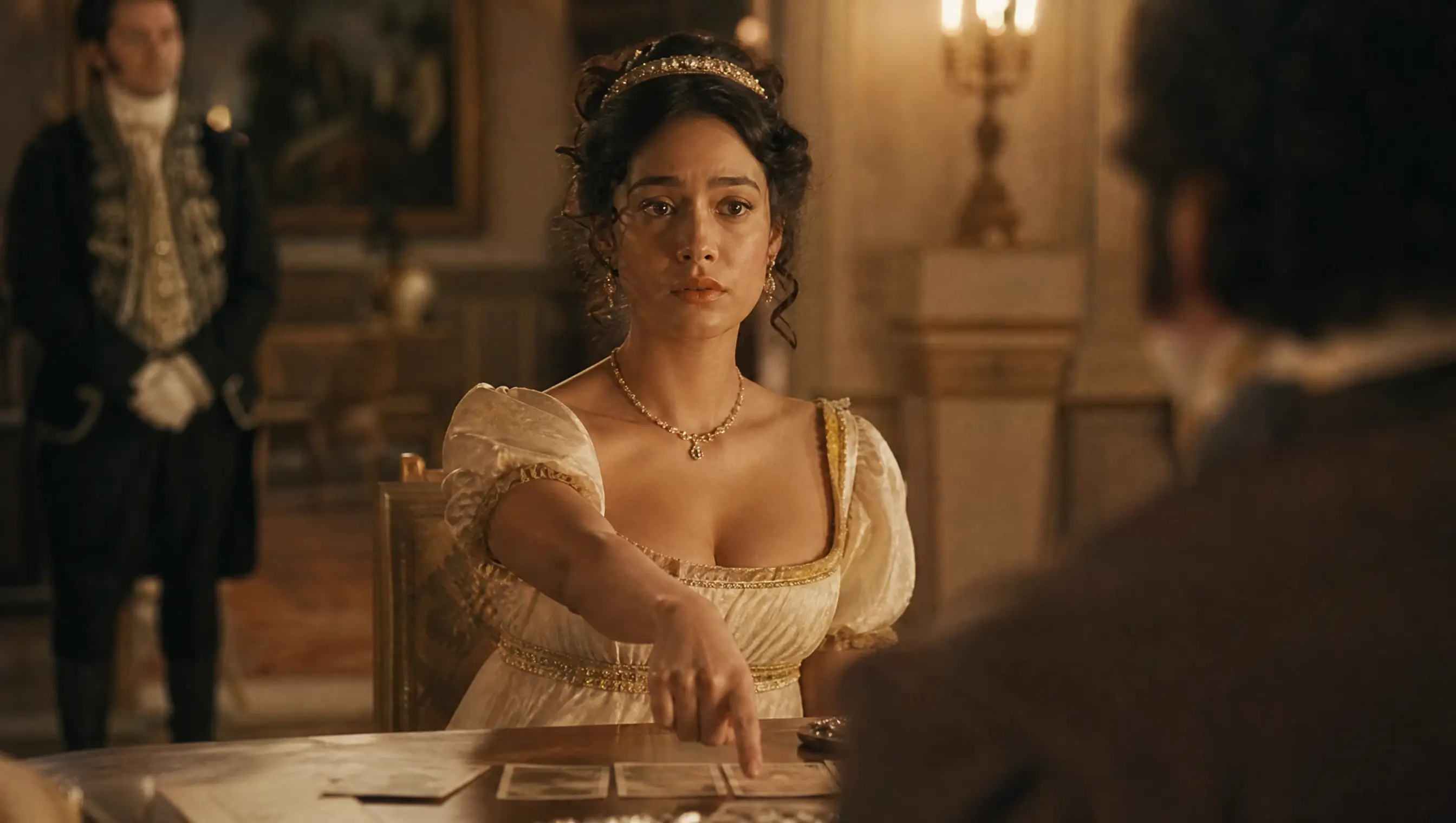
Isolde Fenwick stood at the edge of the green baize as if she had been invited to admire the furniture and not to ruin a duke.
She wore deep burgundy silk, empire-waisted, the short puff sleeves leaving her forearms bare above long gloves. A silver chatelaine hung at her bosom, its little seals and keys catching the light whenever she breathed. Her dark hair was dressed in the fashion that required patience and a patient maid: an elaborate updo with face-framing ringlets that softened a face otherwise too pale, too still, for a room devoted to pleasure. Her eyes were darker still. She did not smile.
Opposite her, at the semi-circular card table, sat Lucien Ashcombe, Duke of Thornmere, early in his twenties and already certain that the world arranged itself for his convenience. His hair was light blonde and wavy, the sort that candlelight made almost luminous. His eyes were a piercing blue that had, until this evening, never needed to look for exits. He wore a dark emerald green tailcoat, a pale gold brocade waistcoat, and a dark cravat tied with the precision of a man who employed other men to be precise on his behalf. Stacks of round chips stood before him like miniature fortifications. Playing cards lay in a neat rectangle under his long fingers.
Around them, older aristocrats watched with the hungry patience of people who had already lost enough money to make watching someone else lose it feel restorative. Two ladies stood close behind Isolde. One wore gold silk and pearls and held a white fan as if it were a weapon she had not yet decided to use. The other wore blue-grey and had pearls woven into her hair; she had the look of a woman who collected other people's scandals the way some collected china.
The evening had begun, as such evenings did, with whist in the outer rooms and laughter that pretended not to care about money. Isolde had arrived on her aunt's arm with a purpose folded as carefully as the note in her chatelaine. For three months she had attended enough polite gatherings to learn where Lucien Ashcombe dealt when he wished to be admired. Whitcombe House, with its rented glory and its tolerant host, was one of those places. Gentlemen played piquet and hazard when the whist tables grew dull. Ladies watched from a seemly distance, or pretended to watch the fire, or whispered behind fans about who owed whom.
Isolde had not come to whisper.
She had come because her brother's papers, sorted on a rainy Tuesday with her mother weeping quietly over a pair of gloves, had yielded a folded note stamped with a crest Isolde knew from carriages and newspapers and the careless talk of men who thought girls did not listen. A thorned wreath. A stag at bay. A ducal coronet in cracked red wax. Peregrine Fenwick's hurried signature beneath terms that climbed like ivy.
She had not slept properly since.
Before Whitcombe House, before the burgundy gown and the stopped cards, there had been the sorting.
It had begun on a Tuesday when the rain made the parlor smell of damp wool and old smoke. Mrs. Fenwick had asked Isolde to help with Peregrine's trunk—the one brought back from his last lodgings by a landlord who wanted the room cleared and the bill paid. Inside were shirts carefully folded by someone who had still believed in mornings; a cracked snuffbox he had never truly liked; letters tied with string; a packet of IOUs in various hands; and, near the bottom, the note with the crest.
Isolde had known the Ashcombe arms the way one knows weather: not from study, but from living under its talk. Carriages in the park. Mentions in the Gazette. A cousin of a friend who had boasted of losing to Thornmere and somehow making it sound like intimacy. She had held the wax to the window and felt something in her chest go still and sharp.
"Mama," she had said, "this is not an ordinary debt."