“Is this the document?”
“Yes. Take a look.”
“It is incredible.”
“Indeed. Proceed with care.”
There is a moment just before a woman’s world falls apart when everything goes very quiet. The candles stop flickering. The laughter in the next room fades. Somewhere deep in her chest, something pulls tight like a string about to snap.
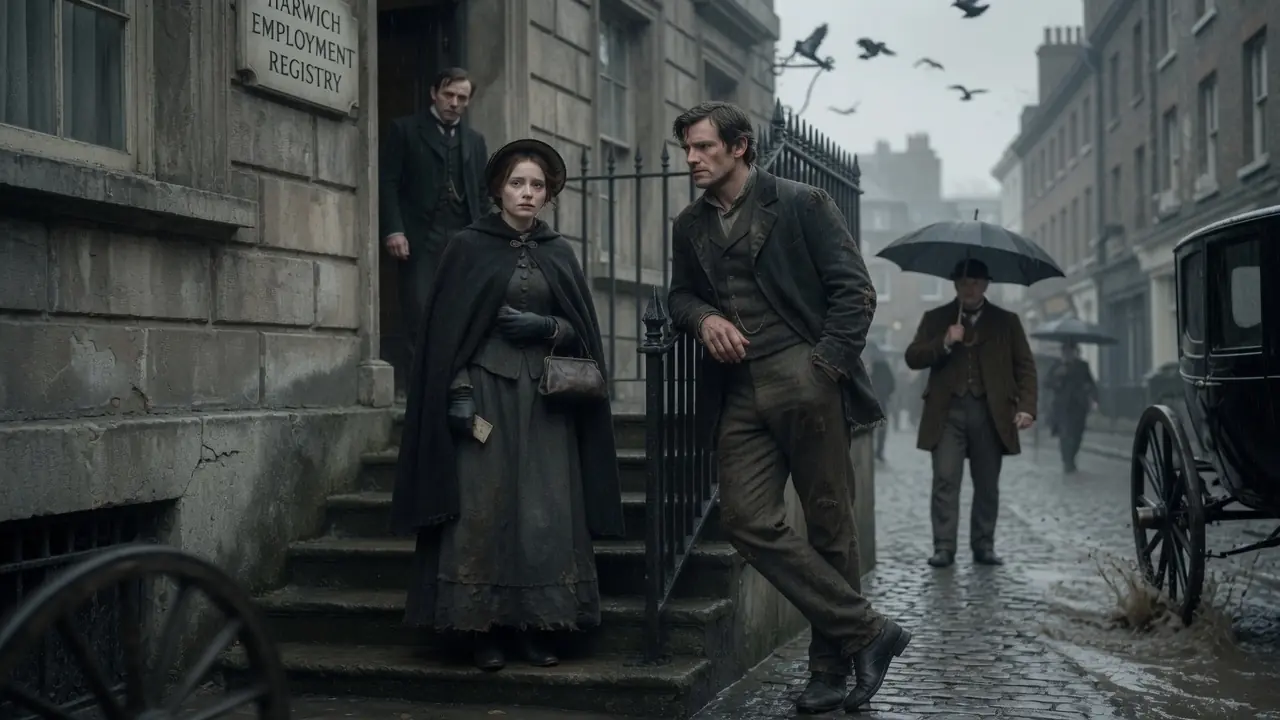
Lynette Corwin knew that moment well. She had lived it the night her father was found dead in his study with a letter in his hand and no explanation in the world. She had lived it again when the solicitor told her the estate was not hers to keep. And she lived it a third time on the cold steps of the Harwich Employment Registry, clutching a small leather purse with barely enough coins to buy herself one more week of safety.
She needed help. Not the kind that came with a smile and a cup of tea. The kind that came with broad shoulders, a steady hand, and the ability to stand between her and the men who had already sent two warnings to her door. She needed a bodyguard.
What she found was a man named Callum Hart. He was leaning against the iron railing of the registry steps when she first saw him, arms crossed, coat worn at the elbows, jaw unshaved, and eyes that looked at the street like they were reading something no one else could see. He did not look like someone who needed work. He looked like someone who had decided, for reasons of his own, to pretend that he did.
She hired him anyway. She could not have known, not then, not in that gray London morning with pigeons circling overhead and carriage wheels splashing mud across the cobblestones, that the man she had just paid twelve shillings to guard her life was Callum Aldrich Hart, the Duke of Renwick. He was one of the wealthiest and most powerful men in England, a man whose name alone could silence a room and whose signature on a document could move Parliament. She did not know, and for a little while, he intended to keep it that way.
The registry office smelled of ink and damp wool and the particular kind of desperation that polite people pretended not to notice. Lynette sat in the third chair from the left, her back straight, her hands folded, her expression carefully arranged into something she hoped looked calm. She was twenty-two years old, recently made an orphan, and currently the target of at least two men who wanted something her father had left behind. She did not know exactly what that something was, and that was rather the problem.
Across the narrow desk, a clerk named Mr. Fitch was reading her written request with the slow and squinting focus of a man who found everything slightly suspicious. “You want a personal guard?” he said. “Yes.” “Not a footman? Not a general household man? A guard, specifically?” “That is correct.”
He set the paper down and looked at her over the rim of his spectacles. “Miss Corwin, this is an employment registry. We place coachmen and housekeepers and the occasional secretary. We are not in the business of—”
“I was told you keep a supplemental list,” she said quietly. “Men with particular experience. Military men, perhaps. Or those who have served in private security arrangements for noble households.”
Mr. Fitch blinked. He did not ask who had told her. He simply reached beneath his desk and produced a second, smaller ledger bound in plain brown leather. He opened it, ran a finger down a column, paused, and then looked up with something unreadable in his eyes.
“There is one name,” he said, “available immediately. He came in yesterday morning. References are...” He paused again. “Unusual.”
“Unusual how?”
“Impressive, but difficult to verify. He says he served abroad. He has a letter from a colonel whose regiment I cannot locate in any current roster.” He cleared his throat. “He is not the sort of man we typically recommend to a young lady traveling alone.”
“I am not traveling,” Lynette said. “I am simply trying to stay alive.”
She said it plainly, without drama, the way one states a fact about the weather. Mr. Fitch stared at her for a long moment. Then he wrote a name on a small card and slid it across the desk. The name read Callum Hart.
She found him exactly where Fitch had said he would be, on the steps outside, leaning against the railing as though he had all the time in the world and had decided to spend it watching London move. He was tall, broader than most men she had encountered in drawing rooms, with dark hair that curled slightly at the ends and a face that might have been handsome if it were not currently set into an expression of magnificent indifference. He was looking at the street when she approached. He did not look at her.
“Mr. Hart,” she said.
“Miss.”
Still not looking.
“I have a proposal for you.”
“Most people who come down those steps do.”
Now he looked at her. Just briefly. Just enough. His eyes were gray, the kind of gray that was not too soft but sharp, the color of river stones worn smooth by cold water.
“What is it you need?”
She told him. She kept it short because she had practiced keeping it short. She needed someone to stay close, to accompany her to two appointments over the next four days, to sleep in the outer room of her rented lodgings, and to be present and capable if anyone made a move against her. She would explain the full situation once he agreed.
She was offering fifteen shillings for four days. She had twelve now and would have the rest by morning. He listened without interrupting, which she appreciated. When she finished, he was quiet for a moment.
“Who is after you?” he asked.
“I am not entirely certain.”
“What do they want?”
“Something my father left. I do not know what.”
He looked at her steadily. “You are hiring a guard without knowing who you are being guarded from or why?”
“Yes.”
“That is not a comfortable arrangement.”
“No,” she agreed. “It is not. But it is the arrangement I have.”
He was quiet again. A cart horse clattered past, pulling a load of timber. A woman called to her child from a window above. The city kept moving, indifferent and loud, while Callum Hart stood still and considered something she could not read.
Then he said, “Twelve now. Three by morning.”
“Yes.”
“Fine.”
He straightened from the railing, and she saw then how completely he occupied whatever space he stood in. Not aggressive. Simply present in a way that made other people’s presence feel smaller.
“Where are you lodging?”
She gave him the address. He nodded once and said he would be there within the hour. He asked only one more question as she turned to leave.
“Your father. How did he die?”
She stopped. Her hand tightened around her purse.
“They said it was his heart,” she said carefully.
“But you do not believe that.”
She turned to look at him, at this stranger she had just hired with coins she could barely spare, this man with worn coat sleeves and sharp gray eyes.
“No,” she said. “I do not.”
He nodded again, as if that confirmed something. She walked away with twelve shillings less, and for the first time in three weeks, something that felt almost like relief. She did not notice the way he watched her go, or the way something shifted in his expression the moment she was out of sight. Not quite calculation or concern, but something between the two, in the space where a man begins to realize that a simple task is going to become something far more complicated.
Callum Hart let out a slow breath and straightened his coat. He had come to London for two reasons. The first was private and would remain so. The second was to understand, without the obstruction of his title and his household and the endless stream of people who wanted something from a duke, whether he could still move through the world as a plain man and find anything worth knowing.
He had not expected to find a girl on the registry steps with steady hands and frightened eyes and a dead father and enemies she could not name. He had not expected to say yes. And yet, he found a boy selling newspapers near the corner and pressed a coin into his palm.
“Take a message to Renwick House on Alderley Street,” he said quietly. “Tell whoever answers that the master will be delayed. No details. Just delayed.”
He thought for a moment. “And tell Sergeant Dowd I need eyes on Vander Lane by nightfall. He will know what that means.”
The boy nodded and ran. Callum watched him go, then turned toward the direction Lynette Corwin had walked. He had been many things in his life. Soldier, heir, duke, grieving son, tired man.
Lynette’s lodgings were on the second floor of a narrow building on Vander Lane, wedged between a printer’s shop and a cobbler’s stall. The landlady was a stout woman named Mrs. Penthorpe, who had a particular talent for appearing exactly when she was not wanted and a parrot named Admiral who shouted the phrase “Shut the window” at irregular intervals throughout the day. The room itself was small but clean. One window overlooked the lane. One bed. One chair.
There was a fireplace that had not been lit in three days because Lynette was carefully rationing coal. There was a writing desk against the wall, which she had covered with every document she had managed to salvage from her father’s study before the solicitors arrived to seal the estate. She was standing at that desk when the knock came at her door.
“Miss Corwin.”
Callum’s voice, even through wood, carried a particular kind of weight. Low and certain, like a clock striking the hour. She opened the door.
He looked different in the narrow hallway of the lodging house than he had on the registry steps. Closer. More real. She noticed that his coat, though worn, was well-cut, the kind of cut that did not come cheap, even second-hand.
She noticed that he stood slightly to the side of the doorway rather than directly in front of it, which meant he was already, without thinking about it, positioning himself so that anyone coming from either end of the hall could be seen and met. She noticed these things and filed them away.
“Come in,” she said. “Please.”
He came in and looked around the room with the same quiet attention he had given the street outside the registry. Not intrusive. Simply thorough. His gaze moved to the desk, to the documents, to the window, to the single door.
He went to the window and looked down at the lane without touching the curtain.
“Landlady?” he asked.
“Mrs. Penthorpe. She lives on the ground floor. She knows I have a guest coming. I told her you were my cousin.”
He glanced at her with something brief and dry in his eyes.
“Cousin?”
“It seemed simpler.”
He said nothing to that and came to stand near the fireplace. He did not sit. She got the impression he rarely sat in unfamiliar rooms.
“Tell me about your father,” he said. “Start at the beginning.”
She did. She sat in the chair, and he stood by the cold fireplace, and she told him about Theodore Corwin, who had been a minor but respected gentleman of modest means, a man who spent his life collecting legal documents on behalf of wealthier clients. A quiet man, a private man, who had no obvious enemies and no great wealth, and no reason in the world to end up dead at his desk with a letter clutched in his hand.
She told him about the letter, how it had been taken by the time she reached the study, and how the solicitor, a man named Mr. Gravel, had arrived the very next morning with documents showing that the estate was mortgaged beyond saving and must be surrendered. She told him how Gravel had been polite and efficient and had looked at her the entire time with an expression she could not name, something between pity and relief. And she told him about the two warnings.
One had been a note slipped under her door at the lodging house three days after she arrived. It read only, “Leave it alone.” The second had been more direct. A man had followed her from the market to the end of Vander Lane, making no effort to hide it, and had stopped only when Mrs. Penthorpe opened the front door and stepped outside to sweep.
Callum listened to all of it without moving. When she finished, he asked, “The documents on your desk, are those from your father’s study?”
“The ones I managed to take before the estate was sealed, yes. I have been trying to find something. I do not know what I am looking for.”
“May I?”
She hesitated, then nodded. He crossed to the desk and looked at the papers without touching them at first, just reading what was visible. Then he picked up one, read it, and set it down. He picked up another and stopped.
“This name,” he said. “Lord Crewe. It appears on three of these documents.”
“I noticed that as well.”
“Viscount Crewe is not a minor figure.” His voice was careful, measured. “He is well-connected. He has interests in several large land acquisitions currently moving through the courts. If your father was holding documents relevant to any of those acquisitions—”
“He would be worth silencing,” she finished.
The room was very quiet. Outside, Admiral the parrot announced, with great conviction, that someone should shut the window. Callum set the document down.
He turned to look at her, and for just a moment, something in his expression came loose from its careful arrangement. Not pity or distance. Something else. Something that looked, briefly, like recognition.
Then it was gone, and he was composed again.
“Get some rest,” he said. “I will take the chair. We go to your first appointment in the morning. And, Miss Corwin—”
She looked at him.
“Do not open that door for anyone else tonight. Not even Mrs. Penthorpe.”
“Understood,” she said.
She meant it. Because whatever this man was, whatever he was hiding behind worn cuffs and careful eyes, she believed with a certainty she could not explain that he was exactly what she needed. She just did not know yet what he needed in return.
Morning came gray and cold, the kind that pressed against the window glass and made the whole city feel like it was holding its breath. Lynette was already dressed when Callum stirred in the chair. She had not slept well. She had lain in the dark, listening to the lane below and thinking about her father’s hands, the way he always folded letters twice before sealing them, the way he hummed without knowing he was doing it.
She had thought about the documents on the desk and Lord Crewe’s name appearing three times like a signature on something dangerous. She had also thought about the man in the chair. Not in the way that would have scandalized Mrs. Penthorpe, but in the way of someone trying to solve a puzzle with half the pieces missing.
Callum Hart did not move like a man who needed twelve shillings. He did not speak like one either. His vocabulary was clean and precise. He had read those documents on her desk the way someone reads something familiar, not like a man studying, but like a man confirming.
She said nothing about this. Not yet. He was awake before she reached the fireplace, eyes open and alert the moment she moved, which told her he had not truly slept either. Only rested in the way soldiers learned to rest, one part of the mind always listening.
“Your appointment,” he said.
Not a question.
“Ten o’clock. A solicitor on Mercer Street. His name is Mr. Aldous Finch. He was a colleague of my father’s, one of the few I trust. I wrote to him last week, and he agreed to see me.”
Callum stood, rolled his shoulders once, and straightened his coat.
“What do you expect him to tell you?”
“I am hoping he knows what my father was holding and for whom. If Finch can give me a name beyond Crewe, something concrete, I can take it to someone with authority.”
“You think that will stop them?”
“I think it is better than waiting in a room for the next warning to come through the door.”
He looked at her with that gray, steady gaze. “You are braver than you think you are,” he said.
It was not flattery. It sounded almost like an observation he had not intended to say aloud.
She picked up her coat from the hook. “Or more desperate. They look very similar from the inside.”
They left the lodging house at half past nine. Mrs. Penthorpe appeared in the hallway as they descended, eyes sharp and expression carefully neutral, which meant she was cataloging everything to discuss with Admiral later. Callum gave her a polite nod that somehow communicated both good morning and none of your business simultaneously. She stepped aside.
Outside, Vander Lane was already moving. A flower seller named Dotty, who had her usual spot near the corner, called out prices for early jonquils. Two boys chased a hoop past the cobbler’s stall. A heavy-set man in a brown coat stood near the far end of the lane reading a broadsheet, which would have been entirely ordinary, except that he had been standing in the same spot when Lynette had looked out the window an hour ago.
Callum saw him at the same moment she did. She knew because his pace changed by exactly one small degree, just enough to shift their angle of exit without making it look deliberate.
“Do not look back,” he said quietly.
“I know.”
They walked to Mercer Street at a pace that looked like two people entirely unconcerned with being followed. At the corner of Briar Row, Callum steered her into a narrow passage between two shops, let thirty seconds pass, then looked back the way they had come. The man in the brown coat had not followed, or had thought better of it.
“He is gone,” Callum said. “For now.”
“Yes. But for now.”
Aldous Finch’s office occupied the first floor of a thin building squeezed between a bookseller and a tea merchant, and it smelled powerfully of both. Finch himself was a small, precise man of about sixty with white side whiskers and the cautious manner of someone who had spent decades knowing things he could not say. He shook Lynette’s hand warmly and looked at Callum with polite but obvious uncertainty.
“My associate,” Lynette said. “He accompanies me everywhere at present.”
Finch accepted this without comment and gestured to the chairs. He poured tea without asking, then sat behind his desk and folded his hands.
“Your father,” he said gently, “was a careful man.”
“Yes.”
“He was also, in the last year of his life, a frightened one.”
Finch chose his words the way a man picks his way across ice, one step at a time. “He came to me six months ago. He had been engaged to copy and authenticate a series of land title documents on behalf of a client. He did not name the client to me, but he said the documents revealed something that the client wished to remain hidden.”
“A prior claim,” Finch continued. “An ownership dispute that, if made public, would invalidate a transaction worth a very great deal of money.”
“Lord Crewe,” Lynette said.
Finch’s eyes flicked to her quickly, then away.
“I cannot confirm a name.”
“But you are not denying it.”
He was quiet for a moment. “Your father made copies of the relevant documents. He sent them somewhere for safekeeping. He told me that if anything happened to him, you would find the location in the thing he loved most that was not a person.”
The room held its breath. Lynette thought of her father’s study, his books, his maps, his collection of pressed botanical prints, his chess set, which he had carved himself over twenty years, and his music box that played a Viennese waltz and had belonged to her mother.
“The music box.”
She was on her feet before she knew it.
“Miss Corwin.” Finch rose with her, his face urgent. “Be careful. The man behind this has long arms and short patience. He has already approached me once, a man named Sutter, thick-necked, scar through his left brow, who asked me what your father had shared with me.”
“I told him nothing because I had nothing firm to say.” His eyes moved to Callum. “Keep her safe, sir. Whatever you are.”
Callum met the old man’s gaze. “I intend to,” he said simply.
They were barely back on the street when Lynette said, low and fast, “The music box. My father always said my mother’s waltz was the most important thing he kept. It is still at the estate with the housekeeper, a woman named Mrs. Blunt. I sent word to her before I left. She hid several small items for me.”
“Is she trustworthy?”
“She has worked for my family for nineteen years and wept at my father’s funeral for three hours. Yes.”
“Then we go to her.”
He flagged a cab at the corner, spoke an address to the driver in a tone that allowed no negotiation, and handed her in. As the cab pulled into traffic, neither of them noticed the young man on the corner across the street, slim, well-dressed, with a notebook in his hand and very attentive eyes.
His name was Perry Ashton, and he was a junior clerk employed by Viscount Crewe. He had been watching the Finch building for two days. He wrote three words in his notebook, closed it, and walked quickly in the opposite direction.
Inside the cab, Lynette looked at Callum and asked the question she had been carrying all morning.
“Who are you, really?”
He did not look away from the window.
“A man doing a job,” he said.
“That is not an answer.”
“It is the one I have for now.”
She studied his profile against the passing city, the strong line of his jaw, the way his hands rested on his knee with a stillness that spoke of discipline, of a man who had trained himself not to fidget, not to betray himself in small ways.
“All right,” she said at last. “For now.”
She looked away. He finally looked at her, just for a moment, when she was no longer watching.
The Corwin estate was forty minutes outside the city by road, a modest stone house set back from a lane lined with elm trees that had dropped most of their leaves and stood like gray bones against the November sky. The gates were locked, but a notice had been fixed to the post, legal language, the kind that turned a home into a transaction. Lynette looked at it without expression. Callum watched her look at it.
They went around to the servants’ entrance at the back, where a narrow door in the stone wall was opened almost immediately by a woman who had clearly been watching for them. Mrs. Blunt was tall, spare, with iron-gray hair and eyes red from recent crying. She seized Lynette’s hands and held them hard.
“Oh, my lamb,” she said. “I was so afraid for you.”
“I am all right, Mrs. Blunt. This is Mr. Hart. He is with me.”
Mrs. Blunt assessed Callum in the way experienced housekeepers assess things, rapidly, completely, and with a verdict already reached before the subject knew they were being judged. Whatever she decided, she nodded and stepped back to let them in.
The kitchen was cold. The estate had been officially sealed, but Mrs. Blunt had stayed on unofficially, sleeping in her room and keeping the lower floor from going entirely to ruin. She had, as Lynette had asked in her letter, gathered certain small items from the master’s study before the solicitors arrived.
She went to the pantry and returned carrying a cloth bag. Inside it were a pocket watch, two framed portraits, a bundle of letters tied in string, and the music box. It was a small thing, oval, rosewood, with a painted lid showing a garden scene that had faded at the edges.
Lynette took it in both hands with a care that had nothing to do with its monetary value and everything to do with its weight of meaning. She turned it over. The base was smooth except for the winding key and a maker’s stamp that had been partially rubbed away with age. She opened it.
The waltz mechanism began, thin and sweet and slightly slowed with age. And there, fitted into the velvet lining of the lid, almost invisible, was a folded square of paper. Her hands did not shake, which surprised her.
She took the paper out, unfolded it, and read. Then she read it again. She passed it to Callum without a word.
It was a short note in her father’s handwriting. It listed an address, a solicitor’s name she did not recognize, and a single sentence.
“Tell them Theodore Corwin sent you, and that the Whitmore deed must not be destroyed.”
“The Whitmore deed?” Callum said, reading it again.
Something moved behind his eyes.
“You know it?”
He was quiet a beat too long.
“I know of a Whitmore property. It was the subject of a land dispute several years ago. The case was settled, or appeared to be settled, in favor of a very powerful buyer. If the original deed still existed and showed the settlement was fraudulent—”
“Someone would lose a great deal,” Lynette finished. “More than money.”
He folded the note carefully and held it out to her.
“Title. Legal standing. Possibly criminal charges.”
She took the note. “I need to get to that solicitor.”
“Not today. Not without more information.”
He glanced at Mrs. Blunt, who had been listening with the still, intent expression of a woman who understood exactly how serious the conversation was.
“Is there anyone who has come to this property since Mr. Corwin died? Anyone who should not have been here?”
Mrs. Blunt’s jaw tightened.
“Three days after the funeral, two men. They said they were from the solicitor’s office, but they did not have the look of solicitor’s men. One was big, neck like a cart horse. The other one was young and thin with a notebook.”
Callum looked at Lynette.
“The man from Finch’s building. Perry Ashton.”
“They went through the study,” Mrs. Blunt continued, her voice hard with controlled anger. “I stood in the doorway and watched every minute. They did not find what they were looking for. I could see it on their faces. They left without a word of thanks or explanation.”
“What did they search for?” Callum asked.
“Books, mostly. The desk drawers. They opened the clock on the mantel. They looked everywhere except—”
“Except the music box,” Lynette said.
Mrs. Blunt looked at it in Lynette’s hands, and something softened in her face. “Your father always kept it on the high shelf behind the curtain, the one your mother used to love. It looked like it belonged to the room, not to him. No one would think to look.”
Callum moved to the window and looked out at the back lane. His expression had changed, sharpened.
“We cannot stay long. If they have someone watching this property, which they very likely do, we have already been here too long.”
Lynette wrapped the music box back in its cloth, tucked the note inside her coat, and turned to Mrs. Blunt. She took the woman’s hands again and held them.
“Will you go to your sister in Bath? I asked you in my letter, and I am asking again now, not as a request, but as a genuine plea. It is not safe to be connected to this house.”
Mrs. Blunt’s eyes were bright.
“When this is over, you come back to me. Do you hear? When you can, come back.”
“I will.”
They left through the servants’ gate and walked quickly to where the cab waited at the lane’s far end. They were thirty seconds from the gate when a second carriage appeared at the top of the lane, moving too deliberately to be accidental.
“Do not run,” Callum said.
“I know.”
“Get in the cab.”
She got in. He climbed up after her and told the driver to go now, immediately, toward the city, not the main road. The driver, perhaps accustomed to urgency or perhaps simply well paid, flicked his whip, and the cab lurched forward.
The carriage at the top of the lane slowed but did not follow. They rode in silence for several minutes. Then Lynette said, “Callum.”
He looked at her.
“Thank you.”
He looked away. Something passed across his face quickly, like a shadow across water, at some private reckoning she was not meant to see.
“Do not thank me yet,” he said. “We are far from finished.”
But his voice, for the first time, had lost a small amount of its careful distance. And she noticed. She noticed everything.
They were back in the city by early afternoon. Callum told the driver to stop two streets from Vander Lane, and they walked the rest of the way in a roundabout manner that took them through an alley, past a bakery, and along a side street busy enough to make following difficult. At the lodging house, a visitor was waiting.
He was sitting on the front step with the posture of a man entirely comfortable making himself at home in other people’s spaces. He was perhaps thirty, with clever dark eyes, an expensive gray coat worn with deliberate casualness, and the grin that arrived on his face before it was strictly appropriate.
Callum stopped. Something between recognition and irritation crossed his face.
“No,” he said.
The man on the step spread his hands in a gesture of innocent arrival.
“I had nothing to do with your being here. That was entirely your own mysterious decision. I am simply keeping you company in it.”
Lynette looked between them.
“You know each other?”
“This is Tobias Granwell,” Callum said with the tone of a man describing a persistent weather condition.
“He is his oldest friend,” Tobias said cheerfully, standing and extending a hand to Lynette. “And before he tells you something less flattering, I will say that I am also entirely trustworthy, excellent in a crisis, and I have information he will want.”
They went upstairs. Mrs. Penthorpe watched from behind the parlor door with undisguised interest. Admiral said something about the window.
In Lynette’s room, Tobias sat in the chair Callum had occupied the night before with the ease of a man who had never once felt out of place anywhere. He looked at the desk covered in documents, at the music box Lynette set carefully on the windowsill, and at the note she placed on the desk. His expression shifted from cheerful to serious with a speed that told her the playfulness was a costume, not a character.
“Crewe is moving,” Tobias said. “Whatever your father knew, Miss Corwin, Crewe has decided he cannot wait for you to produce it quietly. He has engaged a solicitor named Merton to file an injunction, something about unpaid debts your father allegedly owed, designed to give him legal grounds to search your person and current lodgings.”
“That is entirely fabricated,” Lynette said.
“Of course it is. That is rather the point. It gives him official cover to come through that door.”
He glanced at Callum.
“You have perhaps twenty-four hours before Merton files the paperwork.”
“Then we go to the address on the note tonight,” Lynette said.
Both men looked at her.
“The solicitor my father named. We go tonight before any injunction is filed, and we get whatever documents he was keeping for my father. Once we have them, Crewe has no reason to search me, because what he wants is already in our hands and ready to be used.”
A silence settled over the room.
Tobias looked at Callum.
“I like her.”
“Do not,” Callum said.
“Too late.”
Tobias turned back to Lynette. “There is one further complication. The name on that note, the solicitor, Prentice Lowell on Garnet Street, I know that name. He is not simply a solicitor. He is a man who has for many years held documents of a sensitive nature for clients with enemies in high places. He is trusted. He is also watched. Crewe’s people will have him under observation.”
“Then we go after dark,” Lynette said. “And we go carefully.”
Callum looked at her for a long moment. There was something in his expression she was beginning to recognize. Not quite reluctance, not quite admiration, but something that occupied the space between the two, as though he kept being surprised by her and had not yet decided what to do about it.
“After dark,” he agreed.
He turned to Tobias. “I need two more people. Someone who knows Garnet Street and someone who can create a distraction if necessary.”
Tobias was already reaching into his coat. He produced a small card and held it out.
“I have a woman named Ida Flint, former actress, current information broker. She knows every lane in this city and has never once done anything predictable.”
He produced a second card.
“And Captain Hugh Darnell. He was in the regiment with us. He owes me four favors and has been looking for an opportunity to repay them.”
“You planned this before you came,” Callum said.
It was not an accusation.
“Almost. I planned for the possibility,” Tobias said pleasantly. “There is a difference.”
He reached into his coat again. “I also brought sandwiches.”
He produced a folded cloth parcel that smelled of ham and mustard. He placed it on the desk beside the documents with complete sincerity.
“You have both been running all morning. Eat, then save the girl’s inheritance.”
Lynette looked at the parcel, then at Tobias Granwell, then at Callum, who was looking at the ceiling with the expression of a man who had accepted that certain forces of nature could not be controlled.
“Thank you,” she said to Tobias.
“My absolute pleasure, Miss Corwin.”
She began to unwrap the parcel. Callum sat on the edge of the windowsill near the music box, and for a moment, the winter light caught his face at an angle that did something to the careful ordinariness he wore like a second coat. For just a moment, he looked like what he was beneath it. Not a man of worn sleeves and uncertain employment. Something older. Something with a great deal of weight behind its eyes.
But then she offered him a sandwich, and the moment passed.
“Garnet Street,” she said. “Tonight.”
He took the sandwich.
“Tonight,” he agreed.
Outside the window, the city moved on, unknowing and indifferent. Somewhere across London, in a townhouse on a wide and well-lit street, Lord Crewe was receiving a report from Perry Ashton about a young woman who had visited a solicitor, then an estate, and had returned to the city carrying something small wrapped in cloth. Crewe listened. Then he sent for Sutter.
The day moved toward evening like a tide coming in, slow and certain and impossible to stop.
Night fell over London like a curtain dropped from a great height, sudden and complete. By eight, Vander Lane was quiet except for the distant sound of a piano from a public house two streets over and the occasional footstep of someone hurrying home against the cold. Lynette had changed into her darkest dress, a deep charcoal wool that absorbed light rather than catching it. She had pinned her hair close and worn flat shoes that made no sound on stairs.
She stood at the window looking down at the lane while Callum checked the contents of his coat with the quiet efficiency of a man accounting for tools before beginning work. Tobias had gone ahead an hour earlier to meet Ida Flint and Captain Hugh Darnell at the entrance of Garnet Street. He had left with a wink and a promise to have everything arranged, which Lynette found either reassuring or alarming, depending on which moment she considered it.
She held the note her father had left in the music box. She had read it so many times by now that she could have recited it in her sleep, but she held it anyway. It was the last thing her father had done for her. This small folded square tucked into velvet behind a painted garden, behind a waltz that had belonged to her mother. The last careful act of a careful man who had known he was running out of time.
“Ready?” Callum asked from across the room.
She tucked the note into her coat, close to her chest.
“Yes.”
They left through the back of the building, out through the kitchen passage that Mrs. Penthorpe used for deliveries, and into the narrow service alley that ran behind the row of buildings. It was dark and smelled of damp brick and coal ash, but it kept them off the lane and away from any eyes that might be watching the front of the house.
Callum moved with a silence that still caught her attention every time. Not the careful silence of someone trying not to be heard, but the natural silence of someone who had learned long ago that noise was a choice and had simply stopped making it. She matched his pace and did her best to match his quiet.
They moved through three alleys, across a small courtyard behind a church, and emerged onto a wider street two blocks from Garnet Street. Here the city was more alive, cabs and foot traffic providing the kind of cover that crowds always gave. They joined the movement naturally and walked the last distance without speaking.
Garnet Street was a short, respectable lane of professional offices and private residences, gas-lit and reasonably quiet at this hour. Most of the office windows were dark. At the far end, a light burned in a first-floor window above a door marked with a small brass plate.
Tobias was waiting in the shadow of a doorway twenty feet short of the law office. Beside him stood a woman Lynette recognized immediately as someone who had never once in her life been overlooked. Ida Flint was perhaps thirty-five, with sharp cheekbones, hair the color of autumn leaves pinned severely back, and the eyes of someone who read rooms the way other people read sentences. She wore a coat the color of deep red wine and stood with the posture of a woman who expected to be the most capable person present and was usually right.
Beside her was a man who could only have been a soldier. Captain Hugh Darnell was broad, weathered, with a jaw like a cliff edge and a stillness about him that reminded Lynette, oddly, of Callum. Not identical, but from the same school of thought. The school that said a man who was still was a man who was ready.
Callum greeted them both with nods that carried the weight of shared history. Darnell clapped him once on the shoulder with a hand the size of a plate. Ida Flint looked Lynette over in three seconds and apparently reached a satisfactory conclusion.
“There are two of Crewe’s men on this street,” Ida said without preamble. “One is in the cab parked at the north end, which has not moved in two hours. The other is the man pretending to read a notice board at the south end. He has been reading the same notice for forty minutes.”
“The cab,” Darnell said. “I will manage it.”
“The notice reader is mine,” Ida said.
The way she said it left no room for discussion or concern.
“Lowell himself,” Tobias said, looking at Callum and Lynette. “He is inside. I saw movement on the first floor twenty minutes ago. Whether he is alone, I cannot say.”
“We go in the front,” Callum said. “Directly. No hesitation. If Lowell is being watched, arriving as though we have every right to be here is safer than arriving as though we do not.”
“Agreed,” Lynette said.
Darnell was already moving toward the north end of the street. Ida walked south at a pace that was somehow both entirely casual and entirely purposeful. Tobias drifted to a position near the doorway opposite Lowell’s office, where he could see both ends of the street and the entrance simultaneously.
Callum and Lynette walked to Lowell’s door and knocked.
A long pause.
Then a shuffle of movement inside.
Then the door opened on a chain, and a pair of cautious eyes appeared in the gap.
The man was perhaps sixty-five, slight, with thin white hair and the particular look of someone who had spent decades being careful and was now more careful than ever.
“Mr. Lowell,” Lynette said quietly. “My name is Lynette Corwin. Theodore Corwin was my father. He sent me.”
The eyes changed. The door closed briefly. The chain was removed, and it opened fully.
Prentice Lowell was smaller than his caution suggested, a narrow, precise man in an old-fashioned waistcoat who looked at Lynette with an expression that mixed sorrow with relief in equal measure. He looked at Callum with pure assessment, said nothing about him, and stepped back to let them in.
The office was a single room, book-lined and paper-heavy, lit by two lamps that cast warm light across a desk covered in organized stacks. It smelled of candlewax and old leather. A fire was burning low in the grate. It was, despite everything, a room that felt like a sanctuary.
“I have been waiting,” Lowell said, closing the door and bolting it. “Since your father sent word six weeks ago, I have been waiting and hoping. I did not know if you would come. I did not know if you were safe.”
“I am,” Lynette said. “For now. We have very little time, Mr. Lowell. Please tell me what you have.”
He went to the desk, unlocked a lower drawer with a key from his waistcoat, and produced a flat leather folder. He held it for a moment, as though the weight of it was more than physical.
“Your father brought this to me in October,” he said. “He had copied the original Whitmore deed before his client and the man who employed him could have it destroyed. The deed proves that the Whitmore land in Lincolnshire was legally entailed to a branch of the original Whitmore family and was not, as Lord Crewe has maintained, free for purchase and development.”
“The sale was fraudulent. The document Crewe submitted to the courts was a forgery. Your father authenticated the real one.”
“And Crewe knew he had done it,” Lynette said.
“Yes. Your father told him he would not falsify the authentication. He was told that his position should be reconsidered.”
Lowell’s voice carried quiet fury beneath its professional calm.
“Two weeks later, your father was dead.”
The room was very still. Lynette took the folder from Lowell’s hands. She held it with the same care she had given the music box. She did not open it. There was no need. She believed it completely.
“Then what do we do with this?” she asked.
Callum spoke from behind her. His voice was different now, and she noticed it. Lower, more direct, stripped of the careful anonymity he usually carried.
“It goes to the Lord Chancellor’s office, not a magistrate, not a common court. The Lord Chancellor has jurisdiction over land title fraud at this level and the authority to suspend Crewe’s legal actions against you pending investigation.”
Lowell looked at Callum with sudden sharpness.
“That is a very specific answer for a personal guard,” he said carefully.
A silence passed through the room like a draft.
“I have useful knowledge,” Callum said.
Lowell held his gaze for a moment, then looked away. But his expression had shifted into something thoughtful, something that filed information away for later.
“There is a man at the Lord Chancellor’s office,” Lowell said, “a senior clerk named Aubrey Crest. He is honest, which is rarer than it should be. He will receive this properly if you take it to him directly. First thing tomorrow morning. Do not wait.”
“We will not,” Lynette said.
A sound came from outside, a sharp crack like a crate being knocked over, followed by raised voices at the north end of the street.
Darnell creating his distraction with characteristic directness.
“We go,” Callum said.
Lynette gripped the folder. She turned to Lowell.
“Thank you for keeping this. For waiting.”
The old man shook his head.
“Your father was an honest man in a situation that punished honesty. The least I could do was protect the evidence of it.”
He unlocked the door.
“Go, Miss Corwin. Quickly now.”
They went. The street outside had reorganized itself, though the cab at the north end was now involved in a spirited altercation with a street vendor whose cart had somehow ended up across its path. The man at the notice board was gone entirely, replaced by Ida Flint walking calmly toward them from the south end, fixing her glove with an expression of serene unconcern.
Tobias materialized from his doorway.
“Smoothly done,” he said softly. “Move.”
They moved. All five of them, away from Garnet Street and into the network of lanes that Ida knew like a cartographer who had drawn the map herself. Within twelve minutes, they were three streets away, and the night was quiet around them again.
Lynette held the folder against her chest and walked through the dark city and thought about her father humming without knowing he was doing it. She thought, I have you now. Or she thought, I will finish what you started.
And behind her, keeping pace in the dark, Callum Hart watched the street ahead and behind and all around and held inside his chest the growing, complicated weight of a secret that could no longer be kept.
They did not sleep. Not for lack of trying in Tobias’s case, who fell asleep in the chair within twenty minutes of returning to Vander Lane and remained there with the profound commitment of a man with no conscience and excellent rest habits. Darnell sat by the door with the patient immobility of long habit. Ida Flint made tea from supplies she had apparently produced from her own coat pocket and sat at the desk reviewing the documents in the folder with the focused attention of someone who had read dangerous papers before and understood how to extract what mattered.
Lynette sat beside her reading along while Callum stood at the window. He had been standing at the window for over an hour. She noticed because she noticed everything about him at this point. The particular quality of his stillness. The way his hands resting on the windowsill were not tense but not relaxed either.
She noticed the way he was looking at the street with a focus that had gone beyond watching for danger and into something internal. Something he was working through behind his eyes while his face held steady. She let it go. She turned back to the documents.
The Whitmore deed was extraordinary in its plainness. It was a simple, clear, legally worded document that said what it said without ambiguity. The Whitmore land in Lincolnshire had been left in entailment to a surviving line of the family. It could not be sold without the consent of those heirs.
The heirs had not consented. They had in fact never been located or informed because Lord Crewe’s solicitors had deliberately ensured they would not be found. There was a second document beneath the deed, her father’s written authentication, signed and dated, confirming the deed was genuine. And beneath that, a three-page account in her father’s careful handwriting describing every step of the process, every instruction he had received from Crewe’s representative, and every moment at which he had understood that he was being asked to participate in a fraud.
“It is,” Ida said quietly, setting down her teacup, “enough to ruin Crewe completely. Enough to bring criminal charges. Enough to restore the Whitmore heirs, whoever they are and wherever they can be found, to their rightful property.”
“Your father knew exactly what he was doing when he made these copies,” Ida said. She was not a sentimental woman, which made the gentleness in her voice more significant. “He knew the risk. He did it anyway.”
Lynette nodded. Her throat was too tight for words.
At the window, Callum turned from the glass. He stood for a moment in the lamp-lit room, looking at Lynette with an expression she had never seen on his face before. All the careful distance was gone. Not stripped away suddenly, but worn away gradually over two days of alleys and cabs and cold kitchens and a music box that played a waltz that belonged to a dead woman and her honest, frightened husband.
He said her name. Just her name.
“Lynette.”
She looked up. He crossed to the desk and crouched to her eye level, which was not a thing she had expected from him. This deliberate making of himself smaller, this choosing to meet her where she was rather than speaking down from his habitual height.
“I have to tell you something,” he said.
The room went quiet in the particular way rooms do when something true is about to be said. Tobias, from the chair, cracked one eye open and then closed it again with the tact of a man who understood that some moments did not belong to him.
“My full name,” Callum said, “is Callum Aldrich Hart. I hold the title of Duke of Renwick. I have held it for four years, since my father died.”
He said it plainly, without apology or performance, the way he said most things.
“I came to London without my household and without my title because I wanted to understand what I was without either. But I did not come to the registry looking for employment. I came because I knew the kind of men who go there, the ones with military backgrounds and complicated histories, and I wanted to see if anyone was using that route to find work they should not be doing.”
“I was looking into something else entirely. And then I met you.”
She looked at him. She looked at him for a long time. She thought about his coat, well-cut beneath its wear, the way he read documents like a man who read them regularly, the way he had known about the Lord Chancellor’s jurisdiction without a pause, the way Lowell had looked at him with sudden sharpness and then said nothing.
She thought about the way Tobias Granwell wore expensive clothes with deliberate casualness and called himself Callum’s oldest friend, the way Darnell had clapped his shoulder like an equal but not like a man greeting an employer. She thought about all the small things that had not quite added up, and she felt not betrayal, not anger, but something more complicated than either. Something that sat in her chest with weight and edges and a warmth she had not expected.
“A duke,” she said.
“Yes.”
“Who hired himself out as a bodyguard for twelve shillings.”
“Fifteen by morning.”
Something moved across her face. Not quite a smile. Not quite anything she had a name for.
“You said yes,” she said. “When I came down those steps with barely enough coins and a story with no ending and enemies I could not name. You said yes.”
“I did.”
“Why?”
He held her gaze.
“Because you were not afraid of being afraid,” he said. “Most people, when they are frightened, try to hide it or deny it. You looked at it plainly and kept moving. I found that...”
He paused, searching for the word with the care he gave to most things.
“Remarkable,” he said. “I found you remarkable.”
The lamp flickered. Outside, a cart passed, its wheels loud on the cobblestones and then fading. Darnell cleared his throat softly from the door and looked at the ceiling. Ida Flint picked up her teacup and studied its contents with intense interest.
Lynette looked at Callum. This man who had crouched to her level to tell the truth, who had spent two days standing between her and danger with a title folded up and put away in a pocket like something he could choose whether or not to use.
“You could have told me,” she said.
Not accusatory.
Simply true.
“Yes,” he said. “I should have.”
“Why did you not?”
He was quiet for a moment. “Because you hired a man,” he said. “Not a duke. And I wanted to be useful as a man first.”
She held that answer. Turned it over. Found it honest, which was what she had always valued most, more than wealth or position or any of the things society said should matter.
“The Lord Chancellor’s office,” she said. “You can get us a direct audience. Not a senior clerk. A direct audience.”
He looked at her steadily.
“Yes.”
“Then that is what we do in the morning.”
He nodded. He stayed crouched at her eye level for another moment as though leaving that position required a choice. Then he straightened, returned to the window, and resumed his watch.
But something had changed in the room. Something that had been held apart was now, tentatively, provisionally, beginning to come together. Tobias opened both eyes and looked at the ceiling with an expression of deep personal satisfaction. He said nothing. He closed his eyes again and smiled.
Ida Flint drank her tea. Darnell watched the door. And Lynette Corwin held her father’s folder against her chest and breathed slowly and thought about something remarkable, and found that the word turned back in her direction did not feel entirely unwelcome.
At three in the morning, a sound came from the lane below. A scrape of boot on stone. One, then another. Not accidental.
Callum was at the door before anyone else had fully registered the sound.
“They are here,” he said quietly. “All of you. Now.”
They all moved. They came in through the front and the back simultaneously, which told Callum they were professionals, not Crewe’s usual intimidation men, but something hired specifically for this. People who understood that exits needed to be covered before a door was knocked down.
He had three seconds between hearing the sound and the first impact against the front door. He used them well.
“Darnell, back passage. Hold it.”
Darnell was already moving, pulling the door to the back stairwell closed behind him with a silence that belied his size.
“Ida, window.”
Ida went to the window, looked down, looked up, assessed, and moved to the far corner where she pressed flat against the wall beside the frame. She produced from somewhere inside her coat a small item that caught the lamplight and which Lynette decided not to examine too closely.
“Tobias.”
“Already considering our options,” Tobias said, which was his way of saying he was thinking fast and would have something ready when it was needed.
Callum turned to Lynette. He crossed to her in two steps, took her by the shoulders, and looked directly at her.
“That folder does not leave your coat, no matter what happens. Do you understand?”
“Yes.”
“Stay behind me.”
“And if I can be useful?”
He held her gaze for one second.
“Then be useful, but not before me.”
The front door gave way. Two men came through hard and fast, the way men do when they have been told quickly and not to be gentle about it. The first was large, familiar, the neck like a cart horse that Mrs. Blunt had described, the scar through the left brow. Sutter.
He carried a short club and wore the expression of a man who had done this many times and found it straightforward work. Behind him came a second man, leaner, faster-looking, with a coat that cost more than anything Sutter wore, which meant he was in charge.
The room was small. Callum used that. Sutter came at him first, which was expected. Sutter was the kind of man who went first.
Callum stepped inside the swing, used Sutter’s own momentum, and redirected him hard into the door frame. The club dropped. Sutter did not go down because men built like Sutter rarely went down from one thing, but he staggered enough for Callum to put himself between both men and Lynette.
The lean man stopped. He was measuring the room, measuring Callum, recalibrating.
“The folder,” he said.
His voice was controlled, educated. This was not Sutter’s kind of work. This was management.
“Give us the folder, and no one needs to be further inconvenienced.”
“I think not,” Callum said.
The lean man looked at him properly for the first time. Something shifted in his face. The recognition was small, but unmistakable. The way a man looks when he thinks he knows something but cannot place it.
“But you are not a bodyguard,” the lean man said slowly.
“No,” Callum agreed. “I am not.”
From the back stairwell came the sound of Darnell doing what soldiers do when a back passage needs holding, efficiently and with finality. One crash, one thud, then silence.
Sutter lunged again. Lynette, who had not stayed behind Callum as she had been told because she had identified in the moment that she would be more useful elsewhere, had crossed to the fireplace while the two men were focused on Callum. She picked up the iron poker that stood in the rack beside the cold grate.
When Sutter came within range, she swung it with both hands and connected with the back of his knee with a sharp and accurate precision that dropped him immediately. He went down hard. He did not get up.
Callum turned, looked at her, looked at Sutter, and looked back at her.
“You said it would be useful,” she said.
He turned back to the lean man, who had taken two steps toward the window and found Ida already standing in his path with the calm, implacable quality of someone who would very much prefer he tried something.
He stopped. He looked at the room. Sutter was on the floor. The back passage was silent in the way that meant no help was coming from that direction. He was outnumbered, outpositioned, and looking at a woman with a fireplace poker who had just demonstrated accurate aim.
“Lord Crewe will not stop,” the lean man said.
Not a threat.
Almost a statement of fact.
“He has resources you cannot match.”
“Lord Crewe,” Callum said.
And now his voice carried something different, something that had nothing to do with Callum Hart of worn coat sleeves and had everything to do with what lived beneath the disguise.
“He will find, when he reads his correspondence tomorrow morning, that the Duke of Renwick has taken a personal interest in the Whitmore land matter and has arranged a direct audience with the Lord Chancellor for ten o’clock.”
“He will find that the documents your employer has spent six weeks trying to recover are now in the hands of someone with enough legal standing to ensure they are received and acted upon before any injunction can be filed.”
The lean man stared at him.
“The Duke of Renwick,” he repeated.
“Yes.”
A silence followed that was almost a sound in itself.
“Tell Crewe,” Callum continued, “that the appropriate response to this information is a letter of resignation from his current legal proceedings, all to be delivered to my solicitor by noon. If it is not delivered, I will ensure the matter is referred not only to the Lord Chancellor, but to every member of the House of Lords who has a professional interest in land title integrity, which I assure you is many.”
The lean man straightened his coat. He looked, for the first time, like a man who understood that the evening had not gone the way it was planned. He looked at the floor where Sutter was carefully regaining the ability to stand. He looked at Callum with an expression that had moved from aggression through recalculation and arrived somewhere in the vicinity of retreat.
“We are leaving,” he said.
“Yes,” Callum agreed. “You are.”
Ida stepped aside with a grace that managed to convey both courtesy and warning simultaneously. The lean man helped Sutter to his feet. They left.
Tobias closed the door behind them and held it shut with one hand while he listened to the footsteps descend the stairs, cross the front hall, and exit the building.
Darnell appeared from the back stairwell, brushing dust from his sleeve.
“Two more out the back,” he said. “They will not be contributing further this evening.”
A pause settled over the room. Then Lynette set the poker back in its rack, and her hands were steady, which she noted with a quiet, private pride. She turned to find Callum looking at her with an expression she had no word for. Something full and complicated. Something that had been building across two days and a night, and a music box, and a dead father’s careful handwriting.
“Are you hurt?” he asked.
“No.”
She looked at him.
“You?”
“No.”
Tobias sat back down in his chair and exhaled with feeling.
“Wonderful evening,” he said.
“Really?”
“I feel very alive.”
Ida poured the remaining tea into her cup, found it cold, and set it down with the philosophical acceptance of a woman who had given up expecting things to be perfect.
“We should clean this room up,” she said practically. “And someone should sit with that door until morning.”
“I will take it,” Darnell said.
Callum had not looked away from Lynette. She had not looked away from him. The room was busy around them, Tobias settling, Darnell repositioning, Ida being pragmatic about cold tea and displaced furniture. And all of it happened at the edge of something that was, very quietly, happening in the center.
“Tomorrow,” Lynette said.
“Tomorrow,” Callum agreed. “We take it to the Lord Chancellor.”
“Yes.”
“And then?”
He looked at her. The lamp was low now, warm and steady. Around them, the room was quiet enough that she could hear, from downstairs, Admiral the parrot making one final authoritative declaration about the window before going to sleep.
“And then?” Callum said.
And his voice had lost every last remnant of the careful distance he had worn like armor since the registry steps.
“We talk about what comes after.”
She held his gaze. Something moved in her chest. Not the tight string of fear she had grown used to, but something different. Something that had more room in it.
“All right,” she said. “After.”
And the night settled around them. The folder stayed close to her heart. The city outside kept moving in its permanent, indifferent way, entirely unaware that something small and significant had just finished one thing and quietly begun another.
Morning arrived the way mornings do after nights that have cost something. Quietly. Without fanfare. The kind of light that comes in sideways through curtains and lands on the floor in pale strips, asking nothing. Offering only the plain fact of a new day.
Lynette was the first one properly awake. She had slept for three hours in the chair that Tobias had vacated sometime before dawn, the folder tucked inside her coat. Her coat was still on. Her head tipped against the wing of the chair in a posture that would make her neck ache for two days, and which she did not regret at all.
She sat up. The room was gray and still. Darnell was at the door, awake because she suspected Darnell was always awake. Ida was asleep on the floor with her coat folded beneath her head and the serenity of someone who had made herself comfortable in far worse places.
Tobias was horizontal across the foot of the bed with his boots still on and one arm draped over his eyes. Callum was at the window. Of course he was at the window.
She stood, straightened her coat, pressed the folder once through the fabric to confirm it was there, and crossed to stand beside him. He looked at her briefly, then back at the lane. There were shadows under his eyes. He had not slept.
“You should have rested,” she said.
“I was thinking.”
“About the Lord Chancellor?”
A pause.
“Among other things.”
She looked at the lane below. Vander Lane in the early morning was a different place from its evening self. The flower seller, Dotty, was already setting up her corner, bundled in a thick shawl, her breath coming in small clouds. The cobbler next door was taking down his shutters. Two children ran past with a dog that was enormously pleased with itself about something.
Ordinary.
Completely, peacefully ordinary.
“My father used to say,” Lynette said quietly, “that the most dangerous thing a dishonest man can do is make himself look ordinary. He said the whole trick of deception is that it wears the same face as everything else.”
Callum was quiet for a moment.
“He was right.”
“He was right about most things.”
She looked at the folder pressed against her chest.
“He was wrong about one. He thought he could manage it alone. He thought if he kept me at a distance from it, I would be safe.”
She paused.
“He did not understand that the distance itself put me in danger once he was gone because I did not know enough to protect myself.”
“You knew enough,” Callum said.
She looked at him.
“You knew to keep moving,” he said. “You knew to find help. You knew which documents mattered and where to look for them and who to trust and who not to. You walked into a registry office with twelve shillings and an incomplete story, and you made it work.”
He looked at her fully now, turned from the window, and his gray eyes in the early light were very direct and very clear.
“Your father protected you the best way he knew how. You protected yourself in every way he could not have anticipated. Between the two of you, you got it done.”
She looked at him for a long moment. Something in her chest settled, not resolved, not finished, but settled. The way a wound settles when it has finally been properly acknowledged.
“Thank you,” she said. Not for the compliment. For all of it.
He nodded once. Then, with the particular decisiveness of a man who had made up his mind about something and was done waiting to act on it, he turned to the room and said, “Everyone up. We move within the hour.”
Tobias sat up from the foot of the bed with the immediacy of a man who had not been as asleep as he appeared. Ida opened her eyes and was fully alert within seconds. Darnell was already standing.
They washed quickly, ate the remains of the provisions Ida had brought, and were out of the lodging house by half past eight. Mrs. Penthorpe watched them go from the parlor doorway with an expression that suggested she had several strong opinions she was generously restraining. Admiral said nothing, which was unusual and felt, in its way, like a send-off.
They went in two groups. Darnell and Ida took a separate route to the Lord Chancellor’s office on Lincoln’s Inn Fields, arriving ahead of them to ensure nothing unexpected was waiting. Tobias walked with Callum and Lynette, close enough to be useful, far enough to give the appearance of coincidence.
The morning was cold and bright, the sky a sharp, clean white above the rooftops. London smelled of coal smoke and bread and the river, that particular mixture that was not pleasant exactly, but was entirely itself. The smell of the city going about its enormous, complicated business.
Lynette walked with the folder inside her coat and her chin level and her steps steady. She thought about her father. She thought about her mother’s music box. She thought about a man on registry steps who had looked at the street like he was reading something no one else could see.
And she thought, with a calm that surprised her, that she was ready.
The Lord Chancellor’s office occupied a building of significant weight and intention, the kind of architecture that communicated without ambiguity that the decisions made within it were decisions that mattered. The steps were broad. The door was tall. The clerk at the entrance was young and correct and looked up from his desk with the polite blankness of someone trained to reveal nothing.
Callum stepped forward. He did not change his posture. He did not change his voice. He simply stopped performing the minor details of a man who needed to be overlooked.
And what remained was what had always been underneath. It was not arrogance. It was simply the complete absence of uncertainty.
He gave his name and title. He stated his purpose with precision. He said that the matter concerned land title fraud at a significant level and that he required an audience with the senior officer on duty, not a preliminary clerk, not a waiting room, not an appointment for a future date. Today. This morning. Within the hour.
The young clerk looked at him, looked at his card, looked at him again, and left at a pace considerably faster than he had probably intended.
They were shown into a private meeting room within fifteen minutes. The senior officer was a man named Commissioner Aldgate, perhaps sixty, broad across the shoulders, with a white mustache and the careful, unhurried manner of someone who had heard many serious things in this room and knew how to listen to all of them without showing on his face what he thought before he had finished thinking it. He shook Callum’s hand, nodded to Lynette with genuine courtesy, and sat.
Lynette placed the folder on the table herself. She opened it. She laid out the documents in the order her father had arranged them. The deed first, then the authentication, then the written account.
She spoke clearly and without embellishment, beginning with her father’s engagement, moving through his discovery, his refusal to falsify, his death, the warnings she had received, the visit to the estate, and the note in the music box. She named Crewe. She named Sutter. She named the lean man, whom she did not know by name but could describe precisely. She described the previous night’s events at the lodging house without drama or exaggeration.
She spoke for twelve minutes. Commissioner Aldgate did not interrupt once. When she finished, he looked at the documents for a long moment in silence. Then he looked at Callum.
“Can you attest to the events she has described?”
“Every detail,” Callum said.
“And you have witnesses?”
“Three. Available immediately.”
Aldgate looked at the deed again. He looked at Theodore Corwin’s authentication and his written account. That careful, precise handwriting that had spent a lifetime transcribing other people’s important papers and had finally transcribed its own.
He closed the folder gently, with a respect that Lynette noticed and held close.
“Lord Crewe’s solicitor filed a preliminary injunction at seven this morning,” Aldgate said. “It has not yet been processed.”
He paused.
“It will not be processed.”
Lynette breathed out slowly.
“The matter will be referred for full investigation,” Aldgate continued. “I am placing an immediate suspension on all legal proceedings initiated by Lord Crewe relating to the Corwin name or estate. The original Whitmore deed will be entered into evidence and preserved. The Whitmore heirs will be located.”
He looked at her directly.
“Your father’s account will be read. It will be taken seriously. And, Miss Corwin, I want you to understand that what is in this folder is not a small thing. It is a brave thing. His signature on that authentication, knowing what he knew, knowing what it might cost him, is the act of a man who understood his responsibility and chose it anyway.”
Her throat tightened.
She nodded.
They were outside on the broad steps of the building forty minutes later in the cold, bright morning, the city spreading out before them. Darnell and Ida had been given their statements separately. Tobias was standing at the bottom of the steps with his hands in his coat pockets, looking at the sky with the expression of a man performing casualness while actually feeling something rather genuine.
He looked at Callum and raised an eyebrow.
“Done,” Callum said.
Tobias nodded.
He looked at Lynette.
“Your father would be proud,” he said.
He said it simply, without performance, which made it land completely.
She could not speak for a moment. So she nodded. And Tobias, understanding perfectly, looked back at the sky and said nothing further.
Ida Flint shook Lynette’s hand with a firm, clean grip and said she hoped their paths crossed again under less complicated circumstances. Darnell gave a single serious nod that managed to convey both respect and farewell in one motion. They left together, Ida already talking to Darnell about something practical, their footsteps fading down the street.
Tobias lingered a moment longer. He looked at Callum with the knowing expression of a man who had been his friend for twenty years and had watched him keep the world at a careful distance for most of them. Then he looked at Lynette. Then back at Callum.
“I will see myself home,” he said pleasantly. “I suspect you have things to discuss that require fewer people.”
He descended the steps, tipped an invisible hat in Lynette’s direction, and walked away into the morning city with the particular gait of someone who was, despite everything, deeply enjoying himself.
Callum and Lynette stood alone on the steps. The city moved below them, cabs and carts and people with their own enormous, complicated lives, indifferent and alive and continuous.
“What happens to the estate?” she asked.
Not with grief.
With the practical curiosity of someone beginning to look forward rather than back.
“The fraudulent debt claim will not survive investigation,” Callum said. “There are grounds to challenge the original mortgage documents as well, if they were prepared by Crewe’s solicitors during the same period. Lowell can advise you. I can recommend additional counsel.”
He paused.
“You may not get everything back, but you will get enough to stand on.”
She nodded slowly.
“And the Whitmore heirs?”
“They will be found. What your father preserved makes that possible.”
She looked at the folder, which she still held. She had not let go of it since Lowell’s office. She thought she might carry the weight of it for a long time, even after it left her hands, even after it became evidence and record and legal process. It would always be, in some part of her, her father’s last act of honesty.
She thought she could carry that. She thought, actually, she was glad to.
“Callum,” she said.
He looked at her.
“When you came to London to find out who you were without the title,” she chose her words carefully, “what did you find?”
He was quiet for a moment. The wind moved along the street, cold and purposeful, lifting the edge of his coat briefly before settling. He looked at the city below with an expression that had none of its former careful blankness.
It was simply open, the way a window is open, letting the outside in.
“I found,” he said, “that I am still capable of choosing things for the right reasons. That I can still be useful without my name doing the work for me.”
He paused.
“And that I am apparently willing to stand in cold alleys and unlock bolted doors and argue with the Lord Chancellor’s office for someone I have known for exactly two days.”
“Two days is a long time,” she said, “under the right circumstances.”
He looked at her.
“Yes,” he said. “It is.”
She thought it was remarkable. She thought about the registry steps and the worn coat and the gray eyes that read the street like a language. She thought about a man who had crouched to her level to tell the truth, who had stood between her and every door that had tried to come down around her, and who had done all of it without his title, as himself, simply as a man who had said yes on a cold morning when he did not have to.
“I would like,” she said carefully, “to know you better outside of emergencies.”
Something shifted in his face. Not a smile exactly, or not only a smile. Something wider and less containable, something that had been waiting behind the gray eyes and the careful distance and was now, finally, allowed a small amount of room.
“I would like that very much,” he said.
They stood on the steps for another moment. The city spread before them, ordinary and enormous, full of people who did not know that a music box had saved a woman’s life, or that a duke had spent two days being a man, or that honesty practiced quietly and at great cost by a small and careful person had finally, at last, been enough.
Then Lynette Corwin tucked her father’s folder firmly under her arm, lifted her chin against the cold, and descended the steps.
Callum Hart fell into step beside her, and they walked together into the bright, cold, continuing morning.