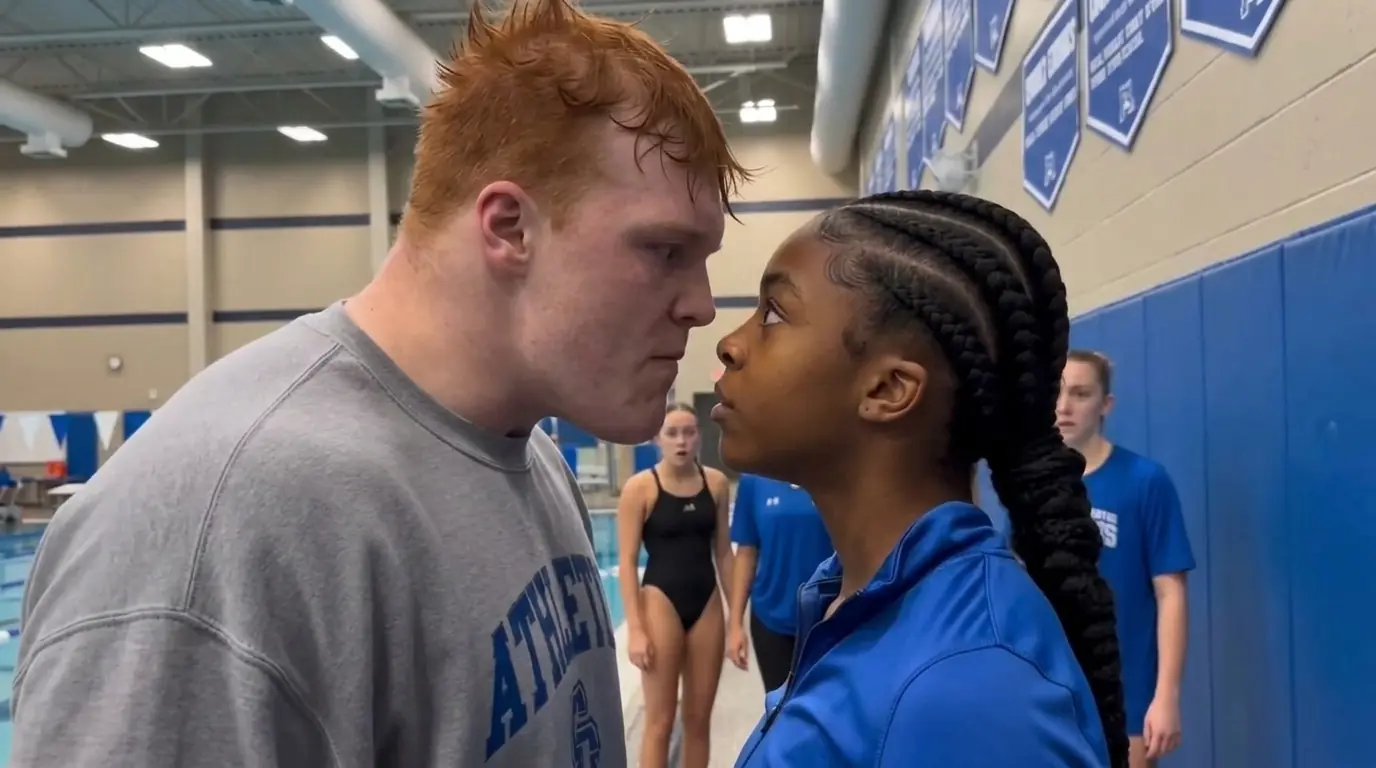
The first time Imani Brooks walked onto the pool deck at Cedar Ridge High School, she did not look like someone coming back to the sport she loved. She wore black warm-up pants instead of a swimsuit, a navy team jacket zipped to her collarbone, and white sneakers that squeaked against the wet tile. A large equipment bag hung from her shoulder while fifteen swimmers stretched beside lanes already steaming beneath the fluorescent lights. Most of them welcomed her back, but one girl standing near the diving blocks looked at Imani as though something had just been stolen from her.
Her name was Brittany Hayes.
Brittany was eighteen, strong, fast, and built like the kind of swimmer coaches wanted in sprint events. She had been Cedar Ridge’s fastest 50-yard freestyle swimmer since sophomore year and had spent the entire summer believing senior season would finally become hers. With last year’s captains graduating, everyone assumed Brittany would be named team captain and anchor the championship relay. Brittany assumed it too.
Then Coach Rachel Monroe gave the captain’s jacket to Imani.
Technically, Imani had already earned it months earlier. The team voted before summer break, and Coach Monroe approved the choice because Imani had spent three seasons doing the things captains were supposed to do when nobody was applauding. She stayed after practice to collect kickboards, helped freshmen learn flip turns, and once missed an individual warm-up because she was calming a terrified sophomore before her first varsity meet. Imani was not Cedar Ridge’s fastest swimmer, but she was the person teammates looked for when everything started going wrong.
Brittany believed leadership should belong to the best athlete.
Imani believed leadership started after the stopwatch stopped.
Neither girl had ever discussed the difference because, before senior year, they had mostly stayed out of each other’s way. Brittany competed in the sprint lanes and traveled with the loudest group on the team. Imani specialized in backstroke and individual medley, preferred early-morning workouts, and usually left practice before social drama had time to organize itself. They were teammates, not friends.
Then Imani injured her shoulder.
It happened at an invitational in June, two weeks after school ended. Imani felt something sharp while finishing a backstroke pull and immediately knew the pain was different from ordinary soreness. An MRI confirmed inflammation around the rotator cuff and a partial tear that did not require surgery but did require rest. The sports doctor told her she could probably compete again by winter if she stopped swimming completely for several months.
Imani heard only one word.
Months.
Swimming had structured her life since she was nine years old. Morning practice before school, homework during bus rides, Saturday meets, Sunday recovery, chlorine permanently living in her hair no matter what shampoo she used. Suddenly she was being told to stay dry while everyone else started the most important season of high school.
She almost quit the team.
Coach Monroe would not let her make the decision angry.
“You can still captain from the deck,” she said.
“What am I supposed to captain? Towels?”
“People.”
“That sounds worse.”
Coach Monroe smiled.
“You’ll survive.”
Imani did stay, though at first she hated almost every minute. Instead of jumping into lane four, she stood beside it holding a stopwatch. Instead of completing sets, she carried equipment, recorded splits, and helped Monroe organize relay exchanges. She wore the same navy jacket every afternoon because being dressed like a swimmer without being allowed to swim somehow hurt more.
Most of the team adjusted quickly.
Brittany did not.
The first comment came during the second week of September.
Coach Monroe had left Imani in charge of timing relay takeoffs while she spoke with the athletic director. Brittany stepped onto the block early for three consecutive repetitions, each time gaining an advantage that would have disqualified the relay in a real meet. Imani stopped the group.
“Again.”
Brittany looked down from the block.
“That was fine.”
“You left early.”
“No, I didn’t.”
“Point two-three.”
Brittany laughed.
“You’re measuring two hundredths from over there?”
“I’m measuring two-tenths.”
A freshman in lane five tried not to smile.
Brittany noticed.
She climbed down.
“You’re not even swimming.”
Imani looked at her.
“What does that have to do with your takeoff?”
“Nothing.”
“Good. Again.”
Brittany performed the next exchange perfectly.
She never forgot the laughter.
Afterward, the comments became more frequent but stayed small enough to dismiss individually. Brittany called Imani “Coach Junior” whenever Monroe was out of earshot. She complained that somebody who could not compete should not be deciding relay orders, even though Imani had no authority over the final lineup. When Imani carried the team equipment bag, Brittany once asked loudly whether captains were supposed to be swimmers or janitors.
Imani ignored her.
That bothered Brittany.
Her jokes worked on almost everyone else because people either laughed or became defensive. Imani did neither. She would look at Brittany for one second, decide there was nothing worth answering, and continue whatever she had been doing.
Brittany interpreted silence as arrogance.
The rest of the team mostly interpreted it as Imani.
By October, Imani had been cleared for limited pool work. Twenty minutes at a time. No sprinting, no paddles, no racing, and absolutely no backstroke under fatigue. To Imani, those restrictions sounded like being allowed inside a restaurant only to smell dinner.
Still, she began rebuilding.
Coach Monroe kept it quiet for the first week because she did not want Imani pressured into returning too quickly. She assigned a lane at the end of practice after everyone else had finished and personally monitored each session. Imani’s first fifty yards felt terrible. Her timing was off, her shoulder felt weak, and she finished several seconds slower than times she had recorded at thirteen.
She climbed out fighting tears.
Monroe handed her a towel.
“That bad?”
“I swim like somebody’s aunt.”
“I’m somebody’s aunt.”
“You know what I mean.”
Coach Monroe sat beside her.
“Recovery is boring.”
“I hate boring.”
“That’s why it works.”
Imani came back the next day.
By Thanksgiving, she could complete half a normal workout. By early December, she was close to racing speed. The possibility of returning for the conference championship stopped feeling impossible.
That was when Brittany’s attitude changed from irritation to fear.
Cedar Ridge’s best relay was the 200 freestyle. Brittany anchored. Two other seniors, Kayla Jensen and Morgan Lee, swam the middle legs. The opening position had belonged to sophomore Lily Evans since Imani’s injury.
The relay was good.
With Imani healthy, it could be exceptional.
Imani’s best split from junior year was faster than Lily’s by almost a second. In a relay decided by hundredths, that was enormous. Everyone on the team understood what her return might mean before Coach Monroe said anything officially.
Brittany confronted Imani near the locker room.
“So you’re taking Lily’s spot.”
Imani stopped tying her shoe.
“I’m not taking anybody’s anything.”
“You’re swimming relay trials Friday.”
“So are eight people.”
“Come on.”
Imani looked up.
“Brittany, if you have a problem with the lineup, talk to Monroe.”
“I’m talking to you.”
“I don’t make the lineup.”
“But you know what she’ll do.”
Imani stood.
“No. I know what the clock will do.”
Brittany stared at her.
“That captain thing really went to your head.”
Imani laughed.
“What captain thing?”
“You think everybody has to listen to you.”
“You walked over here.”
The answer landed harder than Imani intended.
Brittany stepped closer.
“You were gone for four months.”
“Injured.”
“Same difference.”
“No.”
“Yes.”
Brittany folded her arms.
“We built this team while you carried bags.”
For the first time, Imani’s face changed.
“Be careful.”
Brittany smiled.
“Why?”
“Because you’re starting to sound like you think I wanted to get hurt.”
“I’m saying the season kept moving.”
“So did I.”
Imani picked up her backpack.
“That’s why I’m still here.”
She walked away.
Relay trials happened Friday.
Lily swam well.
Imani swam better.
Not by a second.
By six-tenths.
Coach Monroe posted the provisional championship relay Monday morning.
IMANI BROOKS. MORGAN LEE. KAYLA JENSEN. BRITTANY HAYES.
Lily moved to the medley relay and remained part of the championship roster. She was disappointed but handled it better than anyone expected. She actually hugged Imani afterward.
Brittany watched from across the locker room.
That afternoon, a rumor appeared in the team group chat.
Someone claimed Coach Monroe had already promised Imani the relay before trials.
Morgan immediately replied that it was false.
Then somebody posted that captains should not be allowed to “control lineups while pretending they earned them.”
The message came from an anonymous account.
Nobody needed detective training.
Coach Monroe called the entire team together.
“If anyone has a concern about relay selection, you come to me.”
Nobody spoke.
“Not social media. Not anonymous messages. Me.”
Still nothing.
Brittany stood at the back with both arms folded.
After the meeting, Imani began collecting pull buoys beside the pool.
Lily approached.
“I’m sorry.”
“For what?”
“You know.”
“You didn’t post it.”
“No.”
“Then don’t apologize.”
Lily hesitated.
“Brittany told me you were trying to replace me before trials.”
Imani stopped.
“When?”
“Like three weeks ago.”
“What did you say?”
“That I’d rather find out from Coach.”
Imani smiled.
“Good answer.”
Lily looked worried.
“She’s really mad at you.”
“I know.”
“She thinks you embarrassed her.”
“When?”
“Pretty much every time you don’t argue back.”
That almost made Imani laugh.
Instead, she nodded.
“Thanks for telling me.”
Conference championships were eleven days away.
Imani wanted those eleven days to be boring.
They were not.
Her locker was filled with wet towels Monday.
On Tuesday, someone dumped half a container of protein powder into the pocket of her team jacket.
Wednesday, the stopwatch she used at practice disappeared and was found beneath a bench.
None of it could be tied directly to Brittany.
Imani documented everything anyway.
Coach Monroe became angry enough to threaten suspending the entire senior group from the next meet unless someone talked.
Morgan finally did.
She had seen Brittany put the wet towels in Imani’s locker.
Brittany denied it.
Morgan refused to change her statement.
Coach Monroe called Brittany’s parents.
Brittany’s mother, Sharon Hayes, arrived furious.
Not at Brittany.
At Monroe.
“My daughter has spent four years carrying this program.”
Monroe remained seated.
“This meeting is about harassment.”
“You’re taking another student’s word over hers.”
“I’m taking a detailed statement from a student who says she witnessed it.”
“Imani has had a problem with Brittany all season.”
Imani sat beside Coach Monroe.
She looked genuinely confused.
“I barely talk to Brittany.”
Sharon turned.
“Exactly.”
Imani blinked.
“What?”