Three black SUVs turned the corner onto Westheimer Road and stopped in a perfect line outside the restaurant. Their engines idled, and their windows were tinted so dark that no one could see inside. The front door of the lead SUV opened, and a thirty-year-old man stepped out wearing a tailored charcoal suit and polished shoes that caught the Houston sun. He buttoned his jacket with one hand, looked up at the restaurant sign above the entrance, and did not rush. Men like him never rushed.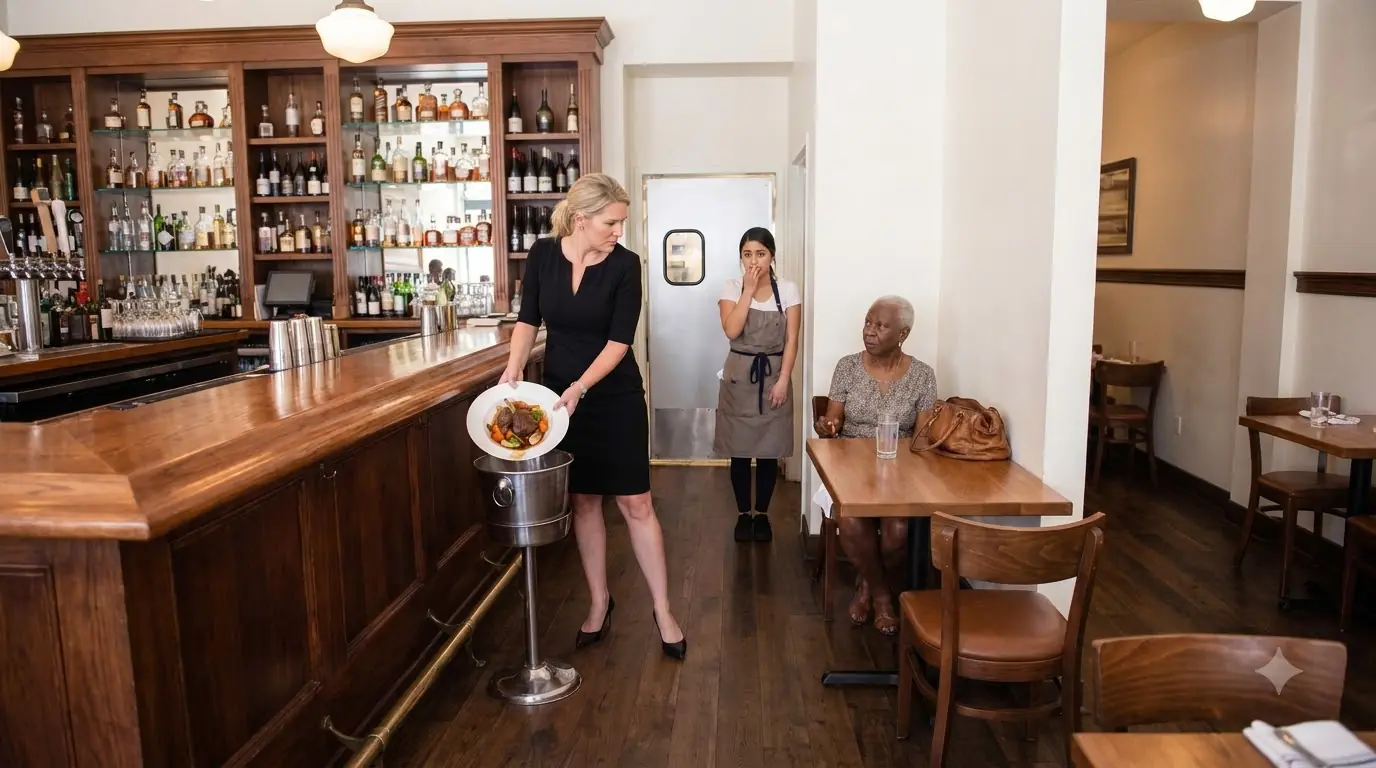
Inside, a seventy-four-year-old woman sat alone at a corner table. Her plate was gone. Her food was in the trash can behind the bar. Her hands were folded in her lap, and she was no longer crying because she had already given that place enough of her tears.
The man walked through the front door. The glass swung open, allowing the noise of Westheimer traffic to flood in for a moment before it went quiet again. Every head in the restaurant turned. The woman behind the hostess stand looked up and felt something cold run down her spine because the man was not looking around the room. He was looking directly at her.
Two hours earlier, the corner table had been empty. The restaurant was half full, and the lunch rush was beginning to build when a small elderly woman in a faded green dress stepped through the front door carrying nothing but a worn leather handbag and a quiet hunger.
Her name was Sirwa Mensah. She was seventy-four years old, five feet two inches tall, with a thin frame and dark mahogany skin shaped by seven decades of sun, wind, labor, and grace. Her white hair was cropped close to her head, and her deep brown eyes had seen more of the world than most people could imagine. She wore a simple green cotton dress, flat brown sandals, and no jewelry except a thin gold wedding band on her left hand.
Sirwa moved slowly, not from weakness but from patience, from the stillness that came with knowing exactly who she was. She had been walking through the Galleria area in search of a gift for her great-granddaughter when the Houston heat began to tire her. Then she smelled food, something warm and rich drifting through an open door, and followed it to a restaurant called Maison on Westheimer.
Maison was upscale and fashionable, the kind of place with cloth napkins, small portions, and prices that could make a grandmother gasp. Sirwa knew none of that. She only knew that the food smelled good and she was hungry.
Crystal Manning stood behind the hostess station. She was thirty-four years old, the restaurant manager, with blonde highlights and a tight, practiced smile. She was typing something into the reservation tablet when she sensed someone standing in front of her. She looked up, saw an elderly woman in a faded dress and flat sandals, and let her smile disappear.
"Can I help you?" Crystal asked.
"Yes. I would like a table, please. Just for one," Sirwa replied.
Her voice was soft, and her Ghanaian accent was thick, the kind that caused certain Americans to slow their speech as though the person before them could not understand English. Sirwa understood English perfectly. She also understood three other languages, but Crystal never asked.
"Do you have a reservation?" Crystal asked.
"No. I was only passing by. The food smelled wonderful."
Crystal looked Sirwa up and down, taking in the faded dress, flat sandals, and worn handbag. In less than three seconds, she made a calculation. This woman would order the least expensive item on the menu, occupy a table for an hour, and prevent that table from producing a hundred-dollar check from someone Crystal believed actually belonged there.
"We are fully booked for lunch," Crystal said.
Sirwa looked around. Half the tables were empty.
"It appears that you have many open tables."
"Those are reserved."
A man seated at the bar overheard the exchange. He caught Crystal's eye and shook his head slightly. Both of them knew it was a lie, but Crystal did not care.
"I am sorry," she said, without sounding sorry at all. "You might try the food court in the mall. It is just down the street."
The food court. She might as well have told Sirwa to go eat where people like her were expected to eat. Sirwa did not flinch. She remained at the hostess stand for a moment before speaking.
"I will wait in case something opens."
Fifteen minutes passed. A couple finished their meal and left, opening a table. Crystal saw it and seated a man who had arrived after Sirwa. He wore a sport coat and loafers, and he did not have a reservation.
Sirwa watched without speaking. Ten minutes later, another table opened. Crystal seated a young white couple dressed in workout clothes. They had no reservation either, but they looked young, affluent, and likely to spend money.
Sirwa watched again and said nothing. Twenty more minutes passed. She had now been sitting on the bench for forty-five minutes when a waitress named Jasmine Torres walked by.
Jasmine was twenty-six, hardworking, and kind-faced. She had been watching the situation from across the dining room. Finally, she stopped.
"Ma'am, are you waiting for a table?"
"Yes. The manager said the restaurant was fully booked, but I have seen other people being seated."
Jasmine glanced toward Crystal and then back at Sirwa. Her jaw tightened.
"Please hold on. I will find you a table."
Jasmine walked to the back section of the restaurant, where two empty tables sat untouched. She pulled out one of the chairs, returned to Sirwa, and held out a hand toward the dining room.
"Follow me, ma'am. I have a table for you."
Sirwa rose and followed her to a corner near the kitchen door. It was the worst table in the restaurant, but it was still a table, and Sirwa sat down as though it were a throne.
"Thank you, dear."
"You are welcome. My name is Jasmine, and I will be taking care of you."
Crystal appeared beside them within thirty seconds, her face tight.
"Jasmine, a word."
They stepped away from the table. Crystal's whisper was sharp enough to cut glass.
"I told her we were booked."
"Crystal, half the restaurant is empty."
"That is not the point. She does not fit our clientele. Look at her. She is going to order a cup of soup and sit here for two hours."
"She is an elderly woman who is hungry."
"She is not our customer, and you do not seat people without going through me."
"What was I supposed to do? Let her sit on that bench until closing?"
Crystal's eyes narrowed.
"Watch your tone, Jasmine. You are replaceable."
She walked away. Jasmine remained there for a moment, her hands curling into fists at her sides. Then she took a breath, picked up a menu, and brought it to Sirwa's table.
"Here you are, ma'am. Take your time."
Sirwa opened the menu and studied it carefully. She ran her finger down the page, stopping at three items.
"I will have the braised lamb, the roasted vegetables, and a glass of water, please."
Jasmine paused. The braised lamb cost forty-six dollars, and the roasted vegetables cost eighteen. This was not a cup of soup.
"Yes, ma'am. Coming right up."
The food arrived. Sirwa closed her eyes and breathed in the aroma before picking up her fork. She took the first bite and smiled, a real smile that began in her chest and moved upward until it reached her eyes.
The meal reminded her of a kitchen somewhere far away and long ago, of hands that had once cooked for her when she was small. She ate slowly and enjoyed every bite. She was halfway through the lamb when Crystal returned.
Crystal was not alone. Behind her stood Tyler, a nervous nineteen-year-old busboy who looked as though he was only following orders.
"Ma'am, I am going to need this table back," Crystal said.
Sirwa looked up from her food.
"I am sorry?"
"We have a party arriving, and I need this table. You will have to leave. I can box your food for you."
Sirwa looked around the back section. Two other tables remained empty. No one was coming, and there was no party.
"There are empty tables beside me."
"Those are reserved for the party."
"I would like to finish my meal. I will not be much longer."
Crystal leaned closer. Her voice dropped, and the false smile vanished. What remained was worse than the fake warmth had ever been.
"Let me be honest with you. This restaurant has a certain standard and a certain atmosphere. Our regular customers expect a particular experience when they walk through that door. You are not part of that experience. You were not supposed to be seated here in the first place. I am asking you nicely. Please leave."
Sirwa stared at her. Seventy-four years of life had taught her what those words really meant. She had spent decades building, surviving, being underestimated, overlooked, and spoken down to by people who could not see past her clothes, her accent, her age, or the assumptions they had made before she opened her mouth.
She had heard this speech before in different cities, in different decades, and in different words. It always meant the same thing: You do not belong here.
"I would like to finish my food," Sirwa said quietly.
Crystal straightened. She looked at the half-eaten lamb, the roasted vegetables, and the glass of water. Then she picked up the plate.
Sirwa reached toward it.
"Please."
Crystal pulled the plate away, turned, and walked toward the bar. She tilted it over the trash can. The braised lamb slid off, the vegetables followed, and the ceramic plate struck the metal rim with a hard clang.
She had thrown an elderly woman's food into the trash, and the restaurant went quiet. Not silent, but quiet in the way a room becomes quiet when everyone continues chewing, sipping, and pretending not to have seen what they have just witnessed.
They had all seen it.
Jasmine stood near the kitchen door with one hand over her mouth and anger burning in her eyes. Tyler remained frozen with a dish towel in his hand, looking as though he wanted the floor to open beneath him. Sirwa sat at the corner table and returned her hands to her lap.
Her plate was gone. Her food was in the trash. The glass of water was the only thing left on the table.
She did not scream, cry, or raise her voice. Instead, she reached into her worn leather handbag and removed a small silver flip phone, the kind almost no one carried anymore. She opened it and pressed a single speed-dial button.
The phone rang twice.
"Nana?" A deep, alert voice answered. "What is wrong?"
"Derek, I am at a restaurant on Westheimer. I believe it is called Maison."
"Are you all right? You sound different."
"I am fine, child, but I think you should come."
"I am twenty minutes away."
"Take your time. I am not going anywhere."
She closed the phone, placed it back inside her handbag, folded her hands in her lap again, and waited.
Crystal passed the table and placed the check on the edge without looking at her. The total was sixty-eight dollars for food now sitting in a trash can. Crystal expected the old woman to argue or create a scene, giving her a reason to call security.
Sirwa opened her handbag, removed a small envelope, and counted out four twenty-dollar bills. She placed the eighty dollars on top of the check, including a tip for the meal she had not been allowed to finish. Then she continued sitting.
Crystal noticed the cash. Surprise flickered across her face, followed by irritation. The old woman had paid, but she had not left.
"Ma'am, you have settled your bill. I need the table."
"I told my grandson I would be here. I will wait for him."
"You can wait outside."
"I will wait here."
Crystal's nostrils flared, but Sirwa had paid and had not caused a disturbance. There was no reason to call security that would not make Crystal look even worse than she already did. So she walked away.
Sirwa sat with her hands folded and waited. In the part of the world where she was born, there was an old saying: The lion does not answer the barking dog. The lion waits. The lion is patient. The lion knows that time is the one weapon that never misses.
Sirwa Mensah had been a lion her entire life. She had simply never felt the need to roar.
Fourteen minutes later, three matte-black SUVs turned the corner onto Westheimer Road. Their tinted windows reflected the afternoon sun as they moved in formation and stopped in a perfect line directly outside Maison. The engines idled beneath the floor-to-ceiling windows, visible to every diner inside.
Crystal looked up from the hostess stand and narrowed her eyes. Then the front door of the lead SUV opened.
Derek Mensah stepped out. He was thirty years old, six feet three inches tall, broad-shouldered, and built like a man who had played college football and never stopped training. His dark skin, clean-shaven face, tailored charcoal suit, white shirt without a tie, and polished shoes made him impossible to ignore.
He buttoned his jacket with one hand and walked toward the entrance. Behind him, four more doors opened. Two men and two women stepped out, all dressed in suits and carrying tablets or leather portfolios. They fell into step behind Derek without speaking.
Derek pushed through the front door. The glass swung open, allowing the noise of Westheimer traffic to rush inside before the restaurant became quiet again. Every head turned.
Crystal activated her customer-service smile automatically.
"Good afternoon. Welcome to Maison. Do you have a reservation?"
Derek did not look at her. His eyes moved across the room, past the bar, the main dining area, and the window tables. They stopped on the small corner table near the kitchen door, where an elderly woman in a faded green dress sat with her hands folded in her lap.
His jaw tightened.
He walked past Crystal without a word. His team followed in silence. Diners put down their forks as he moved through the restaurant. A woman at a window table whispered something to her husband, but he did not respond because he was watching Derek.
Derek reached the corner table and stopped. He looked at his grandmother, then at the table. There was no plate and no food, only a glass of water and a paid check with cash resting on top.
"Nana."
"Hello, my boy."
"Where is your food?"
Sirwa glanced toward the trash can behind the bar. She did not say a word. The glance was enough.
Derek turned his head slowly toward the trash can and then toward Crystal, who had followed him to the table. Her smile was fading rapidly.
"You threw her food away," Derek said.
It was not a question.
"Sir, I do not know what-"
"I am not asking. I see the empty table. I see a paid check for a meal she clearly did not finish. I am telling you what happened. You threw a seventy-four-year-old woman's food into the trash in front of a full restaurant."
"There was a misunderstanding about the table."
"Was there?"
Derek's voice remained flat and quiet, the kind of quiet that carried more weight than shouting. He unbuttoned his jacket and sat in the chair across from his grandmother. His four colleagues remained standing behind him, silent and watchful.
"Do you know who this woman is?" Derek asked.
Crystal shook her head. Her confidence was draining from her like water through a cracked glass.
"This is Sirwa Mensah. She is the founder and chairwoman of Mensah Holdings International. She built a company that employs more than six thousand people across three continents. She owns forty-two commercial properties in the state of Texas alone."
Crystal's face went pale. Her lips parted, but no sound emerged.
"One of those forty-two properties," Derek continued, his voice perfectly level, "is the building in which you are standing right now."
The words struck the room like thunder inside a library. Crystal reached for the hostess stand to steady herself. Her legs began to shake.
"This restaurant pays rent to a property-management company called Westheimer Place LLC," Derek said. "That company is a subsidiary of Mensah Holdings, my grandmother's company. Every month, the owner of this restaurant writes a check that ultimately goes to the woman whose food you just threw away."
Crystal looked at Sirwa. She saw the faded green dress, flat sandals, worn handbag, and thin gold wedding band. For the first time, she no longer saw a woman she believed did not belong. She saw the woman who owned the ground beneath her feet.
Her knees weakened, and she grabbed the back of a chair before she fell.
"I did not know," she whispered.
"You did not need to know," Sirwa replied.
Her voice was steady and clear. She did not sound angry. She sounded disappointed, the way someone who had lived long enough to expect better felt when people delivered exactly what she feared.
"You did not need to know who I was to treat me with decency. I was an elderly woman who walked through your door hungry and asked for a table. That was all you needed to know. But you looked at my dress, my sandals, my accent, and my age, and you decided I was worth less than the people already sitting in these chairs."
Crystal's eyes filled with tears. They were not yet the tears of remorse. They were the tears of someone realizing the floor beneath her had opened and there was nothing close enough to hold.
"Ma'am, I am so sorry."
"You are sorry now because my grandson is wearing a suit and arrived in a convoy. You were not sorry twenty minutes ago when you carried my plate to the trash and poured my food away in front of everyone in this room."
Jasmine stood near the kitchen door with tears running down her face, but she was smiling. It was the smile of someone watching justice arrive exactly on time.
Derek removed his phone and dialed a number. It rang three times.
"Raymond, this is Derek Mensah from Mensah Holdings."
Raymond Voss, the fifty-eight-year-old owner of Maison, spent his weekends playing golf and had never met the Mensah family in person. He dealt exclusively with the property-management company and had no idea his landlord was a seventy-four-year-old woman who wore a faded green dress.
"Derek, hello. What can I do for you?"
"I am sitting in your restaurant right now. Your manager threw my grandmother's food into the trash because she did not look wealthy enough to eat here. I need you here in fifteen minutes."
Silence filled the line.
"Fifteen minutes, Raymond."
Derek ended the call and turned to his team.
"Pull the lease file for this property. I want the termination clause on the table by the end of the day."
One of the women opened her tablet and began typing. Crystal's legs gave out again, and she lowered herself into the chair she had been gripping.
"Please," she said. "I have a mortgage. I have bills. I cannot lose this job. Please."
Sirwa looked at her for a long time, the way a woman who had lived seventy-four years looked at someone who still had not learned one of life's simplest lessons: people were not their clothes, worth was not something a person wore, and the woman in the faded dress might own the building or might own nothing at all. Neither possibility changed what she deserved.
"Stand up," Sirwa said.
Crystal straightened. Her cheeks were wet, and her hands were trembling.
"What is your name?"
"Crystal Manning."
"How old are you, Crystal?"
"Thirty-four."
"When I was thirty-four, I was sleeping on the floor of a warehouse in Tema, Ghana. I had eleven dollars to my name. I was trying to ship my first container of cocoa butter to a buyer in New Orleans who did not believe I could deliver. Everyone told me I was too old, too small, too female, and too African to build a business in America. I built it anyway."
Sirwa paused.
"I did not build it by deciding who deserved a seat at the table. I built it by giving people a seat."
The room remained silent.
"You are not beyond redemption, Crystal," Sirwa continued. "You are a person who made a terrible decision. There is a difference. But that decision tells me something about what you believe. You believe that some people belong and some people do not. As long as you believe that, you will keep throwing plates into the trash. One day, the plate you throw away may belong to someone who can change your life. Today, that person was me."
Every fork was down. Every phone was lowered. Every pair of eyes was fixed on the small elderly woman at the corner table, speaking as though she were delivering a sermon from a pulpit built from pain, patience, and memory.
Raymond Voss burst through the front door twelve minutes after Derek's call. He was red-faced, sweating through his dress shirt, and breathing hard. He had likely broken several traffic laws on the way.
"Mr. Mensah, Mrs. Mensah, I am deeply sorry. I had no idea."
"You had no idea because you built a culture in which this was acceptable," Derek replied. "Your manager did not wake up this morning and decide, without context, to throw an elderly woman's food into the trash. She did it because she believed this was what you wanted. She believed she was protecting your brand, your atmosphere, and your clientele. She did the work your culture taught her to do, and now you are standing here pretending to be surprised."
Raymond's mouth opened and closed. He looked at Crystal, who sat with mascara streaking her cheeks and fear on her face.
"Crystal is suspended immediately," he said.
"No," Sirwa replied.
Everyone turned toward her.
"She is not suspended, and she is not fired. Not today."
Derek frowned.
"Nana-"
Sirwa raised one hand. It was small and thin, but when she raised it, the room obeyed.
"If you fire her today, she learns nothing. She goes home angry. She blames me for ruining her life. She becomes more bitter, more afraid, and perhaps more cruel to the next person who walks through that door wearing a faded dress."
She turned to Crystal.
"Instead, you will work. You will keep your job, but for the next thirty days, you will greet every person who walks through that door as though they own this building, because one of them might."
Crystal stared at her as fresh tears began to fall. These tears were different. They came from being shown mercy by the person she had wronged.
There was no feeling more devastating than undeserved grace. Punishment allowed a person to imagine herself as the victim. Grace forced her to face what she had done with nowhere to hide.
"Raymond," Sirwa continued, "you will meet with my grandson this week to discuss the terms of your lease. Not because I want to punish you, but because I want to make sure the next person who enters wearing flat sandals and a faded dress receives the same plate of braised lamb as the man in the sport coat. No reservation, no interrogation, and no second glance."
Raymond nodded so quickly that his chin nearly touched his chest.
"Yes, ma'am. Absolutely. I will personally-"
"You will not personally do anything. You will train your staff. You will change your culture. You will repair what you built, because what you built tells people like me that we are not welcome. People like me helped build this city."
Jasmine stepped forward. She had remained near the kitchen door throughout the confrontation, crying, smiling, and holding herself together with both arms crossed over her chest.
"Ma'am, may I bring you another plate of braised lamb? On the house, please?"
Sirwa looked at her, and the first real warmth of the afternoon returned to her face.
"What is your name, dear?"
"Jasmine Torres."
"Jasmine, you were the one who seated me when no one else would."
"Yes, ma'am."
"You risked your job for a stranger."
"It was not about my job. It was about what was right."
Sirwa reached across the table and took Jasmine's hand. One hand was young and smooth. The other was lined with decades. Both were strong.
"You remind me of myself when I was your age. Brave when bravery costs something. Kind when it would be easier not to be."
She looked toward Derek.
"Write down her name."
Derek took out his phone and typed: Jasmine Torres.
"When you are ready to do something beyond serving tables, call my grandson," Sirwa said. "Mensah Holdings has a twelve-month management-training program with full salary. We look for people who do the right thing when no one is watching. You did it while everyone was watching. Sometimes that is even harder."
Jasmine's eyes widened, and her hand trembled inside Sirwa's.
"Ma'am, I do not know what to say."
"Say you will think about it, and bring me that lamb."
Jasmine laughed through her tears and squeezed Sirwa's hand.
"I will think about it. And I will bring you the best plate in the kitchen."
She hurried away. The man at the bar who had watched Crystal turn Sirwa away stood and approached the corner table.
"Ma'am, I saw what happened earlier. I heard her tell you there was no table. I should have said something, and I did not. I am sorry."
Sirwa nodded.
"You are saying it now. That counts."
He returned to his seat. Then a woman at a window table rose and approached.
"I am sorry, too. I watched everything."
Another person followed, then another. One by one, diners stood from their tables and walked to the corner to apologize to the elderly woman in the faded dress.
Crystal watched from beside the hostess stand. Each apology became a mirror, and in that mirror she saw herself clearly for the first time. Not the polished version she presented at work or posted online, but the person who had looked at an elderly woman and seen a problem to remove instead of a person to feed.
Jasmine returned with the braised lamb, fresh, hot, and perfectly plated. She set it down carefully with both hands.
Sirwa closed her eyes and breathed in the aroma. Then she picked up her fork, took a bite, and smiled.
Derek sat across from her while his team remained nearby and the convoy idled outside. Every person in Maison understood something they would carry long after that afternoon ended.
No one knew who might be sitting at the table they were trying to clear. No one knew who might be wearing the dress they were judging, who might own the building in which they worked, or who might control the ground beneath their feet.
More importantly, none of that should have mattered.
The woman in the faded green dress deserved her plate of lamb whether she owned the building or not. Whether a convoy came or not. Whether her grandson wore a charcoal suit or drove a city bus. She deserved to finish her food in peace because she was hungry, because she was human, and because that was enough.
Sirwa Mensah could have closed Maison with a single phone call. She could have ended Crystal's career with one sentence, torn the lease apart, and watched Raymond's business collapse. She possessed the power to destroy every person in that room who had failed her.
She chose not to use it that way.
Power was not only what a person could destroy. Power was also what a person chose to spare. It was an elderly woman in a faded dress who owned the building and still said, "Give her another chance."
It was wisdom tested by fire that reached the other side without becoming the fire.