"Who gave you this ring?"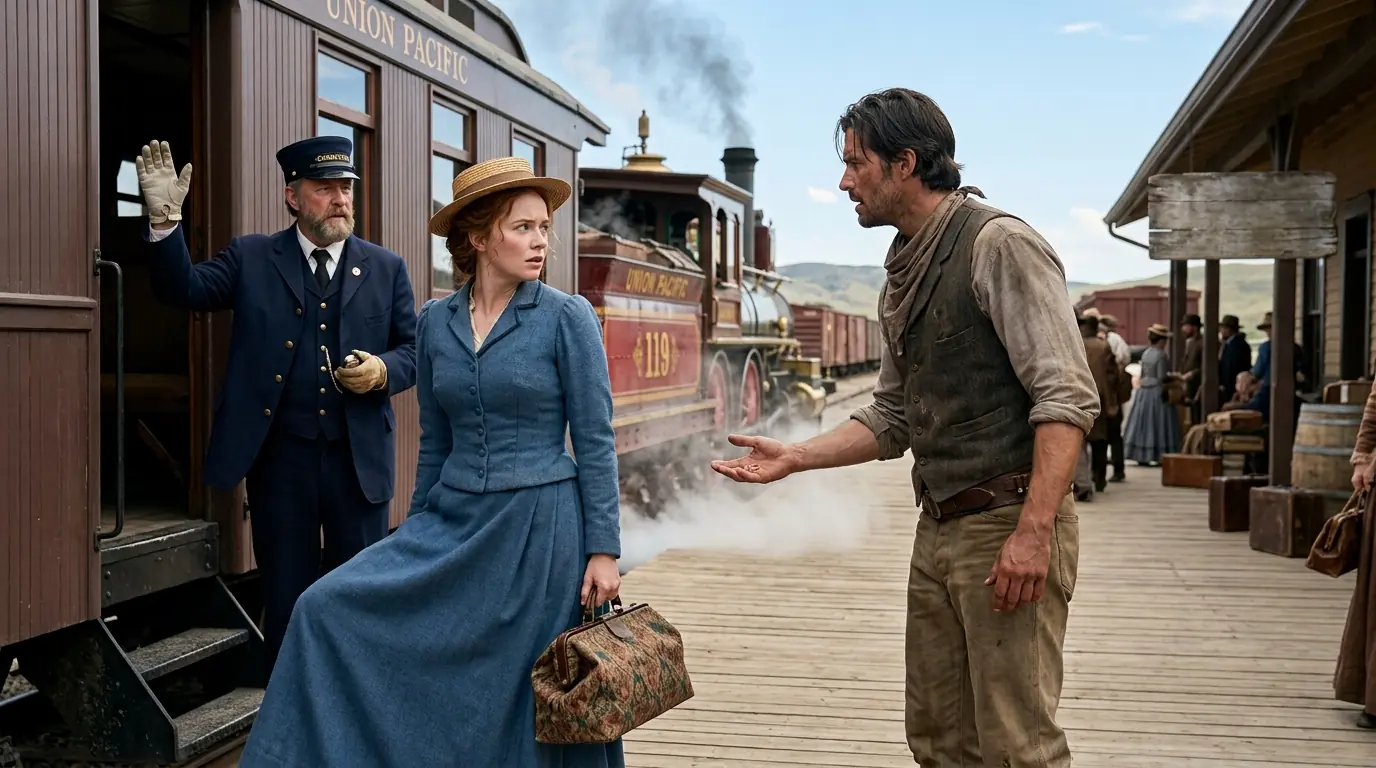
Wyoming Territory, August 1888.
The conductor raised one gloved hand to help Maeve Callahan aboard when a cowboy came running across the platform.
"Don't get on that train!"
Maeve turned. The stranger was tall, dark-haired, and breathing hard from a dead run. In his open palm lay the wedding ring she had sold less than ten minutes earlier.
"I don't understand," she said. "That ring isn't mine anymore."
"I bought it back."
"Why?"
The cowboy turned the band toward the light. Inside the gold were two tiny crescents and the number 47—marks so small Maeve had never noticed them during six years of marriage.
"Because my father made this ring," he said, "and it vanished with him twenty years ago."
Steam rolled across the platform. The locomotive sounded its final whistle.
"Who gave it to you?" the stranger asked.
"My husband."
The color left his face. "Where is he?"
"Gone. He abandoned me eighteen months ago."
The conductor called, "Now or never, ma'am."
Maeve placed one foot on the iron step. The train promised work, a room in Cheyenne, and a future untouched by the man who had ruined her life.
The cowboy closed his fingers around the ring. "Then I don't think your husband simply left you," he said. "I think he ran from what this ring could prove."
Maeve had only seconds to choose between the train carrying her toward a new life and the one object that might finally explain her old one.
Ten minutes earlier, Maeve had stood at the ticket window counting coins that refused to become enough money, no matter how many times she rearranged them in her palm. She was twenty-six years old. The final decree ending her marriage had arrived the previous week after months of notices, testimony, and Thomas Callahan's failure to answer any of them. The marriage was legally finished; the consequences were not.
Thomas had ridden away eighteen months before with one trunk and almost every dollar in their house. He left behind mortgages Maeve had never signed, accounts she had never seen, and a ranch sold at auction to satisfy men who claimed her husband had owed them for years. She spent the following winter sewing for neighbors and sleeping in a room above the feed store, waiting for a court to declare on paper what Thomas had already declared by disappearing.
Now, a cousin in Cheyenne had offered her a bed and work at a laundry. It was not the future Maeve once imagined, but it was honest, and honesty had become more attractive to her than comfort.
The fare cost four dollars more than she possessed. The station agent, Mr. Barlow, looked at the thin gold band on her left hand.
"Railroad can't take jewelry for fare," he said. "But I can buy it from you myself, if you're certain."
Maeve removed the ring before memory could make the decision harder. Thomas had told her it belonged to his grandmother. For six years, it had represented a promise that turned out to be a disguise.
"I'm certain."
Barlow inspected the gold beneath his lamp. At the freight window beside him, a cowboy named Silas Mercer was signing for a crate of fencing tools. He glanced over when the ring touched the counter. The light caught the two tiny crescents.
Silas forgot the tools. He forgot the horse he meant to inspect that afternoon. He watched Barlow pay Maeve from his own pocket, watched her purchase the ticket, and waited until she walked toward the train.
Then he reached across the counter. "Let me see that ring."
Barlow gave him a suspicious look. "Since when are you interested in wedding jewelry?"
"Since I was eleven."
Through the small lens on Barlow's desk, Silas found the crescents. Beneath them was the number 47, scratched in the narrow hand he remembered from his father's workshop. Silas paid twice what Barlow had given Maeve and ran.
Now the train was beginning to move. Maeve looked at the stranger, the ring, and the narrowing distance between the passenger car and the platform.
Then she stepped back. The conductor caught the rail instead of her hand. The train gathered speed, carrying her empty seat west, while Maeve remained at Larkspur Junction with a carpetbag, a useless ticket, and a man who knew something about her husband that she did not.
Silas watched the last car disappear around the bend. Only then did he seem to understand what his urgency had cost her.
"I'm sorry," he said.
"You asked for five minutes." Maeve held out her hand. "Begin with your name."
"Silas Mercer." He returned the ring.
Maeve did not put it on. She wrapped it in her handkerchief and placed it inside her coat.
They entered the café beside the depot, where Silas bought coffee and a replacement ticket for the train due three days later. He laid that ticket beside Maeve's cup before asking his first question.
"You owe me nothing," he said. "If you decide to leave after hearing me, that seat is yours."
It was the first thing he did that made Maeve consider trusting him.
Silas told her his father, Elias Mercer, had been a goldsmith before mining and land claims drew him west. He marked every piece he made with two interlocking crescents. The numbers beneath the mark corresponded to a private inventory ledger he kept inside a locked box. Twenty years earlier, Elias had traveled to Silver Hollow to challenge a man who claimed part of the Mercer property. He carried a leather sample case containing several pieces of jewelry, including ring number 47. He never reached the land office in Cheyenne. His horse returned two days later with an empty saddle. The sample case, his tools, and his body were never found.
"My mother spent the rest of her life wondering whether he died or chose not to come home," Silas said. "I don't know which possibility hurt her more."
Maeve looked down at the ring hidden beneath her handkerchief. "Thomas told me it belonged to his grandmother."
"Did he ever mention Silver Hollow?"
"Never."
Silas leaned forward too quickly. "What papers did he keep? Who wrote to him before he left? Did he own a leather case? Did he ever—"
"Mr. Mercer." The warning in her voice stopped him. "You have asked me about every object my husband owned," Maeve said. "You have not asked what it cost me to miss that train."
Silas looked at the new ticket beside her cup. His face tightened with shame. "You're right. I saw my father's mark and forgot there was a person carrying it."
"Thomas was skilled at forgetting that, too."