The hunger was a cold stone in her belly. It had been two days since Clara had eaten anything more than a handful of withered chokecherries, and the wind cutting across the Wyoming high country felt like it was slicing straight through her threadbare coat. She lay flat on a rise, the frozen dirt biting into her palms, and watched the barn. It was big. Not just big, but solid.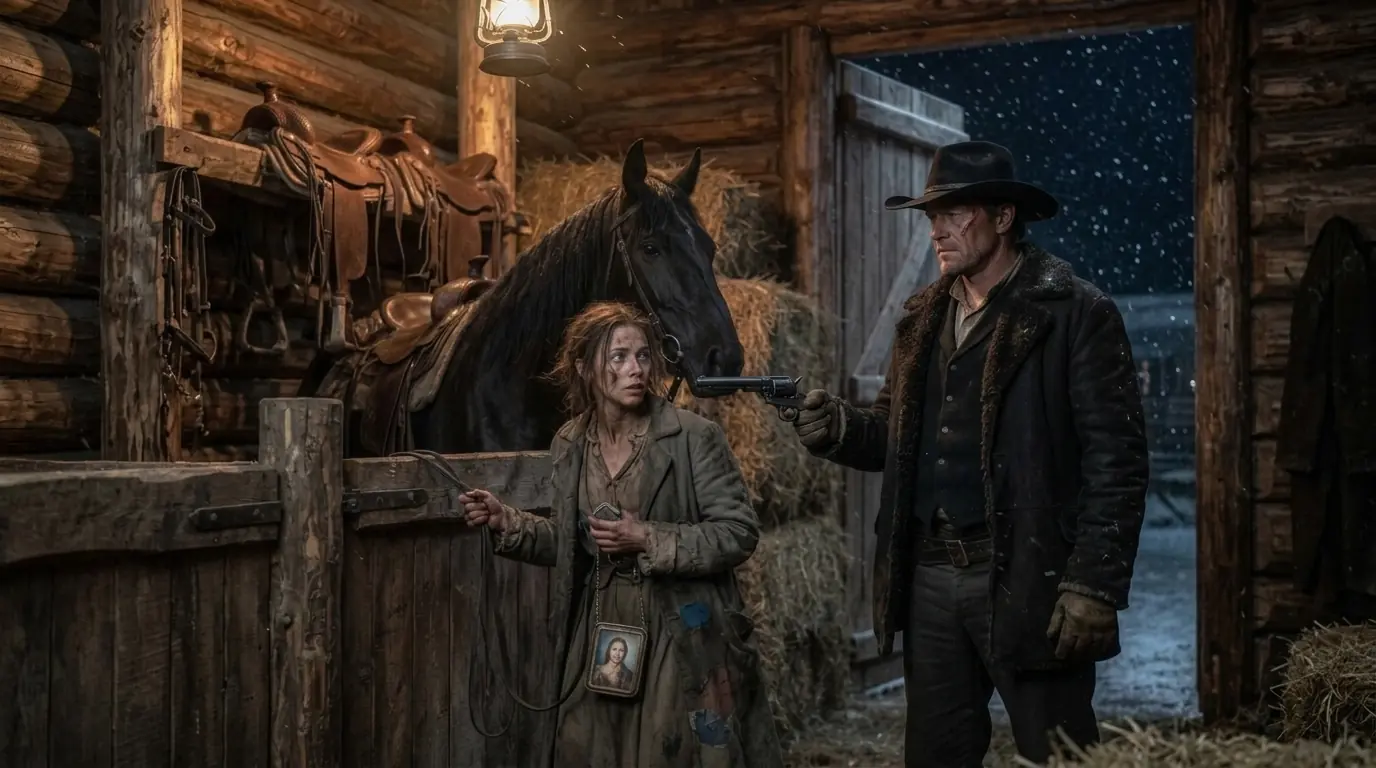
Built of thick, dark logs. It spoke of money and power. Brandt Ranch. Even she, new to this part of the territory and trying to stay invisible, had heard the name whispered. A place run by a man who owned half the valley.
And some said the other half of the devil. But all Clara saw was the horse. He was in the near corral, a black stallion that looked like he was cut from midnight shadow. Even in the fading bruised light of dusk, he moved with a restless power that stole her breath. He was speed.
He was escape. He was the only thing that could get her east, away from the man whose name she couldn't even bear to think before her face showed up on a poster. She was ragged. Her hair was matted with burrs and trail dust. Her knuckles were split and bleeding from the cold.
And she was starving. But the sight of that horse woke something in her that hunger had nearly killed. Hope. A desperate, sharp-toothed hope that tasted like panic. She waited until the sky turned a deep starless purple.
No lights from the main house set far back on a low hill. No movement from the bunkhouse. Just the wind and the restless stamp of the stallion. Clara moved like a ghost, slipping over the corral fence rather than risking the squeal of the gate. The stallion snorted, rolling his eyes to show the whites, but he didn't shy.
She murmured to him, her voice a low, cracked sound she didn't recognize. Words her papa used to use back home, back before. Easy now, easy, blackbird. We're just going for a ride. Her hands shook so badly she could barely work the leather latch on the main barn door.
She needed a saddle, a bridle, anything. She slipped inside. The warmth hit her first, thick with the smell of hay, oiled leather, and warm animals. It was so rich, so safe. She almost wept.
Her eyes adjusted to the gloom. Saddles lined one wall, each one heavy, tooled, and worth more than she'd ever held in her life. She grabbed a bridle, her fingers finding the cold bit. A floorboard creaked above her in the loft. Clara froze.
Every nerve ending screamed. She held her breath, listening. There was nothing but the wind rattling the big door. She let her breath out in a shaky sigh, turning back to the stallion who had poked his head inside. Curious.
One more second, she whispered, reaching to slip the bit into his mouth. He doesn't care for strangers. The voice was not loud. It was low, calm, and cut through the barn's warmth like a sliver of ice. Clara spun, the bridle dropping from her numb fingers.
He stood in the wide doorway, a silhouette against the last of the dying light. Tall, so tall he seemed to fill the entire opening. He took one step inside, and the faint light from a lantern hung on a far peg caught his face. He was cold-eyed. That was the first thing she saw.
Eyes the color of a frozen creek. The second thing was the scar, a pale, puckered line that ran from the corner of his left eye down across his jaw, pulling the skin tight. He wore a heavy sheepskin coat, and his hat was pulled low. He looked less like a rancher and more like a boulder that had been given human form. This was Elias Brandt.
It had to be. He held a revolver in his right hand. It wasn't pointed at her exactly. It was held down at his side, but his finger was on the trigger and his thumb was on the hammer. He was calm, utterly, terrifyingly calm.
He looked at her, his gaze missing nothing, the tangled hair, the dirt on her face, the way her coat was patched with three different kinds of cloth. He looked at her like she was a coyote he had found in his henhouse. Clara's heart hammered so hard against her ribs that it hurt. She pressed herself back against the stall, her hands finding the rough wood. She was trapped.
She thought of the man she was running from. She thought of the rope they used for horse thieves. Both seemed to be standing right here in this barn. I I was just Her voice died. What was the use?
He took another slow step. The stallion snorted and tossed his head, moving away from her toward the man. Elias Brandt didn't even look at the horse. His eyes stayed locked on Clara. "You've got nerve, " he said.
His voice was gravel like stones rolling in a dry creek bed. "Stealing is one thing. Stealing him. " He nodded toward the stallion. "That's something else.
" He raised the revolver. "Not fast. It was a slow, deliberate motion. He didn't aim at her chest. He aimed at her head.
Clara squeezed her eyes shut. A single hot tear escaped, freezing instantly on her cheek. This was it. After all the running, all the hiding, to die in a warm barn, starving. The click of the hammer being pulled back was the loudest sound she had ever heard.
She waited one second. Two. The silence stretched thick and heavy. She opened her eyes. He was still there, the gun still level, but he was just watching her.
His head was tilted slightly as if she were a puzzle he was trying to work out. He saw her tremor, the flash of defiance in her eyes that warred with the stark terror. He saw the raw red of her knuckles and the gaunt hollows beneath her cheekbones. Slowly, just as deliberately as he had raised it, he lowered the revolver. He didn't holster it.
He just let the barrel point at the dirt floor. "You ride like you mean it, " he said. It was not a question. "Or are you just running? " The question hung in the air, sharp and unexpected.
It wrong-footed her. He wasn't asking why she was stealing. He was asking how. "I don't know what you mean, " she whispered, defiance rising in her voice as her only shield. She was cornered.
But she wasn't dead yet. I got lost. I was looking for work. The door was open. I just came in from the cold.
It was a pathetic lie, and the air in the barn crackled with the knowledge of it. Elias Brandt stared at her, a long, unblinking assessment. He saw the lie, and he saw what was beneath it. He saw the faint yellowing bruise that peeked out from the collar of her shirt, a mark shaped like a thumb. He saw the way she stood, poised to bolt, not like a common thief, but like a deer that has heard the wolf.
He recognized the look. It was the look of the hunted, the look of something that has been trapped for a long time and is finally, desperately chewing its way free. He gave a single mirthless huff of air through his nose. A liar and a horse thief. Sheriff Brody will have a fine time with you.
Clara's blood ran colder than the wind. The sheriff, that meant a cell. It meant questions. It meant her name, her face being sent back, back to him. No, she breathed.
The word was pure instinct. Please, I I'll work. I'll do anything. Don't Don't send me to town. Elias watched her panic.
It was real, more real than her hunger. He seemed to turn something over in his mind, his gaze distant for a moment, as if looking at someone else, somewhere long ago. Then his eyes focused back on her, sharp and cold as flint. I'm riding out tonight, " he gestured with his chin toward the mountains that loomed. "Black on black, behind the ranch, taking a shipment up to the mining camps in the Wind River Range.
Gold and medical supplies. It's a hard ride, a long one, and I could use a second gun, or at least a second pair of eyes. " He finally holstered his revolver. The sound of the heavy metal sliding into the oiled leather was terribly final. "So, you've got a choice, " he said.
His voice flat, offering nothing. You can ride with me. You'll be cold, you'll be hungry, and you'll do exactly as I say, or you can stay here, and I'll hand you to the sheriff come morning. " Clara stared at him. This was no choice at all.
The sheriff was a certain end. The mountains, the mountains were an unknown. This man was an unknown. He was cold and he was scarred. And he had looked at her with eyes that had seen killing, but he hadn't pulled the trigger.
She thought of the man she'd fled, of his soft hands and his cruel smile. She thought of what he would do if he found her. Compared to that, the mountains seemed almost kind. She swallowed, her throat dry and painful. "All right, " she said.
Her voice was barely audible, but he heard it. He nodded once, as if he'd expected it. "Get him out. Not him. " He slapped the stallion's rump, sending him trotting out into the corral.
"End stall. There's a buckskin mare. " She's steady-footed and she won't quit on you. Saddle her. You have five minutes.
I'm taking the mule. He turned his back on her. Just like that. As if a woman who had just tried to steal his most prized horse was no longer a threat at all. He moved to a pack mule tied in another stall and began loading heavy canvas wrapped parcels onto its back.
Clara's legs felt like water. She forced herself to move. In five minutes, she found the mare. The horse was smaller, leaner, but had a smart, weary look in her eye. Clara's hands, clumsy with cold and fear, fumbled with the saddle blanket and the heavy stock saddle.
She cinched it tight, her breath pluming in the cold air. By the time she led the mare out, Elias was already mounted on the black stallion. The horse danced under him, sensing the cold in the journey, but Elias sat him with an easy, careless grace, as if he were part of the animal. The pack mule stood behind him on a lead rope, loaded for a long trek. He didn't speak.
He just looked at her, then turned the stallion's head toward the open darkness and the rising slope of the foothills. He nudged the horse into a walk. Clara scrambled into the saddle. The leather was freezing cold With one last terrified look back at the distant, mocking lights of the town she was leaving behind, She kicked the mare into a trot and followed him. That night the snow began.
It was not a gentle blanketing snow. It was a fine hard-driven snow like pellets of sand that stung her face and cut visibility down to almost nothing. They rode in single file. Elias in the lead, then the mule, then Clara. She could barely see him.
Just a dark shape moving against the swirling gray black of the storm. The land changed. It tilted upward. The rolling prairie gave way to sharp-sided gullies and steep hillsides littered with granite. The wind had a new sound here.
Not a whisper, but a high, thin howl that snaked around the rocks and seemed to come from everywhere at once. Clara hunched deep in her coat. The cold was a physical thing, a weight pressing on her chest, stealing her breath. Her toes and fingers had gone numb hours ago. She stopped thinking about where she was going.
She stopped thinking about the man she had run from. She focused on the dark shape of the mule in front of her. That was the whole world, a dark shape, the muffled plod of hooves in the gathering snow, and the relentless screaming wind. She didn't know how many hours they rode. Time had dissolved.
There was only the cold and the dark and the movement. Finally, Elias stopped. He'd found a cut in the rock, a shallow overhang protected on three sides by sheer granite walls. It wasn't a cave, but it broke the worst of the wind. He dismounted before the horse had even fully stopped.
His movements economical, precise. He didn't tend to himself. He tended to the horses first. He loosened their cinches, wiped them down with a cloth he pulled from a saddle bag, and gave them each a small measure of oats, his hands bare to the cold, moved with a practiced, almost gentle efficiency. Only then did he build a fire.
He used dry branches he'd apparently packed on the mule, adding to them with dead wood he kicked free from under the snow. In minutes he had a small bright fire crackling to life. It was a miserable smoky thing, but it was heat. Clara slid from the saddle. Her legs wouldn't hold her.
She crumpled onto the snowy ground. Her body one vast shaking ache. Elias glanced at her, then looked away. He unpacked a bed roll and tossed it near her. Not at her, but near her.
She snatched it, her hands shaking too badly to hold the plate steady. She tore at the meat with her teeth, burning her mouth, not caring. It was salty, greasy, and the most wonderful thing she had ever tasted. She devoured it like an animal and the hard, dry biscuit that followed. When she was done, she licked the plate clean of grease.
She looked up. Elias Brandt was sitting on the other side of the fire, eating his own portion with slow, deliberate bites. He was watching her. His face, illuminated by the flickering, dancing flames, was impossible to read. The scar on his jaw looked livid in the firelight.
The tension returned, thicker than before. Here they were, two people huddled around a small fire in a blizzard, completely isolated from the world. She was his prisoner, his captive. He had saved her from the sheriff. But for what?
He did not ask her name. He did not ask where she was from. He did not ask why a woman would be desperate enough to steal his horse in the middle of a Wyoming night. The questions hung in the air, unspoken, and their silence was louder than the wind. Clara did not thank him.
She did not thank him for the fire or for the food or for not shooting her. Gratitude was a luxury. This was not kindness. This was a bargain. And she still didn't know her side of the payment.
She pulled her knees to her chest, huddling in the thin coat, and stared at the flames. Her hand, chapped and raw, stole inside her coat. Her fingers found the cold, familiar shape of the tin locket she wore on a string around her neck. She didn't dare open it, not here. Not with him watching, but she didn't need to.
She knew the sketch inside by heart. A small, serious face. Dark curls that refused to be tamed. Big solemn eyes that had seen too much. Her child, her daughter, Sarah.
The memory of that face was the only thing that kept the cold from freezing her solid. It was the reason she had endured the beatings, the reason she had finally run, and the reason she would steal or kill or ride into this frozen hell with a man who looked like he'd been carved from it. This was not just about her survival. It was about getting back to her across the fire. Elias Brandt stared into the flames.
He hadn't moved. His plate was clean. Set aside, he just stared. But his eyes were not seeing the fire. His face was rigid.
The scar on his jaw was a white line of tension. He was somewhere else entirely. He was seeing other fires. He was smelling other smoke, thick and acrid, mingled with the copper sharp tang of blood. It was a memory.
Sharp and unwelcome that rose in him whenever the air got cold and the world went dark. It was the smell of war and the smell of what came after. It was the ghost of a promise he had failed to keep. A face he should have protected. He was a man haunted by things he would never speak of.
Trapped in a life he had built to keep the world out. And now he had brought a piece of that desperate haunted world right into the heart of his solitude. The fire popped. Sending a shower of sparks into the swirling snow. Around them, the wilderness pressed in.
The wind howled over the sharp black ridges of the mountains. A lonely grieving sound somewhere in the dark. A frozen river cracked. The sound like a distant rifle shot. They were two small, silent figures in a vast, indifferent, and brutal land.
And the night had only just begun. The next morning, the storm had passed, leaving a world scrubbed clean and blindingly white. The sun, when it rose, was a cold, metallic disc that offered light, but no warmth. The wind had scoured the snow, piling it into deep drifts and leaving ridges of rock bare like the bones of the mountain. Elias Brandt swung into the stallion saddle.
"We're losing time, " he said. And that was that. They pushed deeper into the Wind River Range. This was country few men saw, and none rode in winter unless they were running from something, or toward a fortune. Elias was doing both.
The mountains rose around them like jagged white teeth, canyons falling away into blue shadowed depths that had never seen the sun. The air was so thin and cold it hurt to breathe, searing Clara's lungs with every gasp. She had stopped feeling the hunger. The cold had burned it out of her, replacing it with a deep, penetrating ache in her bones. Now her entire existence was reduced to the plodding rhythm of the mare's hooves and the dark, broad back of the man in front of her.
Elias rode as if the land belonged to him. He never hesitated, never checked a map. He read the terrain like a book he knew by heart. Which slopes would hold the snow? Which ridges would be swept clean by the wind?
Which ice-covered creeks were safe to cross. He was a hard man, harder than the granite they rode over. But Clara was forced to admit he was capable, and he was watching her. She could feel his eyes on her, though he rarely turned his head. He watched her when she dismounted, noting how she favored her left leg, stiff from the cold and an old injury.
He watched how she handled the mare, her hands gentle and sure on the reins, her voice a low murmur when the horse shied at a rattling piece of shale. He saw that she was a natural rider, wiry and tough, moving with the horse instead of fighting it. She was quiet, her eyes constantly scanning the ridge lines, observant. Elias saw something else, too. He saw the way she carried herself, her shoulders hunched not just against the cold, but against a phantom blow.
He saw it in the way she flinched when he moved too quickly for a rope. The way she never ever complained. Not about the food, which was salt pork and hardtack day in and day out. Not about the cold that turned her lips blue. Not about the exhaustion that carved deep bruised hollows under her eyes.
He had seen that kind of endurance before in animals that had been mistreated. She was like a tightly coiled spring, braced for pain. But she was not broken. There was a core of rusted iron in her that had refused to snap. On the third night, the wolves came.
They were camped in a sparse stand of pine, the trees offering little protection from the wind, which moaned through the high branches. The fire was small, spitting angrily against the encroaching dark. Clara was already half frozen in her bed roll, drifting in a shallow, miserable doze. It was the sound that woke her, a long rising howl that seemed to come from all around them, a chorus of hunger that vibrated in her chest. She sat bolt upright, her heart leaping into her throat.
The horses were nervous, stamping and pulling at their picket lines. The black stallion let out a low, warning snort. Elias was already awake. Or perhaps he had never been asleep. He sat by the fire, his rifle across his lap, unmoving.
He was just listening. Another howl. Closer this time. A pair of green gold eyes gleamed in the darkness just beyond the firelight. Then another pair and another.
They were being circled. A raw primal terror seized Clara. This was not the fear of a man, which was cold and calculating. This was the fear of being eaten alive. Without thinking.
Her hands shot out, her fingers grabbing the sleeve of Elias's heavy coat. It was an instinctive gesture, the plea of a child in the dark. "They're close, " she whispered, her voice trembling. Elias did not flinch. He did not look at her.
His eyes stayed on the darkness, scanning the ring of hungry eyes. His voice, when it came, was flat, bored, almost. "They're testing. They won't come closer to the fire. They sound They're hungry.
He cut her off. So are we. He raised the rifle, not to his shoulder, but just enough to be seen. He didn't fire. He just waited.
The wolves whined, making a frustrated, greedy sound. They paced back and forth, shadows detaching and reattaching to the deeper black of the woods. Clara's fingers were still clenched in his coat. She realized it and snatched her hand back as if his sleeve were hot iron. He gave no sign he had noticed.
They sat like that for what felt like an eternity. The silence broken only by the crackle of the fire and the restless movement of the wolves. Elias remained perfectly still, a figure of patient stone. Finally, the lead wolf let out a sharp, frustrated bark, and the eyes began to melt back into the trees. The howling faded, moving east.
Clara let out a breath she hadn't known she was holding. Her entire body was shaking. Elias calmly set the rifle down and added a branch to the fire. He said nothing. He didn't acknowledge her fear or her touch.
He simply endured as he seemed to endure everything. Clara lay back down, but sleep was impossible. The brush with the wolves, the sheer animal terror had stripped a layer of skin from her. She felt raw, exposed, and the memories, the ones she held back every day with all her strength, came flooding in. She remembered being 16.
She remembered her father's farm, lost to drought and debt. She remembered the day Arthur came. Arthur Pendleton, he was older, with a soft body and softer hands, his suit smelling of tobacco and bay rum. He owned the bank. He owned the town.
And he had looked at her, Clara, with her tangled brown hair and her worn out dress like she was a horse he was thinking of buying. Her father hadn't called it a sale. He called it a marriage, a chance. He'll provide for you, Clara, he'd said, his eyes not meeting hers. He'll keep you safe.
She had been sold for the price of a foreclosed mortgage. The first night in his big cold house in Denver, she learned what safe meant. Arthur was a man of particular appetites. He liked to show his power, and his power was rooted in her fear. The first time he hit her, an open palmed slap that rang in her ears for an hour.
It was for burning the toast. The second time, he struck her ribs with a closed fist. It was for not smiling when his business partners came for dinner. She learned to be quiet. She learned to be invisible.
She learned to carry herself, as Elias had noted, like someone who was bracing for a blow. And then in the second year, Sarah was born, her daughter. From the moment Clara held her, a tiny red-faced thing with a furious cry. Something in her shifted. The iron core was forged.
This small, perfect life was hers. Sarah was her light, her breath, her one true thing in a world of suffocating lies. For four years, she endured. For Sarah, she endured the bruises, the humiliation, the cold, creeping terror of Arthur's moods. She became a ghost in his house, focusing all her life, all her love on the little girl with the dark, solemn eyes.
The end came when Sarah was four. Arthur had been losing at cards. He came home in a rage, smelling of whiskey. He had turned on Clara, but for the first time, Sarah had run between them. Her little arms spread wide.
"Leave Mama alone! " Arthur had backhanded the child. Clara had seen Red. She didn't remember grabbing the fireplace poker. She didn't remember hitting him or the sound he made.
She just remembered grabbing Sarah, grabbing her own thin coat, and running. She had made it as far as Cheyenne. She'd found work mending clothes for two months. They were poor. They were cold, but they were free.
They were happy. Then Arthur's men found them. They weren't police. They were private agents with cold eyes and legal papers. They didn't arrest her.
They simply took Sarah. Arthur's family was wealthy. Old money. They had influence. The court papers, which a man read to her in a flat, merciless voice, declared her an unfit mother, violent and unstable.
They said she had abandoned her husband and stolen his child. They had taken her daughter. They had taken her child. Clara had fled. She ran until her money was gone, until her name was a whisper.
She ran toward the wild places where she thought they couldn't find her. But she wasn't just running from Arthur. She was running toward a chance. Any chance to get the money, the power to get her daughter back, the stallion had been the first desperate, stupid plan. Now huddled in her bed roll, she squeezed her eyes shut, the locket under her shirt feeling like a brand, the image of Sarah's face, confused and crying as they pulled her away, was a fresh wound, bleeding in the darkness across the fire.
Elias stared at the flames, lost in his own past. The smell of the woods smoke, the bite of the cold. It always brought him back, not just to the war, but to what came after. He had been a soldier. Yes, a Union man.
He'd seen fields slick with blood in Pennsylvania and forests in Virginia, where the trees were splintered by cannon fire. He had learned to kill, and he had learned to survive. When it was over, he came west, carrying a restlessness that felt like a sickness. He wasn't poor. He had his pay, but he was driven.
He drove cattle up from Texas, fighting raiders and rivers, and sold them for fortunes at the railheads. He bought land, thousands of acres of it, bought it from settlers who had failed, from railroad men at auction, from anyone who didn't see the value in the grass and the water. He got rich. The cattle, the land, it had all worked. And in the middle of it, he had met Eleanor.
She was a school teacher in a small prairie town with quiet hands and eyes that understood his silence. She wasn't afraid of him. She wasn't impressed by his money. She had simply seen him. They were married for two years.
His big empty ranch house finally felt like a home. He'd started to think the ghosts from the war were finally settling. Then the fever came. It swept through the valley one hot, dry summer. It was swift and merciless.
He had all the money in the world. He owned the land, the cattle, but he couldn't buy a cure. He couldn't stop the fever from climbing. He sat by her bed, helpless, holding her hand as she burned up. He, who had walked through gunfire and fought off bandits, could do nothing but watch his wife die.
After he buried her, the silence of the house became a roar. The money meant nothing. The land was just dirt. He had built an empire, and he was alone in it. That was when he started taking these rides alone into the high country, delivering gold, supplies.
It was an excuse, an excuse to feel the cold, to feel the danger, to feel something other than the vast hollow ache of his failure. He looked at the girl huddled across the fire. He saw her desperation. He recognized it. It was just another shape of grief.
The tension between them grew with every mile. The shared silence, which had at first been a truce, began to fray. They were two people pushed to their limits, trapped together, and the proximity was becoming abrasive. The argument happened on the fifth day. On a high, wind blasted pass.
The trail Elias was following was narrow, covered in deep, drifting snow. Every step was a struggle for the horses, plunging them belly deep. Clara, trailing behind, saw a break in the ridge to the north, a shallow canyon that seemed to cut straight through. Avoiding the pass, it looked like a shortcut. She finally rode up alongside him, forcing her mare through a heavy drift.
"There! " She pointed, her voice raw from the wind. That canyon. It looks to be a faster way. It'll take us down off this ridge.
Elias didn't even turn his head. No. What do you mean? No. Look at it.
It's clear. This path is half-killing the horses. I said, "No, we stay on the trail. " His voice was final. Something in Clara, worn thin by the cold, the fear, and the memory of powerlessness, snapped.
Why? Because you didn't think of it. Because you have to be the one in charge. I'm not one of your cattle, Mr. Brandt. He finally stopped the stallion and turned in his saddle to face her.
His eyes were flat, the scar on his jaw stark white against his windburned skin. You are here because I let you be. You are following me because it is the only way you will live through this. You will ride where I tell you to ride. That canyon, he gestured with his chin, is a box.
It narrows two miles in. The snow will be twenty feet deep. It's a trap. Now get back in line. The coldness of his command, the utter lack of any attempt to explain until he was forced infuriated her.
It was the same tone Arthur used, the tone of ownership. "You like this, don't you? " She spat, the words torn from her by the wind. Having someone to order around, someone who has to jump when you speak, does it make you feel powerful? Controlling a half-starved woman?
He stared at her for a long, hard second. He didn't get angry. He got colder. I don't care what you think. And I don't care what you feel.
All I care about is getting this shipment where it's going. You are slowing me down. He turned the stallion and kicked it forward, breaking trail again, leaving her alone in the whipping snow. The insult. You are slowing me down.
Stung more than a slap. She was nothing to him. Not a person, just cargo he had been forced to take on. She followed, her face burning with a hot, bitter shame, her heart pounding with a hatred that was dangerously close to despair, as if the land itself had passed judgment on their conflict. The sky turned against them.
The wind rose from a howl to a physical shriek. The snow, which had been intermittent, began to fall with a blinding horizontal fury, a blizzard. Within an hour, Clara could not see Elias, though he was only twenty feet ahead. The world dissolved into a roaring, suffocating whiteness. The cold became a living thing, a predator seeking to tear the life from her.
Elias appeared out of the white, grabbing her mare's bridle. "We have to find shelter now, " he roared over the wind. He led them off the trail down a steep, treacherous slope, trusting the stallion's footing. Clara just held on, her face buried in the mare's frozen mane. They stumbled into a thicket of pine and then almost on top of it, a shape.
It was an old trapper shack, half caved in, logs rotten, leaning against a granite boulder. It was a ruin, but it was shelter. Elias kicked the flimsy door open. It was tiny inside, dark, and smelled of animal droppings and rot. A large hole in the sod roof had let snow pile up in one corner, but it was out of the wind.
They fell inside. Elias dragged in the saddles and, most importantly, the packs. He fought his way back out to secure the horses in the meager lee of the shack, then stumbled back in, sealing the door with a log. They were plunged into near total darkness. The only sound was the screaming of the wind over the roof.
Elias struck a match. His hands were shaking from the cold. He found a rusted three-legged stove and a pile of damp wood left by the long-gone trapper. He used his knife to shave dry wood from the center of a log. And after several frustrating minutes, a small smoky fire caught.
The meager light revealed their refuge. It was miserable. Water dripped from the leaky roof, hissing as it hit the stove. The wind found every crack in the chinking. They sat on opposite sides of the tiny space, exhaustion hitting them like a club.
They were too tired to eat. Elias checked his gold packs, then leaned his head back against the rough logs, his eyes closing. Clara huddled on the dirt floor, her bed roll soaked. She wrapped her arms around herself, but it was no use. The cold had settled deep inside her.
She began to shiver. It started small, a tremor in her hands, and then grew, seizing her whole body in violent, racking spasms she could not control. Her teeth chattered so loudly it seemed to fill the small hut. Elias opened his eyes and watched her for a moment, his expression unreadable in the poor light. She was huddled into a tight ball, trying to disappear, but the shaking was too strong.
With a sigh that sounded more like annoyance than pity, he stood up. He grabbed his own bed roll, thicker, drier, and made of wool, and threw it over her. It landed like a heavy shroud. "Stop shaking, " he ordered. "You'll waste what heat you have.
" The blanket was heavy. It smelled of him: leather, wood smoke, and cold iron. It was warmer than her own. The shaking subsided slightly, though the bone deep chill remained. She looked at his hand, still near her shoulder where he had dropped the blanket.
A large scarred hand, knuckles chapped raw from the cold. Without thinking, driven by a desperate, shivering need for a single point of human warmth in the vast, freezing world, she reached out and put her hand on his. He froze. She did not pull away. Her hand, small and trembling, rested on top of his.
She just held it there, her eyes looking at their joined hands. Elias did not pull away. He didn't speak. He didn't move a muscle. He simply allowed the contact, his hand remaining perfectly still beneath hers, his body rigid.
It was the longest, loudest silence of her life. Finally, she let her hand fall away. She pulled the wool blanket tighter, the shaking easing into a low tremor. The fire popped. The wind howled in the small, miserable silence.
Clara spoke. Her voice was a low, cracked whisper, almost lost in the storm. I had a daughter once. The words just came out. She hadn't planned to say them.
She hadn't planned to tell him anything, but the cold, the darkness, and his one small, rough act of kindness had breached her defenses. Elias sat back down on his side of the stove. He stared at the leaking roof, his face in shadow. He was quiet for a long time. Clara thought he hadn't heard her or didn't care.
When he finally spoke, his voice was just as soft, a gravelly murmur that barely crossed the space between them. We all lost something. The ride down from the high country was a descent into a different kind of hell. The frozen, clean silence of the peaks gave way to slush and finally a deep sucking mud. The air grew thicker, heavier, and smelled of wet pine and rot.
After eight days of seeing nothing but rock, sky, and snow, the sudden sight of a town felt like a physical blow. It was not a town. It was a wound huddled in a muddy valley. The place called Last Chance Gulch was a long scar of raw lumber, canvas tents, and belching smoke. It was a mining camp that had grown too fast.
A place built on greed and desperation. The single street was a river of filth, churned by ore wagons and populated by men whose faces were hard and empty. They were still on the ridge above it when Clara saw the poster. It was nailed to the side of the first building, a raw planked structure that called itself the assay office. Even from a hundred yards, she recognized the shape of it.
Her heart stopped, then kicked against her ribs like a trapped bird. What is it? Elias's voice was low. He had seen her freeze. Nothing.
Her voice was a dry croak. She kicked her mare forward, her eyes locked on the paper. She got closer. The drawing was crude. A woman's face with shadowed haunted eyes.
It looked nothing like her, but the words printed in thick black letters were unmistakable. Wanted Clara Pendleton for horse theft. Pendleton, her married name, the name she had not used, not even in her own mind, since the day she fled. Arthur's name. It was like a brand burned into the wood for all the world to see.
He wasn't just letting her go. He was hunting her. Horse theft was a hanging offense. He was not trying to bring her back. He was trying to see her dead.
A cold, sick dread washed through her. She felt dizzy, the muddy street seeming to tilt beneath her. "I see him, " Elias said, his voice flat, pulling her back. "Who? " "The man reading your poster.
" Clara's gaze snapped to the boardwalk. A man stood there, thick-bodied, wearing two pistol belts that crossed his chest. He had a star pinned to his vest, but it was not a sheriff's star. It was a private badge, the kind worn by bounty men and railroad agents. He was talking to a stable hand, gesturing, pointing back the way they had just come toward the high country.
He had a patient, greedy look. The trap was closing. She had ridden straight into it. Elias reined the stallion in, keeping them in the sparse cover of the last trees. He looked at her.
His face was as always impossible to read, but his eyes saw everything. He saw the name on the poster. He saw the terror that was making her shake so hard she could barely hold the reins. "Wait here, " he said. His voice was an order.
"Keep in the trees. I'll be back in an hour. " She looked from the poster to the bounty hunter. To Elias, "Wait here alone. " While the hunter was 10 minutes walk away.
If Elias was seen, the man would ask questions. He would ask about the woman who wrote in with him. No. The word was out before she could think. Elias turned his head.
A flicker of cold annoyance in his eyes. Do not argue with me, girl. It's my neck as well as yours if they connect us. And what if he finds me while you're gone? She countered, her voice low and fierce, surprising them both.
What if he circles back? I'm not I'm not waiting to be tied. She looked at the pack mule. You said you needed a second gun. I'm staying with you.
It was a declaration. It was stupid. It was dangerous. And it was the first real choice she had made since the barn. Elias stared at her for a long moment.
He saw the defiance in her eyes, the sheer mule-headed terror that had finally turned into a kind of courage. He grunted. A short rough sound. Stay close. Keep your head down and do not speak.
He nudged the stallion forward and they rode down into the gulch. The mule between them. The town swallowed them. The noise was overwhelming. Shouts in a dozen languages.
The tiny frantic pounding of a piano from a saloon. The clang of a blacksmith's hammer. The smell was worse. Unwashed bodies. Stale whiskey, frying fat, and the open latrine behind the bath house.
Men stopped to watch them pass. They stared at Elias with a mixture of fear and respect. He was known here, his black stallion, his scarred face, the cold aura of a man who minded his own business and expected the same. He was a power. They stared at Clara with something else entirely.
Their eyes stripped her, cataloged her. A ragged, thin woman on a decent horse, riding with a man like Brandt. They drew their own conclusions, and their leering, speculative glances made Clara's skin crawl. She pulled the brim of her worn hat lower, her gaze fixed on the back of Elias's head. He stopped in front of a building called Canyon Supply Gold Exchange.
It was the only stone building on the street. "Dismount, " he said. He swung down and began unlashing the heavy canvas wrapped parcels from the mule. Clara tied her mare and stood by the stallion, her hand on the stock of the rifle in Elias's saddle scabbard. She felt the bounty hunter's eyes on her back, though she didn't dare turn to look.
Elias shouldered the first heavy parcel and walked inside. The proprietor, a small, nervous man in a clean shirt, scurried out from behind the counter. Mr. Brandt, good to see you. We We weren't expecting you for another week. Not with the high pass snowed in.
I came the low way, Elias said, dropping the parcel on the counter with a heavy thud that shook the building. Gold. It had to be. He went back for the other parcels. The medical supplies.
Clara guessed they were lighter. Clara watched the street. The bounty hunter was still there, talking, laughing now. He spat a stream of tobacco juice into the mud. He hadn't noticed them.
Not yet. Elias came back out. The proprietor followed him. Carrying a small oil skin wrapped packet, holding it like it was a holy relic. He handed it to Elias with a slight bow.
From the circuit judge, Mr. Brandt, like you asked. I took the packet. He didn't thank the man. He just nodded once and turned to the horses. Clara moved to untie her mare.
"Wait, " Elias said. She paused, watching him. He stood by the stallion's head, the noise of the street swirling around him. He unwrapped the oil skin with slow, deliberate fingers. Inside was a single letter, thick, cream colored, sealed with blue wax.
The handwriting on the front was elegant, refined. Clara watched his face. She expected him to read it. He had ridden through hell for this parcel. He stared at the handwriting.
His jaw tightened. The scar on his cheek stood out. A pale, angry line. His eyes fixed on the envelope went dead. It was not the cold, watchful look he usually wore.
It was an absence, a void, as if he were staring at a ghost only he could see. Then, with a sudden, sharp movement, he struck a match on his saddle horn. The flame flared to life. He held the flame to the corner of the letter. Clara gasped.
"Aren't you quiet? " He commanded. He held the letter, tilting it as the fire caught. His face illuminated by the small, hungry flame. He was burning it unread.
The elegant script blackened, curled, and turned to ash. He did not let it go until the flame licked his fingers. He dropped the last black fragment and crushed it into the mud with his boot heel. Clara stared at him, stunned into silence. The cold-blooded finality of the act was more violent than a gunshot.
It was a message to the world, to the sender, to himself. Whatever was in that letter, he wanted it gone. "Let's ride, " he said. His voice a low gravel. Before Clara could move, a new voice broke the air.
Well, now, Brandt, I heard you was in the high country, but I didn't figure you for that kind of trapping. A man stumbled out of the Golden Slipper saloon, blocking their path. He was huge, a wall of greasy buckskin and unwashed wool. His beard matted with what looked like dried stew. He was drunk, his eyes filmed and red, but they were fixed on Clara with a greedy, wet hunger.
He leered, showing broken yellowed teeth. You find yourself a new stray? She looks a bit stringy. You should have left her for us wolves. Elias did not look at the man.
He gathered the stallion's reins. Get out of my way, Silas. Oh, now, Brandt. The big miner laughed, taking a stumbling step closer. He was focused entirely on Clara.
Don't be like that. You got your gold. Share the accommodations. He lunged. His huge, filthy hand shot out and clamped around Clara's upper arm.
His grip was like a steel trap. He yanked her forward, pulling her off balance away from the horses. "Come here, girly, " he slurred, his other hand coming up, aiming for her chest. "Let's see what he paid for, " Clara cried out, a sound of pure instinctive terror, twisting away, trying to break his grip. Elias moved.
It was not fast. It was simply immediate. He did not shout. He did not draw his gun. He dropped the mule's lead rope.
He took one step, closing the distance. His left hand shot out and grabbed the miner's shoulder, spinning him around. The man's eyes widened in drunken surprise. Elias's right fist moved. It was not a long punch.
It was a short, brutal, piston-like motion, driven by his entire shoulder and all the weight of his body. It connected with the side of the miner's jaw. The sound was not like a punch. It was a wet, sickening crack of bone. The miner's eyes rolled back in his head.
He did not so much fall as collapse, all his strings cut at once, dropping like a two-hundred-pound sack of grain. He was unconscious before he hit the mud. His head lay at an unnatural angle, his jaw visibly broken. Silence. The entire street went dead quiet.
The piano music stopped. Men who had been shouting in the saloon doorway were now just still. Dark shapes. The bounty hunter fifty yards away had turned and was watching. His hand resting on his pistol.
No one interfered. No one moved to help the man on the ground. No one so much as spoke. Elias Brandt stood over the unconscious miner for a second, breathing hard, his fist still clenched. He looked down at the man with a profound cold disgust.
Then, as if he were wiping mud from his boot, his expression went blank. He turned, retrieved the mule's lead rope, and looked at Clara, who was pressed against the stallion, shaking violently. "Mount up, " he said. She scrambled into the saddle, her hands fumbling with the reins. Elias swung onto the stallion.
They rode out. They didn't run. They walked the horses side by side straight down the middle of the street. Men melted out of their way. The bounty hunter watched them go, his expression thoughtful, but he did not move.
They rode out of the gulch and once clear of the last tent. Elias spurred the stallion, angling them off the main wagon road and up a steep, muddy game trail into the foothills. They rode in silence for an hour. The only sound, the sucking plot of the hooves in the mud. Clara's mind was reeling.
The wanted poster, the bounty hunter, the burning letter, the raw protective violence of the man beside her. It was too much. Her voice when she finally found it was shaking. That that poster, my name. He's hunting me.
He wants me dead. As just grunted, his eyes on the trail. You saw it, she pressed, desperate for him to say something. Back at the ranch, you knew what I was running from. You knew.
And you you didn't turn me in. Why? You could have had money for me in town. He rode on for another minute. The stallion picked its way carefully over a patch of wet rock.
He seemed to be deciding, weighing the cost of the words. He would have caught you anyway, " he said finally, his voice rough. "And I don't care about the money. " She waited. That was not the real answer.
He let out a long breath, a plume of white in the cold air. He did not look at her. He spoke to the trail in front of him. The words pulled from somewhere deep and frozen. You remind me of someone I should have protected.
The confession hung in the air, heavy and fragile. Clara stared at his back at the rigid set of his shoulders. Before she could absorb it, before she could even begin to guess what it meant, the sky, which had been a low, bruised gray, ripped open. A cold driving rain began to fall. Not snow, but a deluge.
The temperature dropped. The muddy track instantly became a treacherous river of brown churning water. The wind returned, not as a high country howl, but as a low, wet roar that pushed at them, chilling them to the bone. They were on a narrow shelf road. A path cut into the side of a steep hill.
A deep rocky canyon falling away to their left. The rain was washing the very earth out from under the horse's feet. "Keep moving! " Elias shouted over the wind, turning in his saddle. "Don't stop, whatever you do.
" The ground beneath Clara's mare gave a low, groaning, shifting sound. The horse whinnied, a high, piercing scream of pure terror as the trail under her back legs dissolved. The mare scrambled, digging with her front hooves, but it was no use. The ledge was gone. Elias, Clara screamed.
She was ripped from the saddle as the horse tumbled backward into the void. She felt a moment of weightlessness and then she was sliding, falling with a torrent of mud, rock and water. She grabbed for a route, but it tore free in her hand. This was it. This was the end.
A hand clamped down on her arm. It felt like a band of steel. Elias. He was still on the stallion on the last solid piece of the trail, leaning at an impossible, terrifying angle. His boots braced, holding her entire weight with one arm.
The stallion strained, its muscles bunched and quivering, its hooves digging into the collapsing mud, holding them both from the edge. "Don't fight, " he gasped. His face was a mask of pure physical strain, the scar livid. He was holding her. He was not letting go.
He pulled. It was a raw, agonizing lift. He dragged her body up out of the slide, her legs scraping against the sharp rock face. He hauled her, sputtering and covered in mud onto the solid ground in front of his saddle. She collapsed, lying in the mud, sobbing, trying to catch her breath.
Her mare was gone, vanished into the roar of the flooded canyon below. "Get on! " His voice was a harsh command. He pulled her up by the arm she thought he had dislocated. He half threw, half lifted her onto the stallion's back, seating her behind the saddle.
"Hold on, " he ordered. She locked her arms around his waist, burying her face against the solid, soaked wool of his coat. He spurred the stallion forward, off the collapsing ledge, and into the relative safety of a pine thicket. He didn't stop until he found a shallow cave, a deep overhang worn into a sandstone cliff face by ancient winds. He rode the horse directly into it as far as it would go, then dismounted and pulled her down.
They stumbled to the back of the shelter out of the driving rain and collapsed onto the sandy floor. They were soaked to the skin. The temperature was plummeting, the rain turning to icy sleet. They had no fire. Every piece of wood was saturated.
Their bed rolls strapped to the stallion were soaked. Night fell, absolute and cold. Clara was shaking. It was not the tremor from before. It was a deep, violent, bone rattling cold that she could not control.
Her teeth chattered so loudly it was a drum beat in the small, dark space. She was going numb. Elias, who seemed to be a furnace, grunted in the dark. You're freezing. She heard him moving.
The sound of wet leather and wool. Here. He stripped off his heavy sheepskin lined coat and pushed it at her. It was wet on the outside, but the thick wool lining was still mostly dry, and it held the heat of his body. "I can't, " she whispered.
"You'll you'll freeze. " "Put it on, " he ordered, his voice leaving no room for argument. Her fingers were numb, clumsy, but she managed to pull it around her shoulders. The warmth of it, the sheer size of it, the intimate smell of him, leather, wood smoke, and man, enveloped her. It was the first moment of real warmth she had felt in days.
She looked up at him. He was a shadow, sitting cross-legged, wearing just his wet shirt and vest, his arms crossed over his chest. He was already starting to shiver. He was staring out at the storm, his jaws set, a statue of endurance. He had saved her.
He had defended her. He had burned a letter he wrote days to get. He had given her his last piece of warmth. He had said she reminded him of someone he should have protected. A wave of something unnameable crashed over her.
It was gratitude. But it was more. It was the terror of the slide, the humiliation in the town, the stark loneliness of her life. It was a desperate, aching physical need for one more point of contact. Before she could think, before her fear could stop her, she leaned forward.
Her movement was clumsy in the heavy coat. She put her muddy, ice cold hand on his scarred jaw. He jerked, his entire body going rigid as if she had struck him. His hands came up, grabbing her shoulders, his first powerful instinct to push her away. He was a man locked in ice, a man who had not been touched in kindness, in desire in years.
He resisted, a silent war fighting behind his eyes in the gloom. She did not pull back, and then he broke. A low sound, half groan, half sigh, tore from his chest. His hands, which had been pushing her away, clenched in the fabric of her shirt, pulling her closer. His mouth came down on hers.
It was not a gentle kiss. It was a collision. It was brutal and it was desperate and it was starving. It was full of all the pain of her past and all the frozen loneliness of his. It tasted of rain and mud and cold and a hunger so deep it had nothing to do with food.
It was not a kiss of affection. It was a kiss of survival. Two people at the edge of the world clinging to the only other living warm thing. It broke as suddenly as it had begun. They pulled apart, both breathing hard, their foreheads resting against each other in the darkness.
The air crackled with the enormity of what had just happened. There were no words for it. Neither of them tried. Clara, trembling from more than just the cold, pulled the heavy coat tight. She curled up on the sandy floor, as close to him as she dared, her back to him.
She was overwhelmed, terrified, and more alive than she had been in years. She squeezed her eyes shut. Elias did not move. He did not lie down. He sat, his back rigid against the cave wall, his shirt freezing to his skin.
He stared out at the black starless sky, watching the storm finally wear itself out, and waited for the morning. The morning light in the cave was thin and gray. The storm had moved on, leaving the world dripping and cold. Clara woke first, stiff and sore, her body aching from the fall. She was still cocooned in Elias's heavy coat.
He was sitting by the cave entrance, his back to her, staring out at the ravaged landscape. He was wearing only his wet shirt and vest, his arms crossed, his shoulders rigid. He had not slept. He had given her his coat, his warmth, and then he had kissed her with a desperate, crushing force. And now he had rebuilt the wall between them.
Stone by stone, the silence was thick. Charged with the unspoken. The kiss was a third person in the cave with them, a ghost that neither knew how to address. "The mule is gone, " he said, not turning. "The stallion is lame.
" Clara sat up, the coat falling from her shoulders. The cold hit her instantly. The mule with the gold and the food, he said, his voice flat. He finally looked at her, and his eyes were as cold and gray as the morning. There was no trace of the man who had held her.
No memory of the kiss. He was the rancher again, the owner. The stallion stepped on a sharp rock in the slide. We'll be slow. She felt a flush of shame as if she had imagined it all.
I I lost my mare, I noticed, he said. He stood his movement stiff from the cold and went to the stallion. We ride double, you'll ride light. He checked the stallion's hoof, packed it with mud and grass to protect it, and cinched the saddle. He didn't offer her a hand.
She scrambled up behind him, her arms finding their place around his waist. She was pressed against his back. He was a wall of cold, wet muscle. He felt as unyielding as the granite they had slept on. But she knew now that it was a lie.
She knew the fire and the loneliness banked deep inside him. They rode in that tense, brittle silence for two days. They moved south, descending from the muddy foothills onto the high, empty plains. The land was vast, a sea of brown. Winter killed grass under a sky that felt too big.
They had no food, save for a strip of jerky Elias found in his saddle bag, which he tore in two and shared without comment. The bond between them had deepened, but it was a strange, haunted thing. It was not the easy comfort of friends or the open affection of lovers. It was the shared secret knowledge of desperation. They had tasted each other's loneliness, and the knowledge sat between them, heavy and dangerous.
On the third night, Clara woke up screaming. She sat bolt upright, her breath tearing from her lungs, her hands reaching for something that was not there. The stars were brilliant, cold, indifferent. Elias was on his feet in an instant, his revolver in his hand, his body silhouetted against the sky. "What?
" He demanded, his voice a harsh whisper. "Riders, no! " She gasped, the dream still clinging to her like spiderwebs. She was shaking. "A dream?
It was just a dream. " He lowered the gun, but he did not relax. He watched her, a dark shadow in the moonlight. "What dream? " She buried her face in her hands, trying to scrub the image away.
My my daughter, she whispered, the words ragged. Sarah, I dreamt I found her. I went to the house, the house in Denver, and she came to the door, but she didn't. She didn't know me. She looked right at me.
And she didn't know me. She looked up at him, her eyes wild with a pain that was sharper than the cold. She's seven now, Elias. I've been gone so long. What if she's forgotten my face?
What if What if he told her I died? The questions poured out of her. The ones she held down every day. The ones that were the real reason for the poster. The real reason she was here.
He's in Denver. Arthur Pendleton. His family is rich. They have a big house on a hill. They took her from me.
I have to go there. I have to get her. She grabbed his arm, her fingers digging into his sleeve. I have to go to Denver. Elias looked down at her hand, then at her face, his expression unreadable.
He waited until her breathing eased, until her desperation had crested and broken. Then he spoke, and his voice was flat, pragmatic, and utterly cold. That's suicide. The word hit her like a slap. What?
You heard me. It's suicide. He pulled his arm free from her grasp. You think you can ride into Denver, a woman alone, with her face on a wanted poster, and walk up to the house of a rich, powerful man, and just take a child. They will have you in irons before you cross the street.
They will hang you, and you will never see your daughter again. Not ever. He was not being cruel. He was being truthful. It was the same hard-edged logic he used for weather, for horses.
For trails. "What do you have, Clara? " He pressed, his voice low. "You have no money. You have no lawyer.
You have no law on your side. They have all of it. Going there now is not just dying. It's stupid. " She recoiled, pulling back from him.
The small, fragile warmth that had begun to grow between them. "The warmth of the coat, the desperation of the kiss. " It all went cold. He was just another man telling her what she could not do. Then what was all this for?
She whispered, her voice thick with betrayal. What am I? What am I even doing out here just to to survive? To end up like you, alone in the mountains, burning letters from ghosts? The shot hit home.
She saw him flinch, a tightening around his eyes. That gold. She pushed, her anger rising. The gold we lost, the letter you burned, that was from a judge. I heard the man.
You're rich. You own half of Wyoming. Why are you risking your life for for what? A bribe to buy more land to keep a secret? Elias turned away from her and stared out at the dark, empty prairie.
He was silent for so long she thought he would not answer. He was weighing the cost of the words. When he finally spoke, his voice was different. It was not cold. It was hollow.
"It's not for land, " he said, his back still to her. My brother Jacob, he was younger than me. He wasn't. He wasn't built for this country. He saw the good in people.
I always saw the rot. He paused, the silence of the prairie pressing in. Jacob fell in love. He continued, his voice so low she had to strain to hear it. With an Arapaho woman, her name was Little Sparrow.
He married her, built a small cabin up near the river. He didn't care what the town thought. He was happy. Clara watched his rigid back, afraid to breathe. A rancher, one of my neighbors, lost a calf.
He and a few others wrote to Jacobs. They said he did it. They said They said she put a spell on him. They dragged him to town. It was never about the calf, Clara.
It was about her. He kicked at a clump of frozen dirt. I was on a drive. I didn't know. By the time I got the message, it was I rode for two days.
I didn't stop. The judge, he said, his voice thick. Judge Harlon, the same man that letter was from. He ran the trial. It took less than an hour.
He sentenced Jacob to hang. I got there that night. I had money. I had $5,000 in my saddle bags. I went to Harlon.
I told him I'd pay. He was considering it. But the mob, they didn't want to wait. His voice broke just for a second. They took him from the cell.
They They dragged him to the big cottonwood tree outside of town and they made her watch. They made his wife watch him die. When I found him, he was still warm. I cut him down. She was She was sitting under the tree just holding his hand.
She didn't cry. I don't think she ever cried again. She walked back to her people in the mountains, and I never saw her again. He finally turned to face Clara. His eyes were not cold.
They were burning. They were haunted by an injustice so profound it had hollowed him out. So that gold, he finished. It wasn't a bribe for him. It was a bribe to him.
Silence money. He knows what I know about that night. About the men in that mob, men who are now respectable. He keeps his nose out of my business. And I I let him live.
The letter, it was him asking for more. He looked at her and she understood everything. She understood the scar, the coldness, the ranch, the isolation. She understood the man who had looked at her with frozen eyes in that barn. "When you said I reminded you, " she whispered.
"Jacob, " he said. "I should have protected him. I should have been there. I was too late. Clara moved toward him.
She didn't think. She laid her hand on his arm. Elias. He flinched at her touch. A lifetime of holding himself in check.
But this time, he did not pull away. He just stood there, letting her touch him. Two scarred people standing under a cold, star-filled sky. They rode on. The next day, Elias's mood was darker, more watchful.
He was scanning their back trail constantly. "What is it? " Clara asked. "Riders, " he said. "Five of them, miles back, but they're moving fast.
" Clara's heart seized. "The bounty hunter? Did he follow us from Last Chance? " "No. " Elias shook his head, his eyes narrowed.
"That's not a bounty man. That's a posse, and they're not from a sheriff. " He looked at her, his face grim. Railroad men. They want my ranch.
More specific. They want the water rights to the river that runs through it. They've been trying to push me out for a year. Threats. Burned a hay barn.
I figure they heard I was in the mountains. They'll kill you, she said. It wasn't a question. They'll try. He spurred the stallion, wincing as the movement jarred his stiff, cold body.
We need to get to cover. They were in broken country now, a maze of dry arroyos and steep rocky ravines. The riders were gaining. They could hear the shouts now, the sound of horses scrambling on rock. Elias was pushing the stallion, but the horse was tired and carrying double.
The riders were fanning out, trying to cut them off. "They're pushing us, " Elias grunted, pulling the stallion to a halt at the edge of a deep, narrow ravine. "They're in front of us, too. It's a trap. " As if to prove his point, a rifle shot cracked from the opposite rim of the ravine.
The bullet sang past Clara's head, so close she felt the wind of it. "Get down! " Elias yelled, half falling, half pulling her from the horse. They scrambled behind a cluster of boulders. Another shot kicked up dust where they had just been.
"They have us pinned, " Elias said, his voice grim. He unslung his rifle. They'll pick us off or wait us out. He shoved the rifle into her hands. Can you shoot?
I I've shot a scatter gun at birds, she stammered. Point it at anything that moves on that rim, he said. And pull the trigger. Don't stop. Don't think.
Just shoot. He drew his revolver, checking the loads. I'm going to draw their fire. Give me cover. Before she could protest, he broke from the boulders, running low toward the head of the ravine, firing his revolver.
Over here, you cowards. Rifle fire exploded from two positions. Bullets ricocheted off the rocks around him. Clara saw a puff of smoke from a ledge across the way. A man's head and shoulders.
She lifted the heavy rifle. It shook in her hands. She thought of Arthur. She thought of the men taking Sarah. She thought of the drunken miner.
She thought of Elias running to draw their fire. Her hands went steady. Her eye found the sight. She put the sight on the puff of smoke, took a breath, and pulled the trigger. The recoil slammed into her shoulder.
A brutal, painful kick. The noise was deafening. Across the ravine, the man stood up as if in surprise. He grabbed his chest, his rifle clattering onto the rocks. He took one step, then crumpled and toppled, disappearing from the ledge.
Clara stared, her stomach turning to water. She had just killed a man. "Reload, " Elias yelled. A shot rang out. "Closer this time!
" Elias cried out, a sharp, choked gasp, and fell. "Elias! " He had staggered back, sliding down the rock face, clutching his leg. "Damn it! I'm hit!
" Clara scrambled to him. There was a dark, wet stain spreading high on his thigh. "The horse, " he grunted, his face pale with pain. "Get the horse! " The other riders were moving, emboldened by his fall.
Clara could hear them shouting, scrambling down into the ravine. She ran to the stallion, which was panicked. Rearing at the gunfire, she grabbed the reins, hauled herself into the saddle, and spurred it back to Elias. "You can't ride, " she cried. "The hell I can't, " he growled.
He grabbed the saddle horn, his other hand gripping her arm. With a roar of pure pain and effort, he hauled himself up behind her. "Ride! " he yelled, firing his revolver back at their pursuers. "Ride, Clara, now!
" She kicked the stallion, digging her heels in, and the powerful horse scrambled up the far side of the ravine, bullets snapping at their heels. They broke free onto the open plain and fled, leaving the remaining riders behind. They rode for an hour, the stallion running on pure heart until Elias was swaying in the saddle. "In there, " he gasped, pointing toward a thick stand of aspen on a hillside. Have to stop.
He was losing too much blood. She guided the horse into the trees, following a path so faint it was almost invisible. And then she saw it. A cabin, tiny, built of logs and sod dug into the hillside so it was nearly invisible. A line shack.
A hideout. Elias slid from the stallion's back, collapsing in a heap by the door. "Stone by the step. The key. " Clara fumbled, her hand slick with his blood.
She found the key, unlocked the heavy door, and dragged him inside. It was one room, cold and dusty, but it was safe. There was a narrow cot, a cold stove, and shelves stocked with supplies, tins of food, jerky, bandages, and a bottle of whiskey. She half-lifted, half dragged him to the cot, his body a dead weight. She ran back out, unsaddled the exhausted stallion, and brought the saddle bags inside.
First, the fire. Her hands were shaking so badly she could barely strike the match. The memory of the man falling, but she got it lit. A small fire crackled to life in the stove. Then the wound.
She tore his trouser leg open with her knife. It was high on the thigh. A ragged dark hole bleeding sluggishly. Whiskey. He moaned.
His eyes squeezed shut. On the shelf. She grabbed the bottle. For the wound. For the wound.
He panted. And for me, he took a long, desperate pull from the bottle, then handed it back. Do it. She uncorked it, took a deep breath, and poured the raw liquor directly into the bullet hole. Elias screamed.
It was not a yell. It was a raw, strangled sound of pure agony. He arched off the cut. His teeth bared, his hands gripping the wooden frame so hard his knuckles turned white. Clara did not flinch.
She grabbed a clean rag from the shelf and pressed it into the wound, cleaning it, her face pale, but her eyes steady. He fell back, panting, sweat pouring from his face. "God! God! " She found bandages and began to wrap the wound, her touch surprisingly gentle.
She worked in silence, the only sounds his harsh breathing and the crackle of the fire. He was in a haze of pain, his eyes unfocused. He watched her face as she worked. He saw the smudge of dirt on her cheek. The concentration in her brow, his hand shaking, found hers.
"Thank you, " he whispered. His eyes fluttered. "Thank you, darling. " The word, a slip of the tongue, hung in the small, warm room. "Darling!
" It was an echo of another life, another woman. It was the name he must have called his wife, Eleanor. Clara froze, her hand stilled on the bandage. A small sharp ache went through her, separate from the fear and the violence. Elias's eyes focused.
He saw her expression. He realized what he had said. "Clara, " he stammered. "I I didn't mean sh, " she whispered. "It's all right.
" She finished tying the bandage. She looked at him at this strong, cold man, now broken and bleeding and laid low by the ghosts of his past. He had saved her. She had killed for him. She leaned down.
She kissed him. It was not the desperate crashing kiss in the cave. This was slow. It was gentle. It was infinitely needy.
It was a kiss of gratitude, of shared pain, of a terrifying, growing tenderness. He kissed her back, his hand moving from hers to the back of her neck, his fingers tangling in her hair. He pulled her closer, his pain forgotten, his loneliness rising up to meet hers. "Clara, " he breathed, his voice rough with a new kind of hunger. In the cold light of the small fire, with the wind rising outside, he pulled her down onto the narrow cot.
It was slow and it was awkward, and it was gentle. It was not the desperate coupling of animals in a cave. It was two broken people trying to find a place to heal. Afterward, they lay tangled in the blankets, the fire burning low. Elias had finally fallen into an exhausted, pain-filled sleep, his breathing heavy.
Clara lay awake, curled against his good side, listening to the wind, and she wept. She cried silently, the tears tracking down her temples into her hair. She cried for the man she had killed, for the terror, for the impossible, aching tenderness she felt for the man beside her. "What is it? " His voice was a sleepy, pained rasp.
"He wasn't asleep after all. " "I I killed him, " she whispered. "It was him or us, " he murmured, his hand finding hers in the dark. I know. She took a shuddering breath.
And the real fear, the one that lay beneath all the others, finally broke free. I don't even know if my little girl remembers me. The confession was a raw, open wound. I've been gone so long, Elias. She was only four.
They're rich. They They probably gave her a new mother. What if I find her and she she runs from me? What if she doesn't even know my face? He was silent.
He was a man of facts. He had told her it was suicide. He had listed the reasons she would fail, but she had saved his life. She had fought for him. She was no longer just a stray he was protecting.
She was the woman who had killed for him. He shifted in the cot, a sharp intake of breath as his leg protested. He turned, his body aching, until he was facing her in the dim flickering light. He looked at her at the tear tracks shining on her face. He made a choice.
He was done running from ghosts. She remembers, he said, his voice low and certain. Clara looked at him, her eyes wide, wanting to believe. We'll find her, Elias promised. They stayed in the cabin for three more days.
Elias's leg was bad, the skin around the wound an angry dark red, and a fever was settling into his bones. He was quiet, but his eyes, when they looked at her, were filled with a raw, unsettling gratitude that was almost as intimate as their embrace, his promise. We'll find her, had changed everything. It was no longer his journey. It was theirs.
On the fourth morning, he could stand. He was weak, his face pale and drawn, but the iron will that had carved his life out of the high country was still there. We ride, " he said, his voice a hoarse rasp. It was a nightmare getting him onto the stallion. He cried out, a sharp, muffled sound of pure agony as his weight settled on the injured leg.
Clara had to do most of the lifting, her arms wrapped around his waist, his dead weight leaning on her. She got him into the saddle, but he was swaying, barely conscious. "I can't I can't ride, Clara. " He breathed, his head falling forward. I'm too weak.
You don't have to, " she said, her voice surprisingly steady. She took the stallion's reigns. "I'll lead, " she walked. He rode. They left the small secret cabin and headed south toward Denver.
It was over a one hundred miles of open, hostile country. Clara walked, her eyes scanning the horizon, her hand never far from the butt of Elias's revolver, which she now wore. He slumped in the saddle, sometimes conscious, sometimes lost in a fevered haze. His good hand knotted in the stallion's mane. They moved like ghosts, following dry creek beds and the hollows between hills, avoiding the open roads.
Clara's boots, worn thin, were shredded by the rock and brush. Her feet were bleeding, but she did not stop. Every step was a step towards Sarah. They were on the rolling plains south of the Platte River, a vast empty grassland. When she saw the riders, five of them, moving easy, their hats pulled low.
Not railroad men. Their gear was worn. Cattlemen. Clara pulled the stallion into a shallow gully, her hand on the horse's muzzle to keep it quiet. "Riders, " she whispered.
Elias lifted his head. He blinked, trying to clear the fever fog from his eyes. "He saw them. " Move, " he grunted. "Get us out of sight.
" But it was too late. One of the riders had seen the movement. He shouted, pointing, and the five men kicked their horses into a lope, fanning out to circle them. Clara's heart turned to ice. She pulled the stallion to a halt, her body exposed on the flat prairie.
She stood between the riders and the horse, protecting Elias. They reined in, forming a loose half circle. The leader, a man with a graying beard and cold blue eyes, looked at the stallion first, then at Elias, slumped in the saddle. Finally, his gaze settled on Clara. His eyes narrowed.
He looked at her, then looked again. A slow, dawning recognition. "Well, I'll be, " he said, his voice a low drawl. He spat a stream of tobacco. "I never thought I'd see the day.
That's That's Arthur Pendleton's wife. The one that run off. Clara said nothing. She could feel Elias shifting behind her, trying to reach for the gun that was no longer on his hip. Another man, younger with a cruel mouth, laughed.
"That's her. All right. Heard there was a reward for her. $500. Dead or alive.
" She ain't much to look at, the leader said, his eyes traveling over her ragged coat, her matted hair. But 500? That's 500, he looked at Elias. And what's this? Your new man?
He looks half dead. He's sick, Clara said, her voice shaking. We don't want any trouble. We're just passing through. Trouble's what you got, ma'am, the leader said.
He unlooped the rope from his saddle horn. Pendleton's family. They own the brand we ride for. They'd be right pleased if we brought you back, or at least brought back the reward. The cruel-mouthed man dismounted.
I'll take her, boss. The man, too. He might be worth something. He lunged for her. Clara stumbled back, pulling the revolver from her belt, but she was too slow.
The man grabbed her wrist, twisting it. The gun fired into the dirt. She cried out in pain. "Clara! " Elias roared.
He launched himself from the stallion. It was a desperate, foolish move. He landed hard on his wounded leg and collapsed, but his momentum carried him into the man, tackling him at the knees. The fight was immediate, and it was brutal. The man, furious, rolled on top of Elias, driving his fist into Elias's face.
Elias, weak and fevered, could only try to shield his head. "Get him! " The leader yelled. Two other men dismounted, kicking Elias in the ribs and back. Elias curled into a ball, grunting in agony.
Clara, free from the man's grasp, scrambled for the rifle still in the stallion scabbard. She ripped it free, her hands shaking so violently she could barely work the lever. She chambered a round. The leader saw her. He drew his own pistol.
Drop it, girl, or I'll kill him right now. Clara stared at the man pointing his gun at her. At the two men kicking Elias, at the cruel-mouthed man drawing his own knife to finish him. She thought of Sarah. She thought of Elias bleeding in the cabin.
Promising we'll find her. Her hands went perfectly, terrifyingly still. She did not aim at the leader. She aimed at the man with the knife who was raising it over Elias. She pulled the trigger.
The rifle bucked against her shoulder. The man screamed, a high, thin sound, and grabbed his shoulder. He fell back, dropping the knife, blood pouring between his fingers. Silence. The two men who had been kicking Elias froze, their boots in midair.
The leader stared at her, his pistol still level. Clara worked the lever. The metallic Shing Shik echoing in the sudden quiet. She raised the rifle again, aiming it square at the leader's face. Her voice was not her own.
It was a cold, dead rasp that cut through the prairie wind. "Get away from him. You You shot him, you witch. " The leader stammered, his eyes wide. "I'll shoot you, too, " Clara whispered.
"I'll put the next one right between your eyes. I've killed one man already. Killing four more don't mean a thing to me. Now get away from him. The man looked at her.
He saw her eyes. They were not the eyes of a frightened runaway wife. They were the eyes of the man she'd killed at the ravine. They were empty. They were hopeless.
And they were not bluffing. Micah. He growled to the man she'd shot. Can you ride? I think so.
Boss, my arm, it's broken. Get on your horse, the leader ordered. He did not lower his pistol, but he did not raise it either. He slowly holstered it. All right, all right, we're going.
His men backed away from Elias, their hands up and mounted their horses. The cruel-mouthed man cradled his shattered shoulder, his face white with pain. You're dead, woman. The leader spat. Pendleton will hear this.
You're dead. Just right, Clara said, the rifle never wavering. They rode. They rode fast, disappearing over the rise, leaving their wounded man to trail behind. Clara held the rifle until they were just specks of dust.
Then her strength gave out. The rifle slipped from her numb fingers. She collapsed to her knees, sobbing, her entire body seized by a violent, racking tremor. Clara, his voice was a wet rattle. She crawled to him.
He was a ruin. His face was swollen and bruised. His lips split and his leg. The wound had torn wide open. He was bleeding.
Not the bright, healthy red of a fresh wound, but a dark, sluggish ooze. "Elias, " she wept, trying to lift his head. "It's It's no good, " he whispered, his eyes hazy with pain and fever, tried to focus on her. You You saved me, but it's no good, " he coughed, and a fleck of blood appeared at the corner of his mouth. "The bullet, " he rasped, his hand gripping her arm with a desperate, weak strength.
"It's gone bad. I can feel it. Poison in my blood. " He looked at her, his gaze filled with a terrible final clarity. "I'm dying, Clara.
" No, she said the word a raw denial. No, I won't let you. She grabbed his arms. I won't let you die. You promised.
You promised me. I I'll try. He breathed, but his eyes were closing. She got him onto the stallion. She didn't know how.
She was fueled by a wild animal panic. She hauled him, dragged him, lifted him. He was a dead weight. Unconscious, his blood soaking into the saddle, into her clothes. She mounted behind him, holding him upright, his head lolling back against her shoulder.
She kicked the stallion into a desperate, lurching run. She had no destination, just away. She rode for hours, the prairie blurring around her, the cold wind stinging her face. She was riding a dying man toward a goal that felt impossible. As the sun began to bleed into the western horizon, she saw it, a dark shape against the bruised purple sky, a steeple, just a broken wooden finger pointing at heaven.
It was an abandoned church, its adobe walls crumbling, the roof half caved in. It sat alone on the prairie, a monument to a faith that had moved on. It was shelter. She half carried, half dragged Elias from the horse and into the dusty bird-filled sanctuary. She laid him on a broken wooden pew in front of the empty altar.
The last light of day came through a shattered stained glass window, painting them in colors of blood and shadow. She ran back out, got the saddle bags, and tended to him. The wound was worse than she feared. It was swollen, hot to the touch, and smelled of sickness. The poison was in him.
She had no whiskey. She had no medicine. She had only the water in her canteen and the last of her own worn out shift, which she tore into strips. She cleaned the wound as best she could. He was burning.
The fever was consuming him. He thrashed on the hard pew. His hands gripping the wood. He was delirious, calling out names. Jacob, Jacob, don't.
I'm coming. Hold on. He moaned, his body arching in pain. Eleanor, it's so cold, darling. So cold.
Why? Why didn't you wait for me? Clara sat on the floor beside him, wiping his face with a damp rag, her own tears falling onto his bruised skin. She felt utterly, terrifyingly alone. She had killed for this man.
She had fought for him, and now he was leaving her, just like everyone else. The night deepened. The church was freezing cold, the wind whistling through the broken walls. Elias's breathing became shallow, a faint rattling sound in his chest. He was slipping away.
Clara looked at the broken altar at the dust-covered cross hanging crookedly on the wall. She had not prayed in years, not since her father had given her to Arthur. God in her mind was a man who looked the other way. But now she had nothing left. She knelt.
She knelt on the cold, packed dirt floor. Her hands clasped so tightly her knuckles ached. She did not know the words. She had forgotten them. "Please, " she whispered to the darkness, her voice raw.
"I I don't know who's there. I don't I don't have anything to give you but him. Don't take him. " She choked on a sob, her head bowing. "He's a good man.
He's He's all I have. He promised me. He promised he'd help me. Please don't let him die. I'll I'll do anything.
Just let him live. Please. She stayed there, kneeling in the dark, her body shaking with cold and grief until the first pale gray light of dawn touched the shattered window. She had fallen asleep, her head on the pew beside him. She woke with a start, the cold in her bones.
Silence. A terrible, profound silence. Elias was still his breathing. She couldn't hear it. No, she breathed.
She put her hand to his face. He was no longer burning. He was cool. She put her ear to his chest through his split, bloody shirt. Thump, thump, thump, thump.
It was weak. It was slow, but it was there. His fever had broken. He lay still for two more days. Clara did not leave his side.
She found a brackish well behind the church and forced water between his lips. She found a handful of withered wild onions and made a thin hot broth. On the third morning, he opened his eyes. They were not clear. They were weak, sunken in his bruised face.
But they were his. He looked at her. "You're still here, " he whispered. His voice was a dry crackle. I'm here, " she said, her hand closing over his.
"I told you I wouldn't let you. " He recovered with an agonizing slowness. His body had been ravaged by the infection, and his leg was a ruin of torn muscle, but The iron in his blood and his sheer stubborn will were mending him. A week later, he could sit up. A week after that, he could stand, leaning on her.
"My money in my boot, " he rasped. One afternoon, she found it. A hidden pocket sewn into the leather holding a small fold of bills. That that lawyer, he said, breathing hard from the effort of speaking in Denver. Matthew Quinn, he's not like the others.
He's an honest man. I I got his son out of a saloon brawl in Cheyenne. Kept him from hanging. He owes me. He looked at her, his gaze firm.
The Pendletons, your husband's family, their pride, not money. They won't sell her. Not for 10,000. Not for a hundred thousand. But Quinn, he knows the law.
He can file for custody. We can we can prove Arthur was unfit. We can prove you are fit. It's the only way, Clara. But it will take time.
It was a new hope. A different one. Not a smash and grab. Not a rescue. A fight.
Illegal, slow, painful fight. Denver, she said. Two weeks after the fight, they rode. Elias was pale. A ghost of the man who had caught her in the barn, but he was alive.
He sat the stallion, Clara walking beside him, her hand on his good leg, steadying him. They reached Denver as the first snow of the season began to fall. It was a city, a real city, with brick buildings two and three stories high, carriages, women in fine dresses, and men in clean suits. The noise and the smoke and the sheer number of people were suffocating. Clara pulled her hat low, terrified someone would see her, would see the poster, would see the blood stains on her coat.
Elias found Quinn's office, a small, dusty room above a print shop. He went in alone, leaning on a stick he'd found. He was in there for an hour. When he came out, his face was set. Quinn's working.
He said he's he's filing the papers, but he said it'll be weeks. Maybe months. We have to be patient. Months. Weeks.
Clara looked up at the darkening sky at the snow falling on the bustling street. "Where? " She whispered. "Where is she? " He had the address.
He took her there. They stood on the street corner. Two ragged, broken figures looking at the house. It was a fortress, dark stone, three stories high, with a wrought-iron fence around it. It was a house built on money and power, a house that crushed people like her.
I have to see her, Clara said. It was not a request. She walked away from Elias across the street up the clean swept stone path. Her hand was shaking, but she lifted the heavy brass knocker and let it fall. The door was opened by a maid in a starched black uniform.
Yes, I I'm here to see Sarah. Sarah Pendleton. The maid's face tightened. There's no one here for you. Please, Clara begged.
I'm her. I'm her mother. What is this? A new voice, cold and sharp as breaking glass. A tall woman in a dark silk dress appeared.
Arthur's sister. Agnes Pendleton. Her face was a mask of cold, righteous pride. She looked at Clara and her eyes widened in pure, unadulterated disgust. "You, " she breathed.
"How dare you? How dare you come to this house? I want to see my daughter, " Clara said, tears welling in her eyes. "You have no daughter, " Agnes snapped. "You are a runaway, a thief.
Your face is on a poster in the constable's office. Sarah is a Pendleton. She is being raised a lady. You will not poison her. Get off this property.
Get off this street or I will have you arrested and see you hang. The door slammed in Clara's face. The heavy thud was a final brutal ending. She stumbled back to Elias, broken. All the fight gone.
She She was right. You were right. It's suicide. Elias, leaning on his stick, his face grim, walked to the gate. He opened it and limped up the path.
He knocked. Agnes wrenched the door open again. Her face flushed with rage. "What is ma'am? " Elias said, his voice low and steady.
He took off his hat. "My name is Elias Brandt. I am here on behalf of Clara. I am prepared to offer you $20,000 cash. You just you let the girl go.
You'll never see either of us again. " Agnes stared at this tall, scarred, and clearly wealthy man. She faltered just for a moment, but the Pendleton pride was stronger than greed. "We do not sell our family, sir. Get off my porch.
" The door slammed. Elias limped back to Clara. "Quinn's right, " he said. "It'll be a long fight. " "I can't wait, " Clara whispered, staring at the house as the snow thickened.
"I can't. Not not without seeing her. " That night she went back. Elias went with her, waiting in the shadows of the street. A silent guardian.
The house was dark, save for a single soft light in an upstairs window, a nursery. Clara slipped through the iron gate, her feet silent on the snow-covered lawn. She moved into the deep shadows of a large evergreen. Right beneath the window, her heart was a trapped bird beating against her ribs. She could barely breathe.
She opened her mouth and she sang. Her voice was thin, cracked with cold and fear. It was a song her own mother had taught her. A simple lullaby she had sung to Sarah every night of her life. Hush now, little bird.
Go to sleep. The star is watching. The river is deep. The light in the room moved. A shadow.
The window opened a crack. A small face pale in the moonlight. Dark tangled curls, big solemn eyes. Clara's hand flew to her mouth, stifling a sob. She sang the second verse, the tears streaming down her face, freezing on her cheeks.
Sleep now, little love. Have no fear. Mama is watching. Mama is here. The little girl at the window pressed her face to the cold glass.
She stared down into the darkness. She didn't move. She just stared. Then a sound so faint it was almost lost in the wind. A sound that cut through three years of pain and silence.
Mama. The little girl turned from the window. Clara heard her muffled through the stone. Heard her tiny feet hit the floor. Heard her fumbling with the bedroom door knob.
She heard her running, running down the hall, down the great curving staircase. Mama. Mama. The heavy front door was wrenched open. The little girl, Sarah, in a thin white night gown, her feet bare on the freezing snow-covered porch, ran out into the night, her arms outstretched.
Mama. Clara ran from the shadows, falling to her knees on the stone path, and caught her daughter as she leaped into her arms. The shriek from the doorway was like a blade in the night. Sarah, get back in this house now. Agnes Pendleton stood on the porch, her face a mask of white rage, a heavy shawl clutched around her silk night gown.
Sarah stiffened in Clara's arms, her small body trembling, her fingers digging into Clara's neck. No, I want my mama. You, Agnes spat, pointing a long, pale finger at Clara. You creature, you will unhand that child. She is my daughter, Clara said, her voice shaking but fierce.
She stood up, lifting Sarah against her hip. The child was thin but heavier than she remembered. "She is a Pendleton, " Agnes advanced, her eyes fixed on Clara. "And you are a wanted criminal. I am sending for the Marshal.
" "You will not. " Elias's voice cut through the cold, snowy air. He limped out of the shadows, his face bruised and swollen, leaning heavily on the stick he'd been using as a crutch. He was a ruin, but he stood tall. His presence filled the street.
Agnes recoiled, genuinely startled. "Who who are you? " "My name is Elias Brandt, " he said, his voice low and cold. "And I am this woman's protector. You will not call the marshal.
You will not threaten her. You will go inside your house. I will do no such thing. This woman is a thief. She is here to steal my my niece.
"She is here to reclaim what was stolen from her, " Elias countered. And she will. We have retained counsel, Mr. Matthew Quinn. He will be filing papers in the morning. We will see you in court.
Court? Agnes let out a short, sharp laugh. You think a court will listen to her? A drifter who abandons her husband and child. She will be in jail by noon.
No, she will not. Elias said, his voice quiet, but it carried a finality that stopped Agnes cold. Because the judge who will hear this case is Judge Harlon, and he is an old acquaintance of mine. He will hear the truth, and you you will be judged. " Agnes stared at him at the raw power coiled in this broken man, and for the first time, a flicker of doubt crossed her face.
She looked at Clara at the child clinging to her and then back at Elias. Sarah, Agnes said, her voice suddenly strained, trying for softness. Come inside. It is cold. Your mother will speak with us in the morning.
No, Sarah whimpered, burying her face in Clara's coat. "Clara, " Elias said, his voice gentle. Give her back. Clara looked at him, her eyes wide with betrayal. What?
No, I just got her. "For tonight, " he said, his gaze holding hers. "We must do this the right way, the way that lasts. Give her back or Agnes will have the law on you, and she will be right, and we will lose. " Tears of hot, bitter frustration streamed down Clara's face.
She looked at her daughter. "Sarah, listen to me. " She put her forehead against the child's. "I am here. "I am not leaving you again.
Do you understand? You go inside where it is warm. I will be back. I promise you I will never leave you again. " She kissed the girl's tangled hair, then slowly, her body aching.
She lowered her. Sarah ran to the door, looked back once at Clara, and vanished inside. Agnes gave Elias one last look of pure hatred and slammed the heavy door. The lock clicked. Clara stood on the snow-covered walk, her arms empty, shaking.
"She knew me, Elias. She knew me. " "I told you she would, " he said. He put his good arm around her shoulders. Now, let's go.
We have a war to win. The legal battle began the next morning. Matthew Quinn was a small, wire-thin man with spectacles and a relentless fire in his eyes. He listened to Clara's story, his pen scratching notes, his expression growing grimmer by the minute. "This is not a simple custody matter, Mr. Brandt, " he said, looking at Elias over his spectacles.
"The Pendletons are one of the founding families of this city. They have influence, they have money, and they have a wanted poster for your—for Mrs.—for Clara. " "The name is Clara, " Clara said, her voice quiet but firm. "I am not his wife. " "Not anymore.
" "Miss Clara, then, " Quinn said, nodding. "They will paint you as an unstable, violent runaway, a horse thief, a woman of low moral character, and they will, I'm afraid, have the evidence to prove it. "Then we will give them a different truth, " Elias said. He was sitting in the small office, his injured leg propped on a stool. He looked pale, but his eyes were hard.
I want to see Harlon alone. Quinn raised an eyebrow. Judge Harlon. Elias. He is the most powerful jurist in the territory.
He is not known for his sympathies, and he is a close friend of the Pendleton family. "He is no friend of mine, " Elias said. "But he will see me. " Judge Harlon's chambers were dark, paneled in mahogany, and smelled of old leather and cigar smoke. The judge himself was a large, imposing man, his face ruddy, his white hair immaculate.
He looked at Elias with cold, dismissive eyes. "Mr. Brandt, " he said, his voice a smooth baritone. "A surprise! I had heard you were occupied in the mountains. I trust you received my last correspondence.
"The letter I burned, " Elias said, leaning on his stick. I received it. I'm not here to talk about your blackmail, Harlon. Harlon's smile tightened. Blackmail is a harsh word.
I prefer consideration for my continued silence on certain local histories. Histories, Elias repeated. Like the night of October 12th, 1874, the night a mob of 20 men led by Thomas Baxter and Silas Croft broke into your jail. Harlon went perfectly still. His hand, which had been reaching for a decanter of whiskey, froze.
"You were there, " Elias continued, his voice a low, cold monotone. "You unlocked the cell. You handed my brother Jacob over to them. You gave them the rope. " "This is slander, sir, " Harlon whispered, his face turning a blotchy red.
"You have no proof. I have the sworn testimony of the deputy you fired who saw it all. I have the bank draft showing the consideration Silas Croft paid you the next day. I have the names Harlon all of them men who are now senators bankers and judges. Elias took a step closer, leaning over the massive desk.
You are hearing a custody case. Clara Pendleton versus Agnes Pendleton. You are going to listen to the testimony. You are going to weigh the facts and you are going to rule on the law. And if you do not, if I smell one hint of Pendleton money or Pendleton influence in that courtroom, I will not just expose you.
I will not just see you disbarred. I will take you back to Wyoming. I will stand you under the tree my brother died on, and I will see you hang for murder. Do you understand me? Judge Harlon was pale, his breathing shallow.
He stared at the man who was supposed to be a ghost, a reclusive millionaire. He saw for the first time the man who had survived the war. The man who had built an empire, the man who had nothing left to lose. The case, Harlon stammered. It will be given a fair hearing on its merits.
I know it will, Elias said. He turned, his stick tapping on the floor, and walked out. The courtroom was packed. The story had leaked to the newspapers. It was a scandal.
The beautiful runaway wife of a prominent family, now returned as a horse thief, escorted by a mysterious, scarred millionaire cowboy. It was the best show in Denver. Clara sat beside Quinn, her hands clenched in her lap. She wore a simple gray dress Elias had bought for her. Her hair pulled back.
She looked pale, but she did not look frightened. The Pendleton lawyer was brutal. He painted her as a liar, a thief, an unstable woman who had struck her own husband and abandoned her child. He produced the wanted poster as evidence of her character. And this man, the lawyer sneered, gesturing at Elias, who sat in the front row.
Mr. Brandt, a man of known violence, a man who shot down three men in the territories. This is the company she keeps. Is this a fit environment for a young civilized girl? Then Quinn called Clara to the stand. Her footsteps echoed in the silent room.
She took the oath, her voice clear. Mrs. Pendleton, the Pendleton lawyer began. My name is Clara, she said, looking not at him, but at the judge. Clara? Then he scoffed.
Is it true you fled your husband's home in the dead of night? Yes. Is it true you struck your husband, Arthur Pendleton? Yes. Is it true you stole a horse in Wyoming, an act for which you are currently a fugitive?
Clara took a breath. Yes. A murmur went through the crowd. The lawyer smiled, triumphant. And you?
You believe you are a fit mother? Yes, Clara said. Why? He laughed. Why should this court believe a word you say?
Clara turned her gaze to the gallery, to the reporters, to the cold, pale face of Agnes Pendleton. "I fled my home, " she said, her voice shaking, but gaining strength. "Because my husband, Arthur Pendleton, was a man of great cruelty. Because the marks he left on me were not just on my skin. He told me I was his property.
He told me I was less than his horse. I struck him. Yes, I struck him with a fireplace poker because he had just he had just hit my daughter, my four-year-old child, and I I could not let him. I could not. She looked at Judge Harlon, her eyes filling with tears, but she did not weep.
I ran to save my life. I ran to save her life. And his family, they took her from me. Not because I was unfit, but because they were powerful and I was poor. I stole that horse, " she said, her voice dropping to a whisper.
"I was starving. I was freezing. And I was trying. I was trying to get back to my daughter. I would have done anything.
I would have I did I would have killed. I would have died to get back to her. " She held her head high. I am not a perfect woman. I am I am a wanted woman, but I am her mother and I am the only one who has ever loved her without a price.
That is why I am fit. The courtroom was dead silent. The reporters were scribbling furiously. Elias watched her, his face a mask, but his hands were gripping his stick so tightly his knuckles were white. Judge Harlon, looking pale and sick, cleared his throat.
He looked at Agnes, at the outraged Pendleton lawyer, and then at Clara. He rendered his judgment. He spoke of the sacred right of a mother. He spoke of the evidence of Arthur Pendleton's character, which Quinn had quietly introduced. He nullified the wanted poster, citing duress and the clear malicious intent of the Pendleton family.
He awarded full and immediate custody of Sarah Pendleton to her natural mother. Clara, a cry went up from the gallery. Agnes Pendleton let out a sound, half gasp, half sob, and slumped in her seat, her face paper white with public shame. Sarah, Clara cried, stumbling from the witness box. A marshal brought the little girl who had been waiting in the chambers into the courtroom.
Sarah saw her. Mama. She ran. She ran past the pews, past the lawyers, and launched herself into Clara's arms. Clara fell to her knees, holding her daughter, burying her face in her hair, sobbing the long, tearing sobs of a three-year war finally won.
Elias watched them, his face unreadable. He slowly, painfully got to his feet and limped out of the courtroom, leaving the reporters to their story. The papers the next day were full of it: "The Millionaire Cowboy's Girl" and "Mother's Love Wins Over Pendleton Pride. " Clara and Elias were the talk of Denver, but Elias was already done. I sent a telegraph, he told her a week later.
In the small, clean house they had rented. I sold the ranch. Clara looked up from where she was brushing Sarah's hair. "Sold it? Elias?
It was your home. Your your empire. It was a prison. " He said. He was sitting by the fire, his bad leg propped up.
He looked tired, more tired than she had ever seen him. It was a monument to a ghost. Jacob's ghost. I'm done with it. What?
What did you do with it? The money? He said, staring into the flames. "I gave it to Mr. Quinn. " He's setting up a fund for the Arapaho, for Little Sparrow's people, if he can find them.
For farmers, for freed men, for anyone who needs a start against men like Harlon. He had given it all away. The cattle, the land, the millions. He had kept only what was in his saddle bags. "We're free, Clara, " he said, turning to her.
"We can we can go west California, Oregon. Wherever you want, just us. " She looked at him, at this man who had faced down her past, who had given up his own. She saw the lines of pain around his eyes, the deep abiding weariness. "We can go, " she said, smiling, her heart so full it ached.
"We can finally go. " They were packing two days later. Sarah was asleep in the back room, her small chest rising and falling. A doll clutched in her hand. Clara was folding their few clothes into a new saddle bag.
Elias was cleaning his revolver, his movement slow, his brow beaded with sweat. "Elias, " Clara said, pausing. Are you all right? You look pale. Just tired.
He breathed. The room is warm. He set the gun down. He tried to stand. I think I need some air.
He made it two steps. Then his eyes rolled back in his head. His legs gave out. He collapsed, crashing to the wooden floor. Elias, Clara screamed, rushing to him.
He was unconscious, his skin clammy and cold. She tore his shirt open, his leg, the wound, the one she had wrapped, the one she thought was healing. It had never closed. It was angry, swollen, and dark. An ugly, festering poison that had been working its way through him in secret.
The fight on the prairie. The long ride, the stress of the trial. His body had fought and it had finally lost. She sent for a doctor. The man came, gray-haired and somber.
He knelt by Elias, who now lay on a cot in the front room, his breathing shallow. The doctor examined the wound, smelled it, and shook his head. "Ma'am, " he said, standing up, his voice low. "The infection, it's in his blood. Sepsis, it has been for weeks.
He's He's been dying on his feet. The only thing keeping him alive was his will, and now it's letting go. "No, " Clara whispered. "No, you can you can cut it. Give him quinine.
" "It's too late, ma'am, " the doctor said, placing his hat on his head. "It's in his heart, his lungs. He has an hour, maybe two. I am truly sorry. " He left.
Clara was alone in the room with a sound of Elias's breathing. A faint rattling whisper. She knelt by the cot. She took his hand. It was cold.
Elias. She wept. Please. Please wake up. You can't You can't leave me.
We just We just won. You promised. You promised me. His eyes flickered. He turned his head, his gaze struggling to find her.
A faint weak smile touched his split lips. Clara, he breathed. His voice was a thread. "Don't go, " she begged, clutching his hand to her face. "Don't leave me.
Fight, please, Elias, fight. " He looked at her, and for a moment, the fog in his eyes cleared. He saw her. Really saw her. The woman from the barn, the woman who had killed for him, the woman who had saved him.
I already did, he whispered. I stayed. I stayed long enough to love you. His hand, which had been gripping hers, went slack, his eyes closed, the rattling breath hitched, and then was silent. A week later, she buried him.
She did not bury him in the Denver cemetery with its cold stones and iron fences. She took him by wagon back north, back toward the high country he had loved, the mountains that were his only true home. She buried him on a high ridge overlooking the plains under a lone wind-twisted pine. She and Sarah stood over the simple grave, a mound of rocks. The wind was cold, tearing at their hair.
"Goodbye, Elias, " she whispered. She had no more tears. She turned. She lifted Sarah onto a small, steady pony Elias had bought for her. She mounted the stallion, the black powerful horse that had started it all.
He was hers now. They rode west, away from Denver, away from Wyoming, away from the ghosts. After a day, she stopped. She reached into her saddle bag, tucked inside. She had found it after he died.
A letter, his hand, the script rough but clear. It was addressed simply to Clara. She unfolded it. Sarah rode her pony up alongside her. "What is it, mama?
" "It's from Elias, " she said. Her voice was steady. She read it aloud. Her words carried on the high, lonely wind. "You tried to steal my horse, but I gave you everything.
Ride free, Clara. Don't stop. " She folded the letter, tucked it inside her coat, and looked at her daughter. She looked at the vast open unknown land stretching before them. Then she turned the stallion's head toward the setting sun and rode on.