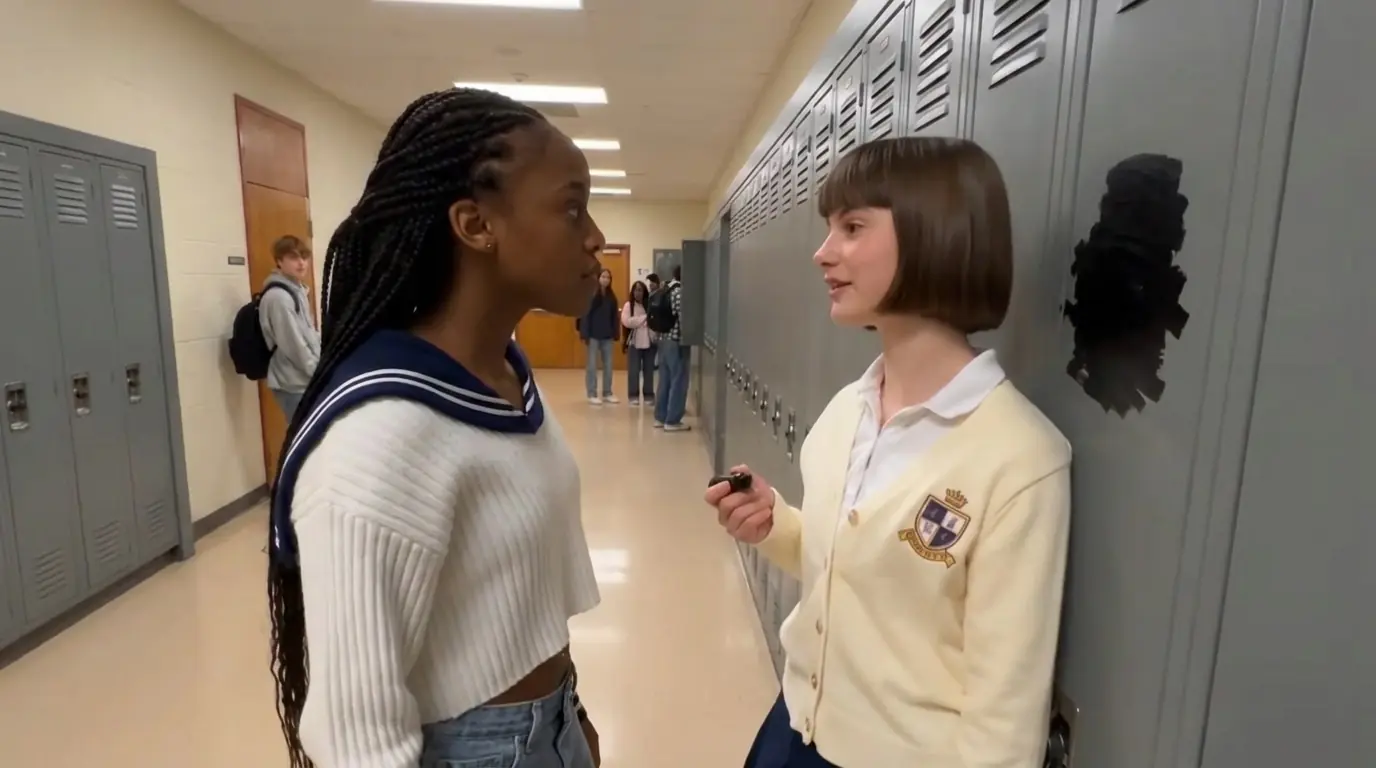
At 2:47 on a Friday afternoon, Claire Hargrove stood alone in the senior hallway of Briarwood Academy with a thick black paint marker in her right hand. She looked once toward the stairwell, then dragged the marker across the gray metal locker in front of her until a wide black scar covered the door. Another stroke followed, then another, each one darker and angrier than the last. Claire was so focused on ruining the locker that she did not notice Nia Wallace walking toward her from the opposite end of the hall.
Nia stopped about twenty feet away.
For a second, she simply stared.
The locker Claire was destroying was hers.
And suddenly, three months of missing notes, strange rumors, damaged schoolwork, and quiet intimidation no longer felt mysterious.
Claire finally looked up.
Her hand froze against the metal.
Neither girl spoke.
Then Nia started walking toward her.
The black marker was still in Claire’s hand.
To anyone who saw only what happened during the next thirty seconds, the story would look simple: one girl vandalized another girl’s locker, got caught, refused to back down, and started a fight she did not finish. But nothing at Briarwood had been simple since the previous November. The black marks on Nia’s locker were not the beginning.
They were just the first time Claire had been caught while making them.
Four months earlier, Nia Wallace had barely known Claire Hargrove existed.
They were both seniors at Briarwood, a private college-prep school outside Philadelphia where students wore variations of the same navy-and-white uniform and complained about rules most public-school teenagers would have considered ridiculous. Girls were required to wear approved sweaters, skirts, trousers, or school-branded tops, and every hallway seemed to have a framed photograph of someone’s grandfather who had donated enough money to get his name engraved on a building. Nia had attended since ninth grade, but she had never fully belonged to the world Briarwood seemed designed for.
Her mother, Tamara Wallace, worked as a radiology technician at Jefferson Memorial Hospital. Tuition had always been impossible on Tamara’s salary, but Nia entered Briarwood through a need-based academic program after placing near the top of the district on a middle-school entrance examination. The school covered most of her tuition, while Tamara took care of uniforms, activity fees, transportation, and everything else that somehow made “almost free” still expensive. Nia knew exactly what her mother sacrificed, which was one reason she rarely gave Briarwood administrators a reason to remember her name.
She got good grades.
She ran track for two years, then quit to work weekends at a bookstore.
She had three close friends and no interest in expanding that number simply because senior year was supposed to be memorable.
Claire Hargrove was the opposite.
Claire had been at Briarwood since kindergarten.
Her father owned several commercial real-estate properties around Philadelphia, her mother chaired the annual fundraising gala, and the Hargrove name appeared on a plaque inside the performing-arts building. Claire was stylish without appearing to try, wore her black hair in a perfectly cut chin-length bob, and had a habit of speaking to teachers with the comfortable confidence of someone who had known most of them since childhood.
She was also editor in chief of The Briarwood Ledger, the school newspaper.
That was how Nia’s life collided with hers.
Nia joined the Ledger almost accidentally.
Her English teacher, Mr. Adrian Cole, had read an essay she wrote about public transportation and asked permission to submit it to the student paper. The piece argued that Briarwood students talked constantly about service while many had no idea how the city worked for people who did not have cars. Nia expected the paper to reject it.
Instead, faculty adviser Ms. Laurel Grant asked her to join.
“You need people who disagree with everybody?” Nia asked.
“We need people who notice things.”
“That sounds more dangerous.”
“It usually is.”
Nia accepted.
At first, working on the Ledger was fun.
She wrote about school lunches, an overcrowded bus route used by scholarship students, and a proposed change to Briarwood’s attendance policy. She discovered she liked interviewing people because questions gave her permission to be curious in ways ordinary conversation did not. By October, Ms. Grant had made her an associate editor.
Claire did not object.
At least not publicly.
Their first real disagreement happened over something called the Senior Legacy Fund.
Every graduating class raised money for a gift to the school. Some years it was a bench, a tree, or new library furniture. Claire and student council wanted their class to fund a large illuminated sign near the athletic field.
The projected cost was almost eighteen thousand dollars.
Nia thought the number was absurd.
“So we’re asking students to donate eighteen grand for a sign telling people they’re already at Briarwood?” she asked during an editorial meeting.
Two students laughed.
Claire looked up from her laptop.
“It’s a digital sign.”
“That improves everything.”
“It can display announcements, scores, event information.”
“Phones already do that.”
Claire closed the laptop.
“The class voted.”
“Forty-seven students voted.”
“There was an open survey.”
“Sent during winter break.”
“It was still open.”
Nia shrugged.
“Then write that in the article.”
Claire stared at her.
“What article?”
Nia smiled.
“The one about how we’re spending eighteen thousand dollars.”
That was the first moment Claire saw Nia as a problem.
The Ledger published the story the following week.
Nia did not accuse anyone of wrongdoing. She simply listed the projected cost, the number of students who participated in the survey, and several other possible uses for the money suggested by seniors. One student proposed creating an emergency textbook fund.
Another suggested contributing to Briarwood’s financial-aid program.
Parents began asking questions.
So did teachers.
Within two weeks, student council postponed the sign.
Claire blamed Nia.
“You made it sound corrupt,” she said after school one afternoon.
Nia was packing her laptop.
“I quoted your proposal.”
“You emphasized the price.”
“Because it costs eighteen thousand dollars.”
“It was supposed to be something the class could be proud of.”
“Then people should be able to defend it after reading the number.”
Claire folded her arms.
“You always do that.”
“Do what?”
“Act like you’re just stating facts when you know exactly how you’re making people look.”
Nia stared at her.
“I didn’t decide how it looks.”
Claire left without answering.
For several weeks, nothing happened.
Then somebody began leaving photocopies of Nia’s article inside her locker.
The first had HAPPY NOW? written across the top.
The second had a drawing of a rat.
Nia threw both away.
The third was taped to the outside of her locker.
Someone had circled her byline in black marker and written:
BRIARWOOD’S FAVORITE PROBLEM.
Her friend Jasmine Reed saw it first.
“This isn’t funny anymore.”
“It wasn’t funny the first time.”
“You should report it.”
“For somebody writing on paper?”
“For somebody targeting you.”
Nia pulled the sheet down.
“I don’t know who did it.”
Jasmine looked toward the newspaper office.
“You have a guess.”
“A guess isn’t proof.”
That answer would become important later.
Nia refused to accuse Claire without evidence.
She also refused to let the notes control her.
For a while, that worked.
Then the senior Legacy Fund story grew into something much larger.
Briarwood’s finance office discovered that student council had already paid a nonrefundable $2,500 design deposit to a sign company before the student survey had closed. The payment had not been approved through the normal faculty process. Student council treasurer Ethan Morales had authorized it after receiving an email he believed came from faculty adviser Mrs. Delaney.
The email was fake.
Someone had created an address nearly identical to Mrs. Delaney’s official school account.
The difference was one letter.
Briarwood administrators quietly began investigating.
Nia learned about the payment from Ethan.
He approached her outside the library looking sick.
“I need to show you something.”
“What?”
“Not here.”
They sat in an empty classroom.
Ethan pulled out his laptop.
When Nia saw the fake email, her first reaction was disbelief.
“You sent money because of this?”
“It looked real.”
“It came from Gmail.”
“I was on my phone.”
“Ethan.”
“I know.”
He rubbed his face.
“The vendor says the deposit isn’t refundable.”
“Who knew you needed approval?”
“Everybody on the executive committee.”
“Who wanted the sign?”
Ethan looked at her.
Nia already knew.
Claire had proposed it.
But that proved nothing.
“You think she sent this?”
“I don’t know.”
“Then why show me?”
“Because the school is acting like this was just a paperwork mistake.”
Nia closed the laptop.
“Maybe it was.”
“Somebody created that email.”
That part was undeniable.
Nia brought the information to Ms. Grant.
The newspaper adviser became uncomfortable immediately.
“This is no longer a student-news issue.”
“Why?”
“Because there’s an active administrative investigation.”
“That means we shouldn’t report on it?”
“It means we need to be careful.”
Nia understood.
She also hated it.
The Ledger held the story for a week.
Then an anonymous account sent Nia screenshots.
The screenshots showed a group chat between Claire and two other student-council members. In one message, Claire complained that Mrs. Delaney was “never going to approve anything unless someone made the decision for her.” In another, sent the same night as the fake email, Claire wrote:
Relax. Ethan has what he needs.
Still not proof.
But enough to ask questions.
Nia confronted Claire privately before going any further.
They met inside the newspaper office.
Nia placed printed screenshots on the desk.
“Did you send the email?”
Claire looked at them.
Her expression barely changed.
“No.”
“Do you know who did?”
“No.”
“What does ‘Ethan has what he needs’ mean?”
Claire pushed the papers back.
“It means what it says.”
“That isn’t an answer.”
“It means Ethan had the approval.”
“The approval was fake.”
“I didn’t know that.”
Nia watched her.
Claire stared back.
“You believe me?”
“I don’t know.”
Claire laughed.
“At least you’re honest.”
Then she leaned forward.
“But if you print something accusing me based on anonymous screenshots, my parents will have an attorney here before lunch.”
Nia gathered the papers.
“I’m not accusing you of anything.”
“Not yet.”
“No.”
Nia looked at her.
“I’m asking.”
Claire smiled.
“Then you asked.”
The school eventually found the answer without the newspaper.
The fake email had been created from a laptop connected to Briarwood’s student Wi-Fi.
IT logs identified the device.
It belonged to Claire.
Her defense was that other students had used the laptop during council meetings.
Then investigators recovered browser history showing the account had been created while Claire’s personal school account was also active.
She admitted it.
Not immediately.
But eventually.
Claire said she had intended only to “speed up” the process because Mrs. Delaney kept delaying the proposal. She insisted she believed the faculty adviser would approve the payment anyway. She described the fake email as a shortcut, not fraud.
Briarwood disagreed.
Claire was removed as student council vice president.
She lost her editor-in-chief position at the Ledger.
She received a one-week suspension and was required to repay the lost deposit through family restitution.
She was not expelled.
Her parents made sure of that.
The school called the matter a “serious lapse in judgment.”
Students called it something else.
Claire blamed Nia.
It did not matter that Nia had never published the screenshots.
It did not matter that the school investigation had identified Claire independently.
In Claire’s mind, everything began with the Legacy Fund article.
Without Nia’s story, parents would not have questioned the sign.
Without questions, administrators might never have looked closely at the payment.
Without the investigation, the fake email might have remained invisible.
Therefore, in Claire’s version, Nia had caused everything.
She returned from suspension in January.
The first time they crossed paths was near the senior lockers.
Nia saw her coming.
Claire stopped directly in front of her.
“Enjoying my desk?”
Nia frowned.
“What?”
“The Ledger.”
“I’m not editor.”
“Yet.”
“Ms. Grant appointed Marcus.”
“For now.”
Nia closed her locker.